Title: Beryl and Pearl
Author: Agnes Giberne
Release date: April 16, 2026 [eBook #78471]
Language: English
Original publication: London: James Nisbet & Co., Limited, 1884
Other information and formats: www.gutenberg.org/ebooks/78471
Transcriber's note: Unusual and inconsistent spelling is as printed.
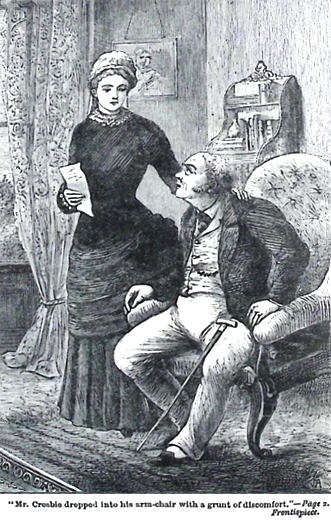
Mr. Crosbie dropped into his arm-chair
with a grunt of discomfort. Frontispiece.
BY
AGNES GIBERNE
AUTHOR OF "MISS CON," "ENID'S SILVER BOND," "KATHLEEN,"
"DECIMA'S PROMISE."
"Mine be the reverent listening love
That waits all day on Thee,
With the service of a watchful heart
Which no one else can see—
The faith that, in a hidden way
No other eye may know,
Finds all its daily work prepared,
And loves to have it so."
A. L. WARING.
FOURTH EDITION
London
JAMES NISBET & CO., LIMITED
21 BERNERS STREET
Printed by BALLANTYNE, HANSON & CO.
At the Ballantyne Press
CONTENTS.

CHAP.
BERYL AND PEARL.

THREE SISTERS.
"MILLICENT! My dear! Hey—I say! Millicent! Milli-'cent!'"
The last syllable rose to a shout. Mr. Josiah Crosbie, a ruddy-complexioned old gentleman, benevolent as to his head, gouty as to his feet, and impatient as to his manners, paused thereafter, and listened. No response came. Evidently unaccustomed to wait other people's convenience, he made his way with some difficulty to the study door, brought down his stick with a sounding rap, and sent forth a stentorian summons,—
"Millicent! I say Milli-'cent!'"
"I am coming, uncle."
The silver voice was not raised or hurried.
A lady entered by the back garden door, and crossed the hall to his side, with the question, "Did you want anything?"
"Of course I did. I shouldn't have called you otherwise," said the old gentleman testily, as he hobbled back.
Millicent followed him, and stood awaiting his pleasure. She was young-looking still, with a pale complexion, features of faultless regularity, and almond-shaped brown eyes, below pencilled brows. It was a Madonna-like face, in calmness and purity, albeit certain lines and shadows told of tempests past. Her slight figure was clothed in some soft black material, closely fitting, plainly made, and graceful in its fall; and her hair was brushed smoothly back under a widow's cap. No one could induce Millicent Cumming to discard this cap; yet, though in age only thirty-two, she was a ten years' widow.
Mr. Crosbie dropped into his arm-chair, with, a grunt of discomfort, possibly also of annoyance. The sunshine of a lovely spring day showed through the window, but he had been shivering all the morning over a blazing fire.
"You don't mean to say you have been guilty of the folly of going into the garden without your bonnet," said Mr. Crosbie.
"I did not mean to say anything about it," she answered, with a smile.
"Keen east wind,—and your chest,—enough to lay you by for a month! Folly!" repeated Mr. Crosbie, who was rather given to the use of strong expressions. "But of course my opinion is worth nothing in the matter. I thought you were a sensible woman. What were you doing out there?"
"Only seeing Ivor and Escott off to school."
"As if they were not big enough to see themselves off! You just spoil those boys out and out, Millicent! It will be the ruination of them. I believe you think of nothing else from morning till night."
"Of my boys and you,—yes. Is it not natural?"
Millicent's gentle face was irresistible, and Mr. Crosbie looked mollified. "Well, well!—There, there!—You are a good girl, Millie." He often called his nieces "girls," though two were widows, and the other had reached the questionable age for spinsterhood of eight-and-twenty.
Millicent smiled at the term, but let it pass.
"You are a good girl," he repeated, "but you should be at hand when I call, my dear,—you should take care to be at hand. And mind, it won't pay to spoil those boys of yours. They are fine fellows, but mothers shouldn't be slaves to their children."
"I don't think they are spoilt yet," she said, with a gleam of motherly pride.
"Well, well, don't do it, that's all. They are nice lads, so far,—promising on the whole,—but thirteen is an awkward age. Fourteen,—dear me, I forgot. It's an awkward age, Millie, just the age when boys begin to think too much of themselves. But now, what I wanted you for, was this letter from Di. Can't make head or tail of it, and that's a fact. Di has no business to write letters, if she can't say her say in plain English. Read it, Millie, read it, and tell me, if you can, what she means. Why on earth doesn't she come and see me, and ask what she wants to know? I shouldn't think ten minutes' walk so much more trouble than four sheets of writing. And what's all this fuss and rubbish about not saying anything to Marian? Why isn't Marian to know? 'I' can't make it out at all, my dear: so I hope you'll be able."
Millicent was patiently endeavouring to decipher the illegible scrawl, while listening to her uncle's remarks.
"Hey!" he said, after a brief pause. "Found any sense in it, Millie?"
Mrs. Cumming put down the sheet. "I saw Di this morning for a minute, and she told me she was anxious to consult you."
"To consult me! Eh, indeed! What about? What about?"
"About those poor children, the little Fordyces. She has heard again from Mr. Bishop—"
"Bishop! Bishop! Who's he?"
"The clergyman of the place where they have been living. Di has heard from him again, and he speaks of them as quite friendless and destitute."
"Why didn't their own parents provide for them, I should like to know. Tell me that, Millie."
"I believe the father was a man of very small means, and they have been some years orphans, living with their aunt. Most of her income seems to have consisted of a life annuity, and whatever else she possessed goes to a distant relative. Mr. Bishop is in great perplexity to know what can be done with the little girls."
"I'm not going to have them here," said Mr. Crosbie resolutely. "Two boys are enough. I won't have my house turned into an orphanage. I hate children swarming about everywhere, like bees in a hive. You understand, Millicent! I wouldn't consent under any consideration. That's flat."
"No one thought of such a thing," Millicent answered serenely, as the old gentleman bit the head of his stick with an indignant air. "The Fordyces are no connections of yours, uncle. Of course they can scarcely be said to have a positive claim upon even Diana; still she seems to be the nearest relative that they possess."
"No relative at all. It's a mere pretence. Let them go to the workhouse," said Mr. Crosbie, showing a severity greatly at variance with his real tenderness of heart.
Millicent knew what all this was worth, for he would have been the first to cry out against such an arrangement; but she only said—
"Poor children! I should not like the workhouse for my boys."
"'Your' boys!! But I tell you, the little brats are not related to Diana."
"No; only she seems to feel that if her husband were living, he would feel bound to do something."
"Frank Fenwick would have felt bound to do nothing that his spoilt pet of a wife didn't wish. Besides, he 'isn't' living. And Di will marry again."
"She says not."
"Absurd."
Millicent was silent.
"Absurd," repeated Mr. Crosbie. "Married for nine months to a man old enough to be her father, and left a widow at twenty-one! Why, she has life before her. She's but a chicken still."
Silence still on Millicent's part. Mr. Crosbie reflected for the space of twenty seconds.
"Well," he burst out, "and what does Di want to do? Adopt the children?"
"That is her idea."
"She'll sicken of the sight of them in a week."
Mrs. Cumming had nothing to say to this. Probably she would have controverted the idea had she been able.
"Di's conscientiousness isn't always in so active a state. There's something else at the bottom. Is she afraid of what might be said of her? Or does she want to enact a pretty tableau? Mrs. Fenwick going about with two elegant protégés under her wing! Pshaw!"
Millicent Cumming could not control a smile.
"Ay, that's it, eh? Absurd, Millie. Why doesn't she get them into an orphanage, and be content to pay so much towards their keep?"
"Di does not think she could afford that. She has not always command of ready money."
"And this plan is to cost less than the other, hey?"
"Di is not very good at money calculations, uncle."
"And why, pray, is Marian to know nothing of the scheme? Why is Marian to be kept in the dark? The bother of the whole will rest on Marian's shoulders. Di will just make a plaything of the children till she is tired, and then toss them into Marian's keeping."
"Don't you think the interest and occupation would be good for Di?"
"No, I don't," Mr. Crosbie answered brusquely. Then he relented. "That is to say—anything would be good for Di, if she would keep to it. But she won't."
Millicent was silent again.
"And why isn't Marian to know, pray? I hate mysteries. Why can't the thing be open and above-board?"
"She will know, of course, but Di seems anxious to have your opinion first. She said Marian was certain to throw cold water on the scheme."
"I shall throw it—and much good that will do. Di likes the importance of a secret, that's what it is. But look here, Millie, if Di's income isn't enough for her own wants, how is she to support two children in addition?"
"She does not think it will cost much. A little bread-and-butter, and a print frock or so—"
"Humph!" said Mr. Crosbie. "I won't have her coming to me to supply deficiencies."
"I think you had better talk the matter over with Di, dear uncle. If you would place the matter before her in a common-sense light—"
"How can I, if she doesn't come and see me? Am I to go to her, pray?"
"She is coming presently. She told me she would write first, that you might have time to consider the matter."
"And save her the trouble. I shall let it alone till I see her." And Mr. Crosbie chucked the pink note-sheets into the fire.
Finding her presence no longer required, Millicent went to the drawing-room, and sat down with her work near one of the open French windows. This was the side of the house, and a pretty lawn swept away outside, bordered by a fringe of lilacs and laburnums bursting into flower. A high wall, lined with young trees, shut off in great measure the house and garden which lay beyond.
While her fingers were busied in stitching a linen collar for one of her boys, Millicent's thoughts were busied about the two little orphans left in so forlorn a position. Would Diana take them in? Would they find a happy home with Diana if she did? Millicent had doubts on this point, knowing her sister's impulsive and inconsequent ways; yet a home with Diana was better than no home, and the unmarried sister, Marian, would supply ballast to the scheme.
A shadow darkening her work made Millicent look up, to meet the gaze of this same sister, Marian Crosbie, resident in the same place, under the roof of Mrs. Fenwick, the other widowed sister.
Strangers would have noticed a resemblance between Millicent Cumming and Marian Crosbie, yet it was a resemblance with a difference. Marian was as tall as Millicent, and had much the same general contour; but the slightness of the one was angular thinness in the other. The outline of features, in both regular, was in the one delicate, in the other sharp; and the sweet gravity of the one was in the other almost austerity. Marian had been one of a lovely trio in early girlhood; but at twenty-eight, though a woman to be noticed, she was no longer lovely.
"What is the matter with Di to-day?" she asked, after first greetings.
"Can't you guess, Marian?"
"Guessing is not of much use unless you have some one to say 'No' and 'Yes.' Don't tell me particulars if you think you ought not. Di is confidential with all the world except me. Yes, of course I guess. Some plan about the little Fordyces is evidently on the 'tapis.'"
"I wish she would talk it over with you."
"Better not. Whichever side I took, she would take the opposite."
"Then she has said nothing?"
"Di never can resist saying something, but I am not supposed to be in her counsels. I only wish she may decide to take the children to live with her. O yes—" at a glance of surprise—"of course Di gave you to understand that she was the victim of opposition from me."
"Why not tell her that you would like it?"
"Because I should not like it. I think it would be the right thing to do, and that is not the same as liking it. Besides, Millie, I don't think you ever will really understand Di. If I took up the idea, she would drop it immediately. I am not to manage anything in the house. She must arrange, and I may acquiesce meekly. I suppose that if only I were five years her junior, instead of her senior, she would not be quite so sensitive."
"Poor Di!"
"Poor Marian, I think. However, it is good discipline. Di's only objection to the plan seems to be that there are two children. She would rather have had only one, and thinks two will be cumbersome. If I were more independent as to means, I would consider whether to adopt one and leave the other to Di. But even if I could afford it, I don't think I should be right to leave Di, and to set up a separate establishment. She wants looking after—little as I can do. And for each of us to have a child, in the same house, would result in the sort of rivalry which takes place when two children have each a tame kitten,—a perpetual domestic contest of 'I' and 'mine.' If the children do come, I shall take the opportunity to get away for some visits."
"Di would need you then."
"Not at first. Better to let her have full swing with them for a time, till she really wants my help. To be present during the first spoiling process, would be to sacrifice all future authority over the poor little waifs."
"Uncle Josiah says she will tire of them in a week."
"No, I think we may give her a month or two,—possibly a quarter of a year."
THE FORDYCES.
"AND whatever in the world is to become of them children, 'I' don't know, nor nobody else neither."
These words smote ruthlessly upon the ears of Beryl Fordyce. Six seconds before she had been sleeping the placid and dreamless slumber of healthy childhood, and six seconds later she would have been again unconscious. But sleep now suddenly fled. She lay listening, with quickened breathing, her eyes fixed upon the partially closed door, through the opening of which streamed yellow candle-rays, in contrast with the white moonbeams entering at the window.
"Poor little dearies!" chimed in somebody else. The tones of the second speaker were smooth and slow, not rasping and rough like those of the first. "Poor little dearies! It is very melancholy, Mrs. Dixon, very melancholy indeed, and there's no denying of it. Now you'll wake 'em,—" as a small object fell with a click against the fender. Probably some such sound had roused Beryl.
"Never you fear. Miss Beryl sleeps like a top, and Miss Pearl too when she's tired. It's a mercy they do sleep, for there's no peace in life when Miss Beryl's awake."
"And their aunt hasn't left them nothing at all?"
"Not one single penny nor farthing. 'I' don't know why. Seems unnatural, seeing they was her own flesh and blood. But Mr. Bishop he seems to know: for he says to me the very day she died, says he to me,—'There won't be not one penny for them poor children,' says he. 'And whatever is to become of them?' says he, and he shakes his head like this, Mrs. Medhurst."
Beryl was seized with a strong inclination to laugh at the uncouth version of Mr. Bishop's utterances, and also at the very unclerical appearance of Dixon's cap-shadow, as it bobbed forward upon the door for an instant.
"And there isn't nobody else—aunt nor uncle nor nothing?"
"Not as I knows. Mr. Bishop he is a making of inquiries, I believe. But Miss Fordyce said to me, when first they come, says she, 'There's nobody else but me to take 'em in, Dixon,' says she. And she sighs, like as if it wasn't agreeable to her no more than it was to me. And if I'd ha' known what was before me, I'd have given warning then and there, and took my departure,—I would, Mrs. Medhurst, and I means it, for all the time I've lived with Miss Fordyce, since I was but a slip of a girl. For it's been 'a' three years, and no mistake; and I wouldn't live through them again, no, not if you was to give me a hundred pounds. And I wouldn't have the bringing up of Miss Beryl, not for nothing you could mention, Mrs. Medhurst. She's that headstrong and 'mischeevious,' as there's no doing anything with her."
"She's isn't so pretty as Miss Pearl, nor so nice in her manners."
"Pretty! She's as ugly as her temper. I never knowed a downright uglier child than Miss Beryl, nor nastier to deal with. Miss Pearl's different. She's easy led into naughtiness, and her frocks do take a deal of mending, but if it wasn't for Miss Beryl, she'd be as good as she is pretty. I've got no fault to find particular with Miss Pearl. But Miss Beryl!—nobody can't manage her, and that's a fact."
"She hasn't the look of a bad sort of child, neither," the other said musingly. "Not downright altogether bad."
"I don't know as you'd call her bad, but she's ugly, and she's worrying in her ways. She'd worry the life out of anybody. She's an odd sort of child: don't seem to care for nobody, and nobody don't seem to care for her. Oh, she don't mind, not she. Miss Pearl is the one to mind. Miss Pearl would cry her eyes out, if she thought anybody was angry; but Miss Beryl is that hard, nothing touches her. Nobody likes her, and she's none the wiser. She never cares a straw what's said. That's her sort. It's aggravating, Mrs. Medhurst, and 'she's' aggravating. I just wish you had to do with her one week, and you'd know. Oh, you'd know fast enough. You wouldn't like Miss Beryl. Nobody does."
Indignation rose high in the heart of the listening child. For Beryl was sure that Pearl loved her.
Raising herself cautiously to a sitting posture, Beryl obtained a glimpse of two figures, seated on either side of a table in the next room, a tallow candle being on the table. One of the two women was spare and angular, and wore a cap. The other was plump and round, and wore a bonnet.
Beryl and Pearl were in two little iron beds, placed side by side. A ray of moonlight fell upon the small fair face of the younger sister, with its framework of glossy hair, and across the slender hands, tossed gracefully out upon the coverlet. Pearl had always lain in unconsciously graceful attitudes from very babyhood. She was at this time just eleven, but of small and slight make. Beryl, eighteen months her senior, was somewhat large-boned, and awkward in movement.
Dixon had been the servant of Miss Fordyce during forty years, and she had unwillingly tended Miss Fordyce's nieces during the last three of the forty. She was, after her fashion, conscientious, and never neglected that which she undertook. But she hated children, and did not scruple to express in plain terms her dislike to their presence in the house.
Beryl and Pearl Fordyce had been six years motherless and three years fatherless. Now they were yet farther orphaned by the sudden death of their aunt. She had been an invalid for many years, but the attack which carried her off at last was sharp in nature, lasting only a few hours.
The children's loss was to them less of a heart-trouble than might have been expected. Miss Fordyce was a person of cold manners, and the two little girls had been seldom with her. She was not indeed one to endear herself greatly to other people. They had cried a little when first told that they would never see their aunt again. And Pearl had shed a few more tears, as the two watched the nodding hearse-plumes move from the front door, making Beryl feel rather naughty to be unable to do the same. But probably the only real mourner was Dixon, and whatever she felt, she concealed from observers.
The three years of Beryl and Pearl's life in their aunt's house had been tolerably happy. Children possess a remarkable aptitude for fitting in with their surroundings. Dixon and Beryl were at chronic war, yet Dixon saw well to the children's bodily needs. A worn-out old governess gave them two hours of nominal lessons every morning, followed by a walk. Beryl liked reading, but hated learning. Miss Catt avoided unnecessary struggles, and took things quietly, with increase of composure to herself, though scarcely with increase of knowledge to Beryl.
In play-hours, the two children were, as a rule, exceedingly content together. Pearl was alike Beryl's pet and slave; and Beryl was alike Pearl's protector and tyrant. Beryl's temper was never tried in that direction, since Pearl never opposed her will. If Beryl were in disgrace, Pearl was for the time forlorn; but of disagreements between them, there were none.
Thus things had gone on, and thus things seemed likely to go on, when suddenly the change came.
But Beryl had not at all realised the position in which she and her sister stood, until she heard the matter discussed between Dixon and her friend Mrs. Medhurst, wife of the greengrocer round the corner. No one had spoken to her about it, and she was an odd child, full of thought on some subjects, strangely ignorant on others. Dixon had always seemed to her a much more necessary individual in the house than Miss Fordyce.
Perhaps even now, sitting up in bed, and looking at the opening through the doorway, Beryl did not realise it. Certainly, the leading thought in her mind was not concerning the uncertainties of her future, but the question, "Was she really so very ugly?"
Dixon had often called her ugly before. The word, however, had made less impression, when spoken to her in the heat of passion, than when spoken of her quietly to another. To be ugly at all was bad enough. To be so hopelessly ugly that no one except Pearl could ever like her, was serious.
People in general little know the lasting effect which a few careless words may have upon a child's mind, or how far their influence may extend in the after-shaping of character.
These words of Dixon sank deeply, making an impression not soon to be effaced. As Beryl sat thinking them over, a vision of future life rose before her—a cold and comfortless vision of a life, Esau-like in kind, wherein her hand was to be against every man, and every man's hand against her. For Beryl was, as Dixon had truly implied, of a hasty and headstrong nature; and she said to herself, in the childish wrath and pain of that hour, that if nobody liked her, she would like nobody—always excepting Pearl, dear little Pearl, who should ever be her one darling. Dixon had said that she did not care what other people thought of her ways. Beryl felt that this was not true; for she knew she had cared in the past, after her own fashion. But she determined now to care no longer. Why should she? She would do as she chose, and please herself.
Then she came back to the question, "Am I really so very ugly?"
Beryl slipped out of bed, and stole to the window, bare-footed. The moon dipped behind a cloud, leaving the room in darkness, save for the candle-gleams which stole through the door. Beryl stood waiting, and presently it shone out again with increased brightness. A face in the glass met hers, white with the ghastly hue lent by moonlight, having rough hair in a tangled mass on either side, and eyes widely opened in anxious scrutiny.
"I know I have freckles and a big mouth, and I'm not so pink and white as Pearl, and my waist is thick too," murmured Beryl pathetically. "But I can't help all that. And after all, my hair is the same colour as hers, and my eyes are the biggest. I'm ugly, of course, but I don't think I am so ugly as Dixon—not nearly. Her eyes are almost no colour at all, and her nose is so queer and flat, it is like nobody else's. I wouldn't change to Dixon, I'm sure, even if I could."
"Now, Miss Beryl, if that isn't 'just' like you—listening at the crack o' the door!" exclaimed Dixon.
Beryl was back in her bed with a bound, turning then to face Dixon defiantly.
"I'm not," she said. "I wasn't near the door."
"Always spying out something that don't concern her! Oh, 'I' know!" Dixon said scornfully. "'I' know your ways. 'I' saw you, Miss Beryl, a-stealing away when you heard me a-coming."
"I didn't, I tell you," repeated Beryl, shaking with cold and anger. "I never spy. And it does concern me, too—ever so much."
"And to be sure, so it does," acquiesced Mrs. Medhurst, who, candle in hand, had followed Dixon into the bedroom. "It does concern her, there's no doubt whatsomever, Mrs. Dixon. But I shouldn't wonder if Miss Beryl was only just a-looking at the moon."
"No," said Beryl shortly, "I was looking at myself in the glass."
"Now did you 'ever?'" inquired Dixon expressively.
"What was it for, my dear?" asked Mrs. Medhurst.
"Because I chose. And I don't see why you are to call me 'my dear,'" pursued Beryl, reining up her tangled head. "I am a young lady, and you are only a greengrocer."
"'Did' you ever?" reiterated Dixon. "But that's Miss Beryl all over! Never you mind, Mrs. Medhurst; her pride 'll be took down some day, and that it will."
"I am not proud," protested Beryl. "I only like to be spoken to properly. But it was not the moon that I went to look at. I only wanted to find out if I really was as ugly as Dixon said."
"Didn't I tell you she'd been listening?" interjected Dixon.
"And I don't think I am. At least I am ugly, of course, but not nearly so ugly as Dixon," concluded Beryl.
Dixon was speechless.
"It don't so much matter about looks, after all," Mrs. Medhurst remarked, fearing an explosion, and taking refuge in conventionalities. "It don't really matter about looks, Miss Beryl, so as you behave proper and do your duty. 'Beauty is only skin deep,' you know, and 'Handsome is as handsome does,' and that's a true saying. And if you're good, nobody 'll think you ugly; and if you're naughty, nobody 'll think you pretty."
Beryl did not appreciate the truth underlying these homely words. She knew nothing as yet of the transforming effects of a loving spirit, or of an indulged temper, on the features.
"And if you gives way to pride, and takes to underhand ways, why, of course—" began Mrs. Medhurst anew.
"I am not underhanded," Beryl said fiercely, in her helpless self-defence. "I was lying here, and you were sitting there, and you chose to talk and I chose to listen. If you had any secrets to tell, you ought to have shut the door. But I don't care, and I don't believe it all either."
With which Beryl lay down, hid her face in the pillow, and refused to say another word. Nobody saw the tears with which the pillow was bedewed. Pearl slept peacefully through all.
PLANS FOR THE FUTURE.
"I AM desirous of a little conversation with you, my dear, on the subject of your future."
"Don't you want Pearl too?" asked Beryl, looking straight up into the clergyman's gentle and venerable face.
"I—I—think not," hesitated Mr. Bishop, an elderly and shy man, who, having had no children of his own, was somewhat at a loss in dealing with them. "Pearl is very young. You are old enough to comprehend me, I hope. Sit down, my dear—Miss Fordyce."
"Oh, I'm not that," said Beryl, with a gasp of dismay. "I'm only Miss Beryl—and I don't see that you need call me 'Miss,' because you aren't a greengrocer."
Mr. Bishop looked at her dubiously for two or three seconds, and then recommenced, with his soft and deliberate utterance,—
"Beryl, then—since you wish it, by all means so let it be. I desired Mrs. Dixon to send you to me, that I might have a little conversation with you on the subject of your future life. You are, of course, aware that this can no longer be your home."
"Yes, I know that," said Beryl promptly. "I heard Dixon talking about it last night to Mrs. Medhurst, and they said Aunt Anne hadn't left me and Pearl any money, and we have no friends, and nobody to take care of us. And I've been thinking a great deal this morning—a great deal," repeated the child earnestly. "I woke up ever so early, and I thought and thought. I don't want to live with Dixon, please, because she isn't kind. She always says she can't bear me. I would so much rather have a little room alone with Pearl, all to ourselves. We'll keep it quite clean and nice. And I suppose I should have to sell something, like the children in story-books—only I'd rather it should be match-boxes, and not oranges, because I don't like the smell of oranges.
"And the only thing that puzzles me is about Pearl, because I think she would be afraid to be left quite alone—she is so little—and yet she couldn't go out if it rained. She always gets a cold if she does; and 'I' should have to go out every day, of course. But I dare say there's sure to be a nice woman in the house who will take care of her for me. And I shouldn't mind selling matches one bit. I do like running about out of doors."
Mr. Bishop listened to this outpouring in absolute silence, his face growing longer each moment, as he more fully realised the fact of Beryl's utter childishness. Her eyes flashed, and her cheeks grew hot with eagerness while she talked.
"My dear," he said at length deprecatingly.
"I should 'like' it," pursued Beryl, intent on her own line of thought. "And I don't see what else we can do; because you see I'm not old enough to be a governess. And I don't like lessons either."
"But young ladies do not sell matches," said Mr. Bishop, with an indulgent attempt to come down to her level.
"No, I know that," said Beryl. "But father used to tell me I was never to be afraid of honest work. He said Pearl and I would be left alone, and I was the strong one, and I must always take care of Pearl, and I mustn't mind what I had to do. And I don't mean to mind, because I have to take care of Pearl."
"You are a good child to remember what your father said," Mr. Bishop observed, half in admiration, half in amusement, for he found Beryl quite a curious study. "But I am thankful to be able to tell you that you are not entirely friendless. A very kind lady, connected by marriage with your parents, offers you a home."
Beryl did not look delighted. The picture, conjured up by her imagination, evidently had its charms.
"Dixon said there was nobody," she remarked, in a somewhat combative tone. "And I don't see who there can be. Because mamma had only one sister, and she died; and papa had only one sister, and she is dead now; and I'm quite sure there isn't any one else. Pearl and I often do wish there was just one cousin, and then we could have letters from her."
"Your mother's sister married a Mr. Fenwick," explained Mr. Bishop. "Try to understand me, my child. Mr. Fenwick was your uncle by marriage. Your aunt died, and he lived a lonely life for a great many years. But at last, he married again—a young lady—"
"I wonder what her name was?" put in Beryl.
"Her name was Diana Crosbie, and she became Mrs. Fenwick. After a few months, he died—about two years ago, I believe—and she was left a widow."
"Why, they all seem to die," was Beryl's comment. "How funny! And is that Mrs. Fenwick another aunt? I never heard of her."
"She is not your aunt, strictly speaking, but you will of course designate her by that title."
"I shan't call her so, if she isn't my aunt really," said Beryl. "It would not be true."
"She will be in the position of aunt to you, and you will pay her due respect," said Mr. Bishop, slightly dismayed at the independent tone. "Mrs. Fenwick most kindly writes to propose doing what she can for you both."
"Shall we live with her?" asked Beryl.
"I cannot yet speak definitely as to arrangements. She will, I hope, in some manner provide for you. But much must depend upon yourself—upon yourselves. If you are good and tractable children, I imagine it to be most probable that you will find a home in her house. My child, I do not hear a very cheerful report of you from Mrs. Dixon. She speaks well of your little sister, but your ways have evidently given her much trouble at times. I sadly fear that if you yield to the same spirit in the future, it may seriously affect your happiness, and alienate your friends."
Beryl twisted her fingers together, and gazed fixedly on the ground. She did not like to be found fault with, and she was angry with Dixon for speaking against her. Moreover, Mr. Bishop, good and kind as he was, had not learnt the secret of reaching a child's heart. He talked on for some time rather monotonously, using many words which scarcely lay within Beryl's understanding. And presently her thoughts wandered away, so that she did not take in even the general sense of what he was saying.
A few more remarks about Mrs. Fenwick closed the interview. Mr. Bishop went away, somewhat saddened; and Beryl rushed, like a small tornado, to the nursery.
"Pearl! Pearl!" she cried breathlessly. "Dixon said all wrong. There is somebody, and you and I won't have to live in a top garret or to sell oranges. There's a lady who isn't really our aunt, only we are to make believe that she is, and she married the man that married mother's sister, and she lives in a nice place that is called Hurst, and she means to take care of us somehow, and perhaps we'll live with her. And Dixon won't be there!"
With which culminating fact, Beryl glowed.
"A time 'll come to you yet, Miss Beryl, and maybe not so far distant, when you won't be so ready for to throw over old friends and to take up with new ones," Dixon said resentfully.
"I don't think I have any friends," responded Beryl, assuming a meditative air. "Because friends are people that love one another, and you don't love me. I know you don't, for you always say so. But Pearl loves me—don't you, darling?"
A change came over the low-browed square face of the elder girl as she dropped down on the ground beside Pearl, who had coiled herself in the deep window-seat. Beryl's cheeks flushed, and her eyes shone with a kind of devouring affection. She lifted Pearl's pretty little hand, and squeezed it passionately to her own pouting red lips.
"'You' love me, don't you?" she repeated. "I don't mind if nobody in all the world cares for me, so long as 'you' love me, darling Pearl."
Pearl's ivory complexion, with its delicate tinting, remained unchanged. A sharp word would at any moment bring flushes and tears, but Beryl's utterances did not seem to stir her deeply. There was even a touch of perplexity in her blue eyes, as if she could not quite make out why Beryl was so moved, and she answered placidly,—
"Yes, of course I do, Beryl."
"More than all the world, Pearl; more than everybody? I couldn't bear to have you like any one more than me."
"Yes, of course I do," repeated Pearl, with a gentle little yawn. "I love you, and Dixon, and everybody."
"I hate people to love everybody," said Beryl passionately. Then changing again to a caressing manner, "But you do care for me most, Pearl?"
"Why, of course I do," said Pearl. "I haven't anybody else."
And Beryl was, for the moment, satisfied.
Mrs. Fenwick was an impulsive little person, who greatly disliked uncertainties in her plans. She had already committed herself to the care of the children, further than her friends thought prudent. And it was the wish of both Millicent and Marian that she should take no further steps until she had well considered the matter. Mr. Bishop had written word that the children could remain in their present quarters for two or three weeks if necessary, himself undertaking to arrange for them. Diana seemed convinced of the wisdom of brief delay.
But on the morning of the day following that on which Mr. Bishop had conversed with Beryl, Diana's mood changed. She could stand the uncertainty no longer. It was absolutely necessary that she should see the children and judge for herself. What if they should be vulgar little frights, whom she could not endure to have in her drawing-room? Four hours there by rail and four back were a mere nothing, compared with the importance of a personal interview. She would start at once and return before night, leaving Marian to explain her proceedings. Diana only wondered that everybody had not counselled this step at the first. Marian held her peace, and abstained from reminding Diana that she really had suggested it.
So it came to pass that, in the afternoon, when the children's early dinner had been some time finished, a railway cab stopped at the door, and Dixon was summoned downstairs. A long waiting-time followed. Voices could be heard faintly issuing through the cracks of the fast-shut dining-room door. Beryl fidgeted restlessly about the nursery, unable to settle to any employment, while Pearl serenely hemmed a doll's skirt, for she was a tidy little needlewoman.
"I wonder what they are talking about," Beryl said. "I'm quite sure it is Mrs. Fenwick, and she is asking Dixon all about us, Pearl. And Dixon will say everything nice about you, and everything nasty about me, and then Mrs. Fenwick will never like me. I know quite well beforehand."
"Oh, perhaps she won't. Dixon isn't always cross with you," was the best comfort Pearl could offer to the troubled Beryl.
Steps presently drew near. Dixon opened the door and stood with her hand upon it, smiling in face and respectful in manner, after her wont with strangers. Beside her was a very handsomely-dressed young lady in moderate mourning, petite in figure and light in movement, with a pair of sparkling blue eyes.
"So these are the children," she said. "They do you credit, Mrs. Dixon. That is Beryl, of course; and this is little Pearl."
She passed Beryl over with a glance, and laid her hand caressingly against the cheek of Pearl, as the elder child hung back, and the younger came prettily forward.
"Only a year and a half between them! Hardly credible. I should have guessed that there were three years. I can't bear great awkward overgrown children, but this little creature is deliciously small. Pearl!—The very name for her. Quite a pearly complexion, and just the least rose-tint in her cheeks. And such abundant hair! You must have taken great pains with it, Mrs. Dixon. Let me see,—oh, yes, there is quite a little gold tint in the brown, when it is held up against the light; just as should be with these blue eyes. Beryl has the brown without the gold. I never saw a stronger contrast in two sisters. Sweet little Pearl, do you think you can love me?"
The lady's own undoubtedly charming face was brought down to a level with Pearl's. Pearl immediately put out her lips for a kiss, and was thereupon enveloped, in demonstrative fashion, with black silk and gleaming jet bugles.
"We shall just suit, you tiny delightful fairy. People would positively take us for mother and daughter, if I could manage to look a little older. I really do think there is a likeness between us. What do you say, Mrs. Dixon?"
"Uncommon, ma'am," Dixon responded complacently.
"I had no idea I should find such a little gem. You sweet child, I cannot tell you how delighted I am. The only thing I wanted in my life." Then she looked at Beryl, her countenance falling. "But—the contrast!"
Beryl certainly was not prepossessing at that moment. She gazed fixedly at her own shoes, with a thunder-clouded brow.
"Wonderfully different," Mrs. Fenwick said, moving a step nearer and carelessly tapping the elder child's cheek with one finger.
Beryl drew back, and rubbed the spot indignantly.
The movement made Mrs. Fenwick laugh. "Sensitive, I see! Well, I must consider what can be done!"
DIANA'S NEW PET.
"THE sweetest little creature imaginable,—charming in every respect," Diana Fenwick declared next morning, as she sat sipping her coffee, Marian somewhat grimly knitting a sock at the further end of the oval table. Marian was the very soul of punctuality, while Diana was rarely in time for anything, least of all for breakfast. The two sisters seldom had the meal actually together; but Marian was always expected to remain in her seat until Diana had finished. The younger sister liked a listener.
"Absolutely charming," she repeated. "A perfect little lady in her manners, with lovely hair and hands,—the very child I would pick out from among ten thousand to adopt as my own. Mrs. Dixon thinks her remarkably like me,—" and Diana broke into a silvery laugh. "Droll that she should be so, where there is no relationship. But really I could not help being aware of a sort of likeness. One does find it sometimes unexpectedly, even between strangers. People might take us for mother and daughter, if I could only contrive to look a little older. As it is, I suppose we are more likely to pass for sisters. I have the greatest mind in the world to make the pet call me 'Di.'"
Marian opened her lips, and shut them again.
"In which case, would you be willing that she should call you 'Marian?'"
"Certainly not," Marian said decisively.
"Ah—so I expected. You like to stand upon your dignities. Well, perhaps I may submit to be 'Auntie Di.' I'll think it over. Aunts and nieces are often near in age."
"You are more than twice as old as Pearl Fordyce."
"Twelve years older;—yes, she is eleven, though she does not look it. There is often more difference between the oldest and youngest members of a large family."
Marian could not gainsay the assertion. "I think you will be wise to keep your position of authority with the children," she said. "And it is not a question of Pearl only."
"Ah," and Diana sighed profoundly. "If only there were not that unfortunate Beryl as an appendage. A great awkward ill-mannered child. I declare I don't in the least know what to do with her."
"It seems to me that Beryl is the most to be pitied."
"It seems to me that 'I' am the most to be pitied." Marian thought of her own very similar words to Millicent a day or two earlier, and was amused. "There is nothing to laugh at," Diana said rather tartly, misunderstanding her expression. "You are taking good care to shirk trouble for yourself in the matter, fixing to go away the very day after they come, the very time when I shall need you most of all."
"I have my reasons, Di."
"Of course. Everybody has reasons for everything," said Mrs. Fenwick petulantly. "I don't see what that has to do with the matter. If you had the very least consideration for me, you would not dream of such an arrangement. If you were to be at home, I could just put Beryl into your hands for training. You could undertake her, if any one could. I don't know what else to do with the child—tiresome little thing."
"I could not train one child without training both," said Marian gravely. "It will never answer to make differences between the two."
"You are not so unreasonable as to expect me to like them equally, I hope? Pearl is the most winning little pet that ever lived, and I shall perfectly adore her. Beryl has to be put up with, I suppose. But as for 'liking' such a child—why, I assure you, Mrs. Dixon told me plainly that no one ever could care for her. I was positively startled at her description of Beryl's ways. A most unbearable temper, and never a sign of sorrow for naughtiness."
"Is the old woman's account entirely reliable? There may have been some little temper on her part as well as on Beryl's."
"Oh, I don't believe it! A most pleasant superior old servant, quite one of the old-fashioned type. The children are beautifully kept, and she has evidently devoted herself to them. She spoke in quite a grieved way about Beryl—showed very nice feeling, I thought. But the child carries her faults in her face. A regularly sulky look."
"Better that, perhaps, than to have all the good outside, and all the evil below."
"Oh, you—you like ugly faces, and abhor pretty ways. You won't half appreciate my sweet little Pearl, I know beforehand. But you and I never think alike about anything. I can't endure clumsy plain people; they always repel me. And Beryl is more than plain, she is downright ugly. She has not a single redeeming point in the way of either feature or expression."
"Plain people are as God made them," Marian said calmly.
"Everybody knows that," Diana answered, with some curtness. "You might say just the same, I suppose, about slugs and toads."
"You cannot speak of the two together, Di," Marian answered, with a stir in her quiet face. "Slugs and toads have their hidden beauties, no doubt,—but 'they' were not made in the likeness of God."
"You always have the queerest way of putting things!" said Diana. "What horrid coffee it is this morning."
"Waiting too long."
"I shall have some fresh made. It is simply undrinkable. Just ring the bell, please. Thanks—you are nearest, and really I am so tired with yesterday's journey—but as for Beryl, I must consider. I have not at all made up my mind to keep her at home. If she is troublesome, she must go to school."
"You would not separate the two?"
"Certainly I would, if it seems advisable. Why not? Hundreds of sisters are separated every day. I was separated from you and Millie, when I went to school. Pearl is too delicate for school life, and I have set my heart on having her always with me. But for Beryl, I really begin to think that it would be the right and reasonable plan. The idea is quite a relief to my mind. In fact, I don't see what else is to be done, now you will be so long absent. I cannot undertake to subdue such a temper. She would simply wear me out. But happily, I am free to please myself in the matter. I am accountable to no one. It is a matter of pure kindness, my taking up the children at all. No one can say it is incumbent on me."
"How would you afford the expense?" asked Marian, checking one remark after another which rose to her lips. "That would cost more than having the two children here together."
"I don't think so. I don't see why it should. Of course I should not choose an expensive school, but I heard of one lately that might do nicely."
"Where?"
"In Bath."
"Not the one Mrs. Ellis mentioned!"
"Mrs. Brigstock,—yes. That is not the first time I have heard of her. She is just the person to manage a headstrong child like Beryl, and the terms are low. Of course I cannot afford to put her to a first-rate finishing school, and it would be absurd too. I don't think I will have fresh coffee, after all," Diana said, rising, with a manifest wish to close the discussion. "Pearson has not answered the bell, and really I have no time to lose. She can clear away the things when she comes. I am going out almost immediately to choose some chintz for the curtains in Pearl's room."
Marian attempted no response.
Preparations for the reception of the children,—perhaps it would be more correct to say "of the child,"—went on vigorously. Diana threw herself into the work with quite a fatiguing amount of energy. Pearl was to sleep in a small room opening into her own, and Beryl in another small room exactly over Pearl's, equal as to size but inferior as to everything else. Marian protested in vain against this arrangement.
"It would never do to banish that little frail creature to the attics," Mrs. Fenwick replied decisively. "It would have been positively cruel. A great rough child like Beryl would do well enough anywhere; and a room large enough for the two could not possibly be spared on the first floor: so no other plan was possible. Marian 'must' see that it was so."
Marian did not see, but she ceased to oppose, knowing that opposition, as a rule, only strengthened Diana in her resolution.
At six o'clock on Tuesday, the pretty little widow, in a black evening dress of semi-transparent texture and fashionable make, with a faint suggestion of a lace cap on her head, and fair hair rippling below in uncontrollable waves—possibly Diana did not try to control them—stood in the bay-window of the drawing-room, awaiting the children's arrival.
"Here they are!" she cried ecstatically to her sober sister, and she rushed into the narrow strip of front garden, to receive Pearl in her arms.
Marian kept her seat until they entered, Diana tripping in an excited style, leading a pretty child in mourning; while another child, older, darker, and in look moody, followed after. And in the background, an old woman of eminently respectable appearance stood curtsying.
"Here they are, Marian. Here is my precious little Pearl. Isn't she a picture, the darling? Eleven years old, but nobody would dream that she was more than nine. Now do look at her. Don't you see just a grain of likeness to me? Odd, under the circumstances, but really it exists."
"You both have bluish eyes. So have a great many people," said Marian indifferently.
"You pre-Raffaelite creature! Bluish, indeed! But kiss her,—you 'must' kiss her, Marian."
"Pearl is not the eldest," said Marian. She touched Beryl's cheek first with her lips, and then Pearl's.
"Mrs. Dixon, you will like a cup of tea," called Diana gaily. "Pray have it. I think you said your train did not go for an hour. Pearson will take you into the kitchen. Give Mrs. Dixon a good-bye kiss, my little Pearl. Why, what is the matter now?"
For Beryl, with a sudden sensation of utter friendlessness, had seized Dixon's arm, and was holding it in a vice-like clasp.
"What now?" repeated Diana, caressing Pearl, who had obediently given the kiss and returned to her side. "What do you want?"—And she looked at Beryl with displeasure.
"Don't go!" was all that Beryl seemed able to utter.
Dixon was highly flattered. She had never liked Beryl till that moment, but in her sudden gratification, she became quite affectionate. She was well aware that Beryl's involuntary movement would speak well for herself in the ladies' eyes.
"There now, Miss Beryl, don't you worry, my dear, don't you! It's the nicest house you've come to, and the kindest lady as ever was, and no mistake, and you'll be as happy as the day is long. Don't you go for to fret now, for there's no need. Children can't abear losing them as has been good to 'em," Dixon said apologetically to Mrs. Fenwick and Miss Crosbie—"but she'll be all right. Don't you worry, Miss Beryl, my dear. She's got a warm heart you see, ma'am, and I always do say it. And she's going to be a good girl, too, ain't you, Miss Beryl? Now, my dear, you mustn't fret, and hinder, and you've got to let me go, you know."
Beryl was not fretting audibly. She shed no tears; but a forlorn and scared look had come into her eyes, and her clutch did not loosen. Diana looked appealingly at her sister, and Marian advanced.
"Come, Beryl," she said, "you want something to eat after your journey, and so does Pearl. You must not keep Mrs. Dixon, or she will have no time for a cup of tea. We are going now into the dining-room. Come."
She laid her quiet firm hands on Beryl's fingers, and loosened their grasp. Beryl did not resist; she only made a catch at Dixon's other arm, which Dixon was quick enough to evade. Marian took both Beryl's hands into her own keeping, and led Beryl out of the room, Diana and Pearl following.
"I don't want Dixon to go," broke from Beryl's lips.
"I dare say you are very fond of her. She is a faithful old servant."
"O no, I'm not fond of her," said Beryl. "Only there is nobody else."
Marian was rather perplexed. She made Beryl remove hat and jacket, and sit down at the table, and then supplied her plate liberally, while Diana hovered and fluttered around Pearl. Beryl's distress did not prevent her from making a hearty meal. Pearl's appetite always failed her under excitement, and Diana coaxed in vain.
"Do let the child alone, Di," Marian said at length. "She only wants a night's rest."
"She shall go to bed directly, but she must eat something first. Could my pet manage a bantam-egg so delicately boiled? Or a little bit of cheesecake pudding?"
Children, as a rule, respond readily to the spoiling process. Dixon had never encouraged fancies over food, but Pearl had a natural tendency towards fastidiousness in eating, and she saw at once that something was to be gained by making a little fuss. So, with a sweet plaintive smile, she did not think she could manage this, and she thought perhaps she might try that. And Mrs. Fenwick hurried the servant to and fro; and finally the egg and the helping of pudding were both disposed of. Beryl looked up wonderingly from time to time.
"And now my pet must go to bed, and wake up quite rested in the morning," Diana said at length. "I am going to put you to bed myself, Pearlie, and you are to have a wee room of your own, quite close to mine. You will like that, I know."
"Shall Beryl and I sleep there together?" asked Pearl.
"No. The room is not large enough for two. Beryl will have another room over yours, just the same size."
Beryl dropped a slice of cake, and looked dismayed. "But Pearl and I always sleep in one room," she said. "I couldn't do without Pearl."
"You will do as I choose," said Mrs. Fenwick, not unkindly, but quite decisively; "and Pearl does not mind."
"Pearl—don't you?" asked Beryl, in an indescribable passion of hope and fear, as if staking her life's happiness on the answer. "'Don't' you, Pearl?"
"You will like to have a little room all to yourself, and close to mine, will you not, my darling?" asked Diana.
"Yes, very much," Pearl said, without hesitation.
"You will be quite happy sleeping so, with Beryl overhead?"
"O yes, quite," said Pearl serenely; "because you are so kind. And I like a little room of my own—I can keep it so tidy. And I shall have Beryl all day, and of course we couldn't play at night."
"Quite true and sensible, you dear little thing. Come along, my darling. I want to have these pale cheeks on the pillow. Say good-night to Beryl."
Beryl's face was dark with some overmastering emotion. When Pearl came smilingly near, she straightway turned her back, and declined the offered kiss.
"Shocking! What a fearful temper!" Mrs. Fenwick exclaimed, with a shudder. "Really, Beryl, you ought to be ashamed of yourself. Never mind, Pearl darling—don't distress yourself. Come with me, and leave that naughty child alone. You see how it is, Marian—just what Mrs. Dixon led me to expect. I am sure I wish with all my heart that you were not going to-morrow. But this evening, at all events, I suppose you can undertake Beryl."
The two disappeared, embracing as they went. Beryl sat perfectly still, her hands knotted together till the pink flesh grew white with pressure, and her eyes fixed on the table.
"Don't you want to finish your cake?" asked Marian.
"No," said Beryl gruffly.
Marian had had little to do with children, and hardly knew how to meet Beryl's mood. She said, after a pause—"I am sorry to see you vexed with Pearl. The matter is not worth so much feeling. Pearl is a little girl, and she naturally likes change."
Beryl did not speak.
"I think you must be tired, as well as Pearl," said Marian. "It would be better for you to go to bed early, and you will wake up quite fresh to-morrow."
Silence still.
"Suppose I show you the way to your room. I dare say you have some things to unpack."
"They're with—Pearl's." A gulp came between the words. Beryl had ardently pre-pictured her own usefulness in unpacking and in attending to Pearl's needs.
"Then my sister will see to them, no doubt. Would you rather go to bed at once, Beryl, or will you come to my room and help me to pack? I am leaving to-morrow for a time. You must be a good child while I am gone, and try to fit into your new home."
Beryl gave a startled glance. "Won't there be anybody here except—except—her?" she gasped.
"Except Mrs. Fenwick. By the bye, you have to call her 'Aunt Di.'"
"She isn't my aunt."
"Not in reality; but her husband was your uncle by marriage, and she is doing as much for you as any aunt could do. You must be grateful, Beryl."
Beryl looked anything but grateful.
"My other sister lives near—Mrs. Cumming," pursued Marian. "She has two nice boys, rather older than yourself, and you will often see them."
"They won't like me," said Beryl shortly.
"Why not?"
"Nobody does."
Marian secretly feared there might be some truth in the assertion. She was sorry for Beryl, but certainly she did not find her attractive.
"Which shall it be?" she asked again. "To bed or to my room?"
"I don't care."
"Then I think bed will be best for you."
Beryl submitted with an uninterested air. She made no remark whatever about the little room. It had a somewhat bare appearance, especially when compared with Pearl's, which Beryl had not yet seen. Marian brought all that she needed for the night, and remarked, "Your little sister is quite comfortable. I hope she will soon be asleep."
"Doesn't Pearl—want—me?" asked Beryl, with a singular expression.
"My sister wishes her to be quiet this evening," said Marian evasively. "Do you need anything else, Beryl? Dixon says you are accustomed to manage for yourself. By the bye, I see you have only one Bible between you, and that is downstairs. I have brought a Testament of my own, which you can use. I hope you read a few verses every morning and evening."
Beryl kept silence.
"Make haste into bed," Marian said kindly. "Good-night, Beryl. You shall be called in time for breakfast." But she had to leave without a response.
Beryl's whole look changed then. She threw herself down on the ground, and hid her face in the bed. "O Pearl—Pearl—Pearl!" she moaned, in a passion of distress. "O Pearl, dear little Pearl, papa told me to take care of you—and I would, indeed I would—and now I can't. O Pearl, I've nobody else, nobody but you—and she's going to take you from me."
MR. CROSBIE'S GRIEVANCES.
"IT'S always the way—always—invariably," grumbled Mr. Crosbie. "I never yet knew the woman who had a single grain of consideration for anybody in the world except herself."
Mr. Crosbie was not commonly visible before eleven o'clock in the day, but on this particular morning he had actually come down to eight o'clock breakfast. Certain ideas were alive in his brain, which he particularly desired to discuss with his niece; and behold, of all perverse and unreasonable things to do, Millicent Cumming had wilfully selected that particular morning for remaining in bed with a severe cold. No wonder Mr. Crosbie was irate with the whole sex.
"Just exactly like Millicent. She does everything by contraries. If I had advised her not to get up, nothing on earth would have induced her to stay in her room. Well, well, well—I am an old man now, and I can't expect to get my own way any longer. I must look to be shelved, I suppose,—make way for the rising generation. It's the way of the world. Just a degree short of heathen customs—smother the old folks in mud or bury them alive, as soon as they are past being useful. Hey? 'That's' it," quoth Mr. Crosbie fiercely.
"I shouldn't think so, grandpapa. Mother didn't know you would be down."
"Might have guessed it, if she wasn't a woman. But women never do put two and two together. Why, there are all sorts of things I want to settle with her this morning. All sorts of things," repeated Mr. Crosbie indignantly, "and nobody but you two within reach. Absurd! Marian taking herself off, too, nobody knows where, just when she is most wanted. The world is coming to a stand-still. I don't know how anything is to get done. Well, I told your mother she would make herself ill, and she has nobody but herself to thank. There's nothing on earth like the wilfulness of a woman. Tell her she'll catch a cold in a draught, and she'll go and stand in it for half an hour, just to prove her independence. Well, I suppose we're to have no breakfast this morning."
"Escott always makes it when mother is not down," the other lad said cheerfully. "You'll find it all right, grandpa."
"More likely to find it all wrong. Get on, then."
The two boys looked highly amused in a quiet way. They were remarkably alike, to a stranger's observation; and remarkably unlike, to their mother's. Of good height for their fourteen years, they were formed much on the same model as to slimness and uprightness, and much on the same plan as to refined straight features blue eyes, and neatly-clipped fair hair.
"Pretty boys," people sometimes called them, and the term was not inappropriate. They had the look of thorough "home boys," thorough "mother's boys," with none of the loutishness of the ordinary schoolboy, yet without any suspicion of girlishness. Millicent Cumming was turning out two thorough little gentlemen, but she had the greatest horror of seeing them develop into "mollies" or "milksops." They were as good as daughters to her in tenderness and in thoughtful care for her comfort, and they by no means disliked to hear her say so; nevertheless, they excelled in boyish exercises, and she was proud of the fact. Ivor was the stronger in build and the healthier in colouring. He had the rights of the elder brother. Escott, the younger twin, was slightly smaller in make, thinner and paler. If either of the two "had" a faint touch of girlishness about him, despite all his mother's efforts to the contrary, it was Escott.
He seemed quite at home with the teapot; measured out the tea with a quick and ready hand, poured in the due amount of hot water, placed the sheltering cosy in position, and finally remarked,—
"Mother has prayers next."
"Teach your grandfather to suck eggs," muttered Mr. Crosbie. "Well, ring me the bell, and get me the Bible. Where is your mother reading?"
"In the Old Testament, grandpapa, because you read the New in the evening."
The boys found the place for him, and took their seats, frank and contented in manner both of them, not the least ashamed of the part they were acting.
Prayers over, breakfast followed, and a gay meal it proved. Mr. Crosbie grumbled on for a while, and then was drawn into a conversation which soon induced peals of merriment. Mr. Crosbie was a very boy himself in laughter, and took his full share in the manufacture of jokes. Escott presently rushed upstairs three steps at a time, to ask after his mother, and returned more slowly.
"Her chest was very bad, and he and Ivor were to start in good time, and ask the doctor to call. Mother didn't think she must come down."
"Always so," muttered Mr. Crosbie, and he made his way back to the study, to sit there in high dudgeon, nursing his wrongs.
About three hours later, Diana Fenwick came tripping in.
"So Millie is ill," she said, as Mr. Crosbie saluted her with an injured air. "What has she been doing to herself?"
"Some folly or other; a more imprudent woman never breathed," growled Mr. Crosbie. "Always told her she would do for herself some day. Shouldn't wonder if she has now."
"Poor Millie!" Diana said, with a touch of younger-sisterly patronage. "Those gentle soft creatures are just the ones who always 'will' have their own way."
"Gentle soft creatures! She!" Mr. Crosbie fairly stamped. "She's one of ten thousand, Diana. There isn't another woman living her equal. 'You' don't know what she is."
"Oh, of course she is very good and all that,—a sort of semi-angelic being," said Diana lightly. "Millie and I never did really suit one another. But, dear uncle, don't be vexed. I am not saying anything unkind of her. How could I? She is a dear good creature, of course—nobody doubts it. Smith tells me that the doctor orders quiet, so she won't admit me. Talking makes Millie cough, she says."
"Smith is a very good judge,—an excellent woman," said Mr. Crosbie.
"Only I particularly wanted to consult Millicent about something."
"So do I. Everybody wants to consult Millie," said Mr. Crosbie, finding satisfaction in the thought.
"However, I need not complain, having 'you' at hand," pursued Diana, suddenly assuming her sweetest air. "Now, dear uncle, pray tell me what you would advise me to do; tell me how you would act in my position."
"Why, I would obey the doctor, my dear, and keep out of the room," said Mr. Crosbie, mollified, as he always was, by his niece's engaging ways, though he did not really believe in them.
"I don't mean that. I was just going to explain, dear uncle. I was not thinking of poor dear Millie. Of course, there is nothing to be done but to leave her quiet. Marian might have been of use in her room, but Marian has chosen to flit, and really my hands are more than full—'more' than full. I feel quite overwhelmed with the responsibility of the charge I have assumed."
"Look so!" muttered Mr. Crosbie.
"Ah, that is unkind." And her blue eyes really did fill with tears. "It is my way to keep up and be cheerful, and people never will believe what I feel." Diana spoke droopingly. "That is not like you, dear uncle."
"Well, well, go on," said Mr. Crosbie, in a gentle tone.
"The children arrived last night." Diana sighed heavily.
"The little orphans! Just what I wanted to hear about," said Mr. Crosbie, with a sudden air of briskness. "You have acted very well, very well indeed, I must say, Diana, in giving them a home."
"Oh, I am so glad you say so. Then at least I have 'your' approval—whatever the results may be. But, indeed, I knew you could not look on the matter from any other point of view,—with you feeling heart. Poor little things! Nothing remained but Parish help, if I had not been willing to take them in, so how 'could' I hesitate? At the worst, I can but divide my last crust with them."
This was going a little too far. Mr. Crosbie gave vent to a "Humph!"
"Of course I speak metaphorically," she said, aware of her mistake. "I don't quite expect to come to my last crust yet. Still I shall have to be very careful and economical. I must come to dear Millie for hints. But at the present moment I have another perplexity. I am terribly at a loss how to manage."
"Hey? What? Measles? Whooping-cough?" exclaimed the old gentleman, with an alarmed gesture; for he had a morbid horror of infection, not unusual at the age of seventy.
"No, nothing of that sort. O no, indeed. But the two are such a contrast—it is quite distressing. The youngest is all I could wish—a sweet little creature, one to be loved at first sight. I shall find the greatest happiness in her companionship. It will be the solace of my loneliness. But the other,—really she is a most unfortunate little being. I don't know what to do with her."
"Physical deformity?" asked Mr. Crosbie.
"No, no."
"Mental incapacity? You don't mean to say she is an idiot?"
"O no; but such a fearful temper and headstrong will. Nobody can control her. Poor little Pearl seems positively to shrink from being left alone with Beryl. And the old servant showed nothing but relief at being quit of the charge."
"Dear me; that's bad."
"I really don't know what to do. If Marian were to be at home, things might be different, though even then—But you see, dear uncle, after all I have gone through—" and Diana looked pathetic,—"I have not spirit to cope with such a nature. The child would wear me out completely. Her will must be broken by proper discipline."
"Broken? Nay, nay! Bent, if you will."
"True, uncle; I spoke hastily. But the bending is beyond my power."
"Well, yes; training children is not precisely your 'forte,' I should imagine."
"It is not, indeed. I am only too conscious of my own deficiencies. Beryl ought to have a good education, to prepare her for making her way by and by. She has not even the elements of a good education now, for she has evidently resisted all attempts of her last governess to teach her. She can read, to be sure, but her writing and spelling are atrocious. And as for the catechism, Mrs. Dixon has been struggling for three years to make her learn it, without success. What am I to do?"
"Get a good governess," said Mr. Crosbie.
"I thought of that. But the two sisters would be together still; and Beryl's influence must be so bad for little Pearl. Besides, the child seems under a sort of incubus in Beryl's presence—afraid to move or speak naturally. She is quite a different being when I have her alone. And I should come in for all the battles. I really have not health or spirit to act umpire."
"Why, then, I don't see that you have any alternative but to send Beryl to school," said Mr. Crosbie.
"Do you really think so?" asked Diana.
Little dreamt Mr. Crosbie that she had meant him to say this all along, and had step by step led him to the utterance.
"You do not think it would appear unkind to separate the two? Of course it is for their good, and children don't distress themselves long about partings. In fact, I imagine that the relief would be greater than the pain, so far as poor little Pearl is concerned. If you advise a school—"
"I don't see what else you are to do," repeated Mr. Crosbie.
"Thank you so much. It is the greatest relief to my mind. Of course there is the question of the additional expense,—no light matter with my limited income. Still, if it is plainly my duty—"
Mr. Crosbie was silent.
"I know of a school in Bath. It is a long way off, but the terms are very reasonable, and it would not be necessary to have her home more than once a year, perhaps. Mrs. Brigstock shows quite a gift for managing troublesome pupils, I am told. And she has some children whose parents are abroad, and who remain with her all the year round; so I might at any time arrange for Beryl to stay there through the holidays, if it seemed advisable. That might be an advantage. Of course the pull upon my purse will be exceedingly heavy."
"Well, well, I don't mind promising a mite of aid, just for a short time,—till Beryl is seventeen, we'll say. Twenty pounds a year towards her schooling,—a five-pound note quarterly, Di, and mind you don't ask me for a penny more."
"Dear uncle, 'how' generous!" sighed Diana. "'Ask' you! As if I could! That will indeed be help."
After which, she went home, pausing at a linen-draper's on her way, to order materials for two new frocks for Pearl.
On arrival, she found Pearl crying in the dining-room, and Beryl wearing what Diana called "her sullen look." Reasons for the tears were difficult to get at, beyond a general assertion that "Beryl was so unkind."
Beryl attempted no self-defence, beyond one unhappy "I'm 'not,' Pearl."
Diana flung some indignant reproaches at Beryl, kissed and comforted Pearl, and sat down to write two letters. One was to Mrs. Brigstock, asking whether she could receive a pupil, and how soon. The other was to Marian, and contained the information that "Uncle Josiah advised Beryl being sent to school, entirely of his own accord; so of course that settled the matter."
"I am going to take Pearl for a drive with me," Mrs. Fenwick said, after early dinner. "Crying has made her look quite pale, poor child. There is not room in the chaise for you both, so you must amuse yourself at home, Beryl. Pray, do not get into any mischief."
Beryl said nothing. She had not spoken many words all day, beyond a few burning reproaches to Pearl for her fickleness, when the two were alone together. Pearl had immediately taken refuge in tears, thereby driving Beryl to the refuge of silence.
The little hired chaise drove off, with Pearl seated, affectionate and happy, beside her new friend. The driver was a boy on a very small coach-box, and there was ample room for two grown people in the chaise. A second child might no doubt have been squeezed in; but Mrs. Fenwick objected to crowding. So Beryl remained behind, alone and very forlorn. She did not in the least know what to do with herself. The two servants were in the kitchen regions, shut off by a door, and the rest of the house was empty and silent. Beryl had always had Pearl for her companion, and solitude was quite a new experience in her life. She felt it keenly.
For a while she stood listlessly at the dining-room window, gazing out at the little garden, bounded by the back wall of a second garden which lay beyond. It was not an enlivening look-out, and Beryl did not find herself enlivened. She had in her heart a kind of dull emptiness, like that of the house, mingled with a more active feeling of dislike towards everything and everybody around her—everybody except Pearl. She would never dislike Pearl. Beryl did not love very readily, but once to love was always to love with her, and this was a fine point in her character. Pearl might cease to love Beryl, but Beryl would never cease to love Pearl. That only made her present pain the more severe.
Growing tired of inaction, Beryl presently wandered into the drawing-room, a pretty room, overcrowded with easy-chairs, tiny tables, and ornamental knick-knacks. Beryl paced aimlessly about, peering at brackets, admiring a Swiss châlet under a glass shade, gazing at an Indian elephant of carved ivory, and finding certainly some relief to her own mind in the slight occupation.
Suddenly she became conscious of a restraining twitch, and on looking down she found that her feet were entangled in a length of grey worsted, wound also about her dress. She had evidently dragged it with her unconsciously in some of her peregrinations, for the grey threads were twisted in complex fashion among chairs and tables. Beryl was rather amused, and she speedily tracked the wandering worsted to its source in a large work-basket belonging to Miss Crosbie. Seizing the ball, she began eagerly to wind it up, with divers tugs at the loose lines, not so careful in kind as they should have been.
Alas! The worsted in its travels had taken a turn round a small carved table, on which stood a valuable vase of Sèvres china. Mrs. Fenwick was unused to children in the house, or such a vase had never stood on such a table. One more turn of the ball, and crash came table and vase to the ground together; the table broken, the vase smashed.
Beryl's enjoyment died out instantly. She looked round in dismay, her heart beating wildly. The china lay scattered over the carpet. What "would" Mrs. Fenwick say? Beryl shuddered, and walked from the room, not daring to touch the worsted again.
In the passage, she found herself face to face with two pleasant boys, just in the act of familiarly entering by the front door, with the air of people at home. They shook hands with her, as a matter of course, and she submitted, bewildered still.
"You are Beryl Fordyce, are you not?" one of the two said frankly. "We've just seen Aunt Di and your little sister, and they told us you were alone—at least Escott asked. You have heard of us, of course. I'm Ivor, and this is Escott."
"Mother is ill, but we knew she would like us to come and see after you," added Escott, "Ivor and I mean to get her some primroses—it's our half-holiday, you know, and there's a splendid lot of flowers in the wood. And Aunt Di says she does not care if you like to come with us. Would you?"
Like to go primrosing! Beryl's whole face glowed. The broken vase disappeared utterly from her memory. She dashed upstairs for hat and jacket, the boys shouting injunctions from below to "mind and put on good thick boots, for the woods were awfully swampy in parts."
A ramble followed, the like of which Beryl had never known in her life. Through lanes and fields, over hedges and ditches, in dust and in mud, did the two boys escort their companion. Beryl was wild with delight. She fell down in mud, and tore her dress, and scratched herself with thorns, and cared not a whit for it all. Cheeks flushed, hair disordered, hat awry, dress soiled,—herself eager, excited, noisy, almost ready to shriek with joy,—Beryl had a rare afternoon!
The boys were very good to the little stranger. They did not admire her, as they had admired the sweet and graceful little Pearl, seated in the chaise beside their aunt. Beryl was not exactly according to their notions of what a girl ought to be. But it was pleasant to see her abounding enjoyment; and they exchanged a good many glances, alike satisfied and amused.
Beryl did not in the least know which of the two she liked best; indeed, she could hardly distinguish the one from the other for a while. But when they were not far from home, on their return, Ivor bade her good-bye and disappeared down a lane, while Escott undertook to see her back to her own door.
"Ivor has some work to do, and that's a shorter cut," he said.
"It has been such a 'lovely' afternoon," sighed Beryl. "I wish Pearl was with us."
"She wouldn't be up to such a scramble, perhaps. I say, Beryl, what a little beauty she is!"
Escott did not intend it, but those words were the first shadow on Beryl's sunshiny walk. He was astonished at the sudden change in her face.
"Why, you are not jealous, are you?" he said. "You don't mind Pearl being pretty?"
"No—I don't think so," Beryl said slowly. "I'm not the very least pretty, am I?"
Escott gave her an involuntary glance, and truth forbade such an answer as he would fain have given.
"No; I know I'm not," Beryl said, shaking her untidy head. "And I never shall be."
"Everybody can't be pretty. That doesn't matter, so long as people are nice and pleasant," Escott replied.
"But I'm 'not' nice or pleasant," said Beryl hopelessly. "And Dixon said I was so ugly that nobody could ever like me."
"I don't see that at all," said Escott slowly, somewhat perplexed. For down in his heart, he knew that he was not very much taken with Beryl Fordyce—he could not have told why, though he would have indignantly repudiated such a cause as mere outside plainness. "We don't like one another for looks."
If Beryl had not the gift of fascinating other people, she had to some extent the gift of reading other people's thoughts. She stood still in the dusty road, with her arms full of delicate primroses, and her eyes fixed upon him.
"But you and Ivor don't like me," she said.
"Nonsense, Beryl," Escott said, with an uneasy little laugh. "Rubbish. Here, let me carry some of your flowers."
"I know you don't," she replied. "I am sure you don't."
"I don't really know you yet," said Escott, with adroit courtesy. "You have been as merry and good-tempered as possible all the afternoon."
"But you liked Pearl the very moment you saw her?"
"Of course I thought her awfully pretty," the boy said, with some adroitness again.
"That wasn't all. You 'liked' her," said Beryl resolutely, her face crimsoning. "And you've only been kind to me because you think you ought."
Escott was fairly at a loss for an answer.
Beryl turned away from him and hurried homewards, dropping some of her flowers by the way, and dropping one or two tears with them, not unknown to Escott.
He was puzzled how to deal with her. And after leaving her on the doorstep of Mrs. Fenwick's house, he went home to detail to his mother what had passed.
"She's the oddest child, mother," he said. "But really, she isn't very taking, and what is a fellow to say?"
"Poor little girl!" Millicent said compassionately. "It is not natural to have such thoughts at her age. There must have been something unhappy in her bringing up."
ABOUT THE VASE.
THE door was opened, not by Pearson, but by Diana Fenwick,—Diana in a white heat of rage. Beryl had been angry herself many a time, and many a time had seen Dixon angry; but she had known nothing before quite like this. For Diana's very face was changed, and her slender figure shook with passion, and her lips were colourless. She grasped Beryl's arm, and dragged the child by main force into the drawing-room, pointing with her free hand to the overturned table and the shattered vase.
"You dared!" she gasped. "You dared—you naughty naughty child—you 'dared' to come in here and meddle with my things—"
"I didn't mean," Beryl tried to interpose.
"Take that!" Diana Fenwick, a spoilt child and a spoilt wife, utterly untrained in self-control, was for the moment beside herself, and her hand bestowed a ringing box upon Beryl's ear.
Pearl in Beryl's place would have cried bitterly; but though Beryl staggered beneath the blow, she did not shed a tear. Her face crimsoned, and her brow grew sullen, as she wrenched herself free from Mrs. Fenwick's grasp.
"Stand still," commanded Mrs. Fenwick. "Do you know what you have done, you wicked shameless child? Do you know that the vase was worth twenty pounds if it was worth a penny? There is nothing in all my house that I would not sooner have lost. And much you care!"
Beryl retreated another step in silence. Her expression certainly was not penitent.
Diana Fenwick, quivering and white still with anger, was by far the most agitated of the two.
"Twenty pounds!" she repeated. "Twenty pounds, if it was worth a penny. And to think of all that I am doing for you—as if it were not enough without this! Talk of gratitude! I don't believe you know the meaning of the word. No wonder Mrs. Dixon warned me! The vase that my dear husband bought to please me,—one of his last gifts. O it is too too bad!" And Diana's excitement culminated in a fit of sobbing.
Beryl stood motionless, her brow drawn into puckers, her hands knotted together, her ear burning and tingling, while the proud spirit within burnt and tingled yet more sharply under the indignity.
"A loss that can never be replaced—never!" sobbed Diana. "Fifty pounds would not pay me back for the loss. To choose out that—the very thing of all others which I care most about. Nothing else would have mattered. And to wait till I was gone—so underhand, so deceitful! You have not told me how it happened," Diana said sharply, drawing her handkerchief away from her face with a sudden whisk. "Ah, I thought so, you have nothing to say for yourself. Not even to tell me you are sorry."
"No," Beryl said huskily.
"You are not sorry! You tell me so to my face, Beryl!"
Beryl would not unsay the word. She was not sorry at that moment, and her face showed too plainly what she felt.
"Well, it is no more than I might expect, after all that I was told. But this quite decides me—quite," said Diana, ignoring the fact that she had been "decided" before. "I cannot possibly keep you at home. You will go to school, where this sort of thing will be put down with a strong hand. That is what you need,—a strong hand over you. Pearl is a good little gentle girl, and I shall keep her with me, but you will go to school the very first day I can arrange for it. And if you do not choose to tell me you are sorry for behaving like this, and to beg my pardon, I certainly shall not trouble myself to have you home for the holidays. I am not going to have everything in my house broken. You may go upstairs now, for you are not fit to be seen, and I have had enough of your tempers for one day. Racketing about in the fields, and enjoying yourself, after such behaviour! It just shows that you have no principle. Don't make a mess with your wretched flowers here,—" as some primroses fell from Beryl's hand. The greater number had been already dropped in the brief scuffle. Diana was in a mood to be vexed with everything. She caught up a handful of pale-yellow blossoms and flung them into the fire-place.
"You may go," she repeated to Beryl, "and your tea will be sent to you. I don't choose to have you downstairs again this evening. That beautiful vase! There isn't another like it for ten miles round. I shall never forget what you have done."
Nor would Beryl. She went slowly out of the room, and upstairs, step by step in measured style, while her whole frame was pulsating with suppressed emotion. Passing the open door of her sister's little room, Beryl walked straight in, and found Pearl brushing her hair before the glass. Beryl stood beside Pearl, and the two faces were reflected together; one ivory-white and tinted with rose, fair and serene; the other burning, gloomy, and troubled.
"Pearl," Beryl said abruptly, "I meant my primroses for you. But you won't care for them now."
Pearl turned with a half-alarmed look.
"O Beryl, how could you break that beautiful vase?"
"I didn't mean—" began Beryl, in a thick breathless voice. "It wasn't on purpose. But it's no good for me to say so. She won't believe me. Pearl, do you love her?"
"Aunt Di? Yes, of course I do, very much indeed."
"I don't. I shall never love her—never, if I live to be a hundred years old—never," repeated Beryl.
"I think you ought, though," Pearl said.
"But you love me most, Pearl—Pearl," said Beryl passionately, and Pearl made an involuntary step backwards. "You do love me best, Pearl?"
"I love you both," Pearl said with caution. "She isn't cross to me, as you are."
"I am not cross," said Beryl. "It isn't crossness. Oh, I wish,—I do wish,—if only there was somebody who could understand!" Then, with a change of tone, "Look, Pearl—she struck me."
"But it was very naughty of you to break the vase," said Pearl.
"She had no business to strike me," Beryl answered, her face flaming at the recollection. "Dixon never did. She says I am to go to school, and I think I am glad. I think I'd rather. I don't want to live with her, and I can't bear to see you and she always kissing and hugging."
"She would kiss you too, if you would be good," said Pearl.
"Beryl! Go to your own room immediately. Mere naughtiness," Mrs. Fenwick said, in a displeased voice from the doorway.
Beryl brushed past her and disappeared. The door of the room over Pearl's was heard to slam heavily.
"My poor little girl, you are quite frightened," said Diana, sinking into a chair. "And no wonder. We cannot go on like this, Pearl. It makes me positively ill. Beryl must go to school for a time till she has learnt to command her temper."
Pearl took the matter philosophically. After all, there is no denying that her affection for Beryl was mixed with a touch of fear. Having tasted something of freedom during the last day or two, she was perhaps the less disposed to wish for a continuation of the former state of things.
And Mrs. Fenwick, while condemning Beryl's temper, was not in the least troubled with recollections that her own temper had been by no means under control. She counted hers to have been only righteous anger.
But the breach between her and Beryl seemed to be irreparable. Beryl appeared no more that evening; and when, next morning, she came downstairs, she wore a fixed expression of sullen unhappiness. Mrs. Fenwick addressed her seldom, but when she did she spoke to the child sharply, and Beryl answered only in the curtest monosyllables. Pride and temper were thoroughly aroused in Beryl. Towards Pearl, her manner was constrained and cold, though with an occasional quiver of painful distress and longing. It was sad that, Millicent being laid by and Marian away, softening influences were utterly wanting.
Two days passed thus, and on the third Diana said stiffly:—"I have heard from Mrs. Brigstock, and she can receive you at once. There is no object in delay. You will go on Monday."
Beryl heard silently, offering no response.
"Remember, you have not told me yet that you are sorry about the broken vase, or asked my pardon," said Mrs. Fenwick.
A cloud came over Beryl's face. "When shall I see Pearl again?" she asked.
"That depends upon yourself,—upon your making a proper apology for your conduct, and also upon the reports that I shall receive from school. I will not have you here, to behave as you have done the last week."
"If Pearl 'might' go to school too!" broke from Beryl.
"Certainly not. I could not be so unjust as to punish Pearl for your misconduct. Besides, Pearl will be far happier without you. Mrs. Dixon told me how you tyrannised over the poor little thing, and I find it to be quite true. You have no idea of consulting Pearl's will in anything."
Beryl looked bewildered, for, like many children, she was not at all aware of her own faultful tendencies. "Pearl always liked what I liked," she said, speaking involuntarily in the past tense, though the new order of things had lasted but a few days.
"Pearl is sweetly yielding, and she submitted to your dictation sooner than have a quarrel. That is different from 'liking' to be domineered over. If you go on as you have done, all your schoolfellows will dislike you, Beryl. All depends upon yourself. And if you leave home in this sulky mood, refusing to apologise for the way in which you have treated me, you are sure to go wrong."
Beryl's brows drew together uneasily. "I can't say I am more sorry than I am," she muttered.
"Then you admit that you deliberately broke the vase."
"No," Beryl said in a stolid voice. "The worsted got twined round the furniture, and I didn't see. And I was winding up the worsted, and it pulled the table over."
Diana felt that the words were entirely truthful.
"And you are not sorry?"
Beryl's eyes glowed. "I should be—if—if—you had not struck me."
"Nonsense," said Diana shortly. "Children must be punished, and if you behave like a little child, you must be corrected like one. You deserved ten times as much. Then you do not intend to ask my pardon? . . . Very well, I have made an easy opportunity for you, but I certainly shall not trouble myself to do it again. You will go to school next Monday, and you may write to Pearl once a week, but I shall expect to see neat letters. If you behave well, you will see Pearl now and then, when I can arrange to have you in the holidays. If not, you must take the consequences."
Beryl murmured, "I'll try."
Somehow the reports from school were not satisfactory. Whether or no Beryl "tried," she certainly did not for a long while succeed in pleasing her schoolmistress. Diana had passed on to Mrs. Brigstock the "character" that she had received of Beryl from Dixon, adding thereto sundry observations on her own account. Beryl, thus docketed as an undesirable pupil, was placed necessarily at a disadvantage. Preconceived opinions adverse to a child usually result in jaundiced views, and Beryl probably suffered to the full from such views.
The journey from Bath to Hurst was no light expense, and Diana cared less and less to undertake it as time went on. Beryl and Pearl met but seldom during the next five years. Once a year, in the summer, Mrs. Fenwick took Pearl to the seaside for a month's change, and she usually arranged to have Beryl there. Through the last three of the five, Beryl never once set foot in Hurst. And the last summer before her school life came to an end, an epidemic of measles in the school prevented any meeting between the two sisters. When Beryl reached the age of seventeen-and-a-half, she had not seen Pearl for eighteen or twenty months.
SCHOOL LIFE OVER.
MRS. BRIGSTOCK'S establishment was by no means a "first-rate finishing school." It lagged very many degrees behind any such attainment of excellence.
The house was tall and narrow, and it stood at the corner of a particularly dull side-street, with shops for near neighbours. Bath is a beautiful town, but even Bath has its unattractive side-streets, and Mrs. Brigstock had certainly succeeded in finding one for her school.
Fifteen young ladies could, by dint of close packing, be stowed under the roof, but "packing" had never yet proved necessary. The number present at once rarely rose above nine or ten, and at the close of Beryl Fordyce's school life, it had sunk to seven. Beryl was the oldest of the pupils by a matter of two years, but Annie Jones, the smart befringed little maiden of fifteen, who came nearest in age, could surpass Beryl in a class, and plumed herself considerably thereupon.
Annie's father was a wealthy but parsimonious watch-maker, who could be quite content with a cheap and second-rate education for his clever daughter. After Annie Jones, came three sisters, varying in age from fourteen to eleven, daughters of an East Indian coffee-planter. The eldest of the three was the devoted friend of Annie Jones. The other two fraternised with two other little girls, about the same age as themselves, who had lately joined the school. This completed the number.
But Beryl Fordyce stood solitary, and had no friend. She gave out no love, and she received none. These younger girls never turned to Beryl for sympathy. She held herself quietly aloof, and went her own way: always busy—for it was Beryl's nature to find occupation—but doing everything alone.
The last evening of her school life had come, and no regrets were expressed at her departure. Beryl had not expected any. She sat in the window of the big barely-furnished schoolroom, looking through her small desk, apart from the other six, who did things always by twos. They were gathered together at the further end of the room, chatting and working. It was a sunny evening in June; for Mrs. Brigstock kept to the old-fashioned division of terms.
Beryl joined in none of the conversation. It was "not her way" to talk much, people said. She was greatly changed by her five years of schooling. The passionate and impulsive child had developed into a staid and self-contained girl; square in build still, though not stout, with a uniform complexion of somewhat muddy paleness. Strangers counted her "ordinary" as to features, with a "sensible" expression, but on the whole, decisively and irremediably "uninteresting." She was not even interestingly ugly, but simply plain, with no redeeming points in the way of intellect, sparkle, or piquancy; the kind of girl, seemingly, to go through life in a straightforward downright fashion, making no attempt to attract others, and quite content to "be" uninteresting.
Beryl was rather an enigma to her teachers. Mrs. Brigstock had fought some battles with the sullen and headstrong child of earlier years, not always coming off conqueror. Miss Walker, the "English teacher," had been at perpetual war with that same child, for her reckless and untidy ways.
But somehow a change had come about, creeping on in gradual inevitable fashion, as change creeps over the first young shoot of a tree in its growth to a sapling. No distinct break between two periods could be pointed out; yet, during many months past, fault-finding had become altogether needless with this sensible and self-controlled maiden. No one counted Beryl clever, and nobody was at all surprised that she did not excel in her studies; but what she undertook was done commendably well, minutes were no longer wasted, and disorder was at an end.
Mrs. Brigstock, a woman of clever but shallow mind, and one who never saw below the surface, counted Beryl a fine result of excellent training, and was well satisfied. Miss Walker took to holding her up, as a model of order and good behaviour, to the younger girls, not greatly to their delectation. None of them exactly disliked Beryl, but none of them loved her.
The only person who was not content, the only person who really troubled her brain about Beryl, was the young Swiss teacher, advertised in the school circulars as imparter of the best Parisian accent,—poor little thing, she had never been nearer Paris than Geneva in her life, and did not know the Parisian accent when she heard it. She was scarcely over twenty, very simple and transparent, but exceedingly warm-hearted, and her warm heart was utterly nonplussed by the cold-mannered English girl. She had resided only three months in the house, though her life in England had extended to nearer three years. Those three months had contained daily additions of perplexity, with regard to the eldest pupil.
"For Beryl," the Swiss girl pronounced it "Bé-ril," "cares for none, loves not anybody. It is a life apart and alone. For me, I cannot comprehend it. She is well-behaved 'à merveille'—she forgets nothing, neglects nothing. The giddy Annie leaves half of her duties unaccomplished, but not so Beryl. O no, she is blameless, only she shows no warmth, no heart."
"It is the change from childhood to girlhood. People often develop quite differently from what one would expect," Miss Walker said in her staid fashion. "Beryl was an odd child from the first. I never felt that I really understood her."
"'Je m'étonne'—does she understand herself, the poor girl?"
Miss Walker did not take up the line of thought suggested. "Beryl's relatives never show any particular affection for her," she said. "In fact, I don't think she is one to win love easily. Some people do not seem to have the power. Though she has been here so many years, she will be less missed by us all than any one of the other children would be. I don't know why it is, except that she is proud, and will not take pains to make herself liked; and also she is very much absorbed in her own pursuits. She is a singular girl."
Mademoiselle sighed to herself that it was "triste." She went presently to the schoolroom, and found the pupils as already described, six grouped together, with minor divisions into couples, and Beryl seated apart in the farthest window. Was that to be her fashion of going through life?
Mademoiselle was so young and kindhearted that her presence was not counted a check, as that of Mrs. Brigstock or Miss Walker would have been. The children threw her affectionate smiles across the room,—all except Beryl, who seemed quite wrapped up in her employment. The two elder of the six sprang up and began to play a lively duet on the piano, and the other four were chattering merrily.
Mademoiselle Bise stood looking at them. Rather common children they were in appearance, not very lady-like, with dresses somewhat too smart, and voices very much too high. Beryl Fordyce, however square and plain and downright, had a certain something about her which belonged to a different section of society. Nobody in the house detected the difference, except Mademoiselle.
Under cover of the rattling tune, she went straight to Beryl's side, and said softly, "Your last day here. Are you glad or sorry?"
Beryl, though of late a steady worker at lessons, had never succeeded in mastering French so far as to converse easily in the foreign tongue, and this evening English was permitted.
"I am not sure," replied Beryl, with a touch of surprise at the question. "It depends—"
"Depends?" repeated Mademoiselle.
"On how things go on. I suppose I am to live at my aunt's."
"'Chez Madame?'—"
"Mrs. Fenwick. Pearl's—my sister, I mean,—Pearl's home is with her."
"And yours also, without doubt."
"I never think of Aunt Di's house as my home. I believe I am to live there for the present."
"You have not any other home?"
"No."
"'Pauvre enfant,'" murmured Mademoiselle. "And yet you only suppose—suppose."
"I shall know soon. Mrs. Fenwick's sister is in Weston-super-Mare, and I am to go to her first." Beryl paused, and gave a hard little laugh. "To be inspected, I dare say."
Mademoiselle looked compassionate. "And this sister—Pearl, do you call her,—does she resemble you?"
Beryl searched in her desk, and presently produced a carte-de-visite. "That was taken two years ago," she said; "just before I saw Pearl last. No, she is not like me."
"'Mais qu'elle est gentille!'" Mademoiselle said admiringly.
"Yes, everybody calls Pearl pretty. I don't suppose I shall find her much changed."
"And she and you are 'only' sisters," said Mademoiselle. "No more sisters, no brothers, no father and mother; how much then, to draw you together! If I were you, Beryl, I could keep nothing, nothing, from that dear only sister, who is all that God has left to you. My very thoughts would I tell out to her."
"I never tell my thoughts to any one," responded Beryl. "And Pearl is not particularly fond of me."
"Not!" Mademoiselle was at a loss for words. She spread out her hands expressively.
"Not particularly. Pearl is very fond of Mrs. Fenwick, and I do not like Mrs. Fenwick at all."
The expression of Beryl's face at that moment was inscrutable to the young Swiss girl. Something unwonted stirred beneath those composed eyes. Mademoiselle could not divine its nature.
"But you—you love your sister dearly—love her of all your heart? 'N'est-ce pas?'"
"Yes." Just the monosyllable and no more.
"And you will win her love? You will give yourself no rest, short of gaining that love?"
"Pearl does not need me," said Beryl, the stir of feeling having apparently vanished. "She is quite happy with my aunt, and has everything she cares for. I never thrust myself where I am not wanted."
"But Pearl has need for you,—it must be so. Others cannot make up to her for you, Beryl. If you could but see it so."
"I should see if it were so. You don't know Pearl or Mrs. Fenwick either, so how can you be a judge, Mademoiselle?" Beryl asked, with a touch of impatience. "I used to be unhappy about it, but I have made up my mind now that it is foolish to worry myself when things cannot be helped. One must take life as one finds it, I suppose. What is the good of minding? It is Pearl's fate to be made much of, and it is my fate to be made nothing of. I dare say I shall get through life as well as Pearl, in the end. I never talk like this to anybody, as a rule, only you are making me do it—" and again there was a tinge of vexation, as if Beryl felt herself to be failing in the programme which she had laid down, and was annoyed at the failure.
"And I 'will' make you, if I can. I wish from my heart I had made you speak out thus oftener," Mademoiselle Bise said earnestly. "Anything rather than to shut up your own self into your own heart, and open to nobody. It is starvation, Beryl; it is petrifaction. And 'getting through life' is the least part of what we have to do. And there is no 'fate' for the child of God,—no, nor for any man. Fate is a heathen word, not Christian. There is God's will, and there is Satan's will, and there is man's will,—but there is not 'fate.'"
"I used the word in a general sense. Some people seem born to be happy, and some not."
"And you are not happy?"
It was an assertion rather than a question. Beryl made no answer.
"You have held apart from me, 'mon amie,' and these three long months have not sufficed for that I should know you. But this evening,—will you promise me, on the brink of parting, to love me and to let me love thee?"
Beryl's heart sprang in response, but her face did not light up, neither did her fingers return the pressure of Mademoiselle's hand laid upon them.
"I like you better than any one in the house," she said. "But you do not really care for me, Mademoiselle. If you did, it would be different."
She saw one of the younger children eyeing their movements, and drew away her hand. "I should not like any one to call herself my friend, just out of pity,—I mean, just because she thought I wanted one."
Suzette Bise looked steadily at Beryl, with a sudden sense of revelation. Pride's presence was not shown in the latter by aristocratic features or short upper-lip, but there, none the less, he plainly held his habitation.
"You fear to be patronised," she said. "But think—consider—how might 'I' patronise—I, a poor young governess in a strange land! You shall pity 'me,' Beryl; and I claim your pity, for I am far from my people, and I am sad and lonely often. I have no friend in England, and truly I need one. Will you pity me, and be my friend? Will you write to me, and let me write to you? I will tell you all about my pleasures and my troubles, and you shall tell me yours, tell me of your sister and your aunt and your home. 'N'est'ce pas, mon amie'?' Shall it be a compact?"
"If you wish," Beryl answered. "Yes, I should like that."
"And you will call me Suzette,—not Mademoiselle, after to-morrow. I have none in England to call me by that name."
The music stopped, and no more could be said.
Mrs. Brigstock presently sent for Beryl to her own sitting-room, and had some conversation with her, and gave some good advice, couched in stiff terms, to which Beryl listened superficially. Five years under the same roof had not linked these two hearts together. Mrs. Brigstock regretted the loss of another pupil, but for Beryl personally, she cared little.
Beryl slept in a tiny room alone, and she lay awake that night unwontedly long, thinking over the past conversation. A stagnant pool in her heart had been stirred, and the stirring brought some pleasure and some pain with it.
All that existed of the impassive in Beryl's nature was not indigenous to the soil, but rather was fruit of cultivation or outer influences. There were certain depths below which "could" be lashed into a tempest,—and not a tempest of the mere storm-in-a-teacup description. Childish storms were over now, however, lying in the far background; and with the growth of her girlish common-sense and philosophical resolution to make the best of things, Beryl counted herself to have passed quite beyond any danger of unnecessary heart-tempests. What good would they do to her or to anybody? Only it vexed her a little, this particular night, that, between Suzette's words and her own uncertainty as to her future, she could not settle quietly off to sleep as usual, but found herself compelled to toss restlessly to and fro, with wakeful heart-communings.
Suddenly the door opened, and a little figure glided in.
"'Dormes-tu?'" whispered a voice.
"No," Beryl said.
Mademoiselle struck a match, lighted a candle, and bent over the bed.
"One word with you. See—I have brought something—"
"What?" Beryl found lying in her hand a plain gold ring, with a few neat pearls set in a row on one side.
"It shall be thine own, 'mon amie,' as a link between us."
Beryl was startled. She had had no present for a very long while. Nobody had cared to give her presents. She had schooled herself often against feelings of envy for others upon whom loving gifts were showered. Now she looked wonderingly in Mademoiselle's face, where tears were running freely from the black eyes. Not in the least pretty was Suzette's little brown face, with its most irregular of features, but it had the light of a loving spirit shilling through from within.
"It shall be your own, Beryl. Listen,—my father gave me this before he died, and for his sake, I love it well. But I have other gifts of his, and this shall be yours, to bind us together when far parted. See, it will slip on your finger, and it is for mine too large. I have not worn it since I was a young girl, fatter and plumper than now. But take it off once more, and look,—nay, you cannot see by candle-light. There are tiny words printed within the ring. Let me tell you them:—
"'Or ils seront les Miens, a dit le Seigneur des armées, lorsque je
mettrai à part mes plus précieux joyaux.'
"I know not the words in your English Bible, but you shall find them in the third 'chapitre' of Malachi. Stay,—here is your Bible. Will you that I look? 'Ah, les voici.'
"'And they shall be Mine, saith the Lord of Hosts, in that day when I
make up My jewels."
Suzette Bise returned the Bible to its place, and clasped her hands over one of Beryl's.
"'Mon amie,' it is in my heart this night to desire and to pray that this shall be truth of 'you,'—that you shall be a jewel in the crown of the Lord of Hosts,—thou a pure Beryl in His crown, and thy sister a fair white Pearl. And the ring shall bring to mind this wish of mine."
Mademoiselle came to a pause in her earnest speech, and sat on the side of the bed, waiting.
"I never pretend to be what I am not," Beryl said at length. "I do not suppose I am so religious as you."
"For the religiousness, I ask not. But are you His? That is the question for us. In that day when He shall make up His jewels,—oh, Beryl, shall Christ the King be able to say to thee lovingly, 'THOU ART MINE,'—or shall He have to cast thee aside, as worthless? 'Pardon',—but it must be the one thing or the other. There are jewels in the earth never made meet for the King's use. And even the fairest must still be cleansed and shaped."
"But what must I do?" asked Beryl.
Perplexity and uneasiness were struggling with displeasure. Suzette saw all three.
"The King's own blood can cleanse thee, and the King's own hand can shape thee," she said. "Only go to Him in time. He can make thee pure and beautiful,—fit for His diadem. And keep this ring, to bring to mind what we have said."
"You are very kind," Beryl answered, with something of shyness. "I don't know whether you ought to part with the ring. But if you really wish me to have it, I'll—I'll promise not to forget, and not to give it away. And I will write to you."
Then they kissed and parted.
Beryl lay long awake, thinking. "Does Mademoiselle 'really' care for me, or is it only because she fancies that I am lonely?" The proud spirit wanted to know.
MILLICENT'S "BOYS."
BERYL'S guess that her visit to Mrs. Cumming was for purposes of "inspection" lay near the mark.
"You are within such easy distance of Bath," Diana had written to
Millicent,—"could you not just manage, out of pity for me, to invite
Beryl to your lodgings for a few days, and see what sort of being she
has turned out? An opinion beforehand would be an immense help. Two
years ago, she was one of the most unpromising of school girls. If she
has learnt to behave herself,—and at seventeen she ought,—I suppose
I can't well get out of giving her a home for the present. Everybody
seems to expect it of me. But I do not want to commit myself in a
hurry—one learns wisdom as one grows older. Do pray try, my dear, to
bring it about, and send me a report of her. I don't believe Uncle
Josiah would mind, and you know you can always get your own way with
him if you choose. It only wants a little management. Tell him it
would be a kindness to Beryl, and so forth. He is sure to give in, if
he thinks it will be a benevolent action. The last year's reports of
Beryl have been good, but one does not really know what they are worth,
and Mrs. Brigstock is a common sort of person. I am dreadfully afraid
sometimes that I made quite a mistake in sending Beryl there, and that
she may have turned out a vulgar girl, whom we shall all be ashamed
of. If she has, I simply 'cannot' have her in my house. It would fret
me to death. But after all, how could I have afforded anything better?
It is quite dreadful, the way money runs through one's fingers. Now
do, Millie dear, help me in this. I am sure it is little enough of
assistance that I get from anybody."
Millicent Cumming did not exactly follow the course suggested. She went indeed to her uncle with the required petition, but she told him quite frankly about Diana's anxieties, and explained the proposed kindness as being primarily towards Diana herself, though no doubt the visit would be a pleasure to Beryl. Mr. Crosbie disliked strangers, and he grumbled a good deal, but he yielded.
They had lodgings in one of the large houses on the cliff, facing the Prince Consort Gardens, with the sea beyond. Millicent sat in the window, sewing, on the afternoon of the day when Beryl was expected. She would have gone to the station to meet her visitor, but Mr. Crosbie placed a veto on the plan.
"He was not going to let Millie knock herself up for anybody. What was the good of girls if they could not be independent? Elderly folks always had to be dancing attendance on young folks in these days,—spoil them out and out,—" and so forth. For Mr. Crosbie was much the same that he had been five years earlier, just as kindhearted and just as discontented. Some men grumble their way through life as unceasingly as an ill-set wheel creaks throughout a journey,—good men too, many of them, little realising how dark a blot on the Christian character is the habit of complaining. Mr. Crosbie was by no means aware of the defect in himself. It was always somebody else that had done wrong, or somebody else's fault that things were not right.
Millicent did not like Beryl to arrive unwelcomed, but she gave in, as she always did give in on minor points, to Mr. Crosbie's wishes, for the sake of peace. And she sat quietly sewing in the window, now and then lifting her eyes to the broad waters beyond and below the cliff gardens,—brown and green and streaky waters, any kind of colour except the orthodox ocean-blue. Millicent at thirty-six had silver hairs showing on either side of her fair brow, and certain shady hollows in her face, though still Madonna-like in serene beauty. Her boys counted that no woman in the world ever came near "mother" in looks, though perhaps one of the two made a small mental reservation in favour of Pearl Fordyce, looking upon himself almost as disloyal for the same.
The twin brothers, now nineteen in age, were changed. Ivor was tall and broad, sunburnt and vigorous. The likeness between the two, so marked in boyish days, had lessened much in the developments of the past five years. The strength and energy due to the twain seemed all to have flowed into the frame of Ivor, while mental growth seemed rather to have favoured Escott. Not that the young officer, now on leave of absence from his regiment, was wanting in intellect of fair ordinary calibre, but certainly his tastes were not bookish. He could wade through a novel occasionally, and he had had one in his hand during the five minutes since his return to the drawing-room. Also a newspaper possessed interests for him, and he studied with tolerable diligence so much of military lore as appeared necessary for advance in his profession. Further than this, he cared little to go. He was a fine young fellow, handsome and popular, and extremely fond of his mother, and she was unlimitedly proud of him.
But strange to say, Millicent did not lean upon Ivor. All the leaning in which she indulged was upon her other boy, the puny wraith-like faced being, lying on a sofa, with hollow cheeks, and large eyes, and long thin fingers. Millicent loved both her sons intensely, and lived for them both, but around Escott her very heart-strings were twined.
It was said that he had no strength of constitution, that he read too much and thought too much. Reading may be stopped, but not thinking, so it was a difficult case to deal with. He was not in a consumption, but from the age of sixteen, he had dwindled and shrunk out of comparatively healthy boyhood into sickly young-manhood; and two terms at college, away from his mother's care, had broken him down utterly. To Escott, the trial was great of being thus cut off from all the work in life, which he had planned and for which he longed. To his mother, the trial was not less, for she knew his to be no common order of mind, and she had looked to see him distinguish himself. But both were patient,—outwardly at least.
Ivor perused his novel steadily for full ten minutes, and then threw it down. "Mother, I'm going out. Anything I can do for you?"
"There would have been," she said, looking up: "if I had expected you in so early. I should have liked you to meet Beryl Fordyce at the station. But I thought you were engaged, so I would not suggest it."
"So I thought this morning. I forgot Miss Fordyce. Can't I go now?"
"Too late. She is a quarter of an hour over-due already."
"What a lazy set she will count us, sitting here at our ease, and leaving her to fend for herself. I wonder if she is like the excitable little being whom we took out primrosing."
"She is older," said Escott.
"That stands to reason, five years having elapsed. Pearl and she must be almost strangers by this time. They will live together now, I suppose, mother?"
Millicent moved her head in doubtful style. "The decision rests with your aunt," she said. "I hope it may be so. We must try to make the poor child happy while she is with us."
"It has been rather a forlorn look-out for her certainly," Ivor said, sauntering to the window. "Here she is, mother,—cab, box, and all."
He was off like a shot to the front door.
Millicent looked at Escott, smiling. "Good boy,—he never fails in politeness," she said. "I shall make him take her for some long walks."
Beryl came in composedly, much more at her ease in a silent way than Millicent had expected. She was evidently prepared to be received as an entire stranger, and her formal manner rendered impossible the kind kiss which Millicent would have given. For Millicent had often thought pityingly of the banished girl.
But somehow Beryl was one of those people whom one does not kiss easily. She sat down as requested, and returned a succession of brief answers to Millicent's questions. Her journey had been quite comfortable, and she was not at all tired; and she agreed that the day was fine, and she had never seen Weston before. And she liked the sea pretty well; and she would not have known Mrs. Cumming's sons again. Millicent, always easily checked, found her powers of small talk failing fast. She took Beryl upstairs without further delay, told her how soon afternoon tea would be ready, asked if she had lunched, sent a maid to unstrap the box, and returned to the drawing-room.
"Hopelessly dull," Ivor said, with a shrug. "Not the least objectionable, but, commonplace to the last degree."
"Not quite so pretty as Pearl," said Millicent.
"Mother!" both cried indignantly.
"Don't let us condemn her in a hurry as too—too—utterly uninteresting," laughed Millicent. "At all events, she is not unladylike."
"It's a case of negative excellence," said Ivor. "Not unladylike, and not downright ugly, and not positively disagreeable,—but a sort of colourless stage bordering on all three."
"Ivor, you have to take her out for long walks, and act showman to Weston," said Escott, his eyes sparkling with amusement.
"I shall decamp. Mother, 'do' probe her and find out what she can talk about. I'm up to anything—except philosophy, crewels, or silence. Good-bye; I'll be back to dinner," and Ivor disappeared.
WHAT BERYL HAD TURNED OUT.
"WHAT Beryl could talk about," seemed to Mrs. Cumming a hopeless enigma.
The girl came presently downstairs, and took a seat opposite the mother and son, with her back towards the window, her attention becoming speedily concentrated on a flat square of knitting, dingy white as to hue. She wore a dress of dust-colour, about the most unbecoming tint that could possibly have been chosen for her complexion, "trimmed with itself," as the dressmakers say, and therefore unrelieved by any other colour.
Tea was brought in, and Beryl seemed glad to make a heartier meal than usually belongs to the hour. Having disposed of so much as she wanted, she returned to her knitting and was silent.
The sparkle of the Channel waters possessed apparently less attractions for her eyes than the ins and outs of white cotton, growing into a close web beneath her fingers.
"You seem to be more of a workwoman than Pearl," remarked Millicent.
"Pearl used to like work in old days," said Beryl, in her cut-and-dried manner, with occupied eyes.
"I don't think she does now. What are you making, my dear?"
"A counterpane. This is the fourth square."
"How long will it take you to complete the whole?"
"I don't know." Beryl's manner seemed to add,—"and I don't care."
"Do you take to crewels?"
"No; I like straightforward work. I have no knack for fanciful things."
"You must be very sorry to say good-bye to all your schoolfellows," Millicent said after a pause.
Beryl did look up now, to ask,—"Why?"
"People don't generally live together for years, without the growth of a little mutual liking," observed Escott.
"I do not like any of them particularly. They are all younger than I am, and some have not been there long."
"And you have no especial friends among them, Beryl?" asked Millicent, determined to avoid the stiff "Miss Fordyce" to which she felt disposed.
"I don't dislike them."
"Negative," muttered Escott.
"But, my dear, you must have cared for somebody in the house," said Millicent.
"There was Mademoiselle Bise," said Beryl, with seeming reluctance.
"The French governess? Is she your friend?"
Beryl actually paused in her knitting to consider. "I don't know," she said at length. "We never thought about it till yesterday evening. Of course I cannot be sure yet."
"She certainly is an original!" thought the entertained Escott. "Ivor is wrong. The specimen is not precisely commonplace, except as to the outside."
"How long will it take you to be sure?" he asked.
"I don't know," Beryl answered again shortly. "People sometimes profess a great deal, and change afterwards."
"Schoolgirls do, perhaps."
"I do not mean schoolgirls."
"Your experience seems to have been more unhappy than mine," said Escott. "It is well to trust a friend, when one gains him—or her."
"I would rather not trust than be disappointed?"
Escott's look expressed dissent, but he did not carry on the conversation, and Beryl seemed quite content to work at her square in silence.
Escott went back to his book, supporting himself on one elbow, while the thin fingers strayed thoughtfully through the fair hair. Once absorbed in reading, he heeded nothing else.
His mother, presently laying down her work to watch him, thought he looked painfully frail; and he had not turned many pages before a wearied look stole over the white brow. She dreaded to tease him with over-solicitude, yet longed to see the book laid aside. In her anxiety, Beryl's presence was almost forgotten, and mother and son were alike startled to hear the blunt remark,—
"I don't think you ought to try to read."
Escott glanced up, to meet Beryl's gaze. "I beg your pardon?" he said.
"You don't look fit to read," repeated Beryl, varying her words slightly. "Are you ill?"
Millicent wondered how he would take the question. He had at all times a dislike to observations upon his health, and this dislike had of late increased to an almost morbid extent. "No," he said curtly, and he went on with his occupation.
"I don't think you ought," repeated Beryl.
Millicent would have given a silencing sign, but she could not catch Beryl's eye.
Escott evidently had a moment's struggle with himself. Then he said,—"Thanks for good advice,"—threw the book on the table, and went out of the room.
"He looks ill, whether he is or not," said Beryl. "What is the matter with him?"
No answer coming, she glanced up to find a cause,—and saw the mother's tears. Beryl drew her own conclusion immediately. "Then he is ill—very ill," she said. "I thought he must be."
Millicent regained her voice with difficulty. "No," she said; "it is weakness only. There is no positive disease, I am thankful to say."
"But why can't something be done?"
"A great deal has been done; and we hope he will be stronger by and by. My dear, you must not, if you please, remark on his health or seem to watch him."
"Why not?"
"It troubles Escott,—annoys him. You must not do it, my dear. He does not like to have his delicacy remarked upon."
"I don't see the good of making believe that a thing isn't when it is," said the downright Beryl. "But of course, if you wish it, I will try not to seem to be noticing."
Escott soon returned, going to an ordinary chair instead of the sofa, and—perversely, Beryl thought—taking up his book anew. She fully meant to follow Mrs. Cumming's directions, but somehow her attention persisted in wandering from her knitting; and so surely as her eyes were turned, though but for a moment, in his direction, those large blue eyes with their heavy lids were raised to meet them. Escott was evidently on the "qui-vive," and evidently also he was bearing up with difficulty; but no more was said.
Millicent was presently summoned into the next room, where Mr. Crosbie slept away a considerable part of the afternoon, and she came back to summon Beryl also.
"You have not been introduced to my uncle yet," she said.
A brief and not lively interview followed. The old gentleman speedily gave his niece a hint that he had had enough, and when she had taken away Beryl, she was herself immediately recalled.
"So that's the girl," said Mr. Crosbie. "That's Beryl Fordyce,—Pearl's sister, hey?"
"Yes, uncle."
"It's easy to say, yes, uncle,'" growled Mr. Crosbie. "But what is to be done with her?"
"I think we must keep her here for a few days at all events. I do not fancy we shall dislike her."
"Dislike her! There's nothing to dislike. I don't dislike a post or a stock or a stone, I hope. But what on earth is to be done with her?"
"Beryl's home will probably be with Di," suggested Millicent.
"Well, well, well," said Mr. Crosbie, moving his hands up and down. "Well—well,—keep her out of my way, my dear—keep her out of my way. That's all I have to say. I wish Di joy of her, that's all."
"She is an odd girl. I can't quite make her out yet," Escott said a few days later.
"The greater riddle to me is how you manage to feel enough interest in her, to trouble your head at all about the matter," Ivor said lightly.
"I am interested in anything that I don't understand," said Escott, half smiling.
"If that is all, I can supply you with a clue to your riddle. You say you can't make her out—but in my humble opinion, there is nothing to be made out. When you have seen the outside, you have seen all. It is a homogeneous substance—solid and respectable, not superior in quality, but the same throughout."
"Ah! Is it? I have my doubts there."
"A good substantial piece of deal boarding," laughed Ivor. "Not the least ornamental, but quite capable of being useful. It isn't mahogany or walnut, and it is more fit for kitchen or bedroom use than for the drawing-room. Nothing of veneer or polish about it,—still, quite unexceptionable of its kind. Not brilliant, of course; but who expects brilliancy in a deal board?"
"You are hard upon her, Ivor."
"Hard to call a thing by its proper name! I don't see that. But you would rather have it veneered perhaps?"
There was some excuse for Ivor. He had really tried his best with Beryl, and had failed. A handsome and gentlemanly young fellow, already accustomed, though he had not passed his twentieth birthday, to be admired and courted on all sides, he found in Beryl's staid indifference a new and not a fascinating experience. He was steady and well-principled, popular in his regiment no less than in general society, and not at all more self-satisfied than any average young man would be in a like position. His submissive devotion for his mother and his strong affection for his twin brother, would have been redeeming points in a much more faulty character. However, a touch of masculine vanity undoubtedly ranked among his faults, and being used to appreciation from ladies, he did not quite approve the lack of it from Beryl. For Beryl certainly did not trouble herself to show any particular appreciation of him. She showed a growing interest in Escott; but for Ivor, she did not care.
It was no fault of his. He had tried walking, and he had tried talking, without success. Beryl's old love of wild-flowers seemed to have forsaken her, and her old love of scrambling had died a natural death. She liked a walk along a well-beaten track, but showed entire carelessness as to whether Ivor, Mrs. Cumming, anybody or nobody, were her companion, and to sit indoors over her slowly-growing counterpane appeared to be the more favourite occupation. In conversation, Ivor found himself nonplussed. He could make talk to any amount for all the other young ladies of his acquaintance, whether singly or collectively encountered; but he could not make talk for Beryl. She never started a subject herself; and though she answered when he spoke, her answers caused no rebound of ideas. At the best, the two played a game of shuttle-cock, wherein the counting rarely advanced beyond two or three turns. To pick up the shuttle-cock and begin anew so frequently was fatiguing, more especially as the exertions devolved chiefly on Ivor.
"It was a herculean task," he said despairingly, after one of these walks.
And though his mother laughingly patted his broad shoulders, and told him he had herculean strength to match, she fully sympathised.
For Millicent too had failed. She had been from the first anxious to delve beneath the outer shell of Beryl's mind, but she had been hitherto unsuccessful. Millicent, in her sweet attractiveness, was as little used as was Ivor to find her attractions unavailing. Diana was, perhaps, the only living person hitherto, within reach of Millicent's influence, who had not bent to it. Millicent had had in her lifetime about as much spoiling of admiration as falls to the lot of any woman in an ordinary way. She had had her counterpoising trials also, and was not spoilt. But Beryl puzzled her.
"There must be a soft spot somewhere in the nature," she said, not accepting Ivor's "homogeneous" theory. "If one could find it!"
A week had elapsed, and as yet she had not found the "soft spot." Beryl seemed disposed to pass through life in a jog-trot and uninteresting fashion, caring little for others, cared for little by others, and not unwilling to have things thus. Was she really willing?
Millicent had no definite fault to find with her visitor. Beryl was tidy, well-behaved, and punctual. She appeared good-tempered; at least, nothing had caused her to appear the contrary. She did not step out of her way, commonly, to exercise courtesy and self-denial. But if Mr. Crosbie lost his spectacles or required a book, Beryl was quite willing to put down her knitting, and to hunt for the one or fetch the other. If only there had been a touch of warmth, of spring, of gracefulness, about what she did! If only she had not been so hopelessly staid and matter-of-fact!
Millicent was direfully at a loss what to say in writing to Diana. A word too much might injure Beryl's standing for years; while a word too little might be counted untrue. She wrote and tore up three letters, having waited several days for clearer light as to Beryl's real character. Then, in despair she went to her uncle, and begged his advice,—a step which the old gentleman always approved.
"Tut, tut!" he said. "Tell the truth, my dear. No good to mince matters. Di will see with her own eyes, if not with yours. A well-meaning commonplace sort of girl. You can't describe her as anything else."
"Poor Beryl! She is very good-humoured and easy to get on with."
"Tell Di so—if you think it."
"But Di wants a full and particular account."
"Sort of diagnosis of the case! Humph! Women always want what they can't get. Why not have Di and Pearl here for a few days, and let Di judge for herself?"
"Here!" repeated Millicent. "She would not come, uncle."
"Try,—you just try," chuckled Mr. Crosbie. "I've a notion that she would. Di seems to be under a horror of committing herself. If she comes here, she can see for herself what Beryl is. The whole thing is rubbish, to my mind. She could just as well have Beryl home at once, and leave plans uncertain for a few weeks as to the future. But Di never can walk straight forward."
"There are two or three rooms in the house empty," mused Millicent; "and Di said in her last letter that Pearl looked pale, and wanted change. Yes; I think the idea is good. I will write directly."
Which she did, saying nothing to Beryl.
Diana's answer arrived late on the evening of Saturday.
MEETING AGAIN.
AT breakfast, on Sunday morning, Millicent said to Beryl, without preface—
"How will you like a sight of Pearl the day after to-morrow?"
Ivor had the satisfaction of finding that Beryl could be disconcerted. She coloured, hesitated, and asked—"Am I to go so soon?"
"My sister and Pearl are coming here on Tuesday for a week."
"Mrs. Fenwick!"
"Your aunt Diana!" Millicent answered a little pointedly, noticing, as she had noticed before, that Beryl rarely used the title. "You will be pleased to see them both."
"I shall like to see Pearl, of course." The tone was not one of delight.
"But not Mrs. Fenwick," mischievously suggested Ivor.
"No," said Beryl, with decided shortness of manner. Then, after a pause: "I do not know Mrs. Fenwick well enough to care for her,—and—"
"And—what?" asked Ivor.
Beryl looked towards Millicent. "I was going to say—'and I never could;' but I thought you might not like it."
"I think you would be wise not to make up your mind until you know her better," Millicent said kindly. "People who might be friends are often kept apart for years by preconceived notions."
"Mrs. Fenwick and I could not be friends," said Beryl slowly, cutting her toast into strips.
"She has been a good friend to you."
"Yes,—I don't mean that. I mean that we do not care for one another, and that we could not—"
"Until you are better acquainted."
"No; I know her enough for 'that.' I have been with her three times for a month, and she writes to me sometimes."
Painful recollections of one kind or another seemed to come up. Beryl suddenly turned crimson, ceased speaking, and began to eat her toast with unnecessary speed.
Ivor exchanged glances with his mother, discovered that he had to speak to Escott, apologised and disappeared.
Millicent remarked quietly—
"Your acquaintance with my sister was unfortunate in its beginning, Beryl. I always think the report of your aunt's old servant did harm, and gave a false impression at the first."
"Did it? I don't know. I suppose I was a troublesome child," said Beryl, in the manner of one whose childhood lay far in the rear. "But that is no reason—"
Beryl paused, and Millicent made a sound of questioning.
"I was only going to say—that is no reason why she should be always unkind to me."
"She has not been intentionally unkind, I am sure," said Millicent.
"I don't know. Perhaps not," Beryl said with an air of incredulity.
"One must read people by their actions, at least as much as by their words," suggested Millicent.
Beryl evidently understood. "It is not words only," she said. "Cannot you see by a person's face when she dislikes you? Of course I am not a child now, and I do not forget that she has given Pearl a home, and has paid for my schooling. And I—I suppose I am grateful. Of course I am. Only, I would rather have had things different. I would rather have kept Pearl."
"You will probably be much more with Pearl in the future," said Millicent kindly.
"I don't know at all. Mrs. Fenwick—Aunt Di, I mean—does not tell me where I am to live. And she said I might have to go out as a governess. I should not mind working for my livelihood, but I don't think I am clever enough to teach. I would much rather be trained as a nurse. I think I could do 'that.' But Mrs. Fenwick said I must leave it to her to decide, and she has told me nothing lately. Sometimes she writes as if I were to live with her and Pearl. But I don't know—it would not be the same. Pearl is not mine now."
The last two sentences broke out abruptly, with no dearth of feeling in them. Beryl gathered some crumbs into a little heap on the table-cloth, and crushed them in her hand.
"The uncertainty is trying for you," Millicent said slowly, in some doubt how to answer. "I do not think my sister has quite made up her mind yet. A good deal, I suppose, depends on how you meet, and how you get on together. After all, we must have our times of uncertainty and waiting. They do not really harm us."
"It is not the uncertainty that I mind. It is the feeling—"
Beryl broke off again, and Millicent said—"I am a little afraid that this feeling of yours about my sister may prevent things from being as they should be."
"It is not my fault. Could 'you' like a person who could not bear you?" asked Beryl. "If she cared for me, I would try to care for her."
"But, my dear child, the caring must begin on one side," said Millicent persuasively. "Why should it not begin on yours? My sister has at least shown you much kindness. Can you not repay it with loving gratitude?"
"One can't love because one ought," said Beryl.
"Not precisely; but one can look at the best instead of the worst in another, because one ought. One can cultivate the kindliness of feeling which often grows into love. And one can pray to have the wrong feelings conquered."
"I don't think the feelings are wrong. I think I have reason," said Beryl coldly. "I cannot say much to you, of course, because you are her sister—but—I 'have' reason."
"I can believe that you have in some measure. My sister is impulsive, and she may have misunderstood you. Still I do not think you are quite right to suspect her of unkind motives, or of actual dislike."
"It is not suspecting. I 'know,'" broke in Beryl.
"Know her motives?"
"No; I know she dislikes me."
"If it were so, there is such a thing as returning good for evil, and loving those who hate us,—even hate us. That goes far beyond the utmost feeling which you can accuse her of."
Beryl thought not. Her face wore a slightly defiant expression.
"And if she does not love you yet, why should you not sooner or later win her love?"
Beryl looked down. "I do not care to try," she said sullenly, her usual fence of good-humoured indifference broken down for the moment. "It is Pearl that I want,—not Mrs. Fenwick. She has stolen Pearl from me. I do not want 'her' love."
Millicent knew too well what Beryl meant. She had often grieved over Diana's management of affairs, and over the growing estrangement of the sisters. Yet she could not in so many words admit the fact to Beryl.
"There have been mistakes, no doubt," she said. "But the fact that Pearl is fond of my sister ought not to touch her affection for you. If Diana has caused you pain, you can at least forgive her. We all make mistakes, and need to be forgiven."
Beryl looked up straight in Millicent's face, the old childish glow shining in her eyes. "I never forgive Mrs. Fenwick for stealing Pearl from me," she said.
"'Forgive us—'as' we forgive," uttered Millicent.
"I cannot help it. One may talk easily enough," said Beryl. "But you don't know what it is. You don't know what it is to have no home, and nobody."
Millicent would have given much to have escaped an interruption at that moment. It came, however, as such interruptions often do come, when apparently least to be desired, in the person of Ivor. He evidently thought he had allowed ample time for exchange of confidences.
Beryl rose and went to the window, and when, two minutes later, she turned round, she had entirely regained her usual staid and collected air, and looked as if she had never in her life been farther from any display of feeling. But Millicent had obtained a glimpse of what lay beneath the smooth surface.
She had no opportunity of obtaining a second. Beryl studiously avoided another "tête-à-tête" during the remainder of the day. And in conversation, she glided persistently away from the subject of Mrs. Fenwick and Pearl.
Monday was the same. Beryl worked at her counterpane with an air of profound attention, and had another long walk with Ivor. But she gave vent to no remarks beyond the merest commonplaces, and Pearl's name scarcely passed her lips. Ivor was indignant at the seeming indifference, for Pearl's sake; and Escott would have been indignant also, but that he knew something from his mother of the Sunday morning conversation.
"It is Aunt Di's fault—not Pearl's," was his view of the matter. "Perhaps you will be able to give Aunt Di a hint some day, mother, how to manage differently. And after all—when once Beryl is thrown with Pearl—"
He flushed up, and left the sentence unfinished, evidently resting his hopes there for an improvement in the state of affairs.
Millicent was not so sanguine as regarded Pearl, and she had no confidence at all in the good effects of a hint to Diana. Advice in that direction commonly acted in a reverse fashion from what was intended.
Tuesday afternoon came, and the same train which had brought Beryl brought Mrs. Fenwick and Pearl. Ivor met them at the station, and ushered them into the drawing-room, exchanging arch nothings with Pearl, and showing himself to be on terms of brotherly intimacy.
Diana looked not a day older than five years before, and her costume was, as usual, elaborately fashionable. Bugles had gone out of use, but there was always a sheeny sparkle about Diana's dress, suiting the sparkle of her face and manner. She wore mourning no longer, though her prevalent tone of colour was subdued.
Beryl paid small heed to Diana Fenwick, though the two shook hands, and exchanged a conventional kiss. Her attention was concentrated on her sister.
Pearl Fordyce had grown into a lovely girl. Thu promise of her childhood was already richly fulfilled. She was not tall, but her slight figure was perfectly graceful; and the delicate little face, with its pensive blue eyes, was set off by ivory whiteness of complexion, and geranium tinting in cheeks and lips. The smile, too, with which she answered some gay banter of Ivor's, though not brilliant, was sweetly winning.
"The sisters are as great a contrast as ever," Diana remarked.
It was an unnecessary observation, and it jarred on more than one present. Pearl laughed faintly in a deprecatory way. Diana sat looking from one to the other, carrying on her comparison.
"I suppose one could not expect anything different; and after all, sisters are not always alike. How is Uncle Josiah? I should think he had had enough of Weston by this time. For my part, I cannot endure the place. In fact, I almost wrote yesterday morning to say we would not come, but that silly child nearly broke her heart at the idea, so I had to give it up."
"Dear auntie, you promised not to tell," murmured Pearl, with just enough heightening of colour to add to her loveliness.
Ivor stood watching her with an air of easy and undisguised admiration. Escott's hand was shading his eyes, but Millicent knew that those eyes were bent in the same direction. She could not wonder. Very few people were able to sit in the room with Pearl and not look at her. Very few would have been able to knit calmly, with downcast eyes, at a dingy white counterpane square, as Beryl was now doing. Of a certainty, no one could have supposed that these two sisters had not met for twenty months, they had so little to say to one another.
"Did I? Ah, I forgot!" Diana responded, laughing. "Little goose, was she not, Millicent! Weston seems to have more charms for her than for me. I have no predilection for mud. However, a change is a change, and we must make the best of it, though really journeys are a terrible expense in these days."
Millicent wanted to bring the sisters nearer together, but she found it not easy. A proposal that the travellers should go to their room was negatived by Diana. She was "dreadfully tired," and so she supposed was Pearl; and they would rather have tea first. Millicent did not think Diana carried her fatigue in her face, and she had rarely seen Pearl less pale, but she could not combat the assertion. She rang for tea, and dispensed it with as little delay as possible, Ivor making himself generally useful, and Escott starting up to wait upon Pearl with an air of subdued pleasure.
Pearl received the attentions of both brothers as a matter of course, paying for them with sweet smiles and little soft-toned utterances.
Beryl worked on in steady silence. Then Millicent proposed that Beryl should show Pearl her room, and Ivor met this with a counter-proposal that Pearl should take a turn in the gardens across the road, and have a nearer view of the sea. Escott protested that she would be tired, but Pearl said—
"O no, it would be delicious."
"Then Beryl must go too," Millicent said decisively.
And Beryl rose with a reluctant expression.
"Don't ask me, that is all I entreat," Diana said languidly.
But Escott volunteered to be of the party. He was not well enough for the exertion, and Millicent knew he would suffer for it afterwards; yet she would not tease him by objections. She watched the four from the window, crossing the road, Ivor and Escott on either side of Pearl, in eager conversation, and Beryl beyond Escott, walking a little apart and silently, in contemplation of the dust.
"She is not improved," Diana observed.
"Beryl, do you mean? I think she is, Di, in some respects."
"They must be hidden 'respects,'" said Diana, gaping.
"She is quiet and obliging, and gives no trouble; and I never saw a girl more uniformly busy."
"I hate people to be busy about nothing. Worse than idleness."
"Hardly, Di. Misdirected energy may be turned in a right direction, but one can make no possible use of idle tendencies."
Diana gaped again. "There's a sort of mania for making use of everything and everybody in the present day. It is quite fatiguing. Nobody shall make use of me, if I can help it."
"But, Di, you could not expect Beryl to turn out pretty."
"I don't know what I expected. All I hope is that she will not turn my house upside down. If she does, I will not keep her there."
"I do not think there is much danger. Beryl has at least learnt to control herself."
Yet even as Millicent spoke, she wondered how far this self-control would reach.
CONFIRMATION.
"BY THE BYE, have you ever been confirmed, Beryl?"
The question came out bluntly next morning in family conclave. Diana was enjoying the sweets of idleness in an easy-chair, and Pearl was making believe to get through a little fancy-work, as she sat in the bow-window chatting with Ivor. Escott had appeared early, and was doing his best to conceal languor by joining fitfully in the conversation. Millicent's calm face had a careworn look. Beryl was for once reading instead of working, and she had not spoken a word since breakfast, finished about half an hour earlier. She looked up at the sound of her name, and said, "No."
"Very careless of Mrs. Brigstock. Of course, I supposed she would see to all that sort of thing."
Beryl coloured, and evidently had a difficulty in speaking on the subject. But after a moment of hesitation, she said stiffly, "I did not wish—"
"Didn't wish what?" asked Mrs. Fenwick, with sharpness.
"Mrs. Brigstock asked me last year if I would be confirmed; and I said not."
"Why, pray?"
"I did not wish it."
"Absurd," Diana said, with an impatient jerk of her gold watch-chain. "Why, Pearl is only just over sixteen, and she was confirmed more than a year ago. You were sixteen last year, 'quite' old enough. Nobody thinks of waiting longer. It is absurd to put off in that way. Now I think of it, I remember writing to you, when Pearl was confirmed, and saying that I wished you to take the first opportunity, if you had not done so already. You remember?"
"Yes, I remember." Beryl lifted her eyes to look straight at Mrs. Fenwick, not defiantly, but with the air of one bracing herself to resistance.
"Then why did you not do as you were told?"
"I did not wish to be confirmed. Mrs. Brigstock gave me the choice, and I said I would not."
"Mrs. Brigstock had no business to do anything of the sort. What was your reason for refusing?"
Beryl was silent.
Diana evidently had not the faintest idea that the conversation was one which should have taken place in private.
"I hope you have not taken up any ridiculous scruples about the rite being of no use, and so on," she said, with sufficient vagueness. "One never knows what notions people will get hold of next, in these days."
Silence still.
Diana flipped a crumb from a small crevice in the arm-chair.
"If you have no reason to give, of course I can only suppose it to have been a childish fancy. There will be a Confirmation in Hurst next autumn, and I shall expect you to be confirmed then. I shall give in your name directly we return. It is provoking, for the classes are always held at a most inconvenient time, just so as to interfere with one's meals, and I hate to have arrangements upset. But it can't be helped. As Mrs. Brigstock did not choose to see to it, I must."
Beryl was crimsoning. "I would rather not," she said.
"But I would rather you should," said Mrs. Fenwick.
The defiant look came now unmistakably, and, Beryl breathed hard. "I shall not be confirmed," she said. "Not yet, I mean. It would not be right for me. I do not wish it, and it is not a thing can be forced."
"Forced! Rubbish," said Diana petulantly. "Why, you are nearly eighteen. It is not proper or respectable to go on without Confirmation. Everybody is confirmed."
"I hope not—in that spirit," Millicent said involuntarily. "If Beryl does not feel yet that she could take the vows from her heart, she is right to hold back."
Beryl's eyes sent one glance of gratitude in her direction, while Diana reddened angrily.
"Stuff! Nonsense!" she said. "Why it is a form,—very good and necessary, of course,—but it is a form. It is a thing one has to do. Everybody does it. It is just that."
"Just a piece of respectability," put in Ivor.
"If it really were 'just that,' and no more, one could not be surprised at any one counting it a meaningless rite," said Millicent.
"I am sure 'I' don't know what you mean. It is a form,—everybody knows that. And everybody goes through with it. You had your boys confirmed as soon as they were sixteen."
Millicent's gentle face lighted up. "Yes," she said, looking across to the "boys" in question. "It was their earnest wish, and I was thankful. I could not look into their hearts, Di, and God alone knows whether they felt as much as they seemed to feel, only I know they honestly thought they did. They did not come forward to make solemn promises before God, merely as a respectable form, with the deliberate intention of breaking their word."
"You talk just as if the baptismal vows were promises in the common sense of the expression," said Diana.
"'They did promise and vow three things in my name,'" quoted Millicent.
"Oh—well, yes,—but everybody knows there is a difference—"
"I see none. A promise is a promise,—certainly not 'less' when spoken to God than when spoken to man."
"Well, I am tired of the subject," said Diana pettishly. "The upshot of it all is that you encourage Beryl to set up herself against me."
"You mistake me," said Millicent quietly. "I should be very sorry to see Beryl opposing you for the sake of opposition. She owes you far too much. But I think you will agree with me here, when you have considered the matter. Children, is it not a pity you should waste your morning indoors this fine day?" She often call them "children" thus, in her motherly tender way, and the boys liked the word from her lips, though a good many young fellows of their age would not have liked it. "Why not take a walk—Beryl and Pearl and Ivor?"
"And Escott," her other son said.
"Are you up to it this morning?"
Escott said, "Quite," and a general stir followed.
Millicent went out of the room with them, and when the quartette had disappeared, she came back, to find Diana shedding angry tears.
"As if I had not worry enough already," she said. "It really is too bad. The girl will be perfectly unbearable."
"But, Di, it is evidently a question of conscience."
"Oh, nonsense! I don't believe it. She likes oppose me, and to make a fuss. Conscience is the excuse for everything in these days. But I intend to have my own way in the matter. I will not be baulked by a girl's whims."
"I hardly see how you can obtain your way. It would be better to yield gracefully in the beginning than to be defeated in the end, putting aside more serious considerations. Beryl has simply to tell Mr. Bishop that she has no wish for Confirmation, or even to do no more than decline to answer any questions, and she will not be admitted."
"Beryl will do what I choose, or she will be sorry for it. Why, I had no such fuss with Pearl. She said 'Yes' at once, and went through the classes, and I am sure she looked a perfect picture in her white veil. Everybody was noticing her. She was like a little bride."
Millicent felt that the discussion was hopeless.
"As for making such a fuss about feelings, the less people say the more they feel, as a rule. I don't believe in all that talk about religion. It is a pure case of conceit and obstinacy. Beryl likes to go against me on all occasions, and always did. But she shall learn to submit, or I will have no more to do with her. Not wish for Confirmation, indeed! Your boys were not so absurd, say what you like in defence of Beryl."
"They did wish for it, Di. That made all the difference."
"Of course they did, and so would any person with proper feelings. 'I' wished it when I was a girl. I never thought of putting it off. And it is not that your boys are so tremendously religious either. Escott may be inclined that way—sickly people often are,—but Ivor is just like any other young man."
"I think 'not,'—if you mean any other irreligious young man. Ivor is reserved, but he has high principle, and I believe there is much deeper feeling than appears on the surface. I am not denying that he has his faults,—that is another question. And I do not for a moment contend that self-deception is not possible,—is not even frequent. I only say that no one ought to be confirmed, without at least a strong sense of the reality of the promises, and an earnest purpose to keep them."
"Well, I am sick of the subject. But I intend to have my own way with Beryl. It would never do to let her begin by defying me." And Diana settled herself to the perusal of a yellow-backed novel, with her feet on the sofa, in a fatigued attitude.
IN THE WOODS.
THE four wended their way along the Kewstoke Road, turning after a while into a broad shady path which slanted upwards to the right, gradually widening its distance from the lower road. It was a charming way through the woods; one of the few really pretty walks in Weston-super-Mare. There had been much soft rain in the spring of this particular year, and the result appeared in a semi-tropical luxuriance of growth. Almost every trunk had its clothing of ivy; and between the thick growth below and the dense foliage above, creepers hung in countless festoons.
To the right of the path, which was almost broad enough to deserve the name of a road, the wooded height ascended somewhat steeply, and to the left it descended in much the same fashion. The path in front rose steadily, and in the rear it slanted downwards, without a bend, arched over by boughs, and seeming to terminate in the sea. The road and beach intervening were not visible. Only the sunlit waters showed in a round green frame.
Beryl was thoughtful, but Pearl had a gay fit on her, and looked her prettiest. She and Ivor chatted together merrily. The little party did not fall into two and two, as might have seemed more natural. Escott attached himself persistently to Pearl's other side. And Beryl walked sometimes evenly with the three, sometimes a little before or behind. Escott became soon as silent as Beryl, but Pearl was so busily conversing with Ivor as for some time not to notice this. Happening at length to make some slight appeal to him, she came to a stand-still.
"Why, Escott,—are we going too fast for you?"
"Only the heat," Escott said, attempting to smile, but he was terribly pale, and thick drops stood on his brow. He leant against the trunk of a tree, evidently thankful for the pause. "This hill is rather a pull."
"I hardly noticed that it was a hill at all," Ivor said, with concerned looks. "But of course it is a warm morning. You must not go any farther, my dear fellow. What have we all been thinking about?"
"Had you not better sit down?" asked Pearl, her sweet eyes bent kindly on him. "Poor Escott! I am afraid you are not much better yet for Weston air. Shall we all rest here for a few minutes, Ivor? It really is a tiring climb."
Escott looked grateful as she betook herself to a little upright tree-stump, motioning him to another. He obeyed, and sat with his face resting on his hands, evidently exhausted.
Ivor hovered about, concerned still, but aware that the kindest plan was to leave his brother alone.
Beryl sat on the opposite bank, near, yet apart. And after a minute, she said bluntly,—"Have you not some eau-de-cologne, Pearl?"
"Of course I have. Thank you for reminding me. We will all refresh ourselves," Pearl said, with tact. "Handkerchiefs out, please,—Beryl—Ivor—Escott."
Beryl declined, saying she disliked scents, but Ivor was not so disdainful, and Escott came in for a bountiful share. "What a pity to give me so much," he said.
"I have plenty more at home, and it will do you good," Pearl said, with another of her kind sweet glances, which carried captive most people's hearts. She did not mean anything by them. Pearl was only fond of Escott in sisterly fashion.
Then Escott was left quiet again, and Pearl and Ivor chatted unceasingly about anything or nothing, and Beryl remained apart, lost in her own thoughts,—thoughts stirred up by the conversation with Diana Fenwick.
Beryl was troubled, and anxious, and unsettled. She did not quite know what, in her heart of hearts, she really wished. Certain words uttered by Suzette Bise had been often in her mind of late, bringing unhappy feelings with them. The year before, she had unhesitatingly decided against offering herself for Confirmation. This year, though she did not exactly wish to be a candidate, yet she wished that she "could" wish it. Beryl was very true and honest. If she took the promises at all, she would feel herself bound to keep them to the best of her ability; so much was clear. She was not quite so clear as to what was contained in the promises; and she believed that a good many things might be implied which she would not like to do: yet somehow she could not feel so easy or contented as the year before, to leave the matter thus.
Beryl wished she had somebody to consult, but there was nobody. Millicent Cumming's very beauty and grace made her, despite her gentle goodness, seem at a hopeless distance, and gave Beryl always a sense of constraint with her. She wanted to find somebody more like herself, more on her own level. Suzette Bise, as a foreigner, would know little about the question, she thought; also Suzette Bise had not yet answered her letter, written immediately on arrival at Weston. Beryl was beginning to decide that Suzette Bise was only another example of fickle human nature. "Another," for she looked upon Pearl as the prime example in her experience, even while loving her still with unchanged affection.
So Beryl sat apart, lonely and self-occupied. Escott sat in a manner apart too, with attention bent not upon self but upon the picture opposite,—the graceful little figure, with shady hat, and smiling eyes, and soft waves of hair showing as gold in the gleam of sunlight which fell upon it through crossing boughs. Escott was only nineteen, but ill-health had developed him early, and in feeling, he was far more of a man than the vigorous sunburnt Ivor. Escott was becoming very much wrapped up in Pearl Fordyce. He loved his mother dearly, yet there was a pedestal in his heart occupied by Pearl and not by Millicent. Ivor could honestly declare his belief that his mother was unrivalled by living woman. But Escott could not quite echo the words. He did not think Pearl "like" his mother, but certainly he thought her unequalled.
Ivor was not at all in love with Pearl. Both boys had been for years on brotherly terms with her; and the change which had begun of late to creep over Escott had not affected Ivor at all. He had not even a boyish fancy that he ought to be in love with so pretty a creature. He admired Pearl greatly,—almost as much as he admired himself. He liked Pearl, and he knew she liked him. The brother-and-sister terms of intimacy were very pleasant, and he was much too gentlemanly to be less polite and attentive because of the intimacy.
And Pearl's manner was easy and natural enough. Perhaps, if she had had a mother living, that mother might have detected danger. For, after all, mere brotherly and gentlemanly attentions are not always quite easily to be distinguished from attentions of another sort, and Pearl at sixteen was not versed in such matters, though already accustomed to a considerable amount of admiration. She had very simple and pretty ways with both the brothers; only now and then a tinge of shyness showed in her manner to Ivor; while her pity for Escott gave her a particularly gentle and winning air with him.
A discussion presently arose as to plans. Escott was suffering symptoms of a bad attack from his inveterate enemy neuralgia, and further walking was not to be thought of. He proposed to return home alone, leaving the other three to go on; but no one quite liked the idea. Ivor and Pearl had been suggesting a ramble "some day" straight up through the woods, to the Roman encampment. Pearl did not generally affect scrambling, but she looked prettily eager over the idea. Beryl, when appealed to, understood it as a suggestion for the present, and held back, saying she did not care to climb, and would walk home with Escott.
Ivor seized on the thought, and asked why Pearl should not go at once. Or at least they could climb a short distance, and decide whether she could manage the whole another day.
"Well, just for five minutes while Escott is resting," Pearl said; "and then we can all walk home together."
"Beryl must go too," said Escott.
"I don't care for climbing," repeated Beryl. "One's things get so torn."
"You are not so great at hedges and ditches as five years ago," Ivor said, holding out a helping hand to Pearl, though somewhat unnecessarily. "We shall be back in a few minutes, I expect; but if not, don't wait for us."
"Oh, I think we are sure to be," said Pearl, nodding and smiling from among the trees.
The two figures slowly disappeared. Escott gazed after them, and murmured something about "little angel."
"Is that your idea of an angel?" asked Beryl, in an oddly matter-of-fact tone.
Escott looked at her in some wonder, and her eyes met his steadily.
"You think I am jealous of Pearl," she said. "But I don't think I am. It is not that. She is very very pretty, only I do not think it is angel-prettiness. Your mother looks much more like my idea of an angel. She almost frightens me."
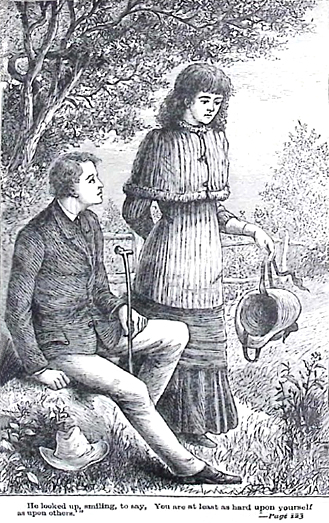
He looked up, smiling, to say, "You are at least as hard
upon yourself as upon others."
"But Pearl's is not mere ordinary prettiness," said Escott, in a low voice. "She is so sweet and tender,—so self-forgetting."
"Is Pearl self-forgetting?" asked Beryl slowly. "I should not have thought so. Girls generally know when they are pretty. I don't see how they can help knowing it, and of course they think about their prettiness. Pearl isn't a single grain worse than other girls, only she has more prettiness than other girls, so perhaps she thinks about it a little more."
"You do not call Pearl vain, I hope?" said Escott coldly.
"I don't call her anything. Most girls are vain," said Beryl, with a touch of cynicism. "And, after all, one may be as vain about ugliness as prettiness—not vain 'of' it, but 'about' it. It is just a question of thinking about one's self, I suppose. Pretty girls like Pearl think about their prettiness, and ugly girls like me think about their ugliness."
The pathetic simplicity of the last words recalled the Beryl of earlier days, and melted Escott's annoyance. He looked up, smiling, to say, "You are at least as hard upon yourself as upon others."
"One is driven to it," said Beryl.
"My common experience has been that with less beauty there is often more conceit," said Escott, anxious to generalise in favour of Pearl. "One is glad to find an exception to such a rule."
"I don't believe it is a rule," said Beryl; "and if it is, I don't believe I am an exception."
Escott could hardly help laughing, but the laugh changed into a sigh.
"Had you not better walk home?" asked Beryl. "I do not suppose they will come back. Ivor is bent on getting Pearl to the Roman encampment,—only some stupid heaps of stones, after all."
"You don't pretend to archæological tastes."
"I don't care for that sort of thing. Escott, I do think Mrs. Cumming would say you ought to go home if she saw you. I am sure you are in very bad pain."
"Only neuralgia. Five minutes are hardly over yet, and we must allow them a margin."
Beryl pulled out the old-fashioned silver watch which had been her father's. "They can't expect us to wait more than another five minutes, at any rate," she said.
Then, with the watch in her hand, she sank back into her former train of thought, and was suddenly aroused by the question, "What are you so intent upon?"
Beryl came back to present life with a start. The inquiry took her by surprise, and somehow she responded to it involuntarily, the uppermost idea in her mind finding vent:
"What made you and Ivor wish to be confirmed?"
Then she turned crimson, and would have given anything to recall her own words. "It doesn't matter," she added hastily. "Had we not better go home?" And she stood up.
Escott stood up also, actually forgetting to refer to Pearl and Ivor. He was at least as much taken by surprise as Beryl had been. When they had gone a few paces side by side, his answer came; not at all the answer that Beryl would have expected.
"I was so sorry for you," he said, with real feeling. "It was too bad of Aunt Di."
That touched Beryl to the quick. She was so little used to sympathy that it had the more power over her. He caught one glance from eyes actually full of tears, and then she looked resolutely down.
"It is her way, you know," he said apologetically. "But it must have been very trying and disagreeable. Ivor and I would have made our escape, only it was a little difficult—and nobody knew what was coming. I don't think my aunt understands the feeling of reserve one has on such matters. But I thought you very brave."
The feeling of reserve was on Beryl strongly at this moment. She managed to break through the cobweb sufficiently to say, "I could not be confirmed only just to please her."
"No, of course not. It would not be right. But don't you really wish it yourself?"
He did not think Beryl meant to answer this, and he felt half afraid she was vexed. They left the woods behind them, and walked slowly along the lower road, Beryl gazing steadily into the dust. When at length she spoke, she was evidently quite unconscious of the time which had elapsed since his question.
"I do not know," she said. "If I were good enough, I should wish it, I suppose."
"Only it isn't exactly a question of goodness, after all," Escott said. "Not of our own goodness, I mean."
"I suppose that depends on what one means by goodness," said Beryl. The effort of the conversation was greater to her than to him, though Escott did not speak without constraint. Beryl's shyness rendered her voice gruff. "One ought to want to be what one promises, at all events."
"Are you sure you do not want it?"
"I don't know," she answered. "I don't know what I wish or don't wish. Only 'if' I take those promises, I must keep them. I would rather not take them at all, than not keep them."
"I can understand the feeling," said Escott thoughtfully. "I remember saying almost the same to my mother. She made me see that things were not as I thought—that it was not a question of taking or not taking the promises, but simply of coming forward openly to confirm them. For the promises have been made already, at our Baptism, for us, and nothing can undo that. They are binding on us all the while, whether or no we acknowledge it. Mother always said so. She tried to make us feel that we were 'bound' to God's service, solemnly promised already to Him, though of course we had the power to rebel. And then the very promises would only add to our guilt."
Beryl was looking up with wide-open startled eyes. "I never thought of that," she said. "I thought—of course—I was free to choose—"
"I suppose we are all free, if you mean merely having the power to choose. But God has the 'right' over us," said Escott. "A soldier once enrolled in the Queen's service may be a deserter, but he cannot undo the Queen's right to his obedience."
"Some people would say God has a right over everybody," said Beryl, in a low voice.
"No one could deny that, who believes in Him as Creator and Father. But He has a double right over those who are bound and promised from very infancy to Him."
"I'll think about it," Beryl said, after a pause. "I did not mean to get into all this. Please don't tell anybody."
"Could you not talk to my mother?"
"O no, I would rather not. Don't say a word to anybody, please."
"Very well. I will not."
And these were the last words uttered, until the house was reached.
UNEASINESS.
LUNCHEON-TIME came, and Pearl and Ivor were absent still. Mr. Crosbie disliked unpunctuality, and grumbled heartily,—to little purpose, except that of making others uncomfortable, since the absentees could not hear him. Beryl was silent and absorbed. Escott, equally silent, was unable to eat, from an attack of violent neuralgia in head and face. He bore pain with the patience which sometimes, though not always, springs from long habitude, but his suffering look distressed his mother and fretted Mr. Crosbie. Diana had regained her composure, and chattered unceasingly, albeit her manner towards Beryl showed displeasure. Beryl did not appear to be conscious of the same.
Luncheon over, Mr. Crosbie withdrew to his own sitting-room, and Escott to the sofa, while Beryl betook herself to the counterpane, and Millicent brought one or two remedies to Escott, which sometimes gave relief. Diana found employment in looking out of the window, watching for the wanderers, and bemoaning herself over the dulness of Weston.
"I hate to be in a place where I know nobody," she said. "How you can have endured to spend a whole month here, and to make not a single acquaintance, passes my understanding. One might as well go to a desert island."
"I thought it better for Escott, not to have people incessantly in and out," said Millicent.
"I don't believe in anything of the sort. Dulness is good for nobody. Besides, you had to think of Ivor too, poor fellow. But well people always have to go to the wall, where invalids are concerned. Really, I think it is quite a charity in me to have brought Pearl. He has somebody to speak with now,—and somebody who can give him an answer. Young men don't care for a society of only middle-aged people and dummies."
Her words stung right and left. Beryl felt the slight, and Escott was pricked, and Millicent endured for both.
"They make a pretty picture together,—he and Pearl. I always do think so. One of the prettiest pictures I have seen for a long while. He is really almost as good-looking for a man as she is lovely for a girl. Of course they are very young still,—but that sort of thing often begins early. All the better when it does. I shouldn't wonder at all if, some day, before long—"
"I think premature suggestions of this kind are a very great pity, even when made in jest," said Millicent gravely. "Pearl is a mere child still, and Ivor is really only a boy. My pleasure is in seeing them both so perfectly simple and at their ease. I do not believe such an idea has ever crossed Ivor's thoughts."
"Don't you?" and Diana laughed. "My dear Millie, you count all the world as innocent as yourself; but it won't quite do, you know."
"If not, I am sorry for it. But you mistake me, Di. This is a matter of principle, not of ignorance, with me. It would be sheer cruelty, from any love of joking or love of talk, to suggest such a notion to those poor children. They are both too young to know their own minds. I hope I may trust Beryl never to repeat to Pearl what you have said."
Beryl's look was a sufficient answer.
Diana laughed again. "What a fuss about nothing," she declared. "Why, everybody says that kind of thing, and everybody knows what it is worth. Of course I don't pretend to be infallible. But my own private belief is that Pearl's little heart is taken captive already, whether she knows it or not. You would believe the same, if you had seen the state of distress she was in, when I proposed to give up coming here."
"I do not believe it," said Millicent, so earnestly as to be almost sternly. "The very suggestion about her is positive cruelty, Di. How do you know that Beryl and Escott may never make an unwise or unkind use of your words? I believe they are safe, but how can you know it? You are reckless, surely, to put Pearl so into the power of any one,—poor little defenceless Pearl. Suppose any of us chose to repeat your words to Ivor,—and suppose Ivor to be, as I believe him to be, without a thought or wish of the kind. Think what a position Pearl would be in."
Millicent was actually trembling with womanly indignation. Diana seemed rather pleased than otherwise to have succeeded in exciting her.
"My dear, I am getting a little too old for elder-sisterly lectures," she said. "And I don't think they ever had much effect upon me. We must each 'gang our ain gait,' and take the course we think proper. For my part, I believe that desirable affairs are sometimes helped forward by a timely suggestion behind the scenes. But I don't expect you to take that view of the matter. You and I unfortunately never did agree,—and as for Marian, she and I don't even discuss our differences of opinion now; it is such a perfectly hopeless matter. Well, I really think I shall take a drive this afternoon. We live in such an atmosphere of virtuous argumentativeness and setting people to rights, that I am getting out of sorts and positively ill-tempered. I shall keep a sharp look-out for Pearl and Ivor, and break in upon their 'tête-à-tête' if possible."
She did not offer to take Beryl, but went out of the room with her perpetual little rustle.
"My sister has been talking utter nonsense," Millicent said then. "Mind, children,—you are both to forget it."
"Pearl is younger than I am,—only sixteen," said Beryl.
"Yes,—it is absurd," said Millicent, not often so ruffled. "You must try to forget what you have heard."
Beryl simply answered, "Yes," and Escott said nothing, but disappeared abruptly.
Millicent followed him, to spend over two hours in vain efforts to alleviate a worse attack of pain than he had had since coming to Weston. Possibly she was not without a suspicion of the cause, but she spoke no more of Pearl. She had indeed no time to think about Pearl or Ivor, and even when the pain lessened, she could not leave him for a while.
When at length able to come downstairs, she found tea on the small table, Diana returned, and the walkers still absent.
"Strange," Millicent said thoughtfully. "I do not understand it at all."
"My dear, depend upon it, they have simply strayed on, forgetting the time," Diana said, with her light air of patronage. "Some people's company is sufficiently enchanting to some others, to render them just a little oblivious. For my part, I really think Beryl ought to have gone too,—but it can't be helped now. Do pray give me a cup of tea, for I am perfectly exhausted."
"If I only knew what direction they had taken," Millicent said, arousing herself from a dream to lift the teapot.
"That you might go after them? A mere wild-goose chase. By the time you had reached the further extremity of their ramble, they would be at home again."
"But if anything has happened!"
"What in the world 'could' happen? Ivor may have been stung by a wasp, or Pearl scratched by a bramble. Do be reasonable. Thanks—a piece of cake. There are two of them together. Even if anything so unlikely came about as that one should choose to tumble down and break a leg, the other could call for help. Weston woods are not American forests."
"They are pretty large woods, though," said Beryl. "I quite lost my way in them the other day, when I went alone."
"Some people lose their way in walking from one end to the other of Regent Street. It is a sort of gift,—a happy faculty. Very likely indeed Pearl and Ivor have lost their way now. It is extremely likely. I shall not be in the least surprised to hear it."
"Some bread-and-butter, Beryl?" asked Millicent, her fair brow wearing the gentle dent of displeasure which was its nearest approach to a frown.
"But, of course, if you want to try the effects of a wild-goose chase, you have but to send Beryl and Escott after them," pursued Diana. "'Set a thief to catch a thief.'" She laughed at her own joke, the force of which none but herself could perceive.
"Escott has done enough for to-day, thank you."
"Would you like me to go and look anywhere,—or ask?" inquired Beryl, rather shyly.
"Not the slightest use," said Diana, before Millicent could speak. "I have driven along all likely roads within reach, and saw not a trace of them. Of course you could go where you went this morning, and you might find Pearl and Ivor seated in a shady nook, enjoying themselves,—but it is a great deal more likely that you would find nothing of the sort. Depend upon it, they have gone some tremendous round, which will knock Pearl up for a week at least. It is exceedingly thoughtless of them both. If you go scrambling after them, you are pretty sure to get lost yourself. In which case, I hope 'I' shall not be asked to act searcher. That is all I have to say."
ILL TIDINGS.
ANOTHER hour of waiting passed. Millicent was really growing anxious, and she found Diana's cool assurances that all was and must be right somewhat difficult to bear. Escott had found his way to the drawing-room, and was watching with them.
Suddenly a little figure became visible, hurrying along the pavement in a manner which told of failing power. The hat was falling off behind, the steps though rapid were uncertain, and a general air of disorder and distress was apparent. Millicent and Escott exchanged looks. Diana stared, and Beryl gazed fixedly. All had a suspicion of the truth, yet it was not till the little figure was almost below the window that a general exclamation broke out—"It is Pearl."
And then there was a simultaneous, "Where is Ivor?"
"He has stayed behind for something, of course," said Diana.
Millicent stood up, but did not move farther. Diana rushed to the door, followed by Escott; but when Pearl came in, she pushed past them both, and reached Millicent.
That was all she could do. She was a pitiful sight, wan and blue-lipped, with wide-open distressed eyes, and breath in such laboured gasps that speech was utterly impossible. She grasped both Millicent's hands with her poor little shaking fingers, and struggled, but struggled in vain, for utterance.
The others came pressing round her, unnoticed. Pearl seemed to see no face except Millicent's. Diana was exclaiming and questioning in voluble style. Millicent had grown white to the lips, but she was calm.
"Hush, Di," she said. "Be quiet, all of you. Pearl will tell us directly what is wrong. She has run too fast. We must have a moment's patience."
The gasps were lessening slowly, but with returning breath came thick passionate sobs, fighting their way up, and preventing speech. Pearl wrung her hands together in voiceless agony. And when Diane would have touched her, she flung herself into Millicent's arms, with an incoherent shriek, meant for words.
Millicent held her firmly. "Hush, Pearl, hush," she commanded, with her colourless lips. "There must be no screams. Diana, you 'must' be quiet, or leave the room. Beryl, will you get a glass of water, please? Not a word, any of you."
Even Diana yielded, and for the moment said nothing.
Millicent with difficulty made Pearl swallow a few sips of water. "A little more," she said. "Now wait for a few seconds,—keep quite still, and then you must tell me quietly what is wrong."
Pearl buried her face in Millicent's shoulder, and for several seconds the silence was unbroken, except by her sobs.
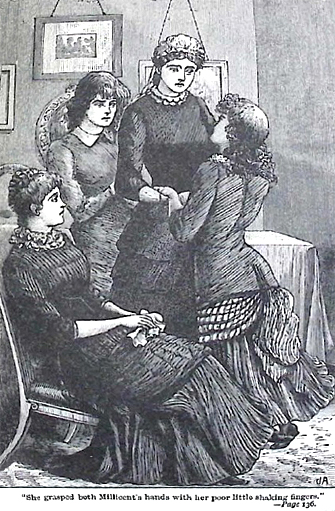
She grasped both Millicent's hands
with her poor little shaking fingers.
"Now," Millicent said at length.
The agony of distress came back. "Ivor—Ivor—Ivor," gasped Pearl. "Oh, what shall I do? I don't know what to do!"
"Pearl, is Ivor dead?"
The mother's lips asked the question slowly and distinctly.
Pearl thrilled all over, and said, "O no!—O no!"
"Then he is hurt."
"O yes—"
"How was it?"
Pearl could not speak. Her efforts only resulted in heart-broken sobs. A stronger and more unselfish nature would, in pity to the poor mother, have put thoughts of self aside for the moment, but this Pearl could not do. She was utterly overpowered.
"Where is Ivor?" asked Millicent, her own self-restraint so heavily taxed as to be in danger of failing. "Pearl, I must know," she said gently. "I must go to him."
Pearl managed to gasp out something about, "near Kewstoke," "house," and "doctor wanted."
Beryl came forward for the first time. "Can't I help?" she asked. "I could fetch a fly,—and if I knew who your doctor is—"
A faint look of relief at the suggestion passed over Millicent's features.
"One moment," Escott said, with a detaining movement. "Pearl will have to tell us where to go."
"Pearl, do have pity on Mrs. Cumming, and speak," said Beryl, in a low voice.
Sobbing still, but not so violently, Pearl drew a folded scrap of paper from her glove. "The men wrote—wrote down the address," she said.
Escott glanced at it. "Then we need lose no more time," he said. "If Beryl will kindly call a fly, I will find a doctor to go with us. Is Ivor 'much' hurt, Pearl?" The words were very gently uttered.
"Oh—yes," gasped Pearl.
"Had he a fall?"
"Not—not exactly!" Pearl was crying excessively again. "He—he—caught his foot—"
It was very unsatisfactory, but more could not yet be obtained. Pearl seemed to be on the verge of hysterics.
Beryl and Escott disappeared on their respective errands, and Millicent too went away, speedily to return, ready for her drive. She found Pearl in a renewed flood of tears, under a process of close questioning from Diana.
"I can't get much out of her," Diana said, "except that Ivor went after something at her request, and she thinks herself guilty in consequence."
"Poor little girl," Millicent said kindly, and she kissed Pearl's brow. "No one will count that of you, my dear."
"He must have been pretty bad. The men had to carry him," continued Diana.
Millicent's hand came on Pearl's. "Was he insensible?" she asked.
"No," sobbed Pearl. "He couldn't—couldn't move."
Then Escott came back, having happily found at home the first doctor at whose house he had called; and immediately afterwards Beryl drove to the door in a fly.
"Mother, I am coming too," Escott said decidedly. "I told the doctor we would call for him in ten minutes, or less."
Then the two were gone, and the stir was over.
"Well,—I shall decide to get home as soon as possible," Diana said, in rather an injured tone. "This sort of thing really is too much for one's nerves. I declare—nobody has thought of Uncle Josiah all this time. Just like Millie! He will be dreadfully angry not to have been told. Well, it cannot be helped now. Do stop crying, Pearl."
The tone was not exactly unkind, but certainly it was not sympathising.
Pearl crouched down in a corner of the sofa, burying her face in the cushions, and sobbing still in a kind of exhausted way, as if she had no strength to leave off.
Beryl longed to go to her, but dared not.
"Come,—the best place for you is bed," said Diana.
Pearl silently declined to move, and Diana made no attempt to enforce her own mandate.
Mr. Crosbie presently came in, and heard the whole story from Diana's lips, gaps in knowledge being lavishly filled up with suppositions. The old gentleman waxed impatient, and questioned Pearl, but she only crouched lower in her corner, and would not speak. When further pressed, she started up and ran away.
"The best thing you can do is to go and put her to bed," Diana observed carelessly to Beryl,—"if you wish to make yourself useful."
Beryl's heart bounded at the suggestion, though her manner showed no particular pleasure. She obeyed immediately, only to find Pearl's door locked. Pearl turned for some time a deaf ear to raps, but it was at length opened.
"May I come in?" asked Beryl.
"No, I don't want anybody," Pearl said, holding the door against her. "Please let me be alone."
"But you will make yourself ill, if you cry so. Aunt Di told me to come."
"I don't care. If you would only leave me alone—"
"I need not stay long. Just let me help you to undress."
"I don't want help. I'm—I'm not going to bed—till—till I know how Ivor is."
She ceased resistance suddenly, and threw herself on the couch, sobbing as much as ever.
Beryl entered and stood over her, a good deal at a loss how to act.
"Pearl, is Ivor very much hurt indeed?" she asked at length. "Don't you think you would feel better if you could speak about it?"
Pearl shook her head and moaned.
Beryl suddenly bethought herself of a certain mode of school-treatment for a certain hysterical child. She brought a basin of water to a chair near, and began bathing Pearl's flushed face and disordered hair with a wet sponge.
Pearl did not resist, but seemed rather to like it, and the violent crying lessened.
"And now you will take your things off," said Beryl persuasively. "Do, Pearl. You are so tired."
Pearl did not respond to the suggestion. She was cramped up on the couch, with her blistered face resting on one arm, sighing deeply every few seconds.
"I can't yet," she said. "Do let me be quiet. Beryl, he—he—didn't fall exactly,—but it was in getting over a high gate,—he caught his foot—"
The sentences were broken up by long sighs.
"Yes, Pearl," said Beryl encouragingly.
"I don't know how—I didn't see. He was going to get a flower for me—" and her face drew up into distressed puckers.
"Don't cry any more," said Beryl. "It's of no use."
"I can't help crying. It was so dreadful," sobbed Pearl. "If only I had not wanted that flower. And I didn't know what to do. I thought he was going to die—he looked so awful—I can't tell you how."
"Did he say he was very badly hurt?"
"Yes—he—he—said so. He couldn't move, and he could hardly speak; but he said it was bad—he thought it was a strain. And I got the men to come, and one of them—one said—it was 'very' bad."
"But I don't understand," said Beryl. "How could he hurt himself so much, if it was a mere slip?"
"O no, it wasn't. I didn't mean that. I think he tried to jump, and it was too high, and his foot caught on the top bar, and he went over. It was a longer way the other side to fall. I don't know how I climbed over to him," sobbed Pearl, "I 'did' tremble so. I saw he couldn't move, and I heard him moan; and when I saw him, I thought he would die that minute. He said I must get help,—and we had seen two men just before, quite near, and I ran for them."
"And they took Ivor to Kewstoke?"
"Yes, at least near Kewstoke,—the house where one of them was a gardener, I think. He said he didn't dare move Ivor farther till a doctor had seen him. He just wrote down the name of the house, and told me I must come straight back for a doctor, and he sent the other man for something to carry Ivor on. Oh, it is so very very dreadful," wept Pearl. "If only Aunt Di and I had never come to Weston. And I made her do it. Oh, I wish I hadn't."
Crying came on again, and Beryl returned to cold water sponging, as better than talk. Presently, to her great relief, Pearl dropped into a sound sleep.
Beryl drew a chair near, and settled herself to watch. She was quite content to sit there, doing nothing. It was a sort of fulfilment of her childish dream of caring for Pearl's wants. The old passionate love of Pearl, long thrust down into deep recesses of her heart, came welling up this hour. The poor little reddened and blistered face was sweeter now to Beryl, than it had been in its loveliness that morning.
"O Pearlie! If you could only care for me!" she murmured.
Then Diana came in, opening the door without warning, and not too quietly.
Pearl stirred, but did not wake.
Beryl looked up, and with difficulty checked a "Hush," which would have given dire offence.
"Asleep, is she?" said Diana. "Silly little goose."
Beryl flushed hotly with a kind of anger. Diana came to the couch.
"Well, the best thing she can do is to sleep on. I shall allow no more long walks. They knock her quite up. I suppose she has not told you any particulars."
"Not much," Beryl said in a low voice. "Ivor tried to leap a high gate, and caught his feet, and fell over. He told Pearl he thought it was a strain."
"Young men are always trying to do more than they are able. It is an absurd habit," said Diana. "I don't suppose it will prove to be much. A sprained ankle, probably."
Beryl was glad to see her rustle out of the room.
Pearl presently woke, but was so weary as to be glad to undress and go to bed, where, after having some tea, she soon sank again into unconsciousness. Beryl waited on her assiduously, restraining expressions of affection, but curiously happy in her task.
Late in the evening, she saw a fly stop in front of the house, and some one descended from it,—Escott, Beryl thought, in the dusky light. She went noiselessly out of the room, not waking Pearl, and entered the drawing-room, just before Escott came in. He walked with bent head and slow step. Beryl knew in a moment that he had brought no good news.
"Well, Escott, what does it all mean?" asked Diana. "A false alarm, I suspect."
Escott looked at her vacantly, and then at Beryl. "Don't tell Pearl to-night," he said. "Let her sleep quietly till the morning. Ivor is dying."
OVER THE WAY.
FIVE years earlier, Mrs. Fenwick's house had faced a meadow lying just across the road, with a good open view beyond of fields and trees and uplands. But Hurst was a growing place, and many changes had come about in the course of five years. Among such changes was the erection of a row of houses in the field opposite Mrs. Fenwick's, each more or less pretty—small, indeed, but gable-roofed, and in variegated red-brick style. Mrs. Fenwick was greatly annoyed. She did not much care about pretty views, merely as views, but she did care extremely about what she called "selectness," and to live in a row facing another row was in her estimation many degrees less "select" than to live in a row facing a meadow. She almost declared, in her first vexation, that she would find another home as soon as possible, and she did quite declare that nothing should ever induce her to call upon anybody who lived in those houses.
The latest finished of the villas was the one which stood exactly "vis-à-vis" to Mrs. Fenwick's. It was detached and surrounded by a neat garden, not painfully prim and bare like most new gardens, for several medium-sized limes and poplars had been spared from the general demolition in which the hearts of builders do commonly delight. Also the borders had been well filled with young shrubs, early in the spring, immediately the house came into possession of its present owners, and the beds gave promise of being speedily bright with flowers.
The said owners were two ladies, supposed at first to be aunt and niece. Despite Diana Fenwick's chagrin at the loss of her drawing-room view, she took a lively interest in these new neighbours, and speedily set down Miss Carmichael, the elder lady, as a strong-minded individual of eccentric habits, undesirable as an acquaintance.
"Call upon her! Not she!" Diana held up her head, and swept loftily past the house, quite unconscious of the amusement with which she was herself regarded by that rather largely-built calm-faced woman, in daintily neat though not very fashionable attire, who might often be seen bonnetless in the little garden. Miss Carmichael perfectly well understood the posture of affairs, and was perfectly well content to wait.
These views of Mrs. Fenwick lasted for a short time, while the two ladies opposite were settling into their new home. The said views then received a killing blow, in the discovery that Miss Carmichael was only daughter of a Sir Stephen and Lady Carmichael, both dead, and only sister to another Sir Stephen and Lady Carmichael, both alive. Eccentricities, real or imaginary, went to the winds. Mrs. Fenwick donned her best feathers, and called at once, all sweetness and graciousness, bent on making a good impression; and the call was returned in due time. Mrs. Fenwick did not like Miss Carmichael, but she liked a baronet's daughter, and she was willing to put up with the individual for the sake of the connection. Miss Carmichael might or might not have liked Mrs. Fenwick, but at all events she "showed herself friendly."
The new acquaintanceship did not at first ripen quickly, for the two ladies were busy about their settling in. Miss Carmichael could be seen to take an active part in these arrangements, "working like a horse," as Mrs. Fenwick expressed it. She did not herself see the slightest need for hard work in life, and she disliked others to see it. Things had to be done, of course, but somebody else would always do them—why not?
A second call introduced Mrs. Fenwick to Miss Carmichael's niece, friend, dependent, or companion,—Diana's curiosity was greatly exercised to discover which might be the true definition,—a Miss Wyatt, who appeared to rejoice in a perplexing variety of names, and whose age might have been anywhere between twenty and thirty.
After that, came the summons to Weston-super-Mare, and a consequent break.
One sunny June evening, the two ladies were together in the drawing-room, which was divided from the dining-room by large folding-doors, commonly thrown open in warm weather. They were open now, and the bow-window at each end gave a peculiar lightness to the appearance of the double room. The operation of "settling in" seemed to be tolerably complete, and the most fastidious eye could scarcely have detected anything lacking in arrangements. There was a subdued harmony about carpets and curtains, and also a grace of finish in minor details, which told of a refined taste in at least one of the ladies.
The elder of the two sat in an easy-chair near the front bow-window, enjoying, and enjoying with evident intensity, the sunlight, the fluttering leaves, and the singing of birds not yet banished from this part of Hurst. Not that she was anything of an invalid, though her attitude told of some fatigue. She could hardly have reached her fiftieth year, and the smooth light hair, brushed neatly under her cap, was untouched by grey. The light-coloured eyes had in them a steady shine of happiness,—not exactly a smile, but a kind of sunbeam reflected from within, over the whole face. Yet it was not a beautiful face, so far as form and colouring were concerned,—not even good-looking. No single feature could be selected as serving by a touch of natural beauty to redeem the rest from plainness. And yet again, no one who really knew that face could ever call it plain. Strangers counted it so perhaps, after cursory observation.
The younger lady was slender and small and dark-haired, not nearly so tall as Miss Carmichael, not strictly pretty, but with a nice colour, and a pair of most expressive eyes, peculiar in tint, and timid as those of a fawn. She was in the back room, making tea and cutting bread-and-butter, moving about with a light step, in a manner pleasant to look upon. The two did not dine late, but had "heavy tea" at half-past seven, and it was now close upon that hour.
"I am glad our drawing-room faces west," Miss Wyatt said, shutting the tea-caddy and coming forward, with the air of one whose work is for the moment accomplished. "And I am glad the sunset takes place just there, where we can see it, and not behind Mrs. Fenwick's house, though of course it will not be so all the year round."
"I am glad of a great many things, Hettie, a great many. The lines are fallen to me in 'very' pleasant places."
"And to me too."
"That is something else for me to be glad about,—if you can say the same."
Miss Wyatt drew near, and rested a hand on Miss Carmichael's shoulder.
"It is delicious," she said, "perfectly delicious. We shall be able to breathe here."
"I am taking a good breathing spell before plunging into work."
"Why, you have done nothing but work, Miss Carmichael, since we came. I want you to begin resting now."
"Carpets and curtains! Well, yes, it is all work of one kind and another. But I shall have time now for the 'other.'"
"Yes, only not yet. Think how terribly you were overdone before we came away. I want you to have six months idle. I'll be your deputy, and work for you."
Miss Carmichael smiled quietly, leaning back, with clasped hands, and her look of measureless content. "Six months is a long while," she said. "My dear, you must not be too much bent upon making a lazy old woman of me."
Miss Wyatt repeated the word "Old!" indignantly.
"Forty-eight next birthday!"
"That is only middle-aged, and some people have the gift of perpetual youth."
"Mentally, yes. One's body must grow old, if one stays on earth long enough. It will be perpetual youth up there." And they both looked at a distant lake of liquid blue, surmounting some layers of torn and crimson-edged clouds.
"At all events your body hasn't begun to grow old yet," said Miss Wyatt jealously.
"You think not, Emmie?"
The words were half playful, half grave, and Miss Carmichael's attention went again out of the window.
"What are you looking at so earnestly?" asked Miss Wyatt. "You see, I was right,—our friends over the way are back. They must have arrived late last night, poor things. And the elder girl is with them. She seems to be very unlike the winsome little Pearl."
"We must call upon them again soon," said Miss Carmichael.
"Yes,—soon, I suppose. Is there any hurry? I don't want to be uncharitable, but I don't at all like that little Mrs. Fenwick. I don't like her at all," repeated Miss Wyatt emphatically. "Do you, Miss Carmichael? She thinks herself immensely charming, and expects to be worshipped; but 'I' don't think her charming."
"She is pretty," said Miss Carmichael.
"Pretty, yes—if that were all that signified. A doll may be pretty. But she is affected. And I did so dislike the sort of slighting way she spoke of the eldest of the two girls. She seemed fond of Pearl Fordyce, I thought; but when she alluded to Pearl's sister, there was quite a sneer on her lips, and a contemptuous tone. Oh, I felt really angry. The girl may not be so taking as her sister, but that is not her fault. I can't endure people to be punished for what they cannot help."
"Why, Emerald, you are hot about the matter."
"I feel hot," responded Miss Wyatt. "Didn't you notice what I mean?"
"Yes," Miss Carmichael answered.
"I knew you did. I saw it in your face. You may be quite sure that poor girl is not happy in her home."
"Patience, Em. We may as well not be too sure till we actually know it."
"But I saw her this afternoon, when I was on my way back from the post-office. They were all three walking together. Mrs. Fenwick bowed to me, and so did the little Pearl,—by the bye, she is looking wretchedly white and ill, anything but better for her change. The other girl gave me a good look. She certainly is not pretty or lively—not in the least,—but that is no reason why Mrs. Fenwick should snub her."
"Some people are in the habit of snubbing everybody, as a relief to their own feelings."
"I never heard her speak to Pearl as she spoke to the elder girl, just before she caught sight of me. Such a sharp contemptuous tone. The girl made no answer at all, but she did not look happy. The moment Mrs. Fenwick saw me, she put on her most gracious manner. I don't suppose she thought I had heard; but I have keen ears."
"Particularly so," assented Miss Carmichael. "Come, I see tea is ready, and I think you want a composing draught."
Miss Wyatt laughed, and followed her to the other room, where the subject was dropped. It came up again after tea, however; for, on returning to the bow-window, a closed fly was visible, standing at the opposite door, and the little figure of Pearl became visible also, dressed in white, with a flower in her hair, and a shawl round her shoulders, waiting on the doorstep.
"There's a concert to-night at the hall," said Miss Wyatt. "They are going to it, no doubt."
"But not the elder girl," said Miss Carmichael, as a second figure in plain every-day dress, Cinderella-like in contrast, appeared beside the first.
"It's a shame," said Miss Wyatt.
"It is a pity," said Miss Carmichael.
"Just returned from school, and left alone the very first evening,—I call it a shame," repeated Miss Wyatt. "There comes Mrs. Fenwick, all rustle and bustle and small self-importance."
"Emerald!" pronounced Miss Carmichael softly.
"Yes, I know it is very naughty," said Miss Wyatt; "but if you knew how I do dislike that little woman!"
"Better not to allow active dislike. Disapproval is enough. The little Pearl is certainly ill or unhappy. She looks wretched."
"There they go," said Miss Wyatt. "And the other left behind. Poor girl! I do pity her. She doesn't seem to know what to do with herself. Just look at her, standing like a stock on the doorstep. They didn't even give her a parting smile. She is going to have a stroll in the garden, I believe."
"Suppose you run across and ask her to come here," said Miss Carmichael.
Miss Wyatt hesitated. "What would Mrs. Fenwick think? We have never even spoken to her yet. Wouldn't it seem rather funny?"
"Very funny," assented Miss Carmichael. "I won't venture to predict Mrs. Fenwick's thoughts. You can't go,—you shy puss! Never mind, I will do it myself."
Before Miss Wyatt could make up her mind to action, Miss Carmichael had gone quickly into the passage, and thence through the front garden, moving in a swift decisive fashion of her own.
Beryl, pacing rather drearily along the path in her dust-coloured dress, heard the crunch of feet upon the gravel, and looked up.
"Excuse my freedom," Miss Carmichael said, with her easy unconsciousness, as she smiled at the astonished girl. "You do not know me, but we have made Mrs. Fenwick's acquaintance lately, and I have come to make your acquaintance. I must introduce myself as Miss Carmichael from over the way."
Beryl gave her hand. "O yes, I know," she said, recalling certain animadversions of Diana's upon the speaker's style of dress—a style neither "outré" nor in bad taste, but marked by extreme simplicity.
Miss Carmichael had thrown a little shawl over her head and cap as she passed out of her door, and the kind face looked out from the grey folds, inviting confidence.
"I know," repeated Beryl.
"And you are the sister of little Pearl Fordyce," said Miss Carmichael.
"I'm Beryl Fordyce," was the answer, in the girl's usual blunt fashion.
"Another gem," said Miss Carmichael softly. "Gems for the King's crown, I hope."
Beryl said nothing, and only looked down, but a wistful expression crossed her face, an expression not often seen there. It did not mean assent or pleasure; neither did it mean the least shadow of offence-taking.
"Come, I think we shall be friends," said Miss Carmichael pleasantly. "Will you let me introduce you to my jewel, across the road,—not a Pearl or a Beryl, but an Emerald."
Beryl looked at her doubtfully.
"I am talking plain English," said Miss Carmichael. "Hester Wyatt and I saw you alone, and we wondered if you would like to sit with us, in our cosy nest, for half an hour."
"To go with you? I should not think Aunt Di could mind," considered Beryl aloud.
"Hardly," said Miss Carmichael.
"I don't know; I never can tell beforehand what she will like," said Beryl.
"Do as you think right," said Miss Carmichael.
Beryl's answer was a move towards the gate.
"Would you not care to get your hat? The wind will soon grow chilly."
"It doesn't matter if you don't mind," said Beryl; "I never take cold."
"Come—that is something to be thankful for."
Hester Wyatt met them at the drawing-room door.
"This is my Emerald," Miss Carmichael said, bringing them together, with a hand on the arm of each. "We shall be friends soon, I expect, beginning of course with—Miss Fordyce—Miss Wyatt. And now, Emmie, bring a nice little low chair into the window for Miss Fordyce, and another for yourself, and we will enjoy ourselves. Busy people know the luxury of a lazy hour. I dare say Miss Fordyce has been very busy to-day after her journey of yesterday, and you and I have certainly been so. I think we have all fairly earned a right to a tired evening."
"I don't think I have been busy," said Beryl. "I have only done things—not hard work—and I am not tired."
"You are stronger than your sister," said Miss Carmichael.
"O yes, I am very strong; I never am ill," said Beryl. "But there isn't much to do; I wish there were. I like being really busy."
"I shall have to hand over some of my superfluous work to you some day," said Miss Carmichael. "How about unpacking after your journey?"
"I got up early and did that before breakfast," said Beryl, with her sober unrelaxed face. "I like getting up early."
"So do I, but it doesn't like me. What have you done since?"
"Not much," said Beryl. "I unpacked for Pearl,—and we all had a little walk,—and I have my knitting."
"Are you great at knitting? Then Emmie and you will sympathise on one point. What do you want to ask, my dear?"
"She is direfully puzzled as to my names," said Hester Wyatt.
"I generally have to explain," said Miss Carmichael. "The truth is, I ought to use only the real names of Hester and Hettie before strangers; but I sometimes forget. Hester is the real name. 'Emerald' is just a pet title of my own coining, and 'Emmie' comes naturally from it."
"But why do you call her 'Emerald'?" asked Beryl.
"Lean forward, Hettie," said Miss Carmichael. "So,—a little more. That is the right light. Now, Miss Fordyce, come here. It is 'almost' too dark, but you may get a glimpse. What is the colour of Hettie's eyes?"
And the pretty shy eyes, usually dark, showed suddenly to Beryl's gaze as a clear green.
"No need to explain further," said Miss Carmichael. "That is how she comes to be my Emerald. Pretty, is it not?"
Beryl did not think the colour at all pretty. "It is like a cat," she said bluntly.
And both her companions laughed.
"I am afraid there is no cure for them," said Hester merrily. "Green they are, and green they will be to the end of the chapter."
Beryl found herself in pleasant quarters, and under the genial influences around, her tongue was becoming rapidly unloosed. She liked Hester Wyatt; but she was still more drawn to that calm face opposite, with its strength and sweetness of expression, a face as sweet as Millicent's though with none of her beauty, but the force of character was greater here. Beryl could not have defined the force; she only felt it. Somehow she knew she might trust Miss Carmichael completely, from the first.
PLAIN, YET BEAUTIFUL.
"WHY did you not go to the concert this evening?" asked Hester, not very prudently, when matters had advanced thus far, and Beryl had been talking freely of her five years' schooling.
"Aunt Diana said it was of no use, because I am not musical."
"Don't you care for music?"
"I like it sometimes. I mean I like some tunes,—'Bonny Dundee,' and 'Cherry Ripe,' and that sort of thing. And I 'do' think the 'Battle of Prague' really beautiful, only they say that is bad taste."
"Bravo!" said Miss Carmichael. "I do like honesty in any case."
"Ninety-nine people in a hundred would have bad taste, if they did not submissively like exactly what they are told to like," said Hester.
"Then don't you care for music either?" asked Beryl hopefully of Miss Carmichael.
"Yes; I care for it. I have been trained to love music of a kind which perhaps you would not admire at all, and I think the taste is inborn too. And I am afraid I don't much like the 'Battle of Prague.' But, my dear, I do like to hear you speak the honest truth, and not pretend to have a taste which God has not given you,—or which perhaps is only lying dormant, and wanting cultivation."
"Then you would not have cared really for the concert this evening?" said Hester.
"I should have liked to go. I wanted it very much," said Beryl. "Some of the tunes might have been nice, and I should have liked to see the people."
"Honest again," said Miss Carmichael. "I wonder how many who go would care to go if they could 'not' see the people—if they had to sit in curtained recesses, and 'only' enjoy the music."
"I should like that. I could have a private little cry, so nicely, at the touching bits," declared Hester, with a blush.
"And yet it is natural for human beings to enjoy things in company," said Miss Carmichael. "There is immense power in sympathy, in the sort of electric sympathy which runs through even a crowd of strangers. We can't unhumanise human nature. Best to take things and people as they are. I should not like at all when I go to church to be shut up in a box apart from everybody. I like to 'see' as well as to hear that we are all worshipping together."
"Pearl did not want to go to-night," said Beryl, after a pause, not able to respond to all this. "She did not like the feeling of it, with Ivor so ill; but Aunt Di said it would do her good, because she is so low and depressed."
"Your sister looks low," assented Hester. "Who is Ivor?"
"Escott and Ivor are our cousins—at least they would be our cousins if Aunt Di were really our aunt," said Beryl, not very lucidly. "Their mother is Aunt Di's sister, Mrs. Cumming,—and she lives with her uncle, Mr. Crosbie."
"Any relation to Miss Crosbie opposite?" asked Hester.
"Yes, she is Aunt Di's and Mrs. Cumming's sister," said Beryl. "Mrs. Cumming is a widow, and she has these two sons, nearly twenty years old now. I like Escott, but I don't think I care for Ivor. Other people do, though."
"And he is ill?" asked Hester.
"He and Pearl went for a long walk at Weston, and he tried to leap a high gate to get a flower for Pearl, and he caught his feet in the top rung and fell over. He hurt himself dreadfully—a sort of internal strain, I believe. They don't seem to expect he will get over it for a long while. The doctor thought he could not live through the first night, but he did, and there has been another doctor down from London. He thinks Ivor may perhaps get better, but nobody can tell yet."
"Bad," said Miss Carmichael, drawing her lips together. "Poor young fellow. He is at Weston, of course."
"Yes; at least very near Weston, not in it. He was carried to a gentleman's house, not far from where the accident happened. The gentleman and his family were away, but they have been very kind. He wrote to Mrs. Cumming that she must not think of moving Ivor, until the doctors should say it was quite safe; and I don't know when that will be. The accounts of him haven't been so good to-day and yesterday. At all events, he couldn't possibly be moved yet. Aunt Di would not stay in Weston more than four nights after Ivor was hurt. Pearl cried and fretted so that Aunt Di said she would make herself ill, and she thought we had much better come home. And Mr. Crosbie and Escott wanted very much to go to some lodgings in Kewstoke, so as to be near Ivor. I wished they would ask me to stay, but I suppose I couldn't really have been a help."
"It is a sad thing for the poor mother," Miss Carmichael said feelingly.
"Yes, and Ivor has always been the strong one. Escott is often ill, but Ivor is always well. I mean, he has been until now. And he doesn't care for books, so it will be worse for him than for Escott."
"Is Mrs. Cumming like Mrs. Fenwick?" inquired Hester.
"O no," Beryl answered, with unusual warmth. "Not the very least. She is like nobody that I ever saw. She is so beautiful and good that one feels quite afraid of her. It never seems as if I could say 'anything' to her, as I could perhaps to some people."
"Is that the usual effect of beauty and goodness upon you, my dear?" asked Miss Carmichael, with just a touch of sadness in her tone. For she knew—how could she help knowing?—that she had been a "plain" woman all her life through, according to certain ordinary ideas of plainness, and she had never attempted to disguise the fact from herself. It had been something of a life-trial to her, bravely accepted. And she did not know—how could she?—of the genuine positive beauty which was in her face, shining through from below.
"I don't know," Beryl said slowly, in her staid fashion. "I think I feel that with Mrs. Cumming. If I were like Pearl, I suppose I should not. But I am so different. If I were pretty, instead of ugly—"
"I don't believe in ugliness," broke in Hester impetuously, with flushing cheeks and kindling eyes. "In ugliness of that sort, I mean. I never saw the face yet that couldn't look pretty under certain conditions,—except a bad face. And the ugliest and wickedest face I ever saw was that of a particularly handsome man. It isn't a mere question of features. If there is a beautiful mind, the face must have beauty. I don't believe in the sort of nonsense that people talk about looks."
Beryl gazed hard, astonished at Hester's extreme warmth, and then she noticed Miss Carmichael's smile.
"The child is doing her best to comfort her old friend for not being a beautiful woman," Miss Carmichael said. "But don't distress yourself for me, Emmie darling. I have never expected admiration, for I have always known it could not be mine."
"It 'is' yours," said Hester, with a sob, and she knelt down beside Miss Carmichael, and looked up with eyes overflowing. "It is yours. I don't care who doesn't agree with me. I admire you with my whole heart, and you are beautiful—lovely—to me. I'm not flattering you, and you know it. The look in your eyes, and your dear bright smile, are lovely. Do you think I don't mean what I say?" And finishing off with a passionate kiss, Hester sprang up, and ran out of the room.
"My little Hettie is excited on the subject," Miss Carmichael said. "But her loving heart cannot do away with the truth. Will it be any comfort to you, my dear, to know that my lack of good looks has not lost me friends and loving-kindness and happiness, all through life?"
"Miss Wyatt is very fond of you," said Beryl. "But people don't care for me."
"Why not?"
"I don't know." Beryl hesitated, but her reserve was not proof against Miss Carmichael's thawing influence. "I thought it was 'that,'" she said. "I thought that if I were like Pearl, people would take to me, of course."
"If you were like Pearl, people in general might run after you more. But being run after for a pretty face does not mean being loved."
"But people do love Pearl, and they don't care for me," said Beryl, finding it a relief to unburden her mind to one who could, at least in some measure, feel with her. "I heard an old servant say of me once, when I was a child, that nobody ever could care for me, because I was so ugly and disagreeable. And I suppose it is true. I never expect anything else now."
Miss Carmichael sat looking at her.
"You may have been disagreeable as a child," she said. "I do not find you so now,—only I should like to unbend you a little. It was a wrong thing for a child ever to hear said. Has your life since been embittered by those words?"
"I don't know. I couldn't forget them, of course," said Beryl slowly.
"Have you kept them in mind, and allowed them to sour your intercourse with others?"
"I don't know," she repeated, and then she suddenly found herself in danger of following Hester's example. "I couldn't help it. I used to be very miserable, for a long long while. And then I thought it was no good to mind, and I settled that I would just keep to myself, and let other people alone, and be brave and not care."
"And shut up your heart against the many who would willingly enter it. Poor child!"
"There hasn't been—anybody," said Beryl.
"No one who ever could have loved you? How can you tell?"
"Except Mademoiselle at school. She said she would be my friend, and she gave me a ring, and I wrote to her and she never answered me. People are all alike."
"I would trust Mademoiselle a little longer. There may be unknown causes for the delay. People all alike! Nay, my dear, you don't know much yet about human nature."
"They are all alike to me," said Beryl. "And I don't care to have friends who only just become friends because they are sorry for me. If people don't really like me for myself, I would much rather be left alone."
"You are not like me there. If people are kind and loving, I don't pretend to get to the bottom of their motives. It is a hopeless task. I never yet succeeded in getting to the bottom of my own."
Then she rose, crossed over, and placed a hand on each of Beryl's shoulders.
"Hester and I will try not to be sorry for you," she said. "Look up at me, Beryl. We should be sorry for most people who feel as you feel, but you are of too independent a spirit to want pity, so we will offer none. Still, do you not think you would like to have a little love from us?"
Beryl looked up, as directed,—composedly at first, but a changed expression came soon. Her mood melted, and her eyes filled.
Miss Carmichael bent down and kissed her forehead.
"It is no such hard task," she said. "There is plenty of lovable stuff below, my dear, if you don't smother it up. Now mind, there is to be no steeling of your little heart against us. You are to be at home here, and to run in whenever you feel lonely. You understand? I hear Hettie coming, and you may go into the conservatory and gather some cherry-pie for yourself. People who don't like to be pitied, don't like to be caught crying, I know. Run, my dear, and you will come back all right."
THE WORST.
"I AM DREADFULLY tired this morning," said Mrs. Fenwick. "Really, the heat last night was quite appalling. Pearl, you are not eating any breakfast. I insist on your taking something."
Pearl looked blue-lipped and spiritless, and she sat in a drooping posture.
"You are not likely to hear any news of Ivor to-day, so it is of no use expecting," said Diana, with a yawn. "Dear me, sitting up so late does make one sleepy. Millicent is sure not to write two days running, and Marian will get out of it if she possibly can. She has a mortal horror of putting pen to paper. Besides, I don't suppose there will be any change for the present. He will be ill for months. I always do think it was the silliest thing to attempt to leap that gate."
This remark recurred on an average about six times a day. Diana Fenwick was one of those people who invariably judge of a deed by its results. Had the leap been successful, she would have praised Ivor's spirit and agility.
"But young men always do silly things, and never learn by experience. No use to attempt to control them. By the by, what were you doing all the evening, Beryl? Pearson says she saw nothing of you. She grew quite nervous, and hunted over the house when it was nearly dark. You are not old enough to be walking alone in the lanes so late. I can't think how you can like to do so."
Beryl had been debating with herself how and when to tell what had occurred. "I did not walk," she said. "I was over the way at Miss Carmichael's."
"You don't know Miss Carmichael," said Pearl, surprised out of her apathetic air.
"No, but she saw me alone in the garden, and she came across to speak to me. She asked me to go back with her."
"Extraordinary," said Mrs. Fenwick. "I detest that sort of meddling. What business was it of hers whether you were alone or not? But it is just the sort of thing one would expect from a person like Miss Carmichael. I call it impertinent."
"She was very kind, and I like her very much," said Beryl.
"How long were you there?"
Beryl considered. "I don't know exactly. About an hour and a half, I think."
"Absurd!" said Mrs. Fenwick, evidently annoyed. "I hope you did not gossip about my affairs."
Beryl was silent.
"What were you talking about?" Mrs. Fenwick spoke sharply.
"A good many things," said Beryl reluctantly. "About—music,—and different tunes. And I told them about school,—and about Ivor's accident. And Miss Wyatt showed me some photographs the last part of the time."
"It sounds lively," said Diana, with a sneer. "Rather you than me. Did they say anything about Sir Stephen?"
Beryl did not remember at first. "O yes, she—Miss Carmichael, I mean—showed me a photograph of her brother, and I think Miss Wyatt called him 'Sir Stephen.'"
"When is he likely to come to Hurst?"
"I don't know. Miss Carmichael goes to visit him every year."
"And I suppose you did not find out anything about Miss Wyatt,—whether she is a relation or what?"
"I don't think she is a relation. I think she is Miss Carmichael's friend."
"Her companion, do you mean?"
"No," said Beryl. "Her friend,—or perhaps like her child."
"Adopted?"
"I don't know," repeated Beryl. "They did not say anything about that. Miss Carmichael and Miss Wyatt seem very fond of one another."
"It is queer. I don't understand the connection. What is Miss Wyatt's real name?"
"Hester Wyatt. 'Emerald' is only Miss Carmichael's pet name for her."
"Absurd!" said Diana again. She was much given to using the word, when not in a pleasant humour.
"I did not think you would mind my going," Beryl forced herself to say, after a pause. "Miss Carmichael saw you go off with Pearl, and she thought I might be dull."
"She had no business to think anything of the kind. It was no concern of hers. I hate that sort of overlooking. I suppose you made yourself out an injured individual, in being left behind."
"I told her I was not musical," said Beryl stiffly. She found Diana's manner difficult to bear patiently.
The arrival of letters created a diversion, but there was not one from Weston, and Pearl's face fell. She betook herself to the corner of a sofa with a book, and made believe to read, seldom turning a leaf, and now and then stealthily using her pocket-handkerchief. A bright drop might have been seen to fall occasionally.
Diana rang for the breakfast things to be removed, and disappeared for a time. Coming back presently, she found Beryl in the window, over the never-ending counterpane, now and then diversifying the monotony of her occupation by a glance at the house over the way. The glances annoyed Diana. She did not like Beryl to have advanced further than herself in this new acquaintanceship.
"There is one thing I have to say," she remarked sharply, opening her writing-case. "About your Confirmation."
Beryl's work came to a stand-still, and she made no answer.
"The names have to be given in within the next fortnight. I shall send yours to Mr. Bishop."
"I can't decide in a hurry," Beryl said.
"Hurry! Nonsense. I spoke to you about it days ago. You have had ample time."
"I can't be confirmed, feeling as I do now. It would not be right. I should like to feel differently," said Beryl, finding it by no means easy to say so much.
"Feel differently!" Diana repeated the words with her scornful little silver laugh. "What about, pray?"
Beryl did not attempt to explain. "It would not be right," she repeated. "I must wait."
"Till when?"
"I would rather wait another year, or ten years, than do it too soon."
"You are nearly eighteen. Don't be ridiculous, Beryl. Your duty is to do as you are told, without making a fuss, and I say this is the right time."
"It can't be only just a question of age," said Beryl. "No clergyman would say so."
"I shall tell Mr. Bishop that I consider it the proper thing for you; and I expect you to obey, and not to make difficulties."
Beryl was breathing hard.
"I can't help it," she said; "I must do what is right. I 'cannot' promise what I feel that I don't really want to do."
"Stuff and nonsense. Why, everybody wants to do it—if you mean the Confirmation vows," said Diana. "We all want to do right, I hope. That is all that is meant!"
"Is it?"
The two syllables had a certain sting in them, apparently. Diana flushed, and threw back her head.
"Of course. What else do you suppose is meant?"
"I don't know. Something more than that," said Beryl. "If it only means being like everybody else, I don't see the use of being confirmed at all."
"I suppose you have been getting hold of some ultra notions. You seem to me to be in a muddle about the whole concern. As for 'hurry,' there are ten days to spare still, and you can think as much as you like. But I expect you to do as I wish, and I shall certainly speak to Mr. Bishop."
"Is he the same Mr. Bishop who wrote to you about us five years ago?" asked Beryl, after a pause.
"No," said Diana shortly. "A cousin."
A loud double knock sounded at the door. Pearl started as if she were shot. "A telegram," she whispered hoarsely, and she whitened and trembled.
"Not at all likely," said Diana. "Numbers of tradespeople knock like that. Just see what it is, Beryl. Now, Pearl, don't be a goose and make yourself ill about nothing. It is of no use whatever to be perpetually looking out for news of Ivor. We shall hear no more for a day or two. He may go on like this for six weeks and more, before he really begins to improve."
Beryl came back with an envelope of thin texture.
"Ah, then it 'is' one," said Diana, handling it carelessly, while Pearl leant forward in an imploring fashion. "I wish people would be content to write instead of startling one like this. I dare say Millicent forgot to post a letter yesterday, and thought we should be anxious for news this morning. She had much better have let the matter alone."
Diana opened the sheet, and glanced at the few scrawled words. "From Marian. Dear me—who could have thought it? I 'am' shocked. Poor dear Millie! But, after all, it is no more than one might have expected—poor fellow!"
Pearl muttered hoarsely, "What?"
"It is only what we might have expected," repeated Diana. "The doctors never really thought he would recover. Well, if it 'was' to be, I suppose it is a mercy that Millie is spared the pull of a long illness. It would have worn her quite out. Poor dear Millie!"
"Ivor dead!" broke from Beryl in utter incredulity. "Ivor!" She thought of the strong young frame and elastic step, as she had last seen them, only a few days earlier, and her whole being seemed to rise against the thought. "Ivor!" she repeated. She had made up her mind that he would certainly get well.
"Yes, but I did not mean to tell Pearl so quickly," said Diana, glad to have somebody to blame. "How you do blurt a thing out. But it is always your way. Marian does not say much. It is only—
"'All is over. Ivor passed away at six this morning. M. pretty well.
E. much knocked down.'"
Diana laid down the sheet, sighed, and put her handkerchief to her eyes.
"Poor boy; it is a dreadful thing. I am sure I wish with all my heart that we had never gone to Weston. I did not want to go. But, after all, it might have happened just the same, and of course one never can tell beforehand what is coming. I must write to Millie by the first post, though what to say I really don't know. It will half kill her, I think. One can't help feeling that if only it had been Escott!—He is always so delicate. Ivor seemed such a strong hearty young fellow. Don't cry so, Pearl. It is only what the doctors expected; but of course it is dreadfully sad. I must have all the blinds pulled down at once, and see about mourning for myself. You two are not his real cousins, so it will hardly be necessary for you,—expect perhaps very slightly. Millie might expect that."
Diana talked on, really distressed, but finding relief in words, and Beryl sat feeling stunned. Poor little Pearl's sobs were heartrending.
WHETHER OR NO.
"ALMOST a fortnight since you have been near us. But there is reason, I know," said Miss Carmichael.
She had received Beryl with her frank cordiality of manner, giving a kiss of welcome, and at once making her visitor feel at home. Hester, who was present on Beryl's entrance, slipped away almost immediately, seeming to know by intuition that a "tête-à-tête" with Miss Carmichael was wished for. Beryl looked grave and absorbed, as if something were weighing on her mind.
"You have all been in sad trouble lately," said Miss Carmichael.
Beryl sat opposite, gazing straight before her, not at Miss Carmichael, but at the wall beyond. "Yes," she said.
"How is Mrs. Fenwick?" asked Miss Carmichael.
"I don't think anything is the matter with Aunt Di. Pearl is ill—at least not well," said Beryl. "She cries so, we can't do anything with her, and she won't eat."
"Poor little girl. Only sixteen," mused Miss Carmichael. "And Mrs. Cumming?"
"She doesn't write," said Beryl. "Aunt Marian says she is pretty well. I don't know what they are going to do yet. Escott is so depressed."
"The twin brother?"
"Yes. But I don't hear much," repeated Beryl. Then she sat silent again, and Miss Carmichael sat watching her.
"What is it that you want to say to me, Beryl?" broke the stillness suddenly.
"I don't know whether I can," said Beryl, turning crimson.
"I think you can. It will go no farther without your leave."
"Not even—"
"No, not even Hester. I never repeat what is told me in confidence."
Beryl moved her fingers uneasily, and said no more.
"Come and sit here," said Miss Carmichael, drawing a chair close to herself; and when Beryl obeyed, she laid a hand on the girl's arm. "Now I think you will be able. Hettie will not come back yet. If she does, I will send her away again."
"Aunt Di wants me to be confirmed," said Beryl, "blurting" it out, as Mrs. Fenwick would have said, without preface.
"You have not been confirmed yet?"
"No. Mrs. Brigstock asked me if I would, and I said 'No.'"
"Why?"
"I couldn't. I'm not fit."
"And you do not wish it now?"
"No—yes,—I wish it—no, not really," said Beryl confusedly. "I don't know what I wish exactly. But I don't think I ought."
"Ought to be confirmed? Why not? Because you are not fit?"
"I know I am not," said Beryl. "I don't feel as I ought—and I never shall."
"I don't feel as if I had reached anywhere near the bottom of the matter yet," said Miss Carmichael pleasantly. "What makes one 'fit' for it, my dear?"
The pause following was longer than she expected, but Beryl evidently meant to give an answer, and at last it came:—
"One ought to 'want' to be—to do—to be—good."
"I should say more. One ought to be heartily bent upon serving Christ thenceforward."
"I meant that," said Beryl, in her shyly gruff tone.
"I am going to ask you a plain question, my dear. Is it your wish to be Christ's faithful soldier and servant unto your life's end?"
Another pause, and Beryl's usually staid features were working painfully. "I can't," she said. "I 'can't,' Miss Carmichael—"
"You cannot become His servant? But you are promised to Him already."
"Yes, so Escott said. I didn't think of it before. I have been thinking a great deal since," said the girl earnestly. "But I can't see what is right. If I am confirmed, I must go to—to—the Holy Communion."
"Is that your difficulty?"
"I couldn't go," said Beryl, her colour deepening. "I could not. It would not be right. Nobody ought to go who can't forgive somebody else."
Miss Carmichael suddenly found herself in possession of the clue she wanted. "And that somebody else is—"
"Mrs. Fenwick," Beryl said very low.
"What injury has Mrs. Fenwick done you?"
"She—stole Pearl from me."
"I don't understand. Try to be clear, my dear child."
"It is only that," said Beryl, breathing quickly, "Pearl and I did love one another so much. And she came between and stole her from me. She 'meant' to do it. We had nobody else before except one another;—and I have nobody now. Pearl does not love me."
"And you—do you love Pearl?"
Miss Carmichael had not expected the answer which came. She scarcely realised how great the effort of this conversation was to Beryl's reserved nature, or knew how much strength of will and passion lay beneath the composed exterior. Beryl broke into tears, and sobbed aloud.
"Poor child!" Miss Carmichael said in her tenderest tone.
Beryl was direfully ashamed of herself. She gulped and choked, and struggled back to calmness as speedily as might be. "I didn't mean—" she gasped, "I never do cry,—and I didn't know—"
"You will be better for it afterwards. Tears do one good sometimes."
But when self-command was regained, she said, "Now tell me more."
"I have told," said Beryl, in a voice which to anybody else might have appeared both hard and curt. "There isn't anything more. Only I have lost Pearl—and I can't forgive Mrs. Fenwick. I never have all these years, and I never shall."
"'But if ye forgive not men their trespasses, neither will your Heavenly Father forgive you your trespasses,'" said Miss Carmichael.
"Yes, I know. But I 'can't,'" repeated Beryl, somewhat sullenly.
"And you are content to leave it so," said Miss Carmichael. "For how long, Beryl?"
Beryl was silent.
"Till the end of life?" asked Miss Carmichael slowly and sadly. "That would be very terrible."
"I may feel differently some day," said Beryl.
"But if not? Life is uncertain. Think of poor young Cumming."
Beryl's face changed. "Yes, I know," she said huskily,—"I think it is 'that'—I think that frightened me,—and I do want to be different, but I don't know how."
"There is only one possible 'how.' Come straight to Christ, and tell Him all."
"I thought I must forgive her first."
"Yes, we all want to make ourselves a little better before we ask for His healing. No, my dear. There is no first except coming to the feet of Jesus. To be at His feet, and not to forgive others, is out of the question; and to attempt to come to Him, while determined not to forgive, is useless. But you may be willing and yet powerless, and then He will give you power."
Tears dropped again. "I'll try," whispered Beryl. "But I don't think I can ever like her."
"Possibly not. Liking is a different matter. She may not suit your personal tastes. But if you would be Christ's servant, you must forgive her,—you must not harbour malice."
"And about Confirmation?"
"Think it over, and come to me again."
"I can't. Aunt Di gave me ten days, and the ten days are just at an end. She says I am old enough, and she doesn't like me to put off any longer."
"Well—then send in your name as a candidate. You can go to the classes, and consider the matter prayerfully, and you and I will have some more little chats. If I were you, I would call at the Vicarage and speak to Mr. Bishop alone."
Beryl looked alarmed. "I couldn't say to him what I have said to you."
"There is no need. Simply tell him that Mrs. Fenwick wishes it, and that your own mind is not fully made up, and ask his permission to attend the classes. If you would rather write a note, that would do as well,—or nearly as well. By and by Mr. Bishop will of course see you alone; and unless he thinks it right, he will not admit you. If you still feel doubtful when that time comes, tell him so frankly, and he will help you to a decision."
Beryl's sigh spoke of some relief.
"But I am sure I could not explain in writing," she said.
"Some people find writing easier than speaking. Then try to see him. Why not go now?"
Beryl looked at the clock. "There would be time," she said unwillingly. "I needn't be home for half an hour. Only I do so dislike going."
"We must do a good many things that we dislike, in this world."
"And you think I ought?" said Beryl.
"I think it is the wisest course you can take."
"I should have time," repeated Beryl, standing up, with an air of reluctance. "Only I must be home in half an hour. Aunt Di will be going out, and she will want me to sit with Pearl."
"You have to win back Pearl's love," said Miss Carmichael.
Beryl shook her head hopelessly. "But I like being useful," she said. "Sometimes reading aloud a story to Pearl keeps her from crying for a little while, but she seems as if she could not care for anything. And I think Aunt Di makes her worse. She doesn't seem to understand Pearl at all."
"Then Pearl has the more need of you, my dear."
Another shake of the head. "Pearl does not think so," said Beryl.
"We must have patience. And now you are going to Mr. Bishop?"
Beryl said "Yes" soberly, and walked away.
Miss Carmichael watched her through the garden, and earnestly hoped Mr. Bishop might be at home.
Half an hour later, Beryl entered Mrs. Fenwick's drawing-room, to find the little lady chafing at her continued absence.
"I told you to be back sooner," she said. "That comes of letting you go to waste your time at Miss Carmichael's. I have been ready to start for a quarter of an hour past."
"It is four o'clock exactly," said Beryl. "You told me to be back at four."
"Oh, don't argue, pray. There is nothing I detest like argument. Where in the world have you been? I saw you leave Miss Carmichael's an immense while ago."
"At half-past three," Beryl said, with rather irritating composure, wearing her most stolid look.
"Where have you been since?"
"Only to the Vicarage—to give in my name as a candidate."
"You had no business to go to the Vicarage. That was not necessary. And you told me you would not be confirmed."
"I said I could not in a hurry. I wanted to think first," said Beryl, in a suppressed voice. "You gave me ten days, and the ten days are gone. I told Mr. Bishop I could not be quite sure yet, but he will let me go to the classes, and I am to decide by and by."
"I don't know how I am to spare you for the classes. With Pearl like this, and Marian away, I can't have you perpetually absent. It makes a perfect slave of me. I am sure it is a lesson not to burden one's self with other people's children. I am sick of it, for my part."
Beryl was silent. She really did not know what to say.
"Mind—I am not going to have this sort of thing again," said Diana sharply. "You are not to act without asking my leave."
"You told me I must be confirmed," said Beryl resentfully.
"I have not spoken of it since all this trouble. That alters circumstances. And you know very well that I did not say a word about your going to Mr. Bishop. I am not at all sure that I can let you attend the classes the next few weeks. You will have to do as you are told. My own belief is that we shall have Pearl downright ill in a few days. I don't know what is the matter with her."
Diana rustled to the door, and paused.
"Did Miss Carmichael advise you to go to Mr. Bishop's?"
Beryl was no adept in the art of fencing. She said only, "Yes."
"Miss Carmichael had better take care what she is about," responded Diana, in a quiver of passion. "I always did think her a meddling person. Mind, Beryl,—I will not have interference. And I will not have gossiping about my concerns. I never saw anything like it. You had better take care."
Beryl thought that the question of Confirmation was more her own concern than Mrs. Fenwick's. She had no opportunity to say so, however. The next moment she was alone.
VARIETIES.
IT seemed to Beryl that she had never known Diana Fenwick in so trying a mood as during the next few weeks. Probably the very fact that she was herself struggling to feel differently towards Diana made her the more sensitive to unkindness in word or manner. She sometimes thought the struggle a hopeless one. She "could not" forgive Mrs. Fenwick, "could not" conquer the bitter and resentful sensations which sprang into being, so soon as the two were together.
There were of course two sides to the question. Mrs. Fenwick was to be pitied as well as Beryl. If she was a trial to Beryl, Beryl was a trial to her. She did not love Beryl, but she loved money or money's worth, and she had spent money on Beryl, and for her spending, she had no return. She could not but know herself to be heartily disliked by Beryl, and this dislike she heartily returned, yet she felt herself after a fashion compelled or impelled to admit her as a perpetual inmate of her home.
Diana's extra irritability these weeks had also another cause, unsuspected by any around her. Had Beryl guessed it, had she known of the shadow which hovered over Diana's path, had she seen the despairing tears which the little widow often shed in private, her resentment would all have melted into pity.
Moreover, Pearl's state was annoying to Diana. She disliked the visible presence of grief, and could not understand the expression of it lasting in another more than a few days. Wounds of that description were apt in Diana's heart to heal quickly. For a week or more she was interested in Pearl's distress, and was rather disposed to encourage it, both by tender caresses and by much talk concerning "poor dear Ivor." Then she grew tired of tears and woeful looks, and took to reprimanding in place of coaxing. Pearl only cried and drooped the more for sharp words, would not eat, refused to go out, and slept away half her days in a sort of exhaustion of chronic misery. If not ill yet, she seemed likely to become so soon.
Meantime, Beryl went to the Confirmation classes; and though Diana complained often and much about the inconvenience of sparing her, she was never actually kept away. To have missed any one of the number would have been a real trouble to Beryl. She had never before been in the way of a steady course of religious instruction, wisely and thoughtfully administered, and she drank it all in with thirstiness. Mr. Bishop was a grave and elderly man, not powerful in preaching, but exceedingly earnest, and possessing an unusual gift for systematic exposition. The effect of his teaching, upon Beryl at least, was to cause eager reading of the Bible,—and not reading only, but also searching and comparing. She took notes in her own simple fashion, conned them over, copied and learnt many of the texts, and dwelt much upon them in mind. Questions in the class were seldom answered by her, but the intent face was noticed often by Mr. Bishop with pleasure.
The classes were supplemented by scraps of conversation with Miss Carmichael. Mrs. Fenwick threw many difficulties into the way of intercourse in that direction, but she did not entirely prevent it. Hester generally left the two alone together. Beryl had little to say, beyond the asking of a few questions, but she listened unweariedly to whatever Miss Carmichael might choose to utter. These weeks of preparation were found by Beryl, as they have been found by so many, a time of real good to her spiritual being—a time of awakening to clearer views of things unseen, and a time of food for soul-thirstiness.
Yet when the hour for decision drew near, she was doubting still what to do. Had she forgiven Mrs. Fenwick yet? Beryl thought not. "Could" she come forward to be confirmed? She was conscientiously afraid of deceiving herself. "Ought" was a word which weighed strongly with Beryl. She had not yet reached higher than a general sense of duty, but hers was not a self-pleasing nature.
The sisters did not draw closer together, as Miss Carmichael had expected, in consequence of Pearl's trouble. Pearl seemed to shrink into her shell, and to refuse sympathy; and Beryl did not offer it. She waited on Pearl, kept her company, and read to her by the hour together, but her stolid composure never relaxed at home as it relaxed at Miss Carmichael's.
Millicent Cumming was still at Weston, nursing Escott, who had been laid aside by a sharp attack of illness since his brother's death; and Mr. Crosbie and Marian were still with her. Beryl, though much absorbed in her own interests, saw that certain plans were under discussion, not altogether pleasing to Diana. The latter had taken to watching nervously for the postman, and over her letters from Marian she exhibited often a petulant annoyance.
Matters appeared one morning to have reached a culminating point. Pearl had always taken breakfast in bed of late, and Beryl alone sat at table with Mrs. Fenwick. The postman had brought two or three letters, one of which was evidently from Marian. Beryl was astonished to see Mrs. Fenwick suddenly tear the latter across, fling it to the ground, and stamp her foot upon it.
"I knew how it would be! Just what I expected!" Diana said passionately. "It is always the way. People just make use of one as long as it suits their convenience, and then throw one over like an old shoe. Marian was glad enough to have a home with me, when she had nowhere else to go. But I might have expected this. Everybody's convenience is always to be consulted before mine. If Milly does but hold up a finger, she gets it all her own way."
"Is anything the matter?" asked Beryl.
"A great deal is the matter. I never saw anything like it, for my part. One would think I was a child of six years old, to have things settled over my head in this fashion. 'Of course I shall agree that the plan is wise and right!' Of course I shall do nothing of the sort! I intend to give Marian my mind about it,—let her know for once what I really think. I shall tell her she may please herself, and 'I' shall please 'my'self. Cool!"
"Is not Miss Crosbie coming home next week?" asked Beryl.
"No, she is not. She will not come next week or any week. If she wishes for independence, she shall have it, and so will I."
Beryl waited, really afraid to speak. Diana's face recalled to her the day of the broken vase.
"As if nothing in the world were to be considered but Millicent's fancies! As if nobody in the world needed change except Escott! As if Mr. Crosbie could not go with them, if he chose! But 'I' shall go all the same. I will not be put upon like this."
"Go where?" asked Beryl.
"To the Engadine. They know well enough that I intend it, and this is a trick to stop me. But I will not be stopped. I shall go, and I shall take Pearl with me, as I told Marian I would. If Marian chooses to break through her promise of coming home next week, it is her own look-out. I shall tell her so plainly, and I shall take care that friends understand."
Beryl wondered what was to become of herself, and also felt generally mystified concerning the cause of all this anger.
"Are you going soon?" she asked.
"Of course I am. Next week."
"And Miss Crosbie was to have been here with me?" said Beryl.
"Of course," repeated Diana sharply. "I don't know, I am sure, what to do with you now. Marian is the most inconsiderate creature I ever knew, and she takes a positive pleasure in crossing me."
The door opened, and Pearson said, "If you please, ma'am, could Miss Carmichael have a word with you?"
Diana's face and bearing were suddenly transformed. She did not like to be found in a passion by anybody out of her home circle, and she certainly possessed a power of controlling herself when she would. There was an impatient mutter, "What on earth does she want?" And then a cordial—"Show her in at once,"—uttered distinctly enough for Miss Carmichael to hear. A little flushed still, but gracious and smiling, Diana rose to greet the early caller.
"I must apologise for the hour," Miss Carmichael said, shaking hands with Diana, and kissing Beryl. "You have not finished breakfast yet."
"O yes, we have—quite," said Diana pleasantly. "We were merely talking about a letter—rather a disagreeable one—which I have received."
"I don't like disagreeable letters," said Miss Carmichael.
"This is from my sister Marian. It is disagreeable because it overturns my plans," said Diana, speaking with composure. "Mrs. Cumming is thinking of going abroad with her son for some months, and Marian has decided to live with Mr. Crosbie while they are away. It is inconvenient to me—extremely. But my sister does not think about that. It is extremely inconvenient."
"You will have to make use of Beryl, in Miss Crosbie's absence," said Miss Carmichael.
"I do not know how to manage in the least. Marian knows that I intend going abroad in a week or two myself with Pearl,—that in fact it is a positive necessity. She was to have been here with Beryl. The change of plans has quite thrown me out."
Miss Carmichael looked at Diana in her attentive way, and said somewhat gravely:—"Yes, I think change of air would be good for you, as well as for Pearl."
"I must have it," said Diana, with a quick nervous glance back, as if to see what Miss Carmichael meant. "And Pearl will be ill, if I do not get her away. But I cannot afford to take Beryl too."
"Beryl is quite strong, so it is not necessary; and also there is the Confirmation. She will do very well here."
"I don't know. It makes a difference—in other ways—my sister not being with me," said Diana, drawn on to be confidential, as almost everybody was with Miss Carmichael. "I shall have to send the servants home for a holiday, and shut up my house. My uncle and Marian are staying on at Weston for some time—he has taken such a fancy to the place. Beryl will have to go to them there. I don't suppose my uncle will like it, for he is dreadfully fanciful; but I don't see what else is to be done."
"But the Confirmation!" Beryl broke out involuntarily, though not yet clear as to her own wishes about being confirmed.
"Yes, the Confirmation!" echoed Miss Carmichael. "I can propose a better plan, Mrs. Fenwick. Will you trust Beryl to me, while you are away? Hester and I will take great care of her."
Mrs. Fenwick certainly had not expected this, and certainly did not like it; but what could she say?
"I don't think you need hesitate," said Miss Carmichael. "We are new acquaintances, but we shall not be so much longer. I love to have young people about me; and Beryl will be no trouble. I shall not scruple to make her a useful individual in the house. It really may be a positive convenience to me, for I am thinking of sending Hester away for a short time, and Hester would not like to leave me alone. Shall we consider the matter settled?"
"Thanks,—you are most kind," said Diana rather faintly.
"Then it is to be so! Now I must not hinder you longer, for it is a busy time of day. We will meet again to arrange details. I must not forget the small matter which so happily brought me over. Could you give me the name of a good dressmaker?"
This business completed, Miss Carmichael left, Beryl accompanying her out to the front door, in a state of wordless happiness.
"Yes, we shall get on together, I think," Miss Carmichael said with a smile, answering the girl's look. "Good-bye, my dear."
And Diana received her with a sharp—
"I suppose it has to be; but mind, Beryl, you are not to make my household affairs the talk of Hurst."
"No," said Beryl, trying instinctively not to look too pleased. "But Miss Carmichael wouldn't repeat anything."
"I don't care whether she would or not. 'You' are not to repeat things to her," said Diana, with an uncomfortable consciousness of "things" better not repeated.
A HAPPY NEST.
THE idea of the Engadine roused Pearl more than anything else had done since Ivor's death. She cried less, talked more, and waxed positively eager over the choice of dresses and hats for the trip. Diana seemed not to have the slightest idea how long she would stay away. She showed impatience to be off, and was meanwhile in an uncomfortable state of alternate excitement and depression. Beryl could not make her out.
Marian's defection seemed to have caused even deeper annoyance than had appeared at the first. Diana could not hear her sister's name without an angry flush, and she repeatedly declared that Marian should never again reside under her roof. Something in Marian's letter had probably wounded her self-esteem. A hot and lengthy answer was despatched in the first outburst of passion. Marian's reply was brief, and Diana read it aloud to the girls, under one of her sudden impulses.
"DEAR DI,—I do not think you can have meant all you said in your last.
When you have had time to cool, you will be sorry. It is absolutely
necessary for Escott to travel, the doctors say,—and how could I leave
poor Uncle Josiah alone for six months or more? You could not really
wish it, or ask it of me. I dare say a trip to the Engadine would be
pleasant; but I must say I cannot quite see how you are to meet the
expense of it just now,—after what you said in your last letter.—Your
affectionate sister,—
"MARIAN CROSBIE."
"Cool! I am as cool as a cucumber," Diana declared, with burning cheeks and glowing eyes. "I don't pretend to be a lump of ice like Marian. Couldn't ask it, indeed! Why not? Millicent doesn't scruple to ask what crosses my wishes, and why am I to be tongue-tied? 'Poor Uncle Josiah!'—yes, of course,—poor anybody and everybody except me. Can't see how I am to meet the expense! No, I dare say she can't. What business is it of hers? But they shall see that I will have my own way; I am not going to be sat upon in this style."
The girls had little to say. Pearl only hoped that nothing might stand in the way of the trip, and Diana's anger did not disturb her, when not directed towards herself. Beryl dared not answer. She was falling more and more into the clutches of that uneasy dread of "saying the wrong thing," which checks all freedom of intercourse with some people, occasionally even with those people who stand nearest in order of natural relationship. She did not fear Diana's displeasure, for hers was a tough nature, capable of standing rough words; but she did fear the feelings which the expression of Diana's displeasure aroused in herself.
"I shall write at once, and tell Marian that everything is settled. Thanks to Miss Carmichael, I need not ask any favour of her. I am quite independent."
Beryl began to understand why she was so easily permitted to accept the invitation from over the way.
"I wanted to start next week, but I don't quite see that we can be ready, Pearl. Better say next Tuesday week."
Beryl was sorry, knowing that "next Tuesday week" would be the day of the last Confirmation class. She would much have preferred to be then at Miss Carmichael's.
Diana went on, unheeding:—
"Marian will be sorry by and by for behaving in this way,—when Millicent comes back, and my uncle doesn't want her any more. But I shall not have her here. I can't endure that sort of playing fast and loose. She may look-out for herself in future. I have a great mind to give notice to my landlord next quarter, and go to live somewhere else. I am getting sick of Hurst, and of being overlooked and meddled with at every step."
The last few words filled Beryl with dismay.
Diana noted her expression, and thenceforward made systematic use of the notion, when she wished to annoy Beryl.
Mrs. Fenwick proposed to spend a week with Pearl in London, before starting for the Continent. The last few days before they left, Beryl had enough to do, to satisfy the requirements of even her occupation-loving nature. She was at their beck and call incessantly—sewing, mending, packing, shopping, running up and down stairs, acting the part of "white slave" uncomplainingly. It was gradually becoming a habit with them to hand over to Beryl whatever they did not care to do themselves. Beryl liked to be busy, and liked to be useful. Yet, however willing to work, she had at times a wish for a grateful word or smile in return for her labours. Diana and Pearl could smile and thank gracefully enough, when it pleased them; but they did not count it worth their while to waste smiles upon Beryl. "Just do this," and "Just fetch that," with, "Oh, you have finished at last," or possibly a careless "Thanks," were the order of the day.
Tuesday came at last, and early in the afternoon the travellers started. Beryl was busy up to the moment of their departure. She had found time by early rising to put together what she would need at Miss Carmichael's; but after eight o'clock not a minute of her time had been her own. Diana was excited and irritable; and Pearl, now that things had come to a point, looked flat. Neither remembered to give Beryl a parting kiss, and Beryl would not ask for one. She stood quietly on the step, watching the fly rumble down the road, and feeling as if a sudden calm had come over the face of nature.
"Miss Pearl 'might' have taken the trouble to look round and say 'Good-bye,'" Pearson remarked unexpectedly by her side.
"People don't remember everything when they are busy," said Beryl slowly, turning round.
"She don't forget her ribbons and gloves, though," said Pearson with some point. "You're tired, Miss Beryl."
"I suppose I am—a little," said Beryl, as if not quite sure of so unwonted a sensation. "I don't quite know how I am to get my things to Miss Carmichael's."
"I'll see to that. You just tell me what has to go, and I'll see to it," said Pearson, who had experienced a growing approval of Beryl during the last few weeks, and a growing disapproval of the manner in which she counted her to be "put upon."
"If you don't mind, I should be glad," said Beryl. "I must be off to the Confirmation class in a few minutes, and Miss Carmichael expects me to tea."
"Well, don't you trouble yourself, Miss Beryl. Your things 'll be over all right, by the time you're there. And we shan't be off till to-morrow, so if you want anything more you can just run over in the morning, you know."
Beryl's "Thank you," if sober, was grateful. She went upstairs for hat and jacket, and started soon, with her Bible in her hand.
An hour and a half later, Miss Carmichael saw her coming up the garden path, and Hester met her at the front door.
"Welcome, Beryl,—I am glad you are here at last. We have been looking out for you. Your 'baggage' has arrived first. Go and speak to Miss Carmichael in the drawing-room. I am wanted downstairs for a minute."
Beryl obeyed, and received a second affectionate greeting. Miss Carmichael held her hands, scrutinised her face, and said "Well?" inquiringly.
"They are gone," said Beryl, with an unconscious accent of relief.
"And you have been to your class since. A pleasant one?"
"Yes,—I liked it very much," said Beryl, with emphasis.
"Rather longer than usual, was it not?"
"I don't know. Am I late? It did not seem long, but it is the last. Mr. Bishop wants to see us all alone now, and he has fixed the day after to-morrow for me."
"Do you see your way yet, my child?"
"Yes," said Beryl, lifting her eyes to her friend's face. "I want to be confirmed."
"And the difficulty about Mrs. Fenwick?"
"I think it is gone," said Beryl. "You have helped me so much. I don't feel the same now that I did. I don't 'like' her, Miss Carmichael, and I don't see how I can. But I like to be useful to her,—and I should not be glad to see her unhappy,—and it doesn't make me angry now to see Pearl fond of her. I don't know whether Pearl really is so very fond—but still she cares for Aunt Di much more than for me, and I can bear it now. I 'think' I may be confirmed."
"I think so too," said Miss Carmichael. "But be true, Beryl. Don't have any sham about the matter,—and don't be half-hearted. Let your life be one of real faithful service to Christ from this time forward."
"I want that—" said Beryl huskily, with flushing face. "Miss Carmichael, the class to-day was about—"
Beryl hesitated.
"Yes,—about—?" said Miss Carmichael.
Beryl's tone took its shy gruffness. "Only about—the love of God," she said.
"And that has gone home to your heart?"
"I don't think I ever saw it before," said Beryl. "I thought—of course—I 'had' to try to do right—just because I ought. I didn't see 'that!'"
"You did not see the outpouring of tender love, beyond a mother's, asking your heart in return. But you see it now,—and you will not let go what you have found. If you see His love, you 'must' love Him in return. Only, the life must go with the love. You cannot separate the two."
Beryl's look was responsive. She had no more to say.
"You will be glad of your tea now," said Miss Carmichael. "Come and see your room."
She led Beryl to a cosy chamber, looking out upon the back garden, pretty with white muslin and pink linings. A glass of geraniums stood on the toilet-table, and the very pincushion spoke "welcome" with its pins. To Beryl all this possessed the charm of novelty. She had never before been a petted and honoured guest.
"Your home for the present—for many weeks, I hope," said Miss Carmichael. "Hettie has filled the bookcases with a selection which she thinks may suit your taste. We must try to turn you into something of a reader while you are here. Do not wait to unpack now, or to change your dress, for tea is ready. Just make yourself tidy, and come down."
Beryl obeyed, positively speechless with happiness. She had never known such a sense of peaceful enjoyment as seemed to pervade the very atmosphere of this house—an atmosphere which she had never been so fitted to breathe as on this particular evening. She did not dream how her own usually stolid face was changed by this new sense of peace, within and without. When she re-entered the drawing-room, Miss Carmichael and Hester looked at her, exchanged glances, and smiled, both well content.
"This is to be your seat at the table," said Miss Carmichael kindly. "I dare say you are tired, and hungry too, after your busy day. The last few days have been far from idle, I think."
"No, I have had a great deal to do," said Beryl. "But I am not tired now. I was, before the class—a little. I like being busy."
"That liking is a gift worth having. Hettie and I mean to keep you employed while here. We don't approve of 'idle hands' any more than Watts did. How is the little Pearl?"
"I don't think she is happy," said Beryl. "She seems to have been so very fond of poor Ivor. Aunt Di thinks they would soon have been engaged."
"Poor child! Too young," said Miss Carmichael pityingly. "Foreign travel will be the best cure for her, probably. And Mrs. Fenwick?"
"Aunt Di is quite well," said Beryl. Then she saw something in Miss Carmichael's face which made her add, "Why? Don't you think so?"
"No," said Miss Carmichael, and Hester shook her head.
"I did not know anything was the matter with Aunt Di," said Beryl, rather bewildered.
"She is not well," said Miss Carmichael.
"But what is the matter with her?"
"I am not in her confidence, so I cannot undertake to say. It is easy to see that something is wrong, and that she is aware of it. If you were a little more experienced, you would have noticed the same. Don't talk about it to anybody else."
"She does seem unhappy sometimes," said Beryl. "But I fancied it was only just her way. I did not know she had anything particular to make her so."
"I may be mistaken, but I should say that she has. I am glad you have felt more kindly towards her lately, poor thing."
"Oh, so am I," said Beryl. "But she isn't really ill, is she?"
"'Ill' is an indefinite term. I do not count her well. Try some home-made cake, Beryl."
BRIGHT HOURS.
THE Confirmation was to be on Monday, and the evening before was to Beryl a strangely happy time. She had seen Mr. Bishop in the course of the week, and had received her ticket of admission. A sermon especially intended for the candidates, and full of the subject of that great love of God for men, which had already touched and stirred Beryl's heart with a thrill never again to cease vibrating, had just been preached at the evening service. It seems strange that few sermons comparatively should be spoken upon this mighty theme. Is it because men know so little of God's love?
The three were together in the drawing-room, Miss Carmichael resting, Hester and Beryl on either side of her. Lights were out, and blinds were drawn up, and the moonbeams fell full upon the little group.
"It has been a good time for you, child," Miss Carmichael said at length.
"It has been the very best day I ever had in all my life," said Beryl. "Will to-morrow be better still?"
"Such days are sometimes disappointing, hardly coming up to our expectations. But there is generally a reason."
"What reason?" Hester asked. "I remember a feeling of flatness and disappointment when I was confirmed, as if the whole did not at all come up to what I had pictured beforehand. Why was it?"
"I don't know the 'why' in your particular case, Emmie. It might have been that you gave thought to your own or your neighbour's dress and appearance. Or it might have been that your mind was too easily distracted by the little events of the day. Or it might have been that you expected a sort of unnatural spiritual exaltation—such as comes sometimes in a life, but certainly doesn't come just when it is looked for. Or it might have been that you were more occupied with your own feelings than with your Master."
"I think it may have been a little of all four," said Hester in a low voice, and Beryl inquired abruptly,—
"How am I to keep myself from anything like that?"
"You cannot keep yourself, child. Christ alone can keep you."
"And I can't do anything?"
"Yes; you can look to Him, moment by moment. And you can set it before yourself as a definite aim, in His strength to be calm, to let the little things of every-day life pass by you unnoticed, to be indifferent to what your fellow-candidates may wear or do, and so to escape being tossed to and fro needlessly."
"There is something else I have been wanting very much to ask you," Beryl said presently, finding it easier to talk by moonlight than by daylight.
"Yes. What?" asked Miss Carmichael.
"I don't know about what I ought to do,—I mean, if I live with Mrs. Fenwick. There doesn't seem any work for me."
"Work for God?"
"Yes."
"There is always work for God, if you are where He intends you to be."
"I don't know whether I am."
"Did He place you there, or did you place yourself there?"
"I don't think I had much choice about it," said Beryl slowly. "But I should like something else much better. I should like to be a nurse in a hospital very much indeed. I always think I could do that well."
"I should like has a doubtful sound, in connection with work for God," said Miss Carmichael.
"Is it wrong to like what one has to do?"
"Certainly not; but it would be wrong to put aside what He has given you to do, and to take up something else, merely because you would like it better."
"But it might be the right thing for me," said Beryl.
"It might. Have you any reason for supposing this to be the case, at the present moment?"
"I should like hospital work," Beryl began, and paused. "I mean, I think I am fit for it. I am strong, and I like taking care of sick people. And I am not wanted here. I don't like living with Aunt Di. She does not care for me in the least, and she always speaks as if I were a burden. And I don't see that I can be of any real use to her and Pearl. I have worked for them a good deal lately, mending and so on, and of course I don't mind; but it isn't 'that' work. I should not like to go away from Hurst, because of you; but still I 'do' want to have real work for God."
"'Seeking for some great thing to do,'" murmured Miss Carmichael. "There is a good deal as to your own liking in all this, my dear. Now tell me your reasons for supposing such a step to be God's will for you."
Beryl was silent for some time.
"But, Miss Carmichael," she said, "ought I to live on Mrs. Fenwick, and not do anything for myself?"
"You should ask Mrs. Fenwick herself as to that. She has been practically in the place of a parent to you for years. It is not for you, a mere girl, to break away from her, unless by her will as well as your own."
"But if she did not mind?"
"I have a strong impression that she would mind. If not, your way would become so much the clearer. At the same time, you should be cautious how you bring matters to a crisis. Better that the responsibility of the step should be hers, not yours."
"Only, if it were right for me—"
"If it is God's will for you, indications of your way will soon appear. But there may be work for you to do in your present home first. How if, by your own action, you were to cut yourself off from it? I am not trying to discourage you, my dear, but I certainly recommend you to wait. A few months hence—"
"Months!" repeated Beryl.
"No one is the worse for a little exercise of patience," said Miss Carmichael.
After a break, she added softly:
"Those long years of waiting and preparation at Nazareth—I often think of them. One fancies HE must have been so eager to come forward, to make Himself known, and to do the great work for which He had come. Yet, all through those quiet years, He was just as much 'about His Father's business' as in the three years' busy ministry."
"Miss Carmichael, I will be patient," spoke Beryl. "I won't be in a hurry."
"And be willing to follow the guidance when it comes, my dear, whether or no it may point the same way as your own wishes. Remember, you are perfectly free to '"ask" what you will;' but take care not to '"choose" what you will,' or you will be sorry later. Always leave your Father to choose for you."
Beryl said again, "I will."
They went to bed early, and Beryl slept as usual soundly, to wake in the morning with a placid sense of happiness.
Breakfast passed quietly, little being said by any one. Beryl could see that her companions were anxious not to distract her thoughts by light conversation, though Miss Carmichael was the last person to endeavour to force religious talk.
Breakfast over, she said simply, pressing Beryl's hand, "You will like a short time alone, my child."
And Beryl went away obediently to her own room.
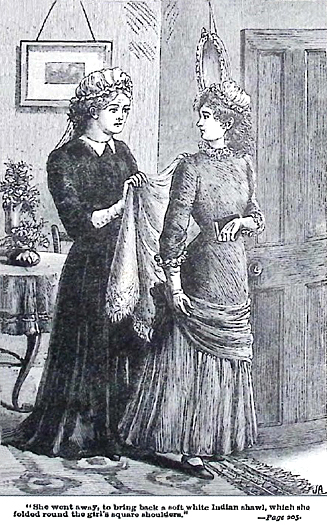
She went away to bring back a soft white Indian shawl,
which she folded round the girl's square shoulders.
Thither Miss Carmichael followed her, when the hour for starting drew near, to see that Beryl was duly equipped. No stir was made about the matter, and Beryl certainly offered no "bridal" appearance. She wore a plain light-grey dress, lately procured for her by Mrs. Fenwick. Miss Carmichael's kindness had supplied a pair of white gloves and a little white net cap; and with her own hands Miss Carmichael fastened the latter on.
"Shall I wear my black jacket?" asked Beryl doubtfully.
"No, my dear; that will not quite do," said Miss Carmichael.
And she went away, to bring back a soft white Indian shawl, which she folded round the girl's square shoulders.
"Now it is all right," she said, and she kissed Beryl.
"You are so kind," was all Beryl could say.
"Never mind me now. I want your little mind to be full of other matters."
"I am trying, Miss Carmichael."
"Don't try after feelings of excitement; only quietly remember your Master, and think how you are promising yourself anew to Him, and how He has promised to keep you to the end. 'I will pay my vows unto the Lord now, in the presence of all His people.' 'Unto Thee, O Lord, do I lift up my soul. O my God, I trust in Thee.'"
Then again she left the room, and only came back when the fly was at the door.
Three hours later the service was over, and they were at home again.
Beryl went upstairs, and Hester remarked, "I think she was thoroughly happy all the while."
"I could not see her face," said Miss Carmichael. "She looks happy now."
"I saw her plainly," said Hester. "She seemed grave and reverent, just as one would wish, and there was no gazing about at her neighbours. And the whole service was so nicely arranged, no fuss or bustle about it. I am glad Beryl went from here, not from Mrs. Fenwick's. She would have heard nothing but talk about the candidates' veils, if she had been there."
"And now, Em, we want our dinner," said Miss Carmichael.
Beryl came downstairs, feeling dreamy, and rather shrinking from ordinary conversation. Dinner over, she seemed at a loss what to do with herself, and was set down by Miss Carmichael to hem a seam. She did as she was told, but remarked, "It feels like Sunday—as if one ought not to work."
"It is not Sunday, my dear, and I doubt if you would find yourself able to attend to a book. Your mind has been on the strain yesterday and to-day, and if you keep it up too long, you will have an uncomfortable reaction. I want this shirt finished for a poor person."
"Oh, if it is really useful, I shall like to do it," said Beryl, her face lighting up. "May I help as much as possible while I am here?"
"That is the first step," said Miss Carmichael, smiling. "I shall soon see what the help is worth."
Beryl was spurred on by the words to diligent exertion, and her next hour's performance was creditable to herself both in quantity and quality. She was disposed to fall into grave talk again about future plans, but Miss Carmichael discouraged this, thinking that enough had been said for the present.
After a while, she sent out Hester and Beryl for a walk, herself going upstairs to lie down.
By teatime, Beryl was natural again, entirely happy, but without her look of strained gravity.
"It has been such a nice walk," she said. "Hester and I have been talking about all sorts of things. And we both think that nobody in the world is like you, Miss Carmichael."
"I suppose I am to take your words as a compliment, my dear; but they have a doubtful sound. One may be pre-eminent for disagreeable qualities, as well as for agreeable ones."
"But you know what we mean," said Beryl, looking into Miss Carmichael's face with an expression which transformed her own, and which would indeed have astonished Mrs. Brigstock and Diana Fenwick. "Hettie says she always thinks of you as a sort of mother, and I am sure 'I' do."
"Then I have two children instead of one child," said Miss Carmichael. "Ah, the post has come. A letter for Beryl. Sensible man to bring it here, instead of dropping it into the box over the way."
"From Mademoiselle Bise!" exclaimed Beryl. "How curious! It seems as if everything nice came together at once."
And presently, she put the letter into Miss Carmichael's hand.
"I should like you to read it," she said. "It is 'very' nice—all through. Poor Suzette! She was taken ill two days after I came away, and she had to go to a sort of home for governesses, and lately she could not find my letter, and didn't know my address. She says she hopes I have trusted her: but I have not."
"Don't doubt friends hastily in future," said Miss Carmichael.
"I'll write to her directly," said Beryl. "She is just going to another school in London. I am so glad I have heard. I had been looking for a letter, and wondering why one did not come, so long. Isn't it strange everything coming to-day?"
"I hope a few more things may come in the next few days," said Hester.
"And the next few weeks," said Beryl. "Oh, I hope Aunt Di will stay a long time at the Engadine,—if I am not in the way here. I wish it could be very long. I want to learn so many things."
"'Homme propose, Dieu dispose,'" murmured Miss Carmichael.
"But it will be so nice," said Beryl.
"Yes, very nice," said Miss Carmichael kindly. "But take each day as it comes, my child. Don't set your heart on what lies ahead."
DISAPPOINTMENT.
"SLEPT well?" asked Miss Carmichael next morning, as Beryl came, glowing and fresh, out of the garden.
She did not look pretty; nothing could make Beryl's plain face pretty; but her open and honest enjoyment was pleasant to behold. The constraint of her school-days seemed to have vanished.
"I always sleep well," Beryl answered. "I have been out of doors half an hour and more. Only think; it is a week to-day since I came."
"Does it seem longer or shorter?" asked Hester.
"I don't know. Longer and shorter too, I think," said Beryl. "I am so happy that the time goes fast, and yet I feel as much at home here as if I had been months and months in the house. To think of weeks more still,—it seems like a dream."
"You will quite belong to us by the time they are over," said Hester.
"It 'feels' like belonging to you now," said Beryl.
Prayers at an end, they drew round the table, and Miss Carmichael's own hands supplied Beryl's plate with toast-and-butter. "Eggs and ham will come soon," she said. "But you are hungry with the fresh air, and you need not wait. Post come?—And another letter for Beryl! From Pearl, perhaps."
"No, it is Aunt Di's handwriting," said Beryl. "I didn't expect her to write to me."
She opened the letter, and, as she read, her happy face clouded over heavily.
"Bad news, my dear?" asked Miss Carmichael.
"They are not going abroad at all," said Beryl, in a thick and half-choked voice.
She crumpled the sheet together, and thrust it into her pocket, beginning to eat dry toast as fast as possible, under an evident impression that it was buttered. Hester handed her a cup of tea, and Beryl gulped some down hastily.
"Take care,—you will choke yourself," said Miss Carmichael.
She sat watching solicitously the girl's perturbed face, crimson with the struggle to keep down tears. It was plainly an almost hopeless struggle.
"Will she leave you with us a little longer, Beryl?" asked Miss Carmichael.
Beryl shook her head.
"What is the reason of the change?"
"I—don't know. I didn't—didn't read it all." She pulled out the crumpled sheet, and thrust it into her friend's hands, tears still gathering in hot rushes, and all but overflowing.
The letter ran as follows:
"DEAR BERYL,—Will you please to go back to our house early on
Wednesday,—some time in the morning. I have decided to give up the
Engadine entirely for this autumn, and Pearl and I will return from
London to early dinner on Wednesday. I have sent word to the servants
to go home the first thing on Tuesday, and they will get everything
ready. I am dreadfully tired, and can't write more; and Pearl has cried
herself ill about not going abroad, but it can't be helped. I dare say
Miss Carmichael will be glad enough not to have you on her hands for a
month or six weeks; anyhow, I must have you at home to help. It is time
you should learn to be useful. Yours affectionately,—DIANE FENWICK."
"Mrs. Fenwick's surmise is wrong," said Miss Carmichael. "I am sorry, not glad." And seeing that Beryl did not understand, she read the letter aloud. "No reasons given, you see."
"It is terribly disappointing," said Hester.
Beryl was reaching a point beyond self-command.
Miss Carmichael saw this, and said quietly, "Come here."
Beryl obeyed, choking with sobs, and knelt down to hide her face on her friend's shoulder.
Miss Carmichael's arm, placed tenderly round her, spoke of comfort, yet the very tenderness made composure the more difficult, and Beryl's crying had about it something of the passionate emotion seen often in her childish days, though of late years commonly suppressed.
"My child, it isn't worth all this distress," said Miss Carmichael. "You are only going across the road. Come, dry your eyes and be brave. I didn't know there was such a reservoir of tears beneath. You and I shall meet often."
"It won't be the same," gasped Beryl. "She always tries to hinder me from coming. And I 'did' so want to be here next Sunday, the first time I go to—"
"Yes, I understand," said Miss Carmichael. "But that will be the same, child, wherever you are. The Master's Presence at the feast is its joy."
"Ah, but she will very likely make me feel so that I shall not think it right to go at all," murmured Beryl.
"I hope not. Something must be wrong if you can only come to the Master's Table when nothing has happened beforehand which could ruffle you. The things may happen—only don't be ruffled. Make it your aim to keep—or rather to be kept—in calmness."
"I'll try," Beryl said, rather despondingly. "But one doesn't always feel quiet when one looks quiet."
"Beryl Fordyce does not, certainly. My dear, there lies the difference between keeping calm and being kept calm by God. Our quietness is an outside affair very often. The peace of Christ, poured into our hearts, reaches to the very depths."
And then, as Beryl remained kneeling beside her, flushed and troubled, she added, "The tea is getting cold. Come, child, we are going to make a good breakfast, all of us. Emmie, give Beryl some eggs and ham."
Beryl had not seen them brought in, but there they were. She went back to her seat, and cried no more, but the heavy look of disappointment continued, a touch of sullenness being mingled with it.
Miss Carmichael took no notice of this. Breakfast at an end, she attended to household matters as usual, and was busy for an hour or more. Then she came to the drawing-room, and found Beryl seated idly in the window, gazing with a forlorn air into vacancy. Miss Carmichael realised suddenly the cause of Beryl's general unpopularity. In her present mood, she certainly did wear an exceedingly uninteresting appearance.
"What have you been doing since breakfast?" she asked cheerfully, taking a seat and pulling some work out of a drawer.
"Nothing," said Beryl.
"Hardly possible that, my dear. Some part of you must have been employed, whether hands or head."
"I have been thinking," said Beryl, with an effort.
"With what result?"
"I don't know. I don't feel as if anything was of much use," replied Beryl. "I feel as if I were just going back to the old way of things."
"Ah!" said Miss Carmichael quietly. "Then the vows of yesterday were hardly more than a form, after all. You are willing to be a soldier and servant of Christ just so long as you may do what 'you' wish. But if He gives an order which you don't quite like, away goes all thought of faithful service."
Beryl was silent, but her face grew softer, and Miss Carmichael left the words to work.
"I don't think I ought to have been confirmed," Beryl broke out suddenly. "I thought I had forgiven Mrs. Fenwick, and I haven't."
"Forgiven her for what?"
"For—everything," said Beryl. "If I had forgiven her, I shouldn't be so angry with her for this."
"You were able to forgive her last week for anything of seeming unkindness in the past. If you are tempted again to an unforgiving spirit, you must fight the battle over again, and conquer in your Master's strength. But as for 'this'—my dear, you are not so childish as to blame her, without knowing her reasons."
Beryl looked ashamed. "I will not," she said. "But I 'did' feel so vexed—"
"Then don't be vexed any more, for you have no cause. You cannot tell what moves her. Better to take the disappointment straight from God's hand, Beryl. That will save much needless worrying. It is His will for you; what matters anything else?"
"It did seem such happiness to be here, and I meant to learn so much," murmured Beryl. "And nobody cares for me there."
"Well," said Miss Carmichael slowly—
"'If loving hearts were never lonely,
If all they wish might always be,
Accepting what they wish for only,
They might be glad, BUT NOT IN THEE.'"
"I didn't think of that," said Beryl, understanding more quickly than Miss Carmichael had expected, for she was not usually quick to grasp another's thought. "Please say it again."
Miss Carmichael obeyed, adding no remarks.
"But I thought—'you' would teach me," whispered Beryl.
"A child at school doesn't have the choosing of her own class and teacher," said Miss Carmichael somewhat quaintly.
"There is nobody to teach me anything at home."
"There is your Master Himself, Beryl."
"I suppose I would rather learn from you than in any other way," said Beryl, tears threatening again. But the sullen look was gone.
"I dare say you would, dear. Most of us would rather turn to the right, when God tells us to turn to the left."
Beryl sighed audibly.
"Aunt Di means to make use of me now," she said. "It doesn't look much like getting away to be a hospital nurse."
"If you are wanted in Hurst, you are not wanted for hospital work," said Miss Carmichael. "Patience, Beryl, and don't be too eager to shape life for yourself. You do not know what God may have for you to do first, over the way. Only remember it is work of His setting, not merely of Mrs. Fenwick's."
And Beryl said at length, meekly, "I am afraid I have been very wrong this morning."
A PERPLEXING CONDITION.
"I AM FEARFULLY tired,—don't bother, pray. Yes, you can pay the cabman,—oh, don't ask me how much. Pearson knows. Here, take my purse. Just get the parcels out of the fly, and take care nothing is forgotten. There is a bandbox, with my new bonnet—don't have it crushed. I hope tea is ready. We could not get off by the morning train; I was not up in time."
Diana spoke in a hurried and peevish voice, as she walked slowly into the house. Beryl had returned home, according to directions, before early dinner; but the absentees had not appeared when expected, and it was not till past five o'clock that the railway cab stopped at the door. Pearl lingered in the passage, while Beryl settled with the cabman.
"Do come with me, Beryl," she said then, in a low voice. "I don't want to be alone with Aunt Di any longer."
"Why?" asked Beryl.
"I don't know what has come over her. She has been dreadfully cross and miserable, crying and moaning half the way. We had the carriage to ourselves, and I wished we had not, for she quite frightened me. She won't say what is wrong, and she will hardly let me speak to her."
"What made her give up going abroad?"
"I don't know in the least. She says she is too nervous, but I don't believe it is really that. She went away alone to see somebody in London, and when she came back, she told me quite suddenly that she had changed her mind. It was frightfully disappointing, and she was angry with me for crying."
Beryl was glad Pearl did not know that she too had cried. She felt rather ashamed at the recollection.
"Of course it doesn't matter to you, but it is 'frightfully' disappointing to me," repeated Pearl, heaving a sigh, and looking both very pretty and very doleful.
"Yes; I don't wonder you are sorry," said Beryl.
They made their way into the drawing-room, where Mrs. Fenwick was seated in an arm-chair, haggard and troubled in appearance.
"What are you both dawdling about?" she demanded, sharply. "I want my tea at once, for I could not eat a morsel at dinner. What have you in the house, Beryl? Cold mutton! I can't touch that. Pearson ought to have known better. Eggs! No. If there were a little cold chicken, I could manage it. I am so sick and exhausted, I must have something. Mutton, indeed! It really is too bad. As if nobody in the house knew anything of my tastes!"
"Cook has made a little dish of mince, ma'am," said Pearson, standing in the doorway. "She thought you might perhaps like it, if you came by this train."
"I hate mince," Diana asserted. "But you must bring it up, if there is nothing else. And be quick, pray. One of you two can make tea."
"Beryl," Pearl said indolently.
Beryl moved to obey, feeling somewhat flattered, and Pearl accompanied her into the dining-room.
"I can't stay alone with Aunt Di," she said, by way of explanation, and she dropped into an easy-chair. "O dear, I am so tired. Put a spoonful for each, and two extra ones, Beryl. We always do. Aunt Di likes it strong."
"Won't she want you, Pearl?"
"O no, I don't suppose she will care. I really can't stand the way she goes on."
"What way?"
"You will see, fast enough."
Beryl's perplexity increased, but she asked no more questions. Her staid common-sense, and her habit of avoiding needless remarks, were of good service to her. She made tea, and put the cosy over the teapot, her thoughts flying to the dear friends over the way. Beryl had to combat a strong desire to be there.
Tea at Miss Carmichael's was a very cheery and chatty meal. Beryl could not but note the difference here. She could herself join in conversation started by others, and was able to enjoy it, but she had small power to originate remarks, and seldom at any time spoke unless addressed. Pearl sat listlessly silent, refusing to eat. Diana tried a scrap of everything on the table in turn, only to grumble at each. She found the butter to be salt, the bread to be underbaked, the mince to be burnt, the cake to be heavy. Beryl dared not answer her complaints, and Pearl paid no attention to them.
"What a pair of dummies you are," Diana said at length, in a dissatisfied voice.
"There is nothing to talk about," said Pearl, yawning. "I wish I could go to bed."
"You may go as soon as you like, for all that I care," said Diana tartly. And she led the way to the drawing-room, saying, when there, "So you were confirmed, Beryl."
"Yes," Beryl answered.
"How did it go off?"
Beryl wore her perplexed look. "It!" she repeated.
"The Confirmation, of course. What else do you suppose I mean? Don't pretend to be more stupid than you are."
"It went off—" Beryl began, and came to a pause.
"Well?" said Diana.
"Nicely," said Beryl.
"What did the candidates wear? Veils, chiefly?—Or caps?"
"I had a cap," said Beryl.
"Did most of them wear caps?"
"I don't know. Some had veils; but I tried not to see," Beryl answered.
"You may as well try the other way in future. I don't see the good of having eyes, if one doesn't use them."
"But at such a time—" said Beryl.
Diana mimicked the words, with a sound of inquiry at the end.
Beryl was silent.
"At such a time! Well? Go on," said Diana.
"I don't want to say any more."
"Pray do. I've no doubt I should find it edifying," said Diana. "Anything better than to be left to hear the clock ticking. You have been in an atmosphere of preaching the last week, and I must expect a few discourses to be handed on for my benefit. I dare say you will manage to curtail them a little. Oh!"
Beryl could not think what had startled Diana. She flushed up, then turned pale, and trembled. Pearl, sitting on the sofa corner near the fire-place, made an uneasy movement, and the fire-irons slightly rattled.
"Pearl! I can't stand that. Do stop fidgeting. You make me so fearfully nervous."
Nervous she evidently was, and even the inexperienced Beryl could not but perceive it. Diana might have recovered herself, but at that moment, the postman's rap sounded sharply at the front door. Diana not only started again, but fairly shrieked.
And Pearl, with an alarmed face, rushed out of the room.
"It is only the post. Are you expecting anything very particular?" asked Beryl, astonished. "Pearl has gone for the letters, and I will see too."
Diana was in an agony of sobs, nearly approaching hysterics.
Beryl went into the passage, and found Pearl hovering near the door, with a scared look.
"Is there a letter for Aunt Di?" asked Beryl.
"I don't know. I haven't looked. Beryl, I wish she wouldn't go on like that. What is the matter?"
"I suppose she is afraid of bad news from somebody," said Beryl, opening the box.
"It isn't that. You don't understand. She was just the same all yesterday. If anybody just tapped at our door, it upset her; and at the station, when the whistle sounded, she quite screamed. I was so ashamed of her. And it does frighten me so. I feel as if I could run away anywhere. Just listen how she is crying."
"I must go back," said Beryl, with a curious pleasure in finding Pearl thus suddenly dependent on herself.
"You can't do any good. I wish you would come with me. It makes me tremble so that I can hardly stand, when she shrieks out in that queer way. We can send Pearson to her."
"I don't think it would be kind to leave her. Hush! She is calling. I must go, Pearl."
Beryl returned hastily. "There is only one letter for you, Aunt Di," she said. "Don't cry so, please."
Diana did not seem to care about the letter. She said beseechingly, "Don't go away; don't leave me!" then dropped the unopened envelope, and buried her face in the sofa cushion.
"May I call Pearson?" asked Beryl.
"No,—no,—nobody. Don't call anybody. And mind, I won't have a word said to Miss Carmichael."
"No," said Beryl.
"Don't go. I can't bear to be left alone," gasped Diana, hearing a movement.
"No; I will stay here," said Beryl, sitting down close to Diana.
What to do next she did not know. Diana kept her face hidden, and moaned repeatedly,—whether from pain or distress, Beryl had no means of guessing. She ventured at length to ask—
"Have you toothache?"
"No," said Diana shortly.
"I thought something must be hurting you," said Beryl.
The only answer to this was a deep sigh. Diana presently sat upright, and sighed again.
"What has become of Pearl?"
"She went away when you called out. I think she was frightened."
"Pearl is a thorough little goose," said Diana scornfully.
"She isn't used—" began Beryl.
"Oh, it isn't being used, or not. I know better. She doesn't like anything that disturbs her peace and comfort. It is all selfishness. Pearl cares for nobody in the world except herself."
Beryl was again much astonished. "Why, Aunt Di," she said, "I thought you were so fond of Pearl."
"There are different kinds of fondness," said Diana. "She is of no use at all when one is ill,—thinks of nothing but her own feelings. If that isn't selfishness, I don't know what is."
The latter assertion was too obviously truth to be contradicted. And Beryl could not venture to make excuse for Pearl, by remarking on the fact, of which she was indeed but dimly conscious, that poor Pearl had been systematically trained into a spirit and habit of self-indulgence.
"Are you ill, Aunt Di?" she asked in her straightforward style, struck with the expression.
"It does not matter whether I am or not," said Diana.
"Miss Carmichael thought you did not look well before you went away, and she seemed sorry," said Beryl, wondering, as soon as the words had escaped her, whether Mrs. Fenwick would be offended. But, on the contrary, she looked rather gratified.
"Yes, I was very much knocked up," she said. "I wanted the change terribly; but really I am too nervous to attempt it just now. And Pearl is no good at all in travelling. She just sits still and expects to have everything managed for her. If I could have afforded to take you too, I dare say I should have found you more useful."
"I like being useful," said Beryl. "Then that is why you did not go abroad?"
The words were rather an assertion than a question, but Diana seemed to take them as a question. A red spot rose in either cheek, and she said sharply, "My reasons are no concern of yours."
Somehow Beryl did not feel angry. "No," she said. "Of course they are not. I didn't mean to ask."
"There are generally more reasons than one for doing a thing," said Diana, going back to her former manner. "How ridiculous of Pearl to stay away all this time!"
Then, after a pause,—"Do pray talk, Beryl. I feel as if I should scream if nothing is said."
Beryl found herself in difficulties. "I don't know what to talk about," she said.
"Anything. I don't care what. Only just talk. I am so fearfully nervous, I really can't sit and listen to the clock. It sends me wild. Tell me about Miss Carmichael, if you like."
"But you don't care for Miss Carmichael," said Beryl.
"That doesn't matter. I don't know that I dislike her. Anyhow, you can tell me about her, can't you?"
"No, I don't think so," said Beryl slowly, with her honest eyes bent on Diana.
"Nothing to tell, after a week there!"
"It isn't that. Of course I could tell a great many things," said Beryl. "But she has been so good to me,—so very very good,—and I love her dearly. And if I told you things—"
"Well! If you did?" said Diana.
"I think you might laugh. I don't mean that there is anything really to laugh at, for there is not," said Beryl. "But you might."
"And if I did?"
"I don't want that. It would make me feel about you as I ought not. I would rather—a great deal—that you should laugh at me," said Beryl, colouring.
"You are a queer girl, if there ever was one," responded Diana. "I am glad to see you can be grateful to some people in the world, at all events."
Beryl could not but understand. She did not meet the remark with silence, as she would have done a few weeks earlier.
"I am grateful to you too," she said, with an effort.
Diana made a sound of incredulity.
"Yes; I know you have done a great deal for me," said Beryl. "But that is quite a different sort of thing. Miss Carmichael loves me."
The dry simplicity of words and manner heightened their effect. If Beryl had spoken with more of passion, Diana would have sneered; but this bare and brief assertion did not lie open to sneers.
"And you mean to say that I do not?" was her reply.
"I don't think you love me, Aunt Di. I always thought you cared for Pearl, until this evening."
"Well, you are making talk now with a vengeance," said Diana. "A particularly good subject for quieting my nerves, I must say." And with a sudden change of voice she broke out, "Loves you! Does anybody really love anybody? It is all a farce, Beryl. People like others for what they can get out of them. That is 'my' experience. People care for you as long as you are young and pretty, or as long as they find you useful, and then they throw you overboard."
"Miss Carmichael would never do that," said Beryl. "I think she would love one more if one were ill."
"Miss Carmichael is like the rest of the world. You don't know what people are. Mind, Beryl, I won't have you tell her I am ill. I don't say I 'am' ill, either."
"No," said Beryl, in her matter-of-fact tone. "But I think you are, Aunt Di."
"Nonsense! Stuff! You don't know anything about it," said Diana, agitated, yet trying to laugh. "I am nervous, and I want change; but I can't have it this year. If Marian were here—"
"Wouldn't Miss Crosbie come, if she knew you really wanted her?" asked Beryl.
"Certainly not," said Diana sharply. "I would not have her on any account. After the way in which she behaved, I will never have her to live with me again,—never. That is quite a settled point. I do not wish to hear anything more about Marian."
Beryl took refuge in silence.
"Of course you don't understand," pursued Diana; "It is not to be expected that you should,—and really I cannot get into an argument now. I am going to try to have a little sleep on the sofa. Just put a shawl over my feet. And tell that little goose to come back. I don't mean to have any more hysterics to-night. I am more likely to sleep if you two are talking. There is nothing I hate like dead silence."
Beryl went immediately to summon Pearl, and gave her a hint as to what was expected. Pearl shrugged her shoulders pettishly, and said, "I am not going to talk just to suit Aunt Di's fancies. I am tired too, and I want to rest."
"But wouldn't you sleep better at night, Pearl, if you didn't sleep now? And you have not told me anything about your week in London."
"Why, you never care to hear about anything that I do," responded Pearl, evidently meaning what she said.
"I thought you never cared to tell me," said Beryl. "I do like to hear—very much."
That set Pearl off; for she dearly liked a sympathetic listener, and she had a good deal pent up in her little mind as to London sights, and more particularly as to shops, dresses, and ribbons. During the first part of the week, Diana had taken her about much, and had largely indulged her taste for buying.
The murmur of voices proved successful, and Diana was soon sleeping soundly. Pearl took a good look to make sure of the fact.
"She won't hear now, Beryl. Yes, it was very nice, until the day when she went away alone,—to pay a visit, she said. That quite changed her. Before that she was always arranging to go somewhere with me, and didn't mind how much she did. Afterwards, she seemed afraid of everything. She said she had a shock to her nerves, but she would not tell me what it was, or let me ask any questions. I think she ought to see a doctor, but I daren't propose it. The least word makes her hysterical."
DIANA'S TROUBLE.
ON Friday morning, somewhat early, Miss Carmichael crossed the road, and sought admittance at Mrs. Fenwick's. "That child has not run in yet," she said to Hester. "I must go and see after her."
She was shown into the drawing-room, and found Diana there with Beryl. Somehow Miss Carmichael discovered, almost at the first glance, that things were on a happier footing between the two than in past days.
"I have come to thank you for the loan of Beryl for a week, and to wish that the time had been longer," she said, kissing the one and shaking hands with the other.
"You were very good to have her at all," said Diana, assuming an air of light indifference.
"When you want to get rid of her again, you will know what to do with her, Mrs. Fenwick."
"Thanks. I don't think that will be at present. Beryl is old enough now to be useful."
"And she has the will and intention to be so, I am sure," said Miss Carmichael.
"She is more practical than Pearl," said Diana. "I do not find I can depend upon Pearl."
"I hope Pearl is better for her little change."
"Thanks," repeated Diana. "I don't think much is wrong with her. Of course the death of poor Ivor was rather a shock,—the two had been on such intimate terms. But she will shake it off in time."
"She is very young,—poor little woman."
"Girls don't break their hearts now-a-days," said Diana carelessly. "She was quite delighted with the West-End shops."
Miss Carmichael's face wore a rather comical expression. "Then I think you are right," she said. "It can hardly be a case of a broken heart with little Pearl. Perhaps the few days' change of scene will have set her up again."
"Perhaps," responded Diana, as if she did not much care about the matter.
"Can you spare Beryl to go for a drive with me this morning? I am expecting a pony-chaise at home in ten minutes."
Diana's colour came and went, and there was a suppressed start.
"Thanks; you are very kind. I—I really don't see how—I don't quite think I can spare Beryl this morning."
"Only for two hours. We would not keep her longer."
"I don't quite see that I can spare her."
Diana's manner was agitated, and her lips trembled visibly.
"It does not matter. I'll come another time to see you, Miss Carmichael," said Beryl, with an effort of self-denial far greater than appeared on the surface.
"I must not tempt you away from your duty;" and Miss Carmichael's smile of approval almost repaid Beryl for the lost delight.
She rose to say good-bye, and for a moment retained Diana's hand, looking solicitously into her face. "You are not well, I am sorry to see," she said.
"I—I—it is nothing, I assure you," said Diana hurriedly. "I am a little nervous and low just now,—nothing of consequence. One must expect that sort of thing occasionally."
"I think you should consult a doctor. It is not well to let oneself down too low."
"Perhaps—yes—if I find it necessary."
"I have noticed a change in you lately. Forgive my frankness, but I do not think you ought to neglect yourself, Mrs. Fenwick."
"No, indeed; I assure you I do not. I am most careful," said Diana, with a cheerful air. "I hope you will enjoy your drive, Miss Carmichael."
"How would the little Pearl like to come with me, since Beryl cannot?" asked Miss Carmichael.
"She would like it very much. You are extremely kind," said Diana. "Pearl shall be with you in five minutes."
"You would not like to put the question to her? No—never mind. If she does not appear in ten minutes or so, I shall understand, and I shall not wait."
"She will be quite delighted," said Diana. "Beryl, you can open the door for Miss Carmichael, and then tell Pearl. She must make haste; and you can come back to me."
Beryl obeyed, accompanying Miss Carmichael into the porch.
They paused there for a moment, and Miss Carmichael said gently, "I am sorry it cannot be you, my child."
"I was afraid you would think I did not care," said Beryl gruffly. "But I do."
"I am not so blind. I confess I do not quite see why you cannot be spared."
"Aunt Di seems so nervous about being alone," said Beryl, in a low voice. "She told you she was nervous, so I suppose I may say that; but please don't tell anybody. She had Pearson to sleep in her room last night, and all day long she can hardly bear me to be five minutes away from her."
"Cannot Pearl take turns with you?"
"Pearl is frightened, and does not like it."
"Well," said Miss Carmichael gravely, "you wanted work, child, and here it is."
"She is much kinder than she was, only she cries so. I like being useful," said Beryl. "But I do long to see you oftener."
"Would she spare you to spend Sunday with us?"
Tears came to Beryl's eyes. "If I only 'could!'" she said. "I am afraid she will not like it."
"Wait till to-morrow, and we shall see. Patience meantime, my child, and do the work your Master gives you. Now send me the little Pearl."
Beryl was rather surprised to find Pearl quite as much pleased as Mrs. Fenwick had foretold. "I don't care for Miss Carmichael," she took the trouble to explain; "but the house is so dismal with Aunt Di like this. Anything to get away."
"You must be quick, Pearl, or Miss Carmichael will start before you get there."
This fear shortened Pearl's operations before the looking-glass. Beryl remained with her, and was thus absent ten minutes from the drawing-room.
As the two girls passed the door, Pearl said, "She is crying again. I shan't go in; there really isn't time."
Beryl knew that remonstrance would be useless, and entered alone.
Diana lay on the sofa, with her handkerchief pressed over her face, in an agony of weeping. It was by far the worst fit of distress that Beryl had yet seen.
"Don't call Pearson,—don't go away," gasped Diana, when Beryl would have rung the bell.
She desisted, and stood beside the sofa, wondering what she ought to do.
"I thought you would never come back," broke out at length in sobbing complaint. "So unkind!"
"I did not mean to be so long," said Beryl, speaking gently. "I just stayed to help Pearl get ready."
"Oh, I know—I understand. Nobody cares what 'I' feel. Nobody cares to be with 'me.'"
"Wouldn't you like me to get a little 'sal volatile,' Aunt Di?" asked Beryl, taking refuge in her most passionless manner.
"No, no,—no use," answered Diana. "Nothing is of any use. Oh, I do feel so ill and miserable. I think I shall die."
Beryl was young enough to be alarmed at the words, though less alarmed than if she had not been accustomed to Diana's habitual use of strong expressions.
"I think you ought to see the doctor," she said. "I am sure Miss Carmichael would tell you so."
"Miss Carmichael knows nothing about it. Nobody knows, and nobody can do anything."
"I thought, perhaps, it was what she said that made you cry," observed Beryl. "I mean, what she said about your looking ill."
Diana's response to this was another paroxysm of sobs, so violent and unrestrained as to break at times into positive screams. There was a strange mixture of childishness and misery in the display. Beryl took the matter with quietness. Happily she was able to do so. Excitement of manner on her part would have made Diana worse. She said what she could; but, finding her words unavailing, she took out her knitting, and sat down by Diana's side, with a half-finished square. This step proved efficacious. Diana's weeping came to an end.
"You certainly are the oddest girl," she said, in a changed voice. "Pearl would be frightened out of her wits."
"I don't see anything to be frightened at," said Beryl calmly. "I wish I knew what to do for you, when you are like that."
"You can't do anything. People must cry when they are utterly wretched."
"I think Miss Carmichael would do something."
"I don't want Miss Carmichael. I am not going to be condoled over and gossiped about," said Diana passionately. "If I am miserable, I can bear it, I suppose. There is nothing I hate like being pitied."
"Do you? I don't think I feel so now," said Beryl slowly. "But I did once, I know."
"You queer girl," Diana said again.
Beryl was naturally silenced. She worked steadily at her square for some time, making no remarks, and never lifting her eyes. She did not notice the change of mood which was creeping over Diana, or see the excitement passing into utter dejection.
But when at length Diana spoke, the sunken and despairing voice could not fail to make an impression.
"Beryl, can you keep a secret?"
"Yes," said Beryl, looking up. Then she laid her work aside, for the haggard misery in Mrs. Fenwick's face called for undivided attention.
"I believe you could, but I can't be sure. Somehow, I think you are a good girl now, Beryl, not what you used to be."
Beryl could not talk freely of herself to any one except to Miss Carmichael, least of all to Mrs. Fenwick. "I want to be different," she said soberly. "If it would be any comfort to you, Aunt Di, I am quite sure I could keep a secret as long as you wish."
"And not tell even Miss Carmichael?"
"No," said Beryl firmly. "I would tell her my own secrets, but I would not tell her yours. I promise to say nothing to anybody, if it is right."
"Right! Of course. Nonsense. Right, indeed! It is nobody's business except my own. Miss Carmichael has nothing to do with the matter. I don't know why I should think of telling you, but there is nobody else. I won't be gossiped about by other people, and Marian has left me, and Millicent has no thought except for Escott. And one can't write such things. But I feel as if I must speak to somebody. I think I shall go mad with it, if I don't."
"Yes," said Beryl quietly. "I think you ought to tell some one."
"Tell—what? You don't know what I mean."
"No; but I can see that you are very unhappy about something," said Beryl. "And I am sure you feel ill. And I think it must be dreadful to have no friend to help you."
"Feel ill,—yes, frightfully. I never felt so ill in my life," said Diana hurriedly. "But that is nervousness,—I am only low and nervous—not ill. You need not fancy me really ill, Beryl. I am not going to die yet, to please you or anybody," and she laughed in a hysterical fashion. "O no, it is not that. As for friends, I don't believe in friends. If I did, you don't suppose 'you' could help me, do you?" She spoke scornfully, and then burst into tears. "But I don't want to be unkind to you, for I have nobody else to depend upon,—and by and by—by and by—I shall have to depend on some one. O Beryl, I am so fearfully unhappy, so fearfully miserable. I don't know how to bear it. And he told me so suddenly, so cruelly. I shall never get over the shock. Sometimes I think I shall die of it in the end. Oh, I am so utterly wretched. And I ought not to cry, they say. Not cry! When I feel like this."
"If you could just say what it is that is wrong, I should understand better," said Beryl gravely.
"I don't want you to understand. I don't want anybody to understand. I wish I didn't know it myself. Sometimes I don't believe it now, and I think I won't believe it. I never thought anything so dreadful could happen to 'me' in life. I can't tell you yet, Beryl. Perhaps to-morrow."
"It must be just as you like, of course," said Beryl. "Only I do think you would feel better, if you did not keep it all to yourself."
"Talking does not make one's troubles less," said Diana. "But perhaps I might feel better. I don't know. I don't think anything can make any real difference. There seems no hope or comfort left in life. And one thing I can't stand, and that is being preached at. You have grown more religious lately, I know; and if you like to be so, you can, of course. But you are not to throw it at me. I am not going to be lectured about submission and patience, and all that sort of thing. I am not submissive, and I am not patient; and I never was."
"No," said Beryl. "But perhaps that is just why the trouble has had to come."
"You know nothing about it," said Diana sharply. "Who is that? A caller? Pearson must say I am engaged."
"If you please, ma'am, it is Miss Crosbie," said Pearson.
Marion Crosbie entered quietly, without waiting for permission. Diana flushed scarlet, rose from her reclining posture, and threw back her head. Marian's greeting was coldly responded to, but she appeared unconscious of any change of manner.
"I thought you were at Weston-super-Mare still," said Diana stiffly.
"I have only come back for a night. There are some books and papers which Uncle Josiah wants, and which a servant could not find for him. The truth is, we are talking of joining Millicent abroad."
"Oh, indeed," said Diana.
"We have poor accounts of Escott, and Uncle Josiah wishes to see for himself how he is."
"Some people are fortunate in having more money to throw away than others," said Diana.
"Some have more calls for their money. I do not suppose we shall start for another two or three weeks, but the plan is under discussion."
"Very absurd, at Uncle Josiah's age. But of course it is no business of mine."
"I suppose you can give me luncheon to-day," said Marian. "There is nothing prepared for me at home. You are not looking well, Di."
"Thanks, I am quite well," said Diana, with more curtness than truth.
"You do not look so. I am sorry you had to give up your tour. How was it?"
"Why, 'you' advised it."
"I gave no advice. I was a little perplexed how you meant to meet the expense," said Marian patiently. "But that could hardly have been the reason for your change of plan."
"I chose to come home instead of going abroad. That is all," said Diana, with a toss of her head.
EXPLANATION.
MARIAN had promised Mr. Crosbie to return on the following day, and her visit was consequently a hurried one. She saw little of Diana, and sought in vain for a few minutes' conversation alone with Beryl. That the latter held a new position in the house, that Diana had begun to depend on her, and that something was wrong with Diana, were facts easily perceived. Beyond this, Marian made no advance. Diana seemed to guess her wish, and carefully checkmated each effort in turn.
"I wish people would leave me in peace," Diana said fractiously on Saturday evening. "I thought I should have a little quiet, now Marian is disposed of."
Beryl simply asked, "What is it?"
"Miss Carmichael wants you to spend to-morrow with her. So unreasonable—just when I need you at home particularly."
"I suppose you didn't tell Miss Carmichael you were not well, Aunt Di," Beryl ventured to say.
"That is no concern of hers. Besides, I am quite well. I have said so before."
Beryl was silent.
"I told her you could please yourself; there was nothing to hinder you that I knew of. She said she should expect you to breakfast at half-past eight."
"Can you spare me?" asked Beryl, with trembling hope.
"Of course."
Beryl was, as usual, at a loss to understand Diana's changes of mood. Pearl looked dismayed when she heard of the plan, and used some persuasions to make Beryl give it up; but Beryl's longing to go was very great.
"You know I shall be quite close at hand," she said. "You can send me word at any moment, if I am wanted."
"You are not going to stay late, I hope. I can't undertake Aunt Di," was Pearl's pettish answer.
Beryl went; but Diana's manner and Pearl's remonstrances cast a grey shadow over her day. She was haunted all breakfast-time by an uneasy wonder, "Ought she to have refused to come?"
At Church, sitting in Miss Carmichael's pew, she could see Mrs. Fenwick's pew to be empty, and her uneasiness deepened. All through the sweet and solemn Communion Service, her attention was painfully distracted.
And when it was over, she walked home between her friends without a word, gloomy and dissatisfied.
"Well, Beryl?" Miss Carmichael said, as they reached the garden-gate.
"I ought to go home now," said Beryl.
"I saw that was in your mind. No; you must dine with us first. We are late, remember, and your aunt's dinner will be over."
Beryl followed her into the house, saying, "I don't think I ought to stay afterwards."
Miss Carmichael offered no objections. Dinner passed almost in silence. Beryl was apt to become engrossed with one idea, and when so engrossed she could not bend her attention to other matters.
But when dinner was over, Miss Carmichael left the room, and came back to say, "I sent to ask how Mrs. Fenwick is, and whether you are wanted. The answer at the door was that she is well, and you may stay with us as long as you feel inclined."
Beryl looked extremely doubtful.
"Do as you like," said Miss Carmichael kindly. "I will not keep you, if you think you ought to go."
Beryl sat considering, and her friends waited patiently.
"No," she said; "not directly. Aunt Di might not be pleased. I think I had better go back in an hour."
"So be it," Miss Carmichael answered.
Somewhat later, when Hester was absent for a few minutes, she said quietly, "The morning has not been all joy."
"No," said Beryl sadly. "I could not feel sure that I was right to come, and it seemed to make everything dull. I didn't enjoy it at all as I expected."
"One's own arrangements are not always the best," said Miss Carmichael. "I wanted you here, and you wanted to come, for this first time. But, under the circumstances, perhaps if you had gone straight out of your home duties, you would have found more happiness in it."
"I was so afraid Aunt Di would say or do something beforehand to upset me."
"Something to bring a shadow. And the very means we took to prevent that, brought the shadow."
"Yes; it does seem odd," said Beryl.
"But now that is over. We will not waste our hour in vain regrets, Beryl. Here comes Hester, and we are going to read something nice, all together. I should like to send you back feeling cheery again."
The hour grew into an hour and a half; unnoticed by Beryl. She rose then, and they would not press her to stay longer.
Pearl rushed out to meet her sister at the front door. "I am glad you have come—oh, I am glad," she said breathlessly. "Aunt Di 'would' send that message. And she went into hysterics directly after, and she has cried so dreadfully. I have been up in my room ever so long. It is horrid to have her like this. I do wish you would make her tell you what is the matter. I was so afraid you would not come back till night. She won't have Pearson with her, and I daren't stay, and she walks up and down the drawing-room and sobs. O dear!"
Pearl really looked white and frightened.
"I would have come back earlier if I had known," Beryl said. "Shall I go to her at once, Pearl?"
"I suppose you must; but I wish you could stay with me. I am so tired of being alone."
Diana had thrown herself on the sofa, exhausted with weeping.
When Beryl spoke, she turned from her coldly, and would not answer. Beryl waited a minute, and then said, "If you don't want me, Aunt Di, I had better go to Pearl."
"No,—I can't be alone any longer,—it drives me wild," said Diana sullenly. "Sit down, pray."
Beryl obeyed silently. But silence was as bad as solitude in Diana's estimation. She broke anew into passionate sobs. Beryl after some hesitation moved nearer, and took one of her hands.
"I am sorry I went away," she said. "I don't think I ought to have done so, when you are so poorly. But now I have come back, I think you ought to leave off crying, or you will be quite ill. If you don't, I shall have to send for Miss Carmichael. I really mean it, Aunt Di. You and Pearl will both be ill, if you go on so."
Diana moaned something about "hard and unkind," but the steady manner took effect. She buried her face in the cushion, gradually becoming still.
"And I think you ought to tell me what is the matter," continued Beryl, in the same tone, after a few minutes—a tone of quiet firmness which surprised herself. "I don't want to pry, but I am sure you ought to speak to some one—either to me, or Miss Crosbie, or Miss Carmichael."
Diana sat up, flushed and agitated. "Very well," she said. "Mind, you have promised not to repeat it."
"Not without your leave, Aunt Di."
"I am going blind!"
Dead silence followed. Beryl was absolutely struck dumb. She was some seconds realising the full meaning of the words.
Diana watched her, at first with a sort of combative self-assertion, but this gradually grew into pitifulness.
Beryl sat motionless. The thought was entirely new to her, and she was turning it over in her mind.
"Going blind!"
Beryl broke out thus, at length, in deepening grief and horror. She had not very quick sympathies, and usually her expression of feeling was much restrained. But restraint broke down here. The threatened calamity seemed to her so fearful,—so especially fearful for one of Mrs. Fenwick's character and habits. Diana Fenwick blind! Why, she would have nothing left to her. All interest in existence would be dashed away at one fell swoop. Beryl remembered too her own long-cherished resentment against Diana in the past. It added keenness to her pity.
"Going blind!" she said. And then, "O poor Aunt Di!" and she burst into tears.
Diana's face changed and softened strangely. "Do you really care?" she asked. "I thought no one would mind."
Beryl could not speak at the moment. She squeezed Diana's hand in a passionate way, and then pressed it to her lips.
"But you don't really care,—not really!" said Diana. "It is nothing to you, Beryl."
Beryl did not attempt to convince her of the contrary, or to analyse the component parts of her own strong emotion. When she spoke, it was in her gruffest voice—a voice often supposed in childhood to mean ill-temper.
"Are you quite sure?"
"Quite. I went to an oculist in London. Beryl, come and sit close to me. I like to know that somebody is really sorry. I have felt so frightfully alone lately."
Beryl obeyed, and Diana held her fast.
"Yes,—so. Put your arm round me, Beryl. Mother used to do that, and nobody has since mother died. I have longed so for mother lately. Nobody else ever understood me, Millie and Marian least of all. But you mustn't say anything of this to anybody."
"No," said Beryl huskily.
"Don't let go. I want you to hold me tightly," said Diana. "It seems to do me good. Beryl, will you take care of me by and by? There is nobody else. Pearl is of no use. She just thinks of herself. You will stay with me?"
Beryl's "Yes" was a sob rather than a word.
"I have felt so differently about you lately,—as if I could depend upon you. I suppose it is because you are more religious." Then she shuddered. "O Beryl, it is very dreadful. To be blind for life!"
"What made you go to the oculist?" asked Beryl, in a low voice.
"I knew something was wrong with one eye; have known it a long while. It has made me miserable for months. I couldn't bear to speak of it to anybody, but it has got worse and worse. I have hardly read at all since you came home; and that is why I have made you do so many things for me. I thought it was just weakness, and I fancied a trip abroad might set me right. But when Pearl and I were in London, I thought one day I would just go and see an oculist, and ask his opinion. I didn't take Pearl, for I did not want her to know."
Diana evidently found it a relief to speak, now she had begun.
Beryl said, "Yes. And you went?"
"Yes; I thought I might as well. Sometimes I felt quite sure it was nothing of consequence, but sometimes I was frightened about myself. I never shall forget that visit. He made me sit in the chair and lean back. And I was quite alone—nobody there to help me. He just looked at the bad eye, and I heard him say softly, 'Cataract!' And then he looked at the other, and said 'Cataract!' again."
"Poor Aunt Di," murmured Beryl.
"I couldn't speak. I can't tell you what I felt. It was just as if all my blood had turned to ice. I nearly fainted away, and he was very kind, and did all he could to bring me round. But he had done the business. I always shall think it was cruel to tell me so suddenly. I have never felt well for a moment since, and I don't think I ever shall."
"Did he say any more?" asked Beryl presently.
"He said I must come and see him again. And by and by, he expects there will have to be—to be—an operation. And I have such a horror of anything of the sort. I don't know how to bear the thought even. I sometimes feel as if I should go mad with the very idea. He said it might be some time first, he could not tell yet. The cataract is much more advanced in one eye than the other. But you can't wonder now, Beryl, that I have been so miserable. To have all this before me—and perhaps to end with being blind for life. Oh, it is far far worse than death. But you mustn't say a word to anybody. You have promised, and I can't have it talked about yet. I mean to keep it secret as long as I possibly can."
IN THE MOUNTAINS.
MILLICENT CUMMING had taken refuge with her boy in a quiet little mountain village, somewhat out of the beaten track of Swiss tourists. The shadow of her recent loss lay heavily upon her still, and she was in no mood for making fresh acquaintances, or exchanging polite commonplaces with strangers. For herself, the calm of this little valley, with great heights and peace around, and the ceaseless rush of a cascade down its slope, meant peace of spirit, and absence of worldly distractions, and nearness to the heavenly land where she confidently believed her boy to be.
With Escott, however, things were different. He was beginning to grow a little weary of this absolute seclusion.
He had been shattered by the shock and grief of so suddenly losing his twin brother, and for a while he had shrunk morbidly from friends and strangers alike, seeming to desire no face except his mother's. She had tended him with unremitting devotion, finding her comfort in so doing, for he was now her all in life.
Escott loved his mother dearly in return, but she was not his all. And while Ivor's death had unstrung him, and caused bodily suffering, that loss was not actually to him what it was to her,—nay, his depression was by no means exclusively owing to that event.
"Mother," he said wearily one day, "how long shall we stay here?"
"Tired of the place, Escott?"
"I don't know. Yes, I am tired of everything."
"Ah, that is so natural," she said tenderly, and her thoughts went straight to Ivor's memory.
And he knew that his thoughts were supposed to take the same course. But it was Pearl's face, not Ivor's, which rose vividly before him, and he was vexed with himself, yet he would not have driven the vision away even had he been able.
"So natural," she repeated. "But one must not give way to the feeling. And this is a sweet little nest, Escott. I think I could be content to live and die here."
"I could not," said Escott involuntarily. "At least—unless others were with us."
A faint shadow crept over Millicent's fair brow. "I have always felt that you and I were sufficient for one another," she said. "But you are young still. I cannot expect it to be the same with you. Then you do not think it would hurt you to see other people now?"
"It would do me good. I think I am getting rusty," said Escott, with ill-concealed eagerness. "I have been wondering so much whether, when Aunt Di and Pearl are abroad, you could not persuade them to meet us somewhere. I know she said she would not come here, but we might move. I think a change would do me good."
"I have just heard about them from Marian," said Millicent. "Diana has given up all idea of a foreign trip this year. I do not understand why."
Escott's face fell heavily.
"I did not know you had looked forward to anything of the kind as even possible," said Millicent. "You know Diana thought it would be better for poor little Pearl to be among strangers. She thought that seeing us would recall—"
Escott made an impatient movement. He and his mother had received exaggerated accounts from Diana of Pearl's low spirits, and somehow Millicent had never realised how much of Escott's own depressed condition was owing to these same accounts.
"Aunt Di knows nothing about it," he said. "'You' could comfort Pearl, if any one could."
Millicent sighed quietly. "I have not told you all my news," she said. "Uncle Josiah and Marian are talking of coming abroad to spend a few weeks near us. You will like that, dear?"
Escott's assent was languid. "That" was not what he wanted. She put the letter into his hands, and after a minute, he remarked, "Mother, she says Pearl is very much disappointed."
"She has never been abroad, so it is quite natural I am glad she is well enough to care for the excitement of a trip."
"Yes; it shows—" Escott began, and stopped. "Mother," he said abruptly, "why not ask Pearl to stay with us? Aunt Marian could bring her out."
Millicent did not seize on the idea. "Do you think you are fit for visitors?" she asked reluctantly.
"Fit! I should be delighted. It would do me more good than anything in the world."
"I thought you said last week you did not feel up to seeing people."
"People! No. But Pearl!"
His eyes shone, and his pale face flushed, with an expression not to be mistaken.
"But, Escott—" she said gravely. "But, Escott—"
Doubt and remonstrance were in the voice. Escott sat upright, with a sudden look of resolution.
"Mother, it is of no use to hide the truth from myself or you. I love Pearl with all my heart. And if I don't win her for my own—mother, I almost think I shall die of it."
"And I am nothing to you!"
Beryl might look upon Millicent as perfect; yet with all her gentleness and sweetness she was human, and she was capable of that poor failing, human jealousy. Dearly as she had loved Ivor, she could have borne calmly the fact of "his" loving Pearl. But Escott was the very core of her being; and it wrung her very heart-strings that another should be to him what she now saw Pearl was. She had been dimly aware for some time of an inclination in that direction, but he had never before spoken openly to her of his love, and she had tried to shut her eyes.
"Mother, how 'can' you?"
He looked hurt, almost displeased, and she was displeased with herself immediately.
"Yes, I know," she said sadly. "I understand. You love me, of course, darling. The new does not touch the old—of course. But, Escott, don't you know what Diana said about Pearl, and her distress at our dear Ivor—"
Millicent's voice failed, but Escott was composed. "I have nothing to do with that," he said. "Nothing was ever said. I do not believe Ivor had any such thought, and it would be very wrong of us to speculate about Pearl's thoughts. It is enough that she cared for him like a sister. If there were anything more—she is very young,—and in time—I should hope—mother, I don't see that we need consider that part of the matter. Aunt Di is no judge. Pearl is poorly, and wants change, and I want her. It would put fresh life into me to see her again. Sometimes I have felt lately as if I could not wait much longer,—as if I 'must' somehow have a glimpse of that sweet face."
"Then it has not been for Ivor!" she said in choked tones.
And Escott said, this time pettishly, "You can't understand, mother. It's of no use to talk."
A few hot tears fell quietly on Millicent's work, and Escott quitted his couch to kiss them away.
"Forgive me," he said penitently. "I am very cross, mother darling. And I know you understand,—or you will when you think it over. There never was a mother like you in the world, and I can't tell you how dear you are to me. But that does not make the other impossible. And you know Pearl, and you know what she is."
"Yes; she is a dear little girl. I don't think there is much strength of character, Escott,—if I may venture to say so."
"Say just what you like, mother. She is soft and tender and yielding,—that is what you mean."
Millicent had not meant it. She knew Pearl to be far from yielding, where her own will was concerned.
"But you shall train her, when she is mine,—make her as like yourself as possible," said Escott.
Millicent smiled, and answered, "A mother-in-law's training is not generally acceptable."
"You will not be the conventional mother-in-law."
"'My son is my son till—'" she half quoted.
"Mother mine, I thought you were above such vulgar delusions. Well, we shall see." Escott suddenly grew desponding, and sighed. "Who can tell? She may disdain the very idea."
"In which case, I should feel that I had been wrong to bring her here."
Escott brightened. "That means that you really will ask her," he said.
And she answered, "Yes."
The letter was enclosed in one to Marian, and in due time reached its destination. Marian wrote with it, from Weston-super-Mare, to say that she would have no objection to escort Pearl, if Diana would allow her to go.
"I can't afford it," Diana said at first. She was more than usually unstrung that day, poorly and hysterical, satisfied with nothing that anybody could do, and unwilling to have Beryl five minutes absent. Pearl flushed with eager delight as the letters were read.
"I really can't afford it," Diana repeated. "I have so many expenses just now—extra expenses. I don't see how I can possibly afford it. And you would not like to go away for an indefinite time, Pearl. It isn't as if I were going too. One can't tell in the least how long Marian and my uncle may remain abroad, when once they are there. He is so odd in his ways. I really can't afford it, Pearl."
Pearl pouted, and her eyes filled. "I wanted so very much to go," she said complainingly. "I do think it is too bad. You promised to take me this autumn, Aunt Di, and you disappointed me. And now that I might have the pleasure, you won't let me. It is so very very unkind." Pearl's handkerchief went to her eyes.
Manner is certainly infectious. Though the two were not connected by birth, Pearl's spoilt child air was an exact copy of Diana's own.
"And you don't care how long you are away from me, now I am ill," said Diana, not so much with anger as unhappiness.
Pearl used her handkerchief, and looked prettily doleful.
"Well, it is just like you," said Diana, her tone becoming indignant. "It is the sort of gratitude one may expect. All that I have done goes for nothing, if you can't have your own way. If there ever was a time when you could be useful to me, it is now, and all you care for is just to keep out of my reach."
Pearl attempted no self-defence, but she was not stirred from her purpose. She murmured in the following pause, "I want so 'very' much to go."
"Then go," said Diana harshly. "That's enough. You may go,—and the longer you stay the better. There, that is enough. I don't want to hear any more about the matter."
"Pearl would not really wish to go, if you can't afford it," Beryl ventured to say.
"Yes, she would. I'll afford it somehow. You may write and say it is settled, Pearl."
The manner was cuttingly cold, and the voice was displeased, but Pearl did not seem troubled. She withdrew her handkerchief from her eyes, said cheerfully, "Thank you, dear Aunt Di," and tripped out of the room.
Diana would speak to no one for the next hour, and was exceedingly curt to Pearl during the remainder of the day. Her pride and also her affection were wounded by Pearl's eagerness to leave her. Whether or no Pearl loved Mrs. Fenwick deeply, there could be no doubt that for years Mrs. Fenwick had lavished the chief of her love and her thought upon Pearl. She was exceedingly hurt, and took no pains to conceal the fact from the two girls.
Mr. Crosbie and his niece were leaving soon, and Pearl had barely a week in which to prepare for her journey. She passed the intervening days in a state of high excitement, looking her prettiest, but so absorbed in her own affairs as not even to notice Diana's deepening depression. Beryl was hard-worked between the two.
"Pearl, do say something kind to Aunt Di before you go," she pleaded, when the last morning came.
And Pearl said, with an amazed look, "Why, what in the world do you mean?"
She understood no better, half an hour later, when it came to the parting.
Diana looked wretched, but this was too frequent an event to make much impression on Pearl. She counted Mrs. Fenwick nervous, and was eager to be off.
"I'm only going for a few weeks, Aunt Di. You needn't be dismal," she said, kissing Mrs. Fenwick, and speaking lightly. "One would think you expected never to see me again."
The random shaft struck home, and Diana broke into a passion of tears. She knew weeping to be a thing forbidden, as injurious to her eyes, but she had never learnt self-restraint.
"I wish you wouldn't," said Pearl, in an injured tone. "It is so uncomfortable. Good-bye, Aunt Di. Beryl will look after you."
"How long shall you be gone, Pearl?"
"Why, Aunt Di, you ought to know best how long Miss Crosbie is likely to stay. Just a few weeks, I suppose. I shall miss my train if I don't make haste. Good-bye, auntie."
Pearl tripped lightly through the garden, and sprang into the fly. Hester Wyatt had kindly undertaken to see her off at the station, as Beryl could not be spared. Pearl was to meet Mr. and Miss Crosbie in London.
"So selfish—to be so glad to go," sobbed Diana. "And I have done so much for Pearl. I am sure her own mother couldn't have done more. And this in return is all the gratitude I have. I shall never see her again,—I know, I know I shall not. My eyes have been so much worse the last few days."
"I am afraid you will make them worse if you cry so often," said Beryl. "Pearl does not know about 'that,' Aunt Di. If she did, I think she would feel differently. She cannot guess what is wrong, and of course it is a great treat for her to go abroad."
"I shall never never see her again," moaned Diana despairingly.
LIFE-TRAINING.
THREE months had passed, and Pearl was still absent.
Winter drew on apace, and days grew short and nights grew long. The little mountain village no more sheltered Millicent and Escott. They had travelled to the south of France, accompanied not only by Pearl, but also by Mr. Crosbie and Marian. Mr. Crosbie, in delight at escaping his enemy, the damp cold of an English winter, talked of remaining there until the spring, and it seemed to be taken for granted that Pearl was to do the same.
"She hasn't even the grace to ask leave," Diana said bitterly. "But it doesn't matter. If she does not wish to come back, I am sure I don't want her. So much for gratitude!"
Diana was sinking into a state of thorough invalidism. Her pretty and youthful looks were rapidly forsaking her, and she grew, week by week, more feeble, haggard, and fretful. She had not been again to London to see the oculist. The necessity for so doing was frequently discussed between herself and Beryl; but she seemed never to be or never to count herself equal to the fatigue of the journey.
Morbid dislike to the truth becoming known continued unabated. Mrs. Fenwick preferred that friends should ascribe her ill-health to nerves, fancies, or anything they pleased, sooner than that they should hear the real explanation. Miss Carmichael was often in and out, but Miss Carmichael asked no questions. She seemed to know by instinct that Beryl was not free to answer; and neither she nor Hester ever put Beryl into a corner, or forced her to take refuge in uncomfortable evasions.
Beryl's life was no easy one, those weeks. She was in attendance on Diana day and night, and rarely had five minutes to herself. Soon after Pearl's departure, Diana had begged Beryl to sleep in her room, "just for a week or so;" and the plan once begun was continued. Diana was an exacting invalid, and her nervous depression, yielded to unresistingly from the first, steadily increased. It became gradually a settled matter that, if Diana could not walk out, Beryl might not walk out either; if Diana could not go to Church, Beryl must sit at home to bear her company.
Beryl chafed somewhat under the restraint. The incessant companionship of a querulous invalid, whom she pitied but scarcely loved, could not but be trying, even to one of Beryl's steady nerves and strong constitution. She had longed for work, and here it was. Now she found herself longing for freedom.
"I don't want to grumble," she said one day, when snatching a five minutes' chat with Miss Carmichael at the garden-gate. "But it is a little tiresome sometimes. Aunt Di doesn't seem to think I can ever want any time at all away from her. And I 'should' like a good sharp walk now and then. Aunt Di only creeps, and I never go out except with her. I think I am getting restless."
"You are young and healthy, and exercise is a necessity for you," said Miss Carmichael. "Cannot you take your own way in this matter, Beryl?"
Beryl shook her head. "Aunt Di can't bear to be crossed," she said.
"My dear, invalids must be crossed sometimes, for their own good as well as for the good of others."
"Yes, only she would not like it from me. I don't want to make her dislike me again. And it is so bad for her to cry."
"Why?"
Beryl began forgetfully to say,—"The occu—" and stopped short.
A light seemed to flash on Miss Carmichael.
"Ah, I see," she said.
"I hope I have not told you anything," said Beryl, distressed. "I ought not."
"No; but I understand. I have fancied once or twice that all was not right there. We will not discuss it now, however, or I may get you into trouble. Good-bye."
On the afternoon of the next day, Miss Carmichael appeared again. And when shown into the drawing-room, she said in a matter-of-fact manner—"I have come to ask leave to sit with you for an hour, Mrs. Fenwick, while Beryl takes a walk. It is a lovely afternoon, and I don't suppose you can walk so far yourself as you would wish her to go."
To Beryl's utter astonishment, Diana offered no objections.
Miss Carmichael's manner of taking consent for granted possibly made them difficult; also this was one of Diana's better days.
Beryl dressed with all speed, and was soon hurrying along the road, into the nearest country lane. "If you go in the direction of Barrowfield, you may possibly meet Hester," Miss Carmichael said to her at the last moment.
And Beryl obeyed, but soon forgot to expect Hester's appearance.
She had perhaps never in her life more enjoyed herself than during this brief and well-earned respite. The sun shone brightly; and a keen wind, which would have troubled some people, only gave zest to Beryl's pleasure. Her quick walk broke at length into almost a run, nobody being within range of sight; but presently, to her surprise, she found herself growing quite tired with the exercise, of late so rare, and she was glad to take a seat on a fallen log.
There she sank into a muse on her little world of interests,—not nearly so wide a world as many gals of her age can boast. She only had Pearl, whom she dearly loved, but in whose return-love she felt no confidence; and Diana Fenwick, whom she pitied greatly, but for whom she scarcely could be said to feel affection; and Miss Carmichael, who was to her the embodiment of all that is good and tender and beautiful; and Hester Wyatt, whom she regarded as a fainter shadow of Miss Carmichael. In a quiet corner of her mind—perhaps of her heart—lay also an image of Escott Cumming, as of one true and trustworthy and kind; and a more dim image of Millicent, statuesque and fair. These comprised the whole of Beryl's heart-belongings, except that into the outer circle crept also a gentle remembrance of Suzette Bise, and of good Mr. Bishop. There was nobody else. Mr. Crosbie disliked Beryl, and made no secret of the fact. Her life touched—consciously to herself—no other human beings. Unconsciously to ourselves, the ripples resulting from our motions spread often farther than we imagine.
These were her human interests, her heart-possessions of this world. And had they been all that she had to turn to, Beryl would have been poor indeed.
But heavenly light had broken of late into the twilight of her being. The little circumscribing wall which closed her in had of late been shattered, and a rush of deeper and wider interests had come to her. She had sprung from a lower to a higher life. For God, not for self; for eternity, not for time; this was the change. It was as if she had stepped out from a small underground cellar, and had suddenly found herself free beneath the wide blue sky.
People are not all alike, and Beryl did not go through precisely the same order of experiences that some others pass through. There is one pathway to heaven, but there is no one stereotyped mode of treading that pathway. And there are many who stumble into and along it, and reach their goal in safety, who are all the while very vague indeed in their ideas and definitions as to the nature of the pathway.
Beryl had little to say as to her own feelings, even to Miss Carmichael, and nothing at all to anybody else; and she would have come off badly in a set examination on forms of doctrine. Yet on some points she was clear. She had come first to the sense of need, and the knowledge of evil in self to be put down; and then she had reached suddenly the great reality of God's love for her, had seen the dying of Christ upon the Cross, had learnt something of His wondrous power to save. Accepting all in easy trustfulness, like a child, she knew Him as her living Lord, and knew herself as His servant. Afterwards, sprang up the longing to do something for Him, followed by disappointment at finding herself ready to murmur at the work when it was given her to do, just because she found it a little burdensome.
"I suppose I don't like it because it isn't exactly the kind I had fancied to myself," Beryl murmured, as she sat on the log. She had little power of definite thought except in spoken words, and consequently she often uttered her thoughts aloud, when alone. "I am sure, though, that one oughtn't to want to choose for one's self. It would not be a good thing if one could. This sort of life isn't really a bit harder than the hospital work, which I wanted,—only that sounded grander. But this is best for me, or I shouldn't have it, of course. I wonder if I am to go on so for years—waiting on Aunt Di. When she is quite blind, she will need me more than ever. And she is so young,—she might live thirty, or forty, or fifty years. It would be rather hard to keep on all that time, never changing. I am afraid I should get impatient. It isn't as if I really loved her from my heart. It seems as if I never could or should do that. But of course, in a hospital I shouldn't love all the patients either, only there would be more bustle and change. Now it is always the same, hour after hour,—never the least change. Well, I must be brave, and try not to mind, that's all."
The last few words were spoken more clearly than any before, and, as if in response, a soft voice said,—
"'Why should I hold my ease so dear?
The work of training "must" be done!'"
Beryl started, and sprang to her feet. She looked behind and around, but could see no human being. The lane in which she sat was straight and narrow, with a thick hedge on one side and a grassy bank on the other.
"Who is it?" she asked, almost trembling, though not at all given to nervousness.
Silence answered. Beryl stood still, waiting. The words came home to her strangely. But by whom had they been uttered? A feeling of awe crept over Beryl.
"Who is it?" she repeated gravely. "Please answer me. Please speak again."
And the voice recommenced, in soft distinct accents,—
"'Why should I hold my ease so dear?
The work of training must be done.
I must be taught what I would know;
I must be led where I would go,—
And all the rest ordained for me,
Till that which is not seen I see
Is to be found in trusting Thee.'"
"Hettie!" exclaimed Beryl, in astonishment.—"Where are you?"
She recognised the voice this time, yet still the feeling of awe was upon her, as if she had received a message from another world. The intonation of the last few words was unmistakable, and it was half in relief, half in disappointment, that Beryl called—"Hettie! Where are you?"
"I am here," Hettie replied.
"Where? I can't see you!"
"The other side of the hedge. I can just see you, through a little peep-hole. The field is nicer than the lane. There is a stile farther on, and we can meet there. No, not that way,—the other."
Beryl sped along at a pace which brought her first to the stile, and she was quickly across. Hester came up more slowly.
"What made you say all that?" Beryl asked, with an odd flushed look.
"I don't know; it came into my mind. I didn't know you were near till I heard you muttering something, and then I found my peep-hole and saw you. I caught a few words that you said, and I answered them. Miss Carmichael is very fond of those lines, and she repeated them to me a few days ago, and said they made her think of you. So I learnt them by heart, meaning to say them to you some time or other, but I did not know it would be so soon. Were you startled?"
"I don't know," said Beryl gruffly. "I thought—almost—just for a moment—it was an angel. At least,—I think I thought of mother."
Beryl choked, and was very nearly crying.
Hester threw an arm round her, and drew her down on the grassy slope.
"Poor Beryl! You don't remember your mother, do you?"
"Just a little; not much."
"I shouldn't have thought mine was at all an angelic voice," said Hester, softly smiling.
"I wish you would write out that piece of poetry for me," said Beryl shyly. "I liked it very much. And I think it would be a help."
"I'll get you a copy of Miss Waring's 'Hymns and Meditations,' and you will find it there, Beryl."
Beryl's "Oh, thank you," spoke of unmitigated pleasure. She had had so few presents in her lifetime that the coming of one unexpectedly was a real delight.
"I suppose the teaching and the leading are a little hard just now," said Hester suddenly. "I mean you must find it a little hard to be patient."
"Yes," said Beryl, "I think I do. I should not mind it for a time—a good long while—but I have been wondering whether it will go on always just the same."
"Nothing ever does go on always just the same," said Hester confidently. "Fresh things are always happening."
"I don't see anything likely to happen now," remarked Beryl.
"No; you can't see round the corner," said Hester, smiling. "But God can. And it is so nice to think that He is arranging all for us. You needn't be afraid, Beryl. It will all come right somehow, if you just leave it to Him."
"But suppose it were the right thing for me to go on for years—forty or fifty years—doing nothing but wait on Aunt Di?" said Beryl soberly.
"Well—if it were," said Hester,—"if it were—God could make it easy to you. He could make her quite different, so sweet and loving that it would be a real delight to wait on her. Or He could give you such great joy in Himself, Beryl, that nothing else would seem of any great importance. I don't know how it will be, of course; only I am 'quite' sure that you may be happy and restful, and may leave it all with Him."
"I'll try," said Beryl. "I suppose it is best not to look forward."
"Why, you can't," said Hester. "You can't possibly look forward. It is all grey mist ahead. God can see through it, but we can't. And what we call looking forward is only fancying all sorts of things, which most likely will never happen at all. I wouldn't, dear. It is of no use."
"I suppose you and Miss Carmichael never get into a worry," said Beryl.
"I dare say Miss Carmichael would say she did sometimes, but she doesn't let it appear. I am trying to trust more, and not to be so easily fretted. It isn't always easy—when one is tempted to try the 'looking forward' plan."
"But you have nothing to look forward to that isn't delightful," exclaimed Beryl.
Hester's smile was sad this time. "Do you think so?" she asked. "It is all utter perplexity, Beryl."
Beryl was amazed, and her face said so.
Bright tears were shining in Hester's eyes.
"I can't see my way in the least. But I know it will all come clear by and by. I can't tell how yet. There must be great pain either way."
"Either way!" repeated Beryl, bewildered.
"There are two paths, and I shall have to go down one. And both look wrong, and yet right; and both mean sorrow, and yet joy. Beryl, you must not say a word of this to anybody,—not to Miss Carmichael, mind. I only say it to you, because I want you to see that other people have their troubles too. But I am trying to leave it all alone for the present, and by and by I shall see my way plainly. You will see yours too, if you wait quietly. 'It is good that a man should both hope and quietly wait,' you know."
"I don't think I am puzzled," said Beryl: "I only feel rather inclined to grumble at what I have to do."
"Don't," said Hester briefly. "One loses so much by grumbling."
"No, I don't mean to," responded Beryl sincerely, though not quite grammatically; and she added,—
"I suppose I can't do anything at all to help you, Hettie."
Hester shook her head, and the two sat on, till Beryl suddenly recollected the time, and sprang up. Her hour of absence was already over.
PEARL'S LETTER.
NO reproaches awaited Beryl on reaching home. Miss Carmichael, seated still in the drawing-room, welcomed her affectionately. Mrs. Fenwick looked unusually bright, and when again alone with Beryl, she said,—"I like Miss Carmichael extremely—much better than I expected ever to do. I have told her about my eyes."
"Oh, I am glad!" Beryl exclaimed.
"She said she had noticed something wrong, and asked if I had found them weak. I told her everything—I am sure I don't know why, for I had not the least idea beforehand of doing so, but it seemed to come naturally. She looked at my eyes, and asked a good many questions. And when I told her the name of my oculist, she did not seem to think much of him. She said it was a case in which I ought to have the very best advice, and she has advised me to go to another for a second opinion. I have written down his name and address—quite one of the first London oculists—and I really think I shall go. It is always worth while to have a second opinion. He might even say that an operation will not be necessary. What a relief that would be! I have such an utter horror of any sort of operation. I really am very glad I spoke to Miss Carmichael. She is wonderfully kind and feeling, and I seem quite cheered up by her visit. I hope she will come again soon. What day do you think we had better go, Beryl?"
Diana was positively excited, talked incessantly for the next hour, and was like a different person. A reactionary low fit set in later, and after indulging in a good many dismal forebodings, and deciding that Miss Carmichael's opinion was worth little, she fell asleep on the sofa.
Beryl experienced a sense of relief. She was just settling herself with a book, when the postman came through the garden. Beryl rose softly, and went out to the front door, thereby stopping the loud rap which would inevitably have aroused Diana.
A letter from Pearl, addressed to herself. Beryl received it with a flutter of pleasure, which was enhanced as she tore open the envelope by perceiving that it was no mere hasty business scrap. Pearl must have been in a sisterly or home-sick mood, indeed, to write so much. Beryl dared not remain alone to enjoy it, as her inclinations would have prompted, and she crept noiselessly back to the window of the drawing-room, stilling every movement which might arouse the sleeper. She wanted to have her letter to herself, just at first. It ran as follows:—
"CANNES, Thursday.
"DEAR BERYL,—We have been having some nice drives and walks lately.
I like Cannes very much, for some reasons, but I think I am growing
tired of being abroad. Of course my French is much better for it. I
could teach French quite well now, only I should hate to teach anybody.
I shall never be able to do 'that.' If it came to the worst, I would
rather make bonnets and caps than teach.
"Mr. Crosbie does not mean to leave Cannes until the spring winds are
over—at least he says so now. He may change to-morrow, perhaps. But
there is a sort of change of plans going on. He is to live with Mrs.
Cumming again, and he says he will stay abroad just as long as she
likes. And Miss Crosbie means to go home. She doesn't like France, and
French cooking makes her ill. I suppose she has written to Aunt Di, or,
if not, of course she will write. She is going to start very soon, and
I am going with her. I don't know exactly what day yet, but I am sure
dear Aunt Di will be glad to have me back; and this is my first chance,
you know. I'll write to Aunt Di to-morrow or next day.
"Don't tell Aunt Di what I am going to say. I am so dreadfully puzzled.
Beryl, Escott has asked me to marry him, and Mrs. Cumming seems to want
it too,—and she seems almost sure that I shall say 'Yes.' I like Escott
very much, of course,—very much indeed. He is as good and nice as can
be. But I don't seem to feel like 'that,'—you know what I mean. Ivor
was so different. If only he were more like Ivor. And yet he is very
nice,—and he seems so fond of me, poor fellow.
"I said at first that I couldn't, and then Mrs. Cumming asked me to
think about it. And I am not sure after all that I shall not. But I
want to come home first. You don't know much about such things, but you
have a sort of sensible way, and I think I should like to talk it over
with you.
"Only mind, Beryl, you MUST NOT say one word of this to Aunt Di or
anybody. It is only just for yourself.
"Escott is a great deal stronger than he was in the summer, though he
looks very white and thin still, I wish he were stronger and browner. I
don't like invalidish men. But I fancy he will get over that by and by.
"Aunt Di doesn't seem well yet, from her own account. Give her my love,
and tell her that I expect seeing me will do her good.—Believe me, your
affectionate sister, PEARL FORDYCE."
"Who is that letter from?" asked Diana's voice suddenly, as Beryl reached the end.
"From Pearl." Beryl was utterly perplexed, knowing what would come next.
"Any news in it? She doesn't often trouble herself to write."
"Pearl and Miss Crosbie are coming home," said Beryl slowly.
Diana sat upright, a red flush coming into either cheek. "Marian is not coming 'here,'" she said.
Beryl was silent.
"What does Pearl say? Read me the letter."
Beryl obeyed, so far as was in her power. She managed cleverly to skip the private piece, without too obvious a break. Diana was unconscious of the hiatus, being, perhaps, too irate for delicate observation.
"Cool. As if my house were a public hotel! I wonder what next! I don't care where Marian goes, but she will not come here. Pearl seems very well satisfied about 'her' welcome!" And Diana laughed.
Beryl folded the letter and slipped it into her pocket, hoping that the danger was over. "Aunt Di, wouldn't it be so much happier for us all, if you could just forgive, and let Miss Crosbie be the same that she used to be?" she asked.
The fact that Beryl might venture to put such a question at all showed the altered relations between them.
"No," said Diana shortly. "I never change my mind. I have said that Marian shall not live here again, and she shall not."
"You won't write and say that to her?" expostulated Beryl, with real courage. "Will you, Aunt Di?"
"I shall write and say what I choose. It is no business of yours. What does Pearl say about the time of their coming? Let me see the letter."
"She says they do not know yet exactly when they start, Aunt Di, but she will write in a day or two."
Something in Beryl's manner roused Diana's suspicions. "Let me see the letter," she repeated.
Beryl made no movement in response. "Have you read the whole of it to me?"
Beryl was always truthful. "No," she answered.
"Pearl can say nothing to you which she would not say to me. I choose to see the letter."
Beryl was in dire perplexity. It was not her way to be frightened, but she could not decide as to which was the right course to pursue. How far was she bound by Pearl's confidence? How far did she owe submission in such a matter to Mrs. Fenwick?
"I choose to see the letter at once, Beryl!"
Diana grew white with passion at the delay. She was alike of a jealous and an inquisitive temperament, and was quick to take offence at what she considered a slight to herself.
But before Beryl's eyes rose a recollection of Pearl's face—a sweet little face, pearl-complexioned, with pink tinting and pretty wistful eyes,—as it had been in childhood, rather than as it had been of late, certainly somewhat marred by habits of self-consciousness and self-indulgent wilfulness, though still it was a face which nobody could help admiring. Could she refuse Pearl's wish, and decline to act the sisterly part for which Pearl appealed?
"I am sorry, Aunt Di, but I don't think I should be right to show it," she said.
"You dare to refuse?"
"It is nothing about you or Miss Crosbie. It is only something about Pearl herself, which she says I am not to tell anybody."
"If you and Pearl are going to band together against me, there's an end of the matter, and I shall wash my hands of you both. A couple of penniless children, who would have been in the workhouse but for me. And this is all the gratitude I get in return."
Diana was working herself up to fever-heat.
Beryl, though greatly troubled, remained quiet outwardly.
"You know you don't really mean that, Aunt Di," she said. "I have tried hard lately to show that I am grateful. And you know I am Pearl's own sister. It is natural she should have something to say to me sometimes."
"I don't care whether it is natural or not. I intend to see that letter before I go to bed to-night."
Silence followed for some seconds, and then Beryl rose suddenly.
"Where are you going?" Diana asked in her sharpest tone.
"Upstairs. I will be back directly."
She passed swiftly out of the room, and went straight to her own. There she drew out the letter, looked at it, and sighed.
"I should have liked to keep it—the first real letter like a sister's that I ever had from her. But I mustn't. I must not mind. I must guard Pearlie's secret. I am so glad that she can trust me."
Beryl walked to the fender, struck a match, and set the sheet alight. Then she knelt watching, till it was reduced to a little heap of light ash.
A movement behind made her look round, and she met Diana's eyes.
"A nice fashion of taking your own way," sneered Diana.
Beryl stood up slowly. "I am very sorry," she said with a strange meekness, for by nature she would have flown out in self-defence, knowing herself to be in the right. "But I could not do anything else."
Diana turned away, and conversation was at an end for that evening. If Beryl spoke to Mrs. Fenwick, she received no answer.
A LONELY DAY.
DIANA'S displeasure continued unabated during the next day, and the hours passed in uncomfortable silence. Beryl wondered how long this was to last. She had sudden liberty granted her to come and go as she pleased, and Diana seemed oddly to lay aside, for one day, her invalid habits. Was it the cheering effect of Miss Carmichael's visit, or was it the excitement of her own anger upholding her? Beryl could not tell.
This condition of affairs went on during the best part of a week. A letter then arrived for Diana from Marian, and another from Pearl by the same post. Beryl recognised the handwritings, and waited for news, but received none. Diana gave her a look, and put both letters straightway into the fire.
"When are they coming, Aunt Di?" Beryl asked, and no answer was vouchsafed. She had difficulty in restraining her vexation at this petty revenge.
On the following morning, Diana's mood seemed to have changed. She came downstairs unwontedly early, dressed unwontedly well, and looking unwontedly lively. In the middle of breakfast, she said—"I am going to London to-day."
"Shall I come with you, Aunt Di?"
"No." The monosyllable was sufficiently ungracious.
"I thought you might want me to help you," said Beryl soberly.
Diana passed over the suggestion. "You may as well spend the day at Miss Carmichael's," she said. "Of course you will be welcome there. Pearson is going with me to London, and I have told Maria that she will have no cooking to do."
"I should not like to invite myself for a whole day to Miss Carmichael's," said Beryl.
"Nonsense. Of course she will be glad to have you. I thought you were on such terms that you could go in whenever you chose."
"Yes,—go in to see her. I could not invite myself there for a day," repeated Beryl.
Diana took no further notice of her, and presently disappeared. When, after the lapse of half an hour, she came back, she was dressed for a journey.
"Pearson is just ready," she said. "We are going to walk to the station. Have you arranged about going to Miss Carmichael's?"
"I have not done anything," said Beryl, in surprise. "I did not know you were going yet, and I don't like the thought of asking for meals there."
"Well, I have no time to stay and discuss the question," said Diana coldly. "You will take your own way of course, as usual. Come, Pearson,—I do not wish to miss my train."
Pearson gave Beryl a look, full of meaning, and followed her mistress out of the house. Beryl stood still, in utter perplexity. What should she do?
Go to Miss Carmichael, and tell her the truth! That suggestion came to her mind as a real relief. She could depend upon her friend's truth and kindness.
Somewhat slowly Beryl went for her hat, and crossed the road. She had hopes of seeing Miss Carmichael's face in the bow-window, but it was not there. The servant, answering the bell, said,—"Oh, I'm sorry, Miss Fordyce, but Miss Carmichael isn't at home."
"Not at home," repeated Beryl.
"No, Miss; she and Miss Wyatt went away yesterday evening to see some friends, and they don't come back till to-morrow."
That settled the matter. Beryl said only, "I am sorry," and turned away, conscious of keen disappointment. She had not liked to invite herself, but a long day with her friends would have been full of delight.
A day alone did not offer to Beryl the enjoyment that it offers to some people. Her mind was by no means to her a kingdom, and she cared little for reading.
Moreover, the sense of being left out in the cold, which had often assailed her as a child, came over her sharply now. She was hurt at Diana's continued anger, after all her careful attentions through weeks past.
"But I haven't been doing it all for Aunt Di's own sake," Beryl murmured, after standing forlornly in the hall for a few minutes. "I have been trying because I wanted to please God, and that ought to be enough. As for Aunt Di, I suppose I do owe her a great deal, and I think she counts all that I can do for her only a paying back. I am not going to be dull and unhappy to-day, just because she has not chosen to take me to London. I am quite sure I should not have been right to betray Pearl's secret; and if Aunt Di is angry with me for doing right, it can't be helped. I just have to be patient."
Mrs. Fenwick's cook, a stout and middle-aged personage, appeared on the scene. "If you please, Miss Beryl, your aunt said you was to spend the day with Miss Carmichael," she said. "And if I knowed when you was agoing—"
"I am not going at all, Maria. Miss Carmichael is away: so I must stay here. I suppose there is a little cold meat that I can have for dinner."
Private plans of Maria's own were plainly disconcerted. Her face clouded over, and she clumped heavily down the kitchen stairs, giving vent to discontented mutterings.
Beryl vigorously determined to have a pleasant time. After all, she found herself in possession of an unexpected holiday, and it was well to make the best of the same. The day was cloudy and dull, with threatenings of rain, but she dressed herself in weather-defying costume, and started on a ramble, which lasted two hours. It would have lasted yet longer, had not a sharp downpour driven her in. She came back, fresh and glowing, having lost sight of all dismal feelings, and the remainder of the morning was taken up with a thorough turn-out of her clothes and orderly arrangements of her drawers.
At half-past one Beryl descended, in a hungry condition, to the rather bare bone of cold mutton which lay on the dining-room table, and which she left the barer. Maria had not seen fit to provide vegetables or pudding, but Beryl found enough to satisfy her hunger, and she was happily of a contented temperament. Luncheon over, she worked for an hour, and then, the rain having ceased, she went off on another ramble.
At half-past four she returned, and saw a railway cab drive away from the door, three minutes before she reached it. Diana back already! Beryl could hardly believe her eyes. She entered with a latchkey, went to the drawing-room, and was face to face with Marian Crosbie.
"How do you do?" And kisses were exchanged quietly, the two being alike habitually sober in manner.
Beryl, in her astonishment, actually forgot at first to miss Pearl.
"I didn't know you were coming to-day," were her words.
"Diana knew," said Marian composedly.
"She did not tell me."
"Di has her own way of doing things. The cook says she has gone to London;—to avoid me, I presume."
"She has only gone just for a day, to see an oculist," said Beryl.
"Only for that! You are sure?"
Beryl considered. "She did not say so this morning, Miss Crosbie,—I remember now. But she has talked lately of going soon, and I thought it was that."
"It may be. She would choose the day—" Marian began and paused. "Diana mentioned a weakness in her eyes some months ago, and I notice that she writes seldom. Is anything seriously wrong with the eyes, Beryl,—or with her health?"
Beryl was embarrassed. "Aunt Di has not been well," she said. "But she would not like me to repeat anything. I think she would be angry at my even mentioning the oculist."
"That is nonsense," said Marian. "I have a right to know, if any one has. Pearl described to us the state Di was in before she left, and called it 'nervous;' but no doubt there was a cause."
"I don't think I must say anything," replied Beryl. "She would be so vexed. Can't you ask Aunt Di herself?"
Marian moved her head assentingly. "You and she get on better now than in old days?"
"Yes, it has been much better, only she is angry with me now, because I could not show her Pearl's letter."
"Could not!"
"Pearl told me I mustn't,—and I thought it would be wrong; but Aunt Di has been vexed ever since."
"Di never knew what it was to have her will crossed in childhood—a miserable training for any human being," said Marian.
Beryl broke out suddenly—"But, Pearl,—Miss Crosbie, why isn't Pearl here?"
"I was surprised that you did not ask sooner. I have a letter for you from her. She will come by and by—not now."
"I thought she was to come with you," said Beryl, looking much disappointed.
"Yes, so matters were arranged,—but there have been changes. Pearl and Escott are engaged."
Beryl stirred suddenly.
"Escott had asked her, and she half refused him, seeming unsettled and uncertain about her own mind. She promised to write him a decisive answer from England. I don't suppose it ever occurred to Pearl as a possibility that Di might not give her a welcome. But Diana has plainly taken offence at something, perhaps at Pearl's remaining so long away. It doesn't much matter what. When people get into a habit of being offended about trifles, anything will do. She wrote a most cold cutting letter to Pearl, and another to me in the same style,—good clear handwriting, both of them, as is generally the case when Di is at white heat. I should not have thought there was much the matter with her eyes judging from those letters. I suppose you know nothing of this."
"No," said Beryl. "Was it after Pearl wrote to me?"
"It was immediately after you and Di knew of our intended return. Di must have written that same night or the next morning, and her letters came a few hours before we meant to start."
"And Pearl changed her mind then?"
"Di's ways are no novelty to me, and I was only more determined than ever to come home; but Pearl nearly broke her heart, cried and clung to Millie, and said she had no home. Millie and Escott did their best to comfort her, and Pearl gave in then and there. I don't know exactly how it came about: only within an hour after the letters arrived, she and Escott were engaged. I wanted her still to return with me, but Pearl said she could never be happy again with Di, and the others would not hear of it. Escott was overjoyed, and Millie is delighted with anything that makes him happy. I hope it is all for the best. He is a dear fellow, wonderfully good and sweet-tempered; but I always think Ivor was her real hero."
Beryl was silent. Her first distinct feeling was of relief that she had burnt Pearl's letter. Every word seemed stamped on her own memory, but nobody else needed ever to know what Pearl had said.
"This is for you," said Marian, taking out an envelope. "When you have read it, I shall be glad of some tea."
Beryl hardly heard the words. She perused the sheet eagerly.
"DEAR BERYL,—I am not coming home with Miss Crosbie after all. I
'can't.' Aunt Di has written such a horrid unkind letter. I don't feel
as if I wanted ever to see her again. I shall never believe any more
that she loves me. I can't think how she 'could.' But I believe she is
tired of me.
"She seems very angry about what she calls you and I 'plotting
together.' Such nonsense! I suppose it is because I told you not to
show her that letter of mine. Please burn it, Beryl, and never tell
anybody what I said.
"I have settled not to come home. I am going to be married to Escott;
and I don't think we shall wait long, either. Escott is so very eager
that we should not. It will be so nice to call dear Mrs. Cumming
'mother.' There never was anybody like her for kindness and sweetness.
"I don't mind if you show this letter to Aunt Di.
"Miss Crosbie wants me to go home now, and not be married till the
spring. But how can I, after that letter? I don't mean to be beholden
any more to Aunt Di, if I can help it. And Escott and Mrs. Cumming are
both set against the plan. So I think we shall be married here quite
quietly. I wish you could come and be my bridesmaid, but I suppose Aunt
Di couldn't spare you, and the expense would be too great. She seems to
have taken 'you' up at last, instead of me.
"But I have a home now, and I am quite happy.—Believe me, your
affectionate sister,—
"PEARL."
WRONG ON BOTH SIDES.
IT is easy to predict what people will say or do under particular forthcoming circumstances; but it is astonishing how seldom such predictions come exactly true. And perhaps it is more astonishing still how slow we are to take a lesson from such failures, and to cease predicting.
Of all uncertain individuals, Diana Fenwick was one of the most uncertain, from the simple reason that she acted entirely upon impulse, and that the faintest breeze sometimes swayed her unexpectedly to right or left.
Marian and Beryl sat long together, talking part of the time, and part of the time watching in anxious silence for Diana's return.
Would she return at all that evening? Had she resolved to embarrass Marian by staying all night in London? Hardly an unkind supposition this, for Diana was given to such actions when out of temper. If she came back, what would be her mood? How if she absolutely declined to give her sister shelter?
"In which case there is nothing left for me but absolutely to decline to go," Marian said, laughing, as she discussed the question with Beryl. "I am determined on one point, and that is, to avoid a sisterly 'split.' Di will thank me by and by for preventing it. If she orders me away, I shall not go; and she will scarcely call a policeman to her aid."
But laugh as they might, they grew nervous with expectant waiting. A woman's ill-humours may be puny, yet have they power to cause distress and uneasiness. Marian was tired, and shrank from an encounter of wills; and Beryl dreaded having to tell about Pearl.
A railway cab stopped again before the door, and Marian exchanged glances with Beryl. Neither of the two stirred.
"I declare I am a positive coward to-night," Marian said. "Hush—here she comes."
Diana tripped into the room, smiling and gay, with her youngest and prettiest look, of late entirely wanting.
"So you have arrived, Marian," she said. "How do you do? Where is Pearl? Gone to bed, I suppose. And Beryl has come back from Miss Carmichael's. Pearson, give me that bonnet-box—carefully. Don't bump it down on the table. Tell Maria I must have something to eat directly. I am as hungry as a hunter, and I forgot to give any orders this morning about supper. If she has nothing else, she can poach me some eggs. I dare say Miss Crosbie will want something too. Well, I have had a delightful day in London. How did you leave them all, Marian?"
Marian was too much bewildered by the changed aspect of affairs to say more than, "Pretty well."
"Escott never is well, of course: so one can't expect it. Has Beryl seen to your bedrooms and everything? But of course she has,—I always find Beryl practical. It was unfortunate my having to be away, but I could not put off going any longer. I have been to see an oculist."
Marian nearly said, "So Beryl told me," but checked herself. "What does he think, Di?" she asked. "You mentioned a weakness in your eyes some months ago."
"Yes; and it has been worse. One can't talk about that sort of thing to everybody; but I went to see an oculist in the summer—not the same as to-day—and he frightened me horribly, talked about cataract, and blindness, and operations, till I almost thought I should die of nervousness. To have a dread like that hanging over one night and day is frightful. I don't know how I have borne it."
"And the oculist you have seen to-day?"
"Oh, he takes quite a different view of my case. He says it is not cataract at all. In fact, he quite pooh-poohs the other's opinion. It is 'such' a relief. I feel like a different person."
Marian and Beryl both began to realise, and to realise pityingly, something of what poor Diana had gone through of late. After all, there is often all unseen cause for the harsh and unpleasant moods of another.
Beryl said nothing. She found it more difficult to express sympathy with Diana in joy than in sorrow; yet she felt sympathy. A positive glow of unselfish gladness was on her, unhindered by recollections of Diana's late coldness. Diana, however, did not seem to be on the look-out for congratulations, neither did she appear to retain her displeasure. She was in high spirits, and evidently in high good-humour with everybody.
"I went there the first thing, so as to have my mind set at rest," she said. "I felt sure Miss Carmichael thought the other man mistaken; and somehow Miss Carmichael is a person whose opinion one trusts. It is odd how one can stand suspense up to a certain point, and then one can bear it no longer. I have felt lately as if I did not 'want' to have the matter settled,—I was so afraid of having to give up all hope. And yesterday it came over me suddenly that I couldn't wait another twenty-four hours, and must positively be off the first thing this morning. I am sure I am glad enough now that I went. It is an immense relief."
"Does he say that nothing at all is wrong with your eyes?" asked Marian.
"Why, no—not that, of course; I couldn't expect it. He doesn't say exactly what is wrong, only he says it is not cataract. He talks of weakness of the nerve, and says it depends a good deal on my general health. I am to feed up well, and to avoid worries, and to have change of air, and I must not read much, or do fine work, or try them in any way. But it isn't cataract—that is my comfort—and I have not to look forward to anything so awful as blindness. I feel as if I had come back to life again. It has been horrible lately."
"You have much to be thankful for," Marian said—a little too much as if she were quoting from a sermon.
"Of course. Will you have poached eggs for supper, or have you had all you want? Has Pearl had plenty?"
"Beryl has seen to my needs, thank you. Pearl has not come back with me, Di."
Diana had risen, and was unfastening the bonnet-box which stood on the table. She paused suddenly, and looked up.
"Not come!"
"No; she changed her mind just at last."
"What for?" asked Diana.
Marian was reluctant to enter on perilous discussions, but an answer had to be given. "You wrote to Pearl," she said.
"Well! What then?" demanded Diana.
"Pearl did not seem to think she would have a warm welcome."
"Nonsense," Diana said tartly. "The little goose!"
"Pearl is engaged to Escott," said Marian.
"Next best to Ivor, I suppose," said Diana. "I always expected that, sooner or later. Pearl might have had the grace to refer to me, I think,—considering the past."
An ominous red spot had risen to either cheek, and she opened the bandbox with a jerk.
"I might have spared myself some trouble to-day, choosing a new hat for Pearl. Thank goodness, I shall have no responsibility in the matter. A sickly fellow like Escott—she will be in for a life of nursing. But of course Millicent only sees his side of the matter. Has Pearl written to me?"
"No," Beryl said sorrowfully. "Only a few lines to me, Aunt Di."
"Confidential, of course," said Diana with a sneer.
"No," repeated Beryl. "Pearl gives me leave to show you the letter. But it would be better not, if you don't mind. Pearl wrote when she was vexed."
Diana held out her hand with a decisive gesture, and Beryl had no choice.
Diana read the letter quickly, her colour deepening, and at the end she tossed it back.
"That's a nice composition. Nice sort of gratitude too. It is a lesson against taking up other people's children. Talk of tempers! Escott will have his hands full, if he doesn't look-out."
"I was anxious that Pearl should come home with me still," Marian said, desirous to soften matters. "But she seemed afraid, after your unfortunate letter, that you did not really want her."
"Unfortunate letter! Nonsense! There was nothing in it," said Diana, who, like many hasty people, had but vague recollections when a fit of anger was over, of her own words spoken or written during its duration. "There was nothing at all in that letter which could make Pearl think anything of the sort. My letter is a mere excuse. But at all events, the matter is settled now. I do 'not' want Pearl, and I don't care who tells her so. She may stay away and welcome—so much the less expense and bother for me. What do I care? The sooner she marries, the better."
Did Diana not care? Her companions wondered, looking at her. The tossed head and flushed cheek scarcely bespoke indifference. If she had loved anybody, she had seemingly loved Pearl.
"The wedding ought to take place from here," said Marian.
"Thanks! The affair is Millicent's, not mine. There has been precious little consideration of my wishes. Pearl has taken her choice, and she may abide by it. I wash my hands of Pearl and the whole affair."
Diana was rather given to "washing her hands" of friends and relatives. She went out of the room, shutting the door sharply behind her, in the manner of a spoilt child.
"If I had guessed the kind of letter Pearl had written, I would not have brought it," Marian said.
"Miss Carmichael often says people ought to wait twenty-four hours before sending off a letter, if it is the least bit doubtful," remarked Beryl.
The breeze about Marian seemed to have died away, or perhaps it was lost sight of in the stronger breeze about Pearl. Marian settled quietly down into her old quarters, and Diana offered no objection. Either she had not meant all she had said, or her mind was preoccupied with other matters.
She showed, however, no signs of a readiness to forgive Pearl. In other respects, she was in high spirits, and in a state of unwonted good-humour; but the most distant allusion to Pearl brought an angry flush to her cheeks. Wounded pride had much to do with the matter. Diana's self-esteem was hurt by Pearl's independent action. But there was the bitterness of wounded affection also. Diana's affection, never of a self-forgetting nature, could not easily recover the blow.
She was laying aside invalid habits, and taking again to walking, driving, and paying calls, apparently with much enjoyment. Her usual version of affairs to friends was in brief,—"Pearl has gone and engaged herself to Escott Cumming, poor little thing. Very foolish, of course, with his health,—and she a mere child still. But my consent was not asked, happily. My sister has undertaken all the responsibility. Escott is a very good fellow, but not equal to poor dear Ivor. The wedding will probably take place in France, and very soon. No particular object in putting it off. I have not any present intention of going, but matters are scarcely settled yet. In fact, I really do not care to give the sanction of my presence. Poor little Pearl! I only hope she will not have cause to regret the step."
Some sympathised with Mrs. Fenwick, counting her slighted in return for years of kindness. Some said, "Mrs. Fenwick seems rather vexed about this affair of Pearl and Mr. Cumming." A few, among whom was Miss Carmichael, said, "Mrs. Fenwick is unhappy about Pearl."
"But I don't see why she should be," said Beryl, to whom the words were spoken by Miss Carmichael.
"Try to see both sides of the matter, Beryl. Mrs. Fenwick has lavished love and care upon Pearl for years. Is this quite the return she has a right to expect?"
"Only, Aunt Di wrote her such a letter!—and with no real reason."
"That is no excuse for Pearl. She owes patience and forbearance, to say the least, in return for all she has received. Remember, Beryl, but for Mrs. Fenwick you two might have been struggling year after year for your very bread, instead of living in ease and comfort."
Beryl's eyes filled with tears, "Ah! But I should have kept my Pearlie then."
Miss Carmichael looked steadily at Beryl. "Yes," she said, after a pause, "that has been your trial. But I am not quite sure that the same might not have come in other circumstances. I am afraid Pearl's is scarcely a constant nature."
Beryl's "Oh!" was as nearly indignant as any word she had ever addressed to Miss Carmichael.
"I think not," repeated Miss Carmichael. "Look at her action about Mrs. Fenwick."
"I can't bear to think any harm of Pearl," said Beryl.
"Then don't," responded Miss Carmichael, smiling. "I like you the better for the feeling. But do not heap a double supply of blame on Mrs. Fenwick, merely because you cannot endure to blame Pearl. That would not be fair. Pearl is in the wrong now."
WHICH WAY TO TURN?
WINTER and early spring were over, and fairly warm weather had set in. The absentees were expected home at last—old Mr. Crosbie, and Millicent Cumming, and Escott with his young wife.
The wedding had taken place soon after Christmas, in the south of France—a very quiet and simple wedding. Diana would not go to Cannes, as invited. She said the journey was too long, and the fatigue too great, and she had "nothing to do with the matter—nothing whatever. All responsibility rested with Millicent."
Neither would she permit Beryl to go. The expense was not to be thought of, she averred.
Millicent then offered to pay Beryl's journey, if an escort could be found; but Diana sharply forbad the plan.
"Pearl has not treated me rightly, and I do not approve of the marriage," she said. "If you go, Beryl, you go against my wish, and you will not come back to live with me."
There could be no doubt that Diana's temper, yielded to unresistingly year after year, was growing steadily worse. Beryl submitted as usual, saying little about the soreness of her disappointment. But her very patience in this and other matters gave the fuller rein to Diana's ill-humours. Pearl had resisted often, had shown wilfulness, had fretted and striven for her own way; but nothing of the kind was seen in Beryl.
Marian marvelled often at the girl's self-command, knowing that the gift of natural serenity was not hers.
It had been a trying winter for Beryl, not alone during the first part. Marian's presence in the house was a help, but Marian had been much away since Christmas, paying a round of visits. Diana had been suffering again from her eyes, and still more from nervous irritability. Pearl's conduct seemed to have had a souring effect upon her. The softness she had at one time showed towards Beryl had entirely ceased, and she indulged often in bitter and cynical remarks about the fickleness and ingratitude of people in general—Pearl in particular being of course implied. She kept Beryl hard at work in attendance upon herself, allowing her scant liberty for intercourse with Miss Carmichael. Beryl had many a struggle against discontent; and as spring drew on, she looked forward with eager pleasure to Pearl's return. That prospect showed as a bright spot ahead in her grey life—grey, so far as outward matters were concerned. But for Miss Carmichael and Hester, it would have been outwardly a cheerless life indeed.
One week more, and the absentees would be in Hurst again. Pearl's home was no longer to be one with Beryl's home. But the delight of meeting would be to Beryl great, and somehow she fancied that Pearl would be more her own now than during many a year past.
A week more only! Beryl was seated in the window one evening, sewing a long seam, and smiling over it unconsciously. Diana, lounging in an easy-chair, watched the square plain face with an uncomfortable contraction of her own brows, almost as if she disliked to see Beryl look so happy.
"What are you thinking about?" she asked sharply and suddenly.
Beryl was surprised into an unhesitating answer,—"Pearl."
"What about Pearl?"
Beryl's manner became unconsciously a little deprecating. "It is only a week before she comes, Aunt Di."
There was a pause of full three minutes. Was Diana making up her mind whether or no to utter just then her next words; or was she actually in that brief space resolving on the course of action which she proceeded to announce?—
"Her coming will make little difference to us. We shall not be in Hurst."
Beryl's work slid from her hands, and dropped to the ground. She gazed fixedly at Diana, in bewilderment.
"Well, you need not stare at me like that! Can't you understand plain English?"
"Not be in Hurst!" faltered Beryl.
"No; we shall not be in Hurst. You don't want me to say it a third time, I suppose."
"But where are we going?" asked Beryl, positively pale.
"London first. I wish to be some weeks near my oculist. After that, to Scotland—and I am not at all sure that I shall not spend the autumn and winter abroad. I am sick of Hurst. I shall consider, while we are in London, whether to let this house furnished for two or three years, or whether to give it up as quickly as I can, and house the furniture. I don't believe I shall ever care to settle down in this stupid place again."
Beryl's next utterance was not her uppermost thought. "And Miss Crosbie?"
"I am not bound to keep a house here merely for Marian's convenience, I suppose."
"And—Pearl?"
"I have nothing to do with Pearl's movements. Next Tuesday I intend to leave."
Tuesday! And the Cummings were expected to arrive on Wednesday.
"Aunt Di, I must see Pearl," spoke Beryl tremblingly. "I must see Pearl. It is so long since we have been together."
"You may take your choice—Pearl or me."
Beryl felt stunned. "Take my choice!" she repeated.
"You have a rude habit of repeating people's words," said Diana tartly. "Yes,—you may take your choice. I mean what I say. If you stay behind to see Pearl, you stay behind altogether. No doubt Mrs. Escott Cumming will offer you a home—if she has the power."
Beryl sat with her hands before her, trying to think. "I cannot give up Pearl," she said, in a pained voice. "She has done nothing really wrong,—nothing deserving of that, I mean,—nothing that ought to make you seem as if you hated her. And you used to love Pearl so much."
Diana's expression changed slightly, just for a moment.
"Aunt Di, do wait. If once you saw Pearl's sweet face, I know you would feel the same that you used to feel about her."
"I do not feel anything particular about Pearl. She is a fickle little creature, not worth troubling oneself about. I have done my duty, and I wash my hands of her for the future. Certainly I do not intend to change my plans, on Pearl's account. I shall start next Tuesday; and if you travel with me at all, you go with me then."
"And if not—where shall I live?"
"That will be your concern, not mine. If I undertake your support, I expect that you will do as I choose. You will manage for yourself otherwise."
"When shall I see Pearl—how soon, I mean—if I do go with you?"
"I have no definite plans for the present. I do not intend to return to Hurst in a hurry. You may think the matter over, and tell me your decision to-morrow."
Beryl was thankful for the respite. Her thoughts were in a whirl, and she could see nothing clearly. The first impulse which came to her was to seek Miss Carmichael's advice, but she dared not attempt to go just then. The second impulse was a wiser one. She stole away upstairs to her own room, locked the door, and knelt down beside the bed. If ever Beryl had prayed earnestly to have her way shown, she prayed then.
The guidance would be sent. Beryl's trust was simple, and she felt no doubt there. By one means or another, her path would become plain.
It was not plain yet. She was in a very tangle of perplexity throughout the remainder of the day. How ought she to decide? Where lay her duty? Was she bound by ties of gratitude to remain, at any cost, with Diana? Ought she and could she give up Pearl? How far would it be a giving up, and not merely a somewhat longer separation? Diana's fickleness of mood and will might incline her to return much earlier than she now intended. But suppose it were not so, would Beryl ever be free to return without her? Should she be right now to follow her own inclinations? And, after all, where did her inclinations really point? She longed to see Pearl, and she dreaded to be away from Miss Carmichael; but also she shrank from finding herself homeless, and foreign travel had a tempting sound.
Beryl had never in her life before spent an entirely wakeful night. This night she gained no sleep, and counted the strokes of the clock each hour in succession. She rose in the morning, unrefreshed, and still troubled and bewildered.
Diana seemed to be bent on preventing an interview with Miss Carmichael. She was captious and irritable, and kept Beryl incessantly busy.
The second post brought a letter from Pearl, addressed to her sister. Beryl happened to be alone at the moment it arrived, but this mattered less, since Diana had of late ceased to show any desire for a sight of Pearl's letters. She had never written to Pearl, or Pearl to her, since Marian's return from abroad.
"MY DEAR BERYL,—" the letter ran:
"We are coming home on the day we intended, and everything is pretty
well settled. I have been wondering whether I ought to send a few lines
to Aunt Di. I don't want to have things unpleasant between us, and
perhaps she would like to hear from me. But I feel lazy, and I don't
know what to say to her. Never mind,—things are sure to come right when
we meet.
"I am looking forward so much to seeing you. There will be all sorts
of matters to talk about. I know you used to think I did not care for
you, dear, but I do. I was a stupid little thing in those days, and
now I feel different—so 'much' older. Being married makes one older, I
suppose. Not that I have any of the cares of married life, for mother
and Escott manage everything, and we are to live all together at home,
just the same. Mother asked me what I would like, and I said I did not
mind in the least. I don't think I should be a good hand at managing a
house. I should have to make you come and do it for me. Aunt Di is sure
to get tired of you some day, and then, perhaps, by and by, Escott and
I might have our own home, and you could live with us; but that is only
a private little dream of my own. There is not room in Uncle Josiah's
house—at least, I know he would say so. And I do think it would be
cruel to take Escott away from mother. She is just wrapt up in him.
"He is so good and kind,—I am sure nobody ever had a better husband.
And the mother is only 'too' good. She quite frightens me, she is so
unearthly. I am afraid they are both too good for me, and they must
think me silly and flippant sometimes.
"But I am really not so flippant as I seem, perhaps—and I want you
to show me how to be better. I think I want something to make me
different. And I can't speak about it to anybody else. But I know you
have always felt just the same for me all along, even when I was most
cold to you, and I do so look forward to having you again. I think you
will understand me, more than anybody. I can say things to you that I
could not say to anybody else—hardly. I know all this is safe with you.
Ever since you refused to show that letter to Aunt Di, I have felt that
I might say anything I liked to you—and I am glad it happened, though
of course I am sorry she was so angry.
"Mother and Escott send love, and I am ever your own sister,—
"PEARL."
"I am so glad, oh, so glad, I never changed to Pearl," murmured Beryl, clasping the letter tightly. "If I had, she might never have turned to me, or trusted me again. But I 'have' felt the same all along. Pearlie, my own darling, I think you are going to be my own again. I don't see how I can leave you just now, Pearlie."
Diana appeared in the doorway, and Beryl was suddenly cool and stolid.
A DECISION.
TOWARDS evening, Diana Fenwick said abruptly,—
"You have heard from Pearl to-day."
"Yes," Beryl answered.
"I don't wish to hear what she says. It is no concern of mine now. But I expect an answer soon as to your plans. My own arrangements depend in some measure upon it."
"You can't travel alone, Aunt Di," Beryl broke out. She had had the thought in her mind.
"Thanks. I am happily not dependent upon you for protection."
"I 'must' see Pearl," Beryl murmured half-unconsciously.
Diana rose to leave the room, as if not choosing at that moment to hear more. But she changed her mind before reaching the door, and turned back.
"It just comes to this, Beryl—do you love Pearl best, or me?"
Love! Beryl had no difficulty in answering that question to herself. And yet her heart sank at the thought of letting the little widow go away alone. If she did not greatly love Mrs. Fenwick, she had for her something of the kind of tender interest which a nurse feels for a sick person under her charge, fractious and trying as that sick person may be. To Beryl, the look-out seemed really more forlorn for Diana than for herself. She almost forgot at that moment her own position of threatened homelessness.
"The question hinges there," said Diana coldly, with a certain glitter in her eyes. "I do not see why I am to go on, year after year, lavishing money and thought upon girls who do not care a rap for me in return."
"I do care for you, Aunt Di," Beryl could truthfully say.
"As much as you care for Pearl?"
This answer came, truthfully too. "No one in the world can be to me what Pearl is. But, Aunt Di, the one doesn't hinder the other."
"And if the choice lies between Pearl and me?"
Beryl lifted a pale and troubled face. "I don't want to be a burden to you," she said. "I would gladly earn my own living, so far as money is concerned. But indeed I don't want to forsake you."
"If the choice lies between Pearl and me!" repeated Diana, with a strange expression, anger and pain struggling for the mastery.
"I should have to choose Pearl. I couldn't give her up," Beryl said sorrowfully.
"Very well. Then the matter is settled. You may find another home for yourself by next Tuesday,—or sooner if you like."
"I have nowhere to go. How 'can' I?" said Beryl, in distress.
Diana swept from the room without making a reply, her head thrown back in disdainful fashion.
Beryl had risen, and she stood now with her hands clenched together, and a feeling of despairing loneliness at her heart. Was she to lose all at one blow?
Yet probably the bitterness of suffering was keener with Diana than with Beryl. For Beryl was acting, as she believed, rightly, and was keeping the love of those for whom she most cared; whereas Diana was yielding to the sway of ungoverned passions, and was with her own hand severing the ties which united her past to her future life.
"What shall I do?" murmured Beryl. "Oh, it is cruel. I have nowhere to go—no one to take me in. Am I wrong? Ought I to have given way to her at once? Would that have been right? I wish I knew."
Then, under a sudden impulse, fearing to be hindered or forbidden, she hastened out of the room and into the garden.
It was a cold evening, but she would not delay to seek wraps.
A window opened in her rear, and a voice called, "Come back this minute, Beryl."
She heard almost without hearing, and the idea of turning back in obedience did not even occur to her mind.
"I want to see Miss Carmichael," she said eagerly to the servant who answered her ring, and scarcely waiting for a reply, she rushed into the drawing-room.
Hester had just made tea, and was beside the table, chatting to Miss Carmichael. Both looked up in surprise at Beryl's abrupt entrance.
"Not even a shawl!" said Miss Carmichael quietly. "Hettie, will you shut the door? Sit down, Beryl, and tell us what is wrong."
Beryl was too much excited to take the proffered seat. She grasped the back of it with her hands, and stood still, panting.
"I have come to see—to ask—" she said hurriedly, in her gruffest voice of stirred feeling—"I thought—I thought you would help me—would tell me what is right. I don't know what to do. Aunt Di is going abroad, and I shall have no home."
"Going abroad to-night," Hester exclaimed.
"No,—but she has only just told me. She is going away from Hurst next Tuesday. And Pearl comes home on Wednesday. And Aunt Di would take me with her, if I were willing to give up Pearl. But I can't—how can I? Pearl wants me, I know. How 'can' I give her up? Aunt Di says I must take my choice." A sob broke into the words. "It seems so cruel, when I have tried so hard to do my very best for her. And she thinks me ungrateful because I care for Pearl most. Of course I love Pearl best. I don't see how I can help it."
"Why should Mrs. Fenwick wish you to give up Pearl?" asked Miss Carmichael.
"I don't know—I mean, she was vexed with Pearl, first about the letter which I could not show her, and then about Pearl being engaged without asking her leave, and not coming home, and writing about Aunt Di as she did. I suppose Pearl was wrong—of course. But Aunt Di has never spoken kindly of Pearl since, and now she seems as if she were determined not to see her. I don't know whether it is only a sudden fancy, and whether she will keep to it: but she talks as if she meant to stay away an immense time, and meant never to live in Hurst again. I shouldn't like that. But indeed I do want to do what is right, and it can't be right to give up Pearl. It couldn't be,—and just now she wants me so much. And Aunt Di doesn't seem to want me at all,—at least, she talks of the expense."
Miss Carmichael asked questions gently, trying to obtain a clear understanding of the case; while Hester listened intently, with sympathising looks, and Beryl became calmer.
"You will feel better now you have told me all," Miss Carmichael said at length. "Cheer up, Beryl, and don't be downhearted. If you are to lose your home with Mrs. Fenwick, some other home will be provided for you."
"Do you think so?" asked Beryl. "Pearl can't take me in, I know. She would like it, I think; but Mr. Crosbie can't bear a full house, and he doesn't care for me either—he never did. Besides, Miss Crosbie will most likely have to go there now. I could work for my living. I have often thought of that. I am not clever enough to be a governess, but I might be a companion to some old lady,—or I might be a nurse. I should like nursing. But it can't be settled all in a moment, and I have nowhere to go."
"Can you stay to tea, and let us consider the matter quietly?"
Beryl hesitated. "Aunt Di would be angry," she said. "Do you think I ought?"
Miss Carmichael sat in grave thought. "No," she said at length. "Better to avoid giving unnecessary offence. I think I will go back with you, and see what Mrs. Fenwick really means."
"O Miss Carmichael!"
Beryl's face told of unspeakable gratitude. Tea was left to grow cold, as it might. Hettie offered no objections, but only wrapped up Miss Carmichael warmly, lent a shawl to Beryl, and watched the two across the road with eyes of eager interest.
"'My heart shall not fear,'" Miss Carmichael quoted softly, as they walked the little distance. "'When my father and my mother forsake me, then the Lord will take me up.'"
"It is easier to trust, now I have spoken to you," said Beryl.
"Don't, wait for that another time. Trust Him always—'at all times.'"
Diana received them coldly, biting her lip and reining up her head, with an air half-vexed, half-embarrassed. "Beryl seems to have fetched you without any warrant on my part," she said, extending two fingers. "I do not know what for. She is a great deal too much given to gossiping about home affairs out of the house."
"Beryl did not fetch me. It was entirely my own idea to come," said Miss Carmichael, quietly taking a seat unasked, since Diana showed no signs of offering one.
Diana bit her lip again, and sat down also.
"Beryl had scarcely a choice, under the circumstances, about mentioning the matter to some one, if she understood you rightly. I have come, in the hope of finding that there is some mistake."
"There is no mistake about the fact that I intend to leave Hurst next Tuesday. Whether Beryl accompanies me or not, is a matter of free choice on her part. If I am not mistaken, she has decided against doing so."
"I hardly think Beryl meant you to understand her words as decisive."
"I think she did. This is a matter which concerns her and me alone, Miss Carmichael."
"Pardon me! It concerns others also," said Miss Carmichael, in her gentlest tone. "Am I to understand that you do not wish to give Beryl a home any longer?"
"You may take it in what way you please," said Diana shortly. "The fact is, I am tired and sick of the state of things. Nobody knows the amount of worry connected with the care of other people's children. I am worn to death with fusses and discussions. Pearl has set herself up against me, and now Beryl is following in her steps. I am not going to have any more of it. If Beryl comes, she does so on my conditions. I don't want a 'managing partner.' If she is to form her own plans, and choose her own time for travelling, and act as an independent lady, and I am to have only the pleasure of paying for her expenses, the sooner we part the better."
"Beryl would be the last to wish for such a state of things. Still, after all these months of separation, is it not natural that the sisters should want to meet?"
"O yes, of course it is natural—highly natural," said Diana, in an irritated voice. "I suppose it is natural, too, that I should want to have my own way in the matter. And perhaps it is natural that I should not care to see Pearl Cumming next week, after the manner in which she has treated me. Everything is natural."
Miss Carmichael did not answer immediately. She seemed waiting either to consider the matter, or to give Diana time to cool.
"You are content to leave Beryl absolutely without a shelter for her head, after all these years of treating her as your own, Mrs. Fenwick?"
"The choice is Beryl's, not mine," Diana replied.
Yet Miss Carmichael's words were not without effect. Diana cared a good deal for the "look of things."
And after a moment's hesitation, she added, "Of course I have no intention of leaving her 'absolutely without a shelter.' If she does not choose to accompany me next Tuesday, I do not choose that she shall accompany me at all. But I am willing to pay for her board somewhere, during a few weeks, while she looks out for employment."
"I am glad to hear so much," Miss Carmichael said. "But it will be unnecessary. Beryl shall remain with me for the present, till we can decide upon her future course."
Diana muttered something which sounded like "preconcerted plan;" while Beryl's troubled face was lighted with a sudden gleam of happiness.
"I beg your pardon, Mrs. Fenwick. This is the first word that Beryl has heard of such a plan. I had not made up my own mind to the step when I came into your house. It is now a settled matter, however. Beryl shall pay me a visit of a few weeks, and I will take upon myself the responsibility of finding an opening for her—in or out of Hurst, as the case may be. She shall be a trouble to you no longer."
There was a slight pause.
"Would you prefer to keep her till next Tuesday, or shall she come to my house to-morrow?"
"I have nothing to do with the matter," said Mrs. Fenwick, her face changing strangely for an instant and then becoming hard. "Beryl has taken to independent action, and she may please herself."
"I think you wrong her. I believe Beryl to be acting conscientiously, and not in mere self-pleasing. But I should be sorry to help on a hasty decision. Will you tell me frankly—would you like two or three days' delay that you may consider the matter afresh?"
"No, thanks. I am sick of delays."
"Do you wish to have Beryl still to live with you, Mrs. Fenwick?"
Diana looked at her and then at Beryl, drew her brows together, and said, "No."
"The decision then is plainly yours, not hers," said Miss Carmichael, speaking gravely, and rising. "Mrs. Fenwick, you will some day regret this."
"I never wish to have people with me who do not wish it themselves," said Mrs. Fenwick.
"I do wish it—if only I need not give up Pearl," said Beryl.
Diana turned away her head.
"Then it is settled," said Miss Carmichael. "Whether Beryl shall come to me to-morrow, or wait until next Tuesday, you must please decide for her."
"To-morrow, if you like. I do not care," said Diana, looking haughty and white.
Her good-bye was of the slightest possible kind.
Beryl went into the hall, and clasped Miss Carmichael's hand with unspeakable gratitude.
"It is too much,—I can't thank you," she said.
Then she returned to a sombre and silent companion who vouchsafed scarcely a remark through the remainder of the evening.
But when they were retiring for the night, Diana said icily, "You may as well go to-morrow. I intend to leave on Saturday. And if ever I come to this place again—"
"I would rather stay and help you to pack up," said Beryl.
"No, thanks. I prefer to manage for myself."
TOGETHER AGAIN.
MRS. ESCOTT CUMMING was much the same that Pearl Fordyce had been—sweetly pretty and winning, but indolent, easy, unpunctual, seemingly content to live an aimless life, pleased to be petted and made much of, and by no means anxious to take up work or responsibility.
Beryl had a sense of disappointment, having somehow expected a change. She could see that Millicent was not satisfied, and she noted that Escott indulged in an expostulatory "My dear!" not seldom, in place of counting his little Pearl a human angel. He loved her intensely, but he had a high ideal of what the womanly life should be, formed on the model of his mother's life, and Pearl's did not by any means correspond with his ideal. Her little vanities, her petty tempers, her wilful moods, did not cause him to love her less, but they did cause him to love her differently. The quality of his affection changed, not the quantity. He was watchfully tender and thoughtful as ever, but in his heart, Escott crept quietly back to the boyish feeling which he had had of old, and which Ivor had never lost, that "there was nobody in the world like mother."
Yet he did not regret his choice. Millicent might and did regret it secretly for him, but he did not for himself. He knew he would not have been happy without Pearl. She disappointed him often, yet she was so winning and fair as to be a great delight in his life. How long that delight would last, with nothing more stable to sustain it, was another question. Not four months had as yet elapsed since the wedding-day.
Foreign travel, and the happiness of winning Pearl, had done much for Escott's health. He was a delicate man still, liable to attacks of illness, and compelled to be careful in his habits of life, after a fashion which rather teased his little wife, for Pearl liked men to be dashing. But he was an invalid no longer. His invalidish ways had been totally dropped in the south of France, and love of study was resuming its old sway over him.
The confidential talks with her sister, to which Beryl had looked forward, did not come about quickly. Pearl was pleased to be with Beryl again, but she seemed rather to shrink from "tête-à-tête" interviews. Diana's conduct was evidently a distress to her, yet she said little in reference to it. Her talk was chiefly about her new dresses and trinkets.
This did not last. Three weeks passed, during which Pearl settled into her new home, and Beryl remained at Miss Carmichael's. No news had been received from Mrs. Fenwick, beyond one brief note to Millicent, in which she carelessly or wilfully omitted to give her address. Marion Crosbie, on hearing what had passed, travelled post-haste to Hurst, only to find herself powerless to take any further steps. She, like Beryl, was rendered homeless by Diana's action. She took up her abode under Mr. Crosbie's roof, and there waited, with the best patience she could muster. Millicent was mistress of the house still, and Pearl lived in it as a petted child. Beryl sometimes wondered how Pearl liked the position.
Pearl's reserve broke down suddenly one day. Beryl had found her for once alone, and Pearl took Beryl to her own room, walking listlessly, as if she had not much spirit or interest in life. She wanted to show her sister a new brooch, she said, which Escott had given her—"such a dear little brooch, just suited to her complexion."
Beryl took the brooch into her hand, looked at it absently, then lifted her eyes to Pearl's pretty face, and said quietly, without having had the least previous intention of so doing:—
"Pearl, are you happy?"
Pearl gave a startled glance, and the pink tinting of her cheeks grew crimson. She hesitated a moment, and then, in a quick low voice said, "No."
Beryl's arm stole round her waist affectionately. "Why not, Pearlie?"
"Oh, I don't know. I suppose—I suppose it isn't in me," said Pearl, with slight sobs catching her breath. "I haven't been happy a long long while. I've always been wanting—something—and it never comes—and it never will now. O Beryl, I wish I were you. Yes, I do," repeated Pearl, as Beryl drew her in front of the looking-glass, where two faces were reflected side by side: one a lovely little picture as to outline and soft hues; the other solidly sensible and plain. "Yes, I do. Being pretty doesn't make one happy,—and you are happy and I am not."
"But, Pearl, darling, what is it that you want and can never have?" asked Beryl, as the sweet face dropped tearfully on her shoulder; and her heart beat fast with the joy of having her own Pearl clinging to her once more.
"I don't know,—oh, I don't know," said Pearl sorrowfully. "Everybody is so kind,—but it doesn't seem enough, somehow. I sometimes think I shouldn't be much missed if I were to die. You would be sorry, I know; but Escott has mother, and she does so much for him. Of course she would let me do things, if I asked her; but they seem to come naturally to her, and I haven't got into the way of being useful. I never was useful, like you. Aunt Marian thinks I waste my time, and Escott wants me to be different—I can see he does. He said once lately that he used to think I cared more about—about religion. I don't seem to have cared much about that or anything, for a long while—ever since Ivor died."
Pearl sobbed again. "I told Escott, when he wanted me to marry him, that he and Ivor had always been such good dear brothers to me, and that I had liked Ivor best,—and he said he knew it, and he only wanted me to love him for Ivor's sake. It was only a silly girlish feeling, Beryl, and poor Ivor didn't know it; but somehow nobody ever satisfied me like him. But of course that is all over now, and Escott is the best and dearest of husbands. Only I am not fit to be his wife. He and mother are so very very good, and I am not good at all. I do feel as if I wanted—something!" concluded Pearl.
"I think you do," said Beryl. "I think you have a longing in your heart for JESUS, Pearlie." She spoke the holy word in a low and reverent tone. "Nobody else can make one satisfied."
"I suppose it is that, perhaps," said Pearl more quietly. "That was what made poor Ivor happy at the last."
"I never heard much about Ivor's death. Was he happy?"
"O yes. Mother can't speak about him often, even now. He didn't say much, for he couldn't. But he did not seem the least afraid, and he was so quiet and patient. And just at last, when they thought him almost gone, he opened his eyes and whispered—'The blood of Jesus cleanseth!' Mother and Escott are always so glad of that."
Pearl was crying, and Beryl caressed her anew.
"I think it is ever since then that I have not been happy," said Pearl. "Partly, Ivor being gone—and partly thinking about its being so sudden. I should have been so frightened, if it had been me."
"Only you know there is the Blood that cleanses," said Beryl softly.
Pearl looked perplexed and pitiful. "Yes, of course I know the text," she said. "But it doesn't seem to comfort me like other people. I suppose I don't believe properly. It all seems like a great blank."
Beryl was not quick at speech, and she had to consider.
"One may know the text, and yet not know the 'thing,'" she said at length. "It wouldn't be enough to have learnt the text, Pearlie, and yet not to have had the real Blood-washing. Don't you think it is that you want?"
"I don't know; it all seems a blank," repeated Pearl.
"I suppose, when the blind man was standing and begging, it all seemed a blank to him," said Beryl. "And yet Christ was there—quite close to him; and when he heard Christ's voice, and when he did as he was told, he was cured."
Pearl's eyes grew wistful. "I should like Him to be near to me," she said.
"Then I am sure He is," said Beryl. "Near—and just waiting till you speak to Him."
"I can't—'speak,'" said Pearl almost tremblingly. "What do you mean, Beryl? I do say my prayers, of course—every morning and evening."
"Yes, but just saying prayers isn't enough," said Beryl. "It must be real asking, Pearlie—telling Him what you want."
Pearl made no answer, but moved away, and began putting her new brooch into its little box. Then she said, "Shall we go downstairs now?"
"If you like," Beryl answered.
Pearl lingered still. "I can't think what makes you so different," she said.
Beryl could not suppress a smile of pleasure, but she only said, "Can't you?"
"No; you used to be so 'gruff,'" said Pearl. "I was half frightened of you, I think. I like you to talk to me now. You don't mean to leave Hurst, do you?"
"I can't tell yet," said Beryl quietly. "I must find something to do. I asked Miss Carmichael to look-out for me, and she promised to consider what would be best. I am very very happy with her, but of course I must earn my own living."
"I think it is quite 'horrid' of Aunt Di to turn you off like this," said Pearl indignantly.
"I think Aunt Di is very unhappy, Pearl. You see, she is so used to having her own way that she can't stand contradiction. I pity her, and so must you. She hasn't many real friends, and I am sure she must feel lonely. She has disliked so much being alone, the last few months, and now she has nobody except Pearson."
"I am very glad you did not go with her," responded Pearl. "I want you to talk to me again, as you have done to-day. And, Beryl, I do really mean to try."
With which shy and vague utterance, Pearl turned quickly to go downstairs.
But Beryl did talk to her again, after the same simple and earnest fashion, not once or twice only, and not without avail. After years of heart-separation from her sister, she had now the great joy of being allowed to help in the guidance of Pearl's faltering steps towards and along the pathway of life.
Nobody else knew much about the matter. Only after awhile, both Millicent and Escott saw something of a change in Pearl, saw her to be fighting against inertia, listlessness, and temper, and found her no longer coldly irresponsive on matters which touched them most deeply.
Pearl was able at length to say one day to her husband, "Escott, I think I am learning to live to God now, and I want to have more to do for Him. Beryl has been helping me, and I should like you to help me too."
But other events happened meantime.
PAST AND FUTURE.
"MISS CARMICHAEL, I think something ought to be settled about me soon," said Beryl suddenly.
She had been working for some time at one of her favourite counterpanes. Not the same which she had had in hand when she left school: that had been long ago finished, and sent as a present to Suzette Bise. This was destined for Pearl. Diana Fenwick had presented her, the previous summer, under a sudden impulse of generosity, with a supply of cotton large enough to keep her busy for a year to come.
"I have seen that thought in your face for half an hour past," said Miss Carmichael.
"Have you? I didn't know," said Beryl. "I have been thinking for some days. It isn't that I am in a hurry to go. The last seven weeks have been the very happiest I ever spent in all my life. But I must not go on so. It wouldn't be right."
"Would it not?"
"I ought to earn my own living," said Beryl, too intent on her own ideas to notice a certain exchange of glances between Miss Carmichael and Hester. "And after all, the longer I stay here, the worse it will be to go. I can't bear to think about saying good-bye. But it 'has' to be. I have stayed seven whole weeks here now. If only I could hear of something in Hurst!"
"We have no hospital in Hurst," said Miss Carmichael.
"No,—and I am not so sure now that I am fit for nursing," said Beryl humbly. "I think one is much more sure about one's self when one is younger. Besides, I don't quite see how I 'can' be a nurse yet, because I should not be paid anything if I were in a hospital, and I have to make enough to get my own clothes. I think it would be best for me to begin by being a companion to some old lady; and I shall try to lay by a little every year. But you did not like me to ask more about Miss Brown."
"No, I did not. You were a good child to obey in the dark."
"I did think that might have done," said Beryl regretfully. "But of course you know best. Only there seems nothing else in Hurst."
"How old must your old lady be?" asked Miss Carmichael.
Beryl looked rather reproachful. "I really mean it," she said. "I am not joking, Miss Carmichael. I think I feel much more like crying than laughing."
"Don't cry just yet," said Miss Carmichael. "I believe I can tell you of exactly what you want, and in Hurst too. I will explain further presently, and you shall decide for yourself. Hettie has something to say to you first, however, and I fancy her 'say' will not leave me much to explain."
To Beryl's surprise, Miss Carmichael left the room.
"Is it a secret?" she asked.
"No; but I made her promise to leave us alone. I can speak more freely when she is not here," replied Hester. "It is odd that you should have brought up the subject, for we had resolved on a talk about plans this very day."
"Does Miss Carmichael think I have stayed too long?"
"No," Hester said, smiling. "Don't be afraid. Beryl, do you remember a little talk we had one day in a field, when you took a ramble alone, and I spoke to you from behind a hedge?"
"O yes," answered Beryl. "You told me you were so puzzled about something—two paths, you said, and one was as bad as the other."
"Well, no; not precisely that," said Hester, looking amused. "Neither path is 'bad.' But I could not see which was the right path for me to take. And now, I begin to think my difficulties are clearing away."
"Are they? I am glad," said Beryl.
"I want to tell you what the difficulty has been. It will have to be quite a little story. I am thirty years old now, and it is just twelve years since Miss Carmichael first gave me a home. She has been a mother to me ever since, and I owe her—oh, more than I could tell. I owe her the devotion of a dozen lives, if I had them."
"I shouldn't think anything would ever make you leave her," said Beryl innocently.
Hester sighed, and blushed faintly. "One cannot judge for another," she said. "There may always be an equal pull in a second direction. I think I have never mentioned Frank Jamieson to you."
"No," Beryl said wonderingly.
"He and I were playmates from almost babyhood, and we were engaged when we were very young—only sixteen and nineteen. After that, he fell among bad companions at college, went wrong, and was rusticated. My dear father was then dying, and one of the last things he did was to insist on the engagement being broken off."
"Did you care very much for him?"
Hester's eyes filled. "Yes," she said,—"more than I can tell you. Life seemed at an end when I had to give Frank up. And yet I knew my father was right."
"And Mr. Jamieson?"
"He seemed distracted, and said I was driving him altogether to the bad. He sailed for Australia, and never wrote a word home to anybody for years. We heard that he was going on in a wild way, and that he had married a woman quite beneath him in position, and not at all a nice person. You can fancy how unhappy I was. To make matters worse, I had lost everything at my father's death, and for more than two years, I had to live with an uncle who looked upon me as a mere burden. It was when things were in that state, and I was feeling so hopeless and wretched, that I met with Miss Carmichael, and she gave me shelter and comfort and everything. Oh, the peace that it was to be with her!"
Hester paused, and Beryl said "Yes?" expectantly.
"Mr. Jamieson's wife died six years ago," said Hester, in a low voice. "For 'his' sake, one could not regret it—he was so miserable in his home life. And since then, there has been a great change in him. We heard first from others about his becoming so steady, and refusing to have anything to do with bad companions. Then he began writing home regularly himself. And three years ago he came to England for a few months. I saw him several times, and it did seem to me that he was growing into all one could wish. He wanted me very much to promise to marry him then, but I could not. I said I must wait; and Miss Carmichael told him he must be content, after the past, to be tested. He was very humble, and said she was right. But he has stood the test well. There cannot be any doubt now that the change in him is genuine."
"And you want to leave Miss Carmichael, and to go to Australia, and to be his wife," said Beryl slowly, with an odd expression.
"Yes," Hester answered simply. "You cannot of course understand that."
Beryl considered the question. "Yes, I think I can," she said. "If I had ever loved him, I could not leave off loving him. And you really mean to go?"
"He is very lonely," said Hester gently. "And I was promised to him so long ago. I have never cared for anybody else, and I never could. It seems as if now I might help him to keep out of danger, by being with him. He and I would serve God together now. Things are quite different from what they were. But my difficulty has been about Miss Carmichael. I cannot bear the thought of leaving her alone. She says I must not think of her. But I do think; and if it were not for that, I would have gone out to Australia months ago. I am sure I would."
"And you have not told Mr. Jamieson yet that you mean to marry him," said Beryl.
"Yes; we are engaged. I am promised to him, only I wrote that it could not be yet. But Miss Carmichael wants me not to delay. She says it is not right."
"I don't know him, of course, and I do know Miss Carmichael, so I suppose I am not a good judge," said Beryl. "It seems to me as if I could never leave Miss Carmichael for anybody else, in your place. I don't wonder you have been puzzled what to do."
"I have been; but I think I see a way out of the difficulty," said Hester. "Beryl, will you live with Miss Carmichael in my place? We both wish it."
Beryl sat staring at Hester. The proposal seemed to her too radiant with happiness to be true. She thought other words must follow, explaining away the apparent sense of the question.
"Don't you understand?" asked Hester. "When I go to Australia, will you take my place with Miss Carmichael, and be her comfort, and do everything you can for her?"
"Live with Miss Carmichael!" Beryl's manner was short, and her voice was husky. She broke into a laugh.
"Would you like it? Or have you a fancy for being independent?"
"Live with Miss Carmichael! I—I—you don't mean only just to stay with her? 'Live' here! O Hettie!"
The undemonstrative Beryl sprang up, and threw her arms round Hester.
"O Hettie, you don't mean it really! I can't believe it yet. Live with Miss Carmichael! Not always!"
"Yes, always," Hester said, gently releasing her neat little figure from Beryl's clutch, and kissing either cheek. "I am glad you feel so about it. I felt sure you would be pleased."
"Pleased! It's—it's—only too good to be true," Beryl gasped.
"But, Beryl, listen to me quietly. I want to say something more. If this is to take place, I want it to be a lasting plan. I don't want to hear by and by, when I am settled in Australia, that you have left Miss Carmichael, and have taken up hospital-nursing or anything else of the kind. I want you to count this your life-work, so long as the need exists—to count yourself bound to it, if once you take it on yourself. It seems to me that the daily ministering to one like Miss Carmichael is as truly work for God as any other work could be. But you may see the matter differently."
"I don't. I see it just the same," said Beryl. "I should like to spend my whole life in waiting upon her. I can promise, with all my heart, never, never to leave her, of my own free choice."
"Unless, of course, Mr. Right makes his appearance, in your case as in mine."
"Oh, no fear of that. I'm too ugly ever to marry, and I care for so few people," said Beryl joyously.
"And how about Mrs. Fenwick? Suppose she should change her mind by and by, and wish you to live with her again."
"I could not do that," said Beryl. "I talked about it the other day with Miss Crosbie, and I think she agreed with me. I would be glad to do anything to help Aunt Di, but I could not be dependent on her again. I should always feel that she might any day want to turn me off."
"Then you can promise that nothing over which you have control shall break through the engagement, except Mr.—"
"O Hettie, I promise with all my heart, and you need have no fear of any Mr. Right or Mr. Wrong either. I shall have Miss Carmichael, and Pearl will be near. I want nothing else."
Hester went to the door, and called,—"Miss Carmichael!"
"Is the matter settled?" asked Miss Carmichael, coming in. "Will you be my child, Beryl?"
Beryl's answer was a wordless clasp of exceeding happiness.
"I don't quite know what the long talk has been about," said Miss Carmichael. "My own fashion of settling the question would have been much simpler, I suspect. But Hettie wished to have the management in her own hands."
"I am quite satisfied with the result," said Hester.
"I can't believe it yet," Beryl said, looking dazed, and she repeated again: "It seems much too good to be true."
"I do not understand that expression," said Miss Carmichael. "I never found yet that any joy in life was 'too good' to be my Father's will for me. 'He giveth us richly all things to enjoy.' And when He gives you of the best, children, 'take, and be thankful.'"
Then turning to Hester,—
"Now your heart is at rest about Beryl and me, what of your own plans, my Emerald? When is it to be?"
"I don't know how to leave you," Hester said, with full eyes. "And yet—"
"How soon?" repeated Miss Carmichael softly. "Will he come home?"
"I don't think I ought to ask it."
"And you are willing to undertake the voyage alone—for his sake?"
"If it is right, I can," said Hester meekly. "He could not come home for many months, and he seems so sad and depressed."
"I must settle the matter for you," said Miss Carmichael, touching Hester's brow lovingly. "A few more weeks only! But the separation is not for long, after all. We shall be together—by and by."
Some minutes later, she said, "I have had a visitor in the other room, while you two were chatting so busily."
"Who was it?" asked Hester.
"Miss Crosbie. She gave me a piece of news. Mrs. Fenwick's house is let for three years."
"Aunt Di's house!" exclaimed Beryl.
"The matter has been suddenly arranged. Miss Crosbie seems uneasy about her sister. Mrs. Fenwick writes to her, as if relieved to be quit of Hurst for the present. But Miss Crosbie thinks she will wish to return long before the three years are over."
"And Miss Crosbie is not going to travel with Mrs. Fenwick?" asked Hester.
"I imagine not. She speaks of remaining at Mr. Crosbie's."
DIANA'S RETURN.
THREE years slipped by, showing the average amount of development in people and in people's lives.
They were happy years to Beryl. She found ceaseless delight in devoting herself to Miss Carmichael, and a full return of love and care was bestowed upon her. Beryl had not the unhappy temperament which must needs make worries where none exist, and she enjoyed to the full her placid life, which yet was thoroughly busy, laid out for others. Miss Carmichael never could rest long without working for those who needed; and though her strength did not permit so much exertion as her will prompted, she found the healthy and vigor Beryl a valuable adjunct. The two were soon in a round of occupations, which yet Miss Carmichael never permitted, either for herself or for Beryl, to become a disorderly rush after more than could be duly accomplished. And Beryl never forgot that her first duty was to Miss Carmichael.
They heard from Hester often. She too was happy in her distant home, with a husband who seemed to satisfy her utmost desires. They had one little child, and Miss Carmichael sometimes said, with glistening eyes, that she felt quite "grandmotherly" towards the tiny stranger.
Pearl had two children. They were twins, just two years old, and an unspeakable delight to herself and Escott, not to speak of Millicent and old Mr. Crosbie. The latter was never weary of petting them, crowing at them, and winning peals of infant laughter. Pearl had wished to name them "Millicent and Marian," or "Beryl and Pearl;" but somebody suggested "Jacinth and Amethyst," and Pearl seized on the idea.
"I want them to be His jewels," she had whispered to Beryl. "O yes, let it be Jacinth and Amethyst."
Amethyst was a dainty little fairy, her mother in miniature; while Jacinth was a square stolid child, with a sturdy and resolute will. If Pearl clung more to one than to the other, that one was Jacinth.
"Everybody will take to Amethyst," she said; "but this little darling isn't pretty, and she will want a double portion of mother's love."
So strong was this feeling that Beryl sometimes feared little Amethyst would be a loser in consequence.
Diana Fenwick had never yet returned to Hurst. The letting of her house for three years seemed to have decided the matter. After a few months of uncertain wandering from place to place, she had settled into some Brighton lodgings, "to be within easy distance of London," she said. She wrote less and less often as time went on, shorter and shorter letters, in more and more illegible handwriting. Marian went at length to see her, uninvited, and brought back a melancholy report of failing health and eyesight. But Diana had refused to allow her sister to share her temporary home, and Marian lived still at Mr. Crosbie's.
That went on for a while. At length, somewhat more than a year after Diana's departure from Hurst, there came a telegram—no letter having been received during many previous weeks—begging Marian to go "at once."
Marian obeyed without hesitation, self-forgetting as usual, and a day or two later, she sent home a sad tale. Pearson, unable any longer to put up with her mistress's irritable temper, had given warning and left suddenly, forfeiting nearly a month's wages. Diana had found no confidential servant to take Pearson's place. She was alone in lodgings, with only an untidy young lodging-house girl to attend to her, suffering from much nervous excitement, and with eyesight rapidly failing.
"Diana did not know me when I came into the room," Marian wrote, "and
she is unable to feed herself properly. I am afraid, from what the
doctor says, that it is an affection of the optic nerve, more hopeless
than cataract would have been. She is fearfully depressed, and has
violent fits of crying; but now that I am here, I am sure she finds my
presence a relief. She said to me this morning, 'You won't leave me,
Marian!'
"And when I said, 'Not till you drive me away,'—she said pitifully,
'Oh, I am past all that now—a poor helpless creature, fit for nothing.'
"I wish I could get her back to Hurst, but she seems to turn from the
idea with positive horror. I suppose it is a dread of being seen and
pitied by old friends. She does not yet mention Pearl or Beryl, and my
one wish is to keep her calm. Poor Di! You and I must pray for her,
Millie. It is a sorrowful story. Sometimes I think this may be the way
in which God is leading her to Himself. But I dare not yet say a word
to her on religious topics. She goes into hysterics immediately, if I
attempt it. Well, my work is cut out for the present. Better so, for
you really have not room for me under your roof."
For nearly two years thereafter Marian never came to Hurst. Diana refused to return, and Marian could not leave her.
Then the three years were at an end, and Marian electrified the home circle by quietly writing,—
"Di's house will be free in a week, and we are coming to live there
again. I thought she would never be willing, but she seems suddenly to
have taken to the idea. Poor dear! She has been so much more patient
and easy-tempered lately. I hope it will last."
The tenants went out, and painters and paperers came in. And a month later, the day being fixed, Marian and Diana arrived.
No one was permitted to meet them at the station, or allowed to welcome them home. The very hour of their arrival remained unknown, by Diana's wish. Miss Carmichael and Beryl happened, however, to be writing letters at that hour, in the pleasant bow-window opposite. They saw the fly drive up, and Marian Crosbie descend, and then they saw her help a slight stooping figure to descend likewise, and to pass slowly up the pathway into the house. The faltering uncertain movements of one sister, and the carefully-guiding hand of the other, told their own tale.
Beryl uttered a startled "Oh!"
"Poor thing!" said Miss Carmichael.
"She can't see to go alone," gasped Beryl. "Oh, poor Aunt Di!"
"I did not imagine it was quite so bad."
"O no—Pearl doesn't know it, or she would have told me. O how dreadful!"
Beryl could write no more. She tore sheet after sheet across, then gave up the attempt in despair, went upstairs to her own room, and stood looking across at the other house, with strangely mingled feelings. It had been her home, and, after all, she owed Mrs. Fenwick much. Beryl had never loved Mrs. Fenwick greatly, never one twentieth part as much as she loved Miss Carmichael. And life in her present abode was sunshine indeed, compared with her past life over the way. Yet her heart ached keenly for the poor little widow.
"Beryl, would you like to ask after Mrs. Fenwick this evening?" asked Miss Carmichael, when she reappeared.
Beryl looked uncertain. "Do you think I might? Would Aunt Di mind?"
"I cannot be sure; but I should advise you not to let any attention on your part be lacking. You need not even propose to go in. Stay,—you shall take a few flowers from the greenhouse, and send them in, with your love and my kind regards."
Beryl looked her gratitude. Miss Carmichael walked into the greenhouse, and culled a bouquet of sweet-scented blossoms, putting them gracefully together. Beryl waited a while longer, till the first stir of arrival should subside. And then she went, almost trembling with a species of nervousness to which she was not commonly subject.
Not the servant but Marian opened the door. "I saw you from the window," she said. "How do you do, Beryl? Come in and see Diana."
"Will she like it?" asked Beryl.
"Yes; I told her it was you, and she asked me to bring you. This way."
Beryl followed Marian into the drawing-room, where, at the further end, a silent figure sat dejectedly in an arm-chair. Diana scarcely stirred. There was a slight turn of her head in the direction of the door, but she neither lifted her downcast eyes nor spoke a word.
"Go to her," Marian said softly.
And Beryl went forward.
"Aunt Di, won't you give me a kiss?"
Diana shook from head to foot. She put both arms round Beryl, and held her in a passionate clasp.
Beryl tried to say something, and found herself sobbing instead.
"Don't cry, Beryl. There must be no tears," said Marian quietly. "I dare say you can stay for a few minutes' chat, while I go upstairs to unpack."
She passed away, leaving the two alone, still clinging tightly the one to the other.
"Poor Aunt Di! Poor, poor Aunt Di!" Beryl whispered once or twice.
"Oh, if only I had not done it! I have wanted you so terribly!"
The words were broken, but Beryl understood. Diana presently loosened her clasp, and leant back.
"I can't see you, Beryl. I am almost blind," she said mournfully. "There is only the faintest glimmer of light sometimes, and that is going."
Beryl pressed her hands silently, not venturing to speak.
"I shall never see you again. And I shall never see Pearl again—my Pearl's sweet little face!" said Diana, with a tearless wail in her voice. "I wouldn't while I could, and now I can't—never, never more."
"Perhaps by and by it will get better, Aunt Di."
"No, never; there is no hope at all. I shall never be able to see again. And I drove you both away. I might have had you still, and been so happy."
"But Pearl is so happy now," said Beryl, "and so fond of Escott; and she has such darling children. And Pearl is sweeter as a mother than she ever was before. I suppose it is because she forgets herself in the twins and in Escott. When you see—I mean, when you are with them all, you will not wish any of that to be different."
"Will Pearl come to me? Isn't she vexed still?"
"O no, indeed. Why, she has written to you, Aunt Di."
"There never is anything in Pearl's letters. Will she really care to see me?"
"Indeed she will—very very often, and so shall I. We shall take care, between us all, never to let you feel lonely. Miss Carmichael and I are so close, that we can run in at any time."
"I shall like that," Diana said. "Marian is very good, and does everything for me, but still we never did suit, and we never shall. She tries me, and I try her. But she is very patient, and I am struggling to be patient too. I think I am beginning to see things differently, and I don't want to go on as I have done. If only all were not so terribly dark, inside and out too."
"The light will come to you by and by, I am quite sure," said Beryl thoughtfully. "The better kind of light, I mean."
Diana shook her head hopelessly. "And you are living with Miss Carmichael," she said, as if to turn the subject. "You have a nice home there—too nice for you to wish ever to leave it?"
"O yes, indeed. Miss Carmichael is just like a mother to me," said Beryl hurriedly. "And I promised Hester faithfully, before she went away, that I would never leave Miss Carmichael of my own free will. But indeed I don't forget all that I owe you. I want to see a great deal of you now, if you will let me."
"You will all grow tired of it soon," Diana answered wearily.
The depressed mood continued on the morrow, and Marian told Beryl that she rarely rose above it even for an hour. She was evidently eager for an interview with Pearl, and Beryl went to beg Pearl to call quickly.
"I shall go at once, and take the twins with me," Pearl said.
She soon presented herself in Diana's drawing-room—a lovely picture of young motherhood, slight and girlish still, with her pearl-white skin and brilliant colour, but thinking nothing about her own appearance in the delight of showing off her tiny pets.
Diana could not see the picture in its prettiness. She stood up, shaken and tremulous, gazing into the darkness with her poor eyes, vainly seeking to catch a glimpse of what she knew to lie before her.
Pearl did not intend to have any agitating scene. She came quickly forward, kissed Diana with much affection, and then placed the little hands of Amethyst and Jacinth between Diana's.
"Kiss Aunt Di, darlings," she said brightly. "Auntie Di is a very dear kind auntie of mamma's, and Amethyst and Jacinth have to love her a great deal. Why, Aunt Di, they ought almost to call you 'grannie,' only it would be rather too absurd. This is Amethyst, and this is Jacinth. Amethyst is like me, and Jacinth is thought rather like Beryl."
"I can't see them," Diana's trembling lips said. "I can't see 'you,' Pearl."
Pearl put her arms round Diana, and placed her sitting in the chair.
"There,—that is better than standing," she said. "You won't feel it all so much another day, Aunt Di. Just at first of course it seems so very trying. But Beryl and I mean to be always in and out, auntie. And these little pets are to be yours too. When I want to get them out of my way, I shall just send them to you for an hour. They have plenty to say for themselves, I assure you, only they are shy just at first. Let me put Amethyst on your lap for a moment,—there—is she too heavy?"
Diana hugged the little one, and really seemed comforted.
Pearl stayed long, chatting, kissing Diana from time to time, and showing off her children's pretty ways. No explanations or apologies took place.
When at length they parted, Pearl's eyes were full, and she went home to break down into a hearty fit of crying over "Poor Aunt Di! So dreadfully changed!"
But the interview had a precisely opposite effect upon Diana, leaving her in brighter spirits than during many past months.
"They are sweet little children," she said to her next visitor, Miss Carmichael. "And Pearl seems so happy. I don't think one can regret things being as they are. Except 'some' things—if they had but been different!"
"I suppose there are many steps in life which we would all retrace if we could," said Miss Carmichael; "but a step once taken can never be untaken. It is better to leave past mistakes alone, and to press on, clinging more closely to the Master's Hand."
"Beryl must be such a comfort to you," said Diana sadly. "I threw that comfort away."
"Yes,—and I wondered at you," said Miss Carmichael gently. "But the child is happy now. She sings over her work like a bird, morning, noon, and night."