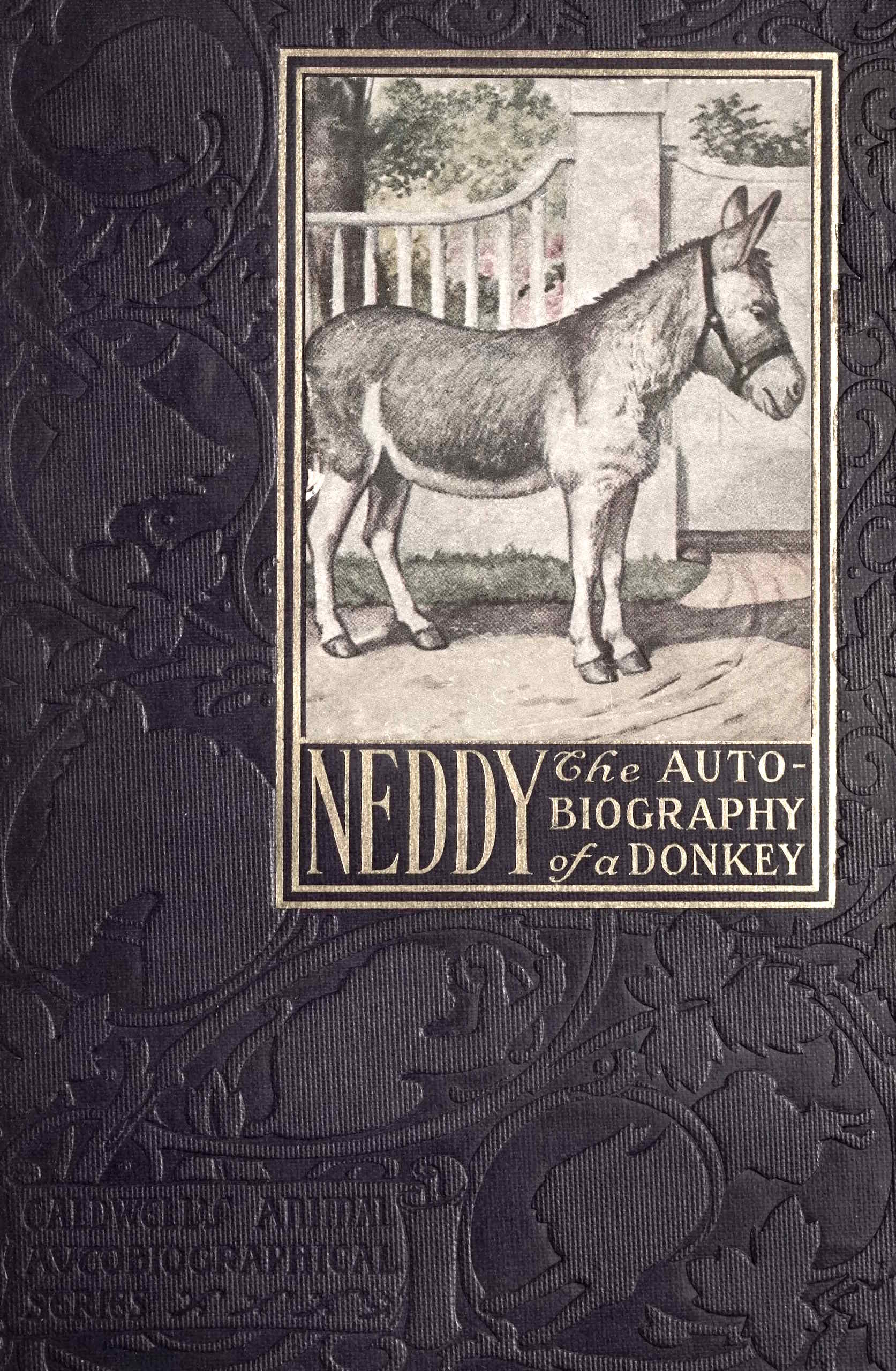
Title: Neddy
The autobiography of a donkey
Author: Charles Welsh
Illustrator: L. J. Bridgman
Release date: April 18, 2026 [eBook #78484]
Language: English
Original publication: Boston: H.M. Caldwell Co, 1905
Other information and formats: www.gutenberg.org/ebooks/78484
Credits: Bob Taylor, Charlene Taylor and the Online Distributed Proofreading Team at https://www.pgdp.net (This file was produced from images generously made available by The Internet Archive)
The Autobiography of a Donkey
Copyright, 1905
By H. M. Caldwell Co.
COLONIAL PRESS
Electrotyped and Printed by C. H. Simonds & Co.
Boston, U.S.A.

The leading incident of this autobiography of a donkey actually occurred, and the scene at the police station was described by the Times newspaper in London at the time of the trial. Two others are taken from a French source.
| CHAPTER | PAGE | |
| I. | Neddy’s Earliest Recollections | 11 |
| II. | Neddy’s First Lesson | 33 |
| III. | Neddy Runs Away | 49 |
| IV. | Neddy’s Trick, and What Came of It | 63 |
| V. | Neddy at the Fair | 83 |
| VI. | Neddy Changes Masters | 95 |
| VII. | Neddy Travels | 117 |
| VIII. | Neddy Gets Home Again | 151 |
| PAGE | |
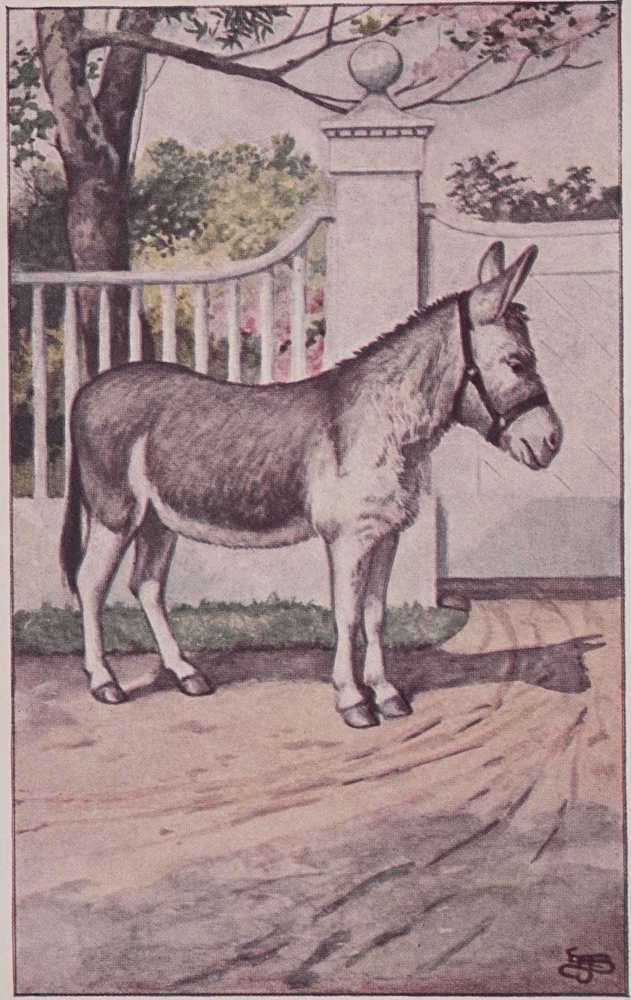
| Neddy | Frontispiece |
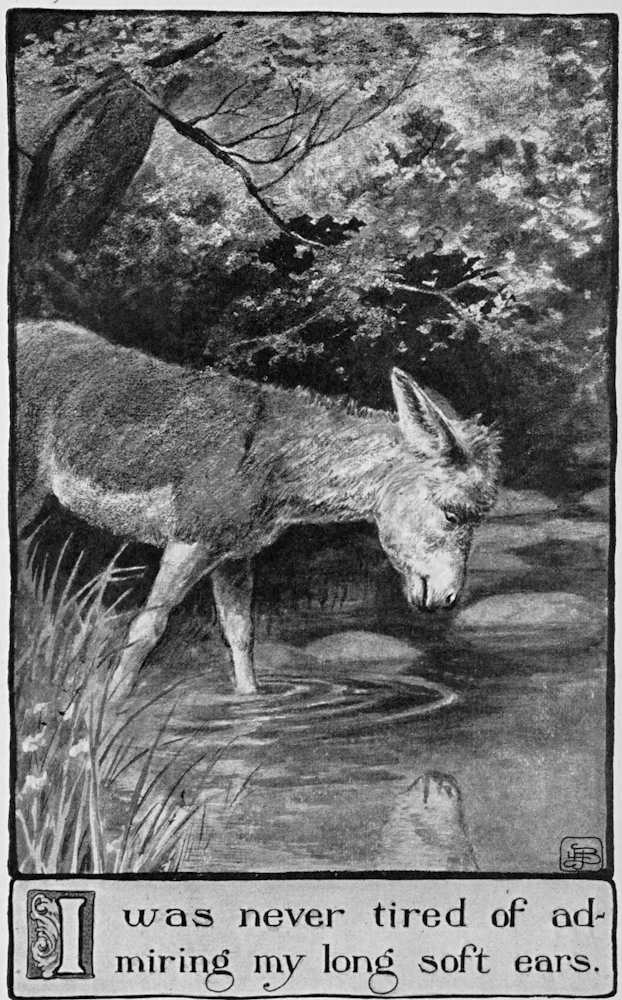
| “I was never tired of admiring my long soft ears” | 39 |
| “She jumped up quickly with a little scream” | 59 |
| “At length my adversary, losing his balance, flew over my head” | 102 |
| “I was let out by the hour” | 126 |
| “I went right up to my mistress” | 143 |
[Pg 11]
CHAPTER I.
MY EARLIEST RECOLLECTIONS—I FIND MY MOTHER RATHER A DULL COMPANION—I MAKE FRIENDS WITH OLD THOMAS—THE RETURN OF MY MASTER’S FAMILY—MY FIRST INTERVIEW WITH MY DEAR MISTRESS—ANNIE AND I BECOME GREAT FRIENDS.
This is the Story of a Donkey written by himself! It is not the first time that such an indiscretion has been committed, and doubtless it will not be the last. And, indeed, if I did not think I had something pleasant to tell, I would not trespass upon your patience; but now, as in my old age I quietly graze through the summer days in my pleasant green field, or keep myself [Pg 14]warm in my comfortable winter shed, I often think over my past career; and it seems to me to have been so full of strange events that I am induced to jot down some of its most stirring incidents, in the hope that, while my faults may be a warning to some, the good resulting from an earnest desire to do my duty may be a comfort and encouragement to all.
My first recollection is of lying quietly down by my mother’s side on the soft green grass of a large field. Very pleasant it looked to me, as I lay there under the shadow of a great oak-tree, and looked out upon the sunshiny landscape; and I thought I should never be tired of being there quite still, and admiring all the wonderfully beautiful objects which met my eyes whichever way they turned.
But as soon as I began to grow a little stronger, this state of inaction became tiresome. My curiosity was aroused to see what there might be beyond my own little world; and many a frisk I took away from my mother’s side, to peep over a hedge into another [Pg 15]field, and amuse myself by looking at some animals very different from ourselves, which my mother said were cows; but I did not admire their shape so much as I did our own; and, as to their horns, I did not think them half so pretty as our ears. Then, when I had looked at the cows till I was tired, off I would gambol to where an iron fence separated our field from a long sloping lawn, bright with beds of many-coloured flowers. Every day I seemed to spy out something more beautiful than before; and I would gallop back to my mother, and ask her to come and look too, and tell me what was the name of this or that wonderful new thing.
But my mother was not of so adventurous a spirit; or perhaps she was getting old, and did not like to be troubled with my endless questions. She was very ready to tell me what little she knew; but she was not the least desirous of increasing her own stock of knowledge.
“Ah, my son!” she would say sometimes, as she gave her ears a melancholy shake, [Pg 16]“I foresee there is a great deal of unhappiness in store for you. Why must you always be spying into that which does not concern you? Why are you not content to stay quietly by your mother’s side? When you are my age you will know the wisdom of just simply enjoying your tuft of grass, or drink of water, without troubling your head as to what the rest of the world are doing.”
“Very likely,” I replied, with a kick of disdain, for I was a pert young donkey from my earliest years; “but as I am not so old as you are by a long way, you need not expect that I should consider munching grass from morning to night is the perfection of happiness. I want to know what life is, and what goes on beyond this field. I declare I get sick to death of hearing you munch, munch, munch, as if you had not a thought beyond your nose.”
“Ah, my son!” said my mother, sadly, “you will know what life is soon enough, never fear, and what work is, and poor fare, and hard blows; and then, when your back [Pg 17]aches, and your sides are sore, you will remember your mother’s words, and think that, if you could but get back again into this pleasant field, you would trouble yourself very little with what is going on in the outer world.”
For a moment I was silent. Work, poor fare, and hard blows were not pleasant-sounding words. I had never heard them before, and began to wonder what they meant; but my mind was suddenly distracted by a sound behind the hedge; off I scampered to see what it might be, and, by the time I came back to my mother’s side, I had forgotten the expressions that had alarmed me, and was as full of tricks and gambols as I had been before.
But though my mother was not fond of conversation, I gathered, from words which she would occasionally let fall, sufficient to make me understand that we belonged to a gentleman of good property; that my mother’s business was to draw his wife in a little carriage, she being in delicate health; and when I asked why I had never seen [Pg 18]her doing this, she told me the family had all been away for some time, but that she should be glad when they came home again, for they were all very kind to her, and often brought her some nice things, such as a carrot, or some cabbage leaves, or occasionally even a small feed of grain.
The idea of these dainties made my mouth water, and I began to be as impatient as my mother for the return of my master’s family, hoping that I, too, might come in for a share in her good fortune. So anxious was I to know when they were coming that at length my incessant teasing became unbearable to my mother, and she angrily told me “to go and ask that old man on the lawn there, for he was the only person the least likely to be able to gratify my curiosity.”
It was very easy to say, “Ask,” but how was I to make him understand what I wanted to know? Not but that we were very good friends. I had made his acquaintance some time ago, during one of my visits to the iron fence which shut me out from my favourite flower-garden. At [Pg 19]first, when he had come near me, I was much frightened, and scampered away as hard as I could; but he called out so pleasantly, “Wo—so ho, little Neddy!” that, though I did not know that was my name, I was sure he meant me, and so I summoned up courage to turn around and look him in the face. And a very kind face it was; and he held out his hand so coaxingly that I was induced to come a few steps forward; but then my heart misgave me, and I took two bounds back.
“Whoo! little Neddy—whoo!” said the kind voice again. “Sure Thomas will not hurt you. Come, my little man; come and be scratched.”
Such an invitation was irresistible. Again I turned, walking a few steps toward my new acquaintance; then I stopped.
“Come! come!” said the voice again; and I made a few steps more in advance. Again I heard myself encouraged; and now I had approached near enough, by stretching out my neck, to smell whether there was any mischief in the hand that was [Pg 20]stretched out toward me. No; all seemed safe; and the hand was held steady till I had been able to sniff all around it, and satisfy myself that no harm was intended me. Then the hand was gently raised to my head, and the pleasantest sensation I had ever felt in my life passed through my whole body. Oh, how soothing, how delightful was that rubbing and scratching! and I browsed against my new friend, and looked up in his face, as much as to say: “Oh, do it again! please, do it again!”
“What! you like it, little Neddy; you like it, do you?” said the kind voice. “Ah! I thought we should soon be friends.”
Friends I should think we were. From that day forth I was always on the lookout for Old Thomas; and no sooner did I see him come on to the lawn than I would gallop up to the iron fence, kick up my heels, and bray out my welcome in my loudest voice—though, by the way, I soon began to perceive that this was not the most pleasing style of address to my friend.
“There, Neddy, there,” he would say; [Pg 21]“that is quite enough of that noise. Be quiet; do.”
At first, I must confess, my vanity was much hurt; I felt inclined to turn my back and take no further notice of my friend; but I was soon sensible that I should be the loser by such folly; and so, wisely endeavouring to alter my mode of salutation, I rubbed my nose against the iron fence, and made the softest and most whinnying tones of which my voice was capable. It had the desired effect. Old Thomas evidently saw that I had got the better of my little tempers, and was trying my best to be pleasant; and so he would put down his rake or his hoe, or leave the flowers he was tying up, and bring me a few carrots, or an apple or two, or something equally good; and, as he was feeding me, he would say, kindly:
“Ah, little Neddy, you are a good-hearted little beast! full of spirits, but not a bit of vice about you; and you will be a rare beauty one of these days, that you will. How my young missus will admire you!”
[Pg 22]
And then I would rub myself against his hand, and look up in his face, as much as to say:
“Who is young missus? Tell me.”
And so, by degrees, as I say, we had grown quite intimate, and I could understand almost everything Thomas said to me; but I was grieved to find he did not comprehend my meaning so easily; so that it was very difficult to get an answer to what I wished to ask him. Sometimes he would say:
“Why, Neddy, you have got such intelligent eyes, you look almost as if you could speak. I wonder what you have got to say to me. Is it more carrots you want, eh, Neddy?” and he would hold out a carrot so close to my mouth that, though that was not what I wanted at all, for the life of me, I could not resist the temptation of eating it; and so Thomas misunderstood my meaning, and went away, thinking, perhaps, what a greedy little donkey I was, while all the time I was only seeking for instruction and information. Ah, well! I have [Pg 23]listened since then to what many a man has said of his neighbour or his friend, and I have come to the conclusion it is not only donkeys whose earnest longings after truth must remain ungratified, and whose best actions are liable to be misinterpreted. If man cannot understand his fellow men, no wonder he knows very little of what we are thinking.
On that day when my mother was angry with me for teasing her, and told me to be off and ask Old Thomas, I felt piqued and angry.
“Who knows,” thought I, “perhaps I can make him tell me, and then there will be a triumph, for mother only sends me to him because she is cross, and because she thinks I shall never be able to find out.” So, putting on my most pleasing manners,—for we can all seem to be very good-humoured when we have got any end to gain by it, however cross we feel inside all the while,—I galloped up to the iron fence, and began whinnying in my most engaging tones. It was not long before I attracted [Pg 24]the notice of Thomas, who, looking up from his work, said, in his usual kind tone:
“Ah, little Neddy, you are come, are you? I have nothing for you to-day.”
Now, though I quite understood this disappointing announcement, I was not one bit more inclined to go away. I had come for a particular purpose, and I was determined to accomplish it, if possible. Our race have the character of being obstinate; and, though I like to dignify it by the name of perseverance, I suppose I am no better than the rest of my species. Anyway, I began a series of gambols, such as generally succeeded in bringing Old Thomas to my side; but in vain. I kicked my best kicks, gambolled around in circles, pricked up my ears, and even tried a short, very short, bray. It was all to no purpose. Thomas went steadily on with his work, paying no attention to all my tricks. At length, sick of an exhibition which attracted no admirers, I was on the point of returning to my mother’s side, very much out of humour, when suddenly I saw Thomas leave off work for [Pg 25]an instant, and, resting on his spade, he looked toward me. This was encouragement enough; and again drawing near the fence, I began rubbing my nose against it more wistfully than before.
“Poor little Neddy!” he said, as he walked slowly up to me; “you will soon have a better playfellow than I am.”
I pricked up my ears at these words. “Ah!” thought I, “now it is coming.”
“You see I have no time to waste with you to-day, Neddy,” continued Thomas. “I have got to get the place to rights. The master’s coming home. Can you understand that, Neddy?”
Understand it? Of course I could; and I rubbed my head against Thomas’s hand to ask him to go on.
“And when he comes, he must not see so much as a leaf out of its place,” said Thomas. “No bits of carrots left by the fence, my little donkey. But it is not long you will be left without a bite of summat, I guess. When Miss Annie sees you, I am very much mistaken if she does not give [Pg 26]you more than ever Old Thomas did. You will forget your old friend then, maybe, Neddy.”
Now somehow, though his voice sounded sorrowful as he said these words, I was so overjoyed at having made the discovery that the family were returning that I paid no heed to Thomas’s grief. My only thought was to get back to my mother, and tell her the news as fast as possible. So, breaking from the kind hand that was stroking me, I turned hastily away.
“Ah, it is just like ’em all!” I heard Old Thomas say. “Men and beasts, they be much alike; they will come fast enough if they think you have got anything for them; and then, when they have got all they can, off they go like a shot, without so much as a ‘Thank ye.’”
I hardly noticed the words then. I was very young, very conceited, and much spoiled; but I have often thought of them since, when I have known what it was to have my own heart well-nigh broken by the unkindness of others. Ah me! it is all very [Pg 27]well for old folks to preach. The young ones will never pay a whit more heed to anything we may say than we did to our fathers. Every one must buy his experience for himself. Happy he who pays least dearly for it!
A day or two after my last conversation with Thomas, as I was frisking about the field, feeling in more than usually high spirits, I suddenly heard a voice exclaim:
“Oh, look, look, papa! Did you ever see such a little darling?”
My natural self-sufficiency leading me instantly to suppose that this term could apply to no other than myself, I turned immediately in the direction of the speaker, and for a moment stood astonished as I saw a beautiful little girl running toward me. Whether it was that she came so fast toward me, or whether it was that she was so unlike Thomas, or anything I had ever seen before, I cannot say; but a panic seized me, and without waiting to give a second look, I galloped off, and never stopped till I found myself safely by the side of my [Pg 28]mother. Then I took courage to look up, and saw that my pursuer had also given up the chase.
Finding this was the case, and emboldened also by seeing that my mother showed no sign of alarm, I peeped out again, and then went a few steps in advance.
“Gently, Annie, gently, my love,” I heard the elder person say. “Do not frighten the little thing. Let us find it something to eat; it will come then.”
“Oh, yes, papa! Thomas says it comes up every day to be fed. I will run and fetch some carrots; may I?”
Permission being given, off ran the little girl, and by the time she returned, I had sufficiently mastered my emotion to approach with a tolerable degree of self-possession. Still, it was not without considerable alarm that I saw Annie come inside the fence, and walk up to where I was standing; and I confess I should have been glad to have had a protection between us. I dare say you think this was very silly; and so it was. But can you never remember, kind [Pg 29]reader, the time when your faults or your follies made you wish to keep the fence between your best friend and yourself? However, this was the last time I ever committed such a mistake with Annie.
From that day forward we became the best of friends. I never was so happy as when I was with her, and few days passed without two or three visits from her. Sometimes she would coax me back with her to the house, and even take me with her into one of the sitting-rooms.
But I did not like those visits, and always escaped from them when I could. It was quite contrary to my nature to behave with the degree of quiet propriety which was necessary in society. My mistress schooled and taught me to the best of her ability, and I did what I could to follow her instructions; but I am afraid I was not at all an apt scholar. I never felt at my ease in a room fitted up with all sorts of strange, queer-looking things, of which I did not understand the use, and which I always dreaded I should knock down and destroy, and so [Pg 30]get into disgrace; and I took pains to show her I only came into the house to obey her, and not from any wish of my own. I think she understood me, for she would often say, in her kind, caressing way:
“Oh, Neddy! you like being out in the fields, frisking about, better than coming into the drawing-room. I can see that plainly enough. But, Neddy, you must remember you must learn to behave like a well-bred little donkey; for if you spend all your life frisking about on the grass, you will grow up so ignorant that I shall be quite ashamed of you. And, after all, you are much better off than I am. I sit for hours, and hours, and hours, quite still, learning my lessons, and you—you stupid little thing!—you are tired if you stand still for five minutes together. Ah, Neddy! you have a great deal to learn before your education is finished.”
And so I had, though I did not know it then; and, like a thoughtless little creature as I was, I did not trouble my head about what was to take place in the future,—perfectly [Pg 31]content to go gambolling about in the enjoyment of the happy present.
Those were pleasant times, and my memory likes to go back to them. It is astonishing how fond the old are of recalling the enjoyments of their young days; and perhaps they are a little apt to forget that what is so very pleasant to themselves is rather tedious to others; so I shall keep the remembrance of the first three happy years of my life for my own consolation, and pass rapidly on to the more stirring part of my existence.
CHAPTER II.
MY MISTRESS LEAVES HOME—ON HER RETURN I DO NOT KNOW HER—MY FIRST LESSON, AND WHO WAS THE BEST MASTER.
My master’s family had been away from home for a long, long time,—so long that I had almost given up hope of seeing them again, and was getting very impatient; besides, my life in the field was very dull. My mother had left it some time ago, and I never heard anything of her now. Not that I regretted that very much. She had long since ceased to think about me, and had centred all her affection upon a younger child. Still, as long as she was in the field, she was some sort of companion for me, and I was now growing to an age to be impatient of solitude, and to wish for more stirring occupation than wandering around and around the meadow by myself, and having nothing [Pg 36]to do but to eat and to drink. Occasionally, indeed, I still saw Old Thomas; but our intercourse was not so frequent as it used to be, and, indeed, was of quite a different kind. I no longer felt it consistent with my dignity to frisk and gambol about; and even when kindnesses were offered to me, I could, when I pleased, assume an air of such perfect indifference that I think, if my mistress could have seen me, she would have acknowledged I was rapidly acquiring that manner of society about which she was always instructing me. In fact, my perfect self-possession and entire indifference to the feelings or comforts of any one but myself would not have disgraced the most well-bred exquisite in the land.
Matters were in this state, when one day, as I was standing all alone under the oak-tree, thinking over my own perfections, and how unworthy my position was of my deserts, I suddenly heard a well-remembered voice call: “Neddy! Neddy!” Turning quickly around, I was on the point of going to meet the speaker, when, instead of the [Pg 37]little girl I knew as my mistress, I beheld a tall, elegant-looking lady coming toward me. So, putting on my most dignified air, I stayed quietly under the great tree, lazily moving my ears, as much as to say: “Here am I; if you want me, you must come to me.”
“What, Neddy! do you not remember me? Have you forgotten your mistress? Oh, Neddy, you ungrateful donkey!”
She spoke so kindly, and yet so sorrowfully, that I felt pained to the heart, not only at my stupidity in forgetting her, but at my folly in having tried to play off my grand airs before her. Still, I did not like to acknowledge myself to have been in the wrong; and so, instead of doing what my heart dictated, and galloping instantly to meet her, I contented myself with coming a few steps forward, and then standing perfectly still. I was properly punished for my pride when I heard my mistress say, as she turned to her father, who had just joined her:
“Oh, papa, would you believe it? Neddy [Pg 38]has quite forgotten me. I have always heard donkeys are stupid and incapable of feeling attachment; but I thought Neddy would be an exception. Oh, papa, I am so sorry!”
“Neddy, Neddy,” she added, as she held out her hand, “you do not know how you have grieved me.”
To hear myself so kindly spoken to, when I had deserved such different treatment, completely broke down my obstinate pride, and, trotting up to my mistress as fast as I could, I began to rub my head against her hand, and to whinny out my sorrow for my past misconduct and my promises of amendment for the future,—excuses which my kind mistress was only too ready to receive; in a few minutes our reconciliation was complete, and I felt happier than I had done for months past.
“Poor Neddy!” said my kind mistress, as she continued to caress me; “I ought to have remembered that I am as much changed as you are yourself. Is he not altered, papa? He is not nearly so pretty [Pg 39]as he was when he was little; but he is a very handsome donkey still. Do you not think so, papa?”
Could there be a doubt upon such a subject? Why, the very idea put me into an ill-humour, so completely had I brought myself to believe that I was one of the most beautiful creatures in the world. Often and often had I stood for the hour together in the clear water of the brook which ran at the bottom of the field, and as I saw my image reflected in the water, I was never tired of admiring my long soft ears and the bright brown of my coat. Ah, well! when we live very much alone, we are apt to get very false impressions. It is only by mixing with our fellows that we learn to estimate our merits aright. Pushing through the world rubs off the sharp angles wonderfully.
I was so engrossed with my own thoughts of mortified vanity that I did not hear what passed between Mr. Morton and his daughter, till suddenly my ears caught the sound:
“Thomas shall break him in, my love, [Pg 40]and then you shall drive him in the little chaise.”
“Oh, I shall like that!” replied my mistress. “Can it be done at once, papa?”
“Yes, directly Thomas is at leisure.”
“Then good-bye, Neddy, for to-day,” continued my mistress, as she again patted my forehead; “we shall soon be better acquainted. I wonder whether you will like drawing me in the carriage as well as playing with me in the field. Ah, Neddy! will you be a good little donkey, and trot along as fast as I know you can trot when you like to?”
I rubbed my head against her by way of reply, and then, when she left me, began to muse not overpleasantly on the words she had just spoken. I had no very clear idea, certainly, of what they meant, but they conveyed a sort of shadowy notion to my mind that my days of liberty were over, and that now I was to be put to some such work as I had often seen my mother doing. I used to remonstrate with her then, on allowing herself to be so tamely yoked to the chaise, [Pg 41]drawing it about in all weathers, and tiring herself to death dragging it up steep hills and over stony roads; and when she would gravely shake her head, and say, with a gentle sigh: “It was her destiny; it was better to yield to it with a good heart, and do her duty cheerfully, than to resist and be beaten,” I used to jeer at her for a meek-spirited creature, who had not pluck enough to stand up in her own defence, and tell her when my turn came she would see a very different state of affairs.
“My son,” my mother would reply, “if you think you have come into the world merely to amuse yourself, you make a very great mistake. We have all our allotted tasks. They must be done. Happy those who can find pleasure in doing them! Take my advice. You are placed here to be the servant of those much stronger and wiser than yourself. If you resist their will, you will smart for it with kicks and blows. If you try to do your duty faithfully, you will find it will bring its own reward.”
My mother seldom made so long a speech; [Pg 42]and, finding I paid but little attention, she did not again trouble me with her advice; and, indeed, I soon forgot her words, till they were brought back to my recollection by those of my young mistress, and a very uncomfortable feeling they gave me.
The following day I was busy eating my breakfast, when I saw Thomas come into the field holding something in his hand. My suspicions being aroused, I determined to have a good look at the enemy before allowing his nearer approach. So, with a snort of defiance, I started back, prepared, if necessary, to take to my heels and be off.
“So—whoo—gently, Neddy,” said Thomas. “Koop—koop, Neddy,” added Thomas, putting his arm behind him that I might not see what he carried in his hand.
But this action, instead of disarming my suspicions, only excited them further. If no foul play was intended, what was there to conceal? and so, determined to be on the safe side, with a defiant kick I started off at a gallop, as much as to say, “Catch me who can.”
[Pg 43]
I soon found out that Old Thomas’s feeble legs were no match for my young nimble ones; and, having the advantage, I kept it, and a pretty chase I led my old friend. Now, for a moment, I would stand still and look at him, as if I intended to give myself up his prisoner, and then, in an instant, just as he thought I was within his reach, I would slip from his touch, and be off with a gallop to the other end of the field.
How long this struggle might have continued, it is impossible for me to say. Thomas was evidently losing both his breath and his temper, whilst I was only getting my wind in the enjoyment of the game. But just at this instant who should come into the field but my young mistress?
“What, Thomas!” she exclaimed, “cannot you catch Neddy?”
“Catch him!” repeated Thomas, standing still and wiping the perspiration off his face; “you might as well try to catch the will-o’-the-wisp. He wants a good flogging, that he does, to bring him to order.”
[Pg 44]
“Oh, do not flog him!” said my mistress, in a tone of alarm. “You will spoil his temper if you do, Thomas.”
“Spare the rod and spoil the child,” answered Thomas, in his dry, peculiar way.
“Ah, we know better than that now, Thomas,” replied my mistress, with a smile.
“Just like all you young ones. You always think you know better than your elders,” said Thomas, rather gruffly. “A taste of the whip is a very good thing sometimes; and, to my thinking, it is a pity some folks do not get it a little oftener.”
“The whip is a good executioner, Thomas, but it is a very bad schoolmaster. It is much easier to whip a child into a bad humour than a good one. Of that I am sure, and I think animals are much the same.”
“Sure, Miss Annie, you do not mean to tell me that you think it right that that little beast there should tire me to bits and get no punishment? He knows fast enough that he ought to come, only he won’t; he is sly enough for that.”
[Pg 45]
I felt quite flattered by the compliment, and inwardly rejoiced that I had managed to outwit Old Thomas so skilfully.
“But you forget, Thomas, he cannot tell how much he is tiring you; very likely he is only frightened. If you will promise me not to whip him, I will promise to catch him for you.”
“You catch him?” said Thomas.
“Yes, I am sure I could. Will you promise?”
“A bargain is a bargain, Miss Annie. If you can catch him, he is safe from me.”
Without another word, Annie came toward me.
“Here, Neddy, good Neddy, come here; come to me, Neddy.”
Should I give myself up? I eyed Thomas, and I thought: “No, no; soft words are not enough for me. I will be off while there is time.”
But then I looked at my mistress, and I remembered how kind she had always been to me, and how grieved I had felt when I had pained her, and how I had promised [Pg 46]myself I would never do so again; and so I thought to myself, “Here is the time now to show you are sorry. Give yourself up, Neddy, without more ado;” and I came a few steps on to meet my mistress; but then my heart misgave me, and I stood snorting and uncertain.
“What is it, Neddy? What are you afraid of?” said my mistress, kindly. “No one will hurt you. Come, then.”
“She would not surely promise that,” thought I, “if she could not perform it. She has never deceived me yet in all these years. I can trust her;” and so, summoning up my courage, I walked right up to Annie, and stood rubbing my head against her hand. Nothing could exceed Annie’s delight at this proof of my confidence. She caressed and fondled me, calling me by every kind name she could think of, until at last even Old Thomas seemed somewhat appeased; for he said, in his pleasant old voice:
“To be sure, miss, you have a wonderful way of your own. The poor beast knows [Pg 47]who is his best friend, sure enough. He need not be afraid of me now, though; my word is my word, and you have saved him from a flogging for this once.”
“Suppose you give me the bridle, Thomas; I will put it over his neck, and then you can put the bit in his mouth;” and in another moment I felt some tight thing passing over my forehead, and a hard substance pressing against my teeth, which made me open my mouth, and then, try as I would, I could not get rid of the thing. This was too much for endurance. I was for springing back instantly, indignant at what I thought was a trick to deprive me of my liberty; but it was too late; I was caught in a trap, and a firm hand held me tightly.
“Gently, Neddy, gently,” said my mistress; “you will only hurt yourself by pulling;” and she patted me in such a caressing way that, angry as I was, I could not help listening. “Ah, Neddy! we must all take the bits in our mouths. You do not know, Neddy, what I mean; I only wish you did. But you will soon learn for yourself that [Pg 48]it is much better to obey the rein than to pull away from it.”
And going back a few steps, and then coaxing me to follow her, I found for myself the truth of what she said. It was not pleasant to have that great iron thing in my mouth, of course not; but still, as long as I did not pull against it, it did not actually hurt me; and so, sulky as I was, I could not but acknowledge that the wisest course that remained for me was to obey, and I did my best to understand what Thomas said to me, and to do what I was bid; as usual, my efforts to do right brought their own reward. Thomas was very fairly patient with any little blunders that I made; and as to my mistress, her praise of my conduct knew no bounds; and when my first day’s lesson was over, and I stood by her side, munching carrots and sugar, and feeling her soft hand constantly patting my forehead, I thought, why, if this is learning, it is not so very unpleasant, after all; and I promised myself I would soon make such progress as would astonish my kind teacher.
[Pg 49]
I RUN AWAY—AM FOUND AND TAKEN HOME AGAIN.
But my unruly spirit was by no means tamed. After much thinking over what had happened to me, and much wondering as to what might happen, I made up my mind to run away.
So around and around the fence I wandered, looking for a chance to get through, and at last I came to a low stile. I was overjoyed at the sight, and, making a long run for freedom, took a clear leap over it.
“No more bridles and no more bits for me!” thought I, as soon as I found myself on the other side.
I looked around me, this way and that, wondering in which direction I should go. It did not take me long to decide. Not far off, as it seemed to my inexperienced eyes, [Pg 52]was a large and beautiful forest. So I ran and ran until I was far out of sight and hearing of my home. But the forest was farther off than I expected, and I was thoroughly tired out when I reached it. However, it was as large and as beautiful as I had imagined it to be, and I was soon wandering in its quiet depths, where I found plenty of good juicy grass to eat, and plenty of bright, cool, sparkling water to drink.
After a good night’s rest, I awoke feeling ready for any adventure. “I shall never be found now,” thought I; “no one will ever come to torment me in this quiet refuge, and this shall be my starting-point from which to explore the world.”
My peace of mind was not to last long, however, for just then I heard the deep baying of a big hound, then of another, and presently a whole pack of them were coming toward me in full cry.
Frightened almost to death, and feeling sure the dogs were after me,—such is the effect of a guilty conscience,—I fled as fast as I could to a little brook which I knew [Pg 53]was not far off, for I had learned that if I walked in the water the dogs could not follow my scent.
Soon I heard a voice saying: “Find him, dogs! Fetch him, dogs! Bring him back, dogs!”
But, so long as I remained in the water, I was safe from the dogs, and I began to run along in the brook. I was safe also from the men, because there were high hedges on each side of the brook which hid me from their view.
I ran, and I ran, and I ran, for quite a long time without stopping, until I was entirely out of breath. Presently the barking of the hounds began to grow fainter and fainter. I ceased to hear the voice of the man who was urging them on, and at last all was silence.
Out of breath, as I said, and thoroughly tired, I rested now to eat and drink. I was stiff and cold by this time through being so long in the water, but I did not dare to go far from it, for fear the dogs should pick up the scent and be after me again. But [Pg 54]presently I regained my courage, got on to dry land, and trotted along by the side of the brook until at last I was out of the forest, and into a meadow where a large number of cattle were feeding. There I lay down in the sun in a corner, all by myself, and rested for a long while in ease and comfort.
Just as the evening shadows began to fall, two men came into the meadow, and one of them said to the other: “We had better take the cattle in to-night. They say that a wolf has escaped from the circus and is running wild in the wood.”
“Nonsense!” said the other. “Who told you that fairy tale?”
“Well, I heard that the young donkey belonging to Old Thomas has been taken away and eaten by a wolf in the forest.”
“Bah! don’t you believe it! I expect that the little fool has run away.”
“They say the wolf is out, anyway, and we had better call the cattle home.”
“Just as you say,” said the other; “it’s all the same to me.”
[Pg 55]
I lay still in my corner. Fortunately the grass was long enough to hide me, and as the cattle were not on my side of the field, the men drove them out of it to the farm where their masters lived, without seeing me.
Now I knew there was no wolf in the forest, because the donkey of whom they spoke was myself, and I had not seen a sign of a wolf anywhere. So I settled down to sleep as soon as the darkness came, and in the morning the cattle came back to the meadow with the two men who drove them home the night before, accompanied by two large dogs.
They belonged to the same pack of hounds from which I had had so narrow an escape the day before, and as soon as they caught sight or scent of me, they ran madly barking in my direction. Now I was in real trouble. What should I do? How could I possibly escape them this time?
Away to the edge of the meadow I flew like lightning; over the hedge I jumped [Pg 56]like a mad donkey, and once more I found my friendly brook.
Soon I heard the voices of the men I had seen yesterday. They looked after me as I was trotting in the brook, and one of them said:
“Call off the dogs; that is not our donkey.”
“Whose is it, then, I wonder,” said the other.
“That must be the donkey the wolf did not eat,” was the reply.
“Well, as we have found our own, we need not trouble about this one.”
And so the dogs were called off. After all, you see, it was not me the dogs were after, but another donkey who had run away. How true it is, as I have heard it said, that,—
Now I went on my way unafraid, and walked and grazed, and walked and grazed until I came to another forest. How many [Pg 57]miles I had gone I could not tell, but I was free,—free from bit and bridle and dogs and men, and that was all I cared for just then.
I did not think of the kind, good friends I had left behind. I did not think of their anxiety as to what had become of me. I thought of nothing but that I was free.
But it began to grow cold as night came on, and I began to wonder where I should find shelter till the morning. I trotted on right through the wood, until I came out on the other side, and saw a village ahead of me.
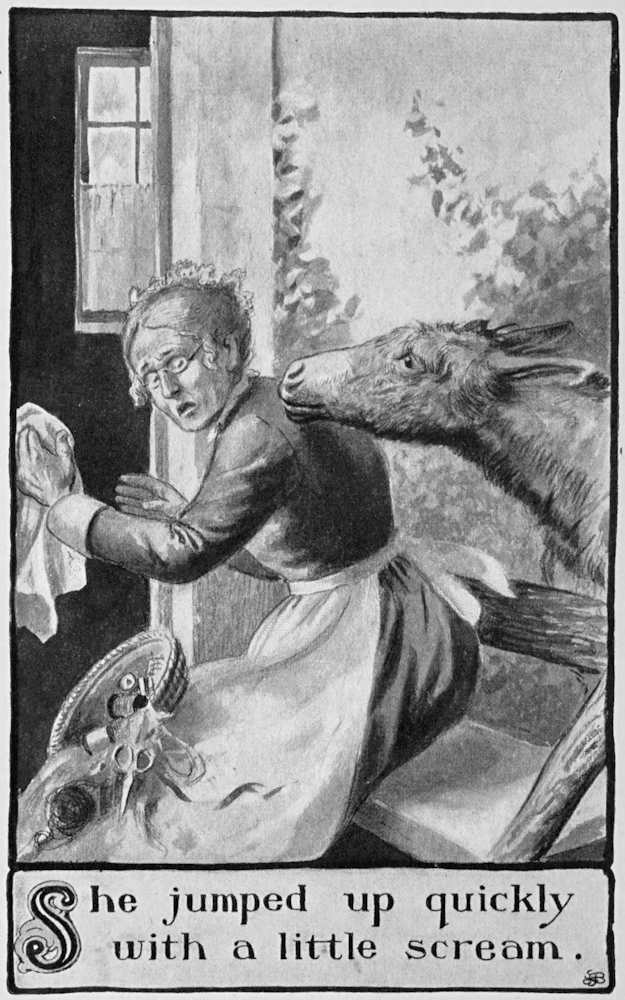
Just outside of the village was a pretty little cottage in a garden all by itself. It was very clean, and very neat and tidy. At the door sat an old woman busy with her needle. What put it into my head to do it I do not know, but I trotted up to her and put my head on her shoulder.
She jumped up quickly with a little scream. But I did not stir, and she began to pat my neck, and stroke my ears, until I was sure I had found a friend.
[Pg 58]
“I’m sure you’re a well-bred donkey,” she said, presently. “I wonder where you came from, and to whom you belong. If I can’t find your owner, I shall keep you myself, for I’m sure I can make you useful. But I think you must have a master somewhere.”
I shuddered at the words “make you useful,” for I had an idea that that must mean bit and bridle again. But when I heard the word “master,” I could not help regretting the home I had left,—Old Thomas and Miss Annie, and my mother and all her lessons, which I had so badly learned.
However, I was determined to keep the liberty I had earned, and when a bright-looking little boy of about six or seven years of age came out of the door to ask his grandmother to whom she was talking, I at once made up my mind that we could be friends.
“Why, granny, where did that donkey come from? May I stroke him?” said he.
“Of course, my boy, but he is a stranger to me,—a lost donkey, I think,—so take care he does not bite you.”
[Pg 59]
Georgie, for that was his name, tiptoed to reach me. I did not stir, so as not to frighten him, but I liked the little lad so well that I could not help turning my head and licking his hand.
“Oh, what a dear donkey!” said Georgie. “Look, granny, he is licking my hand.”
“I wonder how he came here all by himself,” said the old lady. “Run into the village, Georgie, and inquire if any one has lost a donkey. I am sure any one to whom he belongs must be very anxious about him.”
Off went Georgie, and off I went after him. When he saw me coming, he said: “Oh, dear, I must not lose him,” and he set off at a run back to the house. Soon he came with a piece of cord, which he put around my neck, and we started again for the village.
First Georgie went to the village inn. But the innkeeper had not heard of a lost donkey. Then he went from place to place where he thought a donkey might have been living, but nobody was missing a donkey in that village.
[Pg 60]
At last, however, the village policeman came along.
“Hello, Georgie; where did you get that donkey?” cried he.
“He came up to our door this afternoon, and I am trying to find his owner,” said the brave little fellow.
“This must be the donkey from the Hall,” said the policeman. “I will put him in the pound until I can send for Old Thomas.”
“Oh, don’t lock him up,” said Georgie. “Let me keep him and feed him for one night, until his master comes and fetches him.”
The policeman was a kind-hearted man. He knew the donkey was safe with Georgie and his grandmother. He knew, too, that she had a warm and safe stable for the donkey, and so Georgie and I trotted back to his home, where I had a comfortable night.
And now I began to think seriously of what had been happening in the home I had left, since I had been so foolish as to run [Pg 61]away. I did not learn until afterward how much distress I had caused everybody there, or how much trouble I had given to those who had my best welfare at heart. When I did so, I felt remorse and sorrow enough, I assure you.
Well, to make a long story short, the next morning Old Thomas came and fetched me away. He did not say much, and I was not sure if he were glad or sorry to have me back again. But there was no mistaking the delighted welcome which my young mistress gave me, and I made anew the vows of good behaviour of which I told you at the end of the last chapter.
I LEARN TO DRAW MY MISTRESS’S CARRIAGE—I SEE THE WORLD, AND LISTEN TO EVIL COUNSEL—A TRICK, AND WHAT CAME OF IT—AFTER ALL, HONESTY IS THE BEST POLICY.
It would be tedious to trace the progress of my education. Suffice it to say that at last I was pronounced to be so well broken in that it was thought safe to trust me to draw my young mistress in a pretty little carriage that had been made expressly for me. At first I did not like my new occupation at all. It was very provoking to be led out of my pleasant field, when perhaps I had not half finished my morning’s meal, or was deep in conversation with some of my neighbours in the adjoining meadow, or was luxuriously rolling on the soft grass. To be taken away from these enjoyments to drag a carriage over hot, stony roads, and [Pg 66]to stand stock-still doing nothing for the hour together, while my mistress was paying her visits,—all this seemed to me very dull and tedious; but gradually I became more reconciled to my lot.
If it had its disadvantages, it had its pleasures likewise. I saw something of the world; I had the opportunity of conversing with many of my own species, and of seeing how much happier my life was than that of many others; and though, I confess, to my shame, I was apt to forget this, and to give way to my temper, and show obstinacy when things did not go quite as I liked, grumbling and thinking myself a very ill-used being, I believe that, on the whole, I learned wisdom by experience, and gave my dear mistress as little trouble as could be expected.
Occasionally, indeed, I sorely tried her patience. One instance I well remember. It had chanced that I had been required to take my mistress to a house which I had a particular objection to visiting. It was not only that the road that led to it was hilly [Pg 67]and stony, but it was a place where I never received the slightest civility. No hay or water was ever offered me, no shed where I might stand at my ease out of the hot, broiling sunshine; but I was hitched up tight to a post, and expected to stand there for an hour at a time, while a yelping cur would bark at my heels, and the village children, peeping at me from over the fence, would make fun of my helpless condition. All this was very hurtful to my vanity; and, having in vain tried to show my mistress, by my obstinate manner, that I did not approve of being taken to Barstead, I determined one day, when, as usual, I was hitched up to the post, to relieve myself from the hated bondage, hoping, by constant pulling, to be able to break the reins and run away home, leaving my mistress to follow as best she might.
But it was in vain for me to pull and tug; the reins were stronger than I. I was only fretting myself into a fever, and making myself more and more uncomfortable. Thoroughly out of humour, I was venting [Pg 68]my anger in a series of impatient snorts, when suddenly I heard a short, sneering neigh close to my side; and, looking up, I saw a little rough pony standing quite close to me, evidently enjoying my distress.
“Why, my good friend,” said he, “what is the matter? You seem very unhappy. Can I be of any assistance?”
The patronizing tone in which he spoke completely disconcerted me, for I do not know anything more provoking than to expose your own helplessness and incapacity to any one superior to yourself in intellect and station; so, putting on a dogged air of composure, I declined his kind offer of assistance, telling him I was only trying to shift my bridle a bit, and that I had done it now for myself.
The mocking neigh which was his only answer showed me in a moment that my falsehood was discovered, and that I had only lowered myself still further in the opinion of my new acquaintance.
“My good fellow,” he said, “you do not suppose I have worn a bridle all these years [Pg 69]to learn that you are not going the right way to ease the bit. Better tell me the truth. I am older than you, and, if I am not much mistaken, I have seen a good deal more of life than you have. Come, what is the matter? Out with it, and I will help you if I can.”
There was something in his cheery, good-natured manner that conquered my pride, and, in spite of myself, I soon found that I was talking to him as if he had been an old friend, and telling him my grievances as openly as if he had been my brother.
“And now,” said I in conclusion, “what would you advise me to do?”
“To do?” he said; “why, the next time your mistress brings you to Barstead, lame yourself.”
“Lame myself?” exclaimed I; “why, the remedy would be worse than the disease.”
“You little innocent!” said my friend, with his sneering laugh; “you made no scruple in telling a lie just now; why should you find it more difficult to act one?”
[Pg 70]
Involuntarily my ears wagged with horror as I caught a glimpse of his meaning. I had been tempted into a hasty falsehood in support of my dignity. That was bad enough; but deliberately to enact a lie to deceive my kind mistress appeared to me the height of ingratitude and baseness. Alas! I did not remember how easily one fault leads to another.
“You asked my advice, and I have given it to you,” said the pony. “If you are afraid to follow it out, why, you must submit to be tied to a post for the remainder of your life, and that is the proper place for cowards. It is only those who have the pluck to dare and to do who make their way in this world.”
“I am not afraid,” said I, rather faintly. “It is not that.”
“Well, then, what is it?”
Coward that I was! I did not dare to tell him that I feared to do wrong, and vex my kind mistress; so I only grumbled out something about the difficulty of deceiving her.
[Pg 71]
“That is, of course, a point you must decide for yourself,” replied the pony; “only you must be a great bungler if you cannot manage to deceive a woman. In our relations with mankind, either they or we must be the masters, and the strongest will generally carries the day. If force will not do, try craft; but if you are beaten at both points, why, then, good-bye to your independence for all time, and make up your mind at once to sink into a mere despised beast of burden for the rest of your life.”
What further valuable advice my new acquaintance might have given me, it is impossible for me to say; for at this moment, my mistress coming out of the house, the servant came and untied my reins, and I was led away from my place of captivity, having only time to cast a farewell glance at my friend, and to catch the wicked twinkle of the bright eyes which glanced from under his shaggy eyebrows.
All the way home I thought over his words; indeed, so lost was I at times in the reflection that I was unpleasantly aroused [Pg 72]by the sharp cut of the whip across my shoulders, and the sound of my mistress’s voice reproving me very severely.
“Ah, Neddy!” she said, as, having at length reached home, she got out of the carriage and came and stood by my side, without giving me so much as one pat; “you have gone very badly indeed to-day, and you will not have a single carrot, nor a bit of bread, nor a taste of sugar,—no, not one bit. Go away, Neddy,—naughty Neddy!”
So that was my first experience of the fruits of evil counsel. But, alas! my heart was hardened by the words of the tempter; and instead of repenting of my fault, my mistress’s displeasure only made me more obstinate, and more inclined to try and have my own way, and to persuade myself that it was she who was unkind and unjust, and that if she required me to do that which was disagreeable to me, why, of course, I, on my part, was quite justified in avoiding it if possible.
The more I brooded over my imaginary [Pg 73]wrongs, the more ill-used I considered myself to be, and the more was I inclined to follow the advice of my tempter. As is always the case, by constantly dwelling on the fault which I longed to commit, it gradually appeared to me to become less and less sinful. I found such endless excuses to justify my conduct to my own mind that at length I ceased to feel any compunction whatever on the subject, and only awaited a favourable opportunity for putting my intended deception into practice.
It was not long in offering itself. One beautiful bright morning, about ten days after my last visit to Barstead, I was, as usual, drawing my mistress’s carriage, when she turned me up the lane which led, I knew, to the hateful place. “Ah! ah!” thought I, “I know where you are going to now, and we’ll see who carries out their purpose, you or I.” So I cunningly watched my opportunity, and began to tread a little—just a very little—lame, stumbling occasionally as I trotted along.
“What can be the matter with Neddy?” [Pg 74]I heard my mistress say to her companion. “Do you not think, Emily, he goes lame?”
“Ah!” thought I; “you see it, do you?” and I went lamer than before.
“Yes, certainly,” replied Emily; “he is quite lame.”
“Perhaps he has a stone in his shoe,” said my mistress. “Hold the reins, Emily, for a moment, if you please. I will get out and look.”
“Dear me!” thought I; “now she will discover the cheat;” and I trembled all over.
“Poor Neddy! poor Neddy!” said my mistress, patting me. “He trembles so, he must be hurt.”
Would you believe it? Her kindness, instead of softening my heart, and making me see my fault, only hardened me the more. I began to despise her for being such an easy dupe. This feeling gave me the courage to stand quite still, whilst my mistress lifted up first one foot and then another.
“There is no stone in any one of his feet,” exclaimed my mistress, in a perplexed tone, as she stood by my side, “and there doesn’t [Pg 75]seem to be a sign of any stone having hurt him anywhere.”
“Perhaps it was only the ground over which we have just come that made him go lame,” suggested Emily. “I noticed it was very stony.”
“Well, it may be that,” replied my mistress; “we will go on, and try a little way farther.”
And, getting into the carriage, she touched me very lightly with the whip, saying:
“Now, Neddy dear, go on.”
And very, very slowly I went, limping more, and more, and more at every step I took.
“Oh, Emily, I cannot bear this,” I heard my kind mistress say, in a tone of the sincerest pity. “It makes me quite miserable to see the pain the poor creature is in. We must give up our drive for to-day, and go home;” and, checking me as she spoke, she turned me around toward home.
Oh, how my heart beat with joy to think of my successful cheat! “Ah! ah!” thought [Pg 76]I; “it is all very well for you to hold the reins, but I can teach you the way to go. I am master now for all time coming; and I flatter myself you will never take Neddy again where he does not wish to go.”
But my joy was destined to be of short duration. In my conceited delight at having so successfully duped my mistress, I quite forgot that, to make my trick successful, it was necessary that the deception should be carried on to the end; and no sooner was I aware that I was going home than I trotted off as brisk as could be.
A hearty laugh from my mistress and her friend awoke me from my dream of security. I started as I heard the words, “Would you have believed that he could have feigned so skilfully?” and in another moment I felt myself turned back on the road to Barstead, whilst the most hearty whipping I had ever received from my mistress fell on my devoted shoulders.
It was in vain for me to go lame now. I limped till I almost fell to the ground; my mistress only flogged the harder, until, [Pg 77]at length, in despair, I gave up the struggle; and, although in a thoroughly sulky and obstinate humour, I consented to draw the carriage up to Barstead.
Ah! who may tell what bitter thoughts were mine, as I stood waiting for my mistress, tied, as usual, to that horrid post! It was not only the whipping I had received,—that was bad enough, and my shoulders ached again with the cuts,—but to have been discovered in my cheat, this was what galled me to the quick, and for the moment I forgot the fault in the shame of the discovery. In my rage I looked eagerly around, hoping I might see my tempter, and ease my own misery by venting my ill-humour on him who had given me the evil counsel. I had better have looked nearer home, and seen who was the real author of all my wretchedness.
But my fault was destined to meet with a still sharper punishment. Not very long after this excursion to Barstead, my mistress was driving me over a road which had just been repaired, and one of the little flints [Pg 78]happened to fix itself just under my shoe, and on the softest point of my hoof. Oh, the pain I felt! I shuddered all over; I could hardly put my foot to the ground, and limped along in the greatest agony.
“No, no,” said my mistress, whipping me sharply; “no more of this nonsense! Come, make haste and go on.”
Alas and alas for the lie which I had acted! How well I remembered how kindly my mistress had pitied me before! how soothingly she had caressed me! and how I had laughed at her for her pains! Ah! now, instead of whipping me on, increasing my wretchedness every moment, she would, but for my own fault, have seen to me as before, and in a moment my tormentor would have been removed. The knowledge that I had brought it all upon myself did not tend to mitigate the pain; and, though I tried to limp on as fast as possible, I nearly fainted with the agony I was enduring.
At length my evident discomfort moved the compassion of my kind-hearted mistress.
[Pg 79]
“I do really think Neddy has got a stone in his foot to-day,” she said; “at any rate, I will look before I go on any farther.”
Who may tell how grateful I was for a kindness so much greater than I deserved? and, as she got out of the chaise, I held up my foot that she might know at once where the stone was, and see that this time at least I was not deceiving her.
“Poor Neddy! poor fellow!” exclaimed my mistress, as she carefully drew out the stone; “I do not wonder you limped; it must have hurt you dreadfully. But see, Neddy, what it is to deceive; no one believes you when you really are hurt. Cunning people outwit themselves. I wish I could make you understand me. I am very sorry for you poor, poor Neddy!”
Her kindness softened my heart. Not all the pain and the punishment could have made me repent so deeply as did my mistress’s kind words. Oh, how I wished I could make her know all that was passing in my mind! and I rubbed my head against her, and looked up in her face, hoping she [Pg 80]would see how truly I thanked her. For the moment my feelings toward my mistress had made me forget my own sufferings; but no sooner did I put my foot to the ground than I was recalled to a recollection of my late agony. It was in vain to attempt to trot. The slowest hobble gave me such pain that I was obliged to stand quite still to recover my breath. My dear mistress seemed sincerely sorry. She turned toward home immediately, driving me back as slowly and gently as possible. On my arrival at home, warm fomentations were instantly applied; but there was so much inflammation that it was days before I could hobble about even in my field and on the soft green grass, and not for weeks did I entirely get over the effects of the accident.
During this illness of mine, I had plenty of time for reflection, and for seeing not only how foolish, but how wrong, my conduct had been, and what ill results it had brought on me.
“Ah, Neddy!” said my mistress one day, when, as usual, she had been tenderly [Pg 81]inquiring after my wounded foot, “I hope this will be a lesson to you for life.”
“How can you be so absurd, Annie, as to talk in this way to a donkey?” said my mistress’s companion.
“Neddy understands me: I am sure he does,” was the reply. “Look how sensibly he looks up in my face. He can do almost everything but speak.”
And though, perhaps, I did not understand everything she said just in the sense which you would apply to it, kind reader, I took in quite sufficient to make me deeply regret the past, and determine to try and amend in the future.
AT THE FAIR—A PERFORMING DONKEY.
In my time, fairs in England were very common, and they were held in most of the important country towns twice a year, in the spring and in the fall.
These fairs were unlike anything that boys and girls of to-day have seen. They were held in the main street of the town, and the booths, or stalls, were erected on each side of the street, partly on the sidewalk and partly on the road, leaving only a very narrow space for people to walk about, or for horses and carriages to drive.
This would have been inconvenient, as all the people from the country roundabout flocked into the town at fair time, and it was then more crowded than ever. But, as every one wanted to linger and loiter and [Pg 86]look at the things displayed for sale in the stalls, and to listen to the descriptions of the wonders to be seen inside the shows, menageries, museums, and travelling theatres, this did not matter very much.
You will hear more about fairs as you read farther on in my story, but this seems to me to be a good place to tell you something about them as they were when I was a young and observant donkey.
One of the most curious things about these fairs was that they were very often “hiring fairs,” that is, men and women used to go and stand in rows and wait for the squires or the farmers from roundabout to come and hire them as farm-hands or labourers, or household help or dairymaids, or what not. There they would be,—the men all in a row in their smock-frocks, with their whips in their hands, on one side of the street, and the women, neatly dressed in linsey-woolsey gowns (that was the name of the stuff) on the other.
I think I can hear them now: “Where did you work last year?” one of them would [Pg 87]bawl out. And the rest would shout all at once:
“Down in Yorkshire,” or Lancashire, or Berkshire, as the case might be.
The first speaker would then say: “How much did you get a year?”
Then all the rest would reply in chorus:
And the things there were to see at these fairs! Everything that any one could want, from candy for the babies up to coats and boots for the men, and dresses and gewgaws for the women. Fathers and mothers came with their children. Young men and women with their sweethearts, and all bought what were called “fairings” for each other. Everything bought at the fair was called a “fairing.”
Useful things also were sold,—ploughs and harrows, rakes, spades, and hoes, horses, wagons and wheelbarrows,—in fact, everything [Pg 88]the farmer and the housekeeper might want.
But the greatest thing of all was “the fun of the fair,”—the shows and the museums, the freak exhibitions, and such like. There were bearded ladies, fat women, dwarfs, and giants. Lambs with two heads, and calves with six legs, and performing animals without number.
And this leads me to a story about a performing donkey, which I heard from a four-legged friend of mine on one occasion when I was waiting in the town on a market-day.
My friend’s name was Neddy, the same as my own, and one day he went to a fair where every one was talking about a wonderful performing donkey who was exhibiting his tricks in a large tent. “My master,” said he, “went in the tent, leaving me by the door, so that I could see what was going on inside. In a few minutes the showman appeared leading in the donkey that was supposed to be so clever. He was a poor, dismal-looking creature, who looked as if he wanted a square meal. ‘Ladies and [Pg 89]gentlemen,’ began the showman, ‘I have the honour to introduce to you Mr. Muffles, the wonderful performing ass. This ass, ladies and gentlemen, is not such an ass as he looks. He knows a great deal,—a great deal more than some of you. He is an ass without equal. Come, Muffles, show the company what you can do. Make your bow, and let these ladies and gentlemen see that you have learned manners.’ The donkey went forward two or three steps and bent his head in most melancholy fashion. I was indignant with the showman. I thought to myself, ‘It’s quite easy to see that this poor Muffles has been taught his tricks by means of a rope’s end,’ and I made up my mind to be revenged on that man before the performance was over.
“‘Now, Muffles, take this nosegay, and give it to the prettiest lady here.’
“Muffles took the bunch of flowers in his teeth, walked sadly all around the ring, and at last went and dropped it into the lap of an ugly, fat woman. She was quite close to me, and I could see that she had a piece of [Pg 90]sugar hidden in her hand. ‘What a fraud,’ I thought. ‘Of course she is the showman’s wife.’ I was so disgusted with what I thought was the donkey’s bad taste that, before any one could stop me, I leaped clear into the ring, seized the bouquet in my teeth, and, trotting around, I at last laid it at the feet of a little girl I knew, who was really pretty.
“The crowd clapped and cheered, and wondered who I was. ‘So intelligent!’ they said to each other. Muffles’s master, however, did not seem so pleased. As for Muffles himself, he took no notice whatever. I began to think he must really be rather a stupid animal, and that, you know, isn’t common with us donkeys.
“When the audience was quiet again, the showman said:
“‘Now, Muffles, you have shown us the prettiest lady here. Now go and point out the silliest person present,’ and, so saying, he gave him a big dunce-cap made of coloured paper and adorned with rosettes.
“Muffles took it in his teeth, and, going [Pg 91]straight to a heavy-looking fat boy, with a face exactly like that of a pig, put it on his head. The fat boy was so like the fat woman that it was quite easy to see he must be the showman’s son, and of course in the trick.
“‘Good!’ said I to myself, ‘my time has come.’ Before they could think of stopping me, I had taken the cap off the boy’s head, and was chasing the showman himself around and around the ring. The crowd roared with laughter and clapped and clapped until they were tired. All at once the showman tripped and went down on one knee. I profited by this to put the cap firmly on his head, and to ram it down till it fairly covered his chin.
“The showman shouted, and danced about, trying to tear off the cap, and I stood on my hind legs and capered about just as he did until the crowd nearly died from laughing. ‘Well done, donkey! Bravo, donkey! It’s you that’s the real performing donkey!’ they shouted.
“There was no doing anything after this. [Pg 92]Hundreds of people crowded into the ring, and were so anxious to caress me that I was afraid they would tear me to pieces. The people from our own village who knew me were more than proud of me, and before very long all the people in the place were telling wonderful tales of my intelligence and my adventures.
“They said I had once been at a fire, and worked a fire-engine all by myself; that I had gone up a ladder to the third floor, opened my mistress’s door, awakened her, picked her up, and jumped off the roof with her in safety to the ground. They said that at another time I had, all alone, slain fifty robbers, strangling them with my teeth when they were asleep, and that not one had time to awake and alarm the others; that I had then gone into the caves, where the robbers lived, and had set free a hundred and fifty prisoners whom the robbers had captured. At another time they said I had beaten in a race all the swiftest horses in the country, and had run seventy-five miles in five hours without stopping!
[Pg 93]
“The crowd grew thicker and thicker to hear these wonderful tales, until the crush was so great that some of the people could hardly breathe, and the police had to come to the rescue. It was with the greatest difficulty that, even with the help of the policemen, I was able to get away, and I was obliged to pretend to bite and kick in order to clear a path; but of course I did not hurt anybody.
“At last I got free from the crowd and into the road.... But after it all was over, I began to think of the unfortunate showman, and I felt very, very sorry for the unkind trick I had played him.”[1]
[1] This story is from a French source. [Ed.
[Pg 95]
[Pg 97]
CHAPTER VI.
A REAL GRIEVANCE—RICHARD AND I DECLARE WAR AGAINST EACH OTHER—A STRUGGLE—I GAIN A VICTORY, AND AM CONQUERED IN MY TURN—I CHANGE MASTERS, AND ENTER A NEW PHASE OF EXISTENCE.
There is no lot in life so perfectly happy in which one cannot find some cause of complaint; indeed it is too often the case that the fewer grievances people have, the more you hear them grumble. Now, I have no doubt I had a great many imaginary, but I had one real, unmistakable source of unhappiness. One of the servants at the house was a boy whom my master had originally taken out of charity. He was a quick, clever lad, but of a spiteful disposition, and this he was clever enough to keep out of his master’s sight. He delighted in teasing and cruelty, and nothing seemed to [Pg 98]make him happier than to be able to make others miserable. Against myself he had an especial spite, and endless were the tricks with which he contrived to annoy me. Sometimes, just when I was going to be harnessed to the carriage, he would place a piece of holly, or something equally prickly, just under my tail, and when, of course, I tried to kick the inconvenience away, he would declare it was all vice on my part; so I got the whipping he so richly deserved. Then, again, sometimes when I came home from a journey, ready to drop with thirst, the ill-natured little fellow would hold the pail to my lips as handy as possible, and then at the very moment when, eager to drink, I was putting down my mouth for a draught, he would suddenly tilt up the pail, making the contents fly into my eyes and ears, or else spilling the water on the stones around.
These, and a hundred similar injuries needless to detail, and better to forget, made me hate the very sight of Richard; and so little pains did I take to conceal my feelings [Pg 99]that my mistress soon discovered there was something wrong between us.
“I cannot think what it is, papa,” I one day overheard her say, “that makes Neddy so dislike Richard. I am quite sure he must ill treat him.”
What would not I have given at that moment to have had the power of telling my grievances to my kind mistress? But that could not be. I could only sigh, wag my ears very slowly, and trust to my mistress’s acuteness to find out how matters stood for herself. One word then, and what months of misery I might have been spared!
If Richard could play off his spiteful tricks almost under the eyes, so to speak, of my mistress, one may imagine the life he led me when the family were away from home. Then I was almost entirely at his mercy, and he took care to improve his opportunities to the utmost. As a general rule, when my mistress was away, I was not allowed to do any work whatever; but it occasionally happened that a letter had to be sent in a hurry to the mail, or some commission [Pg 100]executed in the neighbouring town, and then, instead of walking, Richard would be allowed to ride me. Ah, those rides! how I dreaded them! What kicks! what blows! what language! In those days I had never heard such words before, and could hardly understand their meaning. Is it astonishing that I rebelled against such treatment, and did my very utmost to get rid of my tormentor?
I must confess, however, that, as a general rule, my efforts were not crowned with the success they deserved. On one occasion, however, I was the victor; but my victory cost me dear.
Richard had ridden me into the town for something that was wanted at the house, and all the way along it had been a struggle between us; I obstinately determined not to go, he as obstinately bent on making me. At length, by dint of kicks and blows, the misery of which became too great to be endured, he succeeded in goading me as far as the market-place of the town.
It happened to be market-day, and the [Pg 101]square was quite full of country people who had come in to buy and sell. Whether it was the desire of showing off, or whether Richard’s temper had become more than usually irritated by my determined opposition to his will, I do not know; but here, in the presence of all these people, he began to beat me violently about the head, at the same time urging me into a gallop. Half-blinded and stupefied by the blows, my only reply was to stand perfectly still. Richard beat me more savagely than before. Cries of “Shame! shame!” resounded from all sides.
“I will tell your master,” said one. “You will lose your place,” said another; while a third cried out, “I wish the beast would kick him off. It would serve him right to have a roll in the mud, that it would.”
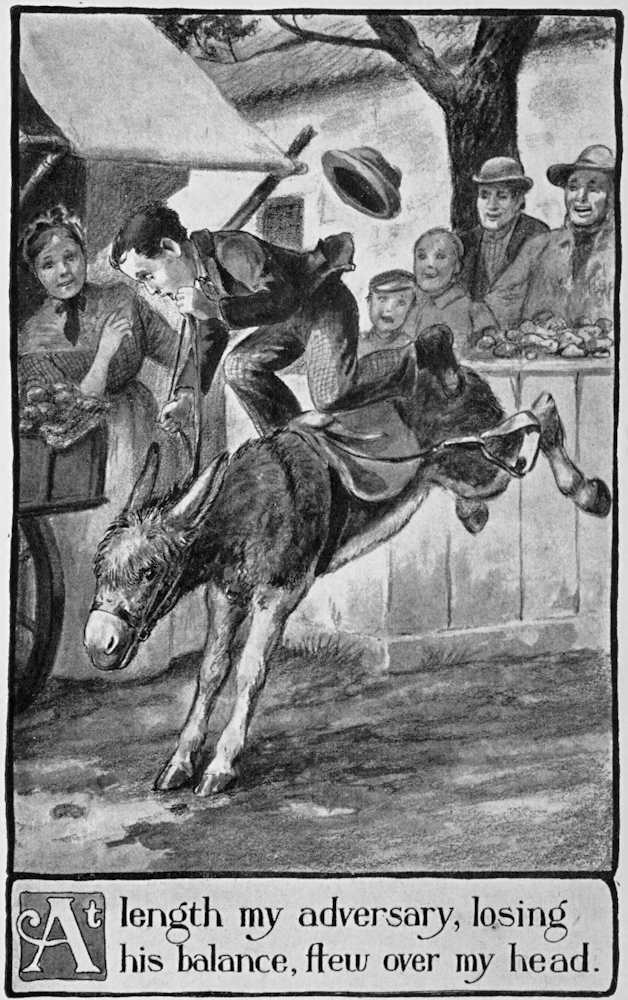
I only needed this one word of encouragement to put the plan which I had formed into execution. Planting my two front feet firmly on the ground, I kicked, and kicked, and kicked with such a thorough, hearty [Pg 102]good-will that at length my adversary, losing his balance, flew over my head, and rolled around and around upon the mud beneath me. Shouts of laughter resounded from all sides. Not waiting to see what would become of Richard, I instantly turned toward home, and galloped up the street as fast as my legs would carry me, the people not attempting to stop me, but rather urging me on to greater speed by cries of “Bravo! Well done, Neddy! Go on, Neddy!”
Excited by these shouts, and by the triumph I had just achieved, I redoubled my speed, my heart beating with joyful pride at my late victory. Alas! how little I knew the price I was to pay for it! If I had had the sense to go straight home, all would have been well; but when one has once tasted of the pleasures of conquest, and listened to the flattery of praise, one’s judgment is apt to be less clear; and no sooner had I reached such a distance from the town as to render me comparatively safe than I slackened my speed, and began, with great self-complacency, [Pg 103]to think over the events of the morning, refreshing myself by constant nibbles at the grass by the wayside. I was indulging in this luxurious confidence when I suddenly felt my rein seized by a vigorous hand, and, looking up, I found myself confronted by a powerful, middle-aged man.
“So you are the runaway donkey, are you?” he said. “I was just on the lookout for you;” and I saw that he glanced hastily up and down the road, but not another creature was in sight.
“So! all is right,” he said. “Come along, Neddy, come along;” and he hastily turned me off the highroad on to a path which led into a wood hard by.
It was all done so quickly that I had not a moment to recover my self-possession, and I was already far on in the path before I had time to consider who the man was, and what he could possibly mean by taking me into this road, which I had never seen before. My first sensation was one of delight, to think how completely I had outwitted Richard; but this was quickly followed by [Pg 104]the dread, “What if I had been outwitted myself?” and I began to reproach myself bitterly with my folly in not having resisted in the first instance, and refused to allow myself to be led from the highroad.
“But better late than never,” thought I; and, giving a vigorous pull at the rein, I tried to get away from the man, determining to regain the road, and never to stop again till I had safely reached home. Alas! I now discovered how far easier it is to take a step in the wrong direction than to retrace it when made.
The man in an instant seemed to discern my intention; and, holding the rein tighter than he had done before, he gave me three or four tremendous blows with a stick which he had in his hand, exclaiming at the same time:
“So you think to get away from me as you did from that boy, do you? You will find yourself mistaken. I will soon make you know who is master now;” and he repeated the blows with greater violence than before.
[Pg 105]
The savage tone in which he spoke, and the pain I felt from the blows which I had received, seemed to stun me, and take away all power of resistance; and, in spite of myself, I walked on by his side, trembling in every limb, and holding my tail tight between my legs, in the vain hope that this would protect me from his cruel blows. I have often thought since that I acted like a coward, and that, if I had plucked up my spirit, I might have regained my liberty. But, after all, I do not know. In a struggle between men and beasts, I suppose if a man chooses to exert his strength, he can always get the mastery. We do not think of this as long as we are in happy homes, and all goes prosperously; we forget that we are servants, and that our master has a right to expect obedience in return for the food he gives us and the care which he bestows upon us. We are apt to grow proud, and to think that our service is entirely optional, and that if we do our duty well, it is a great merit on our part, and calls for gratitude on the part of our master; and then it is not [Pg 106]till we feel his strong hand upon us, conquering our wills, and doing with us according to his pleasure, that we begin to understand that we are only servants of a higher power than our own, and that we should have been wiser to have submitted patiently, and to have done our duty cheerfully, than to have struggled against an authority which, after all, we are powerless to resist. I can think these thoughts now that I am quietly at rest in my old age, but my feelings were very different on the day of my capture.
My new master, having led me through the wood, jumped upon my back, and, by a repetition of the cruel blows I so much dreaded, urged me to gallop on across an open common on which we had now entered. Frightened as I was, I had sense enough to know that it would be better for me to obey; but I did so with a heavy heart, knowing well that every step was taking me farther and farther away from the home which I had never loved so well as now that I had lost it. Still, I made what speed I [Pg 107]could; and, having crossed the common, my master turned me up a narrow lane, urging me on even faster than before, till at length he turned off on to a waste piece of land, the most dreary-looking place I had ever seen in my life,—pools of water here and there, and the ground with scarcely a blade of grass, and nothing but a few stunted bushes scattered about. Here he pulled me up; and, getting off my back, he led me on a little distance; then, standing still, he whistled very loudly and sharply. In a few minutes the call was answered by a man younger and not so powerful-looking as himself.
“Where is the tent, Bill?” was his first question.
“A little way down to the left yonder.”
“Then we must look alive and push on for it, and dress up this donkey here before the search is out for him.”
“Why, where did you pick him up, Jem?” asked his companion, as he proceeded to examine me. “You have been in rare luck to-day. I never saw a more [Pg 108]likely beast. He has been in good quarters, too, I should say, from the look of his skin.”
“That he has,” returned my master. “He is one of Squire Morton’s raising; so you may be sure he is the right sort. I have had my eye on him for some time past; but they kept him so close I could not get a chance before. However, we have not a moment to lose. He is a pet of the family, so there is sure to be a hue and cry. Run on and get the shears and some good strong pitch ready.”
My heart sank within me. I did not indeed understand the full meaning of the words, but I felt sure from the man’s manner that mischief was intended, and again I did my best to escape and make my way home; but it would not do. I was led on, in spite of myself, to the tent, and then the cruel work began. Snip—snip—snip! I heard, whilst a hard, cold, heavy substance ran all over my body; and then came something hot and burning, which made me kick and jump with pain. But it was in vain to [Pg 109]struggle. My tormentors had me in their power, and not till they had satisfied themselves did they at length release me from their grasp.
“There, Bill,” said my master, when at length he had finished; “I think we have done it pretty well. I do not believe even his own mother would know him now. However, we won’t risk it; let us strike tents and be off. Here, give me the log, that heaviest one, and we will put that on his leg. He will not run far with that, I promise him.”
And in another moment I felt a tight, cutting pressure around my ankle; and, giving me a cut, my master told me to be off and eat my dinner, for I should soon be wanted for work. Eat my dinner! My only thought was to get away home; and, once escaped from his hands, I was for galloping off without a moment’s loss of time. Gallop? I could hardly walk. No sooner did I attempt to move than I heard a loud clanking noise, and felt a drag, as if my leg was broken. Looking back in terror [Pg 110]and amazement, I perceived that an immense piece of wood was fastened to my leg by a great iron chain. I tried to shake it off, but my efforts only made the chain cut me more painfully, whilst I bruised my legs by knocking them against the log. Broken-hearted and in despair, I stood perfectly still, bewildered and not knowing what to do next. At length an irresistible desire seized me to see what my tormentors had done to me. I recollected how proudly I had often surveyed myself in the stream at home, and how I had admired my shiny brown coat and the long hairs in my mane. Slowly, very slowly, I dragged myself to the edge of one of the pools. The water was very muddy, and did not perhaps reflect all my hideousness; but I saw enough to make me start back in horror from myself. My mother not know me? why, I did not know myself! My beautiful coat all clipped, and rough, and ragged, and covered with great patches of black and dirt; and my mane,—that mane my dear mistress had so often praised,—oh, what would [Pg 111]she have said to it now? I drew back from the sight of myself, and groaned inwardly. “Ah!” thought I, “and has so short a time been sufficient for so great a change? Is this the beauty of which I was so fond? Fool that I was to set such store upon the very thing which has brought me to all this misery, and which is gone in an hour!” and, laying down my long ears, my heart felt well-nigh broken.
In the midst of all my sorrows I suddenly roused up to the feeling of being very hungry. I had had nothing since the morning, and was quite faint and exhausted with my long gallop and all the agitation and excitement of the day. Looking around me, therefore, I tried to find something that I should like to eat, but there was nothing, actually nothing; for it was not to be supposed that a donkey, bred up as I had been, would condescend to make a meal of rank, sedgy grass, or a few bits of dried-up furze. Sorrow had not yet done its work. My proud spirit was chafed and angry—not broken; and I had still to learn that the [Pg 112]meal I now despised might one day be eaten with gratitude.
I was standing in the sullen gloom of despair when my new master came up to me. “So, Neddy,” he said, “you do not seem to be enjoying your meal. You will know better, my fine fellow, some day than to be particular about trifles. You will not be dainty long, I promise you. It will do you no harm for once to work upon an empty stomach. It will take down your spirit quicker than anything.”
And, unclasping the log as he spoke, he swung it over my back, and led me up to the tent, where he proceeded to load me with every imaginable article. I might be frightened, as tin jingled against tin by every movement of my body; I might try to resist so heavy a load being placed upon my back; but it was all of no good; the weight was fixed upon my shoulders, and then I was driven off with blows as before.
We seemed to be a large party,—one of my own family, but so old and ugly and wretched-looking that I turned from her in [Pg 113]disgust, quite forgetting my own forlorn look, and all the wise reflections I had so lately made. This poor donkey carried some children and a number of things of which I did not know the use; and a sort of van, drawn by an old horse, conveyed the tent and all that the party might want beside. How long or where we travelled, I cannot say. I only know that I was faint and tired and weary, when at length we came to a halt in a wooded dell a little way from the roadside. It looked pretty enough in the bright moonlight, but I was too wayworn to think of that; and when my load was removed from my back, I lay down from sheer fatigue, and, shutting my eyes, tried to forget all my sorrows in sleep.
Only this morning, and what a happy donkey I had been! I do not know well how to measure time; but it seemed to me as long since I had left my home as one of those dreary periods when my mistress was away from it. I thought of all my mother used to say to me about the changes of life, and how thankful I ought to be for the [Pg 114]happy lot that had been given to me, and how grateful and desirous to value my blessings to the full; and now, when I had lost them all, I for the first time felt their value, and knew how lightly I had prized them.
All, did I say? While I was thinking thus despondingly of my misfortunes, I heard a kind voice say to me: “Come, poor Neddy, here is something for you to eat,” and, looking up, I saw a little child holding toward me a large handful of hay. “Come, poor Neddy! good Neddy!” added the child, as she patted me kindly. Then, after all, I was not so utterly forsaken. Even in my utmost distress there was still something left to comfort me; and, as I gratefully munched the hay, I felt the first moment of happiness I had experienced since my misfortune. How often have I found since that there is no trial which may not be made more or less hard to bear by our own conduct under it,—few states so bad but that if we choose we can make them worse! Keep up a good heart, and be grateful [Pg 115]for every little comfort as it comes. That is my advice. I only wish I could speak out, and let my masters know how much lies in their power to make us, their poor servants, happy. If they knew how grateful we feel for kindness, and how much readier we are to go for a kind word than a hard blow, perhaps they would learn to treat us better, if only for their own sake.
Anyway, I felt happier as I lay down that night to rest; and it was a child’s act and a child’s words which had made me so.
[Pg 117]
[Pg 119]
CHAPTER VII.
I TRAVEL TO ALL PARTS OF ENGLAND, AND MAKE ACQUAINTANCE WITH EVERY VARIETY OF PEOPLE—AT LENGTH I GO TO LONDON—REGENT STREET IN MIDDAY—A RECOGNITION—I MAKE MY FIRST APPEARANCE IN A POLICE STATION, AND PROVE MYSELF A VALUABLE WITNESS—I TAKE UP MY ABODE IN THE “GREEN YARD.”
I was aroused very early the next morning from the enjoyment of my quiet sleep by a sharp kick in the side. Jumping up as quickly as possible, I saw my master standing by me ready dressed. Putting the bridle over my head, he led me to where the rest of the party were sitting having their breakfast. They did not offer anything to me, however, and I was obliged to content myself with a few bites of grass from the roadside. To judge from the eager talking that went on, some very important matter was being decided. In a few [Pg 120]moments, my master, throwing some light articles for sale over my shoulders, jumped upon my back himself, and, saying good-bye to his companions, set me off at a good sharp trot. We had not gone very far when my master suddenly pulled me up, and seemed hesitating whether he should turn me around or not. I was wondering what we were to do next, when I saw a man coming toward me, whom I recognized as a workman occasionally employed on my dear old master’s farm. Oh, how my heart beat for joy! “Now,” thought I, “who knows but he may deliver me?” and I came to a dead halt, intending, when the man passed by, to endeavour to attract his notice. But my rider was apparently aware of my intention, for he gave me two or three such frightful kicks, that, almost sick with the pain, I found myself obliged to go on in spite of myself; but I sidled up as much as possible to the side of the road where the man was walking.
He looked hard at us as we passed, and something seemed to attract his attention.
[Pg 121]
“Hallo!” he said; “you seem to have got a smart-looking donkey there.”
“The most obstinate brute that ever was seen,” returned my master; and he took advantage of the observation to give me some severe cuts over the head, which so stupefied me that I could not understand what the man next said. There seemed to be a long and very angry discussion; but it ended by the man walking away, and my master urging me on to the extent of my powers in the opposite direction. How grieved I felt then! how angry with the man for his stupidity in not recognizing me and taking me home! I was yet to learn what an important influence over my future destiny this chance meeting was to have.
It would be tedious to endeavour to give any detailed account of my present mode of life; indeed, one day was so like another that to describe one is to describe all. I had fallen into the hands of a peddler, who went through the country, now selling one kind of goods, now another, as the case might be, to suit the various tastes of the different [Pg 122]communities in the neighbourhood of which we found ourselves. When I was first in his possession, we went miles and miles away from my own dear home; in fact, I soon lost all recollection of where it was, or in what direction I should have to turn to regain it. It was a cold, bleak district where we settled first,—very, very unlike the warm climate to which I had been accustomed, with its rich meadow-land and soft green grass, and bright sunlight. Here, where we now lived, there was nothing to be seen but smoke and dirt. The very grass was all cinders.
At first I was half-scared out of my senses by the strange sights and noises which I saw and heard around me. At every turn in the road there seemed to burst forth fire and smoke; and as to the clank, clank, clank, bang, bang, bang, burr, burr, burr, it was unceasing from morning till night. And then the people, so unlike those amongst whom I had spent my early days. No clean smock-frocks and ruddy, healthy-looking faces; but grim, dirty men, [Pg 123]wretched-looking women, and miserable children! It was quite sad to look at them, as I went from door to door, dragging my load of vegetables, or fish, or what not; and then to hear the swearing and the quarrelling, the bartering and the chaffering,—oh, how unlike my mistress’s sweet voice! how different from those quiet drives in the green lanes of my native country! Ah! now that it was too late, how bitterly I repented me of my past misconduct, and thought, if the time had but to come over again, how differently I would behave! It is of no use, however, to expect that any one will profit by my experience. It is just one of those things that every one will insist upon buying for themselves; and then, when they have to pay the bill, they grumble, and say: “How very dear it comes!” Of course it does; but perhaps it is as well,—we should not value it else. We never do value anything that we get cheap. I often used to hear my master say that.
“Put on a good price, and keep to it, Betsy,” he would tell his wife.
[Pg 124]
“But really, Jem, this or that is not worth the sum you name,” his wife would occasionally reply, for my new mistress was a good-hearted woman.
“A thing is worth what it will fetch,” my master would answer. “Offer it for a lower price, and the people will suspect it to be bad directly.”
And so, often and often, when I stood before the doors of the cottages with whose inhabitants my master did business, I had to listen to such lies and impositions that my heart grieved for the poor people who were made such easy dupes. But what could I do? I could only turn my head around, and look up gravely in their faces, and wag my ears; and then they said—if they said anything to me at all—“How troublesome the flies are to your poor donkey to-day!” and they did not know that I was not thinking about myself, but wondering how it came to be how they were so quickly tickled by a little skilful flattery. There are worse flies, thought I, than those which are biting me!
[Pg 125]
I had wished to see life, and I saw it now in some of its saddest and most miserable forms. Oh, what places we went into! My stable at my dear old master’s was a palace, compared with the homes of hundreds of men, women, and children with whom I now made acquaintance; and then the want of light and air,—why, sometimes I could hardly see how to pick my way along the broken pavement; and as to air,—I could not have got up a bray, no, not if you had promised me a feed of grain to do so. How human beings could live in such an atmosphere, I knew not. It almost killed me to drag my load along in it.
But we did not always stay in the neighbourhood of these great towns. Sometimes we would go long journeys across the country, visiting fairs and other merrymakings. And these were times of peculiar hardship to me: morning, noon, night, I was always at work, and hardly a moment was allowed for me to snatch a hasty meal. No sooner had I dragged the cart, filled with articles for sale, to its appointed post than, instead [Pg 126]of being allowed to stand to rest and amuse myself by falling into the state of half-dreamy unconsciousness so delightful to all our race, I was taken out of the shafts, a saddle placed upon my back, and then I was let out by the hour to as many mischievous urchins as chose to take their full pennyworth of pleasure by the kicking and beating which seem to constitute the peculiar delights of a donkey ride.
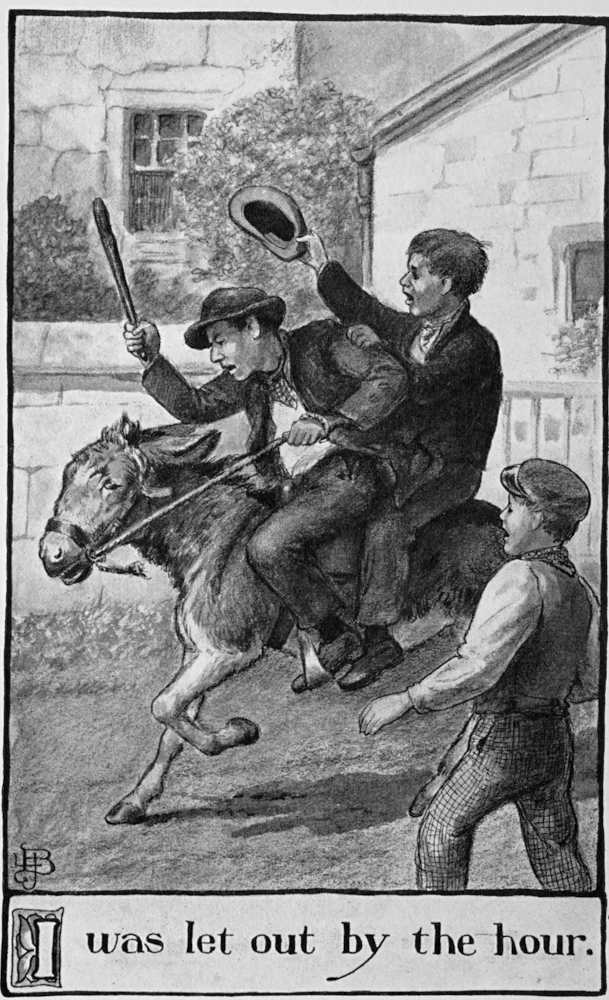
A terrible time I had of it on those fair days and race-grounds, for, being a more than usually handsome and powerful beast of my kind, I was the one invariably chosen by “plucky” fellows, who wished for “a lark;” and small pity they had on Neddy’s legs or sides; and, as to trying to kick them off, it was only to add to my misery and their fun. The more I kicked, the faster fell their blows, and the louder rang their laughter; and if sometimes, in despair, I turned sulky, and refused to go at all, it only increased my discomfort by giving time to two or three of my tormentors to get up at once, when, with hooting, and shouts, and [Pg 127]jeers, I should at length be obliged to give in and gallop ignominiously my appointed round.
But there was one very important good which arose to me out of all this trouble. My master, seeing the admiration I excited by my handsome shape and form, took the greatest pains to make me look as attractive as possible, in the hope, I suppose, of increasing his earnings. My coat had by this time recovered from the ill-treatment it had received, and, by dint of a good dressing, could be made to acquire something of its original gloss; and as I now occasionally got a feed of grain, my appearance was altogether plumper and more like myself. But it must not be supposed that I was merely delighted to hear myself admired. I will not deny that it was far pleasanter to know that I was no longer the wretched, dirty, miserable, half-starved wretch that I had been for so many months; but my great cause for rejoicing in the change was that I thought, if by any chance I should ever [Pg 128]meet with my dear mistress, it was possible that she now might recognize me.
In all my trouble, I had never for one moment forgotten her, and the hope that I might yet see her again was the one bright spot that enlightened many a dark and dreary hour. Ah! how constantly I looked out for her sweet face! how eagerly my ears listened to catch the sound of her well-remembered voice! And then my heart would die away within me, as I thought, “How is it possible that she should remember me? There is not a trace of her Neddy left in this ragged, dirty, jaded donkey;” and I would hang down my ears, and put my tail closer between my legs, as I felt the utter hopelessness of all chance of escaping from my present slavery.
With the knowledge, however, that I was recovering something of my former appearance, my spirits rose, and I became more than ever eager for the meeting with my mistress; but it never seemed to come. I would stand in the market-place of a town, and hundreds and hundreds of people [Pg 129]passed by me, and I would look wistfully in their faces; but they were nothing to me, nor I to them. I would visit quiet country houses, and I hoped and thought—who knew?—she might be among the guests; but no, we went and came, but we never saw the one being who was ever present to my recollection.
Time passed on,—I cannot tell you how long it was, I have no means of reckoning,—but at length our journeyings seemed to take a direction different from any they had taken before. We had left the land of fire and smoke, we had passed by the quiet villages, in the midst of green fields and narrow lanes and high hedges, and we came upon a country of endless, endless houses. What a stir, and bustle, and confusion! I had never seen anything like it, and I felt quite bewildered with the countless carriages and people that were passing me by on every side,—street after street, street after street, and every street as crowded as the one we had just left. Lights flaring, carts rattling, people pushing. I could hardly get along [Pg 130]for terror and surprise, and at every moment I expected some of the great ponderous wagons or overwhelming-looking omnibuses would run over me and the slight little cart I drew, and crunch us both to atoms. If this was London, it was a very horrid place!
But use is second nature, and I soon became accustomed to all the sights and sounds that had at first so much alarmed me, and could walk down a street in the full tide of daily traffic as unconcernedly as I should have wandered across a solitary common.
I had thought my life a very hard one when travelling about the country to visit the different fair and race grounds; but it was happiness itself compared with the wretched monotony of my present experience, with its unceasing toil, scanty food, and dirty shelter. In the country I could at least have the ground, such as it was, to lie upon, room to stretch myself and roll, air to breathe, occasional good meals of grass, and a drink of pure, fresh water; but in London I was forced to content myself [Pg 131]with a dark hole of a stable, so small I could hardly turn myself, and so dirty it made me sick; and I thought myself well off on those days when I could appease my hunger with a few stale, decaying cabbage leaves, and quench my thirst with a drink of half-putrid water.
And then the work was incessant. At earliest break of day I was harnessed to the carriage I had to draw,—a sort of truck on wheels, with a thing like a door laid all along on the top; and then my master would seat himself in front, and off we would rattle, I trotting over the stones as fast as my poor tired legs would carry me; for it was an important object to get first to a great market held in the midst of London, and so take up a good place for purchasing such fruit and vegetables and flowers as should not be judged good enough for the rich customers to Covent Garden.
If I had not felt so depressed and down-hearted, I might often have been amused by the bustling scene around me. It was a pretty sight, there is no denying it, to see [Pg 132]the carts coming in piled with their fresh and fragrant loads, women with baskets of the most deliciously scented flowers, and men with every variety of luscious-looking fruit. Oh, how my mouth would water as the carts passed by me full of fresh carrots or turnips, or soft new green stuff! How I looked and longed that some kind hand would give me just one taste! But no; I must stand hour after hour in the midst of all this plenty, faint and weary, and then think myself happy if an old yellow cabbage—so bad that the very slugs rejected it—was thrown to me as my morning meal. How often would I then look back to my early home, and remember all my grumbling discontent if I had had a little less grain than usual, or if the hay might not have been quite so sweet as suited my fastidious palate! There is nothing like want and hunger to cure daintiness; and I think it would be a very good thing if some of those who are always complaining and repining if things are not quite to their mind, [Pg 133]should make trial for awhile of this sharpener to their appetites.
When my master had completed his morning purchases, which varied with the season of the year, we used to quit the market, and start upon our daily rounds, making our way through miles of streets, till we came to a part of the city that bore some faint resemblance to a country town.
The houses were much lower than those in the streets through which we passed. They stood alone, or in twos and threes, in little gardens of their own; and they seemed to be inhabited by persons more like those we had been accustomed to deal with in the country towns than the ladies and gentlemen I would occasionally see stepping into their grand carriages as we passed through the great streets and squares. I used to wish they would have dealt with us instead; then, indeed, there might have been some hope of my finding my dear mistress; but how was it possible I should see her in the out-of-the-way suburbs where we plied our morning work, or in the lowest streets of [Pg 134]the metropolis, where we were always to be found at night? Morning dawned after morning, night closed after night,—still the same round of toil, and still no hope of escape.
My master had had a more than usually successful morning’s round; my load was disposed of, and we were returning leisurely down Regent Street, when he was suddenly accosted by a man who was walking on the pavement. Being in a particularly good humour, my master returned the greeting cordially enough, and the two friends soon agreed to go together to some saloon near, to take a glass to keep out the cold, and to drink to their mutual prosperity.
“Here, you see to the donkey, Tom,” said my master to a boy who generally went his rounds with him; “and do not you let nobody touch him nor the cart till I come back again. Do you hear, Tom?”
“Yes, I hear,” was the somewhat sulky reply; and, drawing me up close to the curbstone, where I should be as much as possible out of the way, my master, saying he [Pg 135]should not be gone long, turned up a narrow street with his companion, and was soon out of sight.
Tired with my morning’s round, and having had but a scanty breakfast, I was glad enough of the rest, and was just composing myself to a quiet sleep, when I suddenly heard a voice, which made every limb in my body tremble with joy, exclaim, eagerly:
“Why, Neddy, Neddy! dear Neddy! Do you remember me?”
Remember her! my own dear, dear mistress! Could I ever forget her? Half-wild with delight, I forgot where I was, and, dragging the cart after me on to the pavement, I began a series of ecstatic brays, rubbing my nose at the same time against the kind hand that was held out to me, and endeavouring to show, by every means in my power, my unbounded joy at again beholding my beloved mistress.
“Oh, look, papa, papa!” exclaimed my mistress. “Neddy knows me! Neddy remembers me! Good Neddy! Dear old Neddy!”
[Pg 136]
In her delight at seeing me, my mistress had, like myself, forgotten that Regent Street, in the middle of the day, is rather a public place in which to give way to outbursts of affection. Already a crowd had gathered around us, some wondering, some laughing, some standing by in silent curiosity to see what would be the end of this strange greeting; cabmen drawing up to enjoy the fun; omnibus drivers and conductors lingering on their way, and looking back to see what all the confusion was about; every moment the mob increased, swelled, as it was sure to be, by the crowd of dirty boys and idle loungers that in London springs up at a moment’s notice, no one knows how, no one knows from where.
“Annie, my dear Annie, this is no place for you!” exclaimed a voice that I did not recognize; and, looking up, I saw a fine, tall, handsome-looking man, who drew my mistress’s hand away from me, and placed it on his own arm.
“Papa dear, will you see about Neddy?” said my mistress, looking around, evidently [Pg 137]frightened and bewildered by the confusion around her, and endeavouring to make her way through the crowd of bystanders.
But having so lately discovered her, I was in no humour to let her go; and utterly disregarding every impediment in my way, I pushed on, braying loudly as I went. Peals of laughter greeted my attempt.
“Make way for the lady! make way for the donkey!” “Hurrah, Neddy, hurrah!” “Do it again, Neddy! do it again!” shouted the boys; whilst, encouraged by their cheers, I pushed and pushed more strenuously than before.
Louder and louder rose the peals of laughter; higher and higher swelled the cheers; and, thinking I was doing the most appropriate thing possible, I redoubled my efforts to keep up with my mistress, when, just at this moment, who should come down the street but my late master!
“Hallo!” he exclaimed, with a coarse oath; “what is all this row about? Who is interfering with my property?” and he [Pg 138]put out his hand to seize me fiercely by the rein.
“Stay! stay!” said Mr. Morton, in a voice so calm and firm that I felt the hand upon my bridle tremble. “I rather think it is you, my man, who have been interfering with my property. Here,” added Mr. Morton, turning to two or three of the police, who had by this time made their way to the spot, and were actively employed in keeping back the crowd, “I want your assistance here. I have reason to believe that this donkey, which belongs to my daughter, was stolen from me three years ago by this man. I give him into custody on this charge, and require that you meantime should take the donkey into safe keeping.”
It would be impossible to describe the man’s rage as he listened to these words. He swore, he stamped, he abused Mr. Morton in every angry epithet he could think of; and yet all the time he trembled, and did not once dare to look his accuser in the face. Directing the policemen to bring their prisoner to a police station, where he [Pg 139]could substantiate his charge, Mr. Morton jumped into a cab, and was driven quickly from the spot, leaving me in the hands of the policemen, and bewildered by the rapidity of events which, long as they have taken to tell, passed in the space of a few minutes.
My first feeling at finding that my dear mistress had again departed was one of unmitigated terror, and I looked around in trembling dread that now, being once more at the mercy of my brutal master, I should be made to suffer some horrible punishment for having thus given way to my delight at seeing my long-lost friend. But I soon found that, for the present, at any rate, I had nothing to dread. Struggle as he would, my master was in stronger hands than his own. He might curse and swear at me, but he had no power to do more, as, led along gently by a tall, grave, powerful-looking man, and followed by a crowd of noisy, hooting, cheering boys, I slowly made my way down street after street, until, finally, I was stopped before the door of one of the largest police stations of the [Pg 140]metropolis. Here my master disappeared from my view, whilst I remained standing in the street, under the charge of my grave-looking conductor, and surrounded by a continually increasing crowd, to whom I was evidently an object of the greatest amusement and curiosity.
Some time had passed in this manner, when the policeman who led me was joined by one of his companions, who, having said some words very quickly to him, of which I only caught “donkey and cart,” there was a renewed bustle and stir around me, and then the traces that fastened me to the cart were unhooked, and I was led through the crowd, now cheering louder than before, toward a doorway, so blocked up by people that I felt quite frightened, and refused to go on.
“Come, Neddy, come along,” said the policeman who had held me hitherto. “There is no one who will hurt you here; you need not be afraid.” And at the same time he desired his companion to go on, and make a way through the crowd.
[Pg 141]
Encouraged by the kind voice in which he spoke, and by seeing that the people fell back right and left at the orders of his companion, I plucked up my courage, and stepped through the door into a passage, broad and paved with stones like those on which people walk in the streets of London. I had never been in such an odd place before, and I did not half like it, and was more than once inclined to turn back; but the man kept a firm but gentle hold of me, leading me on, till at last two great doors were thrown open, and I found myself in a large room filled with people, sitting on benches raised one above another. I was quite bewildered at the sight of so many heads,—more especially as at my first coming in there was a general buzz of voices, and all eyes were evidently fixed on myself.
A loud cry of “Silence! silence!” gave me a moment to recover myself, and then I heard a grave voice say:
“Let the donkey judge for himself. You are at liberty to call him,” added the gentleman, turning to my late master, whom [Pg 142]I now for the first time perceived standing in an open space in the centre of the room.
“Here, Neddy—Neddy—come here, Neddy. There is a good donkey, come here,” said the man in a voice of the most insinuating gentleness; but as I had never heard him speak so before, no wonder I did not recognize its tones, and the only answer I made was to hang down my ears and plant my tail very firmly between my legs.
There was a general burst of laughter that not the presence of that grave-looking gentleman, nor the reiterated cries of “Silence! silence in the court, there!” could in any measure suppress; while a voice exclaimed: “He has had the donkey, that is clear enough, for the poor brute thinks he is going to beat him now. Hush! hush! See what he is going to do next. Here comes the lady. Silence! Hush! hush!”
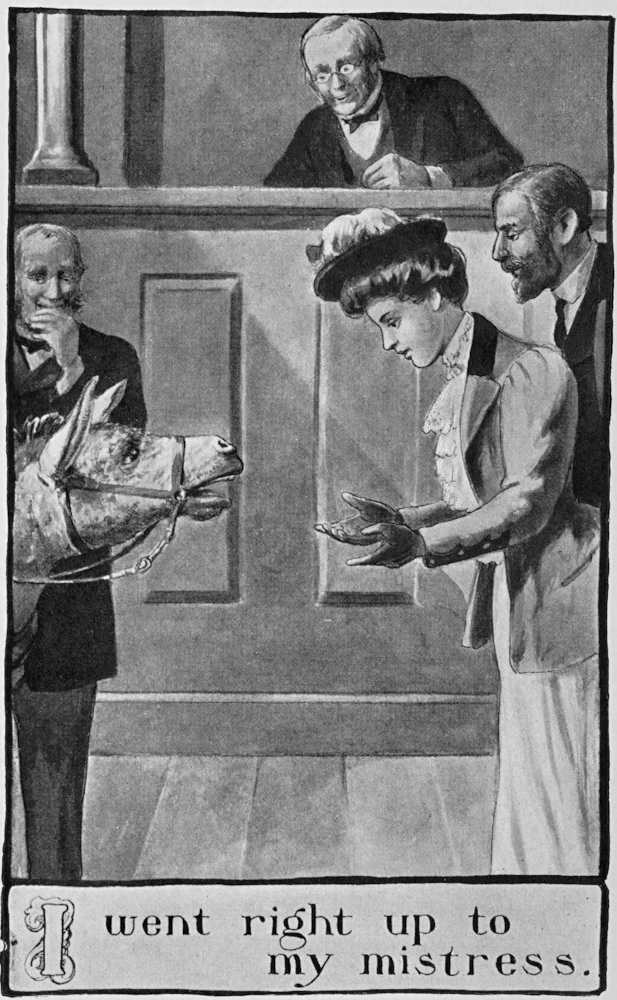
“Now, madam, it is your turn,” I heard the grave-looking gentleman say; and in another moment I saw my dear mistress rise up from a seat by his side, and, leaning on [Pg 143]the arm of her father, come down into the open court.
“Neddy! dear Neddy!” she said, just in the way that she used to call me up to the fence years ago. I forgot all my past misery, and, thinking only of my joy at beholding her, I set up such a bray as I had never brayed in all my life before! Oh, how the people shouted with laughter! The very judge could not resist the infection of their merriment, and gave way in spite of himself.
Why, what had I done that was so ridiculous? I could only express my joy with the voice which nature had given me. If it was not so sweet and gentle as some of theirs, that was not my fault. At any other moment my self-love might have been seriously wounded; but now I could only think of my delight, and, breaking away from the policemen who held me, I went right up to my mistress, and, rubbing my nose against her hand, I whinnied out my happiness, entreating her as best I could to let me stay with her now and for ever.
[Pg 144]
There was no laughter in the court then; and I have heard my mistress say since that there were tears in many an eye. Real, genuine affection is somewhat rare in this world, and, when it is found, it goes straight to the heart even of the most hardened; and there are few so bad that they will make fun of the evidence of pure, unselfish love.
There was a minute’s pause, and then I heard the grave man say, in tones of such kindness as showed his interest in my fate:
“I am quite satisfied, madam. No witnesses that could be produced could speak half so strongly to the truth of your case as does the affectionate remembrance of the poor dumb beast. That the donkey is the one that was stolen from you three years ago, there can be no doubt. All that remains to be proved is, who did the deed; and that, I am afraid, with all his sagacity, the animal will not be able to tell us. I shall send the case to trial; and in the meanwhile,” turning to Mr. Morton, “it is for you to produce the evidence that the man [Pg 145]now charged with the theft was the person who stole the donkey.”
“I have no doubt whatever that I shall be able to do so,” replied Mr. Morton.
“You can remove the donkey out of court,” said the grave gentleman, and then he turned to my late master, who was standing dogged and silent, in charge of two of the police, and proceeded to address him in terms which I did not understand, my whole attention being now fixed upon myself, and upon the thought of being separated from my dear mistress, whom I had vainly hoped I was never to leave again. In my anxiety to remain by her side, I quite forgot that I was in a court of justice, and that, as a well-bred English donkey, it was my duty to submit myself to the laws of my land, and I struggled hard to pull away from the policeman’s hold, and to follow my mistress, who was now led back by her father to the seat from which she had risen.
I do not know how the struggle might have ended; but, seeing that my endeavours to get free were disturbing the whole court, [Pg 146]my mistress once more came up to me, and, patting me gently on the forehead: “Oh, Neddy,” she said, “this is very naughty of you! Come with me.” How could I disobey?
“You may leave him,” she said to my conductor; “he will go away with me directly.”
Go away with her? Of course I would, to the world’s end. My first journey, however, was destined to be a much shorter one; for, no sooner had I quietly walked by her side through the court-house into the passage than, placing my rein in the hand of the policeman:
“He will follow you now, I think,” she said. “Go, Neddy; there is a good Neddy. I will come to see you very soon. Good-bye, Neddy!” and, patting me kindly, before I had time to look around, she was gone.
A crowd, little short of that which had accompanied me to the court, was awaiting my return, and eager inquiries greeted my conductor as to the result of the trial. Every one talked so fast and so loud that [Pg 147]I could not make out much of what was said; but I gathered sufficient to make me very happy in the feeling I should soon be restored to my pleasant home, and that meanwhile I was to be left in the care of my present guardian, whose kindness toward me had already impressed me greatly in his favour.
I gleaned, too, from what I heard, that the result of the trial depended mainly on the evidence of some man who was supposed to have seen me soon after I was stolen from my dear mistress.
This set my brain working; and, as I walked by the side of my conductor toward my new place of abode, I tried hard to recall all the events of the past three years, and think whether there was any one person whom I could remember who could have recognized me in the time of my degradation. In vain! in vain! I could not recall one old friend who could bear testimony to my identity.
Suddenly there came upon me a flash of light, and I bethought me of the man who, [Pg 148]on that wretched morning after my capture, had refused, as I then thought, to rescue me from my dreaded slavery. Who knew but that now he might come forward, and, recognizing my master as the man he had then accosted, might for ever set me free from his power?
It was a bright and happy thought, and kept me up through several long, long days of dreary suspense,—days rendered so much the longer that I had nothing whatever to do, but to ruminate sadly over the past. Not but that I was comfortable enough in my present abode, and had plenty to eat and to drink; but I had been so accustomed of late to an active, stirring life that I got tired of standing hour after hour tied up to a manger, with no one to speak to but a few chance companions, who, like myself, were condemned to a temporary imprisonment. We had all our griefs and sorrows, and could all, no doubt, have told some strange and wonderful adventures; but, one and all, we shrunk from anything like fellowship, and, shutting up in our own [Pg 149]hearts our hopes or our fears, awaited, with what patience we could, the verdict which was to open to us our new and unknown career.
THE TRIAL COMES TO AN END—AN OLD FRIEND VISITS MY STABLE—I TAKE MY FIRST RAILROAD TRIP AND FIND MYSELF IN WELL-REMEMBERED SCENES—HOME AGAIN—CONCLUSION.
As days passed on, and still I neither saw nor heard anything of my dear mistress, my heart misgave me. Was it possible, after all, that she had forsaken me? Would she give me back into the power of that dreadful man? Oh, how I wished that I had not suffered myself to be led out of the court! that I had stayed by her side, and never lost sight of her until I was once more in the pleasant green fields of my early home. It was in vain to regret the past.
I might fume and fret, but it would make no difference to the tiresome present. If I could but have released myself from the bridle that bound me to my stall, I would [Pg 154]have made my escape from the stable, and never rested, I thought, until I had once again found my mistress. Happily for me, I was not permitted to accomplish my object, or my second flight might have been attended with as disastrous consequences as my first; all that I got by my efforts to escape was to draw upon myself the attention of my guardians, and make them secure me more carefully than before.
I hated them then,—foolish donkey that I was!—but I have owed them such a debt of gratitude ever since that nothing pains me more than to hear a word said against the police. Let every one speak as they find; I say, they are a fine, brave body of men, who have a very difficult duty to perform, and do it faithfully and well.
But to come back to myself. I was standing musing, I am afraid, in a very discontented state of mind, when I heard the door of the stable open. Thinking, however, it was only one of the men come to attend to their work, I did not even trouble myself to turn my head, until suddenly I felt a [Pg 155]hand laid on my shoulder, and heard a voice I thought I remembered say, sadly enough:
“Why, Neddy! who would have thought that you and I should have met again in such a place as this; and you so altered? Poor old Neddy! how badly you have been used!”
Old Neddy, indeed! My heart swelled with such mortified vanity at the name that for the moment—ungrateful that I was!—I felt more vexation than pleasure as I recognized Thomas standing by my side. But it was only a momentary feeling, and, looking up in his face, I endeavoured to show my pleasure at seeing any one connected with old times.
“Ah, Neddy!” continued Thomas, “so you know me, do you? It is more than I should have done by you. You do look dreadful bad. Why, I shall never get that rough, shaggy coat of yours right again. No, not though I groom you for hours at a time.”
Thomas groom me again! I never thought of the rudeness of the speech in [Pg 156]my exceeding joy at hearing I was to be again in his care. Ah! then I must be free from my detested master. I must be going back to the home and the mistress I loved so well.
“So it is all over, is it?” inquired a policeman, who at that moment entered the stable and proceeded to unfasten my bridle.
“Yes; it was decided some hours ago,” said Thomas. “It was a queer trial, was it not?”
“The queerest I have ever heard,” returned the policeman; “and that is saying a good deal, for strange stories come to our ears. If it had not been for this donkey here, ten to one your master would never have gained his cause. The man told a wonderful plausible tale. But this dumb beast here told a better. You should have been in court that day. It was a sight to remember, and there was many a one who thought it no shame to be seen with tears in their eyes; and as to Mr. Wickharde, I never seed him so moved in all my life. That donkey [Pg 157]is a first-rate witness. For my part, I would rather have him than half the men I know.”
This testimony in my favour seemed to raise me in the estimation of Thomas, for he patted me far more kindly than before, saying: “Poor old Neddy! He will be glad enough to be amongst his old friends again.”
“How did the trial go?” asked the policeman. “I wanted to hear the end; but I was on duty here this morning, and could not manage it. I almost thought they would have sent for the donkey, and I meant to have taken him down myself.”
“It did not last long,” returned Thomas; “there was no question about the donkey being Mr. Morton’s property. The only point was whether Jackson stole him or not; fortunately, he had been met by one of master’s own workmen the morning after the theft. Jackson was riding the donkey at that moment, and Mills felt sure he recognized it by the star on its forehead. It is a very peculiar mark, you see,” continued Thomas, as he turned my head to the light, [Pg 158]and pushed back some shaggy hairs. “Jackson had never thought of concealing it; and it was rare and lucky for Neddy he did forget.
“Mills had words with Jackson at the time about the donkey; but the man rode off, and Mills did not like to stop him, for he did not know our donkey had been stolen; however, he came on straight to our house, and told his story; but master was away at the moment, and so time was lost; and when the Squire returned, and a hue and cry was raised, Jackson had got clean away, and from that day to this we have never been able to get clue nor trace of him, nor of the donkey neither.
“And it is wonderful, I say, how all this matter has been found out; and it just shows me that, sooner or later, God, who watches over all, will bring our crimes to light. Murder will out, they say; and I think theft must be much the same. Well, of course, as soon as mistress claimed Neddy here, the first thing to do was to send for Mills, and he swore to the donkey and swore [Pg 159]to the man, and the verdict was given in favour of my master.”
“Ah!” thought I; “I see it all now; why, how stupid I have been! So that was the man who came in the other day when I was eating my grain, and I was so cross at being disturbed, and so sulky, I would hardly let him look at my head; and, after all, he had only come to save me, and I, like a fool, was angry at a momentary inconvenience. Neddy,” thought I, “will you never learn wisdom by experience? will you never understand your own utter ignorance,”—and I gave such a great sigh that Thomas broke off his speech suddenly, and, looking at me, added, with a smile:
“Well, I should like to know what the beast has got in his head now. He always had such a queer way with him; I believe he understands every word we say. If he could but speak, maybe it would be a strange story he would have to tell us.”
Strange? Strange indeed! Ah, you men! with all your wisdom, it is but little you [Pg 160]know of what is passing through the minds and hearts of poor dumb beasts.
The idea of freedom was still so new to me that I could hardly realize the fact that I was safe from the brutal treatment of the man whom, for the last three years, I had been forced to call my master; and, as Thomas led me out of my place of confinement, and I found myself once more in the streets of London, I turned and looked about me in nervous dread, fearing that I should suddenly hear the sound of Jackson’s hated voice, and feel myself in the grasp of his powerful hand.
“So, whoo, Neddy! gently, my man!” exclaimed Thomas, in the reassuring voice of old times. “No need to be afraid now; there is nobody coming to hurt you. Come on, old fellow, come on. Come, make haste, and do not put your tail between your legs in that miserable way. I ain’t a-going to flog you, Neddy. Why, you are making a sight of yourself and me, too!”
True enough. I felt I looked a pitiful, craven-spirited wretch; but I had been so [Pg 161]long accustomed to find that a word and a blow went together that it had become a sort of habit of nature to endeavour to protect myself from the assault, and I could have no more helped cowering down and holding my tail tight between my legs than I could have prevented myself from blinking if I had been forced to look suddenly at the sun.
However, seeing that Thomas was vexed at my miserable appearance, and not wishing to mortify the kind-hearted old man, I endeavoured to pluck up courage, and to trot along by his side with somewhat of the air and spirit of bygone days; and, as I found that we passed street after street, and square after square, without stop or molestation, I began gradually to acquire confidence, and to believe in the reality of my deliverance. Having gone a considerable distance, we at length arrived at the entrance to one of the great railway stations.
“Now, my man,” said Thomas, as he pulled me up for a moment, and gave me an encouraging pat, “do not you go for to [Pg 162]make a fool of me and yourself; you are going to see queer sights and hear queer sounds, so make up your mind to behave like a sensible beast, as you are. There, do you hear that? that is one of them,” added Thomas, as a shriek was suddenly heard close by our side, followed by screeches, little less discordant, ending in a series of agitated puffs, as if some mighty monster was giving up the ghost.
“Do you hear that, eh, Neddy?” repeated Thomas, as he turned my head in the direction of the noise, as if to accustom me to the sound.
Hear it? Of course I did; but what did I care for it? Had I not been accustomed to almost every railway in the kingdom? and did not I know the sound of a locomotive, bursting for very spite at being stopped in its mad career?
Often and often, when I had been drawn up by the side of some country railroad station, had I speculated on the nature of those great iron animals that, day after day, and night after night, go tearing along across [Pg 163]the country, dragging their loads after them, without ever so much as seeming to feel their weight, or ever showing symptoms of vexation or weariness, except when they are pulled up in mid-career: then, indeed, they squeak, and spit, and hiss, and make a pretty to-do. Ah! often and often as I had watched the locomotives, I had wished I had a skin like theirs. I envied them their strength and powers of endurance. I afraid of them? I should think not, indeed; and, quite proud to have an opportunity of reinstating myself in Thomas’s good opinion, I held up my head, and, shaking my ears with an air of supreme indifference, I walked with dignified unconcern right into the shed where the engine was showering out a perfect cloud of white breath.
“Well done, Neddy! good donkey!” said Thomas, patting me approvingly; and then he proceeded to lead me up the platform to where a great square box was standing with its doors wide open. Into this dark, uncomfortable-looking cage he bade me [Pg 164]enter; and now I confess a feeling of terror came over me, putting all my boasted courage at once to flight, and, turning around, I struggled hard to escape from Thomas’s hold.
“Whoo, hoo—gently, stoopid! What is the matter?” said Thomas, crossly. “Why, what are you afraid of now? Who is going to hurt you, Neddy?”
Ah, indeed, who? “How am I to tell,” thought I, “shut up all alone in that dark prison? Who is to say whether I shall ever make my escape alive, or, if I am so fortunate, whether it may not be only to fall into the hands of my tormentor; or, worse still, who can say that he is not hidden in some dark corner of the box?”
“Why, Neddy, one would think that you expected to find your late master there,” added Thomas, in a milder tone.
“And so I do,” thought I; but how was I to tell him so?
“You need not be afraid, old donkey,” continued Thomas; “he is far enough away now. He cannot get to you. Come, Neddy, [Pg 165]come along; you will be quite safe and comfortable in there, and I will give you some grain to eat, and you may amuse yourself with it during your ride. Come, Neddy, come along.”
It was impossible to misdoubt the kind tones of Thomas’s voice.
“If he meant any treachery against me, he would never speak like that,” thought I. “Besides, have not I always found him a true, good friend? and is it not very wrong not to trust him now?” and I turned around and looked into the box. It did not look pleasant, certainly; but, after all, I had lived in worse places; and so, summoning up my resolution, I put one step on the sloping board that led up to the cell. Dear me! how hollow my footfall sounded! I did not like it at all, and was all for drawing back again; but Thomas was by my side, and for very shame I did not dare act the part of a faithless coward; so I took another step, and then another. Still that hollow, hollow sound. But it was over now, and I stood inside the box, and looked [Pg 166]around, half in terror, half in surprise. It was not so very bad, after all.
There were nice, soft-looking sides to the stall, and plenty of clean straw to lie upon; and Thomas remembered his promise, and put some food in the manger, and then, tying me up quite tight, he bade me good-bye. The doors were shut, and I was left alone in the darkness. Soon came a whistle, a shriek, and then a tremulous motion. Oh, how my heart sank within me! But there was no escape. I had but to submit, and bide my fate. Then my prison swang from side to side, and rush—rush—rush—roar—ro-r-r—ro-r-r-r—where were we going? I knew nothing—remembered nothing—till suddenly a vibration, a stop. Whirr—whirr—whirr—fainter grew the sound till now all again was silence. My box swings around—I feel quite sick with fright, when open fly the doors, and there stands Thomas, looking so kind and pleasant. I had never loved his face so well before.
“Well, Neddy,” he said, as he undid my [Pg 167]halter, “it is all over. We shall soon be at home again. Ay, do you remember the old place?” he added, as, leading me out of my prison, I stood still, sniffing in with delight the pure fresh air of heaven.
Remember it? I should think so. I knew every inch of the ground as we drew toward home; and, forgetting all my troubles and sorrows, I kicked and jumped about as if I was once again the frolicsome donkey of years gone by. Even gruff old Thomas seemed moved by this evidence of my delight; and, throwing off his usual dry, hard manner, he spoke to me so kindly that my heart leaped again and again with joy. But when at length the gates of my own dear, dear home came in sight, I could no longer contain myself, and trotted on as fast as my legs could carry me, Thomas letting go the rein, saying, with a smile: “You know your way now, old fellow, I guess, and will not run away again, I fancy.”
Open went the gates, and then the avenue was before me, straight now up to the doorsteps; and whom should I spy standing [Pg 168]there, but my mistress, and her father, and the strange gentleman. Oh, how I kicked up my heels with joy, and then galloped up the drive as I never thought my old legs could have galloped more!
You should have heard my mistress’s merry laugh. It was the pleasantest sound my ears had listened to for many a long day past; and you should have seen how she patted and caressed me, and called me her “dear old Neddy—her good, faithful donkey;” adding: “We will never part again—no, never. Will we, Neddy?”
I could only rub my nose against her soft white hand, and whinny out my joy and gratitude. My heart was too full; I almost thought it must have burst from my excess of happiness. And then, when she led me—she, my own dear mistress herself—to the field where I had spent all the first happy years of my existence, who may describe the emotions which overpowered me? First, I galloped around and around the field; then I threw myself down on the soft green grass, and rolled, and rolled, and rolled myself [Pg 169]again and again in my ecstasy. Then, at last, rising up, and looking around me, I seemed as if I could never tire of gazing at all the well-remembered spots. Every twig in the hedges seemed like some old familiar friend; and as the birds sang out their merry songs from the boughs of the trees which had so often sheltered me, it sounded to me as if they, too, were carolling forth my welcome home.
Home! Ah! those who have never lost it can never fully appreciate its value; and, as I lay down to rest that night, it was with feelings of such overflowing gratitude as I know not how to express.
I thought of my mother’s words, and how she had warned me against the self-willed, presumptuous spirit that had made me discontented with my happy lot. I remembered my own insolence to herself, and how I had mocked her when she had foretold that hard blows and bad fare would bring down my proud spirit, and make me understand the blessing of my quiet green fields and tranquil, peaceful home.
[Pg 170]
“I understand it all, sure enough, now,” thought I; “and can only humbly hope that what I have lost in strength and beauty, I may have gained in wisdom. Come what will, it shall not be my fault if I ever again lose the home I prized so lightly, regretted so deeply, and have regained so wonderfully.”
And, full of happy thoughts and good resolutions, I fell into the most peaceful, refreshing sleep I had known for years.
There is but little more to tell. My mistress and I have never parted since, though I do not live now in that home of which I have told you, and to which I was so much attached. I followed my dear mistress to a new home; but the fields there were quite as green, and the sunshine was just as bright, and the air was just as pure, and I soon learned to love it quite as well as the place which I had left; and there I have grown old and gray and staid, and I cannot do much work now; but I go out every day with a group of merry, happy, bright children, and sometimes one and sometimes another [Pg 171]rides upon my back, and sometimes two panniers are thrown across my shoulders, and then, to judge by the joyous shouts and laughter, there must be several little folks all taking their ride together; and Neddy is a general favourite, and there is always some pleasant treat in store for the old donkey. No heavier whip ever falls upon his sides than a bunch of wild-flowers; and so well he loves those children that a daisy chain is bridle enough to guide him where they will.
And his dear mistress, she is growing older too; but to Neddy she is still the same. He cannot see gray hairs, or graver brow; he only hears the well-remembered voice, the endearing tones of kindness, the gentle touch of that loving hand. She says Neddy shall never leave her; that while she lives he shall never want a home; and that, dying, she will commit him to her children’s care.
THE END.