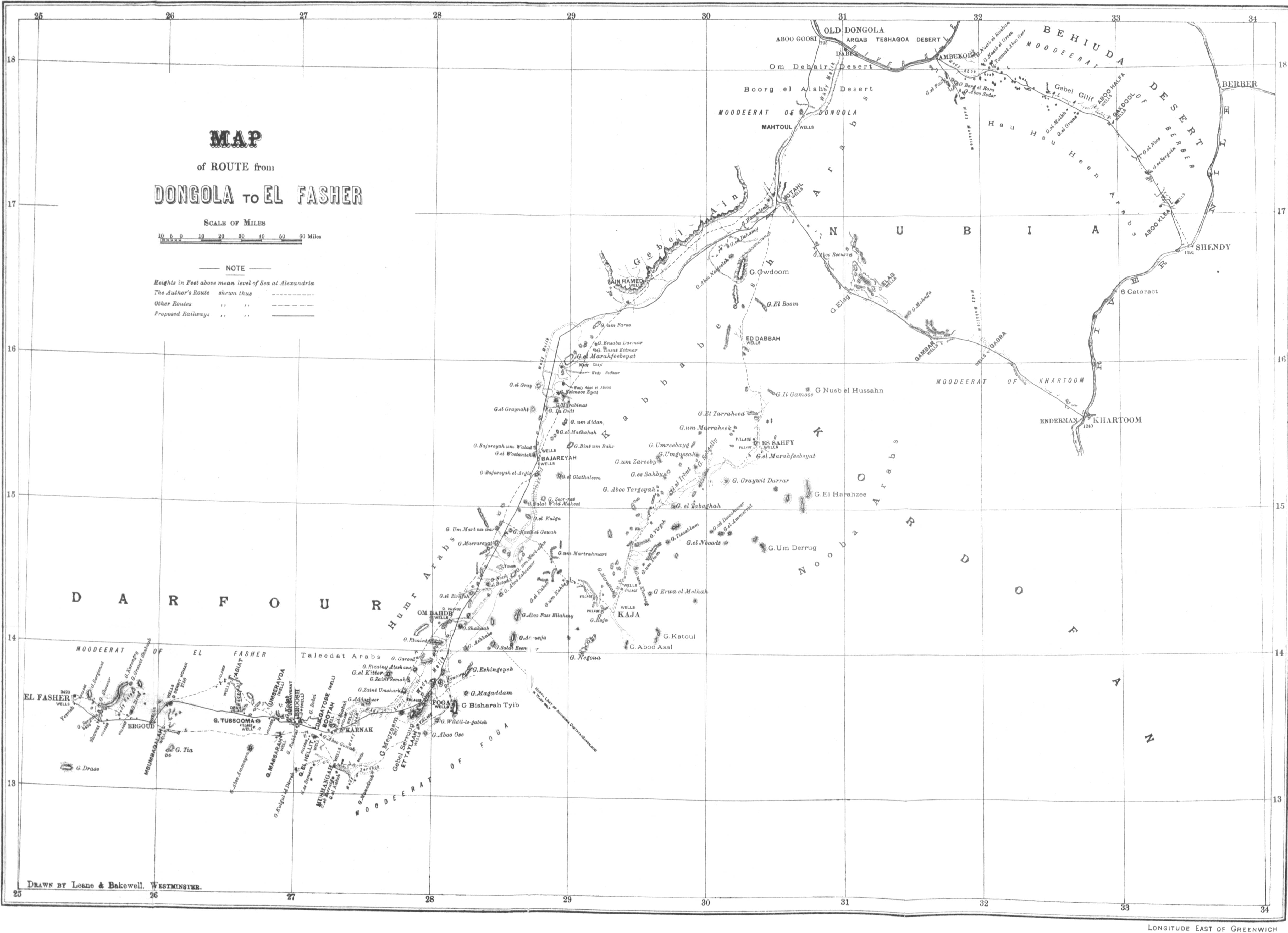
Map
of ROUTE from
OLD DONGOLA TO EL FASHER
INCIDENTS
ON A
JOURNEY THROUGH NUBIA
TO
DARFOOR.
F. SIDNEY ENSOR, C.E.
LONDON:
W. H. ALLEN & CO., 13, WATERLOO PLACE.
1881.
(All rights reserved.)
LONDON
PRINTED BY W. H. ALLEN AND CO., 13. WATERLOO PLACE, S.W.
TO
JOHN FOWLER, ESQUIRE,
(CIVIL ENGINEER),
I DEDICATE THIS
BOOK
AS A MARK
OF RESPECT AND GRATITUDE.
[v]INTRODUCTION.
![[Decoration]](images/decor1.jpg)
Darfoor is an oasis, or rather a cluster of oases, in the south-eastern part of the great desert of Sahara. The country was annexed to the Egyptian dominions at the close of the year 1874; and, in the following year, owing to reports of its extraordinary fertility, it was decided by Ismael Pasha, then Khedive of Egypt, that a survey should be made for a proposed line of railway to El Fasher, or Tendelti, its capital town.
Previous to 1874 there had been only three available routes to El Fasher from Egypt or Nubia.
One from Sioot on the Nile, about two hundred and ten miles above Cairo. This route, throughout its entire length, is in the desert; the wells are sometimes ten days’ journey apart, and in other respects it is quite impracticable for the purposes of a railway.
A second from Dabbe, latitude 18° N., on the upper Nile, across the desert to El Obeid, capital of Khordofan, and thence into Darfoor, over rough and generally unfavourable ground.
[vi]A third from Khartoom, at the junction of the White and Blue Niles, to El Obeid, and thence by the route last mentioned.
A fourth route by the Wady Milkh, said to be very superior to any of the other three, existed, however, from near Old Dongola on the Upper Nile, almost in a straight line, right into Darfoor.
The “Wady Milkh”[1] signifies “Inalienable Valley”; it is so called because since the reign of Achmet Bokr, Sultan of Darfoor (1682-1722), who extended his frontiers as far as the Nile, and beyond to the Atbara, the Sultans of Darfoor claimed the sole right to use it. The route, moreover, was said to be unsafe, owing to the predatory habits of the Arab tribes dwelling in different parts of its length.
It was along this newly acquired “Wady Milkh,” or Inalienable Valley, that the surveys and levels for the proposed line of railway, on which I was engaged, were to be made.
The adventures that I met with while on the journey from the second cataract of the Nile, and afterwards at El Fasher, and the description of the country, form the subject of this book.
![[Decoration]](images/decor2.jpg)
[vii]CONTENTS.
| PAGE | |
| Chapter I.—Wady Halfa to New Dongola | 1 |
| Chapter II.—The Temple of Semneh | 13 |
| Chapter III.—New Dongola | 21 |
| Chapter IV.—Old Dongola | 30 |
| Chapter V.—Taking Stock | 42 |
| Chapter VI.—From Old Dongola to Sotaire | 50 |
| Chapter VII.—From Sotaire to Bagghareeyeh | 61 |
| Chapter VIII.—From Bagghareeyeh to Om-Badr | 72 |
| Chapter IX.—Om-Badr | 84 |
| Chapter X.—From Om-Badr to Karnac | 95 |
| Chapter XI.—Karnac to Ergoodt | 107 |
| Chapter XII.—Ergoodt | 120 |
| Chapter XIII.—Descriptive | 131 |
| Chapter XIV.—History | 142 |
| Chapter XV.—El Fasher | 153 |
| Chapter XVI.—At El Fasher | 163 |
| Chapter XVII.—At El Fasher | 173 |
| Chapter XVIII.—A Ride to Kobbe | 183 |
| Chapter XIX.—Back to Ergoodt | 197 |
| Chapter XX.—Back to Om-Badr | 206 |
| Chapter XXI.—Back to Sotaire | 217 |
ERRATA.
- Page 14, line 17, after “boy” insert “is.”
- „ 15, line 18, for “Madeline” read “Madeleine.”
- „ 25, „ 24, for “like” read “live.”
- „ 86, „ 14, „ “equally” read “equalling.”
[1]INCIDENTS ON A
JOURNEY
THROUGH
NUBIA TO
DARFOOR.
CHAPTER I.
WADY HALFA TO NEW DONGOLA.
Arrival at the second cataract of the Nile. — The desert beyond. — Resting-places. — A distressed traveller. — Green fields again. — Asleep on a horse. — The river from the second to the third cataract. — Irrigation beyond.
ON 13th November 1875 we started up the Nile from Cairo; our expedition consisted of eight civil engineers and one doctor, besides native assistants, soldiers and servants. Our object was to prospect and survey for a line of railway from Aboo Goossi to El Fasher, or Tendelti,[2] the capital of Darfoor. Aboo Goossi is a[2] considerable village six miles higher up the Nile than Old Dongola, and is on the line of the proposed Soudan railway, on the survey of which I had been engaged in a subordinate capacity some years before. There was also to be a branch line surveyed from Sotaire, or Sotahl, to Khartoom. Sotaire, or Sotahl, is the site of two wells about eighty miles from Aboo Goossi on the proposed line to El Fasher.
Two steamers and one large barge were told off to carry the members of the expedition to the first cataract; one steamer was occupied by the engineers and doctor, the other by the native assistants, and the barge by the soldiers and stores. At Assouan we left our steamers and barge and proceeded by a recently constructed railway, nine miles in length, to the top of the first cataract; here we found two other steamers waiting for us and boats for the soldiers. His Excellency, Mustapha Fehmy Pacha, then newly appointed Director-General of the Railways of Upper Egypt, including the Soudan railway at that time in course of construction, accompanied us from Cairo as far as Wady Halfa.
Wady Halfa, “valley of grass,” is a village at the foot of the second or Great Cataract on the right bank of the Nile, at a distance of about a thousand miles from the Mediterranean; it is at the commencement of the Soudan railway. We disembarked on the left bank of the river opposite the village; the camels for our journey, to the number of three hundred and fifty, were in the neighbourhood, some on one side of the Nile, some on the other. The section of our expedition whose destination was Khartoom were ready to go the[3] day before us, and we wished them good-bye to meet again in the Sahara some months after and a thousand miles away. On the following day we paid our farewell visit to Mustapha Pacha and started on our journey.
Tourists from Europe and America, visiting Egypt, seldom proceed further up the Nile than the first cataract; Philæ at its upper end is usually the limit of their travels; some few go as far as the second cataract, but I fancy their numbers may be counted by twos and threes. Indisputable evidence of this may be found in the state of the ruined temples of the Nile valley; below the first cataract Brown, Jones and Robinson may be seen carefully carved on their walls, as also some greater names which the world will hardly remember the longer, or esteem the more, for being in such company. Above Philæ this is rarely the case; time and the elements are left to do their work unaided.
The route generally taken by travellers to Khartoom and the White or Blue Niles starts from Korosco, about eighty miles below Wady Halfa. The route crosses the eastern desert of the Bishareen and Ababdeh Arabs, and joins the Nile again at Aboo Hamed, whence boats may be obtained to Khartoom and beyond, or the journey may be continued on camels.
This is the route that has been taken by all the great explorers; that portion of the Nile between Wady Halfa and Aboo Hamed is consequently little, if at all, known to Europeans.
A complete change occurs in the Nile valley as soon as the second cataract is reached; below this the desert,[4] with its rock and its sand, only comes down to the river in places; above, the river is bounded closely by the lifeless wilderness. From Wady Halfa to the island of Say, I should doubt whether the whole cultivable border on the west bank of the Nile is much larger than Hyde Park; this is a distance of one hundred and twenty miles. Every ten or twenty miles little patches of deposited mud are to be met with, some of them no bigger than a table-cloth; every inch of these is cultivated, generally with beans or lentils. In some places the area is larger, then a little “doura”[3] is grown. Sometimes even in these happy secluded spots a few palm-trees give life to the landscape; two or three mud-houses, with a few families possessing fowls, goats, sheep, and perhaps a donkey, are erected in their shade. The donkey is used for carrying to head-quarters the products of the outlying little bits of land, and, in many cases, so small is the yield that the donkey eats it all up before he gets home. The people living here are happy and undisturbed, scarcely any caravans move up or down through their trackless world, and a few boats, only when the Nile is at its highest, pass to and fro in many years. Their intercourse with the outer world, limited as it is, is, however, sufficient to sharpen their wits and to teach them the value of money. They know what a sovereign is worth as well as anyone in London, perhaps better; once they have become possessed of it they never part with it. They are not[5] averse to trade. A sheep seldom exceeds one dollar in price and fowls in proportion, but I fancy that if a few hungry Englishmen were to take up their quarters in this district prices would very soon go up. The waste that bounds these simple homes is almost devoid of vegetation; small tufts of dry yellow grass may be occasionally met with; they are not, however, sufficiently numerous to give sustenance to even a very small number of camels. The “hammals,” or camel-drivers, generally manage to collect a supply of dry grass before starting to help the more weakly animals through their journey; well-fed and healthy animals, some time out of work, will easily travel for five or six days with only an occasional mouthful.
The usual distance travelled per day by a caravan is twenty miles, and the rate two and a half miles per hour. If towards the end of a day’s journey there should be no approach to the river, the drivers will either stop shorter or go on a little further. They always go down to the river at night. If there should be a patch of cultivated ground at the resting-place, and no guardians near, the drivers help themselves to a meal of the produce, and often the camels, if not properly looked after, finish up the remainder. In those parts of the journey which are distant from the river, little mud-huts roofed over with palm-branches and doura-stalks are occasionally found. Inside is a raised divan of mud from one end to the other, and two or three large vases filled with water are half buried in the ground. These huts are resting-places for weary travellers. Coming to one of them one[6] day, I asked one of the drivers, who placed them there? His reply was “Allah.” I wondered at the time, from the ingenuous simplicity of his answer, whether he really believed that the house and the water had been placed there through some miraculous interposition of Providence. On questioning him again I learned that “Allah” had made the hearts of good men to do it. “Allah brought the water”; or, what was the same thing, “He made the good men bring it.” His philosophy seemed to resolve itself into qui facit per alium facit per se, a doctrine not entirely unknown amongst ourselves. I decided to avail myself of the shade provided by the good men. I went in and spread my rug on the divan, my Arab friend sat on the ground near; I drank of the cool Nile water mixed with brandy, my friend drank it neat—not the brandy, but the water. We lighted my long “chibook” and shared it between us in alternate puffs, and discussed in calm and enlightened terms his theological proposition. I came to the conclusion that in the simple heart of this wandering son of the sand there was a pure and earnest faith which, if properly laid out, might have started many a poor curate in a good way of business and yielded fair returns. May he reap his profits.
One day our party was stopping for lunch in one of these cool and shady resting-places, when we were joined by a poor shoeless traveller, footsore, ragged, and unwashed. He was an Italian who had not succeeded in business. He had walked all the way from Khartoom, following the bank of the Nile, a distance of about eight[7] hundred miles, and, although never very far from the river, had, apparently, not once availed himself of the facilities its waters afforded for taking a bath. He had started without money, and had lived on the hospitality of the natives dwelling on his long and weary route. This kindness, he told us, had never once been refused. At night shelter was always provided for him, dates and doura, or other simple fare, were given him for his breakfast, and more was always offered him for his day’s journey. Let it be remembered, this kind unquestioning hospitality was given to a Christian by Mohammedans who, in England we believe, would rather see a Christian die in a ditch than lift one finger to help him. In our own country he would have been locked up as a rogue and a vagabond, which he certainly was. The story he told us was a sad one. His partner, with the sum they had between them, was to have purchased spirits and beer, to be sold at a profit in Khartoom. He had certainly purchased the spirits and beer, but only retail, by the glass, “to be drunk on the premises”; there were consequently no profits. We were determined not to be behindhand in our hospitality; we gave him some cold lunch, a glass or two of claret, followed by a few cigars and a drop of brandy and water. The cold lunch, the glasses of claret, the cigars, and the drop of brandy and water, opened his poor suffering and disappointed soul—he wept. We raised five dollars between us and gave them to him. One of us, more generous than the rest, gave him an old worn coat, for which he had no further use, and which, as we were in the tropics, was not likely to be of much service to our unfortunate rogue and vagabond. He[8] wept again; this unexampled generosity completely unmanned him. As work was at that time going on briskly at Wady Halfa for the Soudan railway, we referred him by letter to the engineer-in-chief, an esteemed friend of mine, who has since gone to South America in charge of an important railway in course of construction in the Brazils. He placed the letter in the pocket of the nice, warm, moth-eaten old coat, thus putting his handsome present to some use. No arrangement was come to with the engineer at Wady Halfa; the terms were not sufficiently high. He might have earned in one month enough to keep him in idleness for six. Perhaps, however, he was ambitious, and wished to realize a rapid fortune. I found him, on my way back, in a grog shop at Assouan in a state of intoxication but little removed from absolute torpidity.
This melancholy and profitless part of the earth offers no food for man unless it be food for reflection. There can, however, be no pleasure in dreaming about sterile rock and sand; I shall therefore endeavour to describe its loneliness as quickly as possible. There is no better simile than the face of the full moon, beautiful from our far-off distance, but in reality a rocky, waterless, lifeless, scorched-up world. The surface of this desert is waterworn by countless rivers and smaller streams, which may have flowed through a smiling land when, long ago, the earth was a little child, but which are now all dried up, old and gray.
On reaching the neighbourhood of the island Say, green fields of doura and a fringe of date-trees along the banks of the river make a pleasing change from the[9] scorching desert. There is a much-prized salt mine not far off, which is a source of great wealth to its owners. Its produce forms a subject of brisk barter and trade in the district. Two and a half days beyond Say is the fine temple of Pthur, in a very good state of preservation, and seemingly of the Greek or Roman period, light and graceful in design, and, with the exception of the island temple of Isis at Philæ, with its rocky scenery, unsurpassed for beauty and sublimity in any other part of the Nile; and of rock-hewn Aboo-Simbel, with its four sitting giant figures, perfect types of Semitic beauty, it is certainly the finest to be found in Nubia.
Kohe, where it was proposed to bridge the river in order to carry over the Soudan railway, is about one hour’s ride above this temple. Here the route leaves the bank and crosses thirty miles of desert, and joins the Nile again at Fakeer Bender. It is always necessary to travel over this distance in one day, as water is only carried in sufficient quantity for drinking on the road. It is a dreary journey of twelve hours, and throughout the length scarcely a rock is found large enough to cast shadow for a rest and lunch. I once rode over this stretch of desert on horseback, starting shortly before sundown, as no horse could travel through it in the day-time. The natural pace of these miserable, sore-backed, Nubian horses is only two and a half miles an hour, and their gait is like that of the camel, moving two legs on one side at once, the result, I suppose, of pacing with the caravans. Long before morning I was fast asleep in the saddle, and my poor horse must have been sleeping too, for he rolled over and woke me.[10] Finding it useless to persuade him to go further at that time, we lay down and slept side by side for two or three hours, and only reached the tents next morning in time for a late breakfast.
A day’s journey beyond Fakeer Bender is Hannek, which gives its name to the third cataract, at the upper end of which stands Haffeer, where the Nile again becomes navigable.
Although those portions of the Nile in the vicinity of Wady Halfa and Hannek are called respectively the second and third cataracts, it would be more correct to describe the whole length of the river between those places as one long series of rapids, in some parts rougher than in others, and with an occasional stretch of smooth water intervening, but generally unnavigable, unless it be at extreme high Nile, and then only for small boats.
On our first expedition into the Soudan in 1871, it was decided in Cairo, owing to insufficient information, that we should proceed up this part of the river in boats. We disembarked at Wady Halfa, took camels for ten miles to Amka, at the top of the cataract, and re-embarked at that place in open native boats (nuggahs). Although all the available natives living along each bank were requisitioned to tow us, the voyage to Kohe, a distance of one hundred and fifty odd miles, took us nearly a month. At times the north wind would fail us, and we were more than once becalmed for several days, tied to a rock in the middle of the river. Fortunately the atmosphere above the seething and whirling waters is always free from pests in the shape of flies and[11] mosquitoes, &c., or, unprotected by the bed and window curtains which are fixed in the travellers’ “dahabeeahs” below the rapids, we must have suffered, in our anything but convenient boats, more than I care to think about. We had enough of this sort of travelling by the time we reached Kohe. We sent the boats on by themselves, and took horses to New Dongola.
Above Haffeer the struggles between the water and the rocks are over, or, rather, I should more correctly say, have not yet commenced. The Nile flows again, peaceful and smooth, through broad banks of some of the richest land in the world. So wide are these always cultivated banks that the province of Dongola, although so much of it is included in the sandy and stony tract of country I have endeavoured to describe, is certainly one of the richest, if not the richest, in the dominions of the ruler of Egypt. At every short distance along the banks, sometimes as near together as twenty feet, are “zakeeyehs,” or chain and bucket pumps, worked by a vertical and a horizontal wheel, turned by two stout oxen under the charge of a child, boy or girl, seldom more than six or seven years old. The child sits on the shaft and sleeps half the day to the harsh music which the wheels are purposely constructed to grind out of their axles. Sometimes the oxen stop; the child then wakes up and shouts, and if they do not go on briskly, or if they stop again, they are simply unyoked and driven home to feed, others are brought, and the grinding and raising of water goes on as before. This system of irrigation is carried on day and night, and, although simple and rude, is sufficient to render the inhabitants[12] almost entirely independent of the rise and fall of the Nile. When the river is low, they lengthen the rope and fasten on a few more buckets, and as the water rises the extra buckets are removed, and the rope is shortened. At extreme high Nile the wheel stops, the oxen have a rest, and the child goes home to play.
On 2nd January we reached New Dongola, the capital of Lower Nubia, having been delayed a week in our journey from Wady Halfa, by stopping to take a series of soundings for the bridge across the Nile at Kohe.
![[Decoration]](images/decor3.jpg)
[13]CHAPTER II.
THE TEMPLE OF SEMNEH.
Visitors to temples. — The German. — The Frenchman. — The Englishman. — The American. — Description of the temple.
ON the banks of the Nile, forty miles from Wady Halfa, stands the small temple of Semneh.
A visit to a temple has always afforded me instruction and matter for reflection, not less, perhaps, on account of the temple itself than on account of the tourists from different parts of the world, whom, at the right season and in frequented parts, one is likely to find there. Each nationality has its unmistakable peculiarities; each is a study in itself.
The proceedings of the German are, perhaps, most calculated to excite attention. He is a little fat man with a huge red moustache adorning an energetic and determined-looking face. He wears a helmet which he[14] evidently thinks has a national and military appearance; it is, however, always either much too small or much too large, generally the latter, when it hides all his face from view, excepting only the end of his nose and the huge red moustache. The rest of his costume consists of a pair of low shoes, the laces often untied, a pair of very baggy trousers, much too short, made of white duck or brown holland; his coat is of the same material and equally ample; beneath it is his waistcoat with many pockets and of as many hues as the famous coat that Joseph wore and which formed the envy of his brothers. He generally goes to a temple on a donkey, and the pace at which he trots away, and the ease and elegance with which he sits his saddle, are strong evidence that he is not unfamiliar with the control of a nobler quadruped. He despises all guides, the donkey-boy is his only attendant; he takes with him, tied to the back of the donkey, a camp-stool on which he intends to climb to get a better view of the hieroglyphics on the walls of the temple. His white umbrella is under his arm, and the boy trots behind and now and then prods or wallops the donkey. Arrived at his destination he places his stool close to the wall and sits down, while the boy holds the umbrella over his head to keep off the sun. Having carefully blown over the surface of the stone, to dislodge any loose sand that may be there, he takes from his pocket a note-book, a measure, a pair of spectacles, and a lead-pencil; he then measures, with great care and accuracy, the height and breadth of a hieroglyphic, and gets the depth by inserting the end of the pencil; this he does two or three times to be quite[15] sure that there is no mistake. After making notes of all these measurements he moves the camp-stool two or three yards back and mounts to the top, steadied by the boy; an opera-glass is produced from his pocket, and he scans, from end to end, the whole wall of the temple. His observations are now concluded; the glass, note-book, spectacles, measure, and pencil are replaced, and, after a draught of refreshment from a bottle of beer, which has evidently been opened and partly emptied before, he rides back as he came. When he gets home to Germany he writes an exhaustive pamphlet on the temples of Egypt and their hieroglyphics.
The Frenchman goes to see a temple in a different way and for an entirely different purpose; he is generally accompanied by two or three friends. When he gets there he says, “Mon Dieu!” and if he makes any further remark it will be to compare the temple with the “Madeleine,” the “Arc de Triomphe,” or with some other building for which he has special and patriotic admiration. He and his friends then repair to breakfast, champagne and cigars, into the shadiest corner of the ruin; the conversation will be lively and on various subjects, not one of which, however, will have anything to do with the object of the visit. When breakfast is finished he will go home amused and delighted with his excursion, and will talk graphically about the temple for the rest of his life, but will only know as much as our friend the German who wrote the pamphlet.
Before an Englishman visits a temple he reads up Murray’s Guide for the previous six months, and, when[16] he goes, he takes a copy under his arm, and a hammer and chisel in his pocket. He always travels in a large party of fellow-countrymen and women. In the party there are sure to be at least two wise men and, perhaps, as many wise ladies, who make it their business to impart knowledge concerning every particular of the temple, historical and archæological, to their listening companions. When the information of one of the authorities differs from that of the other, there is always much warm argument, until the party is divided into two parties, in a parliamentary sense, who continue the debate until their arrival at the temple, when each party finding itself absurdly wrong, a general silence is the result. The silence, however, does not last long, and our tourist remarks that the temple is “wonderful.” Conversation becomes general and enthusiastic; he feels bound to admire the manner in which the masonry is put together, and to express his approval of the exquisite carving of the hieroglyphics; then, quite forgetting his Murray, he speculates on the age of the temple and on the effect that the arts and sciences of the ancient Egyptians may have had upon the civilisation of modern nations, of which England is the greatest. He then seeks a prominent place in the wall and carves his name on what may, perhaps, be the most interesting cartouche on the temple, and which, if properly interpreted, may be capable of furnishing all the information which he professes himself so anxious to acquire. After the achievement of this, the principal object of his visit, he will, like the Frenchman, sit down to lunch; his conversation will not, like his, be lively, but it will certainly[17] have reference to the temple and to nothing else. On the ride home he will converse much, soon become argumentative, and ultimately quarrelsome, and will go to bed determined never to see another temple. There is one thing, however, which is quite certain, that the English tourist knows much more about a temple before he has seen it than ever he does after, and this is, perhaps, a somewhat singular circumstance.
The American is again different, as a tourist he is unique; he goes to a temple not with the object of going there and of seeing it, but with the object of having been there and of having seen it. He is very erratic in his movements, sometimes he makes his journey alone, sometimes with other Americans, but more frequently he joins a party of Englishmen; he converses fluently about the temple, but it is evident to all that he knows nothing whatever on the subject; perhaps he has not even heard of its name until the day before; his object is to obtain all the information he can from the conversation of the Murray’s-Guide-filled Englishmen; he always succeeds, and on his return journey is often in a position to satisfactorily decide any question about which there may be a difference. He is amiable and generous and well supplied with excellent cigars, which he freely distributes. On arrival at the temple, he invariably knocks a piece of stone off a corner, and tells his attendant to carry it to his hotel; when he gets there himself, he labels it and puts it with many others in a large box marked “Geological Specimens.” On arrival in America he calls them his “rocks,” and[18] gives them to his friends, who value them much. An American tourist is peculiar in other ways: he will sometimes, if hot and tired, only go part of the way to the temple, where he will sit down and wait till the return of his friends, one of whom will certainly have been commissioned to bring his “rock.” When he starts alone to see a temple, he very seldom goes all the way, but picks up a “rock” in the desert, and makes that answer every purpose. He has always plenty of money, and buys nearly all things that are offered to him, paying six times as much as an Englishman, twenty times as much as a Frenchman, and forty times as much as a German. He has at his hotel a trunk full of relics of all shapes, and amongst them several hundred scarabæi, one or two of which may, perhaps, be genuine; in the States he lectures on the collection, and makes the money he has spent on their purchase, and, very often, a great deal more besides.
It has never been my happiness to meet an Italian on a visit to a temple; but I have reason to believe that his proceedings are like those of the gentlemen mentioned above, characterized by dignity, propriety, and fitting veneration for the monuments of an extinct race.
Individuals of different peoples differ, of course, considerably among themselves; but those I have described may, I think, be regarded as fair and often-met-with types.
My visit to Semneh was only short and hurried, and offered me no prospect of meeting with any chance tourist. The temple is much too far removed from the[19] beaten track; its walls are not rich in carvings, ancient Egyptian or modern English, and no “rocks” have been knocked from the corners.
It is about twelve feet in height, and contains but one chamber, thirty feet by eleven. Thothmes III. is said to be the monarch by whom it was erected; he was one of the most famous kings of the eighteenth dynasty, which lasted, according to Sir Gardner Wilkinson, from 1520 B.C. to 1340 B.C., according to Bunsen from 1625 B.C. to 1409 B.C., and according to Mariette from 1703 B.C. to 1462 B.C. It will thus be seen that, at the lowest computation, the temple of Semneh must be more than three thousand years old.
During the reign of Thothmes III., Egypt, in the language of the hieroglyphics, “placed its frontiers where it pleased.” He carried his victorious arms far into Western Asia. Had there been Parliamentary government in those early times, there is no doubt that, by the leaders of His Majesty’s Opposition, he would have been characterised as a regular old Egyptian “jingo.” On the pillars of the temple, Thothmes III. is represented in company with Totouôn and other deities. Osirtasen III., an ancestor, is represented as a god; he was one of the few known kings of the twelfth dynasty, lasting, according to Sir G. Wilkinson, from 2080 B.C. to 1900 B.C., according to Bunsen from 2781 B.C. to 2634 B.C., and according to Mariette from 3064 B.C. to 2851 B.C.; to his reign belong the obelisk at On, or Heliopolis, the tombs of Beni Hassan, the famous Labyrinth, and Lake Mœris, excavated to collect the waters of the Nile for irrigation purposes.
[20]For the above particulars I am indebted to Murray’s Guide, which, on the occasion of my visit to the temple of Semneh, I, as a matter of course, faithfully took with me under my arm.
![[Decoration]](images/decor4.jpg)
[21]CHAPTER III.
| “A table richly spread, in regal mode, | |
| With dishes piled, and meats of noblest sort | |
| And savour.” | |
| Milton. | |
| “Servant | The dancing-girl, and with her the musicians |
| Your grace was pleased to order, wait without. | |
| Archbishop | Bid them come in. Now shall your eyes behold |
| In what angelic yet voluptuous shape | |
| The devil came to tempt Saint Anthony.” | |
| Longfellow. |
NEW DONGOLA.
The Bazaar. — The silversmith. — The soldiers. — A Mohommedan festival. — Our cook in prison. — An accident at a dinner. — Dancing-girls. — Traffic. — Camels for the journey. — Population.
NEW DONGOLA, called by the natives Oordeh, is the first place on the banks of the Nile after entering Nubia which deserves the name of a town, and then only of a very shabby one indeed. It contains a bazaar. The few goods usually exposed for sale are Spanish olives, cloves, raw coffee, coarsely-made slippers, and some few unimportant sundries such as nails, needles, and matches; these, with one or two swords and, perhaps, an old flint[22] pistol or musket, form the stock-in-trade of the entire place, which consists of twenty-five or thirty shops.
There is a tailor and dealer in inferior Manchester goods just outside the bazaar; we employed him to repair and alter one or two of our tents. This he did to our satisfaction, but without impressing us with the conviction that he was so finished an artist as would warrant our trusting to his skill the mending of any of our wearing apparel. I was taken to see a worker in silver, who lived in one of the intricate lanes of the town. His implements were a pair of pincers, a few pillar dollars, a fire, and two stones—the one an anvil, the other a hammer. The things he turned out were very beautiful and well made, in rough imitation of Maltese work. His fame had extended to Cairo, and so proud were the Egyptian Commissioners of this really clever worker in silver, that they had sent him to the Paris Exhibition of 1867, but I did not hear of his having carried off any gold medals. I purchased a cigar or cigarette holder, and left with him three five-franc pieces to be manufactured into two similar holders by my return. These he faithfully finished and left at the Government House, to be given to me on payment of the cost of his labour. He himself had changed his quarters to Berber.
Dongola is a garrison town, and is the first telegraph station after Wady Halfa. The troops stationed here are not drawn from the neighbourhood, but are mostly negroes from the White Nile. Their duties are not overwhelming; they consist chiefly in firing off a cannon at sunrise and sunset in the month of Ramadan, and in[23] mounting guard at the Governor’s residence, where they present arms to everyone, above the rank of a donkey-boy, who has business inside. They are armed with “Remington” breech-loaders, and make a very fair appearance at weekly drill under their officers from the army at Cairo.
The 7th January was a Mohommedan festival, and the principal inhabitants of the town put on all their clean clothes. Our soldiers were paraded in full-dress uniform in the square before our tents, and gave us three cheers. They shook hands all round with us, as well as with everybody else they could find. This harmless excitement seemed to afford them considerable delight. They wandered all day through the town shaking hands with every available inhabitant, young or old, and returned at dark to their tents. After repeating the performance with us, and finally, as a climax, all round amongst themselves, they lay down to sleep happy and contented, and at peace with all the world.
Two of our Abyssinian servants also enjoyed the festival. By some means, legitimate or otherwise, they obtained a bottle of spirits; in a peaceful and secluded spot they drank its contents in harmony and friendship. Friendship, however, does not last for ever, and when the bottle was empty that which had contained the cause of their friendliness and peace became suddenly a weapon of war; the bottle was hurled—with, fortunately, not unerring aim—by the hand of one at the head of the other. Twenty-five lashes with the “korbatch” was the prompt reward of each, and the principal delinquent, after his flogging, was consigned to the town jail. Being[24] our best cook he was, however, unavoidably let loose next day, and each succeeding day during our stay, to cook our dinner, and was committed afresh to prison when his duty was done. To eat bad dinners was, we thought, a greater sacrifice than we ought to be called upon to make, even in the interest of justice and law.
On our return journey from the Bahiuda desert in 1872 we were invited by one of the native officials, who had accompanied us on our expedition, to dine or sup with him at his residence. The house, although one of the most considerable in the town, consisted of one room only on the ground floor (there are no storeys above this in New Dongola) with enclosures at the back for the wife and family, and a court-yard for the goats and fowls. We brought, as requested, our own chairs and knives and forks, as well as some bottles of claret. Our dragomans and servants attended us into the saloon, and remained to share the amusements to be provided after the repast. The host and his sons waited upon us, and could not be prevailed upon to sit down and join us. The dinner consisted of soup, to which we helped ourselves, as is the custom, with wooden spoons from the tureen, a sheep roasted whole, and various side dishes and sweets. After the removal of the soup the remaining courses were placed all at once on the tray, which, only resting on a small three-legged stool, was, unfortunately, capsized in our clumsy and simultaneous endeavours to carve, and the whole of the contents rolled over, greasy and hot, on to the muddy floor. Our poor host, who, I have no doubt, had for a long time in his wanderings in the desert looked forward to the[25] pleasure we were to confer on him by our presence at his table, was for a moment disconcerted, but for a moment only; his hand, which, just as the tray and its contents lost their balance, was occupied in conveying a piece of sheep’s kidney, highly seasoned, into the mouth of one of my dearest friends, was for a second arrested in its course; a second more, the delicate morsel reached its hungry and open destination, and our host’s face regained its wonted calmness and dignity. He was equal to the occasion; the tray and the fallen dinner were carried into the yard and returned again in less than a minute, apparently none the worse for the mishap. Our plates and their contents, being on our knees, escaped the fall, and we continued our meal after an occurrence which, in a more civilised land, would have disturbed the equanimity of a more experienced, but certainly not politer host. The dinner over, our hands washed, and the tray and stool cleared away, we bestowed our thanks on our generous entertainer, praising extravagantly all the dishes, whether eaten or left untasted (we were put up to this sort of thing by the dragomans). His reply was that if we would only condescend to honour his humble roof with our esteemed presence, as long as we might live, he would strive, “Inshallah,” to entertain us every day better than the preceding; and if only, on the last day of all, we were satisfied, he would die happy. We could not hope to match this speech, which threw all our efforts, single and united, into the shade, and we therefore subsided into discreet silence.
The entertainment after dinner consisted of music and[26] dancing, but not such music and dancing as we understand. The band was a kind of tom-tom. The dancing was performed by two Shillook girls, not very young and as ugly as sin, or, as one of my friends who was present, and who is a recognised connoisseur, said, much uglier. Their ungainly limbs, hardly concealed by a single thickness of semi-transparent muslin, and reeking with the odour of stale castor-oil, were moved to the sound of the tom-tom, in bad imitation of the ungraceful dancing, so called, which may at any time be seen in the villages of the lower Nile. Their antics and grimaces, intended to fascinate, only produced disgust. Out of politeness we sat through the unsavoury festivities, smoking our “chibooks” and finishing our claret, and were escorted by our host and his sons, with lanterns, home to the boats at a late hour.
The bank of the river at New Dongola is always lined with many craft coming from the Blue and White Niles, laden with gum, senna, and ivory. Ostrich feathers are also brought down in small numbers, and are as dear, or dearer, than at home, ranging as high as seventy guineas a pound for fine feathers. The boats go on as far as Haffeer, where they discharge, and their cargoes are carried overland to Wady Halfa, in most cases, along the right bank, which over this distance is less inhospitable than the left. A not inconsiderable traffic reaches the town by a camel-track from Zeghawa, the site of natron springs on the main-line of desert trade between Sioot and Darfoor, and, if boats are plentiful, it follows the same route as the last. A certain portion of this traffic, however, finds its way down the left[27] bank of the river by the desert through which we travelled.
As the journey before us was a long one we were advised to provide ourselves with fresh camels, and to engage at least fifty more than the number absolutely required, in order to supply any deficiencies from accident or death on the way.
There are two different classes of proprietors who let out camels for hire, and with each class separate arrangements have to be made. The largest proprietors are undoubtedly the nomadic Arabs, and their camels are the best. The Wady el Kab, a large oasis with many wells, extending more than a hundred miles parallel to this part of the Nile, at an average distance of fifty miles to the west, forms the place of congregation of many thousands in the dry season. Their owners are, however, not very anxious to let them out for long distances, especially if they are required to go to parts out of the regular tracks. The price at which they are compelled to supply them for Government purposes is less than they can get from the travelling jelâbs or merchants by making their own bargains. This is the only tax levied upon these outlying tribes, and, though their camels are sometimes not required by the Government for several years in succession, they are never given willingly, and there is always more or less grumbling on the way. The price to Darfoor is fifteen dollars, or three pounds, per camel; this includes one driver for every six camels. The second class of proprietors is only semi-nomadic, being formed of Arabs who have partly settled down on the banks of the river,[28] intermarried with the fixed population, and devoted themselves for the greater part of the year to agriculture and respectability. This class, being taxed in the same way as the settled inhabitants, is at liberty to make the best bargains it can with the Government as with private individuals. The price was twenty-two dollars, or four pounds eight shillings. The number of camels thus obtainable is, however, only limited, and, in our case, had to be reluctantly supplemented by others from the desert. It was arranged that the fresh camels should assemble, as soon as possible, opposite to Old Dongola, about eighty miles up the river.
To arrive at even an approximate estimate of the population of a town like New Dongola is a difficult matter. A large proportion of the houses along the Nile, for a distance of five miles up and down on each side, are owned by its so-called residents, who consider themselves as such whether residing in the town or staying away for months, or even years, at a time, on their distant farms. No two inquiries I made of the authorities agreed within considerable limits. From my own calculation of the area and of the number of houses, which are closely packed together and are very densely crowded,[4] I estimate that the town, when all its houses are occupied, must contain fifteen thousand or sixteen thousand inhabitants. The simultaneous presence of[29] them all is, however, an event which never, or very rarely, happens. More than half of them are always away, and the population, constantly shifting, seldom, I believe, exceeds six thousand or seven thousand. The Arabs of both classes come here in large numbers to idle away a great deal of their time. They take up their quarters in the houses temporarily vacated by the owners, and are never interfered with until the return of the latter—hospitality, particularly if to one of the orthodox faith, being an inexorable law of the Korân. This circumstance adds, of course, to the difficulty of arriving at any conclusion, and the figures above must be interpreted accordingly.
We left New Dongola on the 13th of January, having been engaged since our arrival on the 2nd, on work in connection with soundings we had taken for the bridge across the Nile at Kohe.
There is a marked improvement in the villages after New Dongola is passed. The houses, some of which have a second storey, are often built of concrete, and present, from a little distance, quite a handsome appearance.
Our resting-places were Sahabeh, Sohri, and Bakri, a short distance beyond which last is Handak or Khandak, one of the best-built towns in Nubia. On the fourth day, the 16th, we arrived opposite Old Dongola, and pitched our tents in a plain on the borders of the desert at the back of the village.
![[Decoration]](images/decor5.jpg)
[30]CHAPTER IV.
OLD DONGOLA.
A deserted town. — The Coptic church. — The priest. — His admiration for England. — The books I gave him. — A search for a bed. — A long swim. — The opposite bank of the river. — White ants. — Started.
THE town of Old Dongola (Dongola Agooss), formerly the capital of the province, is situated at the summit of a high rock on the right bank of the Nile; its houses are almost all in ruins, and the streets or lanes between them are choked with sand which is continually drifting from the desert, and no attempt is made by the inhabitants to arrest the progress of what must, before many years, lead to their miserable town being entirely overwhelmed. Scarcely one house in ten is occupied, and it is possible to perambulate the town from end to end without meeting a single soul; even a dog is a rarity. Having been originally built, seemingly for military[31] purposes, on a rock far above the level of high Nile, there is no vegetation in the town; every drop of water and every bit of food have to be carried up the steep and sandy slopes from the cultivated ground below; the inhabitants are year by year moving over to the opposite bank, and building themselves abodes in a more suitable soil. At the back of the town is an extensive graveyard with some large, well-built stone tombs, showing that at one remote period the place had importance and contained greater and richer population than its present area and wretchedness would lead one to suppose; and here is also a Coptic church, erected on the highest part of the rock, from the top of which a far-extending view of the desert and green-fringed river may be obtained. This church is quite destitute of architectural beauty, and is, I was told, of great antiquity. The walls are ornamented with paintings, some of which had apparently been lately restored; the designs are of the crudest description, scarcely excelling, in merit, the drawings which a very young child might make on a slate. The attendant priest, whom I saw and with whom I entered into conversation, was attired in the ordinary costume of the country; his clothes, however, were black, instead of white or blue, the colours worn by the Mohommedans; another distinction was that he did not wear a “tarboosh,” or head-covering, of any kind. His hair, of which he had a great profusion, was black, long and ragged, and, although he was a young man, it was slightly tinged with gray. He was engaged in wiping down, with an old rag, the saintly pictures on the walls, and appeared to take an interest in their[32] preservation which, I thought, their artistic worth did not seem to warrant. His sallow face was melancholy, handsome and highly intelligent, certainly of the priestly type, but without the fixed and self-satisfied air of unreasoning conviction so generally discernible in that class of countenance. He was the only occupant of the building, and seldom ventured beyond its walls; water and dates, on which he exclusively lived, were daily supplied to him by some member of the Coptic faith in the neighbourhood. He had but one book, a bible in the Amharic language, issued, as I saw on reference to its title-page, by the “Society for the Propagation of the Gospel in Foreign Parts”; this was well-thumbed and in parts scarcely readable. Service, he told me, had not been held in the church for many years, and when a marriage, baptism, or burial was to take place, a superior had to be sent for from Khartoom, or sometimes from Gondar in Abyssinia, he not being yet qualified to undertake such duties. He volunteered to show me over the church, which, however, presented no objects of interest. The pictures, about which I specially inquired, were, I was given to understand, copies of others in Axum, the holy city of Abyssinia; when, or by whom painted he was unable to say, but his opinion was that they had not been renovated for the last hundred years. Seated on the roof of the building, we conversed on various subjects. He was certainly ignorant, as a man so secluded from the civilised world would necessarily be. His thirst after knowledge was proportionately intense. The questions he put were mostly about Europe and the state of Christianity[33] among the different peoples, and their relative power in war. England was the object of an admiration amounting almost to worship. The bible he read all day long, and half through the night by the light of the stars, came, he knew, from England; it had been given to him by his father previous to his leaving his home in Gondar, with strict injunctions to think of England in his prayers whenever he read it. He remembered the Abyssinian war and the release of the missionaries, and although King Theodore had been his countryman and a good Christian, he heard of his downfall without regret as he had been the enemy of England. If Queen Victoria would only visit Abyssinia the whole nation would receive her on its knees, such was the admiration of the goodness and power of England and of her Queen. Beyond all things he was anxious to study the English language. Had I any old books to lend? he would faithfully return them on our way back. I promised that I would send him over an English-Arabic dictionary, and collect some books for him in our camp. Various was the collection I made: a church service, Mr. Midshipman Easy, and Artemus Ward, His Book. The latter work I considered hardly suitable for a priestly student of the English language, owing to its generally frivolous nature and incorrect spelling, but was overruled by the generous donor, who argued that it would afford a good sample of American literature and taste. There was, of course, a legend about the church; a story of love and religion, conflicting duties and long pain, relieving death and a miracle; just such a legend as may be heard any day on the Rhine in its castles and churches. I cannot[34] remember it; let the reader be grateful. I wished my friend good-night, and walked through the sandy lanes of the town to the landing-place on the bank of the river, to find the only boat Old Dongola possessed on the opposite side. The Nile at this point being more than two thousand feet wide, I had no means of communicating to the crew my wish to be ferried across, and returned to the church to get a night’s lodging. The priest offered his “angereb,” or sleeping-couch, which he brought from some secret corner, into the body of the church, saying he would go and read by the moonlight outside; but not liking the look of the “angereb” nor, I must confess, the solitude of the place, I thanked him much and went into the town to seek other quarters. After calling loudly at the doorless entrances of twenty or more vacant huts, I at last found one inhabited by a lonely old woman. She offered me dates and water, and was making me up a bed when, from our conversation, she learned the predicament in which I was placed; she at once went out, and in a few minutes returned with a young boy and told me to go down to the river with him. The boy stript off his clothes on the bank, and proceeded to swim across. In about an hour the boat was alongside, and I was not sorry to get over the river to supper and to bed after willingly paying a dollar, as agreed, to the boy for his trouble.
The houses on the opposite side of the river to Old Dongola differ in no respect, except in being more numerous, from those which stretch in almost unbroken line from Haffeer to Ambukol, the furthest point I have[35] visited on the bank of the Nile. In addition to the various kinds of grains and fruits, the inhabitants cultivate cotton in large quantities. This product requiring an abundant supply of water, a rude canal, the only one I have seen beyond Wady Halfa, has been constructed, communicating with the Nile above and below the village; at low Nile, when the canal is dry, water is conveyed across it in numerous small aqueducts, built on timber uprights, to the cotton-fields beyond. None of this cotton finds its way to Lower Egypt; the trade is exclusively carried on with the population living along the banks and with the wandering Arabs, nearly all of whom wear clothes made in Old Dongola. There are many looms in the town, of the most primitive description. The width of the cloth is fifteen inches, and is usually made in lengths of ten feet; a piece of this width and length forms, with a pair of drawers, the dress of an Arab. It is rolled round his loins and shoulders without fastenings of any kind, and generally lasts him for five or six years, and if he is careful often much longer. I purchased some lengths of this cotton cloth, and had them made by one of our soldiers into trousers. They certainly long out-lasted the duck and brown holland which I had brought from England.
Many of the children, when not engaged in minding the everlasting Zakeeyahs, are employed in fishing; they use the hook, but more frequently a trap. The fish they catch are similar to those obtainable in the markets of the native town at Cairo—the shall, the bultee, and the kharmoot; they are considered edible, but are certainly not worth eating. Enough fish to furnish a[36] dinner for four persons for three days can be bought for fourpence. The flavour of one kind resembles the flavour of another. A very watery plaice with a strong taste of mud gives a very good idea of Nile fish. A market is held twice weekly, Tuesday and Friday. There is always a good attendance, and brisk trade in doura, beans, lentils, tobacco (green), coffee, clothes, French cigarette papers, German or Swedish matches, olives, water-melons, fowls, turkeys, sheep, oxen, &c.; beef, but not mutton, is also sold in pieces, without bones, for the benefit of the classes who cannot afford a whole ox. We were always suspicious about these anything-but-inviting-looking bits of beef, and formed a conclusion, perhaps without justification, that they had been cut from animals who had come to their end by means other than the butcher’s knife. When we wanted beef for dinner we invariably bought a living animal, and as the meat will not keep more than for two days, we were often in a position to offer a feast of good beef to a large number of the inhabitants. My share of the expenses in camp, including those of my servant, were, I find, on reference to accounts, three pounds five shillings for the month of January, just half of which was passed here, the remainder of the month being spent in New Dongola and in travelling. Prices, however, do not vary much, and our consumption was very regular. This outlay included the purchase of beef and mutton, turkeys, fowls, eggs, milk, coffee, lentils for soup, onions, charcoal, water-melons, and butter for cooking, the last an expensive item.
On the 25th we received letters and papers from[37] England dated December 10th, forty-five days on the way out, sent by special messenger from New Dongola; the latter place is the last postal station on this route. The main line goes by Korosco and Aboo Hamed to Khartoom, Kordofan and Darfoor. The delivery, every ten days, is pretty punctual, and the postage from England is one piastre (twopence halfpenny). The letters after reaching Cairo are carried by rail to Sioot, and thence by runners, the shiekhs of the villages on the road being responsible for their immediate despatch at any hour of the day or night. Before leaving New Dongola we made arrangements for a special post to bring our letters once a month up to a certain date, after which they were to go round by Khartoom to meet us in Darfoor.
In Old Dongola white ants abound. Anything placed on the ground so as to exclude the light, brings them from their hidden depths in the earth to eat up all that lies in their way. A pair of boots or a travelling-bag may be rendered quite useless in a single day. The tarpaulin, covered with green baize, which we used for the floors of the tents, they were especially fond of, and holes, as big as the palm of the hand, were eaten out in a very short time. Perfect immunity from their attacks may, however, be secured by raising all edible property, such as chairs and tables, trunks and portmanteaus, a little above the ground, on stones, and placing them in the light as much as possible. The habits of the white ants vary much in different parts of the world. In Southern Africa they construct conical hills, from three to eight feet high, of the hardest possible red clay mixed with woody fibres, and a waxy secretion from their[38] bodies. Schweinfurth, travelling in Central Africa amongst the Niam-Niam, describes the nest of one class as of mushroom shape, and of similar materials to the last mentioned, while another class suspended their nests in the form of a cask from the branches of trees, using the bark and leaves as building-material. This great traveller was obliged to have recourse to the ants as food, and from his account seemed, after long abstinence, to have enjoyed them much. Fortunately none of our party was ever reduced to such extremities, and I am therefore not in a position to say anything about their flavour. In Venezuela, in the forests of which I have passed some considerable time, their architecture is again different. The nests are egg-shaped and honey-combed on the exterior surface as well as inside. They are often a yard long by eighteen inches in diameter, and are attached to the bark of a tree, sometimes near the root and sometimes as high as fifty feet above the ground, close under the first branches. The incessant feeding of the ants on the timber in the proximity of the nest causes the upper part of the tree to topple over, leaving a branchless column for which the traveller has often been puzzled to account. In Nubia they burrow in the earth until they come to moisture, and in the cultivable banks of the river, where they abound most, may be said to rise and fall with the Nile. In the desert, below 18° latitude, within the limits of the tropical rains, they only come to the surface in the wet season to feed upon and destroy the interior of the hardest trees, leaving only the bark standing till the gale comes and blows it away.
[39]We were delayed in Old Dongola for seventeen days, waiting for the camels; the portion of our expedition which had gone on to Khartoom, had engaged a large number, and there was consequently a scarcity. Strict injunctions had been sent by the authorities in Cairo that only camels of the best class should be furnished to us, and this circumstance, in a great measure, tended also to lengthen our stay, as many animals had to be rejected as weak and unfit before our required number was complete.
The character of the camel has formed the subject of various writers of more or less experience; by some he has been described as, under all circumstances, patient, good-tempered, and long-suffering; by others as always surly, ferocious, malicious, and obstinate. Each is an extreme view; he is a mixture of all these qualities, good and bad; his virtues are exhibited on his journey, his vices directly he comes into camp. He is essentially a traveller, rest for him is an abnormal condition. As long as he is moving, whether fairly loaded or not, he will go on unmurmuring without rest, food, or water, if necessary, till he dies, and the less the driver interferes with him the better. Directly the day’s journey is over, and he has to stop, he begins to growl, to snarl, and sometimes to bite; it is the kneeling down, the sudden fall on the front knees, that he objects to. The climax of his ill-nature is reached in the morning when he is again brought into camp to receive his load; the noise he makes is like that of many angry lions. Once on his legs again, and started on his journey, he is quiet and happy. He is utterly unsympathetic, and no amount of kindness[40] will elicit the least spark of gratitude, or even of recognition. I much doubt whether he knows his driver from another similarly dressed. Our European attire seemed at first to disconcert him, but he soon learned to look upon it with indifference. It takes a great deal to alarm him: a rifle may be fired from his back, and, although this may never have been done before, he will give no evidence of even having heard it; a beast of prey may start from its lair, within a yard or two from his track, and he will not deign to notice it. At certain seasons, however, the females are restless and dangerous to ride; they will get scared without cause, and bolt, only coming to a stop when quite exhausted. The seat in the saddle, under these circumstances, is, as I know to my cost, very difficult to keep. The male is much the safer animal to choose. The Egyptian camel has one hump.[5] Some of the better class of animals are trained for riding purposes, and often attain to a speed of seven or eight miles an hour; these “hygeems” are, however, rare. The difference between a “hygeem,” or dromedary, and a baggage-camel, is that which is between the race-horse and the cart-horse.
There have been many different statements printed respecting the number of days during which a camel will endure without water. The whole question is entirely dependent upon how much work he does, and upon the heat of the climate in which he works. In the month of February 1872, I rode a camel for two hours a day, from the 3rd to the 19th, sixteen days, and during the whole[41] of that time he never drank. The temperature seldom exceeded 70° Fahr., and the nights were cold, the thermometer falling to 40° Fahr. On arrival at his destination he was certainly thirsty, and his potations lasted for at least half an hour, during which time he must have consumed eighteen or twenty gallons. In the month of June on our present expedition in Darfoor, when the daily maximum reached 100° Fahr. or more, in the shade, the camels were often without water for ten days, and were kept pretty well worked without seeming to suffer. These were picked animals, and not a death occurred amongst them. Generally, however, camels will work better if allowed to drink every five or seven days. To choose a camel for a long journey is difficult; the best plan is simply to leave the matter in the hands of the guide, who, if you treat him properly, will do his best to be your friend, and will certainly find a better camel than any European, after all the instructions that have ever been printed.
On the morning of the 3rd of February all the camels were brought into camp, and after the loads had been fairly apportioned, amidst much squabbling on the part of the drivers, and growling on the part of the camels, we were ready to start by 11 o’clock, and left Old Dongola, and the white ants, without regret after our long and weary stay.
[42]CHAPTER V.
TAKING STOCK.
Native assistants. — Soldiers. — Servants. — Drivers. — Water-tins and skins. — Tents. — Stores, wines, &c. — Estimate for travellers.
BEFORE beginning our journey into the desert it may not be uninteresting to the general reader, and more especially to travellers intending to undertake journeys into this part of Africa, to give some account of the people and things wherewith we had provided ourselves for the expedition.
The European staff consisted of four engineers and one doctor; four of us, including the doctor, of considerable experience in African travel and exploration; all of us tolerable shots, and the doctor in this respect first-rate. To his excellence in this acquirement I firmly believe we attached more importance than to his higher qualifications, which we, fortunately, had very seldom to call into requisition.
The higher native officials were:—
Mohommed Effendi Ameen, lieutenant of engineers.
Mohommed Effendi Abd-el-Fattáh, lieutenant in command of the troops.
[43]Mohommed Effendi Radjai, Public Works Department, Cairo.
Mohommed Effendi, chief Mahound in general charge of the caravan and water arrangements.
Mohommed Effendi, second Mahound in charge.
Let it not be supposed from the circumstance of these personages all bearing the same first name that there is no other first name in Egypt or Nubia; it was simply a coincidence. Many of our soldiers and drivers had other names, but a call of Mohommed from the door of a tent would always bring not one, but many willing servants to do our bidding. The result was the Mohommeds got all the odd work to do; and this was not forgotten in the distribution of rewards at the end of our journey, when it was unanimously decided that each Mohommed should receive just twice as much “backsheesh” as anyone blessed only with a less universal and exalted name.
Under the charge of Mohommed Effendi Abd-el-Fattáh were two corporals and sixteen soldiers, each armed with a Remington rifle and a revolver, and all supplied with an ample number of cartridges.
We had five servants: Risk and Jacoob, cooks; and Petrus, Ibrahim, and Ibrahim gene al attendants; all, with the exception of the last Ibrahim, natives of Abyssinia, devout Christians, and fervent haters of all Mohommeds and Mohommedans.
The number of camels was two hundred and thirty-four, with about forty drivers; these last, with the owners of the camels, brought the total number of persons composing our “hamleh” or caravan to about eighty-five.
[44]For carrying water we had fourteen iron tanks, measuring eight inches by one foot six inches by two feet, and each holding about twelve gallons; twenty-four smaller tins holding three gallons each, and about one hundred water skins, holding each from two to twenty gallons. Good water-skins keep the water cool in the hottest sun, but necessarily lose a great deal by evaporation, and, moreover, impart to it a strong leathery flavour, as well as a worse taste of the pitch and bad oil with which they are prepared in order to preserve them.
For long journeys the iron tanks are incomparably the best; the water certainly gets unpleasantly warm, but if transferred, immediately on arrival at the camping ground, to good and clean skins and hung up in the wind, it becomes cool in a quarter of an hour.
The camel-drivers are bound to take their own supply of water, but seldom do so in sufficient quantity, and ignorance of their careless habits may sometimes lead to their great suffering and death from thirst on the road.
We had in all about sixteen tents of various sizes. Some of them we had taken with us from England, and others, by far the most comfortable, had been supplied to us by the authorities in the War Office at Cairo. The latter were of cotton canvas, and only single, but we remedied the defect by fitting over the tops of them other and smaller tents of the same material, leaving about a foot’s space between the two.
With respect to tent-furniture, we had carpets, beds, tables, chairs, and complete canteens. In personal luggage we did not restrict ourselves; our native assistants had no personal luggage to be restricted.
[45]For each party of two engineers we took with us from London the following stores, supplied by Messrs. Crosse and Blackwell:—
| £ | s. | d. | |
|---|---|---|---|
| White crushed sugar, 1 cwt. 2 qrs. 8 lbs. at 40s. | 3 | 2 | 11 |
| Kiln-dried flour, 200 lbs. at 3d. | 2 | 10 | 0 |
| Best Java rice, 50 lbs. at 6d. | 1 | 5 | 0 |
| Fine Congou tea, 42 lbs. at 2s. 8d. | 5 | 12 | 0 |
| Huntley and Palmer’s cabin biscuits, 174 lbs. at 4d. | 2 | 18 | 0 |
| Assorted pickles, 2 doz. pints at 10s. | 1 | 0 | 0 |
| Assorted sauces, 4 doz. ½-pints, various | 1 | 17 | 8 |
| Durham mustard, ½ doz. bottles at 17s. | 0 | 8 | 6 |
| White vinegar, ½ doz. quarts at 8s. | 0 | 4 | 0 |
| Cayenne pepper, ¼ doz. bottles at 3s. 6d. | 0 | 0 | 11 |
| Lime juice, 3 doz. quarts at 15s. | 2 | 5 | 0 |
| Jams and marmalade, 15 dozen lbs. | 7 | 2 | 6 |
| Cocoa and milk, 4 doz. ½-lbs. at 6s. | 1 | 4 | 0 |
| Bottled fruits (various) 8 doz. | 3 | 15 | 10 |
| Salmon, 4 doz. lbs. at 19s. | 3 | 16 | 0 |
| Lobster, 3 doz. lbs. at 10s. | 1 | 10 | 0 |
| Assorted vegetables, 10 doz. lbs. | 4 | 17 | 6 |
| Oysters, 3 doz. lbs. at 6s. 6d. | 0 | 19 | 6 |
| Sardines, 5 doz. ¼-lbs. at 9s. 6d. | 2 | 7 | 6 |
| Borwick’s baking powder, 1 doz. | 0 | 12 | 0 |
| Soda-water powders, 3 doz. boxes at 7s. 6d. | 1 | 2 | 6 |
| White pepper, ½ doz. pints at 10s. | 0 | 5 | 0 |
| Salt, 1 doz. bottles | 0 | 4 | 6 |
| Curry powder, ½ doz. ½-pints at 7s. 6d. | 0 | 3 | 9 |
| Arrowroot, 1½ doz. lbs. at 10s. 6d. | 0 | 15 | 9 |
| Opening knives, ½ doz. at 6s. 6d. | 0 | 3 | 3 |
| Windsor soap, 2 lbs. at 1s. 6d. | 0 | 3 | 0 |
| Swiss milk, 4 doz. tins at 8s. | 1 | 12 | 0 |
| Stearine candles, 50 lbs. at 11d. | 2 | 5 | 10 |
| Cases, tins, &c. | 6 | 9 | 8 |
| £60 | 14 | 1 | |
| 41 cases, weighing 1 ton, 4 cwts. 2 qrs. 18 lbs. |
[46]From the above list it is advisable to omit the salt. Salt is a monopoly in Egypt, and the Custom laws are very severe. It may be procured in Cairo at a trifling extra cost, where it is refined from the deposited sea-salt in the dried-up lakes on the borders of the Mediterranean. Lake Mareotis is the chief source of supply.
We also took with us claret at the rate of two bottles per day each, and brandy at the rate of one third of a bottle a day each, making for the two persons for six months—
| £ | s. | d. | |
|---|---|---|---|
| Claret, 60 doz. at 19s. | 57 | 0 | 0 |
| Martell’s Three Star Brandy, 10 doz. at 40s. | 20 | 0 | 0 |
| £77 | 0 | 0 |
These were, of course, purchased in bond.
To some persons these quantities may seem rather large, and to teetotallers perfectly appalling; but it must be considered that in the desert thirst is incessant, and the water seldom drinkable without sophistication of some kind. We had, moreover, to ride nearly every day from twenty to thirty miles and to work hard, to allow for breakages and other losses, and to count upon the possibility of the work lasting longer than the estimated time.
Previous to leaving Cairo for up country we had had about three or four months’ work in the Delta on the surveys and levels of a proposed canal for the general improvement and extension of the irrigation. Our supply of stores on which we had been living was therefore diminished to about that extent. Estimating that what was left would last three months, and that the expedition would take nine months, it was necessary to get a[47] further six months’ supply. These we obtained in Cairo at the establishment of Messrs. Ablitt and Sons, in the Mooskee. The list is materially different from the last, and contains many things which it is not necessary to bring from England because easily procurable in Cairo, but which, of course, are not to be got in the desert. It is as follows:—
| £ | s. | d. | |
|---|---|---|---|
| 232 rottles[6] sugar, at 4½d. | 4 | 7 | 0 |
| 20 packets chocolate at 10d. | 0 | 16 | 8 |
| 4 doz. lbs. cocoa and milk at 1s. 8d. | 4 | 0 | 0 |
| 20 lbs. Parmesan cheese at 1s. 4d. | 1 | 6 | 8 |
| 4 hams at 1s. 6d. per lb. | 3 | 15 | 9 |
| 240 tins of soup at 1s. 4d. | 16 | 0 | 0 |
| 24 tins of Liebeg’s Extract at 2s. | 2 | 8 | 0 |
| 24 packets salt at 10d. | 1 | 0 | 0 |
| 24 bottles mint at 1s. 6d. | 1 | 16 | 0 |
| 36 „ salad oil at 2s. 6d. | 4 | 10 | 0 |
| 24 „ vinegar at 1s. | 1 | 4 | 0 |
| 48 „ raspberry vinegar at 1s. 3d. | 3 | 0 | 0 |
| 24 „ capers at 9d. | 0 | 18 | 0 |
| 232 rottles rice at 3½d. | 5 | 7 | 8 |
| 400 „ flour at 3½d. | 5 | 16 | 8 |
| 80 lbs. macaroni at 4½d. | 1 | 10 | 0 |
| 24 „ corn flour at 1s. 6d. | 1 | 16 | 0 |
| 16 „ barley at 9d. | 0 | 12 | 0 |
| 20 „ tapioca at 9d. | 0 | 15 | 0 |
| 20 packets rice-powder at 1s. | 1 | 0 | 0 |
| 24 lbs. sago at 1s. | 1 | 4 | 0 |
| 96 tins preserved milk at 1s. | 4 | 16 | 0 |
| 112 lbs. soap at 5d. | 2 | 6 | 8 |
| 100 „ candles at 1s. | 5 | 0 | 0 |
| 12 tins wax matches at 2s. | 1 | 4 | 0 |
| 8 doz. Bryant & May’s matches at 1s. | 0 | 8 | 0 |
| [48]12 Bath bricks at 6d. | 0 | 6 | 0 |
| 24 packets baking powder at 1s. | 1 | 4 | 0 |
| 8 tin openers at 1s. 3d. | 0 | 10 | 0 |
| 36 tins biscuits at 2s. 9d. | 4 | 19 | 0 |
| 12 packets julienne at 2s. | 1 | 4 | 0 |
| 2 tins knife-powder at 3s. | 0 | 6 | 0 |
| 8 bottles spices at 1s. 6d. | 0 | 12 | 0 |
| 12 bottles curry-powder at 1s. 3d. | 0 | 15 | 0 |
| 6 doz. tins meat at 1s. 4d. | 4 | 16 | 0 |
| 12 bottles chutnee at 1s. 9d. | 1 | 1 | 0 |
| 80 tins asparagus at 2s. 3d. | 9 | 0 | 0 |
| 84 „ turnips at 1s. 4d. | 5 | 12 | 0 |
| 96 „ carrots at 1s. 4d. | 6 | 8 | 0 |
| 8 bottles sauces at 1s. 6d. | 0 | 12 | 0 |
| 20 lbs. raisins at 6d. | 0 | 10 | 0 |
| 14 „ currants at 6d. | 0 | 7 | 0 |
| 4 doz. Old Tom gin at 20s.[7] | 4 | 0 | 0 |
| 4 „ whisky at 26s. | 5 | 4 | 0 |
| 16 „ Medoc at 20s. | 16 | 0 | 0 |
| Cases and tins | 4 | 4 | 0 |
| £142 | 8 | 1 |
This list of stores was, as before, for a party of two engineers. In some cases a few additional things were subsequently added, of which, however, no record was kept.
From these details, and from the prices paid for the hire of the camels, mentioned in the last chapter, it is easy to arrive at an approximate estimate of the cost of a year’s comfortable travelling for, say, two persons undertaking an expedition into the deserts of Nubia.
[49]The hire of a camel, per month, may be taken at two pounds, and this is the price we paid on our return journey from El Fasher.[8] Fifty camels for the party is a safe estimate if others are easily procurable on the journey, but if not, in order to allow for deaths, &c., it is not advisable to travel with less than sixty.
Estimate for Twelve Months’ Travelling in the Desert for Two Persons, with Servants, &c.
| £ | s. | d. | |
|---|---|---|---|
| 60 camels, per month £2 | 1,440 | 0 | 0 |
| Stores (London List) | 137 | 14 | 1 |
| „ (Cairo „ ) | 142 | 8 | 1 |
| 2 cooks, each at £5 per month | 120 | 0 | 0 |
| 2 men to help pitch tents, &c. at £1 10s. per month | 36 | 0 | 0 |
| Tents, beds, furniture, canteens, &c. | 100 | 0 | 0 |
| Expenses for sheep, milk, fruits, charcoal, &c. | 100 | 0 | 0 |
| £2,076 | 2 | 2 |
The above includes everything but water-skins, which may be had at a very trifling expense. From the estimate it will be seen that the cost is about three pounds per head per day, and that to travel in comfort, as we did, is as dear, or dearer, in Nubia than in any part of Europe.
![[Decoration]](images/decor6.jpg)
[50]CHAPTER VI.
FROM OLD DONGOLA TO SOTAIRE.
Started. — Commotion in camp. — Welcome news. — Festivities. — The gazelle. — Mohommed Effendi’s diary. — A deserted donkey. — Mahtool. — Wady Milkh. — Sotaire. — A polite shiekh. — Tribes. — A legend. — Feuds. — A fantasia. — Rebecca. — A sad story.
BEFORE starting on our journey I desired Mohommed Effendi, Lieutenant of Engineers, to make ample notes of the nature of the country through which we were about to travel. We left our camp at Old Dongola at 11 o’clock and travelled for six hours. Our usual hour[51] for stopping was 4 o’clock, but having been unavoidably compelled to start late, we were anxious to make up for the delay.
After two hours’ journey, when we were about a mile ahead of the camels, we were somewhat startled to observe, from the summit of a low hill we had ascended in order to get a view of the country round, a general commotion in the caravan behind. Its march was arrested, and the sound reached us of rifle-firing, for which we were utterly unable to account. A few of the swiftest riders were seen coming at full speed across the desert in our direction, evidently with something of importance to communicate. The Arabs were flourishing their spears, and some of them their swords, and one or two of the soldiers who were with them were firing their rifles and revolvers in every direction. With many shouts and other demonstrations of joy, we were informed on their arrival that the favourite wife of Mohommed, the chief Mahound, had three days before given birth to an heir, an event to which the family had looked forward for years. A special messenger had been sent on from New Dongola, and had fortunately overtaken the caravan, where the joy was universal. We expressed our unbounded delight, and waited for the camels to come up, when we congratuled the Mahound on his good fortune, and promised him a pot of jam for the festivities which, he smilingly and exultingly told us, would take place that very night, when our travelling was ended. A fantasia was kept up all that evening with music, dancing, shouting, screaming, and firing of rifles and pistols. The happy, blushing father bore the honours done him[52] with dignity, and presided over the entertainment to the unquestioned satisfaction of all concerned.
After the enthusiasm had quieted down, Mohommed Effendi came into my tent with his day’s report. It was as follows:—
“General character of ground sand and stones, similar to Bahiuda desert, no vegetation.
“5 P.M., moving sand-hills.
“Om Medhayr (no water).”
His report was correct except in saying “like Bahiuda desert.” In that desert large quantities of fossil wood are found, occasionally even entire trees, in addition to volcanic fragments and much lava, although no craters of extinct volcanoes exist in the country.
All through this day’s journey we saw troops of gazelles, from two to four in number, but never near enough to give us a shot. In a large tract of desert country like that through which we were travelling, where even the small quantity of grass which grows in the rainy season is, for the greater part of the year, dried up and incapable of affording the necessary moisture for food, it is somewhat difficult to account for the presence, in large numbers, of so considerable an animal as the gazelle. It is never seen in the cultivated parts, which it would necessarily have to traverse in order to get down to the Nile to drink, and all the wells in the neighbourhood are many feet below the surface of the ground. The great speed of the gazelle enables it to travel over vast distances in a comparatively short space of time, and those we see to-day scampering over[53] the sand and stones, may within a week be many miles away to the south, in a region where the vegetation is, all through the year, green and sufficiently moist to give them proper sustenance. They are caught by the Arabs throughout these parts by a foot-trap, to which a log of wood is attached, not heavy enough to fix them to the spot, but only forming an impediment to their rapid flight, when they may be easily run down by a dog or an active man. Sometimes they are found starved to death with the trap and log attached to the foot. That they travel far is evidenced by the circumstance of their being occasionally taken with marks on them of their having escaped from traps used in the distant country of the Shillooks, where, in addition to the method of catching them described above, they are also trapped by the neck, a trap never used by the Arabs, as the animal sometimes dies by strangulation, rendering it unfit for the food of a good and pious Mohommedan. Their flesh is excellent eating, resembling venison, and, if prepared for the table in the same manner, is in no way inferior.
On the second day we travelled for nine hours and fifteen minutes. On arrival in camp Mohommed Effendi furnished me with the following notes of the journey:—
“Small stones, little sparse grass, and rolling sand till 11 o’clock.
“Rolling sand and stones till 12.
“Level, sandy, with stones and rock till 1.30.
“Rock to right and left till 2.
“Flat, sandy, till 3.40.
“Rocky till 5.10—end of journey. Few trees, no water, uninhabited. Met a donkey.”
[54]Than these few short notes of the Lieutenant, it is impossible to give a better description of this desert.
The deserted donkey we found on the road offered us matter for as much speculation as the watch that Dr. Paley invites his readers to suppose they might find on a heath. We concluded it had not been there for ever, but how it got there at all was to us a puzzle. It was standing on the top of a slight rise, fixed and motionless, with its head hanging down to the ground, as though grazing, and was visible to us for nearly two hours before we reached it; but presenting only an end view, we could make nothing of its appearance at all. We supplied it with water and half a dozen Abernethy biscuits. It became a grateful friend and a useful servant, but the mystery of its existence we were never able to unravel.
After travelling for two hours on the following day we arrived at Mahtool on the border of the Wady Milkh, or Royal valley, a large extinct river, from ten to thirty miles wide, along the bed of which we proposed to travel to Darfoor. Its deepest part, for a width of two or three miles, contains a few thorn-trees and shrubs. Its sides are formed by a more or less interrupted series of sandstone rocks, marked and water-worn into picturesque and castellated forms. The outlet of this dried-up valley is at Dabbe, seventeen or eighteen miles higher up the Nile than Old Dongola. The last five miles of its ancient course have been entirely choked and obliterated by the rolling sand, so that at Dabbe no traces of this once gigantic tributary of the Nile are now discernible. The quantity of rain which falls on[55] its area is never sufficiently large to give it a current in any part of its course; the water lies about in pools only in the rainy season, but wells sunk to a depth of thirty or forty feet will, I was told, always surely find it.
The wells at Mahtool are only two in number, but, unlike many others in the desert, never run dry and are always abundantly supplied with water, which is, however, brackish. They are situated in a small plain, about two hundred feet long by eighty feet wide, surrounded on all sides by sand-hills. There are no habitations near, the site being too near the latitude of the rainless district. The vegetation in the centre of the valley is very sparse, and the surrounding desert is, as I have described it, almost barren. We stayed here two days, in order to give the camels, which had fasted since our departure, an opportunity of feeding in the valley and of having a drink. On the morning of the 7th, having replenished our water-skins, we started again, following the Wady Milkh. The trees in the centre, consisting only of the thorniest varieties of the mimosa, became almost hourly more numerous and the scattered tufts of yellow grass more plentiful. Gazelles were running about in numbers, affording us good sport, and the sheep we had brought with us from Old Dongola were now sadly at a discount. On the second day we arrived at Sotaire, two wells in a little valley buried among the mountains about a mile distant to the east. The vegetation in the Wady Sotaire, though much greener and denser than that below, affords not a tree nor a blade of any kind of grass which the sheep, or[56] even the camels, will eat, and our animals, after watering, had to be taken down into the Wady Milkh to feed. We pitched our tents in the neighbourhood of the wells, and decided to empty away all the brackish water we had brought from Mahtool, and refil the tanks and skins with the more palatable element of Sotaire.
Several wandering Arabs were stationed in the district, some of whom were drawing water for the large flocks of sheep, goats and cattle they had brought with them. The shiekh came into our camp shortly after our arrival and, after salaaming, said that he and his family and every one of his people wished to be our servants and our servants’ servants while we remained, and would draw water for us all. Yacoob brought coffee and cigarettes, which we drank and smoked with the venerable old shiekh, father of many families. He intended remaining for the dry season at Sotaire and should water run short, which it was sure to do, his sons and his oxen, his wives and his daughters (camels he had none) would leave daily for Mahtool, and bring up the necessary supplies.
Mohommed Effendi procured the names of the sub-tribes, some of each of whom were staying round the wells:
- Welled Ochbeh.
- Otoobeh.
- El Khawachleh.
- Barharrha.
- Mahadeed.
- Saragahbeh.
- Horhab.
[57]All of these belong to the great tribe of the Khababbeesh, the western limits of whose happy hunting-grounds is only reached on the borders of Darfoor.
It was a great gathering of the clans. For long years there had been an irreconcilable feud between the families of the Welled Ochbeh and the Otoobeh. Many years ago (the Lieutenant, who had been out among the people to learn the story, said a thousand, but I subsequently discovered it was only ten), a young girl of the Welled Ochbeh, while driving home an ox late at evening, had been suddenly set upon by a very bad man of the Otoobeh, who had beaten her and taken away her ox. She had, of course, cried very much, but was, nevertheless, determined to have revenge. All through the night she had tracked the spoiler, and seeing him, next morning, leaning over a well to draw water, she had crept stealthily behind him and, making a sudden rush, had fairly pushed him over into the well. Since then murders had constantly been taking place. The families with their relatives, from all parts of the desert, were now met for the purpose of reconciliation, to kill the fatted calf and hold a grand fantasìa. I wandered away from our tents after dinner and dark to the site of the Arab encampment, about half a mile distant among the stony mountains. The tents consisted only of four upright sticks in the sand, with a piece of rush matting spread over as a protection from the sun by day and the moon by night; they were about thirty in number, most of them placed in a semicircle—those of the meaner members of the society being on the outside. The women were nearly all still at work grinding corn; few[58] of the men had arrived, and these were hunting up their musical instruments for the fantasìa, in which everyone, high and low, was to take part.
Among the crowd of Arabs, men and women, boys and girls, whom we found on our arrival round the wells, was a young girl about fourteen or fifteen years of age, and of extreme beauty. I named her in my mind “Rebecca,” and, like Abraham’s servant to Rebecca of old, introduced myself by begging her to draw me some water from the well; this she did, and gave me to drink from the gourd which she wore suspended from her neck. I found her again in the Arab camp surrounded by her friends grinding corn; the offer of my cigarette-case, for most Arab girls love to smoke, was sufficient excuse for sitting down next to them.
The fantasìa commenced soon after. The old men with the shiekh in their centre seated themselves in a semi-circle smoking their “chibooks.” The musicians and singers were three boys with rude cane pipes giving forth two notes, or three at most; they placed themselves in a row in front of the shiekh, and alternately advanced and receded a few paces, playing on the pipes or singing. Melody or tune, to my untutored ear, there was none; the old men, however, as well as the rest of the audience, listened apparently entranced. Silence prevailed through the whole camp; only the shiekh, and occasionally one or two of the elders, ventured at intervals to whisper, “Teiyib, teiyib” (Good, good). The boys at length were tired, and, without saying a word, simply went away into the outer circle, and sat down and joined the spectators. Other three boys came forward after the lapse of two[59] or three minutes, and repeated the performance with the same instruments, without varying the monotony in the least.
Throughout the long tedium of this terrible fantasìa my lovely Arab friend was seated near me on the sand. Each of us was equally absorbed, she in intently watching the movements of the three droning musicians, I in contemplating the beauty of her dreaming moonlit face. I disturbed her from time to time to give her a cigarette, which I always previously lighted, as is the custom from a servant to a superior, or when the giver is desirous of doing honour to the person who accepts.
The fantasìa continued until 10 or 11 o’clock, when a middle-aged woman, probably her mother, reminded the girl that the goats and sheep were still scattered abroad. She rose, and, wrapping her ten feet of Old Dongola cloth more closely round her form, proceeded to execute her mother’s commission. I took my departure shortly after, as all my interest in the fantasìa, which was interrupted only for a time, was now at an end. Half a mile distant I overtook her, directed to her presence by the sound of her voice, calling to collect the flocks, which was certainly more musical than the strains to which I had listened in the camp above. I expressed my appreciation of the fantasìa, and congratulated her upon the termination of the long feud which had existed between the Welled Ochbeh and the Otoobeh. Her sudden exclamation was, “La, la, la, la!” (No, no, no, no), and she energetically waved her forefinger in front of her face in order to emphasize her negative. Fantasìas as great, or greater, even with six boys singing, and two[60] men making additional music on tomtoms, had been held three or four times every year, as long as she could remember, with the object of reconciling the families; but this had always failed, the quarrel still remained, and would remain for ever. When the great shiekh was away, either a murder or some other outrage would be committed; then the shiekh would come back and cause another fantasia to be held, which would end, as all the others had ended, in effecting friendship only for a very short time.
The sheep and goats collected round her in obedience to her calls, and we wended our way slowly back to the neighbourhood of the camp. The music had recommenced, and sounded somewhat better from the distance.
We parted with many expressions of friendship and good-will, and I walked thoughtfully home to dream of the nut-brown Kabbabbeesh maid, whose like, for beauty and purity of face and soul, it has not been my lot to meet again in this or any other land.
![[Decoration]](images/decor7.jpg)
[61]CHAPTER VII.
FROM SOTAIRE TO BAGGHAREEYEH.
A Cheap ox. — Gebel Ain. — A sick camel. — Ordeal by fire. — Windy nights. — Delinquents. — The disciplinarian. — Judgment and sentence. — Hares. — Foxes. — Sand-storm.
ON the following morning at sunrise, when the cattle came down to drink, we selected a fine ox, made a bargain with the old shiekh, and paid him three Maria Theresa dollars, or twelve shillings, for it. We were advised to let it drink before slaughtering, and the steak we had that morning for breakfast was equal to any I have eaten in the famous grill-rooms in London, and was certainly much cheaper.
As our journey was now to follow along the proposed line of the Darfoor railway, we decided to make, while travelling, a sketch-survey by triangulation with prismatic compass. We divided ourselves into two sections, one to follow the sinuosities of the low part of the valley,[62] which skirted the eastern line of rocks, and I to travel nearer to the western side; we should thus obtain a general survey of the whole valley, accurate enough to enable us to lay down an appropriate centre line for the guidance of the Khartoom party, who, on their return to Sotaire, would carry their work along the Wady Milkh in order to meet us as we worked back from El Fasher. We devoted this day and the next to making a plan of the country round Sotaire to a distance of ten miles in every direction, and on the morning of 11th February, after paying a farewell visit to the shiekh and other friends, we parted, each section of our party to pursue its intended journey, and to meet again four days after at the well of Gebel Ain.
As the Wady Milkh has very seldom been used by caravans as a highway into Darfoor, there is no discernible track. I instructed the Mahound in charge to keep about midway between the vegetation on the left and the wall of Sandstone rock on the right. My companion and myself, accompanied by Mohommed Gadderâb, the guide, and by Mohommed Rhanum, the soldier in command of the lunch camel, wandered about in every direction making the sketch-survey, sometimes to the base of the water-worn hills, at others far away to the left, on the borders of the thorny mimosa-trees in the bottom of the valley. At evening we generally reached the camp at 7, or half-past, to find it pitched precisely as on the previous day, with the beds and furniture arranged in the same manner in the tent, and the cloth laid, and the dinner ready to be served in its special tent as soon as we had completed our toilets. In[63] the event of our being late, the soldiers would spread themselves about and discharge a few rifle-shots to indicate by the sound the whereabouts of the camp.
The desert through which we travelled afforded few features of interest; occasional ridges of granite, trap, or quartz broke the even sameness of its face. Little dried-up watercourses stretched, few and far between, down to the hollow; some of them contain a few trees, and we generally seized the opportunity of resting an hour for lunch beneath their grateful shade. Grass was only found here and there in patches, but in quantities large enough to afford pasture for the camels and sheep. Of gazelles, throughout the four days’ journey, we saw none; they were, however, numerous enough in the valley below, and our friends who took that route, more fortunate than ourselves, were plentifully supplied, as we correctly augured from hearing, in the far distance, the report of the doctor’s generally unerring rifle. Each day the wind blew continually from the north, and although during the hottest part of the day the thermometer reached 90° in the best shade we could obtain, the atmosphere was so exquisitely pure and dry that we never suffered in the least degree from heat or oppression; our health was perfect in every respect; the mere breathing of the bright exhilarating air was a pleasure which a dweller in a moist climate like that of England can hardly conceive. At night, which, like the day, was absolutely cloudless, the north wind would sometimes cease to blow, and we would then remove our beds outside on to the sand, and could often lie down to read, before going to sleep, in the dead calm,[64] with an unsheltered candle burning in the open air. Generally, however, the wind continued to blow all night, sometimes so severely as to necessitate our having to call up the soldiers to drive the tent-pegs more firmly into the ground. The thermometer at night mostly fell to 50° Fahr. and rose on those nights when the wind ceased to 60° or 65° Fahr.
The ground was generally so smooth and rose so gradually as to offer no obstacles for the construction of a railway; the rails might have been laid on their sleepers on the surface, and neither cutting nor embankment was in any case necessary over this distance.
Insects of any kind there were none, with the exception of flies which had followed us from Old Dongola, and which never left us. All our efforts to abolish them were in vain, and they remained with us, increasing as we journeyed until we returned to the Nile. Each village we came to further on added to their numbers, and they eventually became as numerous as in the worst season of the year in Lower Egypt.
On the afternoon of 14th the caravan, shortly afterwards followed by that of the other section, reached the well, or rather spring, of Ain-Hamed. The Gebel Ain is a long, almost perpendicular wall of rock forming the western boundary of the Wady Milkh. On its top is an extensive plain, reaching as far as we could see, and only here and there broken by extinct watercourses. The boundary of the valley on the eastern side is less regular, but the general level of the high land is about the same as the top of the Gebel Ain, namely, four hundred and fifty or five hundred feet above the valley[65] below. The spring, which is of excellent water, is situated, as we enter, on the left side of a vast chasm in the rock.
On our arrival within about half a mile of the camp, which had been pitched right in the centre of the rocky chasm, we found one of our baggage camels standing stiff and motionless, still loaded and apparently deserted. Some few severe blows from our guide were not of any use to induce it to move. After a time two of the drivers arrived and commenced to light a charcoal fire; heating to white heat an iron, used for the purpose, they pressed it quickly and remorselessly to the hind-quarters of the camel, which, however, never stirred nor uttered a sound; the process was performed a second time ineffectually, but on the third application the poor beast sent forth so unutterable a wail of agony as I shall ever remember. After a great shake of his body and limbs he trotted off, quite refreshed, to join his companions at the spring. Camels are subject to fits of seeming lifelessness of this description, and have consequently to be sometimes abandoned, when they of course die of thirst. Nothing but very severe measures are of use, and, notwithstanding the pain this generally effectual remedy produces, they are fit for work next day and seem none the worse for the treatment.
The spring is at the bottom of an artificial hole, about ten feet cube, excavated in the base of the rock; the water is excellent in quality and abundant for the greater part of the year, but in the weeks preceding the commencement of the rainy season runs nearly dry. During our stay here we were fortunate enough to make[66] the acquaintance of a new animal for the table; its shape and horns resemble those of an ibex, and its flesh is somewhat like beef. I cannot find it mentioned in any of the books, and was unfortunately not able to learn its Arab name. The specimen we had for dinner was seen early one morning leaping among the fragment of rocks at the back of the ravine. He had evidently descended from above to drink, but, finding the spring occupied, had, while on the way back to his plains, fallen a victim to the doctor’s rifle. I cannot speak very favourably of the flesh of this animal, but it, nevertheless, formed a desirable change from that of the gazelle, of which we all, in course of time, grew somewhat tired.
Our camp being pitched in the narrow ravine, in no part more than one hundred yards across from top to top, we were much inconvenienced by the wind which, both by day and night, blew down from the heights above, in one awful and continuous storm. On the third night of our arrival my tent was carried away and split from top to bottom with a report as though the rocks on either side of the chasm had fallen down. Several of the other tents shared the same fate, and the first hours of the following morning were occupied in general repairs throughout the camp.
We remained at the spring for three days, long enough to allow all the camels to drink, which was a tedious process, there being only one source of supply. After plotting our sketch-surveys and trial barometrical section from Sotaire, we continued our journey on the morning of the 18th, travelling as before in two[67] sections. We were rather late in getting away as, as I mentioned above, several of the soldiers and servants were engaged for some time in sewing up the tatters which the storm of the night had made in many of our tents. My route was to be a direct line, on a bearing of about S.W., to the wells of Bagghareeyeh; the other section descended again into the hollow which, making a great sweep, we crossed on the second day of our journey, and got our camels a little mixed with those of the other caravan, which reached our crossing-place at the same time as ourselves.
We had now passed the Gebel Ain, which came to an abrupt end shortly after the spring. The valley was wider, but sloping more unevenly down from the high ground on each side. Numerous tributary valleys flowed— or, rather, at one time had flowed—into the central main Wady Milkh, some of them as much as twenty or thirty miles long and a mile broad. The surface of the ground in the immediate vicinity of the low part of the valley was, however, sufficiently smooth to enable us to choose a centre-line for the railway which would involve no works of importance.
On arrival in camp rather late in the evening of this day we found Mohommed Effendi, lieutenant in command of the troops, pacing impatiently to and fro in front of our tent, with a gigantic “korbatch,” or whip of hippopotamus hide, in his hand, a whip capable of inflicting a punishment compared with which that inflicted by the prison “cat” can only be agreeable titillation. I was rather surprised, as, with the exception of on one occasion, when two of our servants at New[68] Dongola were guilty of theft and drunken brawling in the camp, we had never once had to complain of the conduct of any of the men. I learned that two of the camel-drivers had been fighting, and had wounded each other severely. Mohommed Effendi, evidently a strict disciplinarian, was waiting for my sanction to leather them well with his pet “korbatch.” The two men were produced; they had quarrelled and fought with stones, and their faces were disfigured with blood and bruises, but there appeared to be nothing dangerous in the wounds which either of them had received. The quarrel had arisen in the partition of some dry wood they had collected in the valley in order to have a fire to warm themselves at night. Thinking the punishment each had already received was sufficient for the offence, I told him that it was not the custom in Egypt, or elsewhere, to flog idiots or madmen, which it was evident they must be to fight about so ridiculous a matter, and that when, in future, there was anything to divide, one of them should portion it into two heaps, and the other choose which of the heaps he pleased, and so avoid all quarrelling. They must, however, take something to cool their heated brains—an ounce of salts each, with a little senna, the whole stirred up with two or three lumps of sugar. Each went away under the impression that he had had a fit of temporary insanity, and that the nauseous medicine would effectually prevent a recurrence. After this drastic treatment there was no more fighting in camp throughout our expedition. Mohommed Effendi, however, was evidently disappointed, and probably cursed me in his soul for preventing him from[69] executing what he considered justice in such a breach of discipline.
On the first two days of our journey from Gebel Ain, previous to crossing to the southern and eastern side of the Wady Milkh, we met with no gazelles, but started a few hares and saw one fox. The hares were smaller than those in England, but not inferior in flavour; the fox was of rather paler hue. After crossing the Wady the vegetation became sensibly denser; trees and shrubs were not now confined to the centre of the valley, but were scattered pretty frequently over the surrounding country; different varieties of grass, some of them exquisitely scented, nearly covered the beds of the many hollows. The common boxwood tree, of very stunted growth, was first seen by us on the third day. Gazelles were now very numerous, in herds of from twenty to thirty.
On this day, from the summit of an isolated sandstone hill, two or three hundred feet above the level of the ground, I saw one of the sublime and appalling sights of the desert. Away to the west, distant two miles, across the brown-green trees in the valley at my feet, seven lofty pillars of sand were travelling swiftly along the undulating plain. The centre one of these was vertical, and those surrounding it, at a distance of two or three hundred yards, leaned slightly towards it; a smaller eighth column, about half a mile behind the others, was inclined towards them at an angle of about forty-five degrees, and was fast overtaking them. The sand at the base of the columns was lashed by the furious whirlwind into a surging sea; trees of the hardest wood[70] were torn up with their roots and whirled hundreds of yards away and high up into the air; even the grass that grew in the path of that terrible storm was shorn clean away from its roots. The summits of the seven columns at length joined and then burst forth, from their united tops, a yellow gigantic cloud of sand of such magnitude and density as to obscure from me, in my remoteness, the face of the bright afternoon sun. The whirlwind or sand-spout, called by the natives “zobahah,” shortly after subsided, but the cloud of sand and grass, which had been raised high in the heavens, continued to darken the setting sun for more than another hour. The smaller column behind travelled, increasing, until it reached the site of the break-up of the others, and then added its mite to the universal destruction and confusion.
With my sextant, as I stood in security, I measured the height of the centre column of sand; it was eight hundred and fifty feet. The others round it rose, during the time I observed them (about a quarter of an hour), from six hundred feet to a height equal to or greater than that of the centre column. When the junction of them all took place, the sudden eruption of sand and leaves and grass reached to a total height of over three thousand foot, but this was only an approximate calculation.
Storm sand-spouts are rarely so severe in any part of the desert as that which I have described; isolated “zobahahs,” more or less clearly defined, reaching to the height of a thousand feet, are, however, very common, and woe betide the tent that happens to stand[71] in their way. Ten yards from the column the air may be perfectly calm, but within the small circumscribing circle there rages such a tempest as will carry away a tent, however firmly fixed in the ground, into the regions of the upper air as easily as an ordinary gust of wind will blow away a piece of paper. An Arab will always know whether one of these approaching “zobahahs” is likely to come upon him, and will take down his tent, or temporary house, to meet its convenience. It appears that their usual method of travelling is in the arc of a wide circle, and the direction of the centre of the circle is almost invariably from south to north.
Late on the evening of the fifth day we reached the wells of Bagghereeyeh. Both caravans were already there, and the tents were pitched. Our friends of the other section had not yet arrived, and we ordered the dry grass to be ignited to show a light to enable them to find their way home, where dinner was waiting, to which we were both anxious to sit down.
![[Decoration]](images/decor8.jpg)
[72]CHAPTER VIII.
FROM BAGGHAREEYEH TO OM-BADR.
A trapped gazelle. — A lost camel. — The warning of the storm. — The storm. — Arab prowlers. — The plain of Om-Badr. — A crowd. — An unfriendly shiekh. — A conversation.
AT Bagghareeyeh there are about a hundred and fifty wells, all in the centre of the valley, varying from ten to thirty feet in depth. The shallow wells, however, only contain water during the fall of the rains. A short distance below a ridge of quartz crosses the valley, which tending to retain the water, has evidently led to the selection of this site for the wells.
[73]While, on the day following our arrival, we were devoting ourselves to the contemplation of the heavens in order to fix our position on the earth, we were disturbed in our labours by a sight which, though common among the Arabs, was certainly new, not to say disagreeable, to me. A gazelle, caught during the night in an ordinary foot-trap laid by our Arabs, passed near us, dragging, in its frantic endeavours to escape, a large thorny branch to which the trap had been tied. Four men were pursuing it, and overtook it close to where we were stationed. Their knives, which they carry in sheaths fastened to the left arm a little above the elbow, were quickly drawn. One cut was made across the throat, and, while the animal was still breathing, its stomach was half cut, half torn open, and the green and yellow partly-digested contents were ravenously devoured in handsful. One of the Arabs, his hands and mouth reeking with the blood of the gazelle, rushed to us, and, in his politest and most winning way, stretched forth a handful of the disgusting mass of chewed leaves and grass, and begged us to set to while it was still warm. We did not eat it, we told him we had already breakfasted. The Arab, however, knowing the flavour better, and consequently appreciating more, soon showed us that the good things of this world were not to be despised. The flesh of the gazelle was speedily disposed of; large lumps were torn off by hands and teeth, and swallowed whole. When the meal was finished, and the blood wiped from the hands and faces of those who had partaken of it, nothing remained but the sucked and marrowless bones scattered about on the ground. The[74] skin was taken away to be cured, and the entrails to be dried and presented at some future period, as ornaments or for stringing beads, to the sweethearts and wives of the fortunate captors of the unhappy gazelle.
On the morning of the 26th we continued our journey, my companion and myself starting on a bee line for Om-Badr, and the other section following the centre of the valley. We got away early, leaving the caravan to follow, and rested for lunch about twelve o’clock some ten miles on the route along which the camels would have to travel. One o’clock came and no caravan was in sight; two o’clock, and still no caravan. I sent Mohommed Gadderâb back to ascertain what the matter was, and with instructions that under any circumstances the caravan was to get on as fast as possible. On its late arrival I learned that one of the laden camels was lost, and that all the drivers had searched for miles round in vain; and, moreover, that Mohommed the Mahound had been much concerned and had prayed, and that his efforts had been equally in vain. I first inquired whether the camel was laden with my property. With many protestations the unhappy “Mahound” assured me that it was not; the camel was laden with two large sacks of soldiers’ bread. I eased his mind by telling him that very likely there was plenty of bread to be had at El Fasher, where a body of troops was stationed, and that, should none be obtainable there, we had plenty of rice and flour in our stores, and could, if necessary, make up the loss. I suggested to him that it was highly probable that the camel had by mistake walked off with the other caravan, and that one of the[75] guides could ride over to-morrow, or, if he preferred it, at once, and find out if such were the case. This idea of the camel’s having got mixed up with those of the other section had never occurred to our friend the “Mahound.” Its probability struck him immediately, and a smile lighted up his hitherto forlorn-looking face. He told me I knew everything; he would at once despatch a guide to bring back the missing camel and bread. I pointed out to him, eight or ten miles away, what I fortunately knew was the site fixed upon by the other section for the first day’s resting-place. The camel and bread were safely brought back late at night, and a fantasìa was immediately inaugurated. I had earned the reputation of being a wise man, but at the dear cost of being kept awake half the night by the music and shouting of that long-lasting fantasìa.
Our route after leaving Bagghareeyeh was along the western side of the Wady Milkh. The boundary of the valley was very indefinite, and the rocks were scattered about in all directions. To our right lay a dismal mountain region very high above the level of the valley, but without a marked line of beginning and, from aught we could see from some of the highest peaks we ascended, without approachable end. On the rough and waterworn highland, stretching away to the remote west, not a particle of vegetation was to be seen; but an hour’s journey on foot—it was too rough even for the camels—disclosed some few low-lying parts whence a few thorn-bushes and some grass climbed for a little height up the perpendicular sides of the bare rocks. A few ibex-like animals were feeding in the hollows, and[76] some might be seen leaping about like chamois, seemingly for exercise only, on the highest summits of the barren peaks.
The distance from Bagghareeyeh to Om-Badr is rather more than four days’ journey. The delay of three hours, occasioned by the temporary loss of the camel at starting, was more than made up by travelling for two hours longer on the two succeeding days; and on the fourth day I gave instructions to the “Mahound” to go right on to Om-Badr, and not to stop, as on the preceding days, at sunset. At about two o’clock one of the head-men of the camel-drivers rode up to me and asked whether the caravan might not stop at four o’clock, as on that night there would be a great storm of wind, which was likely to be worse at Om-Badr, as that place was high up in the mountains. His meteorological knowledge surprised me not a little, as the sky appeared to me to be as clear as usual. He was, however, positive, and said it would be well to choose the camp early, and if possible to get into a valley and tie the tent-ropes to the trees, as he was sure the tent pegs would not hold them. On my expressing some doubts as to his prescience, he energetically took hold of my wrist and walked me off to the top of a low hill, when, extending his finger towards the south, he told me to look. I looked and looked again, and continued looking, but could see nothing, and told him so. He seemed to pity my helpless blindness. Mohommed Gadderâb, my own guide, came up shortly after, and pointing, as the other man had pointed, to the south, told me to look, as a storm was to come that night. He described the cloud as[77] resting on the horizon, white at its centre and fading towards its sides into the pale blue of the air. He had seen it since the morning, when it was fainter still. I felt now in a state of utter bewilderment. After partial recovery I decided, however, to have a good long and thoroughly exhaustive gaze: to my eyes there was still nothing to be seen. After my blinding stare I came to the conclusion it was a hoax got up by the Arabs in order to enable them to have a good night’s rest, or even perhaps another fantasìa. At five o’clock, however, a cloud began to show itself in the south, and rapidly assumed proportions portending a furious wind. The guide called my attention to it; should he ride on and stop the caravan? I told him “Yes.” He sped like lightning across the desert and overtook the caravan. Its march was arrested, and the camp pitched in the deepest findable hollow; the tent-ropes were tied to the trees, or, where this was not feasible, heavy lumps of rock were brought and placed so as to give additional power of resistance to the tent-pegs.
The whole of the southern sky was now filled with vapoury clouds, some of them floating slowly towards us near the low-lying ground, others chasing each other fast, like the waves of a furious sea, along the tops of the rocks on our distant right, and, over all, one mass of gray dense cloud tearing through the heavens at tempest speed, and promising soon to fill up the whole of the north with darkness as it had already filled the south. Our camp was soon in total obscurity; the host of impenetrable cloud was above us. Swiftly as it moved, the air beneath was calm or nearly so. A few[78] little vapour-clouds rolled slowly over the site of the camp, moistening the walls of the tents, but there was no perceptible wind. Before the horizon to the north was completely hidden from view, a small light began to show itself towards the south. Soon the southern sky again became visible, and within half an hour the whole dome of the heavens was free from the hideous clouds, and full of the beautiful light of the stars. Late on into the night a hot and suffocating wind blew from the south, not severely enough to endanger the stability of the tents, but preventing anything like comfortable sleep. The terrors of the storm itself were spent on the upper air; we had fortunately escaped them.
On the next morning about twenty Arabs, some on horseback, some on foot, were scattered round the camp at about a mile distant, evidently night prowlers from Om-Badr out on a camel-lifting adventure. We had been warned about these people, and had taken precautions to keep our camels in bounds. A short time previous to the acquisition of Darfoor by the Egyptians, Munzinger Pacha, in charge of an expedition, had been attacked here, and in an affray had lost his second in command, and had been compelled to retrace his steps without being permitted to fill up his water-skins.
This tribe of Arabs, the Hamr, were represented as the most warlike and thievish of all the tribes in Darfoor, and were, moreover, reported to be well-armed with double-barrelled guns. We rode up to them after breakfast, and found them an ill-bred and surly lot of fellows, but certainly not of very warlike appearance.[79] Their horses were of the most miserable description, half-starved and sore-backed. Only a few of the riders had saddles, and none of these had girths. The men sat their horses, which seemed only capable of a walking pace, as a tailor sits his board when at work. Those on foot stood leaning on their spears, with the sole of the right foot pressed close against the shin of the left leg—a posture, I believe, purely African, common amongst the Kaffirs of the south, and, from Sir Samuel Baker’s drawings, common amongst the negroes in Central Africa. The Hamr are, however, the only Arab tribe whom I have seen adopt it. The report concerning their arms turned out to be nonsense. Only one of the Arabs, either of those prowling round our camp, or of those we found at Om-Badr itself, possessed a fire-arm, a single-barrelled flint musket, marked with a crown and “G. R. Tower.” Half-way down the barrel was a circular hole, evidently caused by a refractory bullet which, not having been able to find its way out by the muzzle, had forcibly made an aperture for itself. The value of this formidable weapon must, however, have been considerably diminished, owing to the circumstance of its possessor having no ammunition. These amiable and warlike Arabs refused to give us any information or to enter into conversation at all. Mohommed Gadderâb called them by the name of an animal to which all Mohommedans have an invincible repugnance: they only grunted, and this circumstance, I have no doubt, tended to confirm him in his opinion.
In about an hour, from one of the high summits we[80] could see the plain, up among the rocks, where the wells of Om-Badr were situated.
The plain, only half a mile distant from the foot of the mountain on which we stood, presented an interesting sight. Its surface as far as we could see was crowded with animals. Flocks of black sheep and goats, and large herds of brown cattle mixed with white and gray of the thousands of camels, gave the scene a piebald and variegated appearance. Through a gorge leading from the higher plains to the westward, a long and continuous stream of camels was slowly descending, its white continuity broken, here and there, by strings of cattle and sheep. Several large tents were visible on some low sand-hills at the top of the pass along which our own caravan was approaching from the valley below, soon to add its little mite to the numbers on the plain. Before long a row of our tents began to appear, and we came down from our height and were soon in the midst of the crowd.
Mohommed Effendi, the lieutenant of Engineers, had started off with his note-book directly on his arrival, glad of the opportunity to distinguish himself in collecting statistics, the more especially as his services had not been required since our departure from Sotaire. The following were the notes he made and handed to me soon after I came into camp:—
“Men, 1,050; women, 2,100; boys and girls, 3,000; horses, 50; oxen, 150; sheep, 2,400; goats, 1,350; camels, 50,000—every day 10,000 come down to drink; wells, 500.
“Races of Arabs—Hamr, Maganeen, Beni-Hamran.”
[81]I thanked him for the information, which I took every means of verifying, and found pretty correct.
The name Beni-Hamran, “sons of the Hamran,” struck me as rather singular. The home of the Hamran Arabs is on the other side of the Nile, bordering on Abyssinia. Sir S. Baker alludes to them as the “Sword Hunters,” and speaks in terms of admiration of their unrivalled dexterity in hunting all kinds of beasts with the sword only. I mentioned this circumstance to Mohommed Effendi, and pointed out on the map the site of the Hamran or Sword Hunter Arabs. He suggested we should go and have a talk with the shiekh. We found the old man squatted on the ground smoking his “chibook,” and surrounded with camels and cattle, some of them at times so close that there was scarcely room for us to seat ourselves without fear of being trampled upon. As we came up and saluted he did not rise, a very unusual thing in an Arab. The fact was, our caravan was attended by Arabs of the Kabbabbeesh tribe, with whom the Hamr and the allied sub-tribes had long carried on bitter war. The old gentleman did not like the company in which we travelled. We, however, selected comfortable places by his side, and Mohommed Effendi started the following conversation:
“Salaam Aleycoom.”
“Aleycoom es salaam.”
“There are many peoples round the wells, very rich and powerful.”
“Yes, three tribes, all powerful and strict followers of the Prophet. He (the speaker) was the father of one of the tribes.”
[82]“Did the people wander much over the earth?”
“Yes, over the whole earth, to Darfoor, to Wadai, and further to the west; to Khordofan and far to the south, where Allah was not known, to the Kafrs (heathen) for slaves.”
“Did they ever go to the north among the Khabbabbeesh as far as the river?”
“They had had many great wars with the Khabbabbeesh, but they were now brothers. Yes, they went to the river, but very seldom.”
“Where were the fathers of the Beni-Hamran?”
“The fathers were with Allah.”
I told him a great traveller had seen the Hamran tribe on the far side of the river on the borders of the Habeshi.
“Was the great traveller a Beni-Hamran?”
“No.”
“Was he a friend of mine?”
“No.”
“Then he must be wrong. The Hamran Arabs did not cross the river. How could the camels cross? and what would be the good of crossing? There was plenty of food for the camels here.”
“But as the Hamran were at this day on the other side of the river, perhaps the Beni-Hamran had left their fathers many years ago to be independent.”
“The Beni-Hamran had always been independent and free, and owners of many slaves; and no Arab quarrels with his fathers.”
At this point the conversation came to an abrupt termination. The old man rose from his seat, knocked[83] the ashes out of his pipe, and, without wishing either of us “good-day,” walked slowly off, and, winding his course among the crowd of camels, was soon lost to our sight.
The question of genealogy which I was so anxious to solve remained, as far as I was concerned, a question still. Whether other of the shiekhs knew anything of the matter is more than I can tell; but all of whom I made inquiries told me about as much as the unceremonious old boor who had just walked off, and that was—nothing.
![[Decoration]](images/decor9.jpg)
[84]CHAPTER IX.
OM-BADR.
Confiding animals. — A threat. — Our reply. — The Hamr Arabs. — The Hakeem. — Hard bargains. — His patients. — His farm. — Serenading. — Travelling merchants. — The Hamr camp. — A prescription. — A long ride.
BY one o’clock or half-past on the morning of our arrival at Om-Badr the ten thousand camels and other animals, having finished their potations, had all cleared away from the wells to the valleys among the rocks to the west, and we saw no more of them until morning, at sunrise, when they again came down to drink.
We had pitched our camp on the plain not very far from the wells, but the camels arriving fast and numerous began to incommode us by too close proximity to the tent-ropes, tumbling over them and endangering the perpendicularity of the tents. The goats and sheep[85] were even more troublesome; many of them walked right into the tent to share with us the shelter from the sun, while others sought the shade outside and lay down close against the canvas. As we required our tents for our own use and not for that of these confiding animals, we decided to move quarters to a more desirable locality, for all our efforts to keep out the goats and sheep, or to drive off the camels, were not of the least avail. As soon as the crowd had moved away we selected a site on the north side of the plain, and shifted camp a short distance up the gentle slope of a hill where we were not likely to be molested.
In the course of the afternoon a large number of Arabs, armed with spears and swords, came down in a body, and sent word by one of our drivers that we must depart that night, and that they would prevent our drinking at their wells. As this was a matter of life or death to us, it can easily be conceived that we did not comply with their demand: it was, however, necessary to come to an immediate understanding on a fixed and satisfactory basis. We sent back word that we did not wish to be interfered with or to interfere with them, but that if they attempted to annoy us we should be compelled to take measures in our own defence, and should prevent them and their animals from using the wells during the time of our stay; nevertheless, if the shiekhs of the tribe would come to the camp we should be glad to talk the matter over. Meantime our sixteen soldiers and the two sergeants were drawn up in martial array, with Mohommed, the commander-in-chief, strutting about in the front. Their appearance was dangerous[86] and produced its effect; the shiekhs came into camp, we invited them into the tents, gave them good coffee and tolerable cigars, and they informed us, with perfect gravity, that they had only sent word that we were not to drink all the water. To this condition, with gravity less perfect than theirs, we unhesitatingly agreed, and a lasting friendship was at once begun and continued as long as we remained in the neighbourhood. I noticed, however, that my old friend, the shiekh of the Beni-Hamran, did not put in an appearance; he was, it afterwards appeared, thoroughly ashamed of himself.
The Hamr are the richest of all the nomads in this part of Africa, far exceeding in numbers the nomad portion of the Kabbabbeesh, and almost equalling the whole of that tribe including the settlers on the banks of the Nile. They also roam over a great extent of territory. The Kabbabbeesh seldom go further south than Bagghareeyeh, although, in peaceful times, they are not considered trespassers at Om-Badr. The Hamr, however, fix their temporary homes sometimes at Om-Badr, sometimes in the west of Darfoor, and sometimes in the extreme south of Khordofan, where much intermarrying and concubinage with the negro tribes still further to the south has markedly impaired their purity as an Arab race.
Om-Badr has always been a favourite resting-place. Until the year before our arrival it was outside Egyptian territory and free from taxation; the altered state of affairs, consequent on the annexation of Darfoor, had only been practically communicated to the Hamr round the wells shortly before our arrival, and the disagreeable[87] frame of mind in which we found them may have been mainly due to this cause. Their ill-feeling towards us did not, however, last long. Through some channel the knowledge reached them that a “Hakeem” was with us in the camp, and this fact at once secured for us the friendship of the whole tribe.
A doctor in the East, especially among Mohommedans, moves about in a surrounding of respect amounting almost to adoration. An ignorant and abject worship equal to that which the illiterate of the dark ages offered to a priesthood almost as illiterate as themselves is, in the East, now lavished ten times over upon any Bob Sawyer who elects to wander away sufficiently far from civilisation. In Lower Egypt which, without doing violence to truth, may be said to be not far removed from a state approaching semi-civilisation, Bob Sawyer is to a very great extent played out. Amongst the Fellaheen, with their thousand different kinds of ills, he is still a great personage, and may, perhaps, reap a tolerable harvest; but in Cairo and Alexandria, and the larger towns, he is estimated at his just value, and only meets with the same courtesy that is vouchsafed to ordinary mortals. It is in the far-off desert among the wondering and superstitious Arabs that the word “Hakeem” exercises its magic power. Often sick, often diseased, or maimed by accident, the only resource the poor Arab has is prayer. Perhaps if the shiekh, or any father of the tribe, is able to read, he may select from the Koran a suitable passage and give it to the patient, copied out on a piece of consecrated paper, to chew and swallow; other treatment there is none.
[88]The advent of a doctor at Om-Badr was therefore a great event, and on the morning following our arrival patients flocked in crowds to his tent. The “Hakeem Ingleesi” ranks amongst the Arabs before all others. Two pairs of Aberdeen tartan trousers, hanging on the tent-ropes to air, suggested to these benighted people no hint that the “Hakeem” was, perhaps, not strictly entitled to be called “Ingleesi,” and the offer of two or three dozen empty bottles marked “Glenlivat whisky,” offered in exchange for as many fowls, or an equivalent in sheep, afforded them no information that he hailed from that part of the British kingdom whose inhabitants are famed alike for driving hard bargains, and for distilling and drinking the mellow fluid which had not long ago formed the contents of the bottles.
Trade commenced at once and very briskly; each bottle was carefully held up to the light to see that it contained no flaw. The corks, which had been religiously preserved, as they materially enhance the value of the bottles, were alternately fitted in and withdrawn; and the beauties of the labels, radiant in silver and gold, were duly pointed out by the doctor, and expatiated upon in eloquent language, which elicited an admiration almost bordering on the unbounded. The scrutiny at length complete, an equal number of fowls was brought, and, after minute examination of them each, the bargain was concluded.
The patients were nearly all women, all of the semi- or full negro type, more or less pronounced. The Hamr keep their thoroughbred Arab wives at home in seclusion; they have not many of them, and they prize them[89] accordingly; they treat them with tenderness and regard, and in every respect like ladies. To be a Hamr wife is a lot envied by many of the women of other tribes.
Most of the patients brought their encumbrances, infants in arms—not in arms—strapped to the back; children, of from one to two years old, held by the hand, walking barefooted over the stones, and grown girls of eleven or twelve who came down with their mothers to see the “Hakeem Ingleesi.”
The story of the pains of all these people was long and varied: many of their ailments were real, some imaginary; some mentionable, others not; some curable, others past hope; some known, others never hitherto heard of.
One of the women at a time was admitted into the tent; the fee per visit was half a sheep, half a goat, or nine fowls; no dead meat to be considered legal tender. Two women, the one ailing, the other not, possessed of a sheep between them, would club their halves together and hand over the united living fee for the pleasure of seeing and of being treated by the “Hakeem.”
The treatment was not much varied; one woman had a wen, another was lame, a third suffered much from toothache; a dose of castor-oil, a little pyretic saline, or a few pills, sent them away relieved, if not in body, at least in mind.
The doctor was rapidly accumulating a large farm.
Later on in the afternoon the patients came down with their musical instruments and serenaded their benefactor; their theme was his praise, the song the usual monotonous drone. Mohommed Effendi made, at[90] my request, some notes of the words, which I give as literally as possible below:
The lieutenant read very much more in the same primitive and not unpoetic strain. He devoted all the afternoon to listening to and reporting the song, which was by no means continuous; it was, of course, “impromptu,” and, although the same ideas occurred many times over, no two sets of lines were precisely similar.
The professional visits were repeated next morning, and every following morning; each afternoon was devoted to music and song, while the Hakeem sat smiling in his tent, smoked his long “chibook,” and did his utmost to empty a bottle, which he afterwards exchanged for a fowl. By the time we were ready to[91] proceed on our journey, he had earned by bottles and fees so many sheep, goats, and fowls, that it was quite impossible for us to carry water for them to drink; he was therefore constrained to leave them behind in charge of one of the shiekhs. Neither the doctor, nor any one of us, ever again saw that shiekh, or those sheep, goats, and fowls.
The tents, which, as I mentioned in chapter viii., were pitched on the sand-hills at the top of the pass by which our caravan approached from the Wady Milkh, belonged to travelling merchants from Old Dongola, on the way to El Fasher, who had followed the same route as ourselves. The merchants, whose camels had only been hired to carry them as far as Om-Badr, had been here for fifty days haggling with the Hamr about the price of others. The value of time counted with them for nothing, and they told us they intended, if necessary, to remain fifty days longer, on the chance of finding camels going that way. Fourteen dollars was the price they offered per camel to El Fasher; this, however, the Arabs refused to accept, although they were willing to sell camels at ten dollars a piece. What arrangement was ultimately come to I do not know; but, from their not arriving at El Fasher during the time we were there, I have reason to believe that they continued at Om-Badr for three weeks or a month at least.
The camp, or temporary village, where the Hamr had made their home, two or three miles away, consisted of tents, probably a thousand in number, extending for a length of more than a mile on each side of two[92] nearly parallel valleys, both debouching into the plain of Om-Badr. The tents were erected with more view to comfort and seclusion than those of the Kabbabbeesh at Sotaire; three rows of poles, the highest in the centre, formed the supports, and the covering was securely fastened down on three sides to pegs in the ground. The outline of the roof, two hanging curves, gave the tents the form which has influenced the architecture of many eastern nations, seen in the pagodas of the Mongols in China, and in the kiosks of the Turks in Europe, and sometimes imitated in the roofs of the summer-houses in our gardens at home.
For miles round the camp in all directions, the large herds, attended by the children, browsed on the slopes of the hills, and in the hollows and valleys. On the occasion of my visit one afternoon, only three or four camels, and as many cattle, were in the camp, left at home invalided, in charge of a mouldering Arabess learned in pathology. Charms were hung from the necks of the sick animals, and a mess of crushed “duchn” (a grain grown in Darfoor), prepared with milk, was given them for food, in which a verse from the Korân, cut into little bits, was stirred up to ensure the speedy and lasting efficacy of the treatment. The old lady repeated to me the verse used on this occasion, and assured me it had never been known to fail in curing all diseases to which camels and cattle are subject. I give the translation I made at the time: “Thanks to Allah, for He made the whole world, the earth, and the sky, and the light, and the darkness. Those who know not Allah consider other gods the same. He has made you of clay, and has[93] written how long you shall live. Only He knows how long; you know not, and do not believe.” I was afterwards informed that the above lines form the commencement of chapter vi. of the Korân, and that that chapter is specially devoted to the subject of cattle.
In my wanderings through the camp I was well received by all, the general desire evidently being to atone for their previous bad behaviour. In one case I was pressed to share in a repast, the inducement offered being a large piece of roast beef; but knowing that, except on occasions of great festivities—such as a marriage or a funeral—an ox is never killed by these Arabs, unless to save it from a speedily approaching natural end, I declined the proffered kindness, and walked home to the tents to partake of my own humble meal.
On March 6th we finished our sketch-map from Sotaire, the barometrical readings were reduced, and the proposed centre-line was drawn on for the guidance of the Khartoom party, who would be expected to carry their work as far as Om-Badr, where we should join them with our own work on our way back. One of our Arabs, whose “hygeem” we knew to be a good one, was despatched with the map, and with letters for England, back to Sotaire, thence to travel in a straight lines towards Khartoom, to find, if possible, the party which was then working on that branch line. He went away alone with a skin of water on one side of his camel, and a skin of “doura” on the other. He reached Sotaire, a distance of nearly three hundred miles, in five days, and in two days more discovered those of whom he[94] had been sent in quest, about a hundred miles further on, midway between Sotaire and Khartoom. Resting a day for a reply to our message, he rode in two days to Khartoom, a further distance of eighty miles, posted our letters to England, and started off on his return journey. He joined us in El Fasher, twenty-seven days after his departure from Om-Badr, having travelled in that time a distance of over eleven hundred miles on the same animal. He had not once replenished his skin of “doura,” which held about three gallons, and which still contained two or three handfuls on his arrival at El Fasher on the afternoon of 2nd April.
![[Decoration]](images/decor10.jpg)
[95]CHAPTER X.
FROM OM-BADR TO KARNAC.
A rough journey. — A shot at an ostrich. — Mohommed Gadderâb. — Mohommed Rhanem. — A strange story. — A narrow escape. — Karnac. — The school. — The tame ostrich. — Cultivation.
ON the morning of March 7th we continued our journey in two sections, each on its way to meet again at Orgoodt, where the routes join.
The Wady Milkh may correctly be described as beginning in the plain opposite Om-Badr. Three valleys here unite to form it: the “Wady Amees” from the south, the “Wady Zancore” from the south-west, and the “Wady Arredeeb” from the west. Two ranges of rocks, the Zancore on the east, and the Zayenat on the west, divide the central of these valleys from the other two, which are of less importance than the Wady[96] Zancore, and rise only ten or fifteen miles before the junction of them all three takes place.
The route I followed with my companion skirted the northern slope of the Zayenat, and the other section travelled by Fogah, Mushanger, and Massarah.
On our left was the range of rocks, varying from five to ten miles in width and from one hundred to four hundred feet in general height, and broken up into a thousand beautiful and fantastic shapes. Seven lofty summits, Zaint Om-Badr, Zaint Anooba, Zaint er Rhannam, Zaint Atshan, Zaint es Semhah, Zaint Om-Sharb, and Zaint Adderb or Megzaam, each about a thousand feet high, nearly equi-distant, and closely resembling each other in appearance, form a very imposing feature in the landscape, and give the name to the Zayenat range, which terminates in the last-named mountain, and joins the Seroog range, a continuation of the Zancore, at a distance of about forty-five miles from Om-Badr. At the top of Zaint Atshan is a natural reservoir, whence the name of the mountain, “Atshan” or “thirsty.” It fills during the rains, and the water lasts for some time after, and is frequently resorted to by the cattle and camels feeding at that season in the Wady Zancore, whence it is easily approachable.
On my right, after we had crossed the Wady Arredeeb, stretched, as far as we could see, a rough expanse of country, intersected by numerous low ridges of granite and quartz, and broken up by as many “khors,” or dry watercourses, with directions towards every point of the compass, and leading nowhere but into the sand. All this ground was pretty thickly covered with mimosas of[97] various kinds, the “kitter” with its claw-like thorns being the most plentiful. On the sides of some of the larger “khors,” where the brown bushes were thickest, a solitary “ziraffa” tree sometimes reared its pale green head, or a small cluster of leafless “gangalooses,” though of stunted growth, towered higher still, and somewhat broke the monotonous and ugly evenness.
Our journey over this part of the route was slow. To avoid the almost impassable bush below, the caravan travelled, when possible, on the stony slopes of the rocks where, however, the bushes were perhaps only a little less dense. When a descent was unavoidable, which was not seldom the case, many a load was dragged by the interlaced branches from the camels’ backs, causing delay and serious damage; and, what was worse, many a water-skin was torn and the precious contents lost. The camels suffered much, many from sore feet, many from lacerated sides, but all went on unmurmuringly. Not so the drivers, who, though they took care of their own skins, growled at the injury done to their water-skins. The loss of the water itself they did not care for, they helped themselves to that which was in our tins. As they were thirsty, it was under the circumstances, perhaps, pardonable. I was not sorry when on the morning of the fourth day we reached the camel-track from Fogah to Karnac—the first sign of a camel-track we had seen since our departure from Old Dongola.
Late in the afternoon of the second day of this journey, while in the neighbourhood of Zaint Atshan, we saw, about three hundred yards off, two stately[98] full-grown ostriches walking slowly, side by side, in the sandy bed of one of the numerous “khors.”
My companion stalked them to within about a hundred and fifty yards and fired. The shot was a fraction of a second too late; they saw him, and away they went, running, leaping, flapping their wings, stumbling blindly against the trees, falling down, standing for a moment still, then rushing off in another direction, and sometimes making directly for us, when, discovering their mistake, they would turn and go off again faster and more madly than ever, jumping over the bushes and rolling over each other as they fell on the other side. I watched them for a long time, during which they never ceased their wild and headlong flight, and they were only hidden from my view when the horizontal rays fell directly on their path, which was towards the setting sun.
From a professed ostrich-hunter whom I afterwards met at El Fasher, I learned that these birds when first scared shut their eyes and run in any direction, sometimes even towards the object of their dread, stumbling over anything that may be in their way, and that when after a short time they partially recover their scattered senses, and open their eyes, they invariably make for some prominent object, such as a mountain or a tree, or often towards the sun when near the horizon; something seems to be necessary for them on which to fix their eyes to enable them to keep anything like a direct line. This circumstance is taken advantage of by the hunters, who, if in the open country there is nothing likely to afford a guide for the birds on which to direct[99] their flight, will erect some striking-looking object for the purpose, where some of the hunting party, concealed near it, make an easy bag of the valuable prey.
The camel-track was well trodden and, though in parts not quite free from “kitter” bushes and larger trees, had evidently been used from time immemorial. It lay through that part of the country where the vegetation was densest, and on each of its sides the trees and scrub formed an almost impenetrable wall. Only at occasional intervals could anything of the surrounding country be seen, and I was forced, for hours together, to give up all idea of making sketches, and walked my camel slowly behind those of the guide and lunch soldier, who rode side by side and chatted as they went.
Each of these men was, in his way, a character. Mohommed Gadderâb, the guide, was of the Khabbabbeesh tribe, and a settler on the banks of the Nile not far from Old Dongola, where he possessed a little land, a small house, a wife, and two little girls, three cows, a few sheep, and a mother who looked after the wife and children, and was responsible to him for their proper behaviour during his absence. In addition to these evidences of prosperity he owned some ten or twelve camels, which we had hired of him for the journey to El Fasher, and for which he received a little extra pay in consideration of his knowing the road and serving as guide. Unlike the generality of Arabs, who wear their heads bare, he wore a date basket tied by the handles under the chin with a rope not less than half an inch in diameter; the long ends were thrown over his shoulders,[100] and mingled gracefully with the folds of his drapery. The object of this head-dress was not protection from the sun, but to keep his head warm and to prevent him from catching cold. He suffered much from an ominous consumptive cough, and seemed to know that he was not long for this world, for when on our return to Old Dongola after the work was done, I expressed a hope that we should see each other again at some unknown future time, he pointed to the graves on the borders of the desert, and said: “You must go and look for me there.” He was very intelligent, faithful, honest, and regular in his devotions. Each morning, when he came to my tent with the riding-camels ready to start, his forehead was marked with a patch of sand about the size of half-a-crown, showing that he had prayed and had bowed his head down to the very earth in strict obedience to the injunctions of his Prophet. He had only once before made the journey from Old Dongola to El Fasher, and although the route was often very intricate, he was never at fault. He knew the names not only of the districts and principal mountain ranges and valleys, but of nearly every single hill possessed of a designation at all, and when it had none, did not obligingly invent one for it, as guides often do, probably thinking that one name is as good as another.
Mohommed Rhannem, as far as intelligence was concerned, was a complete contrast to the guide, and for dull stolid stupidity, without doing any injustice to my numerous friends and acquaintances, I may indisputably award him the first place. To say he was dishonest would be a wide departure from the truth, but to call[101] him an honest man, in the active sense of the word “honest,” would be almost as absurd as to speak of an honest ostrich, an honest mule, or an honest camel. Similarly he was faithful only in the sense of not being faithless. In addition to these estimable qualities he possessed a remarkable fondness for hearing himself talk, and the channel in which his loquacity usually flowed was the narration of stories, partly imagined, partly remembered, and wholly absurd. In camp or on his journey he would seek out an audience, whether of twenty or thirty or of one only was to him immaterial; he would then commence a narrative as interminable as it was inconsistent, until he got so inextricably mixed up that he was fain to leave off suddenly and commence another, equally confused and ridiculous.
On the present occasion, as I rode behind him and the guide, he was as usual telling a story to which the guide listened and put an occasional question when the subject interested him, and to which I, having nothing better to do, listened too. The story went something like this:—
“A very great number of years ago”—
“How many?”
“A million—there lived a great and glorious Sultan.”
“Where?”
“Perhaps Cairo. He had many wives.”
“How many?”
“Four thousand.” Here he commenced giving their names, and had enumerated about a dozen when the guide told him to go on with the story.
“Many as were his wives he had more children still[102] given to him by Allah, and slaves from all parts of the world to serve him and his wives and his children.”
“Go on.”
“Some of the children were boys and some were girls; the boys were all strong and warlike, and the girls beautiful, and married to kings who were subjects of the great Sultan. Numerous as were his children, they were not to be compared in numbers with his army, which marched conquering over all the earth. It was armed with cannons and rifles, and none of the Christian nations could stand against it.”
Here there was an interruption of the story. Mohammed Rhannem leant over the camel and unstrapped the Remington rifle slung at its side, inserted a cartridge, and proceeded to explain the superiority of the breech-loading system, and finished by handing it over to the guide to examine and approve of. The latter handled the weapon in such an extraordinary manner that I began to be afraid lest some accident should occur, and shouted:
“Take care, O foolish son of a mad buffalo.”
The soldier snatched the rifle from him, and turning sharply round fired it off without looking. The ball passed within six inches, more or less, of my helmet, and indisposed me to listen to any more of the story. After using some language which, until quite recent times, would have been considered unparliamentary, and which moreover the soldier could not understand, I ordered him off his camel and told him to serve up lunch.
During lunch and afterwards the story went on, mixed up with a thousand extraneous and incongruous incidents.[103] It seemed to resolve itself into a history of the Crimean war from a Mohommedan point of view. Three Christian vassal-states helped the Sultan to chastise a fourth, who was rebellious and insolent. The chastisement completed, the tribute reimposed and the rejoicings finished, the faithful vassal states were suitably rewarded, and to each of their loyal rulers presents were sent— twenty of the most beautiful wives of the great, good, wise and powerful Sultan. One of the states being, however, ruled by a queen, the twenty wives were presented to her Grand Vizier. I could scarcely help smiling at this extraordinary termination. As Lord Palmerston was Premier at that time, I suppose the twenty beautiful ladies fell to his envied lot, and, from his well-known generosity, have no doubt that he distributed them fairly amongst his successful commanders in the field and the members of his cabinet who aided him in his war against Holy Russia for the benefit of the “irreclaimable and unspeakable Turk.” I sincerely trust all these recipients of his bounty may live long to enjoy his gift.
After two or three hours’ journey on the morning of the 11th, we reached Karnac, the first village we had yet come to which contained a settled population. We were all, more or less, in a state of dilapidation. I especially had not escaped. My camel, a half-bred “hygeem,” irritated by the constant tearing of the thorns at his sides, had made a sudden turn with me into the thickest part of the bush, whence I was not extricated without great trouble and considerable injury to my face and hands.
[104]The well at Karnac (there is but one) is, like those at Om-Badr, situated in a plain surrounded on all sides by hills of various heights; those on the west, towards which our route now lay, are the highest, and form the commencement of an extensive plateau trending westward and northward. The village is built on the northern slopes of the plain, and consists of “tuckles,” beehive-shaped huts, constructed of the branches of trees deeply set into the ground in a circle of ten or twelve feet in diameter, drawn together, and fastened at the top, and firmly interlaced with “duchn” stalks.[10] The interior affords perfect protection from the sun and rain, and the most violent storm of wind can seldom do more than temporarily bend the structure before its blast. In addition to these “tuckles,” there are a few square structures—upright sticks, interlaced with stalks and loosely covered with mats or skins sewn together.
From personal inquiries, made in the village, I am able to lay before the reader the following valuable statistics relating to this important place:—
Men, 58; women and girls, 177; boys, 43; donkeys, 25; sheep, 433; cows, 134.
The people are of the Sayadeeyeh race of Arabs, and, being settlers, own no camels.
[105]The village possesses a school—one of the square structures—to which I paid a visit. There was no schoolmaster and only one pupil—who, when I saw him, was engaged in copying a verse from the Korân written in large characters on a wooden tablet of the same size and shape as our common school-slates. He was writing in ink with an ordinary stylus on a tablet like that on which the original was traced; his copy was fairly good, but his progress was very slow, each word taking many minutes to form. That he was ignorant of what he was writing, I was convinced from the fact of the original and his own work being both upside down. He seemed melancholy and stupid, and had been sent to school as a punishment, the only reason, I was given to understand, for which pupils ever attend. The inference is obvious, those in Darfoor who can read and write must have misconducted themselves in their childhood, and, from the paucity of those possessed of these accomplishments, the conclusion follows that the youth of this nation are generally well behaved.
In a cage, adjacent to the school, and differing from it only in having no covering, was an ostrich stripped of its plumes. These birds are kept for the profit that the sale of their feathers yields, and are generally quite tame, wandering about as they please. This one, however, was jumping and flapping his featherless wings in his endeavours to get out of the cage, and seemed extremely melancholy and stupid, like the poor pupil in the school next door. From the circumstance of the bird’s having not a vestige of a feather on his body, I concluded, perhaps not without reason, that the time[106] for plucking was shortly before our arrival, namely, about January or February. There are generally two or three of these birds in each village; they are one of the chief sources of wealth to the inhabitants.
The ground round the village, as well as that on the southern side of the plain, is planted with “duchn,” only the stubble of which remained, the grain having been gathered in shortly after the termination of the rainy season. With the exception of one or two small patches grown with cotton, there seemed to be no other crop.
![[Decoration]](images/decor11.jpg)
[107]CHAPTER XI.
KARNAC TO ORGOODT.
The well at Karnac. — Boota. — Friendly ostriches, — Broosh. — The shiekh and the frying-pan. — A visit to a “tuckle.” — A novel banking account. — “Tobes.” — “Merissa.” — An universal genius. — A little letter. — My victory. — Abiad. — Hyenas. — Vultures. — Scorpions. — Spiders.
THE well at Karnac is the widest and deepest in Darfoor. With the exception of twelve feet of superimposed sandy soil, it is sunk through solid sandstone rock; its width is from nine to ten feet, and its depth, to the surface of the water, two hundred and eighty feet. When and by whom made, is a mystery; it is however certain that the present inhabitants of Darfoor have neither the energy nor the skill for such a piece of work, and, moreover, they do not possess the necessary tools. The well itself bears evidence of age; the four timbers, trunks of trees, originally placed flat one on each of the four edges of what was once the top[108] of the well, are still there, and are worn in many parts nearly through by the friction of the ropes used in drawing the water. As each set of timbers in course of time became useless another set was placed above it, to be in turn sawn nearly through in a hundred different places. There are fifteen of these sets, one above the other, each of which has served its time for several years. The wood used is the hardest gum tree (sont), on which a sharp knife will scarcely make a mark. Supposing each set of timbers to last only for twenty years, the minimum age of the well would be three hundred years. I have, however, been told that this wood will easily stand for fifty years.
The soldiers and some of the drivers sat on the ground round the well, mending the water-skins with needles and pack-thread. The remainder of the men, assisted by the villagers, drew water for the camels; there being, however, but one well, the process was slow, and only about half the number of the animals had drunk before night. As food was very scarce in the neighbourhood, owing to so much of the ground having been cleared for cultivation, I decided to go on with our journey next day to Boota, only three hours distant, where the remainder of the camels could drink, and where food for them was plentiful. Our road lay to the west, over a spur of the mountains, up one valley and down another, the Wady es Sayal, at the bottom of which lies Boota, very picturesquely placed, with the rocks, Gebel Bobei, on the north covered to their tops with thorn-bushes, and an extensive hummocky plain to the south. Like Karnac, Boota has but one well, cut through the rock to a depth[109] of one hundred and fifty feet; and, judging from the number of timbers that have been nearly worn through by the friction of the ropes, of even greater antiquity. That part of it between the lowest timbers and the surface of the sandstone, a depth of twenty feet, is built in with stone, not cemented, but extremely well laid and certainly very different from anything the people seem able to do at present, when their architecture reaches the limit of its splendour in the “tuckle” and the mud walls of the Sultan’s palace at El Fasher. The number of inhabitants in Boota is three hundred and fifteen, possessing among them two hundred and forty sheep, one hundred and fifty cows, and one tame ostrich. In addition to “duchn” they grow “doura” and cotton, and have two looms in the village, where a cloth similar to that of Old Dongola is woven.
On the following morning we left Boota early, as the journey before us was a long one. The camels travelled light, as we were not now compelled to carry water for more than a day, the villages on our route being not more than a day’s journey apart. From the rocks on the right, which we often climbed, we saw one or two villages among the scrub hidden from view while we were on the path below. Twice on the path we came upon a featherless ostrich from a neighbouring village, out on a foraging expedition. One of these joined our caravan and marched side by side with the camels; finding it impossible to drive him away, we were obliged to give him in charge of the authorities on our arrival at Broosh the same evening.
Broosh lies a little off the track among the scattered[110] rocks to the right. It has three wells, and is larger than any village we had yet come to. The population is three hundred and eighty-two, with cattle, sheep, donkeys and ostriches amounting to nearly fifteen hundred. A market is held twice a week, and is resorted to by the dwellers in the few villages scattered over the plain. Business was not quite finished on my arrival; nothing, however, remained to be sold but about half an ounce of green tobacco and some six or seven dry bamias (small vegetables), the property of a supremely hideous old woman, whose ghastly and withered face had probably frightened away the customers.
Returning to the tents, I went to hurry up the cook about the dinner, as it was already past our time and no cloth was yet laid. I found him in the midst of his labours entertaining a handsome and stalwart Foorawee. The latter, the shiekh of the village, was examining with intense curiosity every utensil in the kitchen, and at the moment of my arrival his admiring gaze was riveted on a frying-pan which he held in his hand. He first played on it with the fingers of his right hand, and not satisfied with the tone elicited, he next handled it as though it were a club, and finally laid it down evidently divided in his mind as to whether it was a musical instrument or a weapon of war. He rose and bowed, and told me he had brought a present, two kid skins filled with tobacco. These I accepted and offered my hand, which he at first refused to take, saying his own was black from having handled the frying-pan. He washed it very carefully with water that Jacoob gave him, and after drying it on his wearing apparel gave it to me to shake.
[111]I invited him into the tent and begged him to sit down. This he at once did on the carpet, on which I offered him a chair. It was quite a novel pleasure to watch his child-like delight at everything he saw in the tent. His questions were as numerous as bewildering; the folding chairs, and, above all, the folding bedsteads, afforded him matter for great marvel and a hundred questions. He examined everything carefully, and after many inquiries concerning each article, invariably finished up by asking whether I had made it. I could only say “No,” and after each “no” I felt that I sank lower in his estimation until the end of the examination, when it was evident he only looked upon me as a very ordinary kind of individual. Dinner arrived shortly, and he rose to retire, his last question being, did I make the knives and forks? He begged me to come, after dinner, to his “tuckle” to taste his “merissa” and tobacco, which he assured me were very good, and that he should esteem it a great honour if I would accept his invitation.
After dinner I walked over. I had been much amused by his conversation, and it was now my turn to put questions, and to learn what I could of the manners and customs of the people at Darfoor. The entrance to the tuckle was about three feet high, and two feet wide, and getting inside necessitated going down on hands and knees in a very undignified position. The interior was in perfect darkness, and I suggested some candles; these he volunteered to go and tell Jacoob to bring, as well as a table and chairs, cigars, &c. &c. The furniture of the tuckle was not sumptuous; it consisted of an “angereb,”[112] on which was seated his wife, a girl of about sixteen, nursing an infant; a few earthenware pots containing sour milk, water, and “merissa”; a skin or two filled with “duchn,” and two stones for grinding it. Besides these there was piled up on one side a heap of dirty blue rags, which by no means added to the elegance of the appartment, or to the purity of its atmosphere. These were current coin of the realm, they were never made into clothes, or converted to any other use; and, until the Egyptian occupation, the people had known no other kind of money. The rags varied in size from half a yard wide, and two or three yards long, to small pieces about the size of a sheet of foolscap; these last counted in the market for two piastres tariff, or nearly fivepence, and, from the magnitude of the heap, I could readily believe my host’s assertion, that this odoriferous banking account represented two hundred dollars, or £40. The cloth was not of English manufacture, but was such as is woven in Bombay, and had found its way into Darfoor through Massowah and Khartoom. Behind the “angereb,” between it and the wall, was a heap of “tobes,” rolls of Manchester cotton cloth of the poorest possible kind, such as is never seen in Europe, manufactured solely for the “Oriental market”; the trade mark of the firm was stamped outside, and in many cases the gilt-edged paper ticket was still attached. The “tobe” is the money standard, and had always served as a dollar; now, however, it fluctuated materially, and he complained bitterly of his loss. The introduction of real silver dollars, and the rejection of the “tobe” in exchange by the new comers, had caused its value to[113] diminish, and in some parts of Darfoor it had fallen to a sixth part of its former value. In Broosh it had already reached a third, and was falling still lower every day. As he had already lost so much, I advised him to part with his blue rags, and convert them into silver money, which, I told him, always fetched its value in every part of the world. This proposition of mine was, however, by no means warmly received; he firmly believed they must keep up their value, the people would never do without them. He brought an armful from the heap on to the table, and commenced expatiating on the fineness and strength of the texture. Not wishing to get an attack of typhoid fever, I told him to put them away; the lady, moreover, had commenced to put in serious objections to parting with the family property, and was becoming very voluble. She politely suggested that I should mind my own business, which I did, and begged her to try a cigar; after this we were soon very good friends.
The young shiekh now sat down and ordered his wife to serve up some “merissa.” The flavour was as of sour milk mixed with rum, and, although the heat of the spirit was mellowed by the milk, I could easily tell that it must be very intoxicating. This, with the circumstance of its surface being ornamented with several dead flies, and numerous legs and wings of other insects, and covered with dust, prevented my indulging in it copiously, which, however, my host and his lady did, occasionally giving the infant a drop to quiet it. He entered into his affairs voluntarily; he told me he had been shiekh only three months, having on the death of[114] his predecessor, been appointed, owing to his wealth, by Ismail Pasha Ayoob, then Governor of Darfoor. He had just returned from El Obeid, the capital of Khordofan, where he had been offered the contract for the erection of the telegraph posts for the new line of wires to El Fasher. The result of his visit was that he had refused the contract; he could not understand the business of the telegraph. When its use was explained, and the working of the instrument shown him, he had come to the conclusion that some kind of sorcery must be connected with it, and had come home in a state of great consternation, determined never again to go anywhere in sight of a telegraph post. The contract was accepted by the shiekh of the Hamr Arabs at Om-Badr, who emigrated with half his tribe to El Obeid, and successfully put up the posts.
My host now asked me whether it was true, as he had been told, that far away across the great sea to the north—further away than he could say—but, at least, as far as the moon, there was a land whose people were very learned, and knew everything, and could make everything; whether I came from that land, and how it was I could not make the wonderful things like the other people there? I told him there were such lands, and that I came from one of them which was a long way off, but not so far as the moon, and that the inhabitants were skilled workers, and made the wonderful things he had seen in the tent, and many other far greater things besides.
His emulation was excited; he pointed to his “angereb,” and told me he had made that; then to the[115] cloth he wore, he had woven it; the “merissa,” too, he made himself, as well as the earthenware pots in which it was kept; and his delight and pride reached their height when, looking up and pointing to the top of his “tuckle,” he assured me that he, unassisted, had built that also. It was fearfully and wonderfully made; the earth rammed hard, not only inside, but for a yard or more on the outside; the circle struck with geometrical accuracy; the upright sticks, sought with great care and labour, fixed firm at equal distances of three or four inches, and interwoven neatly and exactly, with the longest obtainable stalks of “duchn”; the little interstices, where any appeared, jealously filled with warm cotton, to keep the wind away from his wife and child, and the whole, pulled tightly together at the top, and securely fastened, and resembling in all but size and material, the beautiful dome of St. Paul’s. Even this was not all; he had not forgotten dangers other than the storms. He took me outside to show me an old piece of blue plate he had fastened into the wall, about three feet above the doorway; this was to keep away the evil eye, and the “afreets,” or evil genii, who might otherwise come in the night and swallow his child, drink up all his “merissa,” run away with his wife, or commit other atrocities as appalling or unpleasant.
Here, then, was a man who not only made his own furniture, pots, and clothes, and brewed his own drink, but built his own house, and successfully insured it against all dangers, whether of the natural or of the supernatural kind. I must confess that, compared to him, I felt myself rather a helpless creature in the world.[116] What could I say or do to rival such universal ability? I might certainly tell him of Shakespere, of Milton, of Martin Tupper, of Walter Scott, of the “Pickwick Papers,” of “Robinson Crusoe”; of our great artists, philosophers, and inventors; of our stupendous Lord Mayor; of our boundless empire on which the sun never sets; of London itself, the capital of the world, on which it never shines; of our invincible army; of our matchless iron fleet demonstrating about in every nook and corner of the globe, and of a thousand other wonderful persons and things that form the envy of every foreign nation privileged to behold, or to read about them; but no glory or light from these was reflected from me. I was about to candidly and humiliatingly admit my inferiority, when Jacoob came in with a short note in pencil: “Come and have a game at double-dummy, the water is boiling.”
This little note, simple in its simplicity, was the victory of civilisation over barbarism.
My host asked me whether I could read and write. I answered in the affirmative. My superiority was at once established; his admiration knew no bounds, I had overwhelmed him, he was completely dumbfounded; he had no idea he was entertaining so exalted a personage. My victory was absolute, and the rout of the enemy utter. Not wishing to lose my advantage, I determined to beat a retreat, and left him to finish his “merissa” alone. The lady had already succumbed to its influence, and, after dropping her baby once or twice on the ground, had finally gone to sleep on the “angereb.”
[117]Next morning we passed, on the track, two villages each about the size of Broosh—Om-es-Shay-es-Shat and Om-es-Seraydeh. After reaching the latter the camel track turns northward over the rocks towards Abiad, the only place about here where the wells are sufficiently numerous to afford facilities for watering large caravans. We rested this night at the small village of Welled Ghindi, near the Wady Ghindi. The scenery towards the head of the valley is strikingly grand, the rocks assuming every conceivable form, each of them in my imagination resembled some temple, church, or palace with which my memory was familiar. At about one o’clock next day we descended from the heights into the Wady Abiad, and after four hours travelling due north along its bed, with the nearly perpendicular wall of rocks on our right hand, we came to Abiad at the top of the valley.
Abiad (white) is about half a mile from the wells among the mountains. As villages go in Darfoor it is a very large one, and may be said to rank as a town. The population amounts to thirteen hundred and fifty, with large herds of cattle, sheep, and goats, and many donkeys and ostriches. The architecture of the buildings is, however, in no way varied from that of those I have described at Karnac. We remained here one day to allow the camels to drink, and started next morning towards Ergoodt along the track which, like that approaching Karnac, is bounded on each side by thick bush. After about an hour’s journey I came upon a gorged hyena gracefully reposing under a tree on the path. The camel took no notice of him, but the hyena[118] moved off a few yards into the bush and lay down again to sleep. These animals are nearly as tame as the ostriches. There are generally two or three round a village, into which they are allowed free entry, all live stock being perfectly safe from their depredations. Once or twice a week, during the nights, they pay their visits and surfeit themselves on the offal which has accumulated since they were last there. They are perfect scavengers, and the inhabitants look upon them with favour accordingly. Vultures are more numerous, but less regular in their attendance; they seem able to pick up a good living in the country round, and never come to the villages except on the occasion of an important death, such as that of a horse, camel, or donkey, when they are always prompt to attend the funeral, from whatever distance the duty may call them. It is the vulture that, when in the desert a camel drops down under his load to die, picks its bones clean, and leaves them whitening in the sun miles away from any land in which the hyena can exist.
Insects, such as scorpions and hunting-spiders, are rather plentiful about here; the latter, although their bite is poisonous, we never interfered with. All evening and night, while the flies slept on the inner surface of the tents, the spiders darted among them, destroying hundreds. Of the two evils we preferred the spiders. To the scorpions, however, we showed no mercy; they seem to be perfectly useless insects, and possess no graces, either of appearance or character, to awaken sympathy even in the most tender-hearted person. We sometimes found them under the beds, and always[119] thought it wise to carefully examine our boots and clothes, and especially our hats, before induing them in the morning. Fortunately I was never stung by one of them, and am consequently not in a position to say whether their sting is fatal or only painful, but judging from the unsightly and malicious aspect of the bloated yellow insect, some two and a half inches in length, with the small drop of purple venom visible in its transparent tail, I should say, at least, that it was not pleasant. Of insects other than noxious, with the exception of a few very large and beautifully-marked grasshoppers, near Karnac, we had as yet not seen any. The bushes, however, in this part, and for the preceding week of our travelling, were thickly hung with tough white cocoons, about an inch and a half long and a quarter of an inch in diameter. In some parts the scrub was quite white with them, and from a distance it might easily be imagined that a fall of snow had taken place.
At nine o’clock on the morning of March 19th, after passing Derrit Homar, a considerable mountain with a ruined village at its foot, deserted, owing to the wells having years ago dried up, we reached Ergoodt, the capital of a governorship or small province, containing twelve or fifteen hundred inhabitants.
![[Decoration]](images/decor12.jpg)
[120]CHAPTER XII.
ERGOODT.
A squabble. — Arrival of Ismail Pacha Ayoob. — His physician. — His engineer. — Conversation with a pacha. — We invite him to dine. — Cora. — Paul and Virginia. — Music. — A banquet in the desert. — A handsome present. — A British subject. — We reach El Fasher.
NOT many of the habitations of Ergoodt are visible from the plain in which the wells are sunk, but a walk of a few minutes in any direction discloses among the trees numerous tuckles, as well as much cultivated ground. Near the wells stands one large sycamore-tree, and this tree, I found on my arrival, about an hour after the caravan, had been the innocent cause of much squabbling, nearly resulting in blows, between Mohommed Effendi, the lieutenant of the troops, and the village authorities. The latter wanted the shade of the tree in[121] which to build a shed for the use of Ismail Pacha Ayoob, the Governor of Darfoor, who was to arrive that afternoon. The officious and pugnacious little officer claimed it, however, for us. By dint of obstinacy and threats he had carried his point, and the shed had to be built in the sunshine.
Towards one o’clock every villager who possessed a horse rode out, attired in his best apparel, to meet the pacha, who was reported near. In half an hour more he arrived, surrounded by the villagers caracoling their horses round his camel; he entered his shed, and the mob after a time dispersed.
When all was quiet I put on a reserve shirt, and a pair of new red slippers, and walked over the twenty or thirty yards that separated our abodes to pay my respects. The pacha was sitting on his “angereb,” and came out to meet me. His manner was dignified, but jovial; his appearance good-natured, but determined. We entered the shed together, and the inevitable coffee and “chibooks” soon made their appearance.
On a rush mat, spread on the floor, sat the two chief companions of his travels. The one was his physician, a Greek in practice at Khartoom; a short man with a shrewd and dirty face, and long black hair hanging from under a very greasy tarboosh, down to his shoulders. He was very loquacious, and, in saying everything he said, his object was evidently to impress his hearers with the idea that he was a very learned and superior person. The second occupant of the mat on the floor was an old Egyptian engineer of the Public Works Department; fat, smooth, smiling, silent, and humble, with, like the[122] doctor, a dirty face. He held in his hand a map he had made of his journey, and, with a pair of compasses, from time to time made a measurement, with the object of seeming engrossed in his work, just as a boy at school who has been idling his time appears busy and absorbed in his book when the master is in the schoolroom. He held the pacha in great awe, but his awe and humility were only the result of judicious treatment. In the pacha’s youth the engineer had been his tutor, but when, in after years, the pupil grew to be the ruler of provinces, a pacha of many tails, and one of the most powerful men in the country, he rebelled against the authority of his former master. The latter, not relishing this exhibition of independence, had proceeded to rate him soundly, using all the terms of obloquy with which the Egyptian is familiar. The tables were, however, now turned; the rod, or rather the “korbatch,” which the tutor had formerly wielded over the pupil, was now wielded by the pupil over the tutor, who, there and then, received sound personal chastisement at the hands of the pacha. Since this little episode, which I afterwards learned at El Fasher, matters had gone on smoothly: the arrogant master was transformed into the obsequious slave; the pacha was happy in having done a useful action, and, probably, further gratified at having taken revenge for the numerous castigations he had, in youth, received at the hands of his former tyrant.
A general reception now took place. The chiefs, and old men of the village, the Egyptian officers, “mahounds,” and head-men of the camel-drivers, all swarmed round the shed and entered one by one, eager for the[123] honour of kissing and slobbering the hand of the pacha. He bore it all with becoming stoicism, and at the end of the ceremony called for soap and water and washed his hands. Fresh “chibooks” and coffee were brought, and conversation, in which the doctor joined, commenced in French, which the pacha spoke fluently, incorrectly, and with an accent I have never heard equalled, and which is, probably, only to be acquired by long residence in Darfoor, Khordofan, and the still remoter confines of Egyptian territory. He was going home, suddenly recalled, his presence in Cairo being necessitated by the then impending Eastern complications. He was full of his subject, and spoke without reserve of the anticipated war with Russia, with a prescience which events have since proved not prophetic. By easy transition the subject passed to Paul de Kock’s novels, and stories from the Arabian Nights, interspersed with original and apposite remarks and jokes, too recondite for me, but at which the Greek doctor, of course, laughed boisterously, and the old engineer, although he understood not a word, laughed too, nearly as loudly.
By this time the other section had arrived, and soon put in an appearance, followed by the Egyptian officers, “mahounds,” &c. &c., when fresh hand-kissing took place, necessitating a further use of soap and water.
Altogether we spent a very lively and pleasant afternoon. After six weeks travelling in the desert, where my liveliest companions were certainly the flies and, latterly, the hunting-spiders, it can easily be conceived that to meet so profound a statesman, so varied a reader, so gifted a linguist, so accomplished a[124] conversationalist, was a great treat, and that I appreciated it accordingly.
It has been my lot in the course of my sojourn in Egypt to visit many Egyptian officials of different ranks, but until it was my happiness to meet with Ismail Pacha Ayoob, I never came across one who could or would converse; some are too reticent and suspicious, and others, the greater number, too ignorant to venture beyond their well-worn and beaten track of staple and humdrum commonplace. With the generality of Egyptian pachas, beys, and effendis conversation (I use the word because I can find no other) always resolves itself into inquiries after your health, and that of your father, mother, uncles, sisters, brothers, and cousins, so persistently and earnestly reiterated, that it is nearly impossible to avoid a surmise that the questioner is in league with some quack-doctor, anxious to palm off upon you a patent medicine, or universal ointment. The long spun-out series of kind inquiries finally ended, congratulations upon your having escaped the ills of life, and promises of daily prayer for a continuance of your immunity from every kind of pain, follow in thick profusion, ending with complimentary and personal remarks upon your robust and healthy appearance. Conversation, as above described, may probably last, with occasional intervals of coffee or sherbet, smoke and silence, during which the pacha strokes his chin, for the whole of an afternoon, and any attempt on your part to vary it, by the introduction of other topics, would only lead to hopeless and inextricable confusion. I have no doubt that when the English or Russian ambassador in[125] Constantinople pays a visit to the Sultan similar conversation takes place, on which telegraphic intelligence of the event is despatched to all the capitals in Europe, and articles, speculative, political, and learned, appear in the leading journals, affording to all classes of society subject of comment for at least a week, to be replaced at the expiration of that time by the introduction of other matter of equal importance and of interest as vital.
On one occasion when visiting a pacha, after I had acquired experience of the tedium such a visit always entails, I determined to forestall him, and on entering the room, prevented his firing-off the usual battery of questions concerning my health and that of my relations by telling him, at a sacrifice of truth, of course very reprehensible, but, perhaps, pardonable in this extreme case, that I had been very ill, still continued so, and did not hope to get better, and that, moreover, I was a melancholy orphan, and possessed no relations worth mentioning. This unexpected statement took him flat aback, and, as a full-rigged ship, close-hauled, placed in a similar predicament by a sudden shift of the wind ahead, settles down by the stern, slowly and silently, into the fathomless depths of the ocean, so the pacha settled down in a similar manner slowly and silently into the depths of the cushions on his divan.
As I had effectually dammed the usual outlet for the flood of his stereotyped eloquence, I felt it incumbent upon me to open another channel of conversation, and asked him, after an interval long enough to admit of the subsidence of his sorrow for my misfortunes, whether he thought that the Lualaba river, then recently discovered[126] by Livingstone, and since traced by Stanley to the Atlantic, and proved to be the Congo, was in reality the Nile, as Livingstone thought. The subject was one which interested him. Nilotic exploration was, at that time, popular in Egypt. He replied, after having abstractedly stroked his chin for five minutes, that he thought not, and the reason he gave for his opinion was as original as it was astounding; the new river was on the other side of the equator, and must necessarily have to flow upwards, which was an impossibility, before it could reach it. As I was not prepared with maps of the equatorial world to show that some rivers do cross the equator, and would, moreover, have found it difficult to prove to my interlocutor that such a thing was not absolutely impossible, I sank into silence and took my leave after a cup of coffee, and on my way home congratulated myself cordially upon having escaped an afternoon with a pacha.[11]
Our present host was very different, and, to use a forcible expression, was in all respects as jolly as a sandboy. When we got back to our tents we unanimously decided to invite him to dinner, and to give him such a banquet as had never until that time been spread in Darfoor. The invitation was accordingly despatched, begging him, when he came, to bring his concomitants[127]—the doctor and the engineer. Dinner was to be at seven, but he came over at once, followed by the doctor, leaving, however, the engineer behind, and sat down under the tree which had led to so much squabbling in the morning. He brought with him as a present a monkey, although a male, called “Cora,” and two banded ichneumons, Paul and Virginia. The monkey soon grew to be fond of us all, and became a general favourite; the ichneumons never evinced any special regard for anything but eggs, and their method of breaking them, by lifting them up with their fore-paws and dashing them on to the ground, afforded us occasional diversion, which we sometimes enhanced by boiling the eggs hard and serving them up hot. All the three animals were, on our return to England, presented to the Zoological Society, and Cora, rechristened in the label on his door, “Niss-Nass monkey,” became a subject of much interest, and the recipient of many nuts, in the last cage on the right-hand side of the monkey house in the gardens in Regent’s Park. He was there well cared for, grew in stature and improved in appearance, but lost his amiable disposition, and led the other occupant of his cage, a smaller specimen of a different variety, a miserable and altogether unenviable existence. He is now dead. Paul and Virginia, in the small mammal house, flourished for a time, grew sleek and fat, their fur became soft, silky, and handsome, and then they died. It is possible to treat animals too carefully; while they were with us, running about in camp, where they got decidedly more kicks than eggs, they enjoyed life thoroughly, and, although they were not so fat, or their[128] skins so soft, they had perfect health, and under similar treatment might probably have lived till now.
The monkey having been put through his antics, and Paul and Virginia having received a regular “ovation,” the pacha suggested native music, as a novelty, and sent over to the village for musicians. Three little black musical boys soon appeared, bringing with them three pipes, precisely similar to the pipes the three little boys, whom these much resembled, had used on the occasion of the grand fantasìa at Sotaire; exactly as the others had done they arranged themselves in line, advanced and receded, commenced the same lugubrious song, and blew from the pipes the two or three identical notes. As we had all of us seen this sort of fantasìa many times before, we came to the conclusion that it was not a novelty, and the boys were dismissed, receiving, as a reward for their efforts to amuse us, two empty claret-bottles, and an old pocket handerchief, which they tore into three equal parts, one for each musician, before they made their final bow and took their departure.
A few games at backgammom, a game very popular in Egypt, at which I lost three sheep to the pacha, and about half a flock to the doctor, brought us to dinner-time, when our two tables, together with sundry cases of stores, were arranged side by side under a table-cloth, out in the open beneath the tree. The banquet was shortly after served up, and the “menu” was as follows:
Macaroni soup; lentil soup, seasoned with dry mint, resembling pea soup, but far preferable.
[129]Salmon and lobster sauce; Findon haddocks. This course passed off with much eclât.
Curried gazelle chops; boiled mutton and caper sauce; carrots and turnips.
Roast guinea fowl and roast doves; peas and asparagus.
Greengage tart, gooseberry tart, Dutch cheese; claret, brandy, whisky, gin, and “invalid”[12] port.
Our banquet was a complete success. The guests, although they did not say grace, looked it very forcibly. The face of the pacha bore an expression of internal thankfulness that was very gratifying to behold, and not at all surprising considering the length of time during which he had lived on boiled “duchn,” grilled mutton, and soldier’s bread. The Greek doctor was equally pleased, and his praises of all he ate and drank were lavish and loud. He so repeatedly drank our healths, on each occasion mixing his liquors, not in the generally accepted sense of the word, but brandying his claret, and ginning his port, that towards the close of the repast he became quite eloquent, and with his brother physician across the table discussed in scientific and glowing terms the characteristic of every disease which it had been his fortune to treat. This was of course very instructive, and we all listened with profound attention, and were very much interested. Short pipes and long pipes were introduced after dinner, and their relative merits were descanted upon. Most of us agreed that the long pipes were better in flavour, but that[130] the objection to them was that to light them without the assistance of a servant was next to impossible. The unintentional hint was enough; the pacha sent for his little slave-boy pipe-lighter, and begged the astonished speaker’s acceptance of him as “backsheesh.” The boy was an accomplished pipe-lighter, and, I am sorry to say, nearly as accomplished a thief; but I wish it to be thoroughly understood that nothing could be further from my intention than to hint, for a moment, that this was the reason of the pacha’s sudden fit of somewhat embarrassing generosity. He remained with us until we got back to Cairo, and stole all our penknives; he was taken to our Consulate, and, after receiving his “letters of marque” as a free and independent British subject, he became, beneath the sheltering ægis of England’s wide and beneficent power, an idle and homeless vagabond upon the face of the earth, and thieved ten times worse than before.
More backgammon, and more lost sheep, brought us into the small hours; and our, by this time, tired guests wished us good-bye, and went home to their shed.
One day more at Ergoodt, then two days’ travelling across a range of stony hills, the Sarghenat, brought us, amid the joyous songs of the camel-drivers, to El Fasher, the stalk and mud metropolis of the ex-Sultanate of Darfoor.
![[Decoration]](images/decor13.jpg)
[131]CHAPTER XIII.
DESCRIPTIVE.
Our rate of travelling. — Latitudes and longitudes. — Water. — Temperature. — Geology. — Zoology.
THE day and the hour of our caravan’s arrival at El Fasher or Tendelty was Wednesday, March 22nd, 2 o’clock p.m. We had left Old Dongola, as will be remembered, at 11 o’clock on the morning of February 3rd, and, as 1876 was leap-year, had been forty-eight days and three hours on our journey.
The time during which the camels had marched was two hundred and thirty-two hours and eighteen minutes, and the distance travelled by the route I followed was five hundred and ninety-two miles, giving an average rate of something over two and a half miles per hour. Our through rate per day, including stoppages, was twelve miles and a third.
On short distances, if the state of the camels on arrival at the end of their journey is a matter which cannot be taken into consideration, it is sometimes possible to travel, on well-conditioned animals, at their normal pace for sixteen hours a day; and journeys of two hundred and fifty miles have sometimes been made at[132] this rate. At the expiration of that time, however, the camels will require a rest of ten or twelve days before being again fit for work, and many of their number may, moreover, have given in and died on the road. On long journeys, where it is necessary to husband the strength of the camels and of the men, it is always best to work them only for eight hours a day, and if the wells are four or five days’ journey apart, to allow them to rest for two or three days. Twelve miles per day, including stoppages at the wells and delays from all causes whatever, is generally considered a fair rate of travelling. A rate much exceeding this will fail to keep the camels in health and fitness for long and continuous work.
The direction of El Fasher from Old Dongola is south-west. Below is appended a tabulated list of the wells at which we stopped, with their latitudes and longitudes and heights in feet above sea-level.
| Place. | Latitude, N. | Longitude, E. | Number of miles travelled. | Time occupied. | Average rate per hour in miles. | Height above mean sea-level. | |||||
|---|---|---|---|---|---|---|---|---|---|---|---|
| ° | ′ | ″ | ° | ′ | ″ | H. | M. | ||||
| Old Dongola | 18 | 13 | 18 | 30 | 41 | 35 | — | — | — | 790 | |
| Mahtool | 17 | 32 | 30 | 41 | 47 | 17 | 13 | 2·73 | 899 | ||
| Sotaire | 17 | 0 | 30 | 37 | 44 | 16 | 50 | 2·61 | 1,030 | ||
| Ain Hamed | 16 | 31 | 29 | 34 | 80 | 31 | 20 | 2·55 | 1,188 | ||
| Bagghareeyeh | 15 | 20 | 28 | 48 | 104 | 39 | 20 | 2·64 | 1,572 | ||
| Om-Badr | 14 | 14 | 28 | 4 | 92 | 35 | 0 | 2·63 | 1,949 | ||
| Karnac | 13 | 30 | 27 | 20 | 75 | 32 | 55 | 2·28 | 1,926 | ||
| Boota | 13 | 28 | 27 | 15 | 7 | 3 | 30 | 2·00 | 1,801 | ||
| Broosh | 13 | 35 | 27 | 2 | 18 | 7 | 30 | 2·33 | — | ||
| Abiad | 13 | 47 | 26 | 32 | 37 | 15 | 15 | 2·43 | 2,047 | ||
| Orgoodt | 13 | 28 | 26 | 0 | 45 | 18 | 25 | 2·66 | 2,260 | ||
| El Fasher | 13 | 36 | 45 | 25 | 22 | 37 | 43 | 15 | 0 | 2·87 | 2,418 |
[133]The latitudes and longitudes and heights above mean sea-level of Ain Hamed, Om-Badr, and Abiad refer, not to the site of the wells, but to the bottom of the valley, where the proposed railway crosses.
WATER.
An analysis of the water in some of the wells gave the following results:—
| — | Mahtool. | Karnac. | Bootah. | Orgoodt. | |||||
|---|---|---|---|---|---|---|---|---|---|
| Grains of common salt per gallon | 73 | 2·50 | 2·45 | 2·45 | 40·1 | 50·4 | 50·3 | 50·10 | 2·52 |
| Hardness by soap test | 9° | 8°·5 | 8°·4 | 8°·6 | 17° | 27° | 21° | 21° | 23° |
The water in most of the other wells was soft and saltless to the taste, and no analysis was made.
With the exception of the wells at Sotaire and Bagghareeyeh, none of those we stopped at on our way to El Fasher ever become absolutely dry. The year of our journey was unfortunate in the respect that the rainfall of 1875 had been limited, and the quantity of water in the wells was not so ample as it is in most years. We had, however, hitherto experienced no scarcity. Ain Hamed has never been known to be dry, but just before the rains the yield is so small that the well is useless for any caravan but a very small one. Om-Badr, for several months after the rains, supplies water enough, and to spare, for the ten thousand camels that daily drink; but as[134] the dry season advances, many of these have to disperse to other wells, and, just before the rains again begin to fall, there is sometimes not more than sufficient water for a thousand camels to drink per day. It is, perhaps, needless to say that the yield of all these wells might be largely increased and rendered permanent by sinking them to a greater depth.
TEMPERATURE.
Although on a few occasions during the latter part of our journey the thermometer had risen beyond 100° Fahr., we had never felt the heat oppressive, had suffered no inconvenience, and all of us enjoyed perfect health.
The average of the daily registered maxima during the month of March was 97° Fahr.;[13] on ten days in the month the temperature exceeded 100°; on the 6th the maximum attained to 107°; and on the 27th and 28th, the two hottest days in the month, to 109½°. On four days only the maximum was less than 90°, 87° being the lowest. At night the minimum temperature averaged 60°, varying pretty regularly between 55° and 65°, once only descending below 50°, and twice not falling lower than 75°.
In February the average of the maxima was 87°; on five days only the thermometer rose above 90°, and on one day did not rise above 80°. The hottest part of the day in this month, as throughout the year, was almost[135] invariably from one to two o’clock, after which, till sunset, the fall of the mercury was very regular, being, on many days, equal every quarter of an hour. The nights were pleasant, and cool enough to necessitate plenty of blankets. The temperature was registered every night, and the average of the minima during the month was 55°, varying from 51° to 61°.
During the months of December and January, when we were travelling on the bank of the Nile, the temperature was somewhat lower, giving only 82° as an average of daily maximum, and 45° and 43° as the average of the minima for the two months. The lowest temperature reached was on the 27th January, at Old Dongola, 36°, or only 4° above freezing point. On our first expedition 31° was once registered in December 1871.
Table of Daily Maximum and Minimum Temperature between the Months of April, May, June, and July.
| No. | April. | May. | June. | July. | ||||
|---|---|---|---|---|---|---|---|---|
| Min. | Max. | Min. | Max. | Min. | Max. | Min. | Max. | |
| 1 | 69 | 111 | 64 | 111 | 66 | 110 | 81 | 104 |
| 2 | 68 | 113 | 72 | 111 | 71 | 115 | 80 | 112 |
| 3 | 81 | 110 | 57 | 112 | 72 | 115 | 82 | 110 |
| 4 | 80 | 110 | 65 | 113 | 76 | 107 | 77 | 115 |
| 5 | 87 | 110 | 61 | 117 | 72 | 105 | 75 | 112 |
| 6 | 85 | 116 | 71 | 110 | 76 | 101 | 67 | 110 |
| 7 | 81 | 110 | 72 | 106 | 77 | 101 | 69 | 109 |
| 8 | 85 | 110 | 71 | 106 | 76 | 112 | 75 | 106 |
| 9 | 83 | 107 | 64 | 105 | 79 | 111 | 72 | 101 |
| 10 | 82 | 104 | 68 | 112 | 80 | 113 | 74 | 107 |
| 11 | 81 | 104 | 65 | 113 | 72 | 101 | 73 | 105 |
| 12 | 77 | 101 | 66 | 115 | 72 | 102 | 74 | 110 |
| 13 | 71 | 100 | 65 | 113 | 72 | 103 | 79 | 115 |
| 14 | 60 | 99 | 64 | 110 | 72 | 101 | 80 | 113 |
| 15 | 65 | 97 | 59 | 101 | 72 | 105 | 72 | 106 |
| 16 | 59 | 100 | 70 | 112 | 72 | 104 | 79 | 111 |
| [136]17 | 60 | 101 | 68 | 112 | 72 | 104 | 77 | 110 |
| 18 | 63 | 98 | 70 | 111 | 72 | 104 | 75 | 109 |
| 19 | 55 | 101 | 70 | 112 | 76 | 109 | 71 | 106 |
| 20 | 55 | 103 | 69 | 114 | 76 | 111 | Arrived at Old Dongola. | |
| 21 | 63 | 104 | 72 | 115 | 76 | 107 | ||
| 22 | 68 | 110 | 75 | 116 | 72 | — | ||
| 23 | 62 | 111 | 77 | 115 | 64 | 104 | ||
| 24 | 63 | 109 | 78 | 115 | 68 | 105 | ||
| 25 | 75 | 115 | 82 | 117 | 62 | 108 | ||
| 26 | 69 | 108 | 75 | 112 | 70 | 98 | ||
| 27 | 65 | 107 | 79 | 112 | 70 | 97 | ||
| 28 | 59 | 112 | 69 | 100 | 75 | 99 | ||
| 29 | 64 | 113 | 69 | 100 | 78 | 102 | ||
| 30 | 67 | 113 | 74 | 110 | 78 | 98 | ||
| 31 | — | — | 79 | 115 | — | — | ||
GEOLOGY.
Concerning the geological character of the country through which we had passed, I have already made some general remarks. Details may not, however, be wholly uninteresting.
On both sides of the Wady Milkh, as far as the end of Gebel Ain, the rocks consist of layers of sandstone alternating, sometimes, but very rarely, with layers of limestone, and intersected by numerous volcanic dykes of trap. The trap is much broken up by the action of the water in bygone times; pieces of it cover and colour the whole area of the rocks, even when sandstone or limestone forms the upper stratum. After passing Gebel Ain a harder class of sandstone replaces the layers of soft sandstone and limestone, and granite takes the place of the trap rock.
[137]We collected many geological specimens on the journey, of which the following table gives full particulars:—
| No. | 1. | — | Sandstone (quartz veined). |
| „ | 2. | — | Granulite: component parts quartz and felspar. The latter mineral decomposed and now represented by kaolin; the specimen is bounded by cleavage. |
| „ | 3. | — | Decomposing granulite or felspathic grit, much weathered. |
| „ | 4. | — | Sandstone (iron-stained). |
| „ | 5. | — | Talcose schist. |
| „ | 6. | — | Altered sandstone (laminated). |
| „ | 7. | — | „ „ „ and stained with ferric oxide. |
| „ | 8. | — | Altered sandstone. |
| „ | 9. | — | Specimen too much weathered to admit of determination. |
| „ | 10. | — | Altered sandstone (quartz-veined). |
| „ | 11. | — | Sandstone (greenish tint in parts). |
| „ | 12. | — | Quartzite. |
| „ | 13. | — | Granite: components, pink orthoclose, quartz, and magnesian mica. |
| „ | 14. | — | Fragment of quartz crystal. |
| „ | 15. | — | Vein quartz. |
| „ | 16. | — | Quartz, containing little grains of mica. |
| „ | 17. | — | Probably a felspathic grit. |
| „ | 18. | Metamorphosed sedimentary rocks. | |
| „ | 19. | ||
| „ | 20. | ||
| „ | 21. | — | Granulite or Felspathic grit—felspathic ingredients converted into kaolin. |
| „ | 22. | — | Granite. |
| „ | 23. | — | Quartz, containing scales of mica and flecks of a dark mineral (possibly hornblende). |
| „ | 24. | — | Brown hematite. |
| „ | 25. | — | Quartz, veined with brown hematite. Surface of specimen worn and polished (probably by blown sand). |
| „ | 26. | — | Brown jasper. |
| [138]„ | 27. | — | Laminated sandstone. |
| „ | 28. | — | Quartzose conglomerate. |
| „ | 29. | — | „ „ |
| „ | 30. | — | Sandstone. |
| „ | 31. | — | „ |
| „ | 32. | — | Mica schist. |
An eminent geologist, attached to the Geological Survey of England and Wales, to whom the above specimens were subsequently submitted, observed, “They are all very poor specimens, and I should have thought were not worth collecting.” In reply, I can only say that they were all we could find, and that had there been any better we should certainly have brought them. The fact is we were travelling through a second-hand and worn-out part of the world.
ZOOLOGY.
Nearly all the animals found in Darfoor are common to both sides of the Nile in the same latitudes.
The Gazelle (Dorcas) was more or less plentiful along the whole of our route, but abounded most near Bagghareeyeh.
The Ariel (Oryx) were first seen after passing the Wady Sotaire. They are generally alone; but in pairing time, early in the year, they are met with in small herds.
Antelopes are chiefly confined to the district between Om-Badr and El Fasher, but in the rainy season they come further north.
Wash-el-Baggher.—This name, signifying “wild cow,” is given in Darfoor to an animal with very long slightly-curved horns. In shape it somewhat resembles the ox[139] tribe, but is not larger than a donkey. The name is, however, used by the Arabs dwelling in other parts of Northern Africa to designate the Alcephalus bubalis which has horns resembling the two prongs of a pitchfork (Figuier). Near Om-Badr, shortly after the first rains, small herds of these animals were seen; only one or two specimens were met with in the dry season.
Giraffe.—Two of these animals were seen but in the woody parts, near the hills, tracks are very numerous. A tree (Ziraffa), an acacia, is named after it; it has a tall slender stem and branches at the top only, and its leaves are quite out of the reach of any other animal.
Lions.—Tracks of these were noticed, but none were seen or heard. The camel-drivers say that as near as the spring of Ain Hamed the lion is occasionally found.
Leopards are rare, and their skins are much prized. The Arabs eat the flesh, under the impression that it conduces to strength and courage.
Hyenas.—No wild hyenas were seen but in the neighbourhood of El Fasher and of many of the larger villages there are always several prowling about. In Darfoor they are almost looked upon as domestic animals.
Hares are plentiful after Gebel Ain.
Porcupines.—Burrows of these were found after passing Orgoodt; beyond El Fasher they are more numerous.
Jerboas were occasionally seen after passing Bagghareeyeh.
Foxes, after passing Gebel Ain.
Ichneumons.—One was seen after passing Karnac.
[140]Cattle, sheep, goats, horses, donkeys, camels are owned both by the settled and nomadic population. There are a few scavenger-dogs in the larger villages, some are also kept for hunting.
Tortoises.—Several were seen, varying in size from six inches to one foot six inches in length.
Snakes are very scarce, the puff adder is the poisonous snake most often seen.
Python, or Boa Constrictor.—One was killed near Bagghareeyeh. It measured fifteen feet five inches in length and one foot four inches in girth.
White ants are plentiful in the valleys where wood is abundant. In the dry season they burrow deep into the earth to get to water; in the rains they come to the surface and devour the moist trees. After passing Om-Badr ant-hills were sometimes met with generally from one to two feet in height.
Locusts.—The first of these were found between Ergoodt and Gebel Sarghenat on the journey up. On the return journey immense flights of the brown locust were seen in the neighbourhood of Zancore and Om-Badr. The Foorawees gather them and eat them.
Scorpions and hunting-spiders are only found near the wells, where they are pretty numerous.
Immediately after a shower of rain numbers of small spiders of a brilliant carmine colour were found, generally on the ground; as they are never seen except after the rains, the Arabs firmly believe that they fall from the clouds.
Stick insects and a few moths and beetles were seen between Ergoodt and El Fasher.
[141]Common flies are thick in the villages.
Caterpillars, green in colour and about an inch and a quarter long, swarmed during the month of June in the valleys near Om-Badr.
Ostriches.—Only two were seen wild, but further west they are numerous. They are kept tame in the villages, and their feathers are plucked, on an average, once a year. The feathers are reckoned of inferior value, those of the wild birds fetching a much higher price.
Guinea-fowl are numerous between Karnac and El Fasher.
Sand Grouse are found in the desert near the Nile, but nowhere else.
Francolin, a species of pheasant, were shot occasionally.
Parrots, green and small in size, were seen only near Mushanger.
Hawks and Vultures were seen between Bagghareyeh and El Fasher.
Turkey bustard, in pairs, were seen, at rare intervals only, after Om-Badr.
Pigeons and doves frequent some of the wells, more especially Mbombagallah and Ergoodt.
Small birds of several varieties were found near the wells after Karnac; their nests are built with a protecting cover.
A large owl with very powerful claws was shot near Om-Badr.
Snipe and wild duck come down to drink at the pools after the rains.
[142]CHAPTER XIV.
HISTORY.
European travellers. — Early inhabitants. — Delil or Dali. — Intestine wars. — Sulieman Solon. — Meissa. — Achmet Bokr. — Mohommed Dowra. — Omar Leyle. — Aboo-el-Ghassam. — Mohommed Tirab. — Abd-er-Rhannem el Rasheed. — El Fasher made the capital. — Mohommed-el-Fadl. — Loss of Khordofan. — Mohommed Hassim. — Brahim. — Annexation to Egypt. — Maps. — Geography. — Products.
PREVIOUS to our visit to Darfoor only three European travellers had visited the country; Browne in 1795, Dr. Cuny, a Frenchman, in 1850, and Dr. Nachtigal in 1874.
Browne travelled from the north by the desert route from Siout on the Nile, two hundred and ten miles above Cairo, and restricted his exploration to El Fasher and Kobbe, a town about thirty miles distant to the north-west. He had but limited opportunity of seeing much of the country, and did not acquire much knowledge of the customs of the people. Dr. Cuny died in the country, not unsuspected of having poisoned himself. His effects and papers were packed and sealed by[143] the generally honest Sultan Mohommed Hassim, but when they came to be sought for, in order to be sent to Egypt, the cases were found broken open and the contents scattered and lost. Dr. Nachtigal, shortly after his return, contributed, in 1875, a paper, accompanied by a map, to the German Geographical Institute, to which paper I am indebted for the historical information contained in this chapter.
Although the boundaries of Darfoor have never been ascertained with precision, the country may be considered as lying within and nearly filling the area bounded by the parallels 9° and 16° north latitude and the degrees 22° and 28° east longitude. In shape it is a more or less regular parallelogram, measuring about five hundred miles from north to south and four hundred miles from east to west. In the centre stands Gebel Marra, a range of mountains a hundred miles from north to south and sixty miles from east to west, and varying in height from one thousand to fifteen hundred feet above the general level of the surrounding country. This mountain system is the cradle of the Foorawee people; here they originally dwelt with the Dadyos, a people far less numerous and important. On the arrival (when is not recorded) of the Arabs, of whom the Tunyoor were the principal tribe, the Dadyos, recognising their superior civilisation and moral codes, lived with them in common, and finally became completely subject to them. The gain was, however, not altogether on the side of the Tunyoor: in course of time they not only forgot their origin but lost all recollection of the Mohommedan religion, if, indeed, they had ever been acquainted with it. About four[144] hundred years ago, after a long series of troubles, they allied themselves by marriage with the Foorawee, and in turn became a subject race.
The first ruler sprung from this union, King Delil, generally known by the people as Dali, was the true founder of the kingdom of Darfoor. Although his dominion scarcely reached beyond the limits of the Gebel Marra he subdivided his country and established the basis of regular government. The fixed “laws of justice,” afterwards reduced to writing, and generally known by the name of “Dali’s Book,” prove incontestably that in his time Islamism was not known, or that it had, at least, passed into nearly complete oblivion; they deviate throughout from the principles which the Koran inculcates.
The reign of King Delil was followed, for a long number of years, by struggles for the throne, and general intestine war. This period is veiled in nearly impenetrable darkness; the chief occurrence was the separation from the main body of one portion of the Foorawees, and its expulsion from the central mountain home. This unhappy state of affairs was for a long time continued by a war of succession carried on between Tonsam and Koro, two grandsons of King Delil. At first Tonsam, the elder, was, it seems, victorious, for we find Sulieman, called Solon, son of Koro, fleeing to the Massabât, in the east of Darfoor, to which tribe his mother belonged. Arrived at man’s estate, Solon elected to try the fortune of war with his uncle; the warlike young man was victorious, and by degrees drove Tonsam from the Gebel Marra. From this time dates[145] the separation, from the Foorawee stem, of the Massabât, who had lost their native language and had adopted the manners and customs of the Arabs. They gave the followers of Sulieman Solon considerable trouble, and appear to have become at one time so powerful, that in some of the lists of the kings of Darfoor the names of their chiefs or kings are found intermingled with those of the legitimate rulers.
With the reign of Sulieman Solon (“Solon” in the Foorawee language signifies “the red-skinned man of the Arabs”) the history of the country becomes clearer. He firmly established the unity of the government, carried on wars with success, and extended the area of his power. He died after reigning forty-one years from 1596 to 1637. He introduced Mohommedanism into his own family and the districts near, but the people of the provinces looked upon this faith with very little favour.
The reign of his son Meissa was less illustrious; he reigned for forty-five years till 1682, and was succeeded by his son Achmet Bokr, who shares with Delil and Sulieman Solon the fame of a founder of the state. Under him Mohommedanism became the universal religion. With the object of civilising his country he offered inducements to foreigners to settle, and from his time dates the arrival of the Fellâta, of the Bornoos, and of the various tribes from Wadâi at present found in Darfoor. He reigned for forty years till 1722 with undisputed sway, and extended his empire as far as the Nile and even beyond to the banks of the Atbâra.
After him came his son Mohommed Dowra, or Harot,[146] a blood-thirsty tyrant, who, on his accession, caused seventy-two of his relatives, most of them his brothers, to be put to death. He, fortunately, only reigned ten years.
In the time of his successors occurred the long wars between Darfoor and Wadâi which had, however, been commenced in the glorious reign of Achmet Bokr. They were now carried on with less good fortune. Omar Leyle, the son and successor of Dowra, was taken prisoner in 1739, and was succeeded by Aboo-el-Ghassam, his uncle, a son of Achmet Bokr. He also was vanquished in battle and died of his wounds. He was followed by his brother Mohommed Tirâb, who came to the throne in 1752. After a reign, not undistinguished by certain success in war, he was killed in 1785, after reigning thirty-three years, in a war-like expedition he was carrying on against Khordofân. His brother, Abd-er-Rhannam, called El Rasheed, was proclaimed king in the field by the military chiefs, although his son, Ishâga, had been left behind as Sultan during Tirâb’s absence. Tirâb, although he had some brilliant qualities, remarkable learning, dexterity with his pen, and a knightly spirit, exhausted the country by his extravagance and love of display, and his son, Ishâga, promised to walk in the footsteps of his father. Abd-er-Rhannam, a poor priest almost without descendants, was, on the other hand, a very plain, learned, and upright man; but avaricious, suspicious, intriguing, and vindictive. He it was who fixed Tendelti, or El Fasher, as the capital, and in whose reign the Englishman Browne visited Darfoor. In civil war he conquered and slew[147] Ishaga, and died, after a reign of fourteen years, in 1799.
His son Mohommed-el-Fadl, a minor, in whose time the famous Tunisian shiekh, Sheriff Mohommed, lived in Darfoor, reigned at first under the guardianship of the energetic eunuch Mohommed Korra, whose rank was that of “Aboo shiekh,” or “Father of the shiekhs,” and who had been formerly governor of Khordofân. As Mohommed-el-Fadl grew to manhood the grasping ambition of the Aboo shiekh grew more and more evident; envy, mistrust, and jealousy sprang up between them ultimately resulting in open war in which, only by a combination of fortunate circumstances, Mohommed-el-Fadl was victorious, and Mohommed Korra lost his life. From this time Mohommed-el-Fadl ruled undisturbed till the year 1839, in all thirty-nine years. In youth, although a high-spirited, thoughtless, and violent man, he was mostly accessible to proper influences; in later years he became a tyrannical, unjust, and blood-thirsty ruler. Like Mohommed Dowra, he died of leprosy. In this reign took place the loss of Khordofân, the inglorious victory over Wadâi, and the almost complete extermination of the Arab tribe of Eregât. Of Mohommed-el-Fadl’s numerous sons the third, Mohommed Hassim, succeeded his father, and, after reigning thirty-five years, died blind in 1874 while Dr. Nachtigal was in Wadai. He was an intelligent and well-intentioned man, prone to peace, but paltry and covetous, and generally placed his private advantage above that of the State. His wars were mostly waged against the Ritsegât, in the south-east of Darfoor,[148] against whom he equipped fourteen different expeditions, with the only result that the few last years of his life were passed in tolerably good relationship with this restless and warlike Arab tribe. He was succeeded by his third and youngest son, Brahim, on the whole a sensible and well-intentioned man, who was, however, not equal to dealing with the complications which arose with the Egyptian Government. He was misled, and allowed himself to be persuaded into making an open attack on Zobaire Pacha, thus provoking Egypt to war. He died in battle in the autumn of 1874 at Menowâtshi.
After his death, his uncle, Prince Hassaballah, placed himself at the head of such forces as he could collect, and withdrew into the fastnesses of the Gebel Marra, mountains which had never hitherto been successfully invaded from the plains, and which were looked upon as inaccessible and impregnable.
While, however, Ismail Pacha Ayoob was fast succeeding, by peaceful measures, in reconciling the inhabitants of the eastern provinces, and of El Fasher, the bold adventurer Zobaire, penetrated, without delay, into the mountains and established his head-quarters at Torra. The elder brother of the late king, Abd-er-Rhannem Shatool, shortly after tendered his submission, and in the spring of 1875 the news reached Cairo that Prince Hassaballah, the last defender of the independence of Darfoor, had voluntarily placed himself in the power of the conquerors, and that Darfoor, the notoriously evil home of fanaticism, had been finally pacified and annexed to the dominions of the Viceroy.
[149]A work on Darfoor, with a map, was published in Cairo by Shiekh Mohommed, the Tunisian, a learned Mohommedan, referred to above, who resided for many years in the country in the reign of Mohommed-el-Fadl. Although his pictures of the life and customs of the people are faithful and graphic, his map is so confused and distorted as to be utterly valueless. Another map was made by the, so-called, Sultan Tayima, the Foorawee governor of Khordofân, previous to the conquest of the latter dependency by Egypt, and all our hitherto published maps of Darfoor are based upon it. The latitude and longitude of El Fasher, 13° 54′ N. and 28° 15′ E., given in this map, and copied in our atlases, place that town nearly one hundred and eighty miles away from its true position, and an estimate of its value may be formed from this circumstance.
Dr. Nachtigal himself places it a few minutes east of 26° E. longitude from Greenwich, and 13° 45′ N. latitude, but adds that his calculations can only be looked upon as preliminary, and that further examination must modify them.[14] Our own calculations, the mean of nearly one hundred astronomical observations, checked by the through chainage and triangulation both from Wady Halfa and Khartoom, fix the town some forty-five miles west by south of this position.
As the Gebel Marra has formed the political centre of[150] the country’s history, so it forms the centre whence all the rivers flow which water Darfoor.
The greater proportion and the largest of these, such as the Sonot, the Bargo, Baray, the Gheldâma, and, above all, the Adsom, with its many affluents, flow towards the west and south-west. The smallest of these are from two hundred to three hundred yards across; in the rainy season they are perfect torrents, and, although their beds are dry soon after the cessation of the rains, water is always to be found in abundance at a depth of five or six feet. Two considerable streams, the Ghendi and the Boolbul, flow towards the south, and uniting about a hundred miles from the mountains, are said, in seasons of excessive rainfall, to reach the Bahr el Arab, a perennial river flowing eastward between 9° and 10° N. latitude into the Bahr el Gazâl, a large tributary of the White Nile. Like all the other streams in Darfoor, these are dry in the dry season. On the eastern side of the mountains rise the Wady el Kho, and the Wady Amoor; the fall of the ground eastward towards the Nile being only very gradual, their course is almost due south. Neither of them reach the Bahr el Arab, but are finally lost in the sand about two hundred miles to the south of El Fasher.
The goal of our own journey into Darfoor was the last-named town, and of the country west of the mountains I am not able to speak from experience. All the natives of whom I inquired, agreed in saying that it is by far the richer and more densely populated half of the country; that this should be so is easily conceivable. Every day of our journey south-west from[151] Old Dongola brought us perceptibly further away from the utter desolation of the desert skirting the cultivated land on the banks of the Nile. At Bagghareeyeh the ground in the low valleys is cultivable in the rainy season, but is only capable of yielding “duchn” in limited quantity, and of very inferior quality. In the neighbourhood of Om-Badr the clearings are of greater extent. No grain had been sown in 1875 at either of these places, but the short stubble remaining showed that in more favourable years crops are raised. At Om-Badr the “Adansonia digitata,” monkey-bread tree, or “gangaloos,” as the natives call it, first grows, as also the “ziraffa,” or giraffe tree. These trees, as well as numerous varieties of the sycamore, became plentiful on nearing Karnac and Boota. In Ergoodt and El Fasher “duchn” is plentiful and good, but I saw no signs of “doura.” Cotton, onions, garlic, senna, hasheesh, melons, tomatos, lettuces, rice, and tobacco are produced near El Fasher, but are of very inferior description. No perishable fruits or vegetables are obtainable for any length of time after the rains. All these products are credibly said to be yielded in much greater profusion, and of much better quality, in the south and west of the country; there “doura” is cultivated; the plane-tree is found, but is scarce; and the “gangaloos” attains to a greater height and diameter than it does in the north and east. The fruit of this tree, called monkey-bread, is a yellowish-white pod, some five inches long by two and a half inches or three inches wide, filled with large white seeds. The outer part only is eaten; it is very hard, crisp, and dry, with a slight acid taste not unpleasant, but it[152] certainly cannot be considered a delicacy. From the circumstance of the trunk of the tree forming a reservoir, which retains considerable quantities of water after the rains, it is highly valued by the natives, who are thus saved the trouble of drawing what they require from the wells.
Dr. Nachtigal, in the pamphlet alluded to, states that wheat is grown in Gebel Marra, and mentions it as a remarkable and, perhaps, isolated instance of its cultivation in Central Africa.
Of that portion of Darfoor through which I have travelled, namely, from Om-Badr to El Fasher, I estimate one-sixth part only to be cultivable, of which sixth part, perhaps, one-hundredth part is cultivated. No system of irrigation exists, and for the eight or nine dry months of the year the ground is incapable of producing anything at all.
MAP OF EL-FÂSHER.
To face Page 153
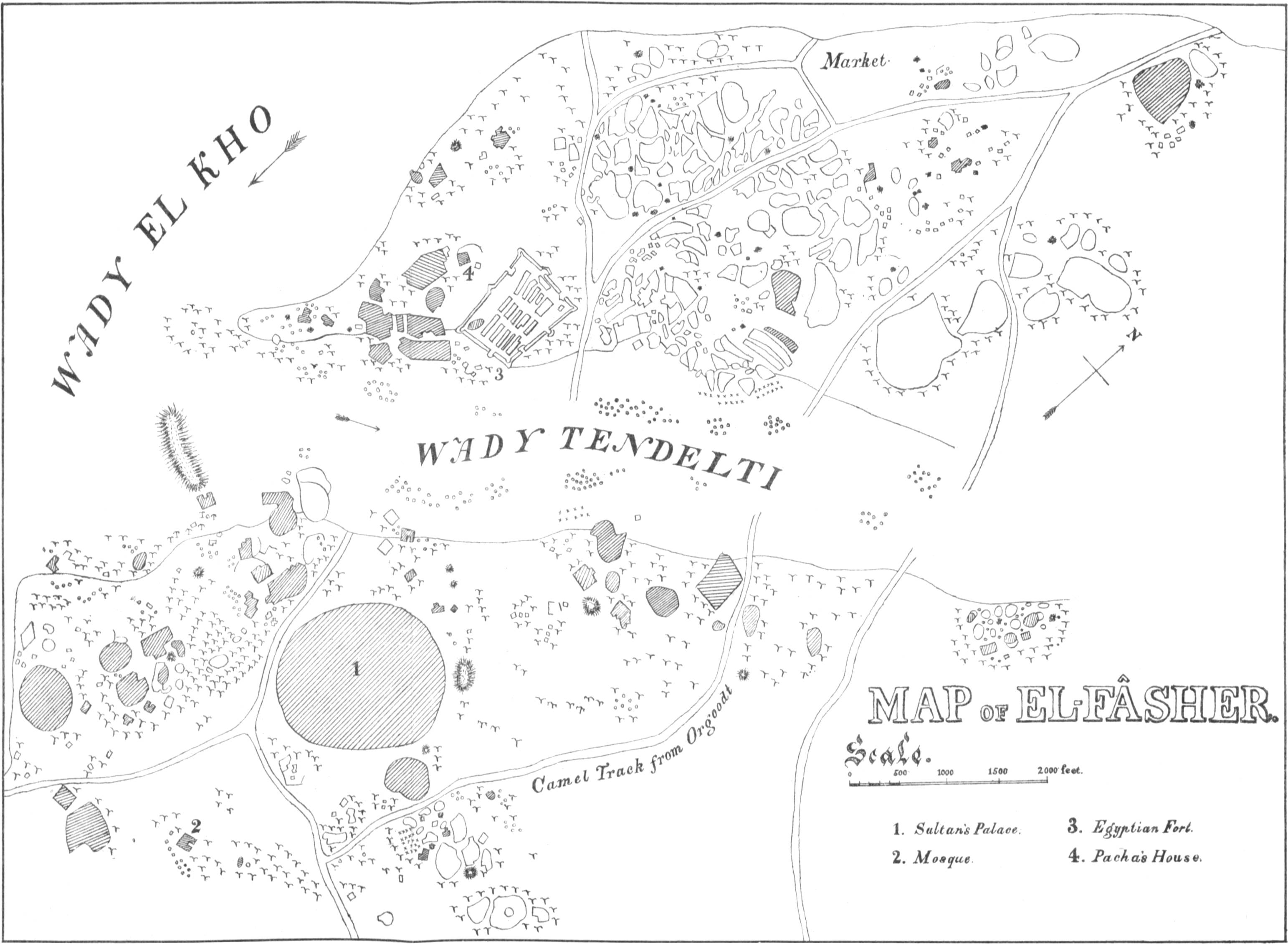
[153]CHAPTER XV.
EL FASHER.
A blind sentinel. — Invitation to the palace. — Description of our quarters there. — Population. — The painted chamber. — Hassan Pacha. — Curaçoa and concert.
EL FASHER, or Tendelty, stands on the western bank of the Wady Tendelty, in an angle formed by the junction of the latter with the far more considerable Wady el Kho. The Tendelty partakes more of the character of an inlet than of an independent wady, and has no current of its own; it is filled, during the rains, by the overflow from the Kho, and a dam constructed near the point of junction retains the water for a considerable time; the wells which supply the town are all sunk in its bed. The town consists almost entirely of “tuckles,” and of box-shaped straw sheds, similar to[154] those described at Karnac. On the eastern side of the Tendelty, stands the palace of the late Sultan; a group of mud huts, and a few “tuckles,” surrounded by a mud wall about twenty feet high. In the neighbourhood of the palace are several mud huts formerly occupied by the officials and nobles of the court, and all of the poorest and meanest possible description. On the town side, directly opposite the palace, the Egyptians have constructed a square fort with bank and trench; one gun is posted on each angle to command the town, and four sentries march up and down the top of the bank; one on each side of the square.
On our arrival, we passed the palace on our left, and, crossing over to the town, not without considerable danger of tumbling down some of the numerous wells, which are scattered about in every direction in the wady, we halted the caravan near the fort and commenced, amidst the growling of the camels, to unload, and prepared to pitch the tents. These suspicious proceedings on our part were, however, not unobserved; the sentry pacing about on the bank saw us, and was evidently sorely puzzled in his mind. He came to a dead stop in the middle of his march, and grounded his “Remington”; then as a mariner on the pier at Ramsgate lifts his hand to his eyes and gazes over the ocean to see if a ship be in sight, so he raised his hand to his tarboosh to shelter his eyes from the sun, and gazed at us earnestly, anxiously and long. We were only a hundred yards off, and the truth at length dawned upon him; it was a caravan, and its people were pitching their tents. His mind was made up at once, action was taken, and the[155] garrison was alarmed. By the time the tents were all pitched and the beds made, a file of soldiers, headed by an officer, came into our camp with orders that we must move, as our presence there might afford cover for an attack on the fort from the town.
In the nature of things it is impossible to imagine that such a request could be heard by Mohommed Effendi, lieutenant of the troops, without producing material effect on the equanimity of the mind of that irascible little gentleman. He went raving mad on the spot. Had he not been restrained, I am thoroughly persuaded that he would, there and then, have torn the officer and whole file of soldiers into little bits. That poor officer was pale with dread; panic was about to seize his men which, spreading to the garrison, might have had disastrous results, and left us helpless and unprotected in the heart of Darfoor, where we might have fallen victims to our policy of aggression and imperialism. We saw the danger, and peremptorily told Mohommed Effendi to shut up. We asked the officer into our tent, and gave him a cup of coffee as a restorative. By slow, but perceptible degrees, from deadly pale to sickly yellow, from sickly yellow to whitey-brown, his face assumed its normal hue, a smile of relief parted his lips, and he placed between them one of our Hamburg cigars. We now inquired what the matter was, and what all the row was about?
“Orders had been issued that no tents were to be pitched within a certain distance of the fort, and he had come to our camp to tell us so.”
This seemed to us reasonable enough, but we asked[156] him why intimation was not sent to us before the tents were all pitched?
“The vigilant sentry on the bank had been staring at us for at least half-an-hour, leaning on his rifle, with his hand over his eyes sheltering them from the sun; why not have let us know at once?”
“That soldier was nearly blind with ophthalmia.”
“Then why not send him into our camp? There was a ‘hakeem’ with us who would be glad to treat him.”
The bright smile on the face of the warrior grew brighter still; it seemed we were again to be saved by our all powerful medicine man.
“He would go and see what could be done.”
During his absence a message came from the palace begging us to take up our quarters there while we were in El Fasher. This we decided at once to do, and leaving orders for the tents to be struck, we walked over, and never saw the officer again or heard what decision was come to in the fort.
The message had come from Colonel Mason, an American officer, attached to the staff at Cairo, who had accompanied, with Colonel Purdey, another American officer, the Egyptian army of occupation; the latter officer was away in Wadai, and it was not our pleasure to meet him. Colonel Mason was an old friend whom more than one member of our expedition, including myself, had known in Cairo and on the Nile in 1871-72. The meeting was a joyous—almost a rapturous one. It is pleasant to meet an old friend in a weary land remote from home. There are a thousand questions to ask—a thousand to answer; adventures to listen to—adventures[157] to tell, many friends to inquire after, and many inquiries after friends to reply to. After a time our friend offered to show us the beauties of the palace, and to find quarters for us. Two of the houses, or rooms, one on each side of the main entrance, had been fitted up by Colonels Mason and Purdey for their own use; the height of the walls had been increased by timber-work, and covered with matting; the mud floor had been boarded with Norway pine planks, which had found their way through England to Cairo, thence by river and desert to Khartoom, and finally on the backs of camels through Khordofân to El Fasher where, on arrival, they had probably cost the Egyptian taxpayer about five pounds a yard run. The next room on the left, in which a large table had been rudely constructed was the dining-room, and at the back of an adjacent yard was the kitchen with grates, &c. already fixed. All these improvements had, of course, been made since the arrival of the Egyptians. Further to the back, in a court by itself, a one-roomed house with a doorway, and no window or light-hole, was assigned to me. This room, I was told, had been the chief dwelling of the chief wife of the late Sultan; it was as well built as any house in the group; the walls were thick, and the roof was formed by entire trees laid across, thickly interlaced with straw, and utterly impervious to sun and rain. The floor was hard and clean, and in the darkest corner was a mud elevation on which I placed my camp bedstead. Colonel Mason, in introducing me to these comfortable quarters, expressed for me his profound regret that the former occupant was no longer there. I appreciated his kindness[158] and his politeness, but could not conscientiously confess to any participation in the regret.
Our camp furniture had now arrived, and soon the apartment assumed quite a comfortable appearance. The bath was placed in the centre of the room, filled with water cool and fresh from the wells. While enjoying its luxuries, and reading letters and papers from England, eight weeks old, but whose news was as delightful and fresh to me as the water, the lieutenant of engineers gave a grunt in the doorway, in lieu of knocking at the door, and came in to impart such information concerning the population of El Fasher, as he had been able to glean in the last hour or two:—
Natives, 1,700.
Es Sâyadeeyeh, 300.
Es Sâbah, 250.
El Melhah, 400.
Total population, 55,000.
The study of numbers with the mazes of addition, multiplication, &c., has always afforded me much delight from my youth up even till now; here, however, was a simple sum in addition which caused me more perplexity and bewilderment than any example in the first four rules which had previously come under my notice. I added up, in my bath, the natives with the three Arab tribes of settlers, but was utterly unable to make the amount agree with what the late Mr. Joseph Hume used to call the “tottle of the whole.” I added it up again, first forwards and backwards, then backwards and forwards, and finally laid it down to await Mohommed Effendi’s explanation, and looked at the walls of my chamber.
[159]They were decorated, or disfigured; four colours were used in the process, brick red, yellow ochre, black, and white; weird cabalistic shapes, a black circle with a red patch in the centre, a white square with a yellow patch in the centre, a straightish line in red over them both, a red triangle, three waved lines in black, yellow and red; a crooked line, then a square, then a triangle, then a circle, then more lines, then all slightly varied over again; no taste, no beauty, no symmetry, only grim, barbaric hideousness; a savage, angering, geometrical, party-coloured nightmare. Like this my room was painted on four walls from roof to ground. Furawee art!
Having finished my bathing, and toileted myself to my satisfaction, I sought Mohommed Effendi and the explanation. The 55,000 related to the province of El Fasher, which included villages distant twenty or thirty miles in every direction, and which is in area about as large as our county of Devonshire. All subsequent inquiries have failed to alter materially the lieutenant’s statistics; some accounts make the population of the town as high as three thousand, but the majority and the best agree more nearly with his two thousand six hundred and fifty.
I was just sitting down to comfortably converse with my newly-discovered old friend, when a message came to the palace begging us to come and dine with Hassan Pasha, governor of Darfoor since the departure of Ismael Pacha Ayoob. To go was not pleasant, to refuse was not polite, so away we all marched. Hassan Pacha lived close to the fort, in a well-built house recently[160] constructed; he received us in his audience room, which was furnished with a deal table and chairs in the European style. Dinner was not ready, but on the table were several green and yellow glass decanters, containing curaçoa, “Mousseline des Alpes,” and other liqueurs of which we were requested to partake.
The Korân forbids the use of wine, but enlightened and thirsty Mohommedans do not consider that the prohibition necessarily extends to spirits, and much less to curaçoa, “Mousseline des Alpes,” and Angostura bitters, which are, of course, not mentioned in that sacred book at all.
Hassan Pacha at once commenced the usual inquiries concerning the state of our healths, and that of our relations. This lasted about an hour, at the expiration of which time he had arrived at our remote and problematical cousins, when two soldiers entered to lay the cloth, and to place round the three-pronged iron forks, black-handled knives, and blue willow-pattern cracked soup-plates, reserved for the use of European guests. All this done, and a plate of bay salt and a pot of black pepper placed on the table, a fine sheep, roasted whole, emitting a grateful odour not surpassed by that which emanates from the grating of any London eating-house, was carried in on a large tray by four stalwart soldiers, who walked slowly, and mutually and kindly advised each other as they proceeded to be very careful what they were about. The Pacha took his place, and begged us to take ours; carving knife or fork there was none, and each helped himself to the part he liked best with his own black handled knife and three-pronged iron fork.
[161]Here we were in the desert, two thousand miles distant from Cairo and civilisation, and, with the exception of so much of the latter commodity as sat at the table and mangled the sheep, no civilisation anywhere nearer. Probably the last thing we should have thought of as likely to be near to afford us delight and surprise was a first-class band of music. I have used the words “delight” and “surprise,” but not these or any other two words can mean the feeling with which I listened spelled to the strains of the overture of Verdi’s latest opera, Aïda, which the military band commenced to play just outside the door of the Pacha’s house. I had seen the opera before in Cairo, and have seen it since in Naples and in London, but not all the rich magnificence of San Carlo, or “Her Majesty’s,” and not the lustrous eyes and glorious song of Patti, produced anything like the sublimity of that music in the desert in the middle of barbarism, where other music there was none but droning boys, squeaking pipes, and monotonous tom-toms. The overture finished, we heartily thanked the Pacha for his thoughtfulness;—the kind old man was evidently pleased with our pleasure.
The sheep being finished with, the four soldiers made their appearance, and, as before, advising each other to be very careful, lifted the tray and remains bodily over our heads. Another tray was brought containing a mass of “duchn,” which, having been boiled in a sheep-skin, nearly retained the form of a sheep; a large bowl of brown sugar was emptied by one of the soldiers over the pudding, and iron spoons were served round to each of us. The duchn, in consistency and taste, was like[162] blanc mange, but not having been flavoured with any essence, was not palatable, even with the brown sugar.
New music and more liqueurs, and “God save the Queen” brought the evening to a close, and we walked over to the palace, pleased with the Pasha and with his curaçoa and concert; and, notwithstanding the dream-inspiring memories of boiled “duchn” and music, and the staring talismanic horrors on the walls of my chamber, I slept dreamlessly, superbly and well.
[163]CHAPTER XVI.
EL FASHER.
A cavalcade. — Love. — Romance. — The market-place. — A big battle. — Morality in Darfoor. — The town. — The Greek merchants. — A bottle of beer. — Wealth. — Half a curiosity. — “Backsheesh.”
WE had much to do at El Fasher, in plotting our work from Om-Badr in order to enable us to decide upon the relative merits of the two routes over which we had travelled, and in taking and reducing our astronomical observations. It was agreed that we should work until a certain hour each day, after which we should wander about in the neighbourhood and glean such information concerning the natives of the country and habits of the people as might be of general interest.
On the day following our arrival, I told Mohommed,[164] the lunch soldier, to go into the town and bring back four donkeys; to hire them upon reasonable terms and, if possible, to make the contract price payable in money, and not in rags. After a time he arrived with four small, sore-backed insignificant animals, without either bridle or saddle, all four for one piastre (2½d.) per day, including a small boy. Mohommed Effendi, Mohommed the guide, the lunch soldier, and myself were to form the party, but before starting it was necessary to improvise a saddle of some sort. The soldier brought my camel-saddle, which, being nearly as large as the donkey itself, did not fit, and I told the soldier he might use it himself. I was obliged to have recourse to my own powers of invention; I first placed on the sore part of the donkey’s back a copy of the Illustrated London News, and over that Mohommed Effendi’s large flock bed, which he kindly lent me for the purpose, and which, being more than six feet long and four feet wide, nearly reached to the ground on either side, and overlapped to the extent of about a foot behind, where the view closely resembled the gable end of a small cottage with vast overhanging eaves. The saddle was in every respect comfortable, and offered to the rider many conveniences; I could ride either in the usual and orthodox manner, or could, if so inclined, sit facing either to the near or off side, according as matters of interest arose to the right or left of the path; or again, I could, without much difficulty, turn round and ride facing the gable end of the donkey, and gaze upon the beauties of the prospect through which we had passed. Everything was at length ready, and we started, like Haroon-al-Rasheed, in search of[165] adventures. We proceeded in Indian file—I leading, with the donkey-boy walking at my side holding over my head Mohommed Effendi’s huge white cotton umbrella. The soldier came last, perched on the top of the camel-saddle, which wabbled about very considerably, and caused the bottles and plates in the lunch bag to rattle much, and to make music suitable to so imposing a cavalcade. The officer and the guide rode between without saddles of any kind; each, however, compensated himself for the deficiency by smoking, as he travelled, a very long pipe; the stem rested on the forehead of the donkey, between its ears, and the bowl reached to about six inches below its nose; the smoke was wafted by the gentle breeze into its nostrils, and the patient animal shared with the rider on its mangy back the fragrant odour of the soothing weed.
We wended our way towards the market-place. On our right we passed a young man and woman in earnest conversation at the door of a tuckle. I could guess the subject of their talk; the eloquent look, the stars and the diamonds sparkling in their coal-black eyes, told me it was love, beautiful love.
Still in this young couple there was visible through all their love an unmistakable look of anxiety, of fear, perhaps of guilt—it might be crime. A knife was lying near with blood on its blade, and the man’s hand was stained. Was this then, perhaps, an African romance, a pathetic and soul-stirring story of first and youthful love, beginning in smiles and black blushes pure as the moonlit Alpine snow, then little quarrels about trifles, and secret tears and reconciliation paying for the pain, then torrid and relentless tropical passion, and raging jealousy culminating in insane crime and the blood of a murdered rival?
“Yah Mohommed! go and learn for me this story, and come back and say whether it is, as I suppose, a story of love and of appalling crime.”
After a few minutes:
“O Effendim! The man is a butcher and has just killed a cow in the market, and the woman is his neighbour’s wife, and her husband is in the market selling duchn, and they have been into his tuckle and have drunk much merissa.”
A few more yards brought us into the market, which is held in El Fasher every day. There was none of the life, bustle, noise, and enterprise usual in an English market-place; dead silence prevailed, and had it not been for the bright light of the sun, the place would have been burdening in its melancholy. The vendors, men, women, and children, sat on the ground, and in front of each was a not ill-made yellow grass tray, or[167] dish, in which the wares for sale were exposed; in one tray were, perhaps, about two pounds of duchn; in the next the same quantity of cotton, still with the seeds; in the next half a pound of green tobacco, or dry bamias, then, perhaps, a large piece of beef, about ten or twelve pounds, covered with great flies, which every now and then would all buzz from their feast into the air with hideous noise, and return in a few seconds and settle down hungry as before. The offal from the beasts which had been slaughtered, was in one mountain in the centre of the market-place, and the congregation of black flies settled upon it made it look, from a little distance, like a heap of cinders. Over this, high in the sky, two or three vultures wheeled in circles on their motionless wings, eager for the business of the day to be finished, that they might get their share of the food before the hyenas came in the night to swallow it all away.
From the direction whence we had come there came a great and sudden noise of men in violent altercation. Some one had whispered
into the ear of the man selling duchn, whose wife we had seen, a short time before, outside the “tuckle” talking with the butcher. The two men now entered the market shouting and gesticulating, and seemingly about to begin a big battle. Foorawee love, with its imagined romance and real ugliness, I had already seen; here was an opportunity of witnessing Foorawee war. The opportunity was not to be lost, we turned the cavalcade towards the angry and eager combatants.
[168]“Five piastres to the man who wins!” I called in my enthusiasm to see a real African fight. The eyes of each sparkled at the sum; the shouts rose in loudness and in number, hands were clenched and held forth defiantly, or swung round windmill fashion, but still came not in contact with anything likely to arrest their progress; heads were lowered ready to butt and to destroy, but still the maddened combatants remained unharmed. As one advanced the other receded, until their gyrations brought them into the centre of the market, and they chased each other, first one, then the other, round the offal covered with the flies.
Suddenly, chameleon-like, or like the transformation scene at a pantomime, the heap changed from black to its true colours of “magenta” and “solferino”; the flies left it, and swarmed, buzzing and angry, in one dense cloud round the heads of the yelling and leaping fiends.
“A dollar to the man who wins, and half a dollar to the loser!”
It was too much; the men stood dead still, and ceased to yell, but the flies still buzzed. The suffered injury, and the promised dollar, fired the soul of the man who sold the duchn; he watched his opportunity, lowered his head, and butted with all his weight full in the butcher’s breast. It was a battering ram: the butcher was bowled clean over backwards into the middle of the heap, and his adversary cast himself upon him. The two men thumped, bawled, and bit each other, and sprawled, kicked, and struggled about in the offal like two great fish floundering and disporting themselves in[169] the warm shallow water. Even the vultures, wheeling slowly in the lofty air, became excited, flapped their wings and increased the orbit of their flight, alarmed at seeing their anticipated dinner kicked and scattered about in every direction. The teeth were the principal weapons used by the combatants. In a few minutes the butcher rose, bitten and bleeding. One horrible unearthly shriek, a high leap over the “magenta” and “solferino” mountain, and another over the heads of the still sitting and impassible market people, and he bounded away, followed by a cloud of flies, out of sight into the distant desert.
I gave the man his dollar, and, after spitting from his mouth the odds and ends of his adversary, he gave me in return a proud exultant smile. The wife, whom I had not yet observed, had arrived on the scene; they conferred together for a few seconds, after which she approached me, and asked for the half-dollar for the loser, she would give it him. I gave it to her, and she and her husband went home rich in money and in restored conjugal felicity.
Subsequent inquiry, observation, and reflection, have convinced me that social morality in Darfoor is at as low an ebb as it is possible to be; even the semblance of propriety is not regarded or expected. The last page of our Prayer Book whose title is, “A Table of Kindred and Affinity wherein whosoever are related are forbidden in Scripture and our laws to marry together,” would, if printed without the only two nots it contains, represent a state of things, not which might arise, but which absolutely exists in Darfoor. Only among the higher[170] classes is the ceremony of marriage ever performed; among the majority of the people it is dispensed with altogether, and this circumstance, alone, prevents it being said with truth that polygamy is general in the country.
A gentle walk round the market-place disclosed only a succession of such wares as I have described, and nothing which the most inveterate curiosity-monger could have purchased with a prospect of exciting the interest of his friends. I bought a bag of “duchn,” and brought it home with me to England, and planted some of it on the sunny-side of a back garden; it has not, however, yet ever appeared above ground, although it has had ample time to do so had it felt so disposed.
The town all round was lonely and hot, dirty, dusty and dull; “tuckles” and sheds, black with smoke, rotten with filth and age, and whose pristine not inelegant shape had been distorted and marred by the storms and rains of a long succession of years, were scattered about in their enclosures without attempt at arrangement or convenience. There was no stir, no life, no signs of happiness, only sloth, apathy, and sleep and flies. There was, however, one exception to all this; the shed of a Greek merchant, which he had built himself as a storehouse and residence. He had been here three years collecting ivory and ostrich feathers, in exchange for his Manchester “tobes,” French wines, brandy, and pale ale. He had been successful, and the shed was richly stored with fine tusks, six to eight feet long, and heavy as a man could lift, and with ostrich feathers, plentiful, long, and exquisitely white, and worth[171] from a pound to five-and-twenty shillings a-piece. To get these he employed the natives of the country round at a piastre a day, and they travelled for him, far and wide, to the west and south, and brought him honestly all they took, and were satisfied if their earnings would enable them to drink, every day for a week, as much French brandy or bottled ale as they could swallow. We stopped the cavalcade opposite his door, delighted to find a resting-place for lunch. Our jaded steeds were our first care, and we gave them water, which they would not drink, and “duchn,” which they voraciously ate, and wanted more, which they got. The Greek came out, followed by other Greeks, all armed with pistols and long knives, looking like cut-throats, but amiable and good-natured, talkative and polite, and anxious to do business. Mohommed, the soldier, brought the lunch bag; but alas the wabbling! the bottles were broken, and the plates and the glasses, and the biscuits and bread were soft and red with the wasted wine. The cold mutton with a vinous taste, the tin of asparagus, the box of sardines, and the pot of jam were placed on the table, and the good Greek lent us plates, gave us “duchn” cake, and by invitation sat down to join Mohommed Effendi and myself. Something to drink was needful. I had not tasted bottled beer since leaving Cairo, more than four months ago. Tennant’s ale, in stone bottles for export, was inside; I bought some, cool, refreshing, very much up, clear as a topaz, and altogether surpassingly delicious, 4s. 2d. a bottle.
After lunch our host showed us over his store. Elephants’ tusks, however, I was not in want of; and[172] ostrich feathers, should I at any time require those ornaments, are much cheaper in London already curled and ready for use; but the mention of a rhinoceros horn, stowed away somewhere, excited my cupidity and curiosity. The coveted horn was at length found, but not entire. The slaughter of its original owner in some remote southern jungle had been a joint-stock affair, and the partners had divided the proceeds equally between them. The half offered to me was about thirty inches long, one inch and a half broad at the base, and tapering to a point fine as a needle. The whole original must have been a tremendous weapon, calculated to make a hole right through the body of an elephant. I was not, however, disposed to purchase, at a fancy price, half a curiosity, and left it behind. When, later on, I reached the palace and went to my room, I found it on my bed, with a little note begging my acceptance of it as “backsheesh.” I much regret to say that it was lost on our journey home.
This, my first ramble through the town of El Fasher, and the sight of its poverty and misery, sin, sorrowfulness, and ugly dirt, did not impress me much in its favour, and I determined, if ever I rambled again, to go further and, perhaps, to fare worse.
[173]CHAPTER XVII.
AT EL FASHER.
An early visitor. — A bargain. — A bad boy. — A dilemma and a half. — Deserted. — Welcome help. — My first lesson. — An incompetent tutor.
WITH the exception of the bed of the Wady el Kho, the country all round El Fasher, for a distance of ten or fifteen miles, is utter desert, and no villages are within that distance.
My wanderings in the town had afforded me neither pleasure nor profit, and the suburban wilderness of sand and small stones offered even less inducement for a stroll. In order to profitably occupy my spare time, I determined, after due and long consultation with Mohommed Effendi, to engage a Foorawee tutor and to[174] acquire so much of the language as might be useful immediately or in after life. My requirements were not many; I wished only to learn a few words of the vocabulary, the alphabet (if any existed), and to ascertain whether any written characters were in use. The lieutenant, or, as he called himself, my aide-de-camp, kindly volunteered to go out and endeavour to find a respectable and suitable person capable of imparting the above information.
The Foorawee language is not much used in this eastern and northern part of Darfoor; the constant intercourse with the numerous Arab tribes has nearly killed the original language. Further west, however, it is, I have been given to understand, universally spoken. Of all the men and boys whom we afterwards employed in our field-work, only a small proportion could speak Foorawee fluently, and only one, from another part of the country, was ignorant of Arabic.
Mohommed Effendi was a long time absent, and did not return that day.
It was my custom, in the desert as well as here, when shelter from the bright moonlight was to be had, to move my bed out of the tent or house and to sleep in the open night. On the morning following Mohommed Effendi’s departure, when I opened my eyes, as usual, just as the sun was about to show himself above the horizon, I saw at my bedside, facing me, about a yard off, a squatted hideous figure staring intently into my eyes.
“Frankenstein” was the first word that came, not to my lips, but into my mind. It was many years since I[175] had read Mrs. Shelley’s awful book, and I had not been dreaming, but the idea came at once, the picture was irresistible. Of which sex the figure was I could not guess; the hands were folded over the breast with the ragged garments to keep away the cold, the shoulders were wide, and the arms long, hard, and muscular, and evidently of almost superhuman strength. The figure standing must have been at least six feet two or three inches. The head was small, very small, scarcely larger than that of an infant; the nose was prominent and sharp, but of chin there was almost none; the upper lip was at least two inches long, and the mouth was wide with hardly visible lips. The eyes were small, beady and black, cunning and remorseless. Over the face the skin was tight, and glistened as though seared with a hot iron, or like the scales of a serpent. Altogether the face was utterly unlike anything I had ever seen before, and there was nothing about it by which I could judge of its age; it might have been that of an evil-minded half-deformed imp of a child, or it might have been that of an aged person, half lunatic, half idiot.
After rubbing my eyes well I endeavoured to fix them upon those of the creature, but found it impossible, the expression was too penetrating, unearthly, and horrible. I asked:
“What’s the matter?”
“My husband is coming.”
The figure was therefore a woman. The voice was small and shrill, like that of an angry, petulant, malignant child.
[176]“What’s he coming for?”
“Here he is.”
The woman stood up, rising without moving her arms or feet, like a sort of automaton. My estimate as to her height was not much wrong. The husband, quite an ordinary mortal, came into the enclosure. He walked straight up to me in bed and stretched out his hand to be shaken. The woman then followed his example, and the clasp of the dry, cold, snake-like figures I can plainly feel now, and shudder as I write. The two squatted down side by side, and, as before, I asked:
“What’s the matter?”
The man replied: “I can teach you the Foorawee language.”
I asked: “How much a lesson?”
The pair looked at each other, without a word, for a few seconds, and then rose and walked some distance beyond hearing. On their return they sat down as before, and the man, always spokesman, said:
“You say how much.”
I replied: “A piastre.”
As before, after looking at each other, they retired, and on returning:
“Ten piastres.”
The margin was large between one piastre and ten, but in this struggle with barbarism and its female demon ally I was determined not to be beaten. I was becoming quite interested.
“Who is to teach me?” I asked.
“Sometimes I, sometimes my wife.”
I thought of Byron’s lines:
and smiled as they came to my recollection.
The additional inducement had its effect upon me, and I offered two piastres per lesson, to last as long as I might like. The loving pair again departed in silence, and returned to name another sum, I think eight piastres. Suffice it to tell that, after many departures for the purposes of conference, an agreement was at length come to for three piastres a lesson.
I told them, if they liked, to go into the kitchen and ask for Jacoob, he would give them some coffee; and that I would shortly appear to arrange the time and place for the first lesson. They both rose and shook hands again; the woman’s hand was warmer. So well do I remember her two horrid shakes, that I could now almost tell the exact number of degrees of increase of temperature of the second over the first; the horrid warm was worse than the horrid cold.
After dressing myself, I found them in the kitchen sipping scalding hot coffee and gnawing some cold bones which Jacoob had given them for breakfast. It was arranged that I should come over to their tuckle, some distance beyond the town, and which everybody knew, at two o’clock the next afternoon to take my first lesson. At the appointed time, again borrowing Mohommed[178] Effendi’s bed, I called for my donkey-boy, who knew where I wished to go, and, with an alarmed expression of face, told me the woman was a witch, renowned in all the country, and that it would be much better to stop where I was, and not to go and see her at all. Everything was at length ready, and I started on my journey.
But in Darfoor, as in all other countries, L’homme propose et Dieu dispose. I was not destined to reach the end of my journey that day. The donkey-boy was evidently not pleased with the destination, and the donkey, from sympathy or, as I verily believe, from being unkindly and surreptitiously prodded behind, became restive in his gait, unstable in his demeanour, and quite unhappy in his mind; I had much difficulty in keeping my seat, and the saddle, already nearly reaching to the ground on either side, became displaced, and trailed on one side in the dirt and sand. It was necessary to alight and, with the aid of the donkey-boy, to properly adjust it. Suddenly, as my right leg was lifted high in the air ready to be thrown over the donkey’s back to remount, the boy tossed off the saddle, Mohommed Effendi’s bed, into the dirt, and, jumping professionally into what should have been my seat, before I had time to realise the situation or to get my right leg into its normal and perpendicular position, shouted “Yah, yah!” like a London halfpenny boy, and galloped away with the speed of the wind.
I was now in a predicament. The bed belonged to Mohommed Effendi, and it was necessarily a point of duty with me that it should be returned to him in due time and in such proper condition that his night’s rest[179] should not be interfered with. To shout after the boy, or to attempt to run after the donkey, would be not only futile, but utterly wanting in the sombre dignity which it is so necessary to preserve in Eastern lands. After mature consideration I came to the conclusion that there were three courses open to me: I could walk into the distant town and wander beseechingly from tuckle to tuckle, with only three piastres in my pocket, the price of the lesson, and endeavour to find some one able and willing to carry the bed back to its lawful owner; I could, like a collier with a sack of coals, lift it on to my back, and so take it away home; or I could, as a third course, wait where I was and sit quietly down on the bed in the expectation of fortune sending me some one to bring me out of my difficulty. To the first course the objection was that I should be compelled to leave the bed in an unprotected state, and that the prowling dogs and hyenas, attracted by so strange an appearance in the desert, might pay it a visit and, perhaps, even venture to lie down upon it and go to sleep. The objection to the second course was that it was impossible. The bed was long and wide, and six inches thick, and, from many years of long and happy sleep, by day and night, had become heavy and conglomerated, and to carry it far was not in my power. Of three courses, a dilemma and a half, I decided to adopt the third, and, spreading the bed on the ground, sat down cross-legged upon it, lighted a pipe, and watched, in peace and forgetfulness of my trouble, the afternoon sun sink in slow splendour towards the purple serrated tops of the distant Gebel Marra.
[180]One pipe, many pipes—two hours, and I was still in oblivion and contented helplessness. The sun was already taking off his golden and gaudy superfluous apparel, and, more fortunate than I, preparing for comfortable nightly repose, which for myself I could see no prospect of obtaining.
Out of the west two tall figures, like coming events casting their shadows before, approached towards where I sat. I rose and hastened towards them, to secure if possible their much needed assistance. The one was my friend of the morning, and the other evidently her sister, her counterpart; as tall, as muscular, as demoniacal, the two seemingly twins. The sole difference, striking and horrible, was a white cataract, opalescent in the light of the rising moon, in the eye of sister number two. Each carried a jar on her head, and the husband, with another jar, was a short distance behind. They had all three been on foot to the slopes of the Gebel Marra to purchase a supply of duchn, and had not comprehended my arrangement for two o’clock, hours, in Darfoor, not being known, time being computed by days. I was not, however, disposed to quarrel with them for their breach of engagement; I was too overjoyed to see them. The circumstance of the flight of the donkey-boy, and the consequent plight to which I had been reduced, inspired the sisters with just indignation, and the three little black beads of eyes sparkled dangerously. They thought the boy ought to be killed, and I have no doubt that for a good-sized cotton pocket-handkerchief the two would have joyfully departed on an errand of murder, and would have[181] strangled the unhappy boy that very night. There was yet an hour before dinner, and I thought the time could not be better employed than in taking my first lesson. I sat down on the bed, and the man squatted on the ground in front of me with the three jars ranged behind him; the two women nestled lovingly and close to me, one on each side—I was evidently already a pet of theirs.
I have alluded to the individual who was to impart to me the rudiments of the Foorawee language as a “tutor,” but did not wish to imply that giving instruction in languages was his profession. He was simply, like all the other inhabitants of El Fasher, a tiller of the soil and a vendor of its produce. His engagement with me was his first undertaking to teach, and, most probably, his last. I was aware of this, and, of course, did not expect much. The few questions, which I had now time to put, had reference only to the existence of letters, of an alphabet, and of written characters. Of such things he knew nothing whatever, and to my every query his reply was a sound with the lips as of a soft administered kiss, which, in Foorawee, as in the Arabic as spoken in these latitudes, means “no.” This sound, vigorously echoed every time by the two women nestled close against me, although resuscitative of memories long dormant and not destitute of pleasure, began to make this, my first introductory three-piastres-worth of lesson, somewhat tedious and strictly monotonous.
Louder, shriller and more frequent came the kiss-like “noes”; closely and more closely to my either side pressed the hideous twins, hot and damp; night,[182] with a million poet stars filling its eloquent immensity, fell lustrous over the face of the dead and boundless desert, and Nature whispered, softly but unmistakably, “Jacoob is laying the cloth.”
It was necessary to start homewards. I gave the man his three piastres, and, after wishing me good-bye, he departed with the sister. The wife rolled up the bed, and taking it under her arm, accompanied me in silence to the palace. The boy who had served me so scurvy a trick was there in fear and trembling, sent back by his parents.
On the following day I repaired to the tutor’s tuckle. It was distant, and the interior was dirty and hot; there was but one “angereb,” and we sat as before, the damp twins one on each side of me, and the man on the ground in front. Every five or ten minutes they emptied between them a gourd of “merissa,” holding nearly a quart. The attentions of the ladies grew in two senses warm, and I made no progress. They grew jealous of each other, and squabbled over every word. The man grew jealous of me, and my position was becoming uncomfortable. I cancelled the contract, refused to drink a gourd of “merissa,” jumped on to my donkey, and rode home as ignorant of the Foorawee language as if it had never been my good fortune to go to El Fasher.
[183]CHAPTER XVIII.
A RIDE TO KOBBE.
A conclave. — Hyenas. — Mohommed’s love. — Mohommed’s prayer. — Its effect. — A runaway camel. — A search for a lion. — The wake of the “ship of the desert.” — A welcome supper. — Two scientific men. — Kobbe. — A scrap of paper.
AS our work in El Fasher drew towards its close, a very serious discussion arose among the members of the staff, involving a question of no less importance than the very essence of the Fourth Commandment. The Mohommedan Sabbath is Friday, and all our officers and men were naturally very anxious that this day should, during our work in the field, be kept as a day of rest to enable them to say the orthodox number of prayers, and to take the requisite number of hours’ sleep in order that they might be fit, both spiritually and temporally,[184] for the resumption of work on the following day. Our own Sabbath was of course Sunday, and our anxiety that the day should be becomingly honoured by grateful repose was not less heartfelt than that of the Mohommedans. For ourselves to abstain from work on Sunday and let the men work would be simply preposterous, as they could do nothing without our guidance; for us to work on the Friday while the men were resting and praying, would be, perhaps, more preposterous still, as we could do nothing without their assistance. The question, therefore, arose—on which day should we rest from our labour. Some were in favour of Sunday, others in favour of Friday. To recapitulate the arguments adduced by the learned theologians composing this conclave would be foreign to the nature of this work, which is not theological. Happily an agreement was at length come to. Mutual concessions, creditable to both sides, were made, and it was resolved nem. con. that we should rest from our labours both on the Friday and on the Sunday.
This arrangement was satisfactory to all parties concerned.
Availing myself of the opportunity thus presented, I determined late on Thursday evening to set out that night on a journey to Kobbe, to consider the intervening Saturday a dies non, and to return by the following Sunday night or early on Monday morning. I had no map of the country, but from inquiries judged the town, which was in the Wady el Kho, to be distant between thirty and forty miles in a north-westerly direction.
[185]I made up my mind to go without a guide, as at that late hour, when everyone in El Fasher was fast asleep, it would be impossible to find one.
Mohommed Gadderâb was to accompany me; he had never been to Kobbe before, but neither of us anticipated any difficulty in finding the way. Our arrangements, two skins of water and one of cabin biscuits, were soon completed, and we left the palace at about midnight. Passing through the silent town we disturbed several hyenas, hard at work in the market-place, making disgusting noises in their efforts to masticate and gorge some delicate morsels too tough for their teeth and too large for their throats. We soon left the last houses behind us, and, after crossing the Wady el Kho, started across the trackless wilderness.
The night, like all the nights, was indescribably beautiful but more than usually cold, and Mohommed pulled the date-basket more closely over his ears, and rolled the ropes three or four times round his neck to protect it from the air. We trotted gently side by side, and my faithful friend and guide, generally, like all Arabs, so reticent, chatted gaily as we went, and opened his heart, and, though I was younger than he, called me his father. He told me of his mother and children, and how he loved them, and of his wife whom he venerated and loved more than all the others put together, and how there was only one thing more in the whole world he wished for, and that was, when he grew rich, to marry again—a beautiful daughter of a wealthy shiekh. When our expedition was over and he obtained his money, an event he by no means considered a[186] certainty, he intended to do this, to give up guiding, and to settle down in peace and contentment for the rest of his days—if the two wives did not quarrel much. I liked the man, and he, I believe, was sincerely devoted to me. I promised him, on our safe return to Old Dongola, a substantial “backsheesh,” with the hope that it might help him in carrying out his matrimonial projects. They were, however, never realised, but abandoned before he reached his home, when his thoughts had reference less to a second wife in this world than to the diviner houris he anticipated meeting in the next.
The deep indigo of the night changed to the pale grey of the dawn, the stars faded one by one in the sky,
Venus’s light was soon put out, and in five more minutes the sun rose and changed the whole of the heavens to blue and gold. Mohommed Gadderâb unrolled the rope from his neck, loosened the date-basket on his head, made his camel kneel down, and then, turning towards the rising sun, knelt down too, and said from his simple heart his simple prayer.
The genuflexions, the sudden rises and falls, the many bowings down of the head and date-basket and ropes into the sand in adoration of Allah and of the Great Prophet Mohommed, produced in my camel, who was not in the habit of witnessing so extraordinary a performance, a sudden and great fear, and, with me on his back, he bolted, mad with terror, across the desert.
[187]This conduct on the part of my camel astonished me very considerably; with the exception of one occasion, when he turned with me into the thorny bush, his behaviour had always been irreproachable. He had travelled for six hundred miles, and had met with many sudden surprises. Thorns had entered his feet and had torn his sides; storm sand-spouts had risen under his very nose; foxes and hares had started from between his feet, and once a hyena, a horrid vision, rose only a yard before his eyes; still he never flinched, but brought me safely to the end of my journey. Mohommed’s prayer and the bobbing basket were, however, too much for him; he became unsettled, his mind lost its balance,
My position on the back of the terror-stricken and wildly-galloping camel was one of pain and much anxiety. Properly to convey an idea of the motion would be impossible, but a tolerably good imitation might, I think, be obtained by mounting astride of two large rocking-horses, each made to rapidly rock in such a manner that when the head of one was in its zenith, the head of the other should be in its nadir.
First away went my hat, my Thresher and Glenny helmet, price thirty shillings, on which I prided myself much, next the folded rug and the jaguar-skin I had brought from South America, and placed on the saddle to soften the seat and make it comfortable. My red morocco slippers followed my jaguar-skin’s example, and at length, worst of all, the little case-bottle, which[188] I had always carried to meet any emergency that might arise, jumped like a living thing from my breast pocket, and fell shattered into the stones. The water in the skin hanging to one side of the camel, and the cabin biscuits in the skin on the other side, made much rattling noise in their respective receptacles, and, for aught I know to the contrary, tended materially to increase the terror of the already maddened beast. As luck would have it, my camel was running square on to the dense mass of thorn-trees and scrubs that fringed the banks of the Wady el Kho. They would not have stopped him, and had he gone in amongst them, the very flesh would to a certainty have been torn from my bones. With my left hand I clutched the upright wooden pommel of the saddle, and with my right pulled with the strength of fear the rope that served as bridle, in order to turn him towards a low sand-hill half a mile off on the right. In this I was fortunately successful; he came to a stop a little way up the slope of the hill, turned suddenly round, and started off in another direction as madly, or more madly, than before. The second bolt was a long one. He must have galloped over the flat, sandy, and stony desert for at least two miles. Finally, when he was exhausted, he came to a walk, snorting. I watched my opportunity, lifted my right leg over the high pommel, and jumped, truly thankful, on to the ground.
The whole of the skin from the palm of my left hand had gone, owing to the friction of the rough wooden top of the pommel which I had clutched. Other than this I had sustained no bodily injury, but the implicit[189] confidence which I had placed in my camel was irretrievably lost.
This fact of the loss of part of my palm leads me to tell how easy it is in the dry air of the desert for the skin to be torn off, and how quickly it again comes. The hands coming in contact with anything in the least rough will at once cause an abrasure, and, happily, but very little pain. My dear friend and colleague, with whom I had travelled to El Fasher, had always kindly volunteered to look after the stores, and every evening on our arrival in camp his good-nature necessitated his using a hammer and chisel to open the cases, and nails to shut them up again. His hands from the use of these tools became in many places destitute of their usual covering, which, however, as quickly appeared again. The Arabs do not suffer in the same way, for the two reasons that they never do any manual labour, and that their skin, although they drink but little water, is always moist; but throughout the European members of our staff the circumstance was universally noticed.
Mohommed rode up in a few minutes with my personal furniture, my thirty-shilling Thresher and Glenny helmet, my two slippers, my rug and jaguar-skin, the stopper of my case-bottle, and the elegant little tin drinking cup which had so conveniently fitted on to its end, and from which, on many happy occasions, I had taken a grateful draught of Martell’s three-star brandy, properly diluted, to the health of my friends at home in England.
“O Mohommed, why did you pray? You see the[190] effect of your prayer. You have for ever spoiled the temper of my camel,—and look at the palm of my hand!”
“O Effendim! why did you not pray? Had you got down from the camel and prayed to your God as I did to mine, it would not have happened; the camel would have rested, and your hand would still have been as God has made it.”
Mohommed had very much the best of the argument. I was soon ready to go on, but took the wise precaution to change camels with Mohommed, in the natural fear lest my animal should take it into his head to stampede again.
The ground through which we now travelled was in many parts susceptible of being cultivated, but no signs of any past or present cultivation existed.
There were numerous porcupine-burrows, with many quills scattered about their entrances. Now and then we came upon a large tortoise, about a foot high and the same breadth and length, pursuing its slow and melancholy way with, perhaps, a destination in the wady below which, at its present pace, it might reach in the course of about six months. Gazelles, ariels (Oryx), and antelopes, resembling the koodoo of Natal, sometimes trotted playfully out of the trees in the valley, saw us, and trotted hastily back. We saw the marks of giraffes and of ostriches, and of many beetles, and occasionally the smooth track of a snake in the sand, but none of the animals, insects, or reptiles themselves.
When at twelve o’clock our shadows had hidden themselves under the camels, we turned into the valley,[191] and sat down in desirable shade to lunch on cabin biscuits and lukewarm water. After lunch we wandered about on foot, and struck into one of the many tributary “khors.” Here I found the footmarks of some wild animal, which Mohommed told me were those of a lion. My curiosity was aroused. I had never seen a lion in a wild state, and with Mohommed’s help I tracked them up the “khor” for about an hour.
Mohommed suddenly came to a stop in our search and said: “Suppose we find the lion?”
This was a contingency which had not yet occurred to my mind. I was anxiously looking for something which I had no desire whatever to find. We were neither of us armed, and to have suddenly come upon an angry, hungry lion guarding his cubs in his lair, might have had results the reverse of conducive to the success of our expedition to Darfoor.
I said: “It is time to proceed on our journey. We will go back to the camels.”
On our further journey we crossed the valley and rode on the north-eastern side. When the night came the bushes were pretty thick all over the land, and we completely lost sight of the dark-green line by which we had hitherto been guided.
I judged, from the time we had travelled, that we were not far from Kobbe, and turned due west. After an hour the country became again quite open and free from trees. A long distance ahead stretched a bright white line, to the right and to the left, as far as we could see. It seemed on the dark expanse of the desert as seems the Milky Way on the dark expanse of the sky.[192] To me it was a mystery, but to Mohommed it imparted certain and welcome information.
We reached it soon; it was the camel-track from Kobbe northward to Sioot, on the Nile, two hundred and fifty miles above Cairo. We had passed Kobbe by a long distance, and we retraced our steps southwards. The remote reaching track to the north was like the white wake of a ship speeding in the night and moon over the face of the ocean: it was the wake of the “ship of the desert.” The powdered and bleached bones of myriads of camels, that for the last many thousand years had dropped under their weights to slowly die, had been trodden into the earth and mixed with the sand: it was Death itself acting as our guide, and charitably showing us the road to our destination. We followed gratefully the spectre on his pale gray horse, and at length reached Kobbe at about midnight. The town was fast asleep. I got off my camel, hobbled one of his legs, and sent him to graze on the scanty tufts of yellow grass in the land of Death, and lay down on my rug and went fast asleep in the bone-dust. Mohommed went into the town to try and find us a more lively lodging.
He was not long absent, but returned in about an hour accompanied by two Greeks, merchants, whom he had found awake in their store, at supper. In ten more minutes I was a welcome guest, eating hot mutton, black olives, Dutch cheese, truffles, and duchn cake, and drinking pale ale and red wine, strongly imbued with the flavour of the leather skin in which it had been brought down from the mountains in the “Isles of Greece.”
[193]Supper ended, a back-gammon board, about the size of a whist-table was introduced, and the two Greeks sat down to play, with men as large as Bath buns, and dice as big as the grains of the cubic powder used in charging the eighty-ton gun at Shoeburyness. I retired to rest in an adjoining apartment, but the rattle of the huge dice and the banging about of the Bath buns, rendered sleep impossible. I rose and took a seat by the side of one of the players. The men were playing high—five pounds a game and twenty pounds for the gammon.
Backgammon is an ingenious game, much played by the clergy in England, but I doubt whether the most experienced English parson would stand any chance with a really skilled Greek. The players throw the dice with the hand, and not from a cup as we do. To play properly is quite a science. Should the thrower want an ace, or any other number, he drops one of the dice on to the board; if it turns up an ace, or the other required number, the second die immediately follows, and the throw remains; if, on the other hand, the wished-for number should not come up, the die is picked up as though accidentally dropped, and the player throws again. A very skilful player will, in the critical parts of the game, perhaps repeat this once or twice, generally with ultimate success. The two players in question were both scientific in the highest degree, but it was Greek meeting Greek, and in every case their efforts were at once detected, and no harm was done. To their request that I should play I gave a polite negative.
To tell about Kobbe, in which town I spent some[194] hours next day, would be only again to tell what I have told about El Fasher. There was the same dust and age, and the same tumble-down grimy tuckles and sheds. The people, however, are perhaps a shade less sleepy and slothful. The town stands on the high camel-track from Sioot southwards, through the oasis of Khargeh, the alum mines of Sheb, the salt district of Selimah, and the natron lakes at Zeghawa, whence on through Kobbe to lake Tchad, in the very heart of Africa. It is, however, only a resting-place; itself has little or no trade. When a caravan goes through the town the inhabitants wake up, and when it has passed they go to sleep again. Beyond this they have no life. In the town there was but the one merchant firm, the two Greeks I have mentioned, and their business was the collection of feathers and tusks.
On Saturday afternoon, at about three o’clock, when the sun’s heat began to grow less, Mohommed and myself started back on an estimated bee-line. The two kind Greeks pressed upon us a bottle of black Spanish olives and a tin of French truffles, to eat on the way. In about fourteen hours we struck El Fasher exactly, arriving just in time for breakfast.
On the afternoon of this day, the 2nd of April, the messenger whom we had despatched with letters from Om Badr to the Khartoom party, rode gaily into the enclosure of the palace, returned from his long ride of more than one thousand one hundred miles. When he had delivered his letters, happily reporting all well, he looked carefully at each of us, as though in search of some one whom he could only find from a description he[195] had received. His eyes at length rested on me, and after gazing for some seconds, he beckoned me to follow him outside.
In a secluded corner,
he unrolled from his loins the old Dongola cloth, his entire wardrobe, and, after untying a knot in one of its remote corners, handed to me a piece of coarse paper, in shape and size resembling a walnut; opened out as large as the palm of my hand. Signature, or seal, the usual method of signing in Egypt, there was none, and the bad and blotted writing was quite illegible to me. Whence did it come? An old woman at Sotaire had given it to him. What was it about? He did not know. On what subject could an old woman at Sotaire or anywhere else write to me? old women are not my usual correspondents. I had paid all my debts for sheep and oxen and milk. There was a mystery in this little note. A surmise came from my heart into my mind. Might it be from the good and beautiful Rebecca who had drawn the water from the well for me to drink, and who, in the solitude of the starlit night, had told me all about the strife and sorrow of her people. She could not write, that was impossible, but she might have employed the old woman to do so for her; old women will do these things. In my vanity I thought so, and, let me be forgiven, I think so now, and have ever since treasured the torn and crumpled piece of paper with its illegible writing. On our return to Sotaire the tribe was no longer there. The secret remains divided between the paper in[196] my desk and the hearts of the writer and of the sender, wandering over the desert thousands of miles away. I have looked at the paper many times since, I am looking at it now; some of the letters seem clearer, and one word, one word only, has grown from month to month into life—“Fantasia.”
[197]CHAPTER XIX.
BACK TO ERGOODT.
Farewell music. — Arrangements for the week. — Pleasant meeting. — A strange guest. — A lonely grave.
BEFORE starting with our work on the way home, it was necessary to weed out from our two hundred and thirty-four camels, none of which we had lost, all such as were weak, sickly, knock-kneed, sorebacked, or otherwise afflicted with the ills to which camel flesh, after long journeys, is heir. These, after minute inspection, amounted in number to fifty. None of the Arab tribes, Es Sayadeeheh, Es Sabah or El Melhah, settlers at El Fasher, are possessed of many camels; to obtain fifty was a difficulty. A contract was, however, at length signed with the shiekh of the Sayadeeyeh, who sent for them into the Sahara, where there were brothers of his tribe, still wanderers, possessed of large herds. The[198] terms per camel were six piastres per day, and the condition of hire was that they were not to be taken into the limits of the wanderings of the Hamr Arabs, who would steal them, as the latter and the Sayahdeeyeh were at constant enmity and war. This necessitated our being obliged to give them up shortly after passing Karnac.
Our sketch map of the country over which we had travelled on our respective routes from Om-Badr to El Fasher was now complete, and a trial line was traced upon it. Considerable deviations from the routes we had followed were found to be necessary in order to avoid crossing the range of rocky hills, the Serghenat, over which the track passed on the last day of our journey. By running a line in a south-easterly direction near the eastern bank of the Wady el Kho, for about fifteen miles we reached the extreme southern point of the Serghenat, where it terminates in two conical rocky peaks, some six or seven hundred feet high, named the “Sergain,” or two saddles. From this point to Ergoodt a fairly good and nearly straight line was obtainable. From Ergoodt we found it desirable to run the line north-easterly in order to pass the Derrit Homar mountains on its northern side, whence, with the object of avoiding the mountains that form the eastern bank of the Wady Abiad, we bore in a direction slightly south of east, and passed the Wady Abiad on our left at the place where it becomes lost in the plain. From this point, still in the same general direction, all was plain sailing, through Broosh, as far as Boota, about seven miles west of Karnac. The short length of seven miles[199] between Boota and Karnac was the roughest part of our line, and for a short distance we judged, from the barometrical section, that a gradient of one in fifty would be unavoidable. Both at Boota and at Karnac the line was sketched on close to the wells. From the latter place to Gebel Megzaam, the last mountain of the Zayenât range, the ground was easy and flat, but from Megzaam to Om-Badr we found it impossible to sketch on a satisfactory line. The route I had followed to the north of the Zayenât was virtually impracticable, and the route followed by the other section to the south of the Zancore-Seroog range was only a little better. It was decided to leave this part of the line, about forty-five miles, out of our present calculations, and, on reaching Karnac, to make inquiries from the natives as to other routes that might exist to Om-Badr, or, if necessary, to undertake further explorations so as to include the space between the Zayenât and the Zancore-Seroog ranges.
On Saturday, 8th April, we were ready to start work on our slow way homewards. The next day was devoted by the drivers to collecting the camels from their wanderings in the Wady el Kho, to giving them to drink, and to filling the skins and tanks. By sunset the camels were all in the palace enclosure, the skins and tanks were all full, and everything was ready for our early start on Monday morning. On Sunday afternoon Hassan Pacha sent word over requesting us to eat our last dinner under his humble roof. We were, however, compelled to decline; the fact that we had a very much better dinner at home assisted us, I have no doubt,[200] in coming to the decision to refuse his kind hospitality. The good-natured pacha was, however, not to be baulked; he sent over his military band to do us honour and afford us pleasure. All that Sunday evening we listened to delightful airs from the various operas, interspersed with lively English popular melodies, the concert concluding appropriately, but, I believe, accidentally, with “We won’t go home till morning.”
The plan we adopted in carrying out our work was to commence as shortly as possible after daybreak and breakfast, leaving the camels and camp behind to follow when all was packed. On their reaching us, at about nine or ten o’clock, we gave the Mahounds instructions what direction to take and how much longer time to travel before pitching the tents. When the heat of the day, about twelve or one o’clock, grew so intense as to forbid our continuing at work, we would make for the tents, which, owing to our management, we generally found ready pitched not far from the end of our day’s work.
My portion of the work was to make the “section,” or, to those not familiar with professional terms, to take the “levels.” One of the officers, sometimes Mohommed Effendi Ameen and at other times Mohommed Effendi Radjai, assisted me by superintending the chainage. Four soldiers worked with us; two Mohommeds—one of them my old friend the lunch soldier—and two Suliemans; the Mohommeds chained—which is heavy work—one day, and held the levelling staffs the next thus alternating their labour with the two Suliemans. This plan had two great advantages; it prevented[201] quarrelling and dissatisfaction about unequal division of labour, and, moreover, avoided confusion in the field. A call to a Mohommed when holding the staff could not be misunderstood by a Sulieman at the chain, or a call to one of the latter at the chain could not endanger a staff being unnecessarily moved when held by a Mohommed. One day “Mohommed” signified the staff and “Sulieman” the chain, and the next Mohommed signified the chain and Sulieman the staff. In addition to these five willing and valuable assistants I had with me two young Foorawees, Achmet and Abd-el-Benât (slave of the women), the former sharp as a needle, the latter nearly as much the reverse as it is possible to be. Their alternate duties were to carry my level, and to look after the camel which carried water for us to drink. At one o’clock luncheon was ready in the tent, and we ourselves were generally ready, too, to do it ample justice. In the afternoon we reduced our levels, and put everything in order for work next day.
Dinner was punctually served at half-past six o’clock, and after a game of cards and a glass, perhaps two, of hot spirit and water, we retired to rest at about nine o’clock.
At first the work progressed but slowly. It took some time for the soldiers and natives to get into the clockwork regularity to which they afterwards attained. In the open country all went easily and well, but when it was necessary to run through the scrub and thorn-bushes, our real unpleasantnesses began. We all got more or less torn by the thorns. The hard trees,[202] which had to be cut down several times, tried the temper not only of the axes, but of the men who wielded them. Of such labour we had a continuous thirty miles between “Sergain” and Ergoodt. The land is such as is called by the natives “Goze”; it consists of sand mixed only with a small proportion of clay in powder, and is, to a certain extent, cultivable, but only yields the poorest results. This part of the line through which we had to cut our way was a hummocky plain, in most parts densely covered with mimosas, the “sont,” the “thundub,” the “merkh,” the “mochert,” sometimes the “egleek,” and, near the wells, the “esher,” or vegetable silk tree.
Between El Fasher and Ergoodt, forty four-miles by the route we came, we passed three villages: El Feraysh, consisting of three tuckles, with a cleared space round them for sowing “duchn”; Hellit Showar, a place of about the same importance; and a village, half-way between Sergain and Ergoodt, containing as many tuckles as the other two put together. Each of these villages had but one well, which was fast drying up, and the inhabitants were preparing to leave for El Fasher to await the advent of the next season’s rains. Our camels were kept constantly at work going to and fro to El Fasher and afterwards to Ergoodt, in order to keep us well supplied with water. The skins they carried soon became lacerated, and we had to send to El Fasher for others; they were supplied, but so old, torn, and full of holes, as to be perfectly useless, and we had to content ourselves with such as we already had.
The Sabbatic arrangement we had come to at El[203] Fasher, although so satisfactory to the disputing parties, was soon found to work quite the reverse of well. The difficulty of keeping us all supplied with water when far from the wells, and the necessity of allowing the camels to drink in proper turn, obliged us to hasten the work as much as possible. A second conclave was at once resolved upon and assembled to settle the vital point as to whether the day of rest should be Friday or Sunday. To endanger our hereafter felicity by the violation every seven days of the Fourth Commandment was a contingency requiring very grave consideration; whereas to selfishly ensure our own salvation at the expense of the everlasting happiness of our poor Mohommedan followers would certainly be a proceeding, to say the least, very unchristian-like. It was determined, after proper examination of this highly important question by the members of the European and native staffs as were well qualified to give a learnedly orthodox opinion, that it was right to be impartial. We should all, Christian and Mohommedan alike, take our chance, whether of mercy or of eternal wrath. After this the work went on better, and until its termination we never rested for a single day.
On 21st April we reached Ergoodt, and pitched our camp on a clearing in the village where the tuckles were far apart. Almost in the same hour we were surprised, needless to say agreeably, by the arrival of Major Prout, an American officer of the Cairo staff, accompanied by Dr. Pfund, a German physician of eighty years of age, who had passed many years of his long life in wandering about Khordofan, and who, I regret to say, has left no[204] record of his experiences. They were on their way to El Fasher, and had travelled viâ Khartoom and El Obeid, capital of Khordofân and Fogah, thence by the general track over the Zancore-Seroog range along the valley dividing it from the Zayenât. Fortunately Major Prout was in a position to report favourably to us upon the nature of the ground between the two ranges, that portion of the country through which we had not passed on our way from Om-Badr to Karnac. We decided to adopt that route for our proposed line of railway, and were thus saved an infinity of labour in further exploration.
We passed a pleasant evening. The old doctor regaled us with many anecdotes of his African life. He brought with him into our tent to dinner a strange but not unwelcome guest—a tame leopard he had reared from its early youth. Although no longer young, it was sociable, amiable, and sportive as a kitten. Its food was anything it could get—raw meat or, failing that, soldiers’ bread, boiled duchn and milk. At our table it ate macaroni cheese, hot curried mutton, and jam tarts, and although in appearance somewhat fierce and formidable, it was as well-conducted an animal as any with which it has been my lot to become personally acquainted. Its caresses were not lavished only upon its master, it was equally friendly and playful with us all.
Dr. Pfund is since dead; he died three months after our parting on the morning of next day. His remote and lonely grave is under the rocks on the eastern slopes of the Gebel Marra; no engraven stone, no “storied urn or animated bust” marks the site. The Arabs who[205] travel in Khordofân knew him well. He had lived among them and was loved. He had often relieved them when in pain and sickness, and had saved many of them from death. To these poor wandering children of the desert the sun seemed to shine more brightly when he was near; many of them shed tears of real sorrow when later I told them he was dead. They say that the light of the full moon falls more softly and more sweetly on the spot where the well-loved stranger sleeps his last sleep; may it always so shine,
[206]CHAPTER XX.
BACK TO OM-BADR.
A journey for water. — “What’s in a name?” — A gust of wind. — The camp blown away. — Bad water. — Snake-bites. — An efficient cure. — We meet the Khartoom party. — Om-Badr deserted.
BETWEEN fifteen and sixteen miles past Orgoodt the line reaches its highest point, sixty-nine feet above the starting point at El Fasher and two thousand four hundred and eighty-seven feet above mean sea-level. After this we had between forty and fifty miles more of hard work cutting down thorn-trees, and we made but slow progress.
During this part of the line, while we were in the scrub, distant about twenty or twenty-five miles both from Orgoodt and Abiad, an incident occurred which might have had disastrous results had it taken place when,[207] as on some parts of the work, we were still further away from the wells. The camels which had been sent for water to Abiad failed to find us, and on one evening we were startled to learn that there were only four skins of water in the camp. The camels were loaded at once with only such impedimenta as was absolutely necessary, and, leaving four soldiers behind to take care of the tents, we rode, wearied and sleepy, due north, through the forest of thorns, in order to strike, as soon as possible, the track from Abiad to Orgoodt. We reached the former town early in the morning, all of us very thirsty, but thankful that the mishap had had no worse consequences than making us all thoroughly tired, and delaying the work for two or three days.
When opposite Obah, about a hundred miles from El Fasher, I ran some levels up to the village in order to ascertain the level of the water in the wells. Abd-el-Benât, Achmet, and my usual assistants accompanied me. Round the wells (there were three about sixty feet deep) half-a-dozen women were drawing water; some old, some young, and all ugly. My work being ended I called to Abd-el-Benât, whose duty it was, on that day, to carry my level. His name—“slave of the women”— produced an immediate and magical effect upon the whole of the half-dozen women assembled at the well; they pricked up their ears, opened their eyes wide, and, with sweet smiles, simultaneously advanced to meet him; they took hold of his hands and arms, clung round his waist, and finally each gave him, one or several, hearty and affectionate kisses. All this was, of course, very pleasant for Abd-el-Benât. Neither of Mohommed[208] Effendi, the soldiers, nor of poor Achmet, nor of my unfortunate self, did they deign to take any notice whatever; we could only look on, envious, silent, and helpless. The caresses they had so profusely lavished upon the owner of the pet name came, at length, like all things, to an end, after which the women wished to carry him off bodily to the village, to give him some “merissa”; this, however, I was not disposed to permit, as I did not wish my level to be dropped and perhaps broken upon our way home.
After all, there is something in a name; had his name been Achmet, Sulieman, or Mohommed, he would not have had all those bright smiles, soft caresses, and warm kisses bestowed so freely and lavishly upon him, and the kind offer of the—to him—delicious “merissa” would not have been made. Romeo himself, with all his romantic love and his beautiful and poetic name, would have stood no chance. O Abd el-Benât, Abd-el-Benât, wherefore art thou Abd-el-Benât?
On reaching Om-es-Seraydeh, a few miles beyond Obah, we came out into the open country, bordering the camel-track, and sped along at the rate of six or seven miles a day, making up for the slow progress we had made while cutting through the bush. After passing Boota, we turned the line up the “Khor-es-Sayal,” following the route we had traced on the sketch plan. Here the minimum radius, five hundred metres or five hundred and forty-seven yards, and one in fifty the steepest gradient allowed, was rendered, for the first time, necessary over any considerable distance.
One evening, as we sat at dinner in our tent, pitched[209] in the valley midway between the steep and lofty rocks on either side, we were startled in our pleasant occupation by the terrible sound of a tremendous wind-storm close upon us. Before we had time to express any wonder as to what it could be, or to swallow what we had already inserted into our respective mouths for that purpose, the tent was carried clean and far away from above our dinner, the candles were blown out, and the two tables, placed side by side, were upset, and the whole of the first course was gone. It was a fearful tempest; all the tents, with the exception of one placed fortunately under the shelter of a great rock, were torn from the pegs, and whirled along the ground until stopped by the trees; a gangaloos standing very near us, after bending once or twice before the blast, was laid, with a horrid crash, low on to the earth. There were no clouds in the sky—the air all round was clear—it was simply an awful and angry rush of wind up the gorge, such as we had already experienced, in a very minor degree, in the gorge at the spring of Gebel Ain.
It has fallen within my experience to witness two such other sudden and destroying blasts of air. Once a “white squall” off the African coast, a few miles to the west of the Straits of Gibraltar. Two full-rigged ships, a mile to windward of us, did not observe the warning these squalls always give, and remained, in the calm, with all sail set; their masts were shorn from their decks, and when the squall, in three or four minutes, had passed away, they were floating in a helpless and pitiable condition upon the surface of the sea, still smooth. Our own ship, whose sails we had furled, bent low before the[210] storm, and after resting on her beam ends until it had passed, righted, and proceeded uninjured on her course. The second occasion was off Columbo, in Ceylon. The wind was light, and blowing from all the points of the compass. Three or four ships, within a distance of a few miles, were sailing with both sheets aft—that is, with the wind dead astern, in as many different directions. Suddenly, without a warning in the sky, the terrible gust came down upon us; we all suffered; sails were scattered to the wind, and yards were blown broken away; we all, however, fortunately preserved our masts.
Neither of these two squalls equalled or approached in intensity the sudden rush up the Khor-es-Sayal; all we could do was to hold on to anything we could find, lest we should share the unhappy fate of our tents and of all the loose furniture, such as hats, blankets, sheets, carpets, &c. &c., which, a few minutes before, had rested comfortably and securely within them. I, myself, hung desperately on to the handle of my largest trunk, and lay down flat, to avail myself of the shelter it afforded. One attempt to look over the top of the trunk to windward, to see what the sky was like, resulted literally in a blow in the face, which nearly knocked my head off. To this day I am thankful that, since that storm, it retains its original and normal position; for this circumstance I am indebted to my large trunk, and am grateful accordingly.
The hurricane lasted only for five or six minutes, after which all was calm and beautiful as before. Our dinner, however, had been destroyed; the sundry pots and frying-pans on the fire were capsized, and the very coals in the grate were blown away and scattered red hot to the winds.[211] The next hour was devoted to finding and pitching anew the tents, and to recovering such of our blankets and sheets as had been arrested by the neighbouring trees. Shortly after, we sat down to a new and welcome dinner, quite as good as that which had been so unceremoniously taken away, and, in a few minutes, were quite forgetful of our sudden, but not happy, windfall. Many articles were not recovered until the light came on the following day, many were never recovered at all—amongst the last, my half rhinoceros horn, which, it may be remembered, the Greek at El Fasher had sent to the palace for me as “backsheesh.” Severe as was the storm, I am not prepared to certify that the horn was blown away; it was heavy, and could offer but little resisting surface to the wind. I think it more probable that it may have been buried by the sand that came blowing along the valley, and so, half or quite hidden, was forgotten in the general confusion of our moving next day.
A few days later, May 23rd, we reached Karnac, one hundred and forty-one miles from El Fasher. We found the level of the water in the well about twelve feet higher than when we had measured it on March 11th. Up to this time we had had no rain, but at Karnac, and for some distance to the east, a very heavy fall had evidently taken place. All over the plain in which the well is sunk, the ground is always covered by the refuse of the numerous animals that daily come down to drink, and, the rain draining through it, the water in the well is, after the first few heavy falls of the season, necessarily rendered very impure and dangerous to drink. Several slight cases of dysentery occurred in our camp, but the[212] use of Dover’s powders cured them in a few days. After this, we always took the precaution to mix with the water we drank a small portion of permanganate of potash, just sufficient to very slightly colour it, with the result that we never again suffered in a similar way.
Another few miles through the thorns, and we entered the camel-track to Gebel Megzaam. After passing the latter mountain we followed the Wady Seroog, or Ermil as it is also called, and the Wady Zancore, to where it debouches into the plain, and obtained a fairly good line.
One afternoon, while in the Wady Ermil, an Arab was borne upon the shoulders of two or three of his companions into the doctor’s tent. There were two little punctures in his heel; he had been bitten by a snake, and was almost insensible. The doctor pronounced the bite to be that of a cobra. The sufferer was treated with ammonia, and with whiskey, and was consequently in a state of dead drunkenness for about a week. He at length recovered, was grateful to the doctor, liked the treatment, and wished for some more. After this case, snakes of a poisonous nature began to abound in the valley. I did not see any myself, but was given to understand by the Arabs that they were hidden under every stone, lurked behind every blade of grass, and were absolutely twined in huge clusters round the branches of every tree. Many Arabs, punctured in exactly the same part of the heel as the first victim, were brought, to be treated, into the doctor’s tent. There were no fatal cases; after the use of the prescribed amount of ammonia, and the consumption of two or three bottles of whiskey,[213] each was pronounced cured. With so many snake-bites occurring every day, the stock of ammonia ultimately gave out, and whiskey remained the only specific. Still the snakes came more numerous than before. In due course the whiskey—so necessary in treating cases of poisonous snake-bites—began to get very scarce; there were but a few bottles left, and another system of treatment became imperatively necessary. This new treatment should be made universally known; it was much more efficacious than the ammonia and whiskey. Instead of languishing in a state of insensibility for several days, the patient was cured at once. The virtues of this potent medicine were, strange to say, not limited to effecting a cure only, they absolutely acted as a preventive; after this there were no more snake-bites. An Arab, himself one of the sufferers, afterwards imparted to me confidentially that the new medicine had acted as a charm, and had driven all the snakes out of the valley into fits.
Much as I should wish to impart to the scientific world and to the general public the nature of the treatment that had such surprising results, I am not in a position to do so from my own personal knowledge. I have, however, strong reasons to believe that representations were made to the doctor, by his best friend, that if he gave all the whiskey away there would, as a natural consequence, be none left, and that he himself would be a sufferer; he was advised to adopt another system—to put on a good thick pair of boots, and, when the next victim presented himself, to swiftly and vigorously apply the right foot to that part of his body where the bite would,[214] in all probability, be, had it been the patient’s unhappy fortune to sit suddenly down upon an angry and venomous snake. This medicine is not to be found in the London pharmacopœia; if, as I was told, it was really used, I am in a position to testify that its therapeutic properties are vastly superior to those either of whiskey or ammonia or of the two combined, the method usually adopted in treating cases of snake-bites.
On June 13th, two of the Khartoom party rode into our camp; we were delighted to see them. They were looking well, although, perhaps, a trifle ragged like ourselves. They had levelled over and surveyed on the main line and branch to Khartoom, a total distance of five hundred and thirty-four miles, and had completed their work to opposite Om-Badr the day before. In coming to pay us their visit, they had not been unmindful to bring with them such creature comforts as they thought it possible we might require, viz. three bottles of brandy and a dozen of claret. This kind forethought made them doubly, perhaps trebly, welcome; we had, owing to having left a large stock of wines, &c. at New Dongola, exhausted our own supply about a week before, and the snakes had drunk up all our whiskey. Three hours later, while we were sitting in our tent recounting adventures, and sympathising with each others’ joys and troubles, a messenger rode into camp full speed from Om-Badr; one of the engineers was taken suddenly and seriously ill. The doctor, after packing up such medicines as he was likely to want, departed on his errand of mercy. The case proved, fortunately, to be not so serious[215] as we had all supposed. The patient had, from his early boyhood, lavished all the love in his soul upon boiled potatoes; the potatoes were, however, at length all eaten up, and the barren desert could provide no others. He languished for his love. Fickle by nature, in the absence of the old love he courted a new one—strawberry jam. The affection was, however, not mutual, and he grew sick, and pined slowly away. On that day he had lunched “not wisely but too well.” The doctor soon put him to rights, and left for his future guidance only one prescription—“Do not eat more than one pot of strawberry jam per day.”
On the morning of June 15th, we effected the junction of our work in the Wady Milkh, near the foot of Gebel Shay Kaab, about seven miles east of Om-Badr. We had levelled over two hundred and twenty-one miles, and had made a map of the country from Sotaire to El Fasher, a length of more than five hundred miles, varying from twenty to fifty miles in width. In a few hours our tents were pitched on the old site in the plain of Om-Badr, near to those of our friends. The place was otherwise deserted; not a human being, nor a camel from which to obtain delicious milk, was anywhere near; not a sheep, nor a goat, nor a fowl was to be had for love or money or rags. The old shiekh of the tribes, Shiekh Biddeh, to whose safe-keeping the Hakeem had confided his hard-earned farm, had departed with the rest, and, what was worse, had absconded with all the sheep and goats and fowls. There was much weeping and gnashing of teeth; all the doctor’s little ones were gone, and he refused to be comforted.
[216]Beyond having to fill up the water-skins there was nothing to detain us at Om-Badr, and we started on 19th June for Bagghareeyeh. Our work was done.
[217]CHAPTER XXI.
BACK TO SOTAIRE.
One of our party missed. — A dreadful night. — Found at last. — Dry wells. — We change our route. — An insolent guide. — Kadjah. — Stolen camels. — An Arab shiekh made prisoner. — The beginning of the rains. — The clouds. — Sotaire. — Solitude. — Good-bye!
SINCE leaving Old Dongola we had consumed more than four months’ stores, and our camels were all light; we were, therefore, in a position to give up without much inconvenience the fifty camels we had hired at El Fasher. The Khartoom party not having had to cut their way through so many thorns or to travel over such rough ground, had preserved their full number of camels in unimpaired health, and were fortunately able to assist us with such few as we required, as[218] well as with some water-skins, many of our own having long since been rendered useless.
On our homeward journey we travelled with the Wady Milkh near on our right. There was plenty of game in the valley, and our table was kept well supplied with gazelles, ariels, antelopes, &c.; we scarcely felt the want of sheep and fowls.
On the evening of the second day we had been an hour in camp, when we discovered that one of our party was missing. He had been last seen, shortly after lunch, in the Wady Milkh with his gun on his shoulder, followed by Mohommed Rhannem, the lunch soldier, the last man in the world likely to be of the slightest assistance to him in finding his way about the desert. The ground, owing to the recent rains, had become consolidated, and then quickly drying under the burning sun was hard, and our camels had left no traces of their march. His position was one of real danger. Darkness came down soon upon our fears, still he came not. Grass, wherewith to make a blaze round the camp, there was none; and the thorn-bushes, quickened into sudden life by the water that had fallen, burned, when ignited, very slowly, and gave no light to bring him home. The soldiers were ordered out, and at intervals of every ten minutes every rifle in camp was fired in volley, making the night ring with the noise of war. We had six rockets in the camp; one of these was discharged every half-hour high into the sky; the stars were, however, too bright for them to shed much light at a distance. All the means known to travellers for bringing stray wanderers home were exhausted; he could not be within[219] several miles of us. Our hearts were growing sick with fear.
That night there was no sleep in camp. We sat over the table, each of us pale, wearied, and anxious, either in helpless silence or making suggestions to be abandoned as soon as made. To give us hope, the rifles fired all through the night every ten minutes till early dawn, but the sound was only thrown away on the air. At length the morning came to bring new life and hope into our hearts. The whitest tent on the camp was packed on to a camel, and sent off to be pitched on the summit of the highest mountain near, in the hope that it might afford him some indication that help was near. Every Arab at all familiar with the desert, each with a rifle to fire, was sent off on the way we had come, not to go together, but to spread themselves right and left over a width of ten or twelve miles, and to proceed in that order until he was brought back. We had water in camp only for three days; we were three days from Bagghareeyeh and two from Om-Badr. If he was not found that day it would be necessary to proceed on our journey the next. We knew that he had but a little water with him, and the doctor said, and he spoke from experience, that wandering about under the sun for two days without water would inevitably lead to the death of anyone but an Arab. Learning this the light had brought us no solace; it only served to make the fears of each more distinctly visible in his face, and to tell us that with every hour that passed hope was drawing to an end.
He came into camp late in the night; Mohommed[220] Gadderab had found him. He was lying on the sand ten miles away, powerless to move; his tongue was thick and dry in his mouth; his unconscious camel was browsing near on the thorny trees, with the parched water-skins hanging at his side. Mohommed Gadderab had taken water with him, and in a few minutes my poor friend was restored. Mohommed Rhannem was about a hundred yards behind in as bad a predicament. He, too, after a gallon or so of water, was brought back to such elementary senses as niggardly nature had bestowed upon him. He held, tightly clutched in his hand, the bridle-rope of his camel, and as he lay dying of thirst on the ground, the stately brute stood motionless, like a statue of stone, peering into the desert. When our friend, a favourite in all the camp, came back, we dined; we had not dined the day before. He was the hero of the dinner, and never, in all my experience, did ever one of us enjoy a dinner more.
On the morning of the 21st, one day beyond our last melancholy site, while we were performing our early ablutions, a few Arabs wandering in the Wady Milkh, told us that the wells at Bagghareeyeh were dry, and that it would be perfectly useless to continue our journey in that direction.
After the late rains there were, in parts, many pools of water which the sun had not yet dried up. These were, however, only known to the Arabs, the Hamr, living in this desert, and for us to have proceeded on our journey on the mere chance of finding them, would have involved a risk of life which none of us were willing to encounter. Kadjah, in Khordofan, two days’ journey distant in a[221] south-easterly direction, was, we were told, the nearest place where wells containing water were likely to be found, and even these wells in some seasons were dried up. We had now but one day’s water; that which was poured out into our basins for the purposes of ablution was poured carefully back into the tanks. It was necessary to economise every drop. No one in our camp knew the road to Kadjah; “would the shiekh who had imparted to us the information send us a guide, we would pay him two dollars,” an enormous sum for an Arab, who, under ordinary circumstances, would have to work for a month to become possessed of a sheep. The shiekh complied with our request, and shortly after the guide came into camp—a truculent, ugly, bumptious, impudent Hamr Arab, insulting every one of the Kabbabbeesh he passed on his way. He came to our tent, and in an insolent tone said he would guide us for fifty dollars. I question whether we had fifty dollars in camp. It was, however, not a time for haggling. A rope was tied round his neck, and the other end was fastened to the back pommel of a soldier’s saddle, a thick stick was placed behind his back, to which his elbows were fastened, and his hands were drawn towards his breast and firmly tied together. The soldier started on the camel on what we supposed was the true direction. Had the guide stopped he must have been strangled; had he led us the wrong way, he feared that the far end of the rope might have been tied to a branch of the nearest tree, and that his soul would have flown straight away to Allah to give an account of his sin in refusing hospitality to the stranger in the desert. His insulting[222] spirit was curbed, he was now like a dog. He led us straight to the wells of Kadjah, which we reached in two days.
The water in the Kadjah wells was very limited and very bad. One poor Arab of our set was seized with cholera, and died in four hours.
A party of Arabs—a branch of the Hamr whom we had not met at Om-Badr—stopped in their travels near us in the night. As a result four of our camels were missing in the morning. These we could ill afford to lose, as we were already short, and those that we had were heavily laden; it was absolutely necessary to get the stolen camels back. As soon as the discovery of the loss was made, a request was sent to the shiekh of the tribe that he should come over to our camp. On his arrival the circumstance was communicated to him.
“As Mohommed is in Heaven with Allah, this thing, O Effendim, is not known to me. I speak the truth, I fear the judgment; there are no dishonest men in my tribe.”
“O venerable shiekh of the rascally Hamr, we are travellers, and our camels have been taken away by your people who are thieves. When the camels are brought back you shall be allowed to return to your camp and to your family and your friends. Until then, O venerable shiekh, you will stop with us and we will take care of you.”
“Allah, O Effendim, is above us, I speak only the truth; none of my men are bad. But I will go back and see if the camels are with us.”
To let the pious old thief go back until the camels[223] were restored was, however, not our intention. He was placed in charge of two soldiers, who carefully guarded him with loaded rifles and revolvers. That night we slept with arms under our beds, ready to meet any sudden surprise from the hostile Hamr, who were four or five times as numerous as ourselves. No attack was, however, made. Next day six camels were brought into our camp, not those that had been stolen from us, others equally good, or rather better, which had evidently been stolen from some other people, as the Hamr marks were not upon them. To have returned our own camels would have been an admission of guilt, which the old shiekh feared might have had serious consequences to himself. He was wise in his generation. Our wrath was appeased. We gave him a cup of coffee, started him off about his thieving business, and proceeded on our journey.
Shortly after this time the rains began to come down. A circumstance that afforded me much surprise was the smallness of the different areas over which they first fell. In travelling over the burning sand we would come upon a patch, perhaps a mile, or less, square, over which a heavy shower had recently fallen, and the ground on that part gave unmistakable signs of being willing and anxious to put forth something approaching in colour to green. In other parts we would suddenly come upon a large pool of water, six inches or perhaps a foot deep, while the ground all round was absolutely barren, and other hollows near were perfectly dry. On some days a small cloud would begin to show itself in the north. As we approached, and as it slowly travelled towards us,[224] it would hour by hour grow larger, thunder would at length be heard, and as the evening began to fall, vivid forked lightning would dart fiercely from its every side, upwards and downwards, to the right and to the left; some great rocky mountain would at last exert its attracting influence upon it, arrest its southward progress, and then down would come its waters. In a few more minutes the cloud was no more, and the sky was full of the moon, which served to show us that a few miles behind the first another cloud was travelling slowly along with its thunder and lightning, to empty its rains where those of its brother had just before fallen.
We reached Sotaire on the 13th July. One of the wells had fallen in, the other was dry. We were, however, fortunately not in want of water.
I walked over in the night to the site of the Arab camp and of the grand “fantasia.” The place seemed very lonely; all the people with their flocks and herds were gone; Rebecca was, of course, not there. I have never seen her since; I could not hope that we should ever meet again. She is for me now dead as much as though I had breathed her latest sigh—as though her heart’s last throb had been echoed in my breast; as though I had mingled my tears with Death’s icy dew on her brow; as though I myself, full of anguish, had laid her deep into the grave. For me she only exists in my long-enduring memory.
Perhaps, however, Rebecca is now married, and lives with an unwashed husband and three ophthalmic children in a grimy mud-hut on the banks of the Nile, and sits all day on an “angereb” drinking much “merissa” full of dead flies and beetles’ hind-legs.
I do not like to think of her like this, but as I saw her, simple-souled and beautiful, as, half tearful, all absorbed, she sat and watched the hideous fantasìa, and as, after that, when we were alone, she raised her large dark eyes,
and, holding forth her small and perfect hand for me to shake, said, softly and sadly, “Good-bye!”
![[Decoration]](images/decor14.jpg)
[227]APPENDIX.
| Hours’ March. h. m. | |||||
|---|---|---|---|---|---|
| 1876. | |||||
| Monday, June | 19th. | Left Om-Badr | 6.0 | 116 miles = 2·7 miles per hour. | |
| 20th. | 8.0 | ||||
| 21st. | Did not move camp. | ||||
| 22nd. | 6.0 | ||||
| 23rd. | Heard Baghareeyah wells were dry | 5.0 | |||
| 24th. | Towards Kajah | 10.0 | |||
| 25th. | Reached Kajah (started at 6.30 a.m.) | 7.42 | |||
| 26th. to 31st inclusive. Camped at
Kajah (6 days). |
|||||
| July | 1st. | Left camp 7.51 a.m. | 6.20 | 120 miles = 2·7 miles per hour. | |
| 2nd. | „ 6.30 „ | 8.15 | |||
| 3rd. | „ 6.53 „ | 7.45 | |||
| 4th. | „ 6.36 „ | 8.0 | |||
| 5th. | „ 6.44 „ | 8.30 | |||
| 6th. | „ 6.56 „ reached Sahfy | 5.0 | |||
| 7th. | „ 6.37 „ | 8.0 | 124 miles = 2·5 miles per hour. | ||
| 8th. | „ 7.4 „ | 8.5 | |||
| 9th. | „ 6.50 „ reached Ed Dubbah | 2.25 | |||
| 10th & 11th. |
Camped at Ed Dubbah (2 days). |
||||
| 12th. | Left camp 5.10 a.m. | 8.30 | |||
| 13th. | „ 3.56 „ | 8.33 | |||
| 14th. | 8.0 | ||||
| 15th. | Camped in Wady opp. Sotahl | 6.0 | |||
| 16th. | 8.0 | 88 miles = 2·6 miles per hour. | |||
| 17th. | 8.0 | ||||
| 18th. | 9.0 | ||||
| 19th. | Reached opp. Old Dongola at noon | 9.0 | |||
LONDON:
PRINTED BY W. H. ALLEN AND CO., 13, WATERLOO PLACE, S.W.
FOOTNOTES:
[1]Or “Wady Malik,” “Royal Valley.”
[2]These are respectively the Arabic and native names of the capital.
[3]A grain resembling maize.
[4]The single room, with its enclosures, where we dined, as related above, was occupied by thirteen people, viz. the proprietor, his two wives, four children (two each), two grown daughters, three grown sons, and one man-servant to look after the goats and fowls, &c. but who never slept inside.
[5]Mr. MacCoan, in Egypt as it is, says it has two humps. This is only an optical illusion.
[6]A rottle is eleven-twelfths of a pound.
[7]These are the best spirits; the drawback at the English Custom House enables them to be sold at this low price.
[8]In Cairo camel-hire is dear. I have myself paid as much as six pounds five shillings per month.
[9]The Nile, or the sea.
[10]“An Andaman hut may be considered the rudest attempt of the human species to secure shelter from the weather. It consists of a few sticks, fastened together at the top, the other end being fixed in the ground. A thatch composed of branches and leaves completes the structure.”—“A Visit to the Andaman Islands,” Good Words, May 1866. The similarity of the structures of two peoples so distant is somewhat remarkable.
[11]Since writing the above, I learn that another traveller in Egypt has alluded to a similar conversation; I have not read it. I can only say that there is nothing surprising in the circumstance of two Egyptian officials having but one geographical idea between them.
[12]From the doctor’s store.
[13]All the degrees given refer to Fahrenheit’s scale.
[14]“Fascher liegt nach meiner vorläufigen construktion einige minuten östlich vom 26° O. L. v. Gr. und in einer Breite von 13° 45′. Weitere Kritik muss dieses vorläufige Resultat modificiren.”—See paper alluded to above.
Transcriber's note:
- In ERRATA, "Madeleino" changed to: "Madeleine"
- Changes in the ERRATA have been made.
- pg 3, Changed: "On the follow ng day we paid" to: "following"
- pg 35, Changed: "kind, and generall lasts him for five" to: "generally"
- pg 48, Changed: "36 tins buscuits" to: "biscuits"
- pg 75, Changed: "sides of the bare roeks" to: "rocks"
- pg 85, Changed: "if the shiehks of the tribe" to: "shiekhs"
- pg 177, Changed: "and which everbody knew" to: "everybody"
- pg 184, Changed: "Monday morning, I had no map" to: "morning. I"
- pg 187, Changed: "turned with me into into the thorny bush" to: "me into the"
- pg 201, Changed: "five willing and valuable asssistants" to: "assistants"
- Minor changes in punctuation have been done silently.
- Other spelling inconsistencies have been left unchanged.