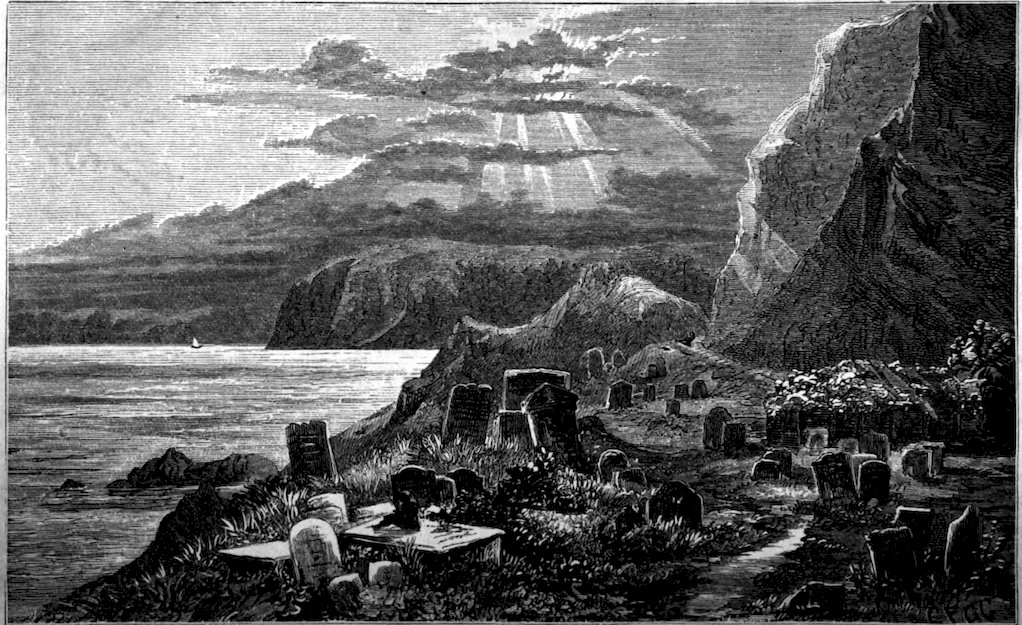
OLD KIRKYARD OF KIL-COLM-KILL, MULL OF CANTYRE To face p. 19.
Title: From the Hebrides to the Himalayas, vol. 1 [of 2]
a sketch of eighteen months' wanderings in Western Isles and Eastern Highlands
Author: C. F. Gordon Cumming
Release date: April 23, 2026 [eBook #78537]
Language: English
Original publication: London: Sampson Low, Marston, Searle and Rivington, 1876
Other information and formats: www.gutenberg.org/ebooks/78537
Credits: Richard Tonsing, Peter Becker, and the Online Distributed Proofreading Team at https://www.pgdp.net (This transcription was produced from images generously made available by Bayerische Staatsbibliothek / Bavarian State Library.)
Transcriber’s Note:
New original cover art included with this eBook is granted to the public domain.
To the Sister, whose loving care preserved such rough “Notes of a Wanderer” as from time to time reached her from over the sea, I dedicated the same, when at her suggestion, I strung them together in their present form.
These pages have lain by for a little while, and in that interval she, at whose bidding they were penned, has passed away from earth.
To her loving Memory I now Dedicate them, ere sending them forth to meet the eyes of less sympathizing critics.
Cresswell, Northumberland.
In the unavoidable absence of Miss Gordon Cumming from England during the progress of her work through the press, the Publishers have to acknowledge their indebtedness to Miss Isabella L. Bird, the accomplished authoress of The Hawaiian Archipelago, who at much personal inconvenience has undertaken the revision of the proof sheets on behalf of her friend. Miss Bird wishes it to be known that, with the exception of certain omissions and verbal alterations, the text remains as originally written.
As these volumes were compiled mainly from letters to near relatives, and from journals intended for their perusal, a few allusions to family memories occur which may not be of interest to the general reader. In the absence of the author, who sailed unexpectedly for Fiji as the first sheets went to press, the editor has thought it best to leave these allusions as they stand.
| CHAPTER I. | |
| THE MULL OF CANTYRE. | |
| PAGE | |
|---|---|
| Its Early History—Its Ruined Churches and Lonely Churchyards—Sundry Legends of Saints and Warriors—Kelp Burners | 1 |
| CHAPTER II. | |
| THE INNER HEBRIDES. | |
| Why the Mull of Cantyre is included—Islay, Scarba, and Jura—Legend of the Whirlpool of Corrievreken—Oban—The Serpent Mound—Serpent Legends—Dunstaffnage—Legend of the Coronation Stone—Iona—Legends of St. Colomba and his Druidic Predecessors—The 360 Crosses—360 Sacred Stones of Mecca—Traces of Heathen Customs—Staffa—Mull—Ben Cruachan—Legends—Rum—Canna—Isle of Muck or Wild Boar—Traces of Animals now Extinct in Great Britain—Legend of the Scuir of Eigg—Reach Portree | 29 |
| CHAPTER III. | |
| THE QUIRAING. ISLE OF SKYE. | |
| Old Church Customs—Lack of Timber—Encroachments of the Sea—Dr. Johnson in Skye—Legend of Hugh’s Castle—The Rock Wilderness of Quraing—Duntulm Castle—Plague of Midges—Great Sacramental Gathering on the Hillside—Island Customs | 101 |
| CHAPTER IV. | |
| A STRING OF QUAINT BEADS FROM MANY LANDS. | |
| xA Concert Room—Duntulm Castle—Chapel of Fladda—Magic Stones and Crystals—Summer Yachting—Fairy-like Caves—Legends of Water Kelpies and Brownies—Of Divers Superstitions still prevalent, and of others now obsolete, common to Britain and India, such as Planet Worship; Ordeal by Fire and Water; Belief in Transmigration; the Fiery Cross; Unclean Meats; Distinction between Wild Boar and Domestic Swine; the Sacred Goose; Sacred Fish; Sacrifice of Cocks in Illness; Magic Circles; of Spilling Salt; of Sneezing—Geology of the Coast—The Storr Rock—A Dismal Walk Home—Sacrifices of Bulls to St. Malruba—Fishers Starting for the Season—Seals and Cormorants—Fish without Scales deemed Unclean—An Eel in a Ball-room—Drawing the Salmon Nets—Transformations of the Jelly-fish and Barnacle Goose—Belief in Existence of Mermaids | 128 |
| CHAPTER V. | |
| MODERN CHIPS OF THE OLD BLOCKS. | |
| Traces of Olden Days—Modern Witchcraft; Selling a Gale; Bewitching Cows; Evil Eye; Numbering the People; Leaving a House Unswept; Making Clay Images to Harm a Neighbour; Jealousy of Giving Fire on Certain Days, answering to the Old Fire Festivals—Kindling the Need-Fire—Sacrifice of an Ox to Arrest Murrain—Sundry Customs supposed to bring Luck to the Cattle—Rowan-tree and Red Thread—Of Reverence for Sunwise Turns common to many Nations—Churchyard and Funeral Superstitions—Carrying Fire Round Horses and Cattle—Traces of the Old, Spring Festival, still called Beltane, or Baal’s Fire—Wheel, Emblematic of the Sun, and Wheeling Dances—Bonfires—Exchanging Easter Eggs—Midsummer Fire Festival (Christianized as the Feast of St. John)-Bonfires and Dances—Leaping, and making Children Pass Through the Fire—Autumn Fire Festival (Hallow-e’en)—How Christianized—Bonfires and Divination Games—Winter Festival—Yule—Adaptation of Christmas and other Festivals—Noel—Rolling Fire Wheel—Burning the Clavie, and kindred Pagan Customs—Traces of Grian, the Sun-god—Gruagach Stones whereon Libations were Poured—Hebrides Dedicated to Goddess Brighit—Institution of Christian Nuns of St. Bridgit to Tend the Old Sacred Fire!—General Process of Assimilation—Offerings of Horses—Pagan Customs at Christian Baptisms—Worship of Neithe, Goddess of Water—Well Worship—Ineffectual Efforts to Check Worship of Trees, Fountains, and Stones—But the King’s Touch as a Cure for Scrofula Sanctioned—Traces of Moon Worship—Odd Customs of Betrothal—Thumb-licking—An Owl’s Question | 182 |
| CHAPTER VI. | |
| A ROYAL FUGITIVE. | |
| Sketch of Prince Charlie’s Adventures while hiding in the Hebrides | 277 |
| xi | |
| CHAPTER VII. | |
| THE OUTER HEBRIDES. | |
| St. Kilda—Home of the Sea-bird Inhabitants—High Character—Toilsome Lives—Traces of Old Churches, and Assimilated Paganism—Edicts Sanctioning this—Ritual Combs—Martin’s Visit to St. Kilda—Origin of Certain Gaelic Names—Church Ceremonies under Difficulties—Sail to Harris—Drive to Fincastle—Temple of Callernish in Lewis—Kindred Rude Stone Monuments Extending in Unbroken Succession to Hindustan—Temples or Tombs—Modern Dolmens—Passing Through the Regenerating Cow, or Perforated Stone, or Rock Crevice—Herring Fishery—Sail to North Uist—Cattle Market at Loch Maddy—Story of the Red Dye—The Machars—An Improbable Shell Midden—Isle of Vallay—Fish Market—Tides and Fords—Benbecula—Treasures Brought by the Gulf Stream—“God’s Blessings”—Timber Supply—South Uist—Barra—South Bernera—Mingalay—Sail to Dunvegan—Piper’s College—Legends of Macleod and Macdonald—Story of Lady Grange | 288 |
| CHAPTER VIII. | |
| FROM SKYE TO CALCUTTA. | |
| At Anchor in Loch Staffin—Sail to Portree—A Calm—Whistling for the Wind—Literal Pouring of Oil on the Waters—A Fortnight Alone in the Rock Wilderness—Sligachan Inn—The Cuchullins—Divers Tourists—Loch Corruisk—A Good Day’s Deer Stalking—Old Boar Hunt—“Blocs Perchés”—Giant Fossils on Isle of Eigg—Legends of a Clan Fight, and the Grave of a Viking’s Daughter—Old Churchyards of Snizort, Nigg, &c.—Of Funeral Feasts—The Skye Railway Foreseen by Local Seers—Drive viâ Balmacarra and Loch Alsh to Shiel House Inn—Glen Quoich—A Bold Outlaw—Fort Augustus—Castle Urquhart—Eastward-ho! | 344 |
| PAGE | |
|---|---|
| Old Kirkyard of Kil-Colm-Kill, The Mull of Cantyre | To face 19 |
| Kirkyard of Kilkevan | 27 |
| Serpent-Shaped Mound near Oban | To face 37 |
| The Cuchullins | To face 100 |
| The Lodge, Uig | 102 |
| The Quiraing | To face 116 |
| Duntulm Castle | To face 129 |
| Schloch Maddie Cave, Skye | To face 136 |
| The Kilt Rock | 158 |
| Dunvegan Castle | To face 333 |
| The Storr | 345 |
| Loch Corruisk, Skye | To face 354 |
| Castle of Eilean Donan | 371 |
| Glen Quoich | 373 |
| Fort Augustus and the Glengarry Hills | To face 374 |
| Castle Urquhart | To face 376 |
A pleasure trip to India seems to be one of the possibilities, still so novel as hardly to have taken a definite place in the British mind, which invariably conjures up dreary visions of burning plains, with everything that can tend to make life hateful. Long summer months, during which the fair fresh Western faces become paler, and more pale, as they lie gasping, under the monotonous swing of the punkah, dreading heat-apoplexy, should the weary “punkah-wallah” fall asleep (as he is only too likely to do), and living from dawn to sunset in such darkness as precludes the possibility of almost any occupation, even reading, while it greatly favours the inroads of every horrible variety of creeping animal life.
This being the general impression of Indian life, and certainly my own till a very short time ago, it is pleasant for once to glance at it through a rosier medium, and see how those who have times and seasons at their own disposal, may now visit this wonderful land, and store their minds with its grand pictures, without being subject to any of its miseries. For my own part, I can tell of a year of unmitigated enjoyment, during 2which my “panorama of travel” has carried me over twelve thousand miles, full of infinite variety, and with no greater trouble or inconvenience than often attends the simplest journey across country (and such monotonous country!) in Old England; and though an old proverb tells us that “east or west, hame is best,” it is a very good thing to arrive at that conclusion for oneself rather than accept an unproven dictum. I have returned from India, having seen more of its marvels than almost any old Indian of twenty years’ service, and yet have never felt one day of real heat, and have rarely seen a punkah in action. Nor have I made acquaintance with any species of venomous creature in its wild state except three harmless snakes, much like those familiar to us on English moors.
Of course, everyone who lands at Calcutta receives the homage always paid by the mosquito to the new-comer; but I never saw them anywhere else, nor found occasion to use those large bottles of “Essential Oil of Lavender” which I had proved to be the only safeguard from the plague of midges, which were the continual torture of my daily life in Skye. My experience of Indian climate, by dint of judicious locomotion, has been to prolong a balmy continuous summer, from one December till the next; and to this a second and a third might well be added, always wandering over new ground. Perhaps these wanderings gained an additional charm from the aimless, easy-going way in which I found myself, almost unconsciously, drifting from the Western Isles to the Eastern Hills. The only mistake was, drifting homeward in like manner; and only the rude shock of finding myself once more in the bitter snows of an English spring, awakened me all too quickly from this fascinating dream, to return to the prosaic commonplaces of ordinary life. Nevertheless, the dream has left the mind stored with multitudinous odds and ends, of picturesque scenes and thoughts, but all so jumbled and ravelled, that, like the tangled skeins in the old nursery story, it would need the touch of a fairy godmother to bring order but of such dire confusion. That good fairy will, I fear, not come to my aid, so I must unravel the threads as best I can. Should any prove interminably long-drawn yarns, you must recollect they were partly spun by jolly tars, who rarely know when to stop. For the most part they can be but a heap of short, broken threads, as 3diverse in colour as in quality, and so I fully expect that you will dismiss my journal, with a criticism akin to that once passed on an odd volume of Johnson’s “Dictionary,” by a hardheaded Scot, who for a whole week had been laid up with a broken ankle and with no other light reading. “Weel,” he said; “there’s no doubt the facts may be real interesting; but as a whole, it’s vara unconnected!”
Do you remember the sunny morning when we parted from you, under the blossoming old cherry-tree? little thinking then of all that would befall us, before you welcomed us home again. Our only plan was to spend some quiet weeks in the most out-of-the-world place we could find; one where my pencil might keep me busy, while my brother could rejoice in perfect idleness after a course of hard reading; and what spot more suitable than the Land’s End of Scotland, the dear bluff old Mull of Cantyre, which had already given us so many pleasant days?
So we started, but without reference to our neighbours, and soon found to our cost that they were keeping holy-day, or holiday, as the case might be. It was a Sacramental Fast—very solemn to one section of the community, but a very “fast” day to the majority. Thus it came to pass that every station was crowded, and the line blocked with extra trains, and hours before we reached Greenock, our steamer had quietly sailed down the Clyde. So far as we were concerned, we had good reason afterwards (and indeed at the time) to rejoice in the delay, as it enabled us to test for the last time what, alas! we may never claim again, the unfailing hospitality of one of our truest and oldest friends,—whose most unexpected death, one short month later, added one more great blank to those which all too quickly thin that precious list.[1]
The third morning found us under weigh, and by midday we were watching the changing lights on the Isle of Arran, or Ar-rinn—‘the land of sharp pinnacles’ most rightly named. Dark shadows were drifting over the granite peaks of Goatfell, which seemed to tower so high above the mist, though their actual height is only 2,875 feet. I little thought, while gazing wonderingly on the grim peaks of Ben Ghoil, the “mountain of the wind,” that I should soon be wandering among mountain ridges as shapely in form, and more than ten times their height. 4Here and there were little clusters of tiny brown huts, nestling in the shadow of the great hills, and human beings with collie dogs and flocks of sheep moved to and fro, like atoms scarcely visible. Nevertheless, the sight of these reminded us of Pennant’s quaint description of his visit to this island in the last century, when he speaks of the terrible prevalence of pleurisy, and describes its cure by bleeding—a process to which every inhabitant was subjected twice a year, in spring and autumn; a ceremony which was observed with the utmost regularity. He tells how “the Duke of Hamilton keeps a surgeon in his pay, who at those seasons makes a tour of the island. On his arrival at any farm, the people bare their arms, when they are bled into a hole made in the ground!” I think our modern Highlanders would object to such treatment almost as much as to the wages for which their grandfathers worked. For, according to the same authority, the farm men considered themselves well paid by thirty shillings a year, together with house, meal, and shoes; while the dairy-maids received thirteen shillings and fourpence, and common drudges only six and eight-pence.
As we passed gloomy Loch Ranza, with its fine dark background to the old ruined castle, once a royal hunting-seat, our attention was called to the boats of the oyster-dredgers; and we would fain have halted for a night to find out whether the oysters of Loch Ranza have the same ear for music as their brethren in the Firth of Forth, who require a continuous dredging-song to lull them to their doom, so that the wily fishers must perforce keep up an incessant monotonous chaunt, in which all their conversation must be carried on. Various collectors of old ballads have from time to time gone out for a night with the dredgers, hoping to add new songs to their store, but all agree in saying that the same words never occur twice unchanged; and so they only gain the bitter cold of a night in an open boat in one of the months “with an R,” which you perceive excludes all the bonnie summer nights. One allusion to this graceful old custom in fisher-life is found in a charming ballad which begins:—
5We passed various small vitrified forts, on prominent headlands, said to have been purposely burnt, so that by the action of fire, a rock-like solidity might be produced. These old ruins generally have the prefix “Dun”—a fort, as Dunaverty, which is at the furthest point of the peninsula.
Among the many theories which have been propounded concerning the traces of a bygone age, none is, to me, so attractive as that which assumes them to have originally been fire temples, the altars of Bel, or Bael, the Celtic Baal, or Sun-god. These vitrified circular masses are generally placed on some commanding height, often too near together to have been used as beacon lights. The stones are fused into glassy masses, the inside more perfectly vitrified than the outside, as would naturally be the case, if these raging fiery furnaces were the altars where fire burnt day and night, and where hundreds of animals and human sacrifices were offered at the great Baal festivals. It is said that long after Christianity was introduced in Britain, the fire worship was continued; and even human sacrifices were immolated on Bel’s devouring altars, the land long remaining in a strange twilight state, halting between two opinions—the grossness of heathen darkness, mitigated indeed by Christianity, but still very far from the light of perfect day; and the people in general resembling the “mixed multitude” which followed the Israelites in their Exodus, with some leaning to the new faith, but a strong hold on the old idolatries.
The golden sunset fell on Ailsa Craig, and the bold headland of Davaar, as we entered the fine land-locked harbour of Campbeltown, wherein lay many fishing-boats of all sizes, with rich brown sails. Again we bethought us of old Pennant, and his account of this crowded harbour, where as many as two hundred and sixty “busses” might be seen at once. I fear that the Cockney mind, picturing a ’bus of the present day, would be somewhat disappointed to find so very dull a little town. Campbeltown is chiefly remarkable for the amazing fact that its annual tax for whisky-duty amounts to £600,000; of which £350,000 is paid to the collector of Inland Revenue at Campbeltown, and the remainder in Glasgow and elsewhere. This is pretty well for “fire-water.” The whisky of Campbeltown and Islay bears a very high character, and the distillers give so high a price for good barley that there is no longer any 6inducement for the Highlanders to deal with the smugglers; who in very recent times had stills for mountain dew all over this part of the country, so extensive a seaboard affording good scope for their trade. The Hebrideans crossed from the Isles to Rhunahourine (the Heron’s Point), thence marching across the hills to Skipness in bands of thirty or forty armed men, whose rough shelties were laden with heavy creels containing the moonlight produce, which was then sent to Glasgow. The “stream in the moonlight which kings dinna ken” has not wholly ceased to flow, and I have heard of sundry mysterious presents of kegs of “the crathur,” very superior in quality to any that is to be procured from the large stills. But the days are gone by when the wild Skipness men thought it all fair play to fight their battles with a revenue cutter; and, having overpowered her crew, to turn them all adrift again without oars or tackle, to be tossed at the mercy of the waves! Some of the old stills are yet pointed out, or rather the caves and deep hollows where the smugglers used to work. Deep pits such as those where we have so often lingered, on hot summer days, in the dark fir woods above Dufftown (that paradise of wild flowers), where, amid richest purple heather, you note in one place a circle of white-stemmed birches, in another a fringe of golden broom and tangled wild roses, clustering round a deep, circular cup, where once the mountain dew was distilled, but where now the greenest and richest ferns nestle in the cool shade, while wood-doves murmur on every side. A pleasant resting-place, in truth.
To such as prize the rarest flora of our isle, that wood has one special interest, as being one of the very few places in Britain where the dainty little Linnæa Borealis has, from time immemorial, uplifted her delicate hair-like stem and tiny pink bell from the low heather beneath which her long sprays of leaflets creep along the ground, only revealing her presence in the noonday, by the faintest fragrance, and reserving for the moonbeams her most honied breath. She is a coy beauty, not to be lured from her chosen home. Only on one small patch of moorland are those fairy blossoms to be found; a safe retreat, happily known to but few, too covetous admirers.
To return to Campbeltown, or as it was anciently called, Dalruadhein. Remote as it now seems to us, there was a time when 7it was the centre of Scottish life, and for upwards of three centuries it was, in fact, the capital of Scotland. This continued till the reign of Kenneth II., King of the Scots, who, having finally subdued the Picts, and merged both races in one kingdom, selected Forteviot, in Perthshire, as a more suitable capital.
These Dalriads seem to have come over from Ireland about the year 502 A.D., and to have founded that kingdom known in Scottish history as Alba; their power and numbers must have increased rapidly, for not long afterwards we hear how the King of Alba invaded Ireland and fought the great battle of Moyra, famous in old song. In fact, these Scots-Dalriads held their place as a strong Celtic race, till the Norsemen overran the land, and moulded existing institutions to suit their own convenience. In later days James IV. here held a Parliament, as “Parliament Close” still attests. There were, however, certain turbulent chiefs who would by no means render obedience to his laws; more especially one Macdonald, whose castle of Cean Loch stood on the very spot now occupied by the large Castle-hill Church. In order to keep this man in check, James V. came here in person, and repaired the old fort of Kil-Kerran, leaving in it such a garrison as might overawe all rebellious subjects. But before the King had got clear of the harbour, Macdonald sallied out of his castle, took possession of the fortalice, and, in the sight of the King, hanged the new governor from the walls.
This old castle of Kil-Kerran stood about a mile from Campbeltown. A very large old burial-ground, close by, still marks the spot where St. Kieran, the Apostle of Cantyre, first taught the people. St. Kieran was baptized by St. Patrick, and soon afterwards seems to have found his way to these shores, where, according to one account, he died fifteen years before St. Columba landed in Cantyre, though they are generally said to have come together. The cave in which he lived, the Cove a Khiaran, lies among the rocks so close to the sea, that you cannot enter it at high water. At all times it is a difficult, slippery scramble. Once there, you find a fine cave, with a dripping well, filling a rock basin with clear sparkling water, whence the Saint drank. And beside it, on a great stone, is a rudely sculptured cross, where, in the solitude of this grand 8wild temple, guarded from all human intruders by that barrier of mighty waters, he might worship his God undisturbed. Of his church, once the most important in Cantyre, little, if any, trace now remains; but two shafts of broken crosses, carved with galleys, figures and arabesques, are among the very ancient stones in the old kirkyard.
While speaking of saintly names associated with this town, I cannot forbear to remind you of one, who has so recently passed away from our midst, that the mention of his birthplace cannot fail to recall to multitudes (and assuredly to every Scotchman, of whatever denomination) the name of the great, and good, and genial Norman Macleod—a teacher as influential and beloved, and one as unsparing of his work, as the mightiest of those Celtic Fathers; one who needs no canonization at the hands of earthly Councils to rivet his hold on the affections and his influence on the life of multitudes, even of those who were never privileged to hear his voice, but who, nevertheless, were followed to the uttermost ends of the earth by his good and loving words—so tender, and yet so strong and invigorating—learning from him year by year something of deeper reverence for things human and divine, and perchance catching from his large-hearted liberality something of a broader and more glowing charity, such as would fain enfold the whole great world in its own boundless love. Truly, were it only for having given birth to one such son as he, Cantyre may henceforth claim to be not least among the provinces of Scotland. In the market-place of Campbeltown there stands a very fine cross of hard blue whinstone, covered with well-carved figures, foliage and runic knots, and bearing an inscription, but whether this is Saxon or Lombardic is still disputed. It is supposed to have been brought over from Iona, where at one time there stood 360 stone crosses, in the cemetery. These the Synod of Argyle, in A.D. 1560, pronounced to be “monuments of idolatrie,” and commanded that they should be thrown into the sea. Some, however, were rescued, and taken to old churchyards and market-places in the neighbouring islands, or on the mainland. They are all very similar, being monoliths, generally of whinstone, and covered with elaborate designs.
About two miles from Campbeltown lies the old kirkyard of Kilcousland, one of many which, to me, give an especial charm 9to these green shores; lying, as they do, almost within reach of the wild spray, which, dashing heavenward, falls in lightest showers over the rank grass and golden iris, and mossy stones, beneath which sleep so many forgotten generations. Kilcousland has no stones of especial interest, but many are quaint and old, and though the majority only show crowns and shields and grotesque death’s-heads-and-crossbones, and fat-faced cherubs with lumps of moss for their eyes, or else such growth of golden lichen as Old Mortality would have loved to scrape away, there are some devices which tell the daily work of the sleeper forcibly enough. Thus, a ploughman has quite a graceful grouping of reins and harness; a carpenter keeps his hammer and saw and sundry other tools; while poor Snip, the tailor, carries his shears and his goose to the end of time.
Why is it that this most useful of honourable trades should be connected in our minds with so many uncomplimentary sayings? The German proverb says that “If it rains while the sun shines, a tailor has gone to heaven!”—apparently an exceptional occurrence. Then we are told that the word “snob” is a contraction of the tailor’s motto “Sic Nobilitas.” From our cradle we are taught that, much as he may impress our childish mind, he is nevertheless only the ninth part of a man; and here we find him carrying a goose to the grave. On the broken shaft of an old cross, a carved galley tells of some forgotten Island chief, while a neighbouring stone bears a knight’s two-handed sword, surrounded with runic knotting.
The next tomb bears only a heavy dagger on a shield, no name to mark who sleeps beneath. The Saint to whom this spot was dedicated is said to have been a certain St. Constantine, a Scotch king slain by the Danes in 881. I sat for many hours in this calm “God’s-acre,” in the shade of the ruined church, watching the ever-changing colours of the quiet sea, lipping up to the foot of the green hill on which I rested; constant changes from blue to green, and purple and silvery greys, all blended by the reflection of every tint of sky and cloud according as the angle of the broken wavelet either mirrors these, or lets us see beneath its surface, into its own depths; giving us hints of the wonderful world below the waters. There were broken reflections, too, from the hills of Arran, and from Ailsa Craig, and now and then a white sail would round the light-house 10and enter the quiet haven. I thought of the words of one whose dying prayer was—
and I thought that just such a churchyard as this was the resting-place for which she craved. It was a scene of great peace, and I lingered till the blue sky of noon had changed to that pale primrose against which each form of earth cuts with such intensity of colour; and the evening breeze, rustling among the tall flags, sounded like a mysterious whisper from the sleepers around me.
The fine old Castle of Saddell, with its kirkyard and ruined monastery, lie further along the coast, and here quaint sculptured tombs of ecclesiastics and warriors lie under shadow of some fine old trees close to the shore. Unhappily the monastery has proved a useful quarry for ruthless hands, and the modern dwelling-house has been in a great measure built at the expense of the church, all the hewn stones having been removed, and the offices paved with gravestones—a species of sacrilege unfortunately but too common even in these days. You remember with what difficulty our father stopped similar devastation at Kinloss Abbey, whose old stones were being fast converted into dykes and farm-buildings, one fine old stone coffin being used as a pig’s trough! And I am told that the same barbarous work goes on in many of these neglected burial-grounds, where the most beautiful old slabs are sometimes taken as convenient stones for fresh graves, and a modern name roughly chiselled over the weather-worn escutcheon of some brave knight of old. In many instances the stone is smoothed and cleaned, to begin with, as in the case of that beautiful stone at Hilton of Cadboll, where the elaborate tracery has been completely obliterated from one side, and replaced by an inscription to the memory of “Alexander Duff, Esq. and His Thrie Wives”! Often, these stones have been found convenient for modern gate-posts, sometimes built into bridges. In some cases the grey ruins of the old church are used by the neighbouring farmer as a convenient byre or sheep-pen, or even pigstye.
11The Monastery of Saddell is one of considerable interest. It was founded in the twelfth century by one of the Lords of the Isles—whether by the great Somerled or by his son Ronald seems uncertain, but it very soon acquired a reputation for sanctity, and great men of old craved to be buried there. Of Somerled, and his wars with Godred, King of Man, both old Sagas and Gaelic legends tell many tales. There were terrible sea-fights, in one of which the Manx fleet of galleys was so sorely beaten, that Godred was compelled to yield all the Sudereys, or Southern Isles, including “Yla and Kintyre,” retaining only the island of Man itself. The wife of Somerled was a daughter of Olaf the Swarthy, King of Man and the Isles. Various accounts are given of the manner of his death, but whether in a sea-fight with pirates, or by assassination in his own tent, seems uncertain. One version is that he sailed with 160 galleys to besiege Renfrew, and fell in action with the Scottish army. In any case his body seems to have been brought to Saddell for burial, and laid where so many turbulent spirits now sleep in stillness, and the only unrest is that of the restless ocean.
In the castle is shown an old dungeon where Macdonald starved a luckless Irishman who had the misfortune to own too beautiful a wife. At first he only confined him in a granary; and the prisoner found means to get at the grain, and so was kept alive. Then he changed his prison; but through the barred window a kindly hen came daily, and gave him her egg. So the flickering flame of life still burned. Once more he was removed, and cast into this deep noisome cell, where nor bird nor beast could bring him supplies—and here at length he died, having gnawed his own flesh in the agony of his hunger. Then Macdonald gave him burial; and the beautiful wife, looking down from the high tower, espied the funeral, and asked whose it was; when she knew that it was her own liege lord, she cried in bitter anguish that she would be with him anon, and with one wild spring, she dashed herself from the battlements, and was buried by his side.
The ruins of another old prison still remain in the wood close by, and many tales of the treachery and vengeance of the lords 12of Saddell are told in connection with these grey walls. This part of Cantyre also has one or two traditions of Robert the Bruce; and the little Isle of Rachrin, off the Irish coast (distinctly visible from the Mull), was to him a haven of refuge in times of danger. In the old Fort of Dunaverty he also found warm welcome. A few scattered stones, on a rocky promontory, are all that now mark this old Castle of Dunaverty, “the Fort of Blood,” once a mighty stronghold of the Danes, whose fleets were wont to anchor near the opposite Isle of Sanda, still known to the Highlanders as the gathering-place of the Danes, by whom it was called Avoyn, the Island of Harbours. Upon it are the ruins of St. Annian’s Chapel, once a place of refuge, where all outlaws might find sanctuary. On the ruins of the Danish Fort a new castle was built by the Macdonalds, who held their own in Cantyre till the days of Montrose, whose cause they espoused even unto death. But when the star of the Covenanters was in the ascendant, and the Royalists were driven even to this Land’s End, Sir Allister Macdonald sailed for Ireland, there to raise new forces. He left his castle in the hands of his brother, with a garrison of three hundred men. Very soon General Leslie, with three thousand of Argyle’s men, advanced to besiege the old fort. Bravely it was defended, but after awhile Leslie discovered that the only well for the supply of the garrison lay outside the walls, and that the water was brought in artificially. Of course this was at once cut off, and not one drop was to be had to quench their raging thirst. It was midsummer, and even the kindly rains from heaven forgot to fall. Vainly were all eyes strained to watch for Sir Allister’s return, across the sea, whose cool green waves dashed their salt sea foam so mockingly in the faces of these dying men at their last extremity. Sir Allister had been slain in battle; so they might watch till they were weary, but all in vain.
At length they were forced to capitulate, and for five days were kept prisoners on their rock together with a hundred more who had been captured in a cave, or rather, smoked out of it, as the manner was. Leslie seems to have inclined to mercy towards the captives, but he was hounded on by a Puritan preacher, Nave by name, and knave by nature, who insisted on the slaughter “of these Amalekites.” At length his counsel 13prevailed, and all the helpless captives were either put to the sword or dashed from the precipice into the sea, where they lighted on hard, cruel, jagged rocks. And so they perished (all save one man, and one infant), and from time to time bleached bones and skulls are still washed up from the clefts of the rocks; and the fishers tell how, when the wind drifts the sand from the bank close by, heaps of human bones are sometimes seen, which the next kindly wind covers up again with a fresh layer of soft yellow sand.
The escape of the little infant was the only gleam of light in that day’s devilish work. Its nurse caught it up naked in her arms and fled along the shore. She was stopped by a Campbell, and vowed the child was hers: “It has the eye of the Macdonald” was the answer. Nevertheless, the heart of Craignish was soft, and, dividing his plaid, he gave her half for the naked baby and suffered her to escape. During those five days of waiting on the rock, another Macdonald drew near with a small body of men, to relieve the garrison. As soon as the piper perceived them, he struck up a note of warning to bid them turn back. Thus they were saved from the cruel fate that awaited their brethren; but the piper paid dearly for his tune, the enraged Campbells cutting off his fingers to prevent his playing any more such strains. Thus it was that Cantyre passed from the hands of the Macdonalds to those of the gleed (squinting) Marquis of Argyle and his clansmen. It seemed as though Heaven’s righteous retribution sought them out, when, ere many years had past, a terrible plague came and utterly depopulated the whole of Cantyre. It was the same year that the Great Plague was raging in London. The pestilence swept over the land in visible form, as a great white cloud laden with death—just such a cloud as, in later days, has rested on Malaga, and other cities, in times of cholera; on Dumfries, for instance, where in 1843 the cholera raged for months, nor ever stayed its ravages till one-third of the inhabitants were laid in great pits in the overcrowded churchyards. And during all the time that the Angel of Death thus brooded over the city, a pestilential cloud hung like a death pall, floating in mid-air, above the circle of hills which enclose the city as in a cup. It was a dull heavy film, through which neither the foul air could escape nor could fresh air circulate, but all was dead 14stagnation; even the sunbeams passing through were discoloured, and fell with lurid glare upon the scene of horror below. The fever-cloud rested long on Cantyre, and left its traces for many generations. So sorely did Argyle’s estates suffer, that moneys were voted by Parliament for his relief, while the poorer folk received such help as the churches could collect.
A sunnier legend of Dunaverty in its palmy days tells how its chief rescued the fair daughter of the King of Carrickfergus from the pillion of O’Connor, the King of Innisheon, who had run away with her against her will. He restored her to her father, and continued his honoured guest till, in his turn, he claimed the maiden’s hand, and was cast into a dungeon to rue his presumption. Thence rescued by the damsel, he escaped to Dunaverty; but once more returning in quest of his love, found that she too was now in durance vile, for having aided his flight. So, like the hardy Norseman of old, he showed that neither bolt nor bar could part him from his own true love, and carried her safely across the sea to his own old castle. The wrathful king followed in his galley, with many mighty men of war, vowing swift vengeance. Happily counsels of peace prevailed, and the lady obtained pardon for her lord; so they all went back together to the Emerald Isle, and lived merrily to the end of the chapter, and their children became kings, from whom the Earls of Antrim claim descent.
The names of the old churches or cells, all about this country, are at once recognised by their prefix Kil—as Kil-Choman, Kil-Michael, Kilcoinan, Kilkeran, Kilcoivan, Kilkevan, Kilcousland, Kilraven, Killdavic, Kileolan, Kill-blaan, Kil-ewen, Killean, Kil-Kenzie; most of these have some carved stones—sometimes knights, sometimes ladies, always swords. On some we find the galley of the Isles; on others deer-hunts, hounds, otters, creatures like griffins with wonderful tails of scroll-work, winding about in intricate patterns of foliage or other tracery; sometimes birds fighting; sometimes shears or other implements of work. All, or almost all, are alike nameless, covering the dust of long-forgotten heroes. Some of those in the best preservation are in the chapel of St. Cormac at Kiels, in North Knapdale, where there are an unusual number of well-carved devices of all sorts. At some of these old churchyards there now remains literally no trace of the ancient 15cell, though they are still used as places of burial. As Wordsworth has it:—
The majority, however, still retain some ruins of the old churches. Others, again, do not betray their character by their name, as Patchen, an enclosure among the sand-hills where the old tombs are half overgrown with bent, and half veiled with salt drifting sand. Many a sad story these churchyards of our seaboard could tell; of terrible nights in which all the breadwinners of a hamlet have been lost, and none but lads and women left to fight life’s battle. Such women, though! so brave and hardy; and withal so leal to the dead. In one of these quiet little churchyards in Yorkshire is a simple headstone, and the fishers will tell you that the man who lies there was drowned one awful night, and the sea did not give up her dead till the end of eleven weeks!—from December till March; and during all those bitter wintry days his wife followed every receding tide, scanning each ledge and crevice of the black rocks, each pool below the slippery tangled sea-weed. Vainly did the neighbours urge her to forego the hopeless search. Early and late the sad solitary woman was at her post, reckless of the beating storm and bitter frosty wind, still keeping her weary vigil; and at last, when almost despairing of success, her prayer was granted and the waves brought him to her feet. So she buried him in “mother clay,” and watched by the green mound for upwards of thirty years, ere she was laid by his side.
Of the old kirkyards in Cantyre, perhaps the most striking is one at the extreme end of the Moyle, near the ruined Fort of Dunaverty before alluded to; just such a one as that where King Arthur was laid, when sorely wounded in that battle among the mountains beside the winter sea—
This is Kilcolmkeil, or the Cell of St. Columba at Keil.
16In defiance of the commonly received account of his having first landed on Isle Oronsay, near Colonsay, and having thence departed because he could still see Ireland, which he had vowed never to behold again, the tradition in Cantyre is that he first landed at this spot; and that, although in full view of the Irish coast, he here built this little church, where he preached for some time before he went to Iona, leaving his saintly mark on many a nook. The Highlanders still point out the “Bay of the Boat,” as the spot where his frail currach, of wickerwork covered with hides, first touched the shore, whence he was to make his way to the court of Connal MacCongail, King of the Northern Scots, to whom he was nearly related, being himself of the blood-royal. Connal and his people, being already Christians, gave him warm welcome, and sent him under safe escort to Brude, the King of the Picts. He too declared himself a Christian; and his chiefs and people were not slow to follow his example. Soon even Broichan, the Arch-Druid, was converted, having been cured by St. Columba of a dangerous and sudden illness.
The illness of Broichan was as miraculous as his cure. St. Columba had requested him to release a certain captive, an Irishwoman. This Broichan refused to do. Columba proceeding to the River Ness, took thence a white pebble, and, showing it to his companions, told them that the Angel of God had stricken the Arch-Druid with a sudden stroke, so that he lay nigh unto death, but that should he repent, he had only to drink a cup of water in which that pebble had been dipped, and he would assuredly recover. While he yet spake, two horsemen galloped up, bearing tidings from the king that all had befallen even as Columba had predicted. The holy man straightway sent messengers to the palace; they received the captive from the hand of the repentant Broichan, while he himself, having drunk of that mystic cup (whereon the pebble floated as though it had been a nut), was immediately made whole. That little pebble was afterwards preserved among the treasures of King Brude, and, retaining its miraculous power of floating on water, in common with other magical stones, it wrought divers wondrous cures. Thus it was that, when the king proposed to bestow on St. Columba the Innis-nan-Druid-a-nach, the Holy Isle of the Druids, he was suffered to hold it in peace, and without great opposition.
17I am told that no part of Scotland is richer than Cantyre in relics of those pre-Christian times; cairns and barrows, monumental pillars erected above stone coffins, and rude urns containing the ashes of bodies that had been burnt, having been found in many of its green downs.
There seems every reason to believe that the honour of having first introduced Christianity to this district has been erroneously attributed to St. Columba, his tutor, St. Kieran, “the Apostle of Cantyre,” whose church and cave we saw near Campbeltown, having come over from Ireland with a colony of Christian Dalriads, who settled in Argyleshire, some fifty years before Columba, the fiery Abbot of Durrow, had quarrelled with and been banished from Ireland by the Ardriagh, or President of the Irish King. It seems that when attending a great meeting of the lords temporal and spiritual of the Green Isle, Columba was rash enough to take with him a young son of Aodh, King of Connaught, who was at enmity with the Ardriagh. Even the sanctity of the Abbot proved no protection for the young man, who was treacherously slain. Then followed war, in which Columba sided with the aggrieved father, and eventually received that command to quit Ireland which brought his fiery energies to the aid of the little Christian band of Dalriads in Cantyre; whence he moved onward to that Isle where, in after years, kings and rulers craved permission to lay their dust near that of one so holy.
St. Kieran is not the only pioneer of the faith whom we are apt to rob of honour due, while heaping veneration on St. Columba. How constantly we hear the latter spoken of, as though he first had brought to our western isles that light of Christianity, which thence radiated to the furthest corners of the mainland! So far from this being the case, we know that for a century before the birth of Columba, a series of duly ordained bishops had ruled over Scottish dioceses in various parts of the land; these being, for the most part, native Christians, who of their own accord had gone to Rome to study. Their existence as Christians gives some colour to the belief that, so early as the third century, Christ’s Name was known in this land.
The first bishop of whom we hear was that St. Ninian who, in the end of the fourth century, returned from Rome to his native county of Galloway, where, we are told, “he ordained 18presbyters, consecrated bishops, and organized parishes.” At Witehorn may still be seen his Candida Casa, the first Christian church built of stone in Britain. Here he was buried, about the year 430. In the following year St. Palladius was sent to this country as “Primus Episcopus to the Scots believing in Christ.”
The next great name that appears is that of St. Patrick (born about the year A.D. 373, at Kilpatrick near Dumbarton), who, having been captured by pirates and carried over to Ireland, seems then and there to have longed to Christianize the Hibernians. We hear that he escaped from slavery, and contrived to reach the shores of Gaul, where he studied the Scriptures for thirty-five years before he was ordained priest. Nor was it till he was about sixty years of age that he was sent back as bishop to commence his mission in the Emerald Isle. The patient student proved a long-lived teacher, and is said to have died at his post in his 120th year.
OLD KIRKYARD OF KIL-COLM-KILL, MULL OF CANTYRE To face p. 19.
Early in the sixth century, we hear how St. Kentigern (better known to us as St. Mungo, the patron saint of the beautiful old Cathedral at Glasgow), fixed his see at the place where that city now stands. To him the credit seems due of first Christianizing part of Wales. He owed his early training to St. Serf, the Apostle of the Orkneys; so those remote Isles must have had their first rays of light long before the disciples of Iona went thither “as doves from the nest of Columba.” The fame of that most energetic worker certainly has no need to borrow lustre by defrauding his predecessors of their rightful share; doubtless, when he landed on this wild shore of Cantyre, his heart was gladdened by the knowledge that the light he strove to diffuse was already glimmering in divers corners of the land. This old Church of Kilcolmkeil (where first he taught the people) lies so close to the sea that the salt sea foam dashes over the old tombs, and the tough green bent creeps up amongst the stones, while bright sea pinks gleam through the mossy grass. A steep crag of reddish rock rises directly above it; and, just beyond, the bluff headland of the Moyle itself rises abruptly from the sea, which here scarcely ever knows calm, but seems to revel in its joyous liberty. There is not a sailor or a fisher on all this coast, or the opposite shores of Ireland (Antrim being but twelve miles distant) who does 19not dread the mighty green waves that are for ever raging in their ceaseless battle with the stern old Moyle. In quick succession the booming breakers burst on the unfeeling rocks, which have withstood them for such countless ages, and now fling them back once more. With swift rush the baffled waters fall back on the advancing wave, and thus reinforced renew the ceaseless; hopeless attack, then, “white with rage,” dash themselves to atoms, and fall in dazzling spray and foam over the cliff. If you count the waves, you will see that about every sixth is larger than the others, a chieftain in fact; and if, as it curls proudly over, you can catch a gleam of light through the transparent water, you will see its wonderful clear green, at the very moment that the land breeze carries back its crest in tossing spray, like the mane of some white sea-horse. Most beautiful of all is the moment when two waves, whose courses differ slightly, come to a violent collision, and dash their white spray heavenward, an encounter which you will here see to perfection, as two strong currents meet at this point. Perhaps if the sea is not very angry indeed, there will come a lull—an amnesty,—and the graves that were drenched with the salt sea spray will dry in the sunlight; and the shepherds can put off their boat, and row to the grassy islands to see how it fares with their sheep.
It was on one of these unwonted days of rest, that I found my way to Kilcolmkeil. You, who love the peace of nature even more dearly than I do, can picture the scene for yourself The beetling crag,—God’s-acre bathed in light,—earth and sky, gleaming with that clear shining that cometh after rain. And the hush and silence of the calm wide sea, noiselessly stealing on and on, till the great brown rocks, with their wealth of golden sea-weeds, lie hidden, like purple shadows, beneath the cool and quiet blue, and only a tiny edge of white rippling foam, marks the lip of the lazy wave as it glides to and fro, or brims over the ribbed sand, glancing and gleaming in the bright sunlight. Only here and there, the still surface of the waters is broken by a broad leaf of brown sea-ware, waving idly from the forest below, with quivering motion, like some curious wriggling sea-snake; or a floating tangle, like long human hair washed to and fro, suggests some fancy of the sea giving up her dead to this green resting-place. Now and then there is the 20quick flash of some white-winged gull, as it darts upon its prey, and then again floating upward, hangs idly poised in the sunny air.
Altogether it is a scene of most blessed peace, such as sinks into the heart with strange sweet power, soothing and lulling the turmoil of its cares. For there is no more dear companionship than that of the sea, which in its ever-changing moods seems almost like some human thing, that one day claims our sympathies with its own wild joys or sorrows, ready in its turn to weep or laugh with ours; to-day so calm and peaceful, laughing in the sunlight; to-morrow roused to mad excitement, lashing itself into wild rage; then, when its wrath is spent, subsiding as though repentant, lying still and silent beneath the cold mists, dreary and desolate and sad, like a sorrowful spirit, when all life’s energies are subdued.
They only who have been cradled and nurtured within sound of that ceaseless song of the wild waters can fully realize their subtle charm, or tell the unutterable yearning for their music,—the craving for their breadth, for their reflections of the great clouds,—for their incessant movement, which oftentimes comes over the spirit, when the body is tied to some monotonous inland region; the unspeakable longing for sight and sound of the great green waves, the tossing spray and screaming sea-birds, and the wild breeze that rushes past, laden with the salt sea brine. None else can understand the intensity of that passionate love which the sea and its shores can inspire—the thousand memories linked with those wide white sands—those slippery rocks—that brown, wet tangle, each leaf of which seems to have some hidden power whereby to twine itself round the innermost depths of the soul. None else can sympathize with the bitter disappointment of awakening from some blissful vision of shell gathering or idling by those great waters to find that in truth it was but a dream.
To such I say, if you would see Old Ocean in its glory, come to Cantyre; but those who desire true mountain scenery had better stay away, for when once you leave the seaboard and turn inland, you will find that you have left all beauty behind you; the great swelling green hills do indeed rise to a height of 2,000 feet; but the very name Cnoc Maigh, or the Hill of the Plain, suggests mere shapeless high ground. Much of this is arable, 21but at the time of our visit a sore pest was troubling the land, owing to the lack of frost in the previous winter. This was a gluttonous grub, which had appeared in countless myriads, and had eaten bare all the fair green crops, leaving only fields of parched red earth. Some of the farmers were brave enough to hazard a second sowing, but with small hope of better success.
But the glory of Cantyre lies in her dairy farms; the rich fine soil yielding abundant pasture, and supporting from twenty to thirty cows on each farm. It is a land flowing with milk and honey, with comfortable, well-to-do inhabitants who thankfully told us that the cattle plague had as yet never found its way to their shores. But though the farmer will offer you wine and spirits in abundance, you must not test his hospitality so cruelly as to expect such a bowl of creamy milk as any old “Caillach” in a black bothy would be proud to offer you, should she own but one gentle “Crummie.” At these great dairies, the farmer prides himself on his unbroken pans of rich milk, therein estimating prospective pounds of butter and cheese for market, with as strong a sense of their pecuniary value as any modern shooter (sportsman, I cannot say) counting heads after a good day’s battue; in which comparison, by the way, the farmer has, perhaps, the best of it; his rich green fields, and bevy of well-paid dairy-maids, leaving no room for invidious qualms, such as may sometimes afflict the seller of game which may possibly have fattened at the expense of tenants, and has certainly been bagged at that of guests, whose dog-carts too often return home after these modern days of butchery and game-dealing much lighter than they came. Just imagine the indignation of a genuine sportsman of the generous old school, on being referred to a head keeper for permission to buy at market price the bird that has just fallen to his own gun, slain by his own powder and shot! Yet such things are, even on Highland braes, in these degenerate times.
There are countless old legends attached to these green hills, and to the cliffs and caves along the shore; tales of the warrior and Nimrod, Fingal, and his faithful hound Bran; wonderful holes in the rock, that have served for his cooking pots, wherein to boil rude kettles formed of the skins of the deer, and filled with flesh, such as he loved to eat half raw, and caves that have been honoured by his presence; but these tales have been so carefully 22collected by our kinsman, Campbell of Islay, that all lovers of such lore need only refer to his writings. A quaint story is told of the old stone at Kilcouslan, with a hole in the centre; namely, that kindly old St. Couslan, who had a strong sympathy with luckless young couples, and very little for stern guardians, established a law that every runaway couple reaching this stone, and here joining hands, should be considered indissolubly tied. So here, you see, was a forerunner of Gretna Green, or else a trace of Scandinavian mythology, as the old Norse custom of betrothal bade the lovers join hands through a circular hole in a sacrificial stone. This was called the promise of Odin, and was practised in the northern Isles long after they had embraced Christianity.
On the other hand, St. Coivin gets the credit of the most wonderful law of divorce, namely, that all unhappy couples should, on a given night, meet at his cell, when they were all blindfolded, and started on a pell-mell race thrice sunwise round the church, suddenly the saint would cry “Cabhag!” i.e. seize quickly! and each swain must catch what lass he could, and be true to her for one whole year, at the end of which, if still dissatisfied, he might return to the saintly cell, and try a new assortment in the next matrimonial game at blind-man’s-buff! This disorderly proceeding has given no character of unwonted frolic to the peaceful and “dacent” inhabitants of the present day. No spot on earth could well be more calm than the shores of beautiful Macnahanish Bay, and the green woods and braes of Losset. The fields close to the house are white with narcissus, the uncultured growth of many generations; while genuine wild flowers, blue and green and gold, riot in the shelter of the glen, and all day long the mavis and merle pour forth their jubilant songs in the quiet wood.
It is curious to note how the absence of frost favours the growth of plants too delicate for our eastern coast. Camellias bloom in the open air, and great hedges of crimson fuchsia live securely all the winter, on the lee side of sturdy fir trees, whose upper branches, however, are all scorched by the blighting sea winds.
I wonder what peculiarity of atmosphere causes the wonderful splendour of the sunsets on this coast. You know how much we have always heard of the amazing glory of sunrise 23and sunset in the East, more especially during the rains. I may safely say that I have scarcely once neglected to do homage to these outgoings of morning and evening, but with perhaps two exceptions, I have seen nothing that could bear away the palm of beauty from our own skies; and I am more and more tempted to believe that these “odious comparisons” are due only to the different hours of rising and dining, which compel travellers to use their eyes in a way they quite forget to do when at home.
Have you not sometimes wondered at the dull hearts and blind eyes that could scarcely glance westward for one moment, though the golden gates seemed to have opened behind the heavy purple clouds, just flushed with rosy crimson; and all so quickly changing; softening and mellowing in the hazy sunset light, till earth, and sea, and sky, alike lay steeped in loveliness? Blind eyes they must be, that have not yet been opened to read the Divine Book of Nature, written day by day by the finger of God Himself; the God of Infinite variety, Whose worship men are so apt to reduce to a mere system of forms, of infinite sameness. Surely the mind that most dearly loves to drink in the beauty of the visible world, must be the most in sympathy with that of the Great Artist who delights in creating such refinements of beauty, “rejoicing in His work.” One advantage over the sunsets of the East we certainly possess, in the long beautiful hours of twilight, when the curlew and the plover alone are on the wing; and that still later hour “’twixt the gloaming and the mirk” when all voices of nature are hushed, except the grand old music of the sea, murmuring its endless harmonies to the wild bent hills.
I doubt if there is any spot in all the British Isles, where you may study Old Ocean in all its varied tempers, more perfectly than you can here, in beautiful Machrihanish Bay, which lies outspread before our windows, so that morning, noon, and night, we watch its changing moods. From earliest times this spot has been noted for the tremendous size and roaring of the waves, which on the slightest provocation seem to lash themselves to raging fury, and many a brave ship has perished here, deceived by the lowness of the land, and so lured on to destruction. The whole force of the broad Atlantic seems to sweep into the Bay, as the great wild waves rush onward, chafing in 24their tumultuous wrath, albeit with such “method in their madness;” rising and swelling so deliberately, as each mighty green billow curls and breaks, in a crest of gleaming foam; and the seething water dashes noisily over the shingle, bubbling and surging among the masses of rock which lie heaped in such grand confusion along the coast—or else tossing its spray in wild sport, right over the cliffs and caves, where the delicate ferns are nestling, to the green bank above, where the young lambs are learning to crop the sweet short grass from those dangerous ledges, and spring back, startled, by such chilling practical jokes.
The waves are not idle in their sport. They are washing up great masses of brown sea-ware, not carefully gathered with a loving hand, but torn up by the roots, from the great gardens in the ocean depths. And the poor kelp burners are watching anxiously to see what harvest they may hope to reap. Some have only their creels, rough wicker baskets, which they carry on their own shoulders, but here and there is a little cart, drawn by a strong pony; a willing little beast, which strains every nerve to drag its burden of wet, heavy weed, over the rough shingle, to some spot above high-water mark, where it may be spread over the grass or sand, and left for several days to dry; this is the most anxious time in the harvest, as anxious as haymaking, in this uncertain climate; for one heavy shower of rain will wash away all the precious salts and iodine and leave the beach strewn only with useless lumber. As soon as it is safely dried, the weed is heaped into little stacks, till the last moment, when the furnace is ready to burn it. It is not “all fish that comes to the net” of the kelp burner. Those broad fronds of brown wrack which strew the shore are useless to him. He only collects the masses of brown tangle covered with little bladders, and when the tide goes out, he will cut all that he can find growing on the rocks, and add it to his store; this being by far more valuable than that which is cast up by the sea.
Let us sit down awhile, and watch him burn those brown heaps which he collected last week. We cannot stand on the open shore, or the bent hills, for the wind is blowing inland with such violence, that we should be sent right across the Isthmus—but there is a green bank at the foot of the cliff, 25facing the sea, where hardly a breath of air stirs the blue bells and foxgloves; for the wind strikes the shore in front of it, and then seems to be thrown upward at a sharp angle to the top of the crag, and though we seem to be right in the wind’s eye, we shall really be in perfect shelter. This is a wrinkle, which holds good for all rocky coasts.[2]
Now the kelp burners have made their kiln—it is a long deep grave lined with large stones. First they sprinkle a light covering of dry weed over these stones, and coax it till it burns, then slowly they add a handful at a time, till the grave is filled, and heaped up, with a semi-fluid mass, which they stir incessantly with a long iron bar; and a very picturesque group they are, half veiled by volumes of white opal smoke which has a pungent marine smell. This work will go on for hours, and when all the tangle has been burnt, the kiln will be allowed to half-cool, and its contents cut into solid blocks which become as hard and as heavy as iron, and are then ready for the market. From this material, much carbonate of soda, iodine, and various salts are obtained. And it was formerly of very great value in the manufacture of soap, alum, and glass.
The great extent to which potass is now imported has however proved a very heavy loss to the kelp burners, whose hard work now brings in very small return. And years ago, the removal of the duty on Spanish barilla was a matter of ruin to many of the Islanders, chiefly those of Skye, where the weed contained a much smaller proportion of the precious salts, than on other shores, such as those of Orkney, and where, consequently, this manufacture has been almost entirely given up. The Orkney kelp is used in the manufacture of plate glass, and fetches double the price of that made in the Hebrides, which is only fit for soap. Within the last few years, the price of kelp has fallen to 4l. per ton. In former times 6l. was the average, though it varied from 2l. to 20l. This high price was 26of short duration, and only continued during a sudden failure in the supply of Spanish barilla. When you consider, with what infinite labour and risk this crop is gathered, and that every ton of kelp represents twenty-four tons of sea-weed, you must allow that there is pretty stiff work for the money, and that these kelp burners do not eat the bread of idleness.
Of all beautiful sandy shores, I know none to compare with the golden beach of Macnahanish Bay, where the broad firm strand stretches for miles along the coast, making the pleasantest drive that can well be imagined, close to the water’s edge, where the sand is hard and firm, and the rippling wavelets run up past the horses’ feet, and retreat again, till you become giddy with watching them, and are fain to look away across the mellow sea, to where the sun is sinking behind the hills of Islay, and the five blue peaks of Jura, endeared to you and to me by many early associations with those who have now gone from us. This drive along the sands being the shortest road to Tarbert, it is not only on fine days that it proves tempting, and sometimes the well-trained horses, who have never felt a whip, but work gladly in obedience to their master’s kind voice, have a difficult task to make their way; with blinding surf almost bewildering them.
Once, only once, the beautiful shore proved treacherous. A long line of shingle had been thrown up, by an unusually violent tempest, and great beds of wrack lay between that and the sea, till day by day fresh layers of sand were blown up, and washed up, and it all looked smooth and firm as usual. But underneath, the hidden weed lay rotting, and as we drove confidently along, suddenly we found ourselves sinking lower and lower into dangerous quicksands. The good steeds knew the danger, and with violent effort dragged us out into the deeper water; and so, got round the perilous bank, which stretched far along the shore. Happily the sea was dead calm, or we should have had a poor chance of escape, especially as we had tied the children into the carriage with a series of intricate knots, to prevent their jumping out to catch jelly-fish, and such-like treasures.
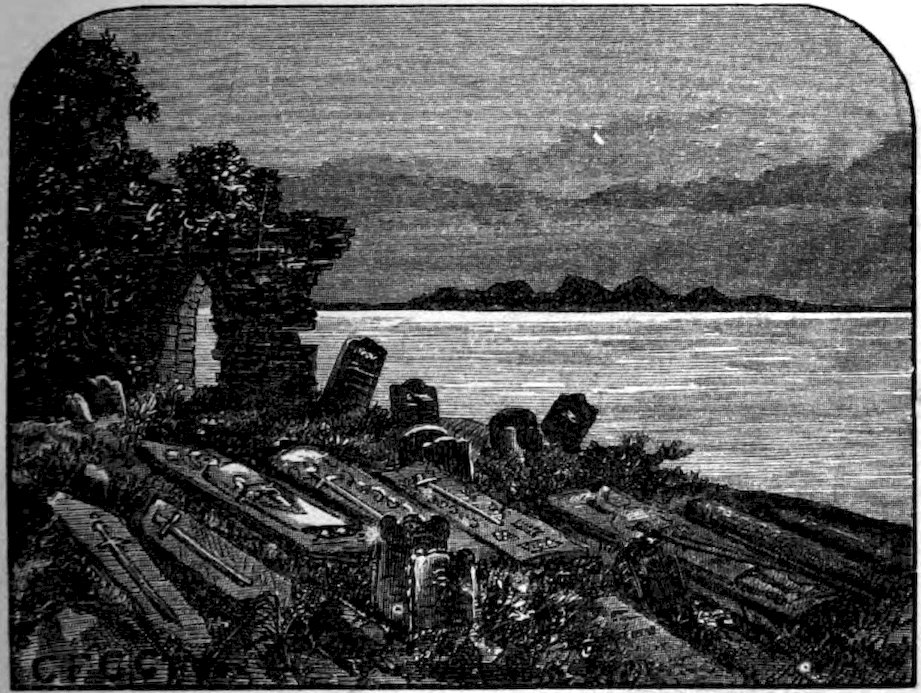
KIRKYARD OF KILKEVAN.
On the high ground overlooking the bay lies the old Kirkyard of Kilkevan, where St. Coivin’s strange games at blindfold love were played. It is one of the most interesting of those we saw, from the extreme beauty of some of the carved stones. Some of these bear the figures of knights, with sword, as long as that of Robert the Bruce, and devices of the chase or armorial bearings, carved all round them. Others have no figure, only one long sword; some have only daggers. There is no mark to tell who sleeps beneath, or whence came the stones, though the people have a tradition that they were brought from Iona,—which, indeed, is likely enough; not as the spoils of ruthless pillage, but as the handiwork of some of the holy brethren, well skilled in cunning stone-work, who doubtless supplied these monuments to such of their neighbours as were willing to pay for them. Be that as it may, the carvers and the knights have been alike forgotten for many long ages, and here they still lie, all facing the east—waiting. The restless agitation of the mighty waters has not troubled their sleep; though, to the idle dreamer who lies among the golden iris watching the broad lights and shadows passing quickly over old 28Ocean’s face, it seems such a constant emblem of the tossing and unrest of life, that he cannot well put away the thousand thoughts thus awakened, and as the murmurous echoes rise and fall with the breeze, they seem to whisper the words of an old song:—
Real Argyleshire rain! Drenching, pouring, soaking, pitiless rain! How it did rain! After such a spell of sunshine, why should it have chosen this very morning to begin this cruel work just as we started for a forty-six mile drive, first across the hills to Campbeltown, and thence to Tarbert, along a coast whose beauty we had already proved, and with which we had vainly hoped to refresh our memories? Our conveyance was the lumbering old coach which still runs between Campbeltown and Tarbert, and it was suggested that we should go inside; but, thinking the remedy worse than the disease, we preferred testing our good and trusty waterproofs; a panoply without which they would be rash indeed who would venture to set foot in the dominions of His Hieland Glory, the great MacCailian Môr, and brave his lawless rain.
It was some consolation that the worthies at the various stages, for once, allowed that it was something more than a “fine saft day,” and condescended to take refuge under their own roofs, and leave drowned understrappers to do all the work; while good John, our gentle Jehu, whose aversion to the whip was as great as that of our host at Losset, soothed and coaxed obedience out of the most unpromising quadrupeds. “Steady, my wee pet,” to a great raw-boned brute, with a wicked eye. “Noo, my bonnie lassie,” to a long-legged, clumsy old cow. A very master in the art of kindly flattery, is this master of the ribbons.
30As we drove along the coast, we had a farewell peep of the little Isle of Gigha, the burial-place of the Macneils, a meet haven for these turbulent island lords, with the wildest sea-waves for ever guarding their rest. On several of the old tombs we can still trace the rudely-carved two-handed sword, half hidden by a coating of warm dark moss. Some relics, too, there are, of yet more ancient days. Great cairns near which stand tall rough monoliths, once, doubtless, suggesting names that in their day were deemed immortal, but of which all tradition has long since been lost. At one place there is a group of three such old cairns, and one great monolith, which has been carved into the semblance of a cross, by some zealous Christian of old. Near this is a well, which the Macneils of yore had only to stir, if they were windbound, and straightway a favourable gale arose, to speed them on their course. A little further to sea lies the low shore of Islay, so called from Yla or Eila, a Danish princess, whose grave near the bay of Knock is still marked by two large upright stones.
Here, too, on the brink of the river Laggan, “Brian of Ila” was buried, standing upright, and holding in his hand a spear, such as that which he used to dart at the salmon. The ruling passion, you see, was strong in death. In Islay, beside Loch Finlagan, one (or more) of the old Lords of the Isles held his court; and standing on a big stone seven feet square, received the homage of all his vassals, a ceremony graced by the sanction of the Church; “for,” says the old chronicle, “the Bishop of Argyle and seven priests did anoint and crown him king of the Isles, placing his father’s sword in his hand, whereupon he swore to protect the Islesmen, and do justice to all his subjects.”
It is curious to note the strange quibble by which this peninsula of Cantyre came to be included among the Hebrides. A very narrow neck of land, such as that which connects this with the mainland, is generally called Tarbat or Tarbert, from two old words: Tarruing, to draw, and Bata, a boat; because in some cases it saved both time and trouble to drag the boats across the isthmus, rather than sail round the land. This was especially true of the Mull of Cantyre, whose difficult navigation and fearful storms were so dreaded, that vessels of nine or ten tons were frequently drawn by horses out of the west loch to that on the east (a distance of barely a mile), thus avoiding the long and 31dangerous sail all round the peninsula. This fact was taken advantage of by the Norwegian king, Magnus, “the barefoot king,” when Donald-Bane of Scotland was forced to cede to him the Western Isles, including all places that could be surrounded in a boat. Placing himself in the stern of a boat, he held the rudder, was drawn over this narrow track, and thus took possession of the Mull.
Well, it poured without intermission till we reached Tarbert, where there still remain the ruins of a castle built by the Bruce. Thence we took the steamer to Lochgilphead, where a smaller steamboat was waiting to take us through the Crinan Canal, and we sat on the deck to catch a glimpse of old Duntroon Castle, but it looked grey and cold and wet, and not a bit like the same place where we used to sail, or row, or scramble in the sunny summer evenings. At Crinan we again changed steamers, and still the rain poured on: “It was never weary.” We knew that on our left lay the Islands of Scarba and Jura, between which rush the mighty tides which swirl and roar round a hidden reef in mid channel, whence shelving rocks on every side project far under the water, and so create the whirlpool of Corrievreckan, “The cauldron of the foaming tide,” which boils and ferments as the impetuous currents meet, till the waves are heaped up like pyramids, which break and spout in dashing spray. Sometimes this wild ferment makes the whole sea white with foam, and then the people say that the Caillach (the old hag) has put on her kerchief, and any ship rash enough to approach would meet its certain doom.
The legend of these tumultuous waters tells that the word Bhreacan (Corrie-Bhreacan), which some have translated as “foaming stream,” was really the name of a brave young Danish prince, who loved a daughter of the Lord of the Isles, and desired to woo and win her. Her father did not favour his suit, yet, not willing to offend the King of Lochlin, he answered craftily that the prince should indeed have his daughter providing he would prove his courage and his skill as a seaman, by anchoring his galley for three days and three nights in the dread whirlpool. The young prince, nothing daunted, returned to Lochlin to consult with his wise men as to the best means of safety. They bade him take three cables,—one of hemp, one of wool, and one of woman’s hair. The hempen 32cable and the woollen one were easy to find, but as to the third, every hair of which must come from the head of a maiden of spotless fame, it demanded such sacrifice as few damsels would care to make. However, the prince was beloved, and the fame of his beauty and of his brave deeds in love and war, had reached the bower of many a Danish maid. So the daughters of the land cut off their long fair locks, and a cable was woven thereof, which should resist the mightiest tempest that ever raged in that seething cauldron. Then the prince returned to the father of his love and announced his readiness to do his will. He anchored in the whirlpool. The first day the hempen cable broke. The second day the woollen one parted. The third day came, and the gift of the maidens of Lochlin still held its ground. The young prince was full of gladness, for his triumph seemed nigh at hand. But alas! for that law which makes the strength of the mightiest cable equal only to its weakest link. There was one fair tress binding him to the anchor of his hope which had been shorn from the head of one whose fame was no longer without blemish. So the resistless might of unspotted purity was not there to bind the raging waters, and the last rope parted, and the ship was sucked down in the mad whirling vortex, down, down, down, to the unfathomable depths of ocean. But the body of the prince was brought to land by his faithful dog, and dragged to a cave that bears his name, where a little cairn still marks the spot where Bhreacan was buried. The dog returned to the water, doubtless seeking some other friend, and he perished in a lesser whirlpool between the Isles of Scarba and Lunga, and that Sound is still known as the Grey Dog’s Slap.
To the north-west of Scarba lies the little island of Elachnave, where there remain traces of some of the very earliest monastic buildings, situated near an ancient cemetery of the roughest sea-stones, one of which bears a rudely graven cross; there are also two beehive cells of slate, covered with grass, perhaps the humble homes of holy men of old.
All this time we were passing through scenery which we believed to be bewilderingly lovely, if we could but have seen it, instead of the sheets of grey rain, which poured down incessantly from the heavy clouds. But towards evening, as we neared Oban, the quiet little harbour, as its name implies, the dark 33storm drifted away, and the sun shone forth in penitent beauty, changing the whole face of nature. Instead of earth, sea, and sky being all of one leaden hue, the scene was now flooded with tender rainbow-coloured light; fairy islands in the far distance seemed to float ethereally on the opal-tinted sea, and the great hills of Mull appeared as if rising from the waves, like some pale spirit, faintly visible through the tremulous evening light.
Just beyond the town rises the stern old Castle of Dunolly, perched on a grey projecting craig, which, rising abruptly from the shore, commands the harbour on either side; a strong tower of defence in olden days, and one which no foeman’s galley could approach unseen. Now a picturesque garden nestles round the base of the craig, adding gem-like touches of colour to the flush of heather which lies in every cranny of the grey rock, while a background of green and gold foliage serves as a rich setting to the whole. Near the base of the cliff one huge rock boulder stands upright, as if placed there by some giant hand. This is known as the Dog’s Stone, for here it was that Fingal was wont to tie his faithful dog Bran in ages long before Macdougals or Campbells had taken possession of the land. You know this grim old fortress of Dunolly was the eerie where the Macdougals of Lorn, eagle-like, built their nest overhanging the waves. They were lineal descendants of the first Dougal, Lord of the Isles, son of the great Somerled, whose place of burial we noted at Saddell. The old castle is now in ruins, later generations having preferred to build themselves a modern home in a more sheltered nook, where, among other family treasures, they still retain the far-famed brooch of Lorn, snatched from the Bruce by their ancestor John of Lorn.
Resolved to make the most of so beautiful an evening, we wandered along the shore in the direction of Gallanach, by far the most lovely, and yet the least frequented road in the neighbourhood of Oban, winding beneath grey crags, close to the sea; and disclosing at every turn some fresh vision of beauty; dreamy isles or the nearer mainland.
The dewy freshness of a sweet spring morning tempted us forth betimes, to explore another fine old ruin, the Castle of Dunstaffnage, a far more imposing mass of building than Dunolly, though lacking the grandeur of its rocky ramparts. But the low grassy shore on which it stands is washed all 34round by the blue sea-loch, so that at high tide it is in fact an island, and the waters, coming close in shore, serve as a mirror to reflect the grey weather-beaten fortress, only rendering its image in mellower tones than the stern walls ever wear in reality. Nor is its beauty lessened when the receding waters expose the dark rocks fringed with golden sea-weed,—rocks on which you may sometimes surprise a whole family of seals basking in the warm sunshine,—a grey old grandmother surrounded by her children and grandchildren, the latter dark in colour as the dry wrack on which they lie. They will slip shyly into the water at your approach, but perhaps you may wile them back with some plaintive song, for they have keen ears for music, and will brave even the dreaded human presence for the sake of some favourite melody. Often, while sailing on this very loch, we have tested this curious fact, and watched the black shining heads appearing from time to time, as these music-loving creatures swam in the wake of our galley, attracted by the sound of songs, or of old Scotch tunes played on an accordion. Talking of “grey old grandmothers,” I remember one patriarchal seal, who in her old age had turned so silvery white that as she lay on the rocks close in shore, we all with one accord agreed that it must be a sheep which had fallen from the cliffs overhead. As we sailed nearer, the likeness seemed to increase, even to the experienced eyes of our older sportsmen; so we determined to put off a boat and rescue the poor sufferer who lay so still and motionless, only from time to time turning her head uneasily at our approach. It was not till we were within easy shot (a shot which, of course, was never fired) that the old lady condescended to lift herself up, and, looking down on us in calm surprise, plunged into the cool clear waves, leaving the invaders very much astonished at their own lack of discrimination.
In a cool shady glade, a stone’s throw from the castle, stands a ruined chapel, ivy-clad, where many a carved stone tells of the sleepers who have here found so calm a resting-place after life’s turmoil—a lonely spot, seldom trodden by human foot, but haunted by white-winged sea-birds that float spirit-like in mid-air, sometimes alighting on the hallowed ground, and peering about inquisitively, as they walk solemnly over tombs of Vikings and Chiefs of old. Apart from the exceeding natural 35beauty which lends such a charm to all this coast, there is the special interest of countless old legends, which connect not only these grey ruins, but all the country round, with the successive holders of the soil,—those divers races who by turns have swept over the land, each leaving their little mark behind them. The very name of this district—Beregonium—falls strangely on the ear, accustomed rather to the sound of Celtic or of Norse than to such classic old Latin, and reminds us of the days when Roman invaders, having driven out the earlier settlers, seem to have recognised the importance of this position as a key alike to the Hebrides and the western coast. Here, in the massive headland (which, jutting into the sea, commands both plain and ocean), they found a position so strongly fortified by Nature’s ramparts of rugged rock, as to require but small aid from human skill to convert it into an impregnable encampment.
Of the original inhabitants, little is of course known, but this spot is believed to have been one of the principal settlements of the Dalriads, if not the capital of their kingdom. Certain it is, that many of the oldest legends of Ossian cluster round this immediate neighbourhood, where Fingal is said to have held his court and shared with his warriors in wild feasts and frays.
From Dunstaffnage we overlook a desolate tract of wide flat moorland, known as Loch Nell Moss, lying between the blue waters of Loch Etive and the broad Atlantic. Here various traces have recently been discovered of the homes and graves of our Pagan ancestors, suggesting dim and shadowy visions of their life in far remote ages. Half way across the Moss rises a large cairn, built of rounded water-worn stones, and surrounded by stunted trees. This has recently been excavated; and in the heart of the tumulus were found two megalithic chambers, containing human remains and urns. Also divers white quartz stones, such as various Pagan nations were wont to bury with their dead, apparently as emblems of purity and indestructibility, thus possibly conveying some idea of immortality and of sin forgiven or cancelled, as when the Greeks of old symbolized a release from some obligation by the giving or receiving of a white stone,—a custom probably alluded to in the book of Revelations in the promise “To him that overcometh .... I will give a white stone, and in the stone a new name written.” Or the 36allusion may have been to the ancient form of ballot, when the favoured candidate was known by the number of white stones which fell to his share. In the present instance, the white stones were arranged in pairs, on a ledge of rock projecting above the urns, a single stone being placed at each end of this double row; another single white pebble was found inside one of the urns.
A considerable number of similar pebbles of white quartz have recently been discovered in various old British tombs on the Isle of Cambrae, as also within the Sacred Circle on the Isle of Man; a circle, by the way, which from time immemorial has been held in such reverence, that to this day the Parliament of the island is there convened. These pebbles were also found in most of the old tombs recently excavated in the neighbourhood of Dundee, in fact so frequent was their presence, that it was common for the workmen employed in excavating to exclaim, “Here are the two stones! now we will get the bones.” Rock crystal is sometimes found in lieu of the white quartz.
As a curious trace of a similar custom in a far-distant land I may mention that Dr. W. F. Cumming tells me that he found several graves thus strewed with white pebbles near the temple of Deir, the capital of Nubia, above the second Cataract of the Nile. A kindred coincidence (bearing on the religious and funereal rites of our ancestors) is, that in several tumuli, at Dundee, Inverary, Letcombe Castle in Berks, and Maiden Castle near Weymouth, there have been found conical stones of white quartz, each in connection with human remains, and precisely similar to those found in the excavations at Nineveh which are now to be seen in the British Museum, the only difference being that the latter are covered with inscriptions, and representations of serpents and of the sun and moon.
Turning from these dwellings of the dead to the sunny shores of Loch Etive, we next come on traces of a lake village, of considerable size, and in fair preservation. Here, on removing accumulations of peat-moss, which would seem to have been the growth of twenty, or perhaps thirty centuries, a series of oval palings were found, still surrounded by wooden stakes, which doubtless once supported conical thatched roofs, like those dwellings of the old Gauls described by Strabo as circular, with lofty tapering roofs of straw. However suggestive to the initiated are these slight remains of the homes of their ancestors, they offer small attraction to the general public, compared with the hints of the ancestral worship recently discovered in Glen Feochan in the rival district of Loch Nell, which, though bearing the same name as the Moss aforesaid, lies about three miles on the other side of Oban.
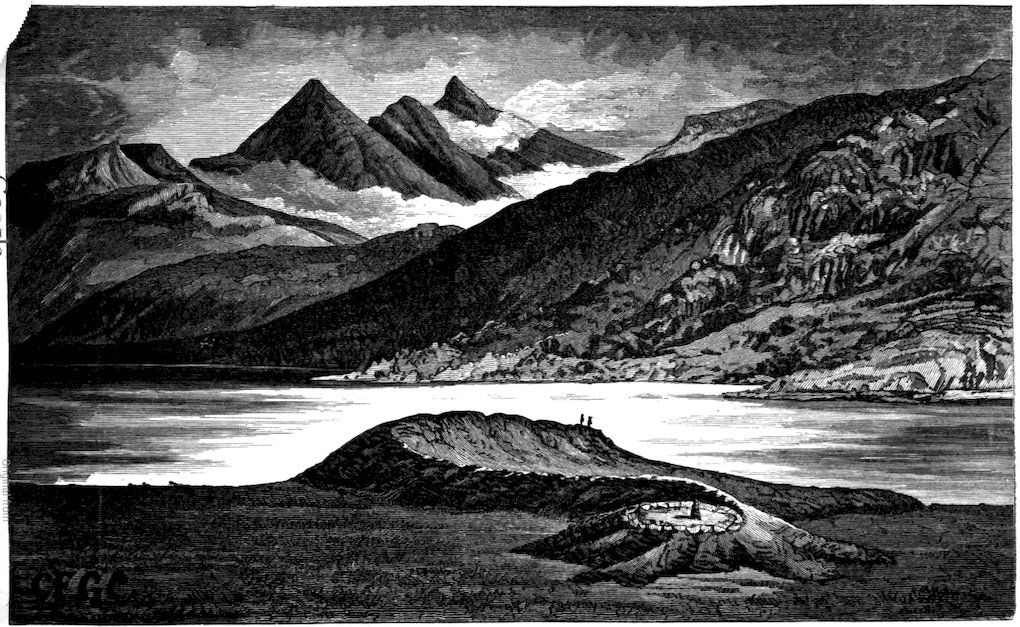
SERPENT-SHAPED MOUND NEAR OBAN. To face p. 37.
37Here lies a huge serpent-shaped mound, the very existence of which, strange to say, was utterly unknown to the scientific world till discovered by Mr. Phené, and by him revealed to the Antiquarian Society in the summer of 1871. Being in Oban soon afterwards, we lost no time in setting forth in search of the monster. Half an hour’s drive brought us to the shores of Loch Nell, beyond which Ben Cruachan proudly rears her triple crest, standing in dark relief against the delicate white vapours which cling to her so lovingly, sometimes veiling, sometimes crowning, this stately queen, as they float around her with ceaseless motion.
The carriage-road winds along the shore, and through broken hummocky ground, in some places clothed with grass, in others with heather and bracken; and, but for the presence of one of the few initiated who had fortunately accompanied us, we should assuredly have passed close below the heathery mound which forms the Serpent’s tail (in fact, the road has been cut right across the tip of it), without ever suspecting that it differed from the surrounding moorland. In short, we should have been no wiser than our forefathers, who for centuries have passed and repassed along the same beaten track, whence only an occasional sportsman or shepherd has had occasion to diverge. It does seem strange, however, that not one of these, looking down from the higher ground to westward, should ever have called attention to so remarkable a form, and one, moreover, which rises so conspicuously from the flat grassy plain, which stretches for some distance on either side, with scarcely an undulation save two artificial circular mounds, in one of which lie several large stones forming a cromlech. These circles are situated a short distance to the south, to the right of the Serpent, but too far to be shown in the sketch.
Finding ourselves thus unconsciously in the very presence of the Great Dragon, we hastened to improve our acquaintance, and in a couple of minutes had scrambled on to the ridge which 38forms his backbone, and thence perceived that we were standing on an artificial mound three hundred feet in length, forming a double curve like a huge letter S, and wonderfully perfect in anatomical outline. This we perceived the more perfectly on reaching the head, which lies at the western end, whence diverge small ridges, which may have represented the paws of the reptile. On the head rests a circle of stones, supposed to be emblematic of the solar disc, and exactly corresponding with the solar circle as represented on the head of the mystic serpents of Egypt and Phœnicia, and in the great American Serpent Mound. At the time of Mr. Phené’s first visit to this spot there still remained in the centre of this circle some traces of an altar, which, thanks to the depredations of cattle and herd-boys, have since wholly disappeared. The people of the neighbourhood have an old tradition that in remote ages this was a place of public execution, and, from various analogies in the customs of other nations, it seems likely enough that this was the case, and that this wild glen may have been to many the valley of the shadow of death, whether their lives were taken judicially or offered in sacrifice.
The circle was excavated on the 12th October, 1871, and within it were found three large stones, forming a chamber, which contained burnt human bones, charcoal, and charred hazel-nuts. Surely the spirits of our Pagan ancestors must rejoice to see how faithfully we, their descendants, continue to burn our hazel-nuts on Hallow-e’en, their old autumnal Fire Festival, though our modern divination is practised only with reference to such a trivial matter as the faith of sweethearts! A flint instrument was also found, beautifully and minutely serrated at the edge; nevertheless, it was at once evident, on opening the cairn, that the place had already been ransacked, probably in secret, by treasure-seekers, as there is no tradition of any excavation for scientific purposes having ever been made here.
On the removal of the peat-moss and heather from the ridge of the serpent’s back, it was found that the whole length of the spine was carefully constructed with regularly and symmetrically placed stones, at such an angle as to throw off rain; an adjustment to which we doubtless owe the preservation, or at least the perfection, of this most remarkable relic. To those who know how slow is the growth of peat-moss, even in damp and 39undrained places, the depth to which it has here attained, though in a dry and thoroughly exposed situation and raised from seventeen to twenty feet above the level of the surrounding moss, tells of many a long century of silent undisturbed growth, since the days when the Serpent’s spine was the well-worn path daily trodden by reverent feet. The spine is, in fact, a long narrow causeway, made of large stones, set like the vertebræ of some huge animal. They form a ridge sloping off in an angle at each side, which is continued downwards with an arrangement of smaller stones, suggestive of ribs. The mound has been formed in such a position that the worshipper standing at the altar would naturally look eastward, directly along the whole length of the great reptile, and across the dark lake, to the triple peaks of Ben Cruachan. This position must have been carefully selected, as from no other point are the three peaks visible.
This reverence for some Triune object, whether a triple-pointed hill, the junction of three rivers, or the neighbourhood of three lakes, seems to have been a marked characteristic of almost every ancient faith. It was some such dim conception of the worship due to an adorable Trinity in Unity which led to the almost universal adoption of some sacred triple symbol, such as the trident of Neptune, which we find again, placed on the pinnacle of every temple of Siva, and carried in the hands of his worshippers. It is daily painted on the forehead of every worshipper of Vishnu, and even reappears as the mystic symbolic letter painted outside the Phylactery worn on Jewish brows, albeit the wearers have long since lost all clue to its hidden meaning. Again, we find it in old drawings of Babylonish priests, who bear it in their hands; and it has been shown that not only was this symbol held in deepest and most mysterious reverence in the temple of Apollo at Delphi, but also that the far-famed idol Juggernaut, representing the same sun-god, is, when undressed, and shorn of its gorgeous raiment, simply a triple symbol with a head rudely engraven on the central limb, for the adoration of the vulgar uninitiated. The idea is further carried out by the fact that the great Juggernaut is only one of a group of three great idols, his brother and sister dividing with him the homage of the people. All these three were, so runs the legend, miraculously fashioned by Vishnu 40himself from one divine log of timber. His brother is also endowed with stumps for arms, so that he also is a triple symbol; but the sister is merely a rough block of wood, with a head carved thereon.
In truth, this doctrine enters largely into the faith of Hindoostan, where the worship of the Trimurti, or three principal gods united in one perfect Being, forms the key-stone of Brahminism. Moreover, we know that the faithful Hindoos who crowd in such countless multitudes to bathe at Allahabad, are drawn thither not merely by the sanctity of the junction of the two great rivers visible to human eye, but by their firm belief that a third and more holy river of life-giving water here pours its stream invisibly into the bosom of the Ganges. Perhaps the most singular instance of reverence for a mystic triple number is to be found where we would least expect it, namely, among the Buddhists; in whose solemn and very ancient service for the ordination of priests, each question and answer, each sacred vow and declaration of faith, must be repeated thrice. That ordination service is said to have been used without alteration for upwards of two thousand years, since the days when the Sanchi Tope (mightiest of Buddhist relic shrines), was reared by the immediate followers of Buddha, and its gateways crowned with the mysterious triple symbol.[3] Even in the decorations of modern Buddhist temples I have often been struck with the recurrence of the threefold number, both in the grouping of sacred lotus blossoms, and that of saintly figures, sometimes seated on the clouds,—decorations generally copied with monkeylike imitation from ancient temples, by modern priests, ignorant of all hidden meaning in the work of their predecessors.
The ancient Egyptians likewise believed the Spirit of Good to be threefold; hence on Theban monuments the gods are shown in groups of three. Sometimes Osiris, Isis, and their son Horus, are thus grouped; sometimes in place of Osiris we find Nephthys, sister of Isis. These are also represented by the figure of a triangle.... Thus too, I am told (though I know not on what authority), that the Persians of old were wont to reverence the threefold leaves of the shamrock, as symbolic of a Divine Triad, to whom this plant was consecrated by the sons of Iran for many long centuries ere St. Patrick made use of the 41same green leaf to exemplify the same mystery to the sons of Erin—a leaf, moreover, to which they already attached some mysterious meaning, regarding it as a certain charm against serpents and all venomous reptiles.[4]
In like manner, the Druids (those Ghebres of the West), who venerated the sacred mistletoe by reason of its mystic triple branches and triple clusters of white berries, were not likely to overlook so mighty an embodiment of the same symbol as a great mountain, with its threefold summit towering heavenward, as if to draw thither the eyes and hearts of a race who were careful to consecrate all such natural types in their worship of Nature’s God.
It was a knowledge of this tendency that first led Mr. Phené to examine minutely all the least trodden glens in the neighbourhood of any such natural features, as for instance round the Eildon and Arran hills, seeking for traces which should mark the spot as sacred; and in each case, among other so-called Druidic remains, he has found just such mounds of reptile form as he was in search of, none however so remarkable as this strange old Serpent, which for so many centuries has lain here undisturbed, as if guarding the valley. All of these are more or less akin to the reptile mounds discovered in Ohio and Wisconsin by Messrs. Squier and Lapham, always in connection with sacrificial or sepulchral remains. One of these in particular is of an unmistakeably serpentine form; and the position of the altar in the circle or oval at the head of the Serpent is identical with that of this Argyleshire mound, the head in each case lying towards the west. The American mound is, however, on a larger scale than its Scotch cousin, being altogether a thousand feet long. It points towards three rivers, thus indicating the reverence for the triple symbol,—another instance of which occurs on the hill known as Lapham’s Peak, on whose lofty summit three artificial mounds were found, carefully constructed of stone and earth,—materials which must have been transported thither with very great labour.
Whatever may have been the origin of these huge serpent-shaped mounds, their existence seems to suggest a clue to the 42meaning of various ancient legends concerning enormous serpents which covered acres of land; the very fact of their dimensions being given in terms of land-measurement seeming to imply that the writers merely alluded in poetic terms to Ophite or Dracontic temples where these symbols were worshipped. Thus we hear of dragons in Mauritania so great that they were covered with grass. Alexander the Great was taken to see a sacred dragon five acres in extent, lying in a low valley, surrounded by a high wall: to this dragon the Indians offered sacrifices of flocks and herds. Strabo mentions two such dragons in India, one measuring eighty cubits in length, the other a hundred and forty. And on the plains of Syria, near the land of snake-adoring Hivites, lay a serpent about an acre in length, of such bulk that two horsemen riding on either side could not see each other, while its mouth was so great that a man might ride in thereat—an experiment not likely to be tried were the reptile a living creature!
But all these are dwarfed by the legendary Dragon of Damascus, which is described as a serpent covering fifty acres of land! a description which Bryant interprets as including a grove and garden round the Ophite temple. He also quotes Ovid’s account of the serpent Python as covering several acres, alluding surely, not to the serpent itself, but to that temple of Delphi which Apollo built with great stones on the spot where he had slain the Python—a temple which Stukely infers to have been similar to our own great temple of Avebury or Aubury in Wiltshire, i.e. a circle whence started two wavy serpentine avenues, forming the Ophite symbol; and although his theories on this subject are now commonly held in ridicule, it should at least be remembered that the form was far more perfect in his day (1723) than it now is, many great stones having been broken up by farmers in his time, and the work of destruction still continuing mercilessly when Deane wrote in 1830.
The same ridicule also attaches to those who claim the marvellous temple of Carnac in Brittany as an instance of serpentine form, and who try to show that these huge monoliths are arranged in a sinuous course, so as to describe the figure of a monstrous snake, so vast, indeed, that its windings are eight miles in length and must have originally been marked by ten thousand stones, many of those still standing being 43upwards of fifteen feet high, while one measures forty-two feet in circumference. In support of this theory, these Ophite antiquarians tell us that the peasants of the neighbourhood have an annual dance at the Carnival, which exactly describes the symbol of the Sun and Serpent. They also say that Carnac is derived from two words meaning fire and snake, hac being the old Celtic name for the serpent. In confirmation of this, we are reminded that the common name for snakes in some parts of England is to this day hag-worms. Hence the name hag to describe an old witch, supposed to have derived supernatural knowledge from her familiar spirits—perhaps originally a snake-priestess. The same word occurs in the Hakpen hills in Wiltshire, and is interpreted as meaning ‘serpent’s head,’ being the place where the serpentine avenue of Aubury terminates. The latter name is brought forward as evidence, and shown to be derived from aub and ur, meaning ‘serpent’ and ‘light;’ thus exactly describing the worshipful Sun-Serpent!
It certainly is a fact worthy of notice, that wherever—in Europe, Asia, Africa, and America—names occur combining the syllables Ob and On (the Serpent and Sun deities of Egypt and Phœnicia), there these forms of worship can be proved to have once prevailed; and so it has been suggested as not impossible, that just as the Israelites called the first place where they encamped, after the upraising of the brazen serpent Oboth, the race who built the serpentine mound, terminating in a solar circle, and who doubtless were settlers from some eastern land, may have given the name of Ob On, or Oban, to the nearest town.
But whatever disputes may arise concerning these vague derivations, and the still more vague forms, of the old temples of which we have been speaking, there can be no doubt whatever of the clearly-defined outlines of the great mound now before us; though, whether its serpentine (or rather Saurian) form is to be accepted as any direct proof of serpent worship in this land, or whether it was simply reverenced as the representative of some tribe (a Totem, in short, of some extinct British race answering to the Nagas, or snake tribes, of the East), will doubtless prove a fertile subject for discussion for many years to come. Certainly we know that the worship of the serpent and of the serpent’s egg, by the Druids, is a matter of history; 44and we are told that they were wont to place live serpents, as symbols, at the foot of the altar during the time of sacrifice, a custom common to almost every ancient nation. In Greece and Rome, Egypt and Chaldea, Arabia and Central Asia, in China and Thibet, throughout the whole Indian empire from Cachmere to Cape Comorin, in Ceylon and multitudinous other isles, in Mexico and Peru, as well as throughout the whole of Africa, the same extraordinary worship is shown to have prevailed. Passing northward, we find it in Scythia and Scandinavia, as also among vast tribes near the Oural mountains and throughout Northern Europe, notably among the tribes on the Ob or Obi river, which is said to have derived its name from the reverence in which this reptile was held. The ancient Muscovites and the people of Poland worshipped domestic serpents, which glided at large in every home and were reverently tended, all misfortunes being attributed to some negligence in their service. This continued till the end of the fourteenth century, when the last heathen duke of Lithuania received Christian baptism. The people of Lapland, the Fins, Norwegians, Swedes, and Danes, all cherished these household gods, which shared the children’s milk! The Vandals also kept domestic snakes; some lived in hollow trees, and the women went thither to pray, carrying offerings of milk, as many do at the present day in India and Ceylon. The Lombards continued to worship a golden viper and a tree long after they were professedly Christian. It was not till A.D. 663 that Barbatus, Bishop of Benevento, finding this custom still prevalent, persuaded them to cut down the tree, and allow him to melt the golden viper, and make thereof a sacramental chalice.
Deane quotes a curious proof of the homage which was still paid to the serpent symbol by the semi-Christianized people of Constantinople so late as the seventeenth century. It seems that Constantine had brought thither the celebrated serpentine column, or conical tripod, from Delphi, whereon the Pythian priestess sat when delivering her oracles. This column was a triple-headed serpent of brass. “When Mahomet II., the Turkish conqueror of Constantinople, entered the city and beheld this object, he inquired ‘What idol is that?’ at the same time hurling his iron mace with such force that he knocked off the lower jaw of one of the serpent-heads. Upon 45this, immediately, a great number of serpents began to be seen in the city; whereupon the people besought him to leave that image alone, as only through its power no other serpents could molest them. Wherefore that column remains to this day. And although, in consequence of the lower jaw of the brazen serpent being struck off, some serpents do come into the city, yet they do no harm to anyone!”[5]
The ancient Serpent Temples of Cambodia with their many-headed snakes, and the temples and rock sculptures of India and Ceylon, showing the hooded cobra rising as a canopy above so many of the gods and overshadowing even the pure and perfect Buddha, tells how this worship was gradually idealized. Strange, indeed, it is to trace how the creature which to us is the very type of all things evil, should there have been recognized as the embodiment of good, and to find thousands and tens of thousands of sculptures of that seven-headed snake, which to its worshippers symbolized their ideal of that Seven-fold Spirit of Wisdom, Whom Christians adore! For thus in mythology the serpent has ever filled a double part; sometimes appearing as a meet emblem of the wisdom of God, sometimes as the type of the subtlety of the Arch Fiend,—one day exalted (as with the Ophites of Alexandria) to a place of honour even upon the Christian altar; the next hurled down to the nethermost hell, as when the ancient Scandinavians sang of the dark shore where the sinful dead found themselves in a dread chilling abode, formed entirely of serpents, twined and intertwined, fold within fold, like wattled wickerwork. And all the serpents’ heads were turned inwards toward that vast and terrible cavern, continually vomiting forth floods of venom, wherein writhed these wretched ones in their hopeless anguish. We know that the Chaldeans, like the Chinese, worshipped a winged dragon as the Being excelling in wisdom; and the Mexicans adored a mighty feathered snake, as well as the great serpent which symbolized the life-giving sun.
This divine feathered serpent, who was born of a daughter of Earth, was the great lawgiver and civilizer who taught the Mexicans, not religion only, but also agriculture and the use of metals; and when he had finished his mission on earth he 46departed, promising to return. Therefore when the Spaniards arrived in Mexico their coming was hailed as that of the returning god. In the Mexican mythology, as in those of Egypt and Greece, the Serpent appears as emblematic of so many divers gods, that he is evidently considered a symbol of the intrinsic divinity common to them all. Nor was his worship only symbolic. Both in Mexico and Peru there were great snake temples, where the living creature was adored and received offerings of human victims. The entrance to the temples was guarded by huge serpent idols, while the sacred drums whereby the worshippers were summoned were covered with skins of large serpents, and the gods within the temples were all entwined with serpents.
A cast of one of their idols was brought to this country—the figure being partly human, while the hands and arms are rattlesnakes; and the drapery is entirely composed of wreathed rattlesnakes woven into what the Mexicans called a garment of snakes. It is to be hoped that this deadly species was not included among the tame serpents which glided at large in every home as household gods! Some of the Mexican sculptures show human beings conversing with the serpent, while others show a conflict between them, the victor being sometimes a man, sometimes a god; in one, the god is cutting off a dragon’s head, but not till the dragon has bitten off his foot at the heel.
The Spaniards recorded very similar forms of worship in Peru, where in one temple they saw a vast image of a serpent of divers metals, with his tail in his mouth, to which annual human sacrifice was offered. At another temple they were told how ‘the devil did speak visibly,’ the medium of his oracles being a spotted snake. The Aztecs, like the Hindoos, reverenced the serpent biting his own tail as the emblem of eternity—the symbol of time ever revolving on itself and returning into itself. They also held the casting of the serpent skin as symbolic of an ever-renewed youth and spring-tide.
To give the names of the gods to whom the symbolic serpent was held sacred would be to enumerate well-nigh every deity in the mythology of every ancient nation, this being the one only characteristic common to all these faiths; a circumstance that would be utterly unaccountable on any theory other than that 47of some tradition common to all, such as that of the Serpent of Paradise. It is easy to perceive how quickly the belief in his supernatural wisdom would lead to his worship; and thus from age to age the arch-enemy has kept up his character as serpent tempter, inducing all mankind to yield abject veneration and adoration to the repulsive reptile whose form he had once assumed.
Of course, the earliest traces of this worship are to be looked for in Chaldea; and accordingly we find that in the great temple in Babylon there were two very large serpents of silver. Moreover the people worshipped a great living dragon (or serpent, for the two words are used promiscuously by old writers, as when, in Bœotia, a dragon had laid waste the town of Thespiæ, and Jupiter commanded that an annual human sacrifice should be offered to the Serpent. Or again, in biblical language, we read in the Revelations that “The great dragon was cast out; that old Serpent called the Devil, which deceiveth the whole world.”) In ancient Persia both the good and the evil principle (Ormuzd and Ahriman) were symbolized by serpents, which were represented contending for the mundane egg. In Mesopotamia, in Syria, in Ethiopia, they were likewise held in reverence, and it is asserted by various writers that to this day both Arabs and Hindoos eat the heart and liver of serpents, hoping thereby to acquire a knowledge of the language of animals. The same curious notion gave rise to the old Celtic legends concerning that pure white serpent, which, if caught and boiled, would confer the gift of omniscience on the first man who tasted this broth, and who would moreover become the wisest of doctors.
Akin to this is the old Greek fable, telling how, when Melampus had saved the lives of two snakes they came to him as he slept under an oak, and licked his ears, whereupon he was able to understand the chirping of birds, and was gifted with prophecy. The same gift of prophecy was bestowed when serpents ‘with their tongues cleansed the passages of the senses’ of sleepers in the temple of Apollo, and made them so sharp of hearing that they could hearken to the counsel of the gods. Others requited certain blind men who had done them service by licking their eyes, and so bestowing on them sight far keener than any human vision.
The primitive inhabitants of Canaan were also snake-worshippers 48(indeed, their name, Hivite, is said to be equivalent to the Greek Ophite). Hence, when the Hebrews intermarried with these tribes, and served their gods, they in fact adopted this worship, which accounts for the readiness with which veneration for the brazen serpent led to actual adoration and burning incense thereto, so that Hezekiah was compelled to destroy it, with other idols. Undoubtedly, faith in the supernatural knowledge of the creature lingered in Palestine till much later days, as we gather from the frequent allusions to consulting ‘those that have familiar spirits,’ an expression which should rather be translated[6] ‘serpents,’ the word used (Ob or Oub) being the same as describes the serpent worshipped in Egypt. Passing on thither, we find the same wide-spread superstition. That this worship was coeval with that of the sun is shown by the earliest Egyptian mythology, relating how Helius, the Sun-god, married Ops, the Snake-goddess. Though peculiarly consecrated to three or four of the principal gods, there is scarcely one Egyptian deity which is not occasionally symbolized by the serpent, and the living reptiles were adored in great temples at Elephantina, Thebes, Alexandria, Onuphis, and Metele, where they were fed with flour and honey by their appointed priests.
There is reason to believe that this strange worship still contrives to continue its existence in the land, in spite of the rigorous laws of Mohammedanism. Bishop Pocock mentions having been shown a cleft in a rock on the Nile, near Raigny, where the great serpent Heredy is said to have dwelt since the days of Mahomet. Against the rock is built a mosque, but the Bishop noticed much blood, and the remains of beasts lately killed, which clearly told their story of recent sacrifice to the Serpent. He says the Christians have as great faith as the Mohammedans in its power to cure all manner of diseases, and adds, that, once a year, the women of the land go a pilgrimage to his shrine, to seek his favour, as the Grecian women of old were wont to do to their serpent gods.
In the mythology of Greece there is scarcely one fable in which the serpent does not figure, nor one god which is not thus symbolized. First we have Cadmus slaying his famous dragon, and planting its teeth, which spring up as armed men, and build 49Thebes. Then Cadmus and his wife are themselves transformed into serpents, and as such are adored by the people. Next comes the founding of Athens by Cecrops, whose first care is to erect an altar to Ops, the serpent-goddess. One fable after another tells how divers gods temporarily assumed the form of either a dragon or a serpent for reasons of their own, generally in order to win some maiden of earthly mould. Sometimes we find the serpent entwining the helmet or the mystic staff of sage Minerva; then he figures in the drunken revels of Bacchus and Isis. Health-giving Esculapius and his sister Hygeia are both invariably accompanied by serpents, sometimes coiled in the lap, or drinking from a chalice, sometimes carried on high like the brazen serpent of the Israelites. Now we have Jupiter taking the form of a “dragon” to deceive Proserpine. Then Apollo, the sun-god, slays the Pythian serpent, and himself gives oracles at Delphi, which were previously revealed by that creature of supernatural wisdom, in whose honour solemn services were held every seventh day.
The latter is a curious fact when taken in connection with the existence of certain Greek sculptures, whereon the serpent is shown entwined in the branches of a tree, with a woman standing by, and seems another link connecting this worship with the traditions of Eden. It occurs again in Orissa, where, at Surabulpore, there lives, or did live a few years ago, a great and holy serpent, seen by various European travellers, which came forth from its cave every seventh day to devour a goat offered to it by the people. Another of these sculptures[7] represents a man kneeling near the woman, as if worshipping the serpent; while on the other side old Charon approaches, leading Cerberus to guard the tree. Live serpents were kept and honoured in the dominions of all the Grecian gods. In Macedonia serpents of largest growth were cherished as household gods, and were the playfellows of the infant children. One was kept in the Acropolis, and consecrated to Minerva, on the walls of whose temples were sculptured Medusa’s heads, fair and beautiful, with snake-entwined hair. There were sacred groves adjoining most of the principal temples of Apollo, both in Greece and Italy, where living serpents were attended by priestesses, and suffered to glide about at their own sweet will, consuming honey-cakes, 50delivering oracular responses to all comers, and occasionally killing a priestess who, with heedless foot, chanced to molest one of her slippery gods.
The husbandmen annually made solemn pilgrimages to these temples, and offered propitiatory sacrifices to the serpents, supplicating a good harvest. If the reptiles were pleased to accept their offerings of cake and wine, the omen was hailed with gladness. It would seem as if the original curse of the ground and its produce for the serpent’s sake, had led to the belief that he who had brought about such mischief still exerted some mysterious influence, whereby he had power to regulate the produce of the earth and her fruits. Hence the Chariot of Ceres, goddess of agriculture, was drawn by serpents, and throughout Hindoostan the serpent is to this day adored as one of the Gram Deotas, or corn-gods, to whom special sacrifice is made at seed-time and harvest.
The head of the serpent has now been so far bruised that his nominal adherents are comparatively few. Perhaps the most curious instance of his open and avowed worship in the present day, among a people professing high civilization, is to be found among the Celestials, who, Buddhists though they be, cannot allow so dangerous a power to remain unpropitiated. Their edition of the old legend tells of a wicked serpent whose head was crushed by a woman; and in their temples they represent a goddess in the act of crushing the reptile. But on the principle of always conciliating evil, they offer sacrifices, not to the good goddess, but to the wicked snake; and in the city of Canton there is at least one temple where, in the very presence of Buddha’s statues, is an altar whereon smoulder warm coals, round which lies coiled a living serpent, which is daily fed and worshipped by the people. Near him on the same raised altar are placed certain sacred shrubs; so here we find the old tree and serpent worship still lingering in the heart of this great populous city.
But to see it in its glory we must turn to such purely uncivilised savages as the Fiji Islanders, or the negroes of Dahomey, over whom the serpent continues to hold sway, just as he probably has done from the earliest ages. Bishop Crowther, writing from one of the Niger Mission Stations, says that it is impossible to rear either goats, sheep, young pigs, or any sort of poultry, by 51reason of the multitude of cobras, which, being considered sacred by the Brass-men, must on no account be killed, but are allowed to overrun the country and help themselves to whatever they please! A still more curious reference to this fact occurs in Britain’s treaty with the natives, made in November, 1856, which contains a clause stating that, owing to the hindrance to trade, from white men having in their ignorance killed certain species of boa constrictors which enter houses and are considered sacred, and having thus excited the anger of the Brass-men, “it is hereby forbidden to all British subjects to harm or destroy any such snake, but they are required, on finding the reptile on the premises, to give notice thereof to the chief man in town, who is to come and remove it.” Just imagine letting a boa constrictor disappear under your bed while the authorities are providing an honorary escort for their god!
All along the western coast of Africa the serpent holds sway, more especially in Congo and Whidah, where the chief temple is called “The Serpent’s House.” Here a great retinue of priests and priestesses, subject to a high priest, await to interpret the serpentine oracles to all anxious pilgrims. We are told that these priestesses are called the daughters of God, and are tattooed with serpentine figures. When Bosman visited these tribes in 1697, he was duly impressed with the pomp and ceremonial of the temples, but chiefly with the fanaticism of the worshippers; for, an Englishman having accidentally killed a snake, the people rose en masse, and massacred all white men on whom they could lay hands, after which they burned their bodies and their goods. Shortly afterwards a hog chanced to kill another snake, whereupon a thousand armed Whidanese went forth, sword in hand, throughout the land, to slay every luckless pig they met! Their tradition of this ancient faith is that in remote days a sacred serpent came to them from some remote land, to claim their adoration, which was freely given. This old serpent still lives, and all his descendants are unspeakably holy. They combine this worship with that of tall trees and the ocean. The custom is not peculiar to these tribes. It is the common practice of all the negro race in every emergency to consult an Obi man or Obi woman, just as Saul in his troubles sought a woman full of “Ob;” that is, possessed of a familiar spirit, or serpent of wisdom.
52On the eastern coast the serpent holds a less prominent place, and, as among the Zulus is simply reverenced as a probable incarnation of their ancestral spirits, whom they do worship, and in whose guardianship they have full confidence. Hence in describing the good or evil that has befallen them, they attribute it to the watchfulness or neglect of their snake; either they suppose him to be sitting up wide awake, or else they mournfully conclude that he is coiled up in deep sleep. The appearance of certain snakes in their villages, more especially one beautiful green variety, is hailed with joy; sacrifices are offered to him, and he is coaxed to stay there as a welcome guest.
In Cashmere the worship of the Naga was formerly so prevalent that in the time of Akbar, A.D. 1560, there were in that kingdom forty-five temples devoted exclusively to his service, while in seven hundred others were carved images of him, which received due share of adoration.[8] To this day the descendants of the Naga tribes of Cashmere are remarkable for their medical skill and possession of healing arts and nostrums, which their ancestors, in common with Esculapius, received from the health-giving serpent. The same skill in healing is attributed to him by many nations. The Celts acquired their medical lore by drinking serpent-broth; the Mexicans hung snake-bones round the neck of the sick; in Pegu, at the birth of a child, a snake’s tongue is tied within a tiny bell and hung round the baby’s neck as a preventive of sickness and harm. And in many parts of India it is customary, in cases of illness, to make a serpent of clay or metal, literally a brazen serpent, and offer sacrifice to it on behalf of the sufferer.
In the mythology of Hindoostan, as in that of many other lands, the serpent maintains his two-fold character—sometimes as a power of good, sometimes of evil. Even where he is not ostensibly worshipped, he appears in connection with the gods, either as a symbol of Siva, the lord of life, or twined round the neck or arms of Vishnu, Juggernaut, Mahadeo, Parvati, and others; sometimes he is coiled up as a couch whereon the god slumbers, the head of the cobra (sometimes single, sometimes five-fold, sometimes seven-fold) forming a protecting canopy.
On the other hand, in the Hindoo hell, as in that of Scandinavia, there are living walls of poisonous serpents, intertwined 53in horrible contortions. And we know that the chief feat of Krishna was to slay the wicked serpent Kaliya, which, nevertheless, continues to receive a certain share of worship, just as the Pythian snake was adored at Delphi, even by the worshippers of Apollo, its destroyer, on the principle that powers of evil must be conciliated.
The open and avowed worship of the serpent lingered in Southern India long after it had ostensibly been driven out from the north by the Aryan conquerors. Thus a richly jewelled image of the seven-headed Naga is one of the three principal gods in the great temple at Maduva. Till very recently it was retained in Ceylon, but even there has latterly fallen into discredit, though it is undoubtedly not extinct. Indeed, within the last few years, there was a snake temple on the small adjacent island of Nainativoe, where the priests daily fed a multitude of sacred cobras; and I am told that on the isle of Tranative, off Jaffna, there is still a temple sacred to cobras, where living reptiles glide about and are tended by priests and priestesses. The natives on the north-west coast of Ceylon showed us black seeds with sharp points, which they call “naga-darana,” or snake’s fangs. These they lay as propitiatory offerings near the hiding-place of any serpent. Their objection to killing a snake, or allowing us to do so, was always very great, and if they could possibly allow it to escape they generally did so. One of our friends, whose house at the mouth of a beautiful river attracted our especial admiration, told us it had only one drawback, namely, the multitude of covered baskets containing cobras which the people living farther up the stream floated off from their own lands and which constantly were washed ashore in his garden! How strange it did seem to us, while, with an irrepressible shudder, we watched these creatures wriggling along in their horrid coils, to remember that we were looking on the gods of our forefathers—the creature, above all others, whose worship has been most universal!
Although the living serpent has ceased to hold a prominent place in public worship, it is still, as we have seen, recognised in all villages throughout Hindoostan as the principal corn-god,[9] to whom sacrifice is offered at seed-time and in harvest, 54and at all other times when rain or fair weather is unseasonably delayed. Even the Brahmins (!) join in these snake festivals and receive their share of the offerings. Some even carry a snake-skin in their holy books. The chief festival is held just after the season when the snake, having cast its skin, comes forth in renewed beauty.
In the native almanacs the fifth day of Srawan is noted as the birthday of the Naga king, and the day whereon serpents must be worshipped. So the people draw a serpentine figure on their houses, and do homage thereto. Then they adjourn to the nearest rocks or trees where serpents are known to live, and which are marked by small cairns smeared with red or black paint. They plant sticks near the hole, and, winding white cotton thread round them, hang up festoons of fragrant flowers; then they lay offerings of fruit, sugar, ghee, and flour round the hole, into which they pour milk, or lay it in saucers. Then the women, joining hands, circle five times round the snake’s dwelling, after which they prostrate themselves, and anxiously await his appearing to know whether their gift is graciously accepted. Should the serpent prove sulky, the omen is dire indeed. He receives similar bribes in all times of sickness. Moreover, when a child is first shaved, after teething or other infantile ailments, the hair is generally offered to some serpent, the Brahmins being present to sanction proceedings which they cannot prevent, and to accept small offerings.
This being the case, it is natural that the natives should strongly object to killing a snake if they can by any possibility drive him away. Like the people of Ceylon, they infinitely prefer to catch him alive, and carry him by night to the lands of the next village, where they turn him adrift. If, however, compelled to kill him, they put a copper pice in his mouth and give him a funeral pyre, and, while burning his body, assure him that they are guiltless of his blood; that they slew him by command of their masters, or because they could not otherwise prevent his biting their chickens or their children.
These serpent funerals must latterly have given a good deal of trouble to the natives of certain districts, where the destruction of these reptiles amounts to quite a large item in government expenses. At Burdwan, for instance, the sum of thirty 55thousand rupees (three thousand pounds) has been paid to the snake-killers within a wonderfully short time, and it is devoutly to be hoped that the desire of gain may induce the natives to overcome their superstitions and attack their common foe in real earnest. It has been suggested that a graduated scale of reward should be offered for different species of snakes, varying with the deadliness of their bite, the highest sum being of course given for the cobra—at once the most sacred and the most dangerous—to whose fang are attributed one-fourth of the annual deaths from snake-bite. These, as a total, are annually estimated at from eleven to twenty thousand, in a population of one hundred and twenty millions. It is hoped that a judicious addition of strychnine and carbolic acid to the offerings of milk and sugar placed at the entrance to the nest of the reptile, may prove among the most efficacious means of ridding the country of this pest.
In our own British Isles comparatively few traces of such reverence are to be found; yet, considering how commonly the adoration of sun and serpent are linked together, and that both are said to have been reverenced by the Druids, it is worthy of note that, till within the last century, all manner of customs for the good of the crops[10] were kept up on the days which in olden times were observed as sun-festivals. Moreover, in the shadowy mythology of early Britain we hear of a god Hu, who was worshipped as the dragon ruler of the world, and whose car was drawn by serpents: there was also a goddess Ceridwen answering to Ceres, who had a car similarly yoked with a serpentine team.[11] Similar inference may be drawn from a very curious old Bardic poem, concerning Uther Pendragon, the Wonderful Dragon,[12] descriptive of the religious rites of the early English, wherein the worshipper, while calling on Bel, the dragon king, describes himself as making the orthodox turn sunwise, first round the consecrated lake, then round the sanctuary, whereon 56is depicted the gliding king pursuing the fair one; while within the sacred circle of huge stones the great dragon, evidently a living serpent, moves round over the vessels containing the drink-offering, whence it may be inferred that the British Druids, like the Syrian Ophites, and Egyptian worshippers of Isis and Bacchus, encouraged the serpent to glide over the gifts on the altar. Mr. Deane notices, as a curious coincidence, that the word draig here translated dragon, signifies also the supreme god. Also that, in one of these poems, the priest enumerates his own titles as a Druid, a prophet, a serpent. Hence it seems probable that the numerous legends which tell of the early Christian saints having conquered serpents, as when St. Hilda changed all the Yorkshire snakes into Ammonites, when St. Patrick banished them from Ireland, and St. Columba from Iona, while St. Keyna changed those of Somersetshire into upright stones, had reference to the conversion or expulsion of their worshippers.
It may be that the great mound lying before us beside the dark mountain tarn may have been just such a temple as this old bard describes, and that within the circle of stones a living serpent may in truth have glided over the offerings of a people, taught by these priests of an Oriental faith to unite this worship with that of the great Day Star, and who day by day gathered round this strange altar, while watching for the first streak of dawn in the eastern sky—the first glowing ray which, gilding Ben Cruachan’s triple peak, told them that the great Sun-god had once more arisen to gladden the earth. Perhaps we ought rather to say Sun-goddess, inasmuch as sun and mountain are alike feminine in the Gaelic tongue.
It is a strange vision that rises before us, as our fancy pictures this gloomy valley beside the dark waters, not silent and solitary as now, but thronged with worshippers congregating from every remote corner of the hills to witness the awful sacrifices which white-robed priests with shaven crowns offered upon the mystic altar, in presence of the mountain and the dragon.
Whatever may have been the true origin of this snake reverence in Britain, certain it is that in countless old Gaelic legends of the West Coast and of the Hebrides, the serpent holds a place of such importance as we can hardly imagine to have been acquired by such puny representatives of the race as are to be found on our British moors, though we are bound to confess that Ben Cruachan 57does give shelter to an unwonted multitude of small adders. And although Hugh Miller tells of the existence of fossil Saurians in the Isle of Eigg, we can hardly give our ancestors credit for pushing their geological researches so far, or for tracing their traditions from such pre-Adamite sources. It certainly is remarkable that almost all these legends are also to be found in the folk-lore of India and Persia.
Thus the story of how Fraoch, for the sake of his golden-haired love, fought with, and killed, and was killed by, a terrible water-snake which infested Loch Awe, has its counterpart in the history of Krishna, the Indian Sun-god, who for love of the pretty milk-maids, fought a terrible battle à l’outrance with the black water-serpent, which poisoned the blue waters of the sacred Jumna, coming up thence to devour the herds which pastured between Muttra and Bindrabund. More fortunate than Fraoch, Krishna slew his foe without receiving dire injury himself, though his heel was bitten in the conflict. When the dragon was dead, his carcase dried up, and became a mountain, whereon children played in peace, a happy termination to the story, and one which possibly alluded to some serpent or dragon-shaped mound, which may have existed on the shores of the Jumna, just as this does here, on the brink of Loch Nell. The Indian story goes on to tell that men and animals afterwards sought refuge with Krishna within the serpent’s head—a story which seems to refer to some custom of sacrifice, or possibly of self-immolation, and which tallies curiously with the Gaelic tradition before alluded to, which points out the Argyleshire Serpent Mound as an ancient place of execution or sacrifice. Similar to these legends of Fraoch and of Krishna, is that told in the old Gothic mythology, where Thor fights the great serpent and bruises his head, but in so doing is himself brought on one knee; finally he slays his foe, but at the expense of his own life; for at the close of the conflict he falls back dead, overpowered by the suffocating venom which the dying serpent vomits forth. We find the same legend again in the battle of Perseus with the sea monster; of Hercules with the hydra; Apollo with the python, and many another dragon-myth, with our own St. George, of course, at the head of the list; always the same story of a mighty holy power which does battle with evil, and finally destroys the destroyer—though too often at the cost of the deliverer’s own life.
58In all these nations we find the same strange anomaly—the worship of a creature—which, according to their own traditions, represents a conquered power of evil. For there is scarcely a land which has not some tradition of the Fall, and promised Redemption. Egypt and Hindoostan, Greece and Persia, Scandinavia and Mexico, all tell of a vanquished serpent and a triumphant hero (son of a celestial father and a terrestrial mother), who, after victory, is numbered with the gods; all recognise the seed of the woman bruising, yet bruised, in the conflict. For only by suffering does the victor conquer; most often he is bitten in the heel, and so dies, as did the Krishna of the Hindoos, who is generally represented crushing with his foot the head of the great serpent. Even Apollo, though unscathed by the python, was compelled to depart from the world for nine revolutions of the years, after which he might return in glory, purified, to take possession of his temple.
I have already alluded to those Gaelic legends wherein a white snake figures in connection with medicinal lore. Thus when a nest of seven serpents is discovered, containing six brown adders and one pure white one, the latter caught and boiled, confers the gift of omniscience on the first man who tastes of this serpent-“bree” (broth), and who thereafter becomes the wisest of doctors. Whether this strange story is traceable to the worship of Esculapius, or the Brazen Serpent, or to some tradition older still, it is remarkable that we should find it here at all. This identical story occurs also in the German folk-lore.
In all old Gaelic legends great reverence was always due to the white snake, which was described as the king of snakes. It is believed by some of the old Highlanders still to exist in the land—a faith which is occasionally confirmed by the appearance of a silvery grey specimen. In Ceylon a silvery white snake is sometimes found, which the natives likewise recognise as the king of the cobras, and venerate exceedingly. I have myself seen one of these, the sanctity of which was duly impressed on me. The Arabs of Mount Ararat have also a story of a great white snake, and of a royal race of serpents, to which all others do homage.
Perhaps the most curious of all these links to Eastern tradition are those which seem most directly connected with Egypt—such as the legend quoted by Sir Walter Scott in “The Abbot,” telling 59how the serpent or dragon pursued Sabœa, daughter of the king of Egypt—a story so popular in this country that it was a favourite subject for the mummers, and thus figured in one of the oldest pastimes in Scotland. This Egyptian lady is said to reappear again and again in our folk-lore, and sundry legends tell of her landing on Scottish shores and converting the people, though in what new form of faith she instructed them does not appear. Certain it is, that according to both Scotch and Irish chronicles, it was from an Egyptian princess named Scota that the great nation of the Scots claim descent; and it was from her, moreover, that they received that mystic coronation stone whereon from time immemorial all Scottish Sovereigns, including Her Most Gracious Majesty Queen Victoria, have of necessity been seated when assuming the Royal Crown. This stone is described in the ancient chronicles of the Picts and Scots as “Pharaoh’s stone from Egypt;” and they further state that its earliest resting-place in Scotland was at Beregonium—a famous settlement of the Dalriad Scots, on Loch Etive, whence it was next removed to the strong tower of Dunstaffnage.
The mention of these names suggests so strong a local interest that I must give you a general summary of the various forms of the legend, which traces back the history of this venerated stone through all its wanderings, starting from the plains of Luz, where, on one memorable night some four thousand years ago, it served as the pillow whereon Jacob rested his weary head while beholding the vision of angels. Thence it was carried into Egypt by the Israelites as a precious memorial, and there it was left by them on the night of their hurried departure from the land of their captivity, but continued to be held in reverence by the Egyptians. Now there was a certain Prince of Athens named Gathelus, who arrived in Egypt in search of a wife, just at the time of the Exodus, and claimed the hand of Scota, the beautiful daughter of Pharaoh. Here, I must tell you, the chronicles confuse generations—the Irish version describing the Greek Prince as Nel, and Gathelus as his son.[13]
60The young couple seem to have had a wholesome terror of the plagues wherewith Egypt had been scourged, and determined to seek a new home; so, taking with them a handful of the Egyptian army which had escaped from the destruction of the Red Sea, and a company of Greek “heroes of dark blue weapons,” they made their way to Spain, carrying with them the Israelite stone of good omen. They founded a kingdom at Brigantium, where, according to one account, they lived and died, and their descendants for many generations were crowned on the mystic stone; till at length, about the year B.C. 580, Simon Breck, a younger son of one of these kings of Spain, determined to found a new kingdom for himself, and having carried off the precious regal stone, he made his way to the shores of Ireland, “ane rude island opposite to Spaine, in the north, inhabited by ane rude people, having neither laws nor manners.” He called this people Scoti, after the name of his Egyptian ancestress, and the land Hibernia, after his favourite general Hiber. Another version of the story tells how Scota herself came in person to the Emerald Isle, and so captivated the sons of Erin by her 61beauty and her grace, that in her honour they thenceforth adopted the name of Scoti, and called their land Ibernia, after her son Iber.
Thus the Stone of Luz was brought to figure in the story of the Irish Kings. Time wore on, and we next hear of it, when a later descendant of Scota, Fergus I., son of Ferchard, sailed across the stormy seas, and established a new colony of Scots in Argyleshire, where he built the town called Beregonium. Of course, he did not fail to bring with him the mysterious stone, which his ancestors had held in such honour from generation to generation. Here, however, it found but a temporary resting-place, for already the fame of Iona, the Druid’s Holy Isle, made Fergus decide on going thither for his coronation. Once more, therefore, this migratory stone was embarked, that its presence might sanction the ceremony. Thus it reached Iona about A.D. 530. We next hear of it in A.D. 597, when Columba—like Jacob of old—adopted it as his stony pillow, and thereon rested his sacred head when he slept the sleep of death. Then, for the second time, this wondrous stone became associated with angelic visions; for as the dark shades of death were closing round him, St. Columba beheld bright angels coming down from heaven, and their presence filled the little church with unearthly light—a light whose splendour illuminated the whole sky, while the angelic guard wafted the saintly soul from the Holy Isle to the place prepared for it in Heaven.
Soon after St. Columba’s death, the venerated treasure was removed to Evonium (now called Dunstaffnage) by Evenus, one of the shadowy Dalriadic kings, who built his tower on the same site as the mighty ruined fortress of later days now stands. A hollow niche in one of the vaults is pointed out as the resting-place of this well-guarded treasure.
At Dunstaffnage the wandering stone seems to have remained undisturbed till the year A.D. 834, when its travels recommenced, and it was removed to Scone by Kenneth II. to commemorate his having there obtained his chief victory over the Picts. At Scone, as we all know, it was suffered to remain till 1296, when Edward I. transported it to London, and deposited it in its present honourable position in the grand old Abbey of Westminster, where to this day it still retains its old king-making prerogative, and lies in a hollow space beneath the seat 62of King Edward’s wooden coronation chair, whence it continues to impart its mystic virtue to every British sovereign. To the outward eye it appears only to be a rough block of red sandstone rudely squared, and measuring 26 inches in length, 16¾ inches in breadth, and 10½ inches in depth. Its cracked and battered appearance tells of many a chance blow received in the course of its wanderings, while the rusty iron rings attached on either side to facilitate its transport, are also suggestive of its many migrations from kingdom to kingdom.
A strangely-suggestive link, in truth, is this time-honoured symbol of royalty, connecting ages far apart by one curious bond, namely, the utterly unaccountable reverence for a poor battered old stone, the history and origin of which are alike matter of vaguest tradition, and which, nevertheless, retains its position, deeply-rooted in the very heart of our monarchic constitution, connecting the stateliest ceremony of modern England with the earliest trace of superstitious homage paid to the rude warrior chiefs of the Dalriad Scots, or our still more shadowy ancestral princes of Ireland; a stone, in short, which has been the silent witness, as well as the authority for, the coronation of each successive generation in these isles for upwards of 2,400 years. Even Cromwell, grim destroyer of all monuments of superstition, did not disdain to borrow a legalising virtue from the old stone, for we are told that “when he was installed as Lord Protector in Westminster Hall, he was placed in the chair of Scotland, brought out of Westminster Abbey for that singular and special occasion.”
The Dean of Westminster, speaking of its present position in his grand old abbey, compares it to “Araunah’s rocky threshing-floor in the midst of the Temple of Solomon, carrying back our thoughts to races and customs now almost extinct; an element of poetic, patriarchal, heathen times; a link which unites the throne of England with the traditions of Tara and Iona, and connects the charm of our complex civilization with the forces of Mother Earth, the stocks and stones of savage Nature.”
But stranger still are the low dreamy whispers from far-distant lands and a long-forgotten past, which tradition murmurs concerning this venerable relic. One ingenious writer, who has lately striven to prove the identity of the lost Israelites with the Anglo-Saxons—a race whose name and history can be traced no 63farther back than the time when they migrated from the banks of the Araxes; that is to say, from the very region where we lose all trace of the lost sheep of the house of Israel; and who thus claims an Israelitic origin for the British race, beholding in the prosperity of England and her vast colonies a literal fulfilment of all God’s promises to Israel, as distinct from the Jews; the fulfilment in short of God’s covenant with his servant Jacob, when He promised that his seed should be as the dust of the earth for multitude, and should spread abroad to the west, and to the east, and to the north, and to the south; a prophecy, by the way, which certainly does seem to apply to the Anglo-Saxons better than to any other race, and one moreover which the Church of England seems unconsciously to have taken home to herself, in that she teaches her children to pray for blessings on themselves as “God’s chosen people,” and special inheritance[14]—this writer, I say, points triumphantly to the miraculous preservation of this rude stone as that very pillar of witness which, transported from its far-distant home at Bethel to its present place of honour in England’s noblest temple, the abbey founded by her great Saxon king, Edward the Confessor, has become the most precious treasure of the English monarchy, while still retaining to popular name of “Jacob’s Pillow.”[15]
He, however, ignores the tradition of the Egyptian princess, and quotes another old chronicle to show that the Lia Fáil, or Stone of Destiny, was brought direct to Ireland about the year B.C. 580, by the Tuatha de Danan, whom he believes to have been the tribe of Dan. He recognises in Simon Breck the Hebrew prophet Baruch, whom he believes to have escaped from Egypt in the ships of Dan,[16] in company with Jeremiah and the daughters of the King of Judah, one of whom, on reaching Ireland, bestowed her royal hand on the Ulster prince, bringing as her dower the king-making stone, whereon he was straightway crowned. Thus came the house of David to reign in these isles, and thus it came to pass that the Pillow of Jacob continues to this day to lend its mystic sanction to the existence of the British monarchy. Mr. Glover also quotes an Irish prophetic 64rune, purporting to have been uttered by one of the wandering Israelites aforesaid, asserting that,—
thereby of course proving our Most Gracious Queen to be a lineal descendant of the fugitive maid of Judah!
But to return from this Israelitish phase of the story to that version which tells of our Egyptian ancestress, and of her journey westward, bearing “Pharaoh’s stone from Egypt,” I regret to say that Mr. W. Skene has striven to bring his usual painful historical accuracy to bear on this charming legend, in order to prove that it was never heard of prior to the year 1301, when Baldred Bisset quotes it in presence of the Pope, while pleading the cause of Scottish independence of English rule. So instead of giving Bisset credit for his knowledge of antiquarian lore, he assumes that he must have invented the story then and there to suit his own purposes. Skene also balances one old chronicle against another, hoping thereby to disprove the history of the stone’s wanderings, and showing that it was lying quietly at Scone during all the time of its reputed travels. Nevertheless, we retain our good old version of the story, as revealing the true and indisputable history of our early connection with Egypt, and of how the Scots bear the name of the Egyptian princess Scota, and their Gaelic tongue that of Gathelus. And as to her Greek prince Nel, why here is a whole district bearing his name, though ignorant men will persist in declaring that Loch Nell only means Loch of the Swans; and to crown all, here, by the shores of this lonely loch, there remains to this day a huge mysterious serpent-shaped mound, about which nobody knows anything, and which certainly has no sort of resemblance to any other mound in the kingdom.
One after another these quaint legends rose to our minds as we looked down on the grim old guardian of Glen Feochan revealing himself alternately as a thing of darkness and of light, in every changing aspect of the hour. Now and then a sharp sudden shower swept over the hills, casting deep cloud-shadows on land and loch; then the sun once more burst forth, shedding a golden glory over the purples, browns and golds of the manytinted 65moorland But the dragon cared neither for sun nor showers. He lay still in his place, couching by the waters, and keeping ceaseless vigil just as he has already done for centuries untold, and as doubtless he will continue to do, till some mighty convulsion shall shake the strong foundations of the earth, and bury him beneath the tumbled fragments of the hills.
I wrote just now of the tradition which tells how the coronation stone was the very pillow whereon St. Columba rested his dying head. I need hardly say that one of our chief objects in visiting the Hebrides was to make our pilgrimage from Oban to Iona, that little lonely isle round which such countless memories have clustered from all ages; once the Holy Isle of the Druids, and held most sacred by our Pagan forefathers, and in later ages, that is to say, some thirteen hundred years ago, so hallowed by the burning and shining light of that most energetic of saints, Columba, that all races of northern Europe made pilgrimage thither, in constant succession, some seeking the learning of the fathers; wise men coming from afar to consult those deemed wiser still, on affairs of Church and State; chieftains and vikings coming to seek blessing; penitents to confess their crimes (murder and sacrilege and cruel forays), that they might do penance meet, and open a fresh account with heaven. Here kings came, seeking consecration, and their fleets of strange quaint galleys, with curious sails and multitudinous oars, were anchored in these quiet harbours; such vessels as that in which King Haco came from Norway—a great ship built wholly of oak, having twenty-seven banks of oars, and adorned with curiously-wrought gilded dragons. Oftener than all came sad funeral processions, galleys freighted with the dead coming to claim a last resting-place in this hallowed isle of graves. Chiefs and kings, ecclesiastics and warriors, were thus brought from afar across the stormy seas, that their dust might not be disturbed by the terrible flood announced in an ancient prophecy—
66Thus it came to pass that on this bleak isle,
Here forty-eight crowned kings of Scotland sleep their last sleep; a long list of royal names, ending with those of the murdered Duncan and Macbeth, both of whom were, as Shakespeare says of Duncan:—
Four kings of Ireland were also buried here, and even from “Noroway over the foam” were royal dead carried hither. Eight Danish and Norwegian sea kings were brought in solemn state, that they might sleep the more peacefully near Columba’s sainted dust; of great lords, temporal and ecclesiastical, the multitude is without number, and includes at least one Bishop of Canterbury, Turnbull by name; and among the monuments of these holy men were 360 carved stone crosses, which in later days were destroyed by order of a ruthless Synod. In short the island has been described as “the Jerusalem of the various Celtic tribes, who sought safety in the eternal world by laying their bones in Iona.” Strange, is it not? to think of all the interests that gather round one little rocky isle, lying so far away in the midst of this lone Hebridean sea, and to think how from its wave-beaten shores the great pure light arose, which radiating thence on every side, never waned till the whole land was Christianized, and churches and chapels were established in every corner. Then the noble Mother Church, having done her great work, seems to have died an unnatural death, and been suffered to fall into such a state of ruin and decay as is hard to account for, unless the solution lie in that old proverb which tells how, “when the croziers became golden, the bishops became wooden,” and so perhaps the old fire and vigour died out, and the churchmen preferred more secure dwellings on the mainland, to the dangers and perils that surrounded them on Columba’s Isle.
Remote, indeed, must have seemed their island home, when frail sailing boats were their sole means of access to the great world, and a difficult and dangerous journey this was too, for the pilgrims who crowded thither; but an easy pleasure-trip nowadays for the bands of tourists who, availing themselves of Mr. 67Hutcheson’s swift steamers, contrive to “do” Iona and Staffa as mere incidents in a delightful day’s sail, returning to their comfortable hotels at Oban in very good time for a late dinner! It is needless, however, to remark that such a trip allows only about one hour’s halt on either isle, just time to run helterskelter from point to point, rushing in mad haste over ground which more reverent and leisurely pilgrims would fain traverse on their knees; at least figuratively!
Of course there are points of interest in every corner of the holy isle which these luckless tourists cannot possibly visit in their one little hour, during which they must, with breathless speed, follow the guide, who rapidly pours forth his concentrated history of each spot ere he hurries on to the next point—a history which they may digest at leisure, when they once more rush on board, feeling surely very much like over-fed turkeys on escaping from the clutches of a merciless crammer. The velocity of their meal, however, depends a good deal on the season of the year; in other words, on the number of sheep which the steamer may have to carry from isle to isle, to or from their winter pastures; so that perhaps in the height of summer the halt may be somewhat more leisurely. And indeed, I am bound to confess that we felt we had wasted a good deal of compassion on the unhappy tourist flock when we noticed how many of them found time to spend fully half their allotted hour on the holy isle in eating and drinking, which they might as well have done on board!
Nevertheless there must be many true pilgrims who would thankfully spend a few days on the isle, were they aware of the existence of a cosy little inn, within a stone’s throw of the cathedral kept at the time of our visit by the kindliest of Highland landladies, to whose motherly care we can bear full testimony, as well as to the excellence and abundance of her dairy produce. Such bowls of creamy milk, and snowy curds, with fresh floury rolls! Such fare as recalled the childish feasts served to us in bygone years by a faithful Highland dairymaid, whose delight it was thus to minister to “her little calves.” Who would not be a pilgrim to Iona to share such fare? Nevertheless my kindly hostess would scarcely think that I did justice to her house, if I allowed you to imagine that she was lacking in all the more orthodox courses of fish, flesh, and fowl; but those I leave you to test for yourself!
68To us there was a charm even in the name of her house. Fancy being welcomed to St. Columba’s Arms! The arms of that very unchivalrous saint, who guarded the strict and severe sanctity of his isle so jealously that he would not suffer womankind to set foot thereon; nay, forbade even cattle on their account, because, he said, “Where there is a cow there must be a woman, and where there is a woman there must be mischief!” So such tradesmen and labourers as were indispensable to the monastic community, and so had to live on the isle, and yet insisted on having wives, were obliged to keep them on a neighbouring islet, called the Woman’s Isle.
Even in death Columba would not suffer feminine dust to rest on this holy ground; nor could even the Lords of the Isles obtain a little space where they might lay their wives and their little ones. Consequently while they themselves were buried in Iona with all due ceremony, these lesser creatures were always taken to the Isle of Finlagan. After a while, however, the women carried the day, and the Canoness of St. Augustine here established a nunnery, or rather a priory of Austin nuns, where, doubtless, the fair daughters of the land lived lives to the full as holy as the holy brethren. The ruins of this nunnery are the first object that we come to on landing. They bear date from about the 12th century, which is also the date of the oldest part of the cathedral, though it was not finished till somewhat later. Of the actual buildings of St. Columba, all trace has, of course, long since passed away, as we may well believe from their frail nature, all his churches on island or mainland being built of wood and wattle, thatched with reeds, where such could be obtained, while here, where wood was probably almost as unknown in his day as it is now (though his biographers do mention that the brethren were sent forth to gather bundles of twigs to build their hospice), the buildings must have been chiefly made of unmortared stone and rubble. Consequently, by far the oldest Christian building on the isle is that which bears the name of St. Oran’s Chapel, which was built in the eleventh century, (that is, five hundred years after St. Columba’s death) by the saintly Queen Margaret, wife of Malcolm Canmore, on the very site of the original chapel, built by the great Abbot himself, and called by the name of his friend and co-worker.
Touching this chapel, the Highlanders have a legend, which, 69if true, would tend to prove that the search for truth at any price had not gained favour among these Culdee teachers. It is said that while they strove to build this (the first Christian Church on the Druid Isle) the power of the evil spirit so prevailed, that the walls were overthrown as fast as they were raised. Then it was revealed to the perplexed saint that a compromise must be made, and one last sacrifice offered to the powers of evil. Oran having generously devoted his own life to the good cause, was interred alive, and remained three days in the grave. On the third day, St. Columba, wishing for one last look at his friend, caused the earth and stones to be removed, when, to the amazement of all, Oran sat up, and spake, revealing strange stories of the border land, more especially that the doctrine of hell, as commonly understood, was a mere fiction of priestcraft, having no real existence. St. Columba having a firm faith in the Eternity of Evil, could by no means suffer such revelations to proceed, so he ordered the earth to be thrown in again, and the voice from the tomb was silenced. You see he lived in the Dark Ages, before the Spirit of Enquiry was fully awakened. Perhaps also, he shared the sentiments of a district visitor who once asked me if I could tell her the names of any strong damnatory tracts, as her people seemed to find them so very consoling.
Tradition seems, however, to have very unfairly fixed this legend on St. Columba. There seems small doubt that it refers to a very much more ancient period, when Iona was most especially the Sacred Isle of the Druids, and known only as Inis Druineach, or Nan Druidhean, “the Druids’ Isle,” which continues to this day to be the name by which the Highlanders call it. Another old legend of the isle, quoted by several writers of the last century,[17] tells of a circular Druidic temple which has now disappeared (at least, we failed to find it). It consisted of twelve great stones, beneath each of which a human victim was buried.
Sir Walter Scott has told us that the Picts thus bathed the foundation of their strong buildings in blood, as a propitiation to the spirits of the earth, and that sometimes a human body was thus buried beneath the foundation stone; sometimes only that of an animal. The Welsh too, in building their strong 70forts, found it necessary thus to appease the earth, else the spirits would demolish by night whatever was built during the day. Thus in Borneo, a slave is still sometimes buried; though more frequently, both there and in India and Ceylon, the burial of a chicken is now considered a sufficient offering. To such as care to trace coincidences between the customs of East and West, these traditions are therefore, of marked interest.
For the same reason, and supposing the probability of the Isle having in early days been colonized by settlers from the east, the name bestowed upon it by the Druids is worthy of note. In the oldest Irish annals it is spoken of simply as I or Hii, which is commonly supposed to have simply meant “The Island,” par excellence, but which some assert to have been equivalent to the name Ei, Lord, under which the Sun-God Apollo was worshipped at Delphi. The addition of “On” would mark the Isle as specially consecrated to the Sun; as in Egypt we read of On, the city of the Sun. The word Ionn in old Irish signifies the Almighty God. In Basque the same word is Ioun. The Scandinavians and Welsh worshipped Baal the Sun-God under the title[18] of Ion, and the Trojans under that of Iona. Hence the Ionian Isles and Colonies of the Greeks. These latter, however, were among the ancient worshippers of the Dove, and it seems to have been the custom of many nations to unite the worship of the Sun with that of their representative plant or living creature—their Totem God in fact,—who was thus in many instances identified with the Sun. Thus the Babylonians, whose great Pyramids were dedicated to the Sun-God, “were also called Iönim, or children of the Dove; and their city Jönah; the Dove being the national emblem and depicted on the military standard and on one of the gates.”
Whether Dove-worship had any hold in these northern regions does not seem to have been ascertained,[19] but so soon as St. Columba settled on the Island as his head-quarters, it was suggested that its name Iona signified in Hebrew a dove. Hence 71the common belief that the Island was called after Columba, as indeed it was, being thenceforth commonly known as I-Colm-Kill, “the Isle of Columba’s cell.” To his predecessors there now remained only a little earth; the spot still known as Pitandruich, “the grave of the Druids.” Only the sons of Erin still retained the old name, and spoke of the Holy Isle as the Irish Drunish. Not that all traces of the ancient faith were at once swept away. Even in the last century, Pennant tells of an unmistakable Cromlech; two great upright stones, supporting a third. He was also told by Bishop Pocock, that on the Eve of St. Michael, the islanders brought all their horses to a small green hillock, whereon stood a circle of stones, surrounding a cairn. Round this hill they all made the turn sunwise, thus unwittingly dedicating their horses to the sun.
There seems also every reason to believe that the 360 great stone crosses, which by the bigotry of a Protestant Synod were cast into the sea, as being “monuments of idolatrie,” may originally have been Druidical monoliths, possibly inscribed with the rude cross, which, as the emblem of universal nature, we find in various heathen lands; or perhaps with that circle divided into four equal parts, which was the Scandinavian symbol of the sun-god, and may possibly have first suggested the form of the ancient round-headed cross. But whatever the original inscriptions may have been, there can be no doubt that the monks of Iona found ample employment in carving beautiful and elaborate designs, like those few which still remain, thereby turning the memorials of a heathen worship to Christian uses. We know that in all parts of the kingdom, these sacred stones were, (by order of Pope Gregory, A.D. 601), sprinkled with holy water; and thus sanctified, while the people were still permitted to offer sacrifices of blood, according to their old customs. In like manner in speaking of the first dawn of Christianity in America, Souvestre says, “On lui baptisa ses idoles, pour qu’elle pût continuer à les adorer. Ce fut ainsi que, ne pouvant déraciner les Menhirs, on les fit Chrétiens, en les surmontant d’une Croix, ainsi que l’on substitua les feux de Saint Jean à ceux qui s’allumaient en l’honneur du soleil.” Thus the people might continue to offer sacrifice to the gods of their fathers, while bearing the name of Christians. In Ireland too, Borlase has told us how crosses were carved on old Druidic monuments, that the people 72who could not give up their superstitious reverence for these stones, might henceforth pay them a sort of justifiable adoration, as Christian memorials. Doubtless the same history belongs to those tall monoliths, surmounted by a roughly hewn cross and circle, which stand by themselves, on the barren heaths of Cornwall, with no trace of human work near, except the ancient Celtic barrows, and grey weather-beaten Druidic stones. Even in Scotland, we still find great Menhirs, such as those at Meigle and Aberlemnie, where the cross appears in combination with many Pagan emblems; serpents, large fish, centaur, mirror and comb, and sun-circles;—or that at Deir in Aberdeenshire, engraven on one side with a rude cross, but on the other with the circle, crescent, or double-wheel, crossed by a royal sceptre emblematic of the worship of sun, moon and planets. Even on the more advanced round-headed cross we find the same strange mixture of Christian and Pagan emblems, commemorating both faiths, and blending as the Runic knots, which so mysteriously interlace the whole. The number of these stones of Iona is remarkable—three hundred and sixty.
At the time when Mohammed protested against the idolatrous worship of the Caaba at Mecca, it was surrounded by 360 rude unsculptured stones, all of which he caused to be destroyed, though he allowed his followers to retain their custom of walking seven times in procession, Deisul, i.e., Sunwise, round the Caaba itself, in reverence for Abraham and Ishmael, who he declared had rebuilt it after the deluge. For you know the original Caaba was a tabernacle of radiant clouds, which came down from heaven in answer to the prayer of Adam, who besought the restoration of that shrine where he had been wont to worship in Paradise, and around which he had so often seen the angels move in adoring procession. When, therefore, the cloud temple was restored to him, he daily walked round it seven times sunwise, in imitation of the angels. On the death of Adam, this tabernacle returned to heaven, but one resembling it in form, was built by Seth; this being destroyed by the deluge, was subsequently rebuilt by Abraham, to whom the Angel Gabriel brought a precious black stone from Paradise, to be inserted in a corner of the outer wall, and adored by the faithful and reverently kissed. This stone is an aerolite of oval form, seven inches in diameter, and incircled by a silver band.
73Mohammed having by this angelic legend sanctified the old intense reverence for this black stone, permitted the people still to kiss it and do it homage, as tens of thousands do to this day. It is curious that long before his own public career had commenced, he was chosen by the people as the most fit person to lift this sacred stone into its place as chief corner stone, after the building had undergone certain necessary repairs. Here from time immemorial, the Arabs had been wont to assemble for solemn worship; and here, when vast multitudes were gathered together, bards and poets sought to win fame by pouring forth in song or recitation just such stirring or pathetic lays, as those whereby Ossian and his kindred bards enthralled our Celtic forefathers.
Perhaps among those who heard their lays, may have been Odin the Scythian himself, it is said once a worshipper of the only God, ere he sought his way to Scandinavia and became the demigod of his people. Perhaps (who knows?) some of his followers may have brought to our isles the tradition of the 360 sacred stones. We know that many such Scandinavian settlers did come to our shores, bringing their own traditions to mingle with those of our fathers, and a curious blending of manifold superstitions we have acquired from the various invaders of our land—Phœnician and Norse, Semitic and Aryan. Mohammed being wise in his generation, encouraged these old pilgrimages to Mecca, and made much of the bards, knowing well their influence on their listeners. So instead of the old lays of the desert, they sang new songs in his praise, and their prize poems were written in letters of gold and posted on the gates of the Caaba.[20]
Speaking of Dove-worship in its possible connection with Iona—it is worthy of note, that amongst the idolatrous emblems which Mohammed found in the Temple at Mecca, were two pigeons carved in wood, sacred to Semiramis. These he caused to be destroyed, as well as the 360 monoliths. Nevertheless, with his accustomed sagacity in turning old superstitions to his own account, he tamed the white dove to sit on his shoulder and peck grains of wheat from his ear, that when the simple Arabs beheld the bird first hovering near, then lighting upon him, as though 74whispering in his ear, they might believe that the spirit of God thus revealed His will to His Prophet. Thenceforth their reverence for the Dove was recognised as orthodox, and even to this day a golden Dove is suspended within the Caaba in memory of this tradition, while myriads of living doves nestle in safety in the city of Mecca, none daring to molest them. You will remember how, in the Latin Church, the Holy Spirit is represented as thus resting in the likeness of a Dove, on the shoulder of St. Gregory, and inspiring his writings; also the clouds of almost sacred doves, which claim special protection from priests and people, as they nestle amid the rich carvings of St Mark’s beautiful church at Venice, the home where probably their ancestors were encouraged to settle by the Byzantine architects, who brought their eastern grace and colour to this western world.
Another curious fact is, that the black stone, which Mohammed could not induce the Arabs to cease from worshipping, had its counterpart in Iona. It was preserved in the Cathedral till the year 1830, and in such reverence was it held, that on it solemn oaths were sworn and agreements ratified. A similar black stone, lying close to the sea, was also long worshipped in the Isles; just as in India, at the present day, we are told that one of the most sacred forms under which Juggernaut is worshipped, is that of a shapeless black stone, unhewn, with diamonds let in, as eyes. You will recollect that Juggernaut, with his rolling cars, is held to be symbolic of the sun.
It would be strange indeed if the coincidence in the number of these 360 great monoliths at Iona, and at Mecca, had been the result of mere accident, when we remember that both these races, who worshipped the heavenly bodies, divided the zodiac into 360 degrees;—that the Arabs, as well as the ancient Hindoos, and their Western Druidic brethren, reckoned a lunar year of 360 days, believing the sun’s revolution to be completed in the same period.
Among the stones of Iona, destroyed by order of the Synod, were three crystal balls, which lay in three hollows worn on a large stone slab. Every person visiting the island was expected to turn each of these thrice round following the course of the sun, according to the custom of Deisul, of which we find so many traces in these Isles. The action of course represented the motion and form of the earth or the apparent motion of the sun. 75The stone on which they rested was called Clach-bratha, because it was supposed that when they had, by constant friction, worn a hole right through the stone, then the brath or burning of the world would come. The stone still lies beside the door of St. Oran’s Chapel, though, unfortunately, it has been broken across the middle. In size and shape it resembles a flat tombstone, and might be passed by as such, were it not for a row of cup-like hollows worn at one end of it. These were pointed out to me by the old guide, as having been, in his youth, occupied by stone balls, about the size of a child’s head—balls which doubtless had replaced the original crystal destroyed by that barbarous Synod. He told me, that in his younger days, he, like all his neighbours, had never passed that place without stopping to turn each of these balls thrice sunwise for luck. How and when these also disappeared, he could not tell. Probably, like their predecessors, they had fallen victims to some ruthless and senseless hater of ancient superstition, himself too ignorant to perceive the bearing of such trivial matters on divers vexed questions of the day—faint whispers from the speechless past, they make one long the more to unravel its mysteries.
For instance, how curious is the coincidence between this custom of the old Druids of Iona and that of the modern so-called Fire Worshippers. Rabbi Benjamin in his account of the Ghebers at Onlam, says: “Early in morning, they go in crowds, to pay their devotions to the sun, to whom upon all the altars are consecrated spheres, resembling the circles of the sun, and when he rises, the orbs seem to be inflamed, and turn round with a great noise, while the worshippers, having every man a censer in his hand, offer incense to the Sun.” The crystal globe seems also to have been reverenced as a sacred symbol by the Babylonians; at least we hear of such a one being suspended on high in the camp of the great king, that it might catch and reflect the first rays of the rising sun. This connection between the symbolism of the East and West was repeatedly recalled to my mind while wandering through the depths of mighty forests in Ceylon. There, in the ruins of the vast city of Anaradhapura, which flourished upwards of two thousand years ago, I noted three sacred Bulls carved in stone, each resting on a small pedestal. To this day, women, whose offspring are not so numerous as they desire, drag these figures round and round three times, following 76the course of the sun. At another ancient city, whose ruins lie hidden mid the richest wealth of tropical vegetation (Pollonarua), I noticed a flat stone, the counterpart of the Clach-bratha of Iona, dented with such hollows as could only have been worn by the continual rotation of a heavy stone ball. A custom akin to the sunwise turning of the balls, and one which was so long retained that it is doubtful whether it is even now wholly extinct, was that of making three turns sunwise in solemn procession, round the dead, as they lay on the green hillock of Eala, the Mound of Burden; that is, the spot near the Martyr’s Bay where corpses were laid on first landing when brought to their last resting-place on the Holy Isle. There they were sometimes waked for three days and nights, with singing of psalms, and wild wailing coronachs, ere they were borne, slowly and sadly, with bitter lamentations, along the “Street of the Dead,” and through the Narrow Way, to the place prepared for them in the Reilig Orain, there to be laid mid kindred dust. It is strange that this isle should be so generally spoken of as having borrowed all its sanctity from the fame of St. Columba, the truth being that (to whatever cause it was attributable) the same feeling of superstitious reverence for the isle was clearly in existence long before he found his way thither. Thus we find King Fergus sailing to Iona for his coronation, though the mainland would surely have been more convenient for that ceremony; and we afterwards hear of his body being carried thither for burial, many years before the fiery young priest had been exiled from his loved home in the Emerald Isle.[21]
We find yet another trace of the old heathenism in connection with one account of the cause of that exile and of the unjust decision, which stirred up Columba’s wrath against the Irish King, and led to his taking so violent a part in what we may call the civil wars, that he was recommended to carry his energies across the seas, which he accordingly did, greatly to the benefit of Scotland. The story was, as you may remember, that the youthful Columba (always of a devout turn and addicted to sacred studies) was struck with special admiration of a Book of Psalms belonging to St. Finian. The latter, saint though he was, must have been a noted churl, for Columba dared not ask leave to copy the manuscript, but determined to do so in secret, 77for which purpose he remained in the church every night after vespers. He had no candle, but a miraculous light shone from his hand and illuminated the page while he wrote.
After a while, this mysterious light attracted attention and led to his discovery. St. Finian, however, feigned ignorance till the work was completed, and then he claimed it for his own—a claim which the vexed scribe resisted. The matter was referred to King Diarmid, who decided that “To every cow belongs her own calf,” hence, to every book its copy, a judgment the injustice of which Columba hotly resented. This book was afterwards known as the Catach or Book of Battles, by reason of the great battles and bloodshed to which it gave rise. Soon it came to be used as a charm, which secured victory to any army which possessed it, provided it was carried thrice sunwise round the host on the morning of battle. This most precious relic is still preserved in the Royal Irish Academy in Dublin; it is a Psalter encased in a highly ornamental silver shrine.
The accounts of St. Columba’s obtaining possession of Iona are various. One tells how he cured the Arch-Druid Broichan of a sore disease, by a draught of water in which he had dipped a white pebble, thereby converting him to Christianity, and inducing him to give up his Isle at the bidding of King Brude. The more plausible story is that it was granted him by his kinsman Conal, the Christian King of the Northern Scots. Certain it is, that this little isle became henceforth the centre of such work as has rarely fallen within the scope of one man. On every side Columba’s resistless energies spread themselves forth, as he sailed from isle to isle, from shore to shore—the busiest Bishop that ever ruled and comforted a flock of his own gathering. Though we associate his name so wholly with Iona, we know that the greater part of his time was spent in constant visitation of the neighbouring isles and mainland, where he founded upwards of fifty churches, while in latter life he so far retracted his vow of eternal separation from the Emerald Isle that at least thirty abbeys and churches in Ireland are said to owe their origin and celebrity to him. Besides the work he did in person, he sent forth his brethren in all directions to teach and to preach, so that ere long there was scarcely an island or a quiet bay along the seaboard where one or other of the Celtic 78Fathers had not built his little lonely chapel, to shed its ray of light on the Gentiles’ world.
With all these dreams of old days fresh in our minds, you need not wonder that every corner of the Isle seemed to us haunted by the spirits of Druids and Culdees. My favourite evening stroll was a solitary expedition across the moor towards the western side of the Isle, to the wildest rocky valley, where a small circle of stones is still dear to the islanders, as the Cathan Cuildich, or tabernacle of the Culdees, for here, they say, it was that the Standard of the Cross was first planted, and that the little band of Christians were wont to assemble in secret, to worship after the new fashion taught them by these strange Missionaries. The circle was however probably of older date still; its avenue of carefully placed stones seems rather to belong to the buildings we call Druidic, and whether as temple or tomb, was probably associated with the earlier form of worship. The mysterious gloom of this lonely glen seemed well in keeping with both traditions. I generally found my way there just as the closing day left the valley in deep shadow, often made darker still by heavy clouds overhead, which, closing in, carried the eye onward, to where the sea and far-away isles lay bathed in lurid sunset light. Not a sound was there to break the deep stillness of the hour, save when the low whistle of the curlew, or the sharp cry of some lonely sea-bird, woke the echoes for one little moment, only to be succeeded by silence more intense.
Returning thence in the deepening twilight, I loved to rest a while on the green hillock overlooking the old monastery, which still bears the name of Tor Ab, the Abbot’s hill; because here it was said, he was wont to sit and survey his domain, or else scan the blue waters, to catch the first glimpse of galleys that might be approaching his Isle, bearing saints or sinners—perplexed brethren, or warriors red-handed from foray or murder—coming to seek his counsel in their difficulties, or absolution from their crimes. Once the little hill was crowned with one of those tall Ionic crosses, the site of which, however, is now marked only by a fragment of the base. Soon a golden glow in the eastern sky told that the great yellow moon was about to rise behind the hills of Mull; another moment and the old Cathedral stood out in deepened shadow against 79the rippling silver of the intervening straits—those narrow straits, across which the brethren of the monastery used to ferry those pilgrims, who chose to shorten their long sea-voyage by traversing Mull’s savage mountain glens, and who, on reaching the opposite shore, had only to cry aloud to attract the attention of the brethren.
Now, all is very still and lonely within those once hospitable walls, where only a few sheep browse peacefully, while a colony of jackdaws find shelter in the crannies of the great Cathedral tower. The islanders have divers superstitions about these birds, which they would on no account molest. They maintain that since the days of Columba they have claimed a home in his monastery, and that their numbers have never either increased or decreased, but that they are uncanny birds, and know many things. I confess I was sometimes tempted myself to agree with the latter clause, for there was something strangely weird in the way they guarded the old place, and resented the approach of human footsteps. Again and again I tried the experiment of whether I could not enter the sacred precincts under cover of night without arousing these vigilant birds, but invariably failed. I might wander wherever I pleased outside their domain, but the moment I stepped within the gate, how noiselessly soever I entered, the watchful sentinel sounded the alarm. As I stood motionless in the deep shadow of the tower I could see him going his rounds, to waken the colony who seemed to be sleepily remonstrating at being thus disturbed, and very much disposed to return to their slumbers, but the instant I ventured to move so much as a hand, the whole body started up with angry, querulous cawing, and after an instant of noisy confusion formed themselves into a close phalanx, a corps of observation, intent on watching every movement of the invader. Thenceforth not a cry was uttered, but in total silence this black cloud of witnesses swept backwards and forwards athwart the dark sky; no sound save that of multitudinous rushing of wings, which, like a blast of wind, one moment came sweeping close above my head, the next seemed to vanish into space, losing itself in the darkness, anon returning at intervals of a couple of minutes. Often I tried to deceive them by moving rapidly along under cover of some dark wall or row of tall columns, but it was quite useless; the dark cloud returned, straight as the flight of an arrow, not to 80the place where they had left the foe, but direct to the spot where I then stood. This invariably went on as long as I stood within the Cathedral walls. The very moment I stepped beyond it, the cawing recommenced, and continued while the black, living cloud, once more settled down on the ruined tower, and composed itself to sleep, not caring how long I might linger in the Reilig Orain, the sacred enclosure round St. Oran’s Chapel, where sleep the kings, and saints and warriors of old.
This place is called in Gaelic, “the ridge of kings,” and formerly three separate covered chapels, inscribed in Latin as Tumulus Regum Scotiæ, Tumulus Regum Hyberniæ, Tumulus Regum Norwegiæ, were set apart to receive the royal dead of those nations. Now however all trace of the chapels has vanished, and the kingly dust has mixed itself with common clay, without even the distinction of such beautifully carved stones as mark the graves of abbots and warriors—stones inscribed with figures of the chase or emblems of life on land and sea—knights in full armour with long two-handed swords, or ecclesiastics in their robes and mitres; all showing as clear in the bright moonlight as at midday; nevertheless gaining from that soft reflected light something of the mystery and peaceful calm which is ever lacking in the rude, uncompromising noon. One stone is shown, (of red unpolished granite, marked only with a rudely cut cross) beneath which sleeps a nameless King of France, of whom tradition avers that he was compelled to abdicate the crown, and then retreated to this isle to find a last resting-place among Macleods and Macleans, Mackinnons, MacQuarries, and Macdonalds.
Whatever peace may have been in store for the dead, there certainly was not much security for the living, who again and again beheld their homes laid waste and their lives in jeopardy by the incursions of savage Danes and Norsemen. Four times between the years A.D. 795 and 825 was the island ravaged by the latter, who on the last occasion massacred sixty-eight members of the brotherhood. Little more than a century passed, ere they returned, and, landing on Christmas Eve, wasted the island, and murdered the abbot and fifteen of his monks. It was after this, that Queen Margaret rebuilt the chapel of St. Oran, a tiny place it seems to us, but one to which surely, some unwonted influence was attached, for we hear how, when a few 81years later, Magnus Barefoot landed here with his wild hordes, he was the first to enter the chapel, but awe-stricken, he started back, and closing the door, commanded that the place and the people should be left undisturbed.
One lovely walk in the early summer morning, is up the green hill of Dunii, which though little more than 300 feet in height, is nevertheless the highest point of the island, which thence appears outspread, map-like, before us, while on every side, as far as eye can reach, the sea is dotted with countless islands, changing colour with the varying play of light, as showery cloud, or glittering rainbow float over them, transforming cool pearly greys into living opal. “Dark Ulva’s Isle” and Inch Kenneth and the distant peaks of Jura, claim our glance by turns, while just across the narrow straits, the great hills of Mull, piled up in strange fantastic form, rise from behind a huge rampart of red granite, the latter contrasting strongly in colour with the clear aquamarine tints of the sea, toned here and there to richest purple by the great beds of brown sea-ware, which lie hidden beneath the water, themselves unseen, yet none the less doing their part in that beautiful picture, and whispering a nature-parable on hidden influences. A little further the same sea is blue as the sky which it reflects—nay, bluer by some tones—a fair setting for the Holy Isle, with its long reaches of pure white shell-sand, which gleam dazzlingly in the sunlight; and the eye hails the rich green grass and banks of delicious white clover and wild thyme which grow so luxuriantly wherever this white lime sand can find its way, and indeed all over the Machars (as these sandy reaches are called). Looking down from our green hill-top, on this scene of so many historic associations, it needed but a little play of fancy to pass over the intervening twelve centuries, and call up visions of that old life, when in place of the stately cruciform cathedral of massive red granite, the ruins of which lie before us, there existed but a rude group of monastic cells, clustering round as rude a church, a church however, from which Christian hymns were wont to rise in tones so sweet and clear that the heathen could not choose but listen and believe. One of St. Columba’s distinguishing features was that marvellously clear and musical voice, so powerful, that according to his biographers, he could be distinctly heard a mile off.
82Just below us still lie the remains of that well-laid, causewayed, road which connected the monastery with the western, and only fertile, side of the island. Along that road St. Columba was carried shortly before his death, in a car drawn by oxen, that he might once more behold his brethren working in their fields, and looking down on that peaceful scene, the grand old saint, whose busy, useful life on earth was so nearly ended, announced to his faithful co-workers that the hour of his departure was now at hand, and standing up on the waggon he lifted his hands heavenward and blessed them, and likewise blessed the happy isle which he was so soon to leave. A week later, on the last day of his life, he once more ascended his favourite green hillock, and looking down on his loved monastery, he blessed the land, the granaries, and the people; then he pronounced his farewell benediction on the isle in words that proved prophetic, for he foretold how “this little spot, so small and low, should, nevertheless, be greatly honoured, not only by Scots, kings, and peoples, but by foreign chiefs and barbarous nations, and saints of other churches.”
Returning to his cell after vespers, he continued his work of transcribing the Psalter, and ending at the thirty-fourth Psalm, told his brethren that Baithen[22] must finish it. When the midnight bell had rung to herald the dawn of the Sunday festival, and call the brethren to matins, he rose quickly, and hurrying forth with feeble steps, hastened towards the church, not waiting to trim his lamp, but finding light enough in the summer night to guide him along the oft trodden path.[23] The first to follow him was the faithful Diarmid, who on approaching the church beheld a radiant light beaming forth from the windows, and entering quickly beheld a glorious vision of angels, who vanished as he drew near. He called his master aloud, but no voice answered. Other brethren now hurried in, bearing lanterns, and beheld their loved abbot lying prone before the altar, unable to speak, but his face radiant with joy. He strove once more to raise his hand to bless his weeping children, and as the hand fell back powerless, the master spirit passed away.
Thus in the seventy-sixth year of his age died this kingly 83priest. A man of fiery energy, bold, impetuous, passionate (anything but dove-like), earnest alike in teaching, counselling, reproving; unsparing of himself, and continually braving peril by sea and by land, “in journeyings often, in perils of robbers (or pirates), in perils by the heathen, in perils in the wilderness and in the sea, in weariness and painfulness, in watchings and fastings, in hunger, and thirst, and cold.” St. Paul himself can scarcely have borne a harder life than did our Celtic apostle. In personal appearance he was tall and commanding, with regular features, and long hair falling on either shoulder, the tonsure being only worn on the crown of the head. It is said that in later years a halo of glorious light shone around him and illumined the little cell where he was wont to pray. Also that angels came and talked to him on the hill, still called by the people Cnoc-an-Aingel, “the Angel’s Hill.”
Curiously enough, the spot pointed out as having been his place of burial is not within the precincts of St. Oran’s chapel, the site always occupied by the church of the Culdees, but on the further side of the cathedral, which, six hundred years later, was built by the Church of Rome. His saintly remains, however, did not long find rest upon Iona, for when, again and again his followers were driven forth from their homes by ruthless invaders, they carried his bones with them, both as precious relics, and to save them from molestation. Kells in Ireland and the cathedral of Dunkeld in Scotland, henceforth divided the honour of possessing them, and thus it was that, until the close of the fifteenth century, Iona came to be included in the diocese of Dunkeld.
One more point of great interest on the isle is the Port-na-Churraich, or Harbour of the Boat, the spot where St. Columba and his brethren are said to have buried the frail wicker corracle in which they sailed hither, lest they should ever be tempted to return to their beloved Ireland; not, however, till they had climbed the neighbouring hill to ascertain that the Emerald Isle was no longer even in sight; hence the name of that hill is to this day the Cairn-cul-n’-Erin, denoting that henceforth they had turned their backs for ever on Erin’s shore. Wishing to visit this point by water, so as to miss none of the beauty of the many-coloured rocks which lie on the south side of the isle, I chartered a boat intending to row thither, close 84along the coast. The weather hitherto had been so faultless that any immediate change seemed impossible, and the dull grey clouds on the horizon spoke their warning so vainly that I made no objection when the boatmen proceeded to hoist a sail. Clumsily in truth they did it, yet it was not till we were fairly under weigh that I realized that their unsteadiness was due to having been over well treated by their friends on board the steamboat, which had called that morning, and in fact that the barley bree had done its work pretty effectually. Meanwhile the wind was rapidly freshening, and a heavy swell setting in, so that, instead of keeping sufficiently near the shore to distinguish its peculiarities, we spent the afternoon in making long and wearisome tacks, and by the time we reached our destination the waves had grown so angry that landing at all was a matter of considerable difficulty. Once ashore, I deemed it more prudent and pleasant to find my way home alone across the moor, greatly to the dismay of my boatmen, whose chivalry was not so clouded by their potations as to let them be willing to desert their charge in so wild a place. I am sure their minds were greatly relieved when, in the evening, on returning to the Baile Mòr (the great town) they found me safe in my usual comfortable quarters.
The spot on which we, like the Celtic fathers, landed is a small bay, closed in by great rocks of gneiss—certainly not much of a harbour, to judge from the violence with which the great waves sweep in and dash themselves upon the beach—a beach composed wholly of hillocks of shingle, composed chiefly of green quartz and serpentine, and red felspar, all glittering like jewels when wet with mist and spray; very pretty to look at, but most unpleasant to scramble over. In the middle of this stony expanse lies one small grassy hillock, just the shape of a boat lying keel uppermost, and, curiously enough, corresponding in size to the measurements of St. Columba’s Curragh. This is the place where it is supposed to be buried, and the only spot where (doubtless out of compliment to the Emerald Isle) the grass contrives to grow. A little further, and far above reach of the highest tide, the shingle is heaped up into innumerable great cairns, said to have been piled, stone by stone, by penitents working on their knees, in expiation of divers crimes. A more painful and wearisome form of treadmill could 85hardly be devised than that of which these heaps are still the tokens.
Turning away from this dreary scene, for once sympathising with Montalembert’s colourless description of the grey and misty Hebridean sea, and cold inhospitable shores, I made the best of my way across the hills towards the cathedral, guided by the position of the neighbouring islands. The storm was gathering fast, and a cold chilling blast would scarcely suffer me to linger a moment at the Pit-an-druidh, the cairn which marks the burial-place of Columba’s predecessors. An old man was standing by who told me that he had seen this grave opened by men who doubted the legend, and that sure enough they had found a great heap of human bones, all of which were reverently replaced. It was well, however, to have found this tangible proof of the actual presence of men, whose shadowy memory has been almost wholly lost in the dim mist of ages. I felt, while standing beside those lonely graves, that there was something strangely in keeping with their desolation in the wild wailing of the sobbing wind, which seemed to echo the dirge-like moaning of the sullen waves, as if murmuring a solemn requiem for the forgotten dead.
Near this place stands the only cottage still remaining on the Isle, with the old fashioned fire-place hollowed in the centre of the floor, and with no chimney except a hole in the middle of the roof. Its inmates gave me cordial welcome, and as the gudeman of the house “had the English” we sat and chatted awhile beside the cheery blaze. He pointed out the manifold advantages of a fire-place that allowed of no monopoly, but round which the whole family could always gather, and as to the idea of any extra danger being involved, he could only say he had reared as promising a brood as any father could desire, and no accident had ever befallen his hearth. As to the smoke, they were used to it, and really had little more than their neighbours, whose wide chimneys let in as much cold air as they let out smoke. So you see there are advantages even in a central fire.
It was pleasant once more to find myself safely lodged beneath Mrs. Ritchie’s comfortable roof. That night there was no moonlight visit to the jackdaws or to the ghostly kings. Such boats as had put out to sea were hurrying home, and the fishers were preparing for foul weather. All night long the waves roared, 86and the winds raved and shook the shutterless windows till we were fain to own that the name of Ithona, the Isle of Waves, was as just a description as Ishona, the Blessed Isle, which hitherto we had believed to be the name most suitable to so calm and peaceful a retreat.
But with the dawn the angry waves were hushed, and the sea that had been churned like yeast gradually subsided, only heaving as though still sullen, till at length, as if exhausted with its own passion, it once more lay still, and calm, and smiling.
Distinctly visible from Iona, at a distance of about eight miles, lies Staffa “the Isle of Columns,” so its name signifies in the Scandinavian dialect. An island now as famous for its natural wonders, as Iona for its human associations, though, strange to say, while the latter has from time immemorial been a centre of attraction, first to the Pagan, and then to the Christian world, the fame of Staffa dates back only for one century. It is just one hundred years since its wonderful caves were first discovered by Sir Joseph Banks, whose glowing descriptions drew thither a handful of geologists and men of letters. Now the name of the Isle is a household word in the mouths of thousands of tourists who pour in thither day by day, throughout the summer, and spend one little hour rushing from cave to cave, disturbing the solemn echoes with their howling and hooting, to the unspeakable disgust of the seals, and cormorants, and white sea-mews whose solitude is thus rudely invaded—to say nothing of the feelings of the mighty Fingal, whose spirit is supposed still to haunt the wondrous cavern that bears his name.
I need not say how eminently unsatisfactory to many minds, must be such a mode of scampering over one of nature’s most awe-inspiring works. But the only way in which it is possible for anyone not yachting to see it more leisurely, is by remaining at Iona, or Ulva, and taking a boat thence for the day. And truly, it is well worth this exertion, to know the inexpressible delight of standing alone within that glorious cave, with no sound of jarring human voice to disturb the sacred silence of that grand temple, “not made with hands” but reared by the great Creator Himself. A wondrous fane indeed, with the perfect symmetry of its countless gigantic columns, and marvellous roof, formed like the strange pavement outside, and like the gallery on which we stand, of the broken bases of hexagonal 87pillars, which fit together in faultless honeycomb. The colouring too, is a marvel of beauty, for this basalt combines every tint of rarest marble that ever human skill brought together to decorate the costliest temple. Warm red and brown, and richest maroon tones prevail, but the whole gleams with green and gold lichen and sea-weed, while here and there a mosaic of pure white lime has filtered through, encrusting the pillars, which seem transformed to snowy alabaster.
Ever and anon, the innermost depths of the great chancel gleam with a sudden flash as the clear green wave comes swelling in, overflowing the causeway of broken pillars that forms so marvellous a pavement, and breaking in pure white foam which shows more dazzling against the gloom of that sombre background, and casting trembling reflected lights, which trickle and waver over every hidden crevice of roof, or clustered columns. Quick as thunder-roar follows the lightning-flash is that white gleam succeeded by a booming sound louder than the thunder itself, yet mellow as the sweetest note of some huge organ, and wakening echoes deeper and more sonorous than ever throbbed through dim cathedral aisle;—echoes which linger and repeat themselves on every side, and are but hushed for one moment of awful silence while the exquisite green water recedes, only to rush back again with renewed force, re-awakening that thrillingly-solemn chorus, which in ages long gone, earned for this cave its old Gaelic name of Uaimh Bhinn, the melodious cavern.
Altogether it is a scene of which no words can convey the smallest idea, and, as we pass suddenly from the glaring sunlight, into that cool deep shade, and look down into the wondrous depths of that world of clear crystalline green we cannot choose but believe that we have invaded the chosen home of some pure spirit of the sea—some dainty Undine, whose low musical notes we can almost think we discern mingling with the voice of the waves.
For us, this cavern has acquired a special interest, since the day when one of our kinsmen narrowly escaped finding here a briny grave among the seals and cormorants. He had left his boat and scrambled along from one basaltic pillar to another, till he was far in the interior of the cave, when a terrified shout from those outside, made him turn round, to see the whole mouth of the cave darkened by one mighty green wave, pouring its volume of water towards the spot where he stood.
88There was not a second to lose, but by a quick flash of inspiration, he remembered having a moment before, observed one pillar so detached from its fellows, that a man could clasp it; and springing to the spot where it stood, he grasped it, with so firm a hold, that, though the rushing waters boiled and surged above his head, he was safe—and when the wave receded, he was able to follow it, and rejoin the more cautious friends who pale with terror, were watching to see his drowned body floating on the water. The steamboat authorities remonstrated with him for his imprudence, but were quite pacified on his assuring them that he had no wish to do it again! It seems that this occasional big wave is a well-known feature of this sea, and one for which the wary are always on the alert.
Although the chief interest of the isle, naturally attaches to Fingal’s cave, there are many others, whose beguiling beauty might well bid us linger awhile in each. Such are “Mackinnon’s” and the “Boat Cave”—the latter so called because it can only be entered by a boat. But more curious than these, is that known as the “Clam-shell,” where the huge columns instead of standing vertically, lie bent like the curved ribs of a ship, showing at both ends of the pillars the invariable honeycomb pattern, and telling of some strange and unwonted influence, which most have affected the mass of molten basalt, and prevented its assuming its regular upright form.
But it is time we passed on to other isles; else you will never have patience to listen to the story of our further wandering. From Iona we, of course, returned to Oban, that great centre of all the West Coast steamers and coaches, thence starting at daybreak for the Isle of Skye, and a more exquisite fifteen hours’ sail than this proved could not well be imagined. The sea was like glass, or oil, or whatever you can think of that is most smooth and mellow.
Every peak and shapely outline of island or mainland lay before us in ethereal lilac, On the one side Ben Cruachan, without a cloud, on the other, the wild beautiful ranges of Mull.
Every rock, every inlet, every old castle has its own tradition. Of one desert rock a mile from Castle Duart, on the shore of 89Mull, it is told how the chief of the Macleans, having married the Lady Elizabeth, the daughter of Archibald, second Earl of Argyle, thereby incurred the wrath of his own clan, who swore that the blood of the Campbells should never rule over them. Rather than this, they would slay both the lady and her little one. The cowardly husband consented to remain passive. One dark winter’s night, they forced her into a small boat, and without pity for her tears and cries, left her on this barren rock, which at high tide is covered by the waves. Slowly the tide rose; and in her bitter anguish she cried in vain in the darkness, and yet there was no voice that answered—no friendly fisher had spread his nets near that treacherous rock. The remorseless waves crept on and on, lipping so gently over her white feet, and silently stealing upward, till she stood knee-deep in the cold, icy darkness; and still her straining ear could catch no sound of welcome oars. Only the white sea-birds circled round, and mingled their sharp, piercing cries with her own. The cruel waters had reached her breast, as the first flush of dawn streaked the east, when a tiny skiff came in sight. With agonised effort she managed to attract attention. The fishers proved to be some of Argyle’s men, who, having thus rescued their ladye from the very brink of the grave, soon brought her safely to her father’s castle. Here she remained hidden till a solemn announcement of her death was sent by her disconsolate husband, who of course had connived at the abduction of the lady. Presently he arrived, with his kinsmen and followers, all clad in deepest dule, to mingle their lamentations with those of her bereaved father.
Argyle received them, also clad in black, and a solemn feast was prepared in the great hall; when the door opened, and the lady entered, superbly dressed, and calmly took her seat at the table. Maclean sprang up aghast, and escaped as far as the castle gate, where the Lord of Lorne, following, slew him as he fled. His kinsmen were made prisoners, and detained as hostages for the safety of the infant, which had been saved by its nurse, and was in due time restored to its mother.
It fared worse, however, with another infant chief of these turbulent Macleans, whose young life was forfeited as a sure revenge on its father. The story runs that Maclean of Lochbuy went forth on a grand hunting expedition, taking with him his 90wife and only child; the latter being still in the arms of its nurse. The deer, hotly pursued by the hounds, came swiftly up the glen, but turning aside by a narrow pass, guarded only by one of Maclean’s vassals, they burst past him, and escaped. The chief, in dire wrath, caused the man to be instantly stripped and flogged in presence of the clan, a degradation which the hot Highland blood could not brook. Before that day was done, the insult was amply avenged, for the forester, burning with rage, watched his opportunity, and in a moment snatched the heir of Lochbuy from the arms of the nurse, and, bounding from rock to rock with the speed of a red deer, he reached an almost inaccessible crag overhanging the sea which boiled below. The screams of the agonised mother, the anguish of the father, were as music and balm to the triumphant Highlander, who laughed aloud as he held the shrieking child outstretched above the waters. In mad despair Maclean craved forgiveness, and prayed for the life of his only little one. At length Allastair relented, and made conditions with his chief. He agreed to restore the child, provided Maclean would bare his own back to the cord, and submit to be publicly scourged, as he had been, in presence of his clansmen. To their grief and indignation the chief consented, and calmly underwent the penalty that must for ever degrade him in their eyes, hoping thereby to save his child. Then turning once more to the pinnacle where Allastair still stood high in mid-air, he bade him fulfil his promise and restore the child. With a burst of fiendish laughter the vassal held the child aloft, and crying aloud “Avenged! avenged!” he sprang from the cliff, still grasping the infant. In another second the raging waters had closed above him, and sucked him down into some deep basaltic cavern, whence, says the legend, neither wave nor storm ever brought back the body of man or child to the wailing mother, who day after day, through long years, wandered wearily, seeking for her little one in every crevice of those cruel rocks.
Beautiful Ben Cruachan has also his own legend to tell concerning the formation of Loch Awe, a story handed down by a long line of Gaelic bards, from the days of Ossian himself, even to the present time. He tells how, in bye-gone ages, the Cailleach Vera or Bera, the aged daughter of Griannan, the Mountain of the Sun, kept ceaseless vigil on his summit. To her charge had 91been committed a certain spring on the top of the highest crag, and her duty it was each night to seal up the mouth of the fountain, laying thereon a mystic stone, carved with strange symbols, ere the sun’s last ray had kissed the mountain-top. For many long ages she had done her work faithfully, and prosperity blessed the fertile lands around. But in an evil hour, Vera was overcome by the gentlest of all insidious foes. When the wild deer gathered around her, waiting to be milked, one refractory hind darted away from the herd, and Vera followed her, over moor and moss, till her aged limbs were weary; so on returning to her seat beside the fountain, she laid her down to rest in the sunny noontide, and a sweet dreamy sleep stole over her. The day wore on—the shadows of evening crept up the mountain side. Vainly did the sun’s last rays gleam on the sleeper. The fountain still lay unsealed, and the murmuring of its waters only lulled her in deeper slumber. The darkness closed around, and with it came a mighty tempest, but still Vera slept. Three times the sun rose and set, ere she awoke from that strange deep dream-world. Then, starting up, she remembered her duty, and sought to seal the fountain with the mystic stone. But instead of its quiet waters, a raging torrent now poured down the mountain side, and all the flood gates of heaven seemed open; while crashing thunder rolled amid the hills. Then, as she glanced downward to the valley of Lorn, hitherto the greenest and most fertile land in all Argyle, she beheld only a raging sea of dark, stormy waters; and Vera the Aged trembled, for she knew what mischief her ill-timed sleep had wrought. Even to this day, the waters lie in the valley; and in wild wintry squalls they can still rage as madly as when first they flooded the land; and the fisher, whose frail boat has battled with those black waves, will tell you that at such times Loch Awe is “awesome” indeed.
But when the great lake, with its green islands and overhanging birches, lies bathed in peaceful sunlight, shepherd and fisher alike confess that Vera’s sleep was no dire evil after all. One little island in the midst of those broad waters has for centuries been dear to the hearts of the people. They call it Inishail; and here in olden days an order of Cistercian nuns found a calm retreat, and solemn chaunts and litanies rose from that old chapel, and floated upward through the sunlit air. 92Here too many a solemn funeral procession came rowing up the lake, while women’s voices wailed shrill coronachs, and the pipes played wild pibrochs and laments. For from many a distant valley the dead were brought, that they might sleep within sound of holy prayer and psalm. Here, even to this day, new generations are laid beside their fathers, but the boat that bears them comes and goes in silence; for some of the “unco guid” fear that the bagpipes are wicked, so the old pathetic music has been put down, and no sound now breaks the stillness, save the shrill cries of the beautiful oyster catchers, or the liquid whistle of the curlew. But wild flowers innumerable lend their honeyed fragrance to this sweet and quiet spot, where a tremulous cloud of blue bells veils each nameless grave, their dainty cups scarce stirred by the faint breezes, which seem as though they loved to linger here. A silent, lonely resting-place is this little island of the dead, floating on the clear, blue waters; while the great hills watch on every side, in grand shadowy masses, as if guarding that store-house of most precious dust.
But beautiful as we may deem this lovely lake, its creation was an hour of bitter grief to poor old Cailleach Vera, who straightway forsook her home on Ben Cruachan, and passed over to the Emerald Isle, where a hilly range at Lough Crew still bears her name. Here she busied herself in piling a great number of cairns of all sizes, which remain to this day. In an evil hour, however, she contrived to break her neck, and several Irish traditions record her burial near one of these great tumuli. One of the most curious Dolmens in County Meath is commonly known as her house, while a roughly hewn stone seat, quaintly engraven with mystic lines and circles, is shown as her chair.
As we sail onward, legends seem to multiply. A wild tale was told us of the little Island of Canna, lying on the other side of Rum. On the top of a high rock, quite detached from the Isle, are the ruins of a small castle, to which the sole access is by a dangerous, almost precipitous path among the crags. This is
From these giddy turrets a fair woman looked and watched through many weary years for the help that never came. One of the cruel Ocean Lords had brought her from foreign shores, and being madly jealous of her beauty, chose this grim fortress 93as a cage meet for his lovely captive; and many a time the boatmen passing near her prison saw her weeping on the castle wall, or heard a plaintive song in some strange unknown tongue. Even to this day they whisper how the fishers who pass by that grey crag in the moonlight have heard low music of a lute, and the sad heart-broken cry of a woman.
When Pennant visited this island in the middle of last century he was much struck by the multitude of horses, in proportion to the few scattered herds of sheep; and also noticed a quaint old trace of sun-worship, like that practised in Iona, namely, that on the Eve of St. Michael every lad mounted his horse without saddle, taking some lass en croupe. He might take his neighbour’s wife if he pleased, but not his own. The couples then rode in procession from the village to an old stone cross, round which they rode thrice sunwise, afterwards returning to a publichouse, where the lass treated her swain, and all present shared a huge oat-cake, made in the form of a quadrant of a circle, and daubed with milk and eggs. The cake was so large as to consume two pecks of meal. Of the origin of this quaint custom the people knew nothing, save its antiquity. It was also observed in the Long Island and North and South Uist, where the places of meeting were the old graveyards.
Now the green island yields its sweet pasture to lowing herds of kine; and calm pictures of pastoral life meet you at every turn, telling the every-day story of many a quiet life, begun, continued, and ended on this lonely sea-girt rock. Those who have dwelt among its people tell of their generous kindliness to the strangers, but never fail to wonder at the strange undertone of melancholy which seems to pervade the whole character of all these islanders, as though a life-long communing with mists and waves had enfolded their spirits in a silent chill, such as comes over even the unimaginative and the full-fed, when wandering on some barren moor, with, cold, grey, spiritual mists floating on every side. Perhaps these people of Canna grow weary of “the ever-sounding and mysterious main,” for from time immemorial they have laid their dead on the furthest point inland, where only a distant murmur of the sea can reach them. A little rugged kirkyard it is; a field of rank waving grass, dotted with grey rocks, carried thither from the shore, to mark the resting-place of the sleepers; while a broken cross of yellow sandstone 94guards this lone God’s-acre. It is one of those stones that tells, perhaps, of ancient superstitions, for on it are carved divers emblems of unknown meaning; amongst others, a camel, the sole instance in which that Eastern treasure appears in Scottish sculpture. There also remain some traces of a church, once dedicated to St. Columba.
Every ledge of this rocky coast is the abode of countless sea-birds. All along the face of the crags they make their home; they float on the waters, and they float in mid-air, with ceaseless varying cry. White gulls and grey gulls; kittiwakes and sea-swallows; black-headed gulls, and snowy gannets; cormorants innumerable, with black glistening plumage, and long necks that rise snake-like from the water; and, quaintest of all, the little puffins with their thick scarlet beaks, peeping out from the old rabbit-holes, or teaching their fluffy infants their first lessons in a life on the ocean wave.
We were now rounding the Point of Ardnamurchan, a bluff, windworn headland, against which a heavy surge continually beats, the strong tides here keeping up a ceaseless turmoil, though the sea all around be calm, as it was this day. This is the most westerly point of Scotland, and in olden days an imaginary line from this point divided the Hebrides into two sovereignties, those to the north being Nordereys, the others Sudereys. When the land was divided into Episcopates, the latter were assigned to the Bishop of Man. Hence the title “Sodor and Man.” The Nordereys were subject to the ecclesiastical government of Iona, and now form part of the Bishopric of Argyle and The Isles.
We next passed the low green pasture lands, which form the Isle of Muck, or Mouach, the isle of swine, once probably the haunt of the wild boar, which has bequeathed its name to many a hill and valley. I should rather have said the wild sow. The boar has namesakes of its own, as Beinn-an-tuirc, but the sow has Scuir-na-Mouach, Sloch-Muick, the swine’s pass, Muckerach, Stron-na-Muich, Ben Muich Dhù, Glen Muick, Loch Muick, Dun-a-muc, Muckairn. There are also two other isles known as Eilan-na-Muck, to say nothing of the Boar of Badenoch and the Sow of Athol on the Highland line! while in Ireland we find Muck Island and Port Muck, near Belfast, and the Abbey of Muck-a-more, the great sow, near Antrim, and Muckross on the lake of Killarney.
95It is believed by many learned authorities that swine were held sacred by our ancestors. We know for a fact that they were so amongst the Gauls, and that they had the run of the sacred oak-groves of the Druids, where they found a plentiful supply of acorns, and were treated with all possible respect, just as they now are in China, where pig-worship prevails to a considerable extent, and where sacred pigs are kept in sacred styes, and only approached with deepest reverence: a fact duly chronicled by sundry dwellers in Canton, where, nevertheless, the worshippers of divers other gods do not scruple to offer pigs in sacrifice, without the slightest regard for the feelings of their porkyolatrous neighbours.
A curious hint of some strange reverence for this ungainly creature has just been brought to light, by the discovery in a tumulus at Beregonium, near Oban, of an urn, in which were stored precious bones and teeth, which Professor Owen has pronounced to be unmistakably those of a pig! It is quite possible that our ancestors had adopted this symbolism from the ancient Scandinavian mythology; from which, also, they had borrowed the custom of gracing the Christmas or Yule festival with the wild boar’s head. Whether a lingering feeling of the homage due to the “primitive mysterious boar” had anything to do with its use as an ecclesiastical decoration, I leave others to decide; certain it is that among the records of the old cathedral at St. Andrew’s (anciently called Muckross, the sow’s headland), it is stated that in A.D. 1520 a gigantic boar was killed, which had slain both men and cattle. The tusks were sixteen inches in length, and were attached to the high altar. Probably, however, their position had no deeper reason than the caprice of some reverent Nimrod, just as in the far east, we see the beautiful ibex horns and other trophies of the chase nailed up upon the hill temples by the Pahari sportsmen.
We had left behind us in Cantyre one noted haunt of these grim old tuskers, namely, Beinn-an-tuirc, the hill of the wild boar, where Diarmid, Fingal’s mightiest hunter, slew a terrible beast which had long ravaged the land. But Connan of the little soul was jealous of Diarmid’s fame, and sought to compass his death. Now, Diarmid, like Achilles, was only vulnerable in the heel. Therefore Connan, with fair words of praise, bade him measure the length of the boar. Diarmid was barefooted, but he measured 96from snout to tail, and the bristles bent beneath his foot. But Connan bade him measure backwards, and a venomous bristle pierced his heel, so that he died.
Then all the mighty hunters cried out in their grief because Diarmid, the swift of foot and the sure of aim, lay dead. And his beautiful wife, Griana, heard that evil had befallen him, and she hastened to his aid. But as she hurried on, it chanced that one drew a bow at a venture, and the arrow pierced her heart, so that she fell mortally stricken. Then they carried her to the side of Diarmid, and laid the beautiful and the mighty in one grave. And all the heroes stood around in grief, and Fingal, leaning on his spear, wept bitterly in silence. And Diarmid’s hounds gathered close round his bier, and large tears fell from their soft faithful eyes, because they had loved Diarmid with exceeding love.
Speaking of the wild boar, it is interesting to remember that all those places in the English lakes in which the word Greys occurs, as Gryesdale-tarn, near Helvellyn, Gryesfell, Grasmere, and also such names as Eversley, Evershot, and Evershaw (derived from eofer, the wild boar), all bear testimony to his presence there in olden days, though he has long since passed away, together with the wolves and the beavers, both of which have likewise bequeathed their names to some of their old haunts, such as Wolferton near Sandringham, Wolferlow in Hereford, and Wolvesey near Winchester, where the Welsh used to pay their annual tribute of wolves’ heads. The beavers have left many a trace of their favourite retreats in the midland counties, where we find such names as Bevercoates, Beverstone, and Beverley, which are all said to mark the beaver’s haunts. So, we are told, do sundry Welsh names, such as Nant Francon, Llyn-y-Afrange, and Sarn-yr-Afrande, that is, the broad-tailed, which being interpreted, are the beaver’s dale, the beaver’s pool, and the beaver’s dam. Curious, is it not, to think that these shy, strange creatures should once have been so abundant in Scotland, that their fur was a considerable article of trade, the duty to be levied thereon being among the items recorded in the Acts of Parliament of David I., King of Scotland? As to the wolves, it is said that the last of that grisly race was slain in 1680 by the spear of Sir Ewen Cameron.
Still we sail onwards, startling the sea-birds, which float in 97busy, noisy crowds, wherever the herring lead them, and scarcely deign to rise from the water at our approach. From the very bows of the ship they float upwards in white and grey clouds, and hover around us for a few seconds with angry cries, then once more returning to the herring shoals, they recommence fishing in good earnest.
Behind the green shores of Muick (the Eilan na-Muchel as its people call it) rise the fine rocky cones of Rum or Ronin; shapely hills, bearing such names as Haskeval, Halival, Scuir-na-Gillian. Green pasture lands, and purplish heather, clothe those steep mountain sides, where bleating flocks pick their dangerous way among the grey crags. But to-day all is bathed in a soft lilac haze, veiling such small detail; and the beautiful hills stand out in grand simple form, all reflected faultlessly in the glassy sea, which, except in the wake of our vessel, is literally without a ripple. A few fishing-boats, with rich brown sails, vainly crave one little breeze to speed them on their way. Sorely must their patience be tried with such long waiting, and we need not wonder if they watch us speeding onward with something of the feeling of the old boatman, who for the first time saw a steamer working against wind and tide, and as he watched her red chimney pouring forth its volume of black smoke, cried out, “Get awa’ wi’ your deil’s reek; I’m just sailing as it pleases the breath o’ God!”
If it had not been for the “Deil’s reek” we should have made but little progress on this calm glorious day. As it was, new beauties opened before us at every turn. On the one hand lay Loch Moidart, opening into the mainland. Here stand the ruins of Castle Tyrim, burnt by Clanranald, its own laird, when starting to fight at Sheriff-muir, to prevent the Campbells from gaining possession of it. Then comes the Scuir of Eigg, a huge rocky mass of porphyry lowering like some stupendous Tower of Babel, from a mighty rampart of Æark trap rock and columnar basalt, the latter inclining to slender columns, few exceeding one foot in diameter. Some of these have fallen; others are broken across and form a curious pavement of honeycomb pattern. Hugh Miller tells us that this whole mass overlies a vast forest of petrified trees, an extinct species of pine, now lying below the encroaching waves, but still telling its own mysterious story of the broad greenwood that flourished 98here before that strange columnar cliff had been upheaved, and cooled and split into those tall pillars. Now, not one twig exists to whisper of the old forest, and the great fort of the giants towers in naked majesty above the low grassy island. Its height is, I believe, 1,340 feet.
Here a terrible deed of vengeance was once enacted. Some of the Macleods having landed on this island of the Macdonalds, and being too marked in their attentions to the daughters of the clan, were seized, bound hand and foot, and then turned adrift in a boat, which a kindly wind wafted safely to Skye. Their version of the story roused the wrath of Macleod, who collected a very strong body of men, and sailed to the island to take summary vengeance.
The terrified inhabitants, knowing themselves powerless to meet such a force, concealed themselves so effectually, that Macleod returned to his galleys, thinking that his victims had taken refuge in the Long Island. One unhappy man, however, ventured from his hiding-place, and was immediately espied, and tracked through the snow to a cave, the entrance to which was partly concealed by a stream of water falling over it. This, the Macleods now turned into a new channel, and gathering a vast heap of turf and fern at the mouth of the cave, made such a bonfire as suffocated all the luckless islanders—200 in number—and their bleached bones lay here for many a long day, though whether this civilised century has utilised them as bone manure deponent sayeth not. The bones were there in the days of Sir Walter Scott. He was barbarous enough to carry off a skull, to the great annoyance of his sailors, who vowed that the wearisome calms which kept the vessel stationary for so long, were all in consequence of this sacrilege.
These old Highlanders were swift in their revenge, and I don’t fancy the hot blood is altogether quenched yet. It is not so very long since the duty of forgiveness being urged on a dying man, he was reminded in whose hands vengeance must lie. “Aye,” said the would-be penitent, “it is too sweet a morsel for mortal man.” “Weel, weel,” he added, “I’ll forgie him.” But (turning to his son) “De’il take ye, Donald, gin ye forgie him.” And it is a story of yesterday, how one of another race being asked on his deathbed whether he could forgive all his foes, Sank back with a grim smile of satisfaction, murmuring, “Je n’en ai plus. Je les ai tous écrasés!”
99There is another great cave in this neighbourhood, where in the days of persecution after 1745, a large body of Roman Catholics used to meet for public worship, a huge ledge of rock acting as pulpit and altar—a wild temple indeed, with the ceaseless voice of the restless wind and waves murmuring solemn litanies on every side.
We neared Skye in the beautiful evening light, first coasting along the peninsula of Sleat, which seemed fertile and well wooded, the latter being by no means a common feature in these islands. We caught a glimpse of Armadale, the home of the Macdonalds, Lords of the Isles, whose people still bear them in their hearts, as truly as in the olden days when the proud chiefs carried the sense of their sovereignty with them, wherever their wanderings might lead them. One chief, best known as Donald Gorm, having found his way to Ireland, was bidden to the lord lieutenant’s table, and entering late, took a vacant seat near the door. His host sent to ask him to come to the head of the table; but the chieftain’s reply, more proud than courteous, was, to “tell the earle, that wherever Macdonald sits, that is the head of the table.” Macdonald made the same speech to Macleod of Dunvegan on whose shores he was driven by stress of weather, during one of the interminable feuds of these two houses. He claimed hospitality from his foe, and was welcomed. But seeing on the table a boar’s head, which he held to be an evil omen, he seated himself before the salt, in the midst of his own men, and when Macleod bade him come up beside him, made this same reply. This passed off well enough, but later, a quarrel arose as to the merits of their respective dirks and the strong right hand which wielded them; then a whispered caution from a Macleod lass to a Macdonald sweetheart, made the chief decide not to sleep in the castle, but remain with his men in the barn prepared for them, whence at midnight, they silently sallied forth and took refuge under a great rock; soon they beheld a broad sheet of flame from the old Barn lighting up sea and sky, the dry heather prepared for their couch having done its work well as fuel to kindle that treacherous tower. And while the Macleods rejoiced over their own vile misdeeds, the Macdonalds marched calmly back to their galley, with their pipes playing, and with a shout of defiance, the blazing and crackling of that inhospitable roof lighting them on their way. We were now passing through the 100Sound of Sleat, and the warm flush of sunset lighted up the wild beauty of Knoydart and Glenelg, “the glen of beauty;” and gleamed on the waters of Loch Nevis, and dark Loch Hourn, the lakes of heaven and of hell. Now we are in the channel of Kyle Rhea, “Straits of the king,” which separates Skye from the mainland; it is but half a mile across, and lies under the shadow of Bein na Caillach, “the old wife’s hill,” which looms dark and huge above us.
Then comes another narrow channel, Kyle Akin, Straits of Haco, and we pass the islands of Scalpa and Raasay, and all this time we are drawing nearer and nearer to the great shadowy Cuchullins, the most beautiful mountain mass in all Scotland, and never seen to greater advantage than on such a night as this, when the broad moonlight gleams upon the water, making midnight clear as noon. Indeed, in this sweet summer time it can hardly be said that there is any night at all, for often I have seen the last faint flush of the gloaming, still tinting the west, when the first mysterious shimmer of the dawn began to tinge the eastern skies;
We were scarcely weary of watching this ever-changing loveliness, when at four in the morning we reached Portree—or rather Portrigh—the King’s Port, the harbour having been so named in honour of King Haco, or as some say, only in recent times, in memory of James V., who landed here while on one of his romantic tours of exploration. As to the island itself, Pennant says its name comes from the Norwegian Ski a mist, and that it was called Eilan Shianach, the cloudy island, by reason of the floating mists and clouds that so constantly rest on its high peaks. Others declare the name of Skye to be derived from “Skianach,” i.e., “winged,” because the headlands of Waternish and Trotternish were supposed to give something of the form of wings to the body of the island. It certainly is curious that this, the largest island of Scotland, should be so deeply indented by the sea that no point of it exceeds four miles in distance from the ocean; very few places exceed two miles. We found comfortable quarters at the Hotel and began our life in Skye by such a sleep as I trust you may enjoy this night.
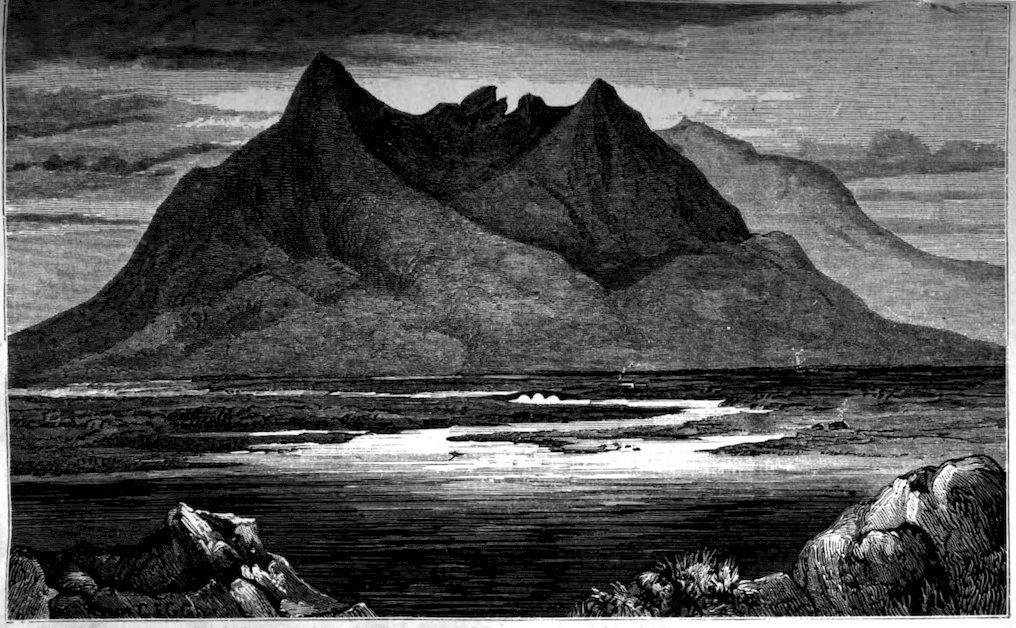
THE CUCHULINS. To face p. 100.
One thing I will say for Skye weather: whatever it does it does in thorough earnest. I went there intending to remain a week, but it was four months before I left its hospitable shores, and during all that time we had either drenching rain or broiling heat in about equal parts. On this, our first morning, we awoke late, with a happy consciousness that a steady downpour had commenced, and hour after hour passed without the faintest promise of a break. The laird of Kilmuir had sent his carriage for us at daybreak, but wary old John suggested the hope of a break in the clouds towards sunset, when sure enough it cleared, and we found the road in such first-rate order that the fifteen miles to Uig were accomplished with wonderful rapidity.
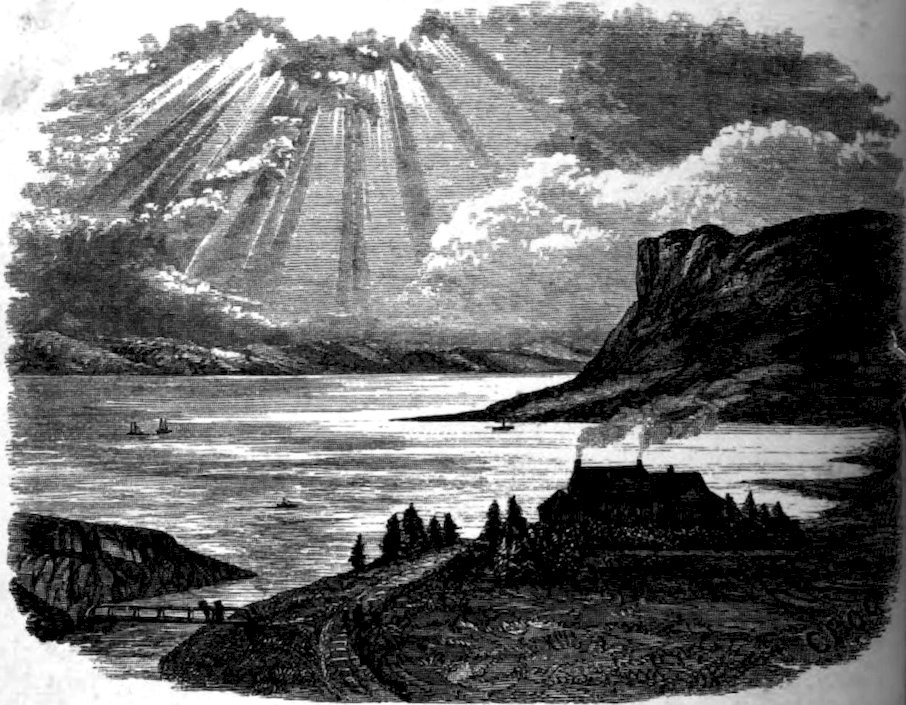
THE LODGE, UIG
Uig is a deep bay, in the form of a horse-shoe, the points of which are two rocky headlands rising abruptly from the sea. The Lodge stands at the head of the bay, exactly in the centre, very few feet above the water level, so that at high tide you may throw a pebble from the window into the sea. Very pleasant on these sweet summer evenings, but I fancy that when wild storms rage outside the bay, their wrath, albeit spent in the outer world, must still sorely trouble these quiet waters, and lash the angry surf till it overleaps the low sea-wall, and throws its foam and tangle right up to the porch. On either side of the house a mountain streamlet rushes to the sea with ceaseless babble. Likewise on either side lie the two kirks, the Free Kirk, which is large and crowded, the Established, which is small and half empty. The service at each is in Gaelic, that combination of savage gutturals being the only language “understanded of the people.” But in consideration of the ignorance of about six inhabitants of the Lodge, each church allowed us a special English service every third Sunday. So after the Gaelic service had lasted about two hours we were expected to walk in, the rest of the congregation remaining 103stationary, though a very small proportion of the men and none of the women understood the English psalm, prayer, and “discoorse,” which followed, after which it was our turn to wait patiently while the Gaelic service came to a conclusion; and though to a southern ear there might be little beauty in the wild tunes to which those old Gaelic psalms are set, to me they seemed so thoroughly in harmony with the voices of wind and waves around us, that they acquired a charm often lacking in more perfect music. The tunes are nominally the same as some of those common in the Lowlands, but from the lips of a Gaelic-speaking race, they seem so entirely to assimilate with the language that it would be hard for even a practised ear to recognise their identity. This is partly owing to the fact that they are sung like a kind of litany, each line being first chanted by the precentor alone, and then taken up by the whole congregation. The verse generally begins in a low subdued tone, which gradually swells as it rolls on, then again the voices sink and die away in prolonged wild cadence. Thus each verse is sung in turn, and as the congregation is in no hurry to disperse, and the number of verses is unlimited, the singing seems to roll on endlessly in a soothing monotony like the sighing of the night wind.
A favourite psalm was the 65th, and its words seem as though written for some such sea-girt land; well watered, and with corn land, and rich pastures, and little hills covered with flocks. Many a time it was recalled to my mind when camping in the uttermost parts of the earth, and from some hill temple in the Himalayas the wild song of the Paharis (those genuine Highlanders) came floating up to my tent. What words they sung I knew not, doubtless hymns to rivers, and pine forests, and snowy mountains, but the voices and harmonies were identical, and they never failed to carry my thoughts back to the Western Isles.
Altogether there is a wonderful charm in the simplicity of these Highland churches, and even the custom which always strikes a stranger as so singularly unpleasant and unnatural, namely that of standing during public prayer, seems here to acquire a special interest, reminding us of those early days of the primitive Church, when the little band of Christians marked the first day of the week by standing at worship in token that 104on this day they were justified and freed from slavish dread by Christ’s resurrection; therefore, while they knelt on the other six days, they “deemed it impious”[24] to bend the knee or to fast on the Lord’s own day. The standing attitude was also adopted during Pentecost, but not observed uniformly by all the Churches, for we find the Council of Nice decreeing that “Because there are some who kneel on the Lord’s day, and in the days of Pentecost, in order that all things may be uniformly performed in every parish or diocese, it seems good to the holy synod that prayers be made to God standing.” So you see that in this matter, and perhaps also in some other respects, the simple worship of the isles comes nearer to the practice of the primitive Christians than does our own more attractive ceremonial.
One picturesque feature of these congregations is that a very large proportion of the older women still continue faithful to their clean white mutches and bright tartan shawls, and some bonnie lassies too, are not ashamed to make a fold of their plaid act as head-gear as their mothers did before them, instead of aiming at one invariable type of dress. The poetic snood, which in olden days was the distinguishing mark of every Highland maiden, has unfortunately quite disappeared, its place being usurped by the commonest hair-net; too often by much beflowered bonnets. This departure from the simple old head-gear was originally due to an order of the General Assembly of the Church of Scotland for awakening sleepers, whose powers of attention were exhausted by the length of the sermons. The 105Kirk Sessions thereupon prohibited all women from wearing plaids or hoods upon their heads in time of Divine service, that they might not sleep unobserved! These law-givers you perceive were men, who could not brook that the women-folk should have such an advantage over them.
They were decidedly selfish, too, in the matter of seats, for until long after the Reformation there were no pews in church save for the big magistrates and landowners. All men of low degree brought their own stools or benches to kirk with them; and the Kirk Sessions of 1597 forbade women to sit on the forms men would occupy. “All women must sit together in the kirk, and sit laigh,” that is, on the ground! and lest they should profit by this lowly posture, and sleep in peace, a church officer was ordered to go through the kirk with a long pole, to remove the plaids from the heads of all women, whether wives or maids. The same enactment is recorded in the year 1649, and at later intervals.
So you see this was another means to that end, which Bishop Burnet sought to ensure, when he found that “the gallants would ogle the ladies of the Court,” and that these likewise would look about them, instead of attending to what Queen Mary called “his thundering long sermons.” He persuaded Queen Anne to allow him to have all the pews in St. James’s Church raised so high that his captives could see nothing lower than the pulpit, an example which was shortly after adopted by many of his dry and longwinded brethren, to the lasting disfigurement of our churches. As to the effects of this legislation on the dresses of our lassies, of course once the plaids were put down by law, it was natural enough that southern fashions should creep in; and the inevitable bonnet with its “gum-flowers” now haunts you at every remotest corner.
I think one of the worst points in spreading civilization is the tendency to put away all distinctive national dress, and reduce all raiment to a dull uniformity. And the people in every land, who formerly wore their own accustomed dress with easy grace and dignity, now ape the stiff fashions of England and France; and a very unbecoming change it is, in almost every case.
The men of the isles are more faithful than the women, and retain their suit of sonsy dark blue homespun and broad bluebonnet. 106The kilt never seems to have found favour amongst them. Happily the number of black coats and hats is very limited, and you see at a glance that you are surrounded by a race of hardworking fishers and shepherds. The marvel is to see such families of well brushed-up lads and lassies—so many, and so well grown—and then to look at the tiny bothy whose roof is home, not to these only, but probably to other sons and daughters as well, who have gone to earn their bread on the mainland, or far over the seas, but whose hearts are so warm to the old home, and to those that gather round its single neuk, that no new ties will ever fill its place. A happy people in truth, to whom the home in childhood, how homely soever, will be the golden mile-stone from which to date each stage of life. And nowhere are the little ones more deeply cared for, and more heartily welcomed. Poor though the hearth may be, that house is reckoned poorest where the quiver is empty, for the Highlanders say that a home without the voices of children is dreary as a farm without sheep or kye.
The bothies are all much alike; there are generally two rooms: an outer one for cattle, and an inner one for the family, the whole enclosed by a double wall of rough unhewn stone, perhaps five or six feet thick, the interstices being crammed with heather. On the inner side of this wall rests a thatch of thick heather, probably encrusted with gold and brown moss, and with a crop of grass that would keep a cow; a crop which the thrifty housewife is careful to gather from time to time. The roof is tied on with a perfect net-work of ropes, and weighted by large stones, to resist the frightful gusts of wind, which would carry off any ordinary cottage roof. A wealthy man, and one who cares about trifles, may perhaps put up an old herring-barrel to act as a chimney, but as a general rule, there is none, and the blue smoke finds its way out where it can, or settles on the brown rafters, encrusting the hanging cobwebs with thick peat-reek which is a much more romantic decoration than our common domestic soot! When the roof has become so thoroughly saturated with this rich brown grease that a new thatch becomes necessary, the old one is broken up, and becomes very valuable as manure for the little crofts.
Owing to the great difficulty in obtaining timber, the real value of the house lies in its rafters; these are for the most part 107the gift of the sea; sometimes the masts of some old ship, whose crew lie deep beneath the waters; oftener some grand old tree torn up by the mighty tempests that months before raged over the western forests; thence floated by rushing torrents to the deep sea, to become the sport of the waves, and the home of strange creatures, animate and inanimate—barnacles and limpets and many-coloured weeds, which the builder has not thought it worth while to scrape off, so that when after a few months they have acquired the general rich brown hue of all within the house, they might very well pass muster as fine old oak carving. As to the roots and branches, you must not fancy that anything so precious is used for firewood; each little chip is turned to some good account; and the man who secures a good log of driftwood has found a prize indeed. Should he change his home from one village to another, he either carries his roof with him, or claims considerable compensation from his successor. Hence when a young couple are courting, their wooing and cooing is accompanied by a most serious search for wood, sticks, straw, and moss wherewith to build and thatch their future nest.
This lack of timber is one of the great grievances of the lairds, some of whom keep up a ceaseless struggle with nature, striving to make wood grow where she has determined to have none. It is vain to suggest that these bare moors are at least in this present era, the true character of the country, and that they might as well try to change an aquiline nose into a Roman one. The struggle still goes on, and good gold is sunk in hopeless plantations and great stone walls to protect them from the cutting sea blasts. By dint of these, the young trees are so far protected that they do get a fair start, but alas for the proud day when they attempt to overtop that kindly shelter! Very few days will pass before they are scorched and burnt up, as if by a furnace; and it seems pretty clear that except in a few sheltered nooks, such as Armadale, Dunvegan, and Greshernish, trees will not grow. This is the more remarkable, as there are traces in different parts of the Hebrides of the comparative abundance of timber in olden days, a fact to which Dean Munro alludes when, writing in A.D. 1594, he speaks of Pabba (now a low grassy island lying off Broadford), as being “full of wodes, and a main shelter for thieves and cut-throats.” With respect to more ancient forests, very extensive tracts exist where trunks and other 108remains of large trees are constantly dug up in the peat-moss, remains both of hardwood and of pine, the latter being invaluable as a substitute for candles, from the clear light of its resinous wood; and many a cosy home group gathers round the ingle neuk, listening to stories of the old days, while one, learned in legends of the past, tells how the Norwegians swept these coasts, and burnt all the old forests, leaving traces of their devastations even to this day, in the charred and blackened timber.
In many instances fine large trunks have been found under the present sea-level, covered with sea-weed and shells, a striking proof of the gradual encroachments of the ocean in certain districts. It is said that whole tracts of land, till recently under cultivation, have disappeared—or are now so covered with sand, as to be utterly worthless—very much in the same way as a great portion of the “Laich of Moray” was submerged by those fearful inundations at the close of the eleventh century, when, says Boethius, “the lands of Godowine, near the mouth of the Thames, and likewise the land of Moray in Scotland, together with many villages, castles, towns, and extensive woods both in England and Scotland, were overwhelmed by the sea, and the labours of men laid waste by the discharge of sand from the sea.”
The bonnie shores of Moray have, however, been shaken by many such commotions of the deep. We know that prior to 1695, those desert Culbyn Sand-hills, which are now the delight of naturalists and the haunt only of strange wild birds, were fruitful fields and gardens, clustering round an old manor-house, where dwelt a wealthy laird in the midst of his farms and his people; the owner of land so fertile, that it was called the granary of Moray. To this day, as the shifting sand-hills change from place to place, they reveal traces of cultivated land; sometimes of old fruit trees and dwelling houses, which, a few days later, are again buried deep beneath the sand; and many a time, after a strong wind has swept the land, I have myself walked on fields where every furrow was still clearly defined, but which on the morrow lay buried deep beneath twenty feet of desert sand.
Nor was this the latest freak of nature on that shore. Prior to the year 1701, the town of Findhorn stood upon a pleasant plain a mile north-west from its present situation, but now the bottom of the sea. This change was effected by a single tide, which 109burst through a great natural sand-bar at the mouth of the river, and forced open its present course, overwhelming the good fishing town. Happily, the inhabitants had so long suspected danger, that they had gradually forsaken their homes, so that few lives were endangered. Near the old town of Findhorn lay a level peat-moss, where many roots and trunks of large trees marked the forest that had once flourished there; and in the middle of this moor rose a conical artificial mound, about forty fathoms high, called the Douff-hillock. This now forms the bed of the ocean, which has encroached so far into the land, that instead of the fisher folk having a five miles’ walk direct to Burghead, they have to make a circuit of upwards of ten miles round the bay.
The latest attempt of the mighty waters to pass their appointed limits on our pleasant shores of Moray was in the year 1755, when the effects of the fearful earthquake at Lisbon made themselves felt even here; and it is recorded that in the parish of Dyke, a flock of sheep, though folded in their usual cot, and far beyond the reach of any ordinary tide, were one and all drowned. But to return to the peat-moss of the isles.
One curious inference drawn from the class of timber which formerly flourished in these islands is, that a very marvellous change in climate must have taken place in comparatively recent ages. This seems to corroborate certain statistical accounts of the temperature which have been preserved at Kilwinning, in Ayrshire, where, it is affirmed, that so great was the heat in the month of May, that farmers had to leave off ploughing at 8 A.M., and could not resume work before 4 P.M. The same account states that the harvest was finished in August—a very different story from our average nowadays, when a harvest-home in September marks a very satisfactory autumn; while, in too many instances, a very much later date might be given.
In the Hebrides the cereal crops are always a matter of risk, owing to the extreme probability of prolonged autumnal rains; and it is only too common to see the crops at the end of the season cut green, and only fit for fodder. In truth, the patience and perseverance of the poor cotters, who continue year after year to toil in such unprofitable soil, are qualities which continually call forth our wondering admiration. The general 110climate is, however, mild, with the same freedom from frost that we noticed in Cantyre; and this is said to be especially true of the remote Isle of St. Kilda, which is more fully subject to the warm currents of the Gulf Stream.
Nevertheless, strange things sometimes drift ashore, which tell rather of having floated down from chilling northern latitudes. Sometimes large fragments of ice, and once a great walrus found its way hither, having probably sailed along unsuspiciously on some detached fragment of his iceberg. His head is still preserved, as that of so rare a guest deserved to be. Two summers ago a great whale, sixty feet long, swam unsuspiciously right up Loch Scavaig, and there found himself so entangled and perplexed by the great black rocks, that he ran right ashore, and for two whole days wriggled and flopped about in the vain struggle to escape, lashing the sea, and overturning huge stones in his despair, and all the time roaring (so say the fishers) like an enraged bull, awakening the ghostly echoes of dark Corruisk, and disturbing the Sabbath calm of its misty mountains. Not till the third day did the poor brute cease to battle with his rocky prison, when he was espied by an amazed English tourist, who forthwith swam to the spot and climbed on to the whale’s back, whence he was shaken off by its last dying struggle. Then the natives assembled, and having finally despatched him, set to work in a fever of excitement to carry off the blubber from this heaven-sent prize. A small portion of this royal fish was left for Her Majesty, but many a lowly home was gladdened through the winter nights by the unwonted supply of oil, although so vast a quantity was suffered to escape, that the troubled sea all round was smoothed and calmed for many days. It was long enough after this dissection, before any one gifted with a sense of smell could again venture near that beautiful sea-loch!
Speaking of rare guests, you will not travel far in Skye before hearing anecdotes of the pompous Dr. Johnson and his little toadying companion. Almost the first thing that will be pointed out to you is Kingsburgh House, as being the place where Flora Macdonald entertained them. To us it had far more interest as being that in which, many years before, in the days of her youth and beauty, she and her princely maid, Betty Burke, had found shelter and safety. But we heard so many legends 111of Prince Charlie’s hair-breadth escapes among these islands, that I will tell you what we gathered on that subject in a more connected form. I do not mean to say that we withheld our tribute of admiration from the brave old man, the City-bred philosopher, who, at the age of sixty-four, forsook the luxury of London clubs, and, though suffering from his sight, and heavy alike from disease, and from his naturally unwieldy size, yet determined to behold with his own eyes those barren Hebrides, which had appeared to him in far-away visions, grey and dreamy, as he sat by his comfortable board in Fleet Street. So, like a true pilgrim, he started on that, then difficult, journey to Iona, and thence to Isles further still, tossing about on stormy nights in an open sailing-boat; riding rough Highland ponies, or even trudging wearily on tired feet over moor and mountain, through scenery that to him seemed only grim and savage. Nothing daunted by storms and discomforts, he pursued his way, seeking for Ossian and for trees. Fancy a man with no Gaelic hoping to find Ossian! He tested his drinking capacity against that of seasoned whisky-loving lairds, and tried to deepen the impression he had made on their women-folk by keepsakes of such light literature as odd volumes of arithmetic! The poor man even tried to get up a due appreciation of the pipes by standing with his ear close to the drone, enduring silent martyrdom without wincing, thinking thereby to test his fine ear for music!
Between Kingsburgh and Uig is an old ruin on a cliff overhanging the sea, a pleasant spot in which to bask away the sunny hours—the blue Cuchullins making a lovely background to the grey walls of Castle Ustian (or Hugh’s Castle), built in the time of James VI. by Hugh Macdonald as a place of refuge. It had no windows, or any means of access, except a small door high in the wall, to which its master climbed by a ladder, which he then pulled up after him; and could rest tolerably secure as long as his provisions lasted. Being next of kin to Donald Gorm Mòr, the chief, he seems to have been weary of waiting for dead men’s shoes; and, having induced some of his neighbours to form a conspiracy against his uncle, they formally drew up a bond, which they all signed.
This compact was left in the hands of one, Macleod. It seems that this man had previously received a bond from a cattledealer, 112for monies due to him, and on this being reclaimed, Macleod, who could neither write nor read, gave the drover the wrong document, which quickly found its way to the chief. He generously determined to meet this villainy with chivalrous goodness, and giving a public feast, invited all these traitors, who duly appeared. He then publicly produced the compact; confronted them with their own signatures, and forgave them. Hugh was solemnly sworn to fidelity along with the others, but being little touched by his uncle’s forgiveness, he soon embarked in a new plot, and the story runs that having written two letters, one to the chief in terms of deepest penitence, and the other to a co-traitor, devising fresh means for his assassination, he folded both letters, and addressed each to the other correspondent. His villainy being thus a second time detected, his uncle determined to secure his own safety, and before Hugh was conscious of his blunder, he was invited to return to the house of his chief, when he was seized and cast into a dark and noisome dungeon, where he was left for many hours without tasting food. When ravenous with hunger, an abundant meal of salt meat was lowered to him. And after awhile, when half mad from raging thirst, a cup followed. But it was the cup of Tantalus—empty, and only mocked his agony. After this no human step drew near again. And he was left to perish miserably in solitude, darkness, and unutterable anguish.
Returning to Uig, you pass the comfortable new Inn, just below which lies the narrow glen of the Conan; a clear, cool, stream, laughing and sparkling in the sunlight, or dreaming to quiet pools under the green shade of ferns, which grow in every cleft of the black, mossy rock; while the yellow broom throws its tremulous reflection on the fairy mirror, or, shaken by the breeze, drops its golden blossoms on to the brown water, startling the silvery trout, that lie on the white gravel below, and making them dart up stream to hide among the pebbles, over which the water frets and ripples, ere it speeds on its seaward way, rushing, tossing, twisting, and flashing in the light, as it hurries past.
113If you watch quietly near this overhanging ledge of rock, you will see a motherly old wild duck swim out with all her brood, darling little balls of brown and yellow fluff, with eyes like black diamonds, rejoicing in their young lives. Presently from among the sedges a water-ouzel will dive right into the stream, in pursuit of some delectable beetle; or the ring-ouzel may fly down from his home among the heathery cliffs, to that flat granite rock, where he will drink and lift up his head to the sun as if giving thanks, and then drink again; sometimes come the lovely black and white Oyster Catchers, with scarlet bills and legs (Sea-Peewits we call them, when they make their spring home on the gravelly banks of the rushing Spey), and the air rings with their wild cries.
As you wander up this bonnie burn-side, you will come upon rich masses of honeysuckle, trailing up the rocks, and hanging down to the water’s edge. And hidden in this sweet tangle of whispering leaves and blossoms, are dainty homes in the woodbine, where young birds are chirping the “Lays of the Commissariat” to their busy foraging mothers.
To all lovers of wild flowers, these islands must have an especial charm, for their infinite variety and beauty. There are rare flowers for collectors, but you and I care more for those we have known from our childhood, and the sweet braeside is all covered with them. The delicate purple rock geranium, and the white Stellaria (the Star of Bethlehem) grow thickest among “the moist and reedy grass” in these shady nooks; and Our Lady’s Mantle holds its large dewdrop in each leafy cup.
The fragrant Bog-Myrtle (or rather, Sweet Gale), lies in green patches, scenting the air; while over every heather tuft, the gossamer spider has spun its delicate web, and you wonder how so frail a tissue can support the thousand diamond-like dew-drops, which glisten and sparkle all over it. The Canna grass or Bog Cotton also waves its soft downy plumes, seeming to sprinkle a shower of snow above the dark peat-moss, an emblem dear to many an old Scotch ballad-writer.
The Grass of Parnassus is here in abundance, but you must go to drier banks to find the loveliest flower of all, the pure white star which crowns that delicate slender stem, from which grows a second star of green leaves, two or three inches below 114the blossom. I only know it as the “Trientalis Europæa.” Far too fine a name for so graceful and delicate a blossom.
When we reach the Falls of the Conan, where the merry waters dash noisily over the dark rock, we will turn aside into a quiet “dell without a name,” where a multitude of conical fairy hillocks rise on every side of us, like innumerable tumuli of some giant race of bygone days. They are all exactly alike in shape, only differing in size; all clothed with short grass, and worn into countless concentric rings, which I fancy must be sheep walks, though they look like water marks, or indeed like human handiwork, like the steps of the Pyramids on a small scale. The only other place where I am aware of the existence of a similar formation is near Loch Torridon, where, in a valley known in Gaelic as that of the thousand hills, the same green knolls rise in endless groups round a central loch.
The highest of these Skye hillocks is crowned by a precipitous rock, called Castle Ewan, so marvellously resembling a fortified castle, that it is difficult to believe some ghostly masons have not been at work. The hillocks are essentially grassy, “with daisies powdered o’er” as old Chaucer says, but in the little valleys between them, there is the same wealth of wild flowers in endless variety. Here are carpets of purple and white Orchis, and golden globe flowers, veiled by the lace-like blossoms of wild parsley; while the honeyed fragrance of the pink bog-heather attracts a humming swarm of bees. The delicate blue butterflies hover like floating harebells over the large pearly-white Gowan, with the golden heart—the wishing-flower the children call it, when they test their little loves by its fortune-telling leaves.
You will hardly find a pleasanter resting-place than one of these grassy knolls, where you can lie in peace and listen to nature’s stillness—“the many-mingled sounds of earth, which men call silence,”—the sounds of the moorlands, the shiver and rustle of grasses, ferns and tall iris-leaves bending before the faint breeze; and the hum of insect life, with that ceaseless undertone of murmuring sea and rivulet, alike invisible. Presently, from their burrow under the fairy hillock, come a family of young rabbits—little, soft, coaxy things—playing all manner of merry antics; springing and leaping like merry kittens, and nibbling at the rich grasses. One sits close to us,
115while the others scamper off to a feast of Dandelion, and, as they touch the feathery tufts of silken down, the whole air is filled with fluffy parachutes, wafted about with every breath; and thistle-down too is floating in soft white clouds.
Do you know how the thistle came to be chosen as the emblem of Scotland? The old tradition is, that when a Scottish garrison was in danger of being surprised by a Danish foe, a barefooted Dane, creeping along in the darkness of night, trod to the sharp prickles of a thistle, and, yelling with the shock of sudden pain, aroused the drowsy sentinel; and the garrison thus saved, adopted the emblem and motto which afterwards became that of the nation.
As we turn homeward from this happy valley, a light curl of blue smoke betrays a lonely sheiling, more picturesque than cosy, I fear. It is built as a lean-to against a great boulder of rock, the honeysuckle has clambered over the heather roof; outside it is a study for a painter, but within, it is dark and dingy, and thick with the rich brown peat-reek of ages. It does own a chimney, through which you will see more of the blue sky than through the tiny window; and when your blinded eyes can distinguish anything, a ray of light (from the chimney) will show two nice old wives—“caillachs,” the Gaelic folk would say—who sit spinning in the corner. They are very deaf, and “have no English,” so your friendship will probably begin and end with a smile and a grip from a kindly old hand that has done plenty of good work in its day. Probably they will offer you a hot oat-cake, for the poorest hut would fain show hospitality to a stranger.
The other stream which flows into Uig Bay is the Rah, whose chief attraction is a very picturesque waterfall—no great thing on a dry day, but after a good night’s rain, when there is something of a spate, and it comes roaring, rushing, and tumbling, as if from the blue sky, down between the black cliffs where the ravens build, into a deep basin, whence it boils over and makes a second fall, and then swirls and bubbles round the great boulders of grey rock, whose golden lichens and brown mosses gleam through the spray—then, I think, it is a thing of beauty, and worth pausing a few moments to see, from some spot nearer than the high-road, along which the tourists hurry to Quiraing; 116that being the thing to do; and to be done, like all sight-seeing, as quickly as possible.
We narrowly escaped bequeathing to the spot such a legend as would have drawn thither all future tourists. For one morning, while I was quietly painting, and my brother scrambling about the rocks overhead, suddenly something flashed past me, and I looked up just in time to see him disappear in the black water below. As we knew nothing of its depth, the first terror was that he would probably strike his head upon a rock, and it was with a sense of thankful relief that, long before I could clamber down from my own somewhat dangerous perch, I saw a white face rise, and in a few moments more, he managed to scramble out, with no worse hurt than a bruised knee.
A few days later we found our way to the Quiraing, which afterwards became a very favourite haunt. It is a stupendous mass of rock (amygdaloidal trap, which is a black rock speckled with white), the grassy hill ending abruptly in a precipitous rock face, whence green banks slope down to the sea. Its general form, and that of its neighbour, “The Storr Rock,” is much the same as Salisbury Crags, which must be familiar to every one who has passed through Edinburgh. The Storr has one gigantic detached needle about 160 feet in height, which stands out clear against the sky like a huge horn, quite separate from the cliff, and visible for many miles on either side.
The Quiraing, in addition to one giant needle, has a perfect wilderness of huge detached masses of rock of every conceivable form. These are striking enough, even when seen in the bright sunshine; but after a rainy night, when fleecy white mists curl and wreathe themselves, like spirit drapery, round each weird form, and vapours steam up from the grass at your very feet till you hardly know where you stand, and every object is magnified tenfold, the feeling of awe and mystery becomes almost overpowering. Sometimes a fantastic white shroud suddenly hides the whole scene, and you see nothing but the grass and rushes under foot. Then a rift in the cloud shows you the blue sea, lying in calm sunlight far below, dotted with islands, and perhaps the white sail of a yacht. Suddenly a fairy hand draws back the curtain, and close to you is a rock, like a huge lion couchant, and behind it a tall pillar, with a kneeling figure, which reminds one of St. Simon Stylites. Another moment, and these have disappeared; but in their place three giant figures, with curled wigs and flowing robes, have slowly emerged from the mist. They are unmistakably a king and queen, and the lord chancellor; who, however, stands uncourteously dos à dos to his sovereign, but facing a solemn and shadowy old Druid priest, who sits gravely guarding his rock sanctuary.
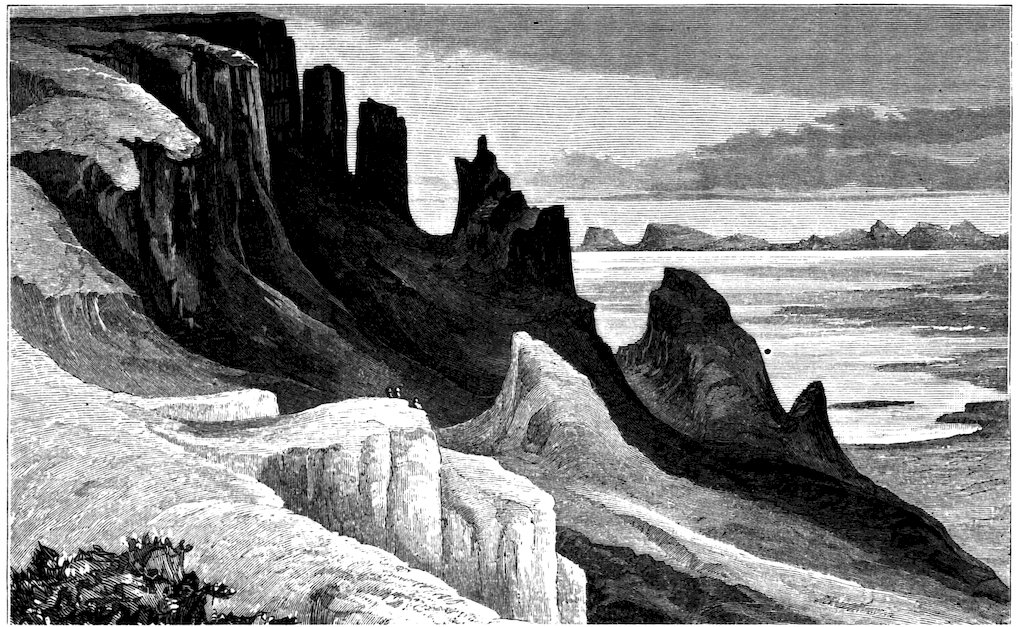
THE QUIRANG. To face p. 116.
117These, and a hundred more, are among the quaint rock forms that jut up from that wonderful confusion like figures in a dream, suggesting the work of some antediluvian wizard, whose spell had suddenly petrified all living things, and thus bequeathed to us these weird groups of fossil giants. Geologists, however, give us a more commonplace reason for this strange formation. They tell how, between these masses of black trap rock, and the columnar trap which crests the sea-cliffs, there lie beds of soft shale and crumbly limestone and oolite; and that as these slowly wear away, the superincumbent mass of rock breaks up, and remains standing in huge isolated blocks and pinnacles like gigantic castles and figures. This process is slowly, but continually going on, and therefore, year by year, these strange rock forms must multiply, as the breaking up of each winter’s frost loosens fresh masses of crag.
To see the Quiraing from the upper road conveys a very poor notion of it; and though the scramble to the foot of the rocks lies over slippery grass and sharp-cutting stones, it well repays the fatigue. Behind the great needle there is a cleft in the rock hardly seen from below. You must scramble up here, over the same sharp fragments of disintegrated rock—a most toilsome process, and one very trying to shoe-leather—and at last you reach the summit; and, standing in the cleft of the mighty cliff which towers above you on either side, you look down into a great cup of greenest pasture, closed in on every hand by the great black crag. In the middle of this amphitheatre lies one gigantic mass of rock, a huge oblong about forty feet high. The top of this is perfectly flat, and carpeted with the richest green grass, smooth as a lawn, and measuring about three hundred feet in length, by half that width. This rock is the Quiraing par excellence; and though the meaning of the word is uncertain, it seems to imply that it was the sheep-fold of some one once famous, who, driving his flocks thither at the approach of danger 118found here rich pasture and a safe hiding-place from foray and raid, at a height of upwards of a thousand feet above the sea, which washes the base of the green hill. As you look down from this high post, through some cleft between the great rock spires and towers, your eye wanders first over a succession of grassy slopes and hillocks, till it rests on that broad, gleaming surface—
all dotted with islands—some near, some faintly visible in the far horizon; while, looking towards the mainland, you discern the great hills of Ross and Sutherland. That the islands are tolerably numerous, we are well aware, having in our infancy been taught that the Hebrides are 490 in number. This, of course, includes every rocky islet as far south as Bute and Arran, whereon pasturage for even one sheep may be found. Of these, 120 are inhabited.
I spent many delightful days alone in this rocky wilderness, enjoying its beauty and its solitude beyond description; and, above all, its intensity of silence, rarely broken, save by the crowing of some cheery old grouse calling its mate, or by the quick whiz of their wings as they shot past me—sounds which, to a child of the moorland, are about the pleasantest that can be heard, associated, as they are, with many a sunny day among the heathery hills. Moreover, there is such a charm in the feeling of out-and-out patriotism of the one bird that is essentially British, and that positively refuses to exist in any corner of the earth save his native moors, where he and his family have from time immemorial lived their jolly and independent lives.
As a general rule, tourists visiting the Quiraing only come by the coach, and “do” the rocks in a couple of hours, during which a fair amount of whisky is consumed, and the echoes are awakened by discordant shouts and songs. It rarely occurs to them to stop a night at the Uig Inn; so when the steamer lands them at Portree, they drive upwards of twenty miles, returning the same day. The excellent roads make this easy enough; and at the time of our visit, rival coaches had reduced one another’s prices to such a pitch, that they were carrying passengers at one penny per mile! Whether, like the Kilkenny cats, they succeeded in devouring one another, or whether either survived, I cannot tell.
119But this I know—that he who would learn the lesson of the hills, must go forth from the multitude, and learn it in silence and solitude; that nature’s voice may whisper to him in sweet low tones that cannot be discerned, amid the jarring sounds of human mirth. Never more forcibly than in this place does one realize the truth and beauty of such a description as that given by Wordsworth of a solitary wanderer, with soul absorbed in intensest sympathy with nature, looking down on such a scene as this, and revelling in its utter loneliness:
Sometimes while you sit here entranced, only conscious of
a shadow will pass over, and as you look up you may see the great golden eagle soar from its eyrie on the highest crag, cleaving the air with strong steady wing (measuring perhaps six feet from tip to tip) and now scanning Duntulm’s lambs, which would be tempting prizes to carry back to the eaglets in their nest of rushes and heather. Sometimes the osprey sails along, for it, too, breeds among these cliffs; but it makes for the river, and would rather catch fish for itself, like an honest bird, than molest the flocks. The kite is less scrupulous, and glides along, marking where the weak and sickly lamb may become his prey. The shepherds call him the gled, because of his smooth gliding flight. One sight for which I vainly watched both here and in the Himalayas, is that of the eagle teaching her eaglets to fly, ready, the moment the young wings are weary, to fly below, and stay them from falling—a fact alluded to with such force and beauty in that last song of Moses, sung in the waste howling wilderness on the eve of his last ascent to the Arabian 120mountains, where he was to die alone on Mount Nebo, and where the eagle looking down from his lonely eyrie, would strengthen his own spirit with the lesson of faith and trust he had just been teaching to his people.
There is no lack of variety in the drives about Kilmuir, and the same good roads in every direction show the wish of the proprietor to open up the country. The most beautiful is one along the sea-coast, passing above the rock needle, known as “The old man of Scudaboro,” who rises from the sea, and whether in tempest or in calm, keeps ceaseless watch, though the human garrison have for many a long century forsaken their vitrified fort, traces of which you may still note on the green hill-top. Beyond rises the red headland of Idrigal, one of the points of Uig Bay. A short distance further comes Monkstadt, so called from an old monastery which once stood on an islet in the lake close by, on which some ruins can still be traced. To the modern house various Jacobite legends are attached.
Passing onward along the coast, with the sea on one hand, and on the other a confused wall of broken-down cliff and great rocks, we come to the ruins of old Duntulm Castle, the Castle of the Grassy Hillock, one of the finest holdings of the old Lords of the Isles, and indeed their original home, built on the site of an old Viking fort. Like all this coast, it is now the property of the Laird of Kilmuir, and the modern house is rented by one of those wealthy farmers, whose names are as familiar at the cattle shows of the mainland as they are in the isles. The old castle has been uninhabited since 1715, and is now quite a ruin, and like all the ancient dwellings, it conveys a wonderful idea of discomfort. Tiny rooms in the thickness of the wall, and little space for luxury in such crowded quarters. Whether the ladies wrought tapestry for their walls I know not; but servants, called rush-bearers, were kept on purpose to strew the floors every morning with fresh rushes. This in due time led to the invention of rush or grass matting, and so to the use of other materials for carpeting. A curious trace of this old custom still lingers among the English lakes, where at certain churches, such as Ambleside and Grasmere, one Sunday in the year is still known as Rush-bearing Sunday. Here, in the memory of old folk now living, it was customary on this day to strew the churches with a thick layer of green rushes, which were left undisturbed for a twelvemonth, 121by which time they had accumulated a fair amount of mother earth! I believe the strewing is now quite given up, but the day is marked by picturesque processions, in which the children carry crosses and other ecclesiastical emblems, made of rushes and flowers. The inhabitants of the castle commanded a grand sea-view, overlooking the channel of the Minch, the rocky Shiant Isles, and those of Uist, Harris, and Lewis; while its site on perpendicular basalt cliffs, rising from the sea, proved a very grand natural fortification.
If we continue our drive along the same wild and beautiful road, it will take us round the foot of the Quiraing by the green hills of Flodigarry to the inn at Loch Staffin; thence two miles of slow ascent and infinite beauty will bring us to the brow of the hill, whence we first caught sight of the wonderful rock wilderness. I have sometimes sat at this spot throughout the beautiful long day without seeing a living creature save a group of picturesque lassies, in the usual short petticoat and white bed-gown, with bare feet and bright scarlet or white handkerchief on their glossy hair, half hidden by the huge bundle of heather, which they would have to carry six or eight miles, that the men might rethatch their bothies. Though their usual habit is to dart off the road and hide on the approach of any gentry, they would rest a while near me, to watch the lady making maps, and laugh and chatter to me in Gaelic, of which I knew about three words, one of which—i.e. meanichulagan, the small flies, alias midges—was a sure bond of sympathy, for these little miscreants are the very torture of life in Skye. You have only to brush over the heather, and even if by any accident they were at rest, up they start in ravenous armed myriads, making work utterly impossible, till at last, with fevered blood, and face and hands literally swollen by their attacks, you probably have to leave the spot to which you had attained with such toil and trouble, and make for home or the sea-shore as fast as ever you can. Never before had we been filled with so righteous a personal detestation to Beelzebub, the god of flies! Never had we so devoutly sympathised with those old Greeks, who considered the office of Fly-disperser to be work enough and to spare for one of their gods, and told him off accordingly![25] We tried every conceivable mixture to drive them away, and even sent to a London physician for special 122antidotes for our tormentors, but all prescriptions failed, and the only thing approaching to relief is always to carry a small bottle of essential oil of lavender, with which to rub your face and hands. It dries so rapidly that there is no danger of greasing your paper, and the scent which to human beings is rather pleasant seems unendurable to the midges. After we made this discovery, every sportsman carried a tiny phial, as the best defensive ammunition. Did it ever occur to you that the merry mazy Reel of Tulloch owes its common name of Hoolaghan to these lightsome airy little midge dancers?
One day while I was sitting as usual on the lonely hillside, I was amazed to see first one group, then another and another, of tidy folk in their Sunday best, coming in an almost continuous stream along the bleak road from Portree. Then I found that there was to be a sacramental preaching on the hillside many miles away. It was to last a week, and this great multitude was gathering from every farm and village in the district. Many of the people had walked thirty miles, and would stay two or three days; though where a hundredth part of them could hope to find cover I cannot imagine. Doubtless vast numbers must have slept in the open air, and happily the weather was hot and dry. The multitude of carts and curious vehicles of all sorts which passed this day and the next was really amazing, and such primitive carts and harness! A bit of rope or twisted bent from the nearest hillock, with a stick to act as crupper! Sometimes a very good dog-cart would pass, full of well-dressed people, the old mare trotting cheerily along, followed by her foal, and every now and then stopping to give it a drink!
I was present at one of these great sacramental gatherings, when, about three thousand people had assembled on the wild coast of Rosshire; and a more picturesque scene I have rarely beheld. It recalled visions of the old Covenanters. As your eye glanced over the bleak expanse of hills, you marvelled whence that great concourse of human beings could have assembled, till you heard that not only every shepherd’s hut in the district, but almost every island and village within forty miles, had sent its pilgrims to the preaching; some by boat, some on foot. Not the able-bodied only, but some poor half paralysed creatures, who took days of hard walking and crawling (sometimes literally crawling on all fours), dragging their weary steps down those 123steep paths, that they might sit at the feet of some favourite, trusted teacher, and, with child-like intensity of interest, drink in the old, old story from his lips. The preachings were as usual to extend over several days. But it was on the great day of the feast that we found our way there, when on the green sward was set the long table covered with fair white linen, round which were gathered a great company of devout worshippers, passing the sacred cup and bread from hand to hand. From time to time a Gaelic psalm was raised, the precentor singing every alternate line alone, and the mass of voices taking up the wild tune, low at first, then swelling into full chorus, and again dying away, like the booming of waves in some ocean cave. The people were all seated on the grass, or clustering in groups up the side of the hill, which formed a natural amphitheatre of grey rocks or fading russet brackens, whose “calm decay” was in keeping with the great peace of all around. The majority of the old wives wore the cleanest of white mutches; some with large white handkerchiefs tied over them and great blue cotton umbrellas, for though it was an October afternoon, the heat of the sun was sickening. Nevertheless the men all sat bareheaded, looking up to the preacher with earnest weather-beaten faces, the warm colours of their hair and beards recalling the russet of the withering brackens around them. Whatever their occupation, nearly all were dressed in the uniform dark blue cloth peculiar to our sea-faring folk.
On the rocky hill above, groups of little rough Highland cattle were feeding, wondering doubtless at such an invasion of their solitude. Close by flowed a tiny streamlet of purest crystal, yielding precious store to all the thirsty multitude. At our feet lay the great calm ocean, on which the sun’s glittering reflection was changing from quicksilver to molten gold. Beyond, faintly seen through the hot misty haze lay the grand Skye hills, all mirrored as clearly as the near cliffs or the countless islands. From the little clachan of black bothies on the shore the blue smoke rose in transparent columns, and there was quiet on every side. Only the distant cry of myriad sea-birds, or the nearer song of the laverock, broke that great stillness, and now and then the crow of black cock or grouse, or the heavy flap of a heron floating past on leaden wing, fell on the listening ear. There was something in the scene that insensibly carried the 124mind back to the multitudes who assembled on the mountains, or by the lakes of Judea, in those early days before the name of “Christian” had been yet bestowed on the new sect.
One marked change, however, there must be in this modern teaching from that of those early days when the disciples, continuing steadfast in the apostles’ doctrine, met daily for the breaking of bread and prayer, a custom which we know was adhered to by the early Church in Rome, Milan, and Spain, and which was retained by the African Church at least until the time of St. Augustine, that is to say, for the first four hundred years after the feast was instituted. In all these churches it was optional whether the Holy Communion should be celebrated daily or weekly. The majority of Christians seemed to have received twice a week, but in no case was less than one celebration in the week thought of.
These modern Christians have but one such meeting in the year, and out of the three thousand assembled on the hillside, only eighty were communicants, the youngest of whom was a shepherd upwards of forty years of age. Painful as it always is to witness the crowds that pour out of our great city churches whenever the “comfortable words” of invitation are about to be spoken (recalling the sad reproach once uttered by their Lord when of the ten whom He had cleansed one only would return to give Him thanks), it seems more painful still to know that these who have gathered from so far to hear His Word, are actually deterred from approaching His table by the impracticable standard of “fitness” exacted by their teachers, the awful warnings known as “Fencing the Tables,” whereby the sick and sad-hearted are turned away sorrowing; while those only whom a human standard declares to be whole, may approach the feast of the Great Physician. This state of things seems to grow worse rather than better, if it be true that not very many years ago these great gatherings sometimes numbered ten thousand souls, of whom two thousand were communicants. In this respect, at least, the Northern Highlands would do well to take a lesson from the Lowlands.
Among the various reminders of simple old manners which still exist, both on the Isles and on some parts of the mainland, is a curious form of ordeal by oath, whereby any lad or lass whose character has been aspersed, may go to the house of the 125minister, and in presence of one or two of the principal inhabitants, swear that he or she is guiltless of the misdemeanour laid to her charge. After this, any one repeating the same, is held guilty of wilful calumny. Many of the common household goods still in use, more especially in the Outer Hebrides, are also suggestive of olden days. Such, for instance, is the old quern or handmill consisting of two hard gritty grindstones, laid horizontally one above the other; the grain is poured between them, through a hole in the centre of the upper stone, which is made to revolve rapidly by a wooden handle. I suppose this was somewhat akin to the old English handmill or Thamis, the wood of which was wont to ignite in the hand of a swift worker, thus giving rise to the saying, concerning an idler, that “he would never set the Thamis on fire,” a proverb often quoted with small thoughts of its origin.
It is strange to think that these poor little handmills should ever have been an object of jealousy to our legislators. Yet in old days various laws were passed advising the lairds to compel their tenants to bring their grain to the water-mills; and also, empowering the miller to search out and break any querns he could find, as being machines that defraud him of his toll. So far back as the thirteenth century, the laws of Alexander III provide, that no man shall presume to grind quheit, maishloch or rye with handmill, except he be compelled by storm; and even in this case he is bound to pay a certain tax to the miller!
The modern miller who cares to behold his ancient rivals may see good specimens in our antiquarian museums, without a voyage to those remote corners of the earth, but it is only here, that he may still see them in active work, and hear the wild plaintive songs with which “the two women grinding at the mill” wile away the monotonous hours. Wilder still are the songs sung by a whole troop of lassies when waulking cloth; that is, when a dozen women sit on the ground, in two rows, feet to feet, with a ribbed wooden board between them, whereon is laid the newly woven woollen web; then with their bare feet the women work the cloth to and fro, till they have rolled it to a right consistency, their song growing louder and louder as they warm to their work, so that a casual observer is extremely apt to imagine that he has suddenly stumbled on the inmates of some private lunatic asylum.
126But more primitive than all, are the agricultural implements of the Isles; especially the Caschrom or wooden plough, consisting of a bent handle four or five feet long, to which is attached a piece of wood like a long pointed foot shod with iron, and this is propelled by the ploughman’s own foot. Sometimes it is made more like a spade, which digs into the ground, instead of scratching it. And with this curious tool, the curious little fields or small crofts are worked. The only marvel is that it should act at all, but the soil is light and rich—so light that after rains which would convert most places into morasses, half an hour’s sun makes the dust fly, and in order to produce the rich soil we see the people dig sea-weed into the earth as a manure. When the fields are thus ploughed by hand, a couple of lassies will yoke themselves to the harrow, and work cheerily for hours, then, perhaps, “travel” nine miles across the hills carrying on their back some heavy box just brought by the steamer, or else with a heavy sack of potatoes, or a creel of peats. I really believe the people infinitely prefer the use of their old tools, to any new-fangled improvements introduced by the bigger farmers, for their heart’s delight is to take plenty of time over their work. They are quite ready to plod away to any extent, and are hard working and hard living—but oh! how slow. They have as little notion of the value of time as a Hindoo. But if you let them take their own way and don’t hurry them, they will willingly endure any amount of hunger and cold and weariness without a murmur, as beseems thoroughbred Islesmen and Highlanders; who would have fallen low indeed in their own eyes, should they betray symptoms of any such weakness. And they are real gentlemen in their way, with delicate inborn tact and all the naturally courteous instincts of good breeding; and, moreover, with a keen perception of all that marks true breeding in others; as well as the pride born of self-respect.
This is the true secret which does so puzzle Englishmen of the perfectly familiar intercourse existing between class and class, yet never breeding contempt; every detail connected with the laird’s kith and kin, being treated by all the people as a matter of personal interest. They take pride in his well being, and if there be evil doings, they will veil them rather than let a stranger suspect any cause for blame.
No one can go much among them, without being touched by 127their leal allegiance to the old blood, the hereditary owners of the soil; even when (as alas! is too often the case) the Sassenach and his gold have the sway, and hold the broad lands, possibly to the great benefit of the tenantry, and certainly to their enrichment, as the Saxon is considered fair game, and may be fleeced to the utmost possible limit; whereas a fellow Highlander is rarely overcharged, except along the regular tourist’s routes, where the “morale” of the people is always rapidly destroyed, and even the children are taught by travellers to run beside the coaches and beg. Once get off the tourist beat, though it may be only just to the other side of the loch, and the hospitable cottage wife will still offer you the bowl of creamy milk, for which she expects no return. But that the Egyptian should be spoiled, is considered all fair, and I fear the old Highland pride is scarcely proof against the many tempting opportunities for reaping a golden autumnal harvest.
To those who make their home in the Isles, the possession of a yacht, or, at least, of a good sailing-boat, becomes almost a necessity. In the first place, all beauty lies along the seaboard; and the visit to a neighbour even on the same island, which may entail a wearisome land journey through dreary country, is often a short and beautiful sail; when, instead of noisily jolting and grinding along a hard road, you may glide silently through air and water—perhaps the only way in which you can ever revel at once in stillness and motion. Besides, to be continually within sight of countless islands, and chains of blue hills, without the means of exploring them, would be tantalizing indeed.
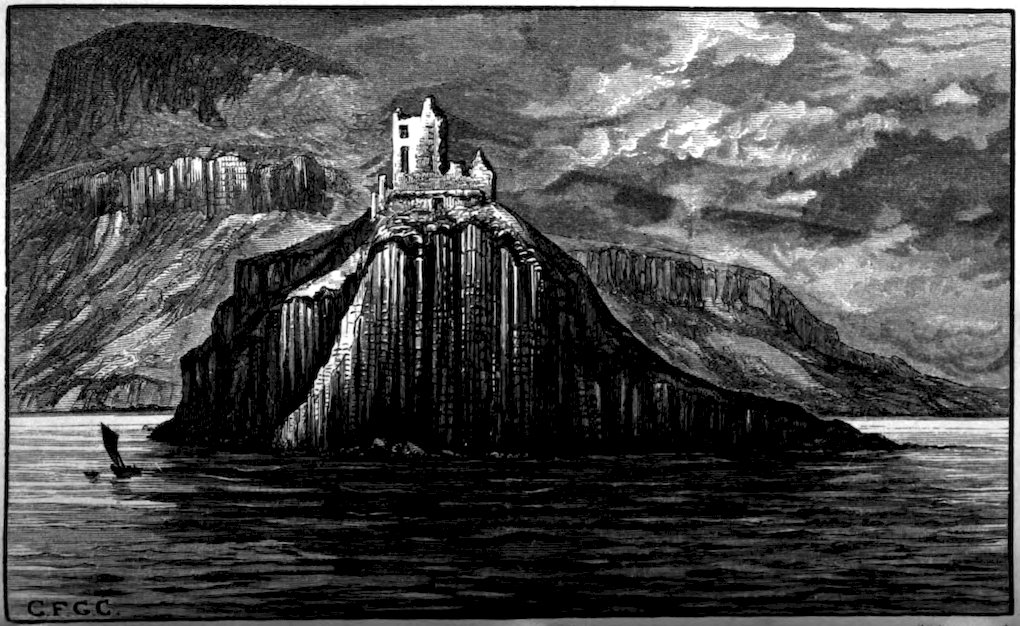
DUNTULM CASTLE. To face p. 129.
So it came to pass that the little fairy “Gannet” flapped her white wings one sunny afternoon, and bade us sail with her over the merry green waves to the opposite coast of Grieshernish, one of the few sheltered nooks where the plantations have actually struggled up to treehood. Here we found our chief amusement in a wonderful music-room, wherein every conceivable variety of musical instrument had its appointed place. Besides piano and 129harmonium, flute and guitar, there was every variety of organ, from the finger-organ down to the most elaborate grinder, with such an array of puppets as would have made the fortune of an itinerant organist. Then there was every species of large mechanical instrument, from a common musical-box up to a large self-acting organ, which played all the favourite operas like a first-rate brass band. Another, something similar, called a Euterpean, gave us more solemn music. Others play reels and dance-music. Next come harp, violin, violoncello, bagpipes, trumpet, cornet-à-piston, reed-pipe—every musical instrument you can conceive down to a Jew’s-harp. For aught I know, sackbut, psaltery, and dulcimer, may have been stowed away in some recess of that wonderful room. It was a quaint fancy of one who had spent his best years on Indian plains, and who had devised this method of shutting out sight and sound of the wild storms and tempests that so often raved round his western home.
We returned to Uig in the evening so well pleased with the swift, lovely little yacht, that we determined to start at once for a cruise round the coast—a cruise so delightful, that I am utterly at a loss whether to award the palm of real enjoyment to yachting in the Hebrides or camping in the Himalayas.
Each day we sailed just so far as might seem pleasant, gliding silently over the waters, rejoicing in the stillness of our noiseless progress; no jarring sound of wheels; no straining engines, or whirring steam; only the plash of wavelets when we anchored for the night in some quiet natural harbour, under the lee of some bluff headland, whence we could row close in shore among all the beautiful cliffs and caves, landing on the small islands to the astonishment of every species of sea-fowl, and of colonies of rabbits, which last proved a very welcome addition to our larder. One favourite anchorage was just below Duntulm Castle; in a clear, green bay, with a pleasant island on one side, where multitudes of large white-winged gannets make their home, and gather wonderingly round their namesake. They were sorely puzzled by our intrusion into this, their sanctum; and often, as we sat on the brink of the cliff where they had built their nests they would swoop past us again and again, flapping their great wings within a foot of us, with wild angry cries as if to drive us away again. If you ever anchor in this quiet bay, you 130must land alone, in the early morning, on this little island; and though the smooth grassy slope is drenched with heavy dew, clamber up to the top, and you will find yourself overlooking a precipitous rock face, down into the clearest green depths; only disturbed by the ripple where the top of some broken basalt pillar rises above the surface.
The old castle stands facing you on a great stack of clustering pillars. On either side, and in the background, lie smooth green slopes, crowned with another range of reddish basalt. The quiet mists are still sleeping in the valley, and above them towers a dark solid mass, which is the Quiraing. Then, as the first rosy flush touches the hill top, the dewy vapours float upward to greet the dawn, and the closed flowers open their cups, and all manner of happy winged insects awake to dance in the quivering sunlight. Everything around you is quiet and still. The only sound is that of
for there is not a grain of sand within miles of you—only sharp shingly beach; so if you want to bathe, and love to paddle about on the soft, yellow sand, you must go to Kilmaloig Bay, or to Loch Staffin.
Now, if you turn and look out to sea, there lies the Long Island on the one hand, and on the other Loch Seaforth, and the wild hills of Torridon, in Rosshire. And much nearer you is the Island of Fladdahuan—Fladda of the Ocean, one of those early Missionaries who here built his cell and chapel. The island, as seen from here, is like some great sea monster. For one large isle lies like a great solid head, while a long line of smaller rocky knobs suggests the dorsal fin of some huge creature swimming across the Minch.
The ruins of Fladda’s chapel were long extant. On the altar lay a round, bluish stone, which was always moist. Should fishermen be detained here by contrary winds, they first walked sunwise round the chapel, then poured water on this stone Hindu-fashion, and shortly a favourable breeze would certainly spring up. It likewise cured diseases, and the people swore solemn oaths by it.
There was a similar stone in the Isle of Arran, of a green colour, and the size of a goose’s egg. It was known as the stone 131of St Molingus, and was kept in custody of the Clan Chattan; and the popular belief was, not only that it cured diseases, but that, if it were thrown at an advancing foe, they would be terror-stricken, and retreat. It was also a solemn thing to swear by. I was strongly reminded of this Hebridean custom when, wandering in the solemn shade of the great forests of Ceylon, in the immediate neighbourhood of the ancient ruined city of Pollonarua, we were shown, in the court of a village temple, a flat slab of stone, esteemed so sacred, that the most hardened villain dares not perjure himself when compelled to swear by it. He must lay thereon a firnam—a coin less than a farthing in value—and then take the required oath.
In these our Western Isles there were many varieties of stones esteemed sacred—more especially such as were perforated; also various crystals. One such magic crystal, the size of a hen’s egg, is still preserved at Ardvoirlich in Perthshire, and it is believed that water into which it has been dipped cures cattle of distemper. Even now, graziers come long distances to procure this precious medicine—sometimes more than forty miles—and are greatly disgusted at finding that the far-famed “Clach Dearg” has been deposited at the bank with other family treasures, and can by no means be borrowed. Whence and when it came to Ardvoirlich is unknown, no tradition existing on the subject; but its silver setting is supposed to be of Oriental work. The person coming for this curative water had to draw it himself, and carry it into the house, where the crystal was dipped in it, and it was then carried off in bottles. But it was necessary that it should enter no other house by the way; so should the bearer visit his friends on his homeward route he most leave the bottle outside.[26] A stone of the same sort is the hereditary property of the Robertsons of Struan. It is called 132the Clach-na-Bratach; or, Stone of the Standard, having been found sticking to the flag-staff of the chief of Clan Donnachaidt on the morning of the Battle of Bannockburn. Since then the clan has never gone forth to battle without carrying this stone, whose varying colour boded good or evil. On the eve of Sheriff-muir, a large flaw was detected in it, and all present knew that evil would befall them on the morrow. No medical stores an needed by those within hail of this precious charm, inasmuch as the water in which it has been thrice dipped, will assuredly cure all manner of diseases of men, of cattle, and of horses.
The Druids specially prided themselves on the miracles wrought by their own magic crystal balls, or adder’s stones as they were called. Of these the most precious were ring-shaped, and supposed to be the crystallized saliva of serpents by them thrown into the air, and caught by watchful wizards ere it reached the earth. We hear of precisely the same superstition at the present day in the East. A recent traveller tells us that in the ruins of Tadmor, he met an old hag who described to him how she had just been watching two serpents thus form a magic crystal, which she had found; she showed him a pearl, which she firmly believed to be made of serpent’s slime.
These magic balls have been found in divers parts of Europe, generally in sepulchral urns. Twenty such crystals were discovered in an alabaster urn at Rome, and one at Tornay, in the tomb of Chilperic, King of France, who died A.D. 480. In his tomb were also found the bones of the horse on which he was supposed to appear in the presence of Odin. Two of these rock crystals were recently found in a tumulus near Dundee. On some of these precious Druidical stones were graven figures of serpents coiled up. In later ages others were adorned with Christian symbols; perhaps a silver rim bearing the names of Gabriel, Michael, Uriel, Raphael; and a silver cross on the top. According as the crystal was clear or clouded, the destiny of the future was explained. Spenser in his “Fairie Queen” tells of such a stone. He says:—
133It is said that the central gem in the brooch[27] which the Bruce was compelled to leave a prey to Macdougall of Lorn, because he could not extricate it from the grasp of his dead foe, is one of these magic crystals, and that beneath it is a hollow space to contain some other amulet. It certainly proved a trusty talisman, in that hour of direst need, when its master was so sorely beset by overpowering odds, and we may well believe that it was a hard necessity which forced him to abandon it.
A list of many such magical stones was compiled two hundred years ago by a Welshman curious in these matters—in which he mentions upwards of fifty varieties in common use among his countrymen and the Highlanders; some round, some oval, some hollow rings, some of crystal, some of glass, but all alike were used medicinally, and more especially on May-day at the feast of Beltane, they were dipped in water, with which the cattle were sprinkled to save them from the power of witches and elves.
A talisman of this sort belongs to the family of Græme of Inchbrakie—a bead from the necklace of a luckless old wife who, about the year 1715, was burnt at Crieff on a charge of witchcraft. The Laird of Mongie, her foster son, was the only person who dared to plead for her life, and in gratitude for his goodwill she bit this bead from off her necklace (her hands being bound), and spat it towards him, promising that so long as he and his descendants preserved that charm, the house of Inchbrakie should never lack a direct heir, or lose their patrimony. In the same breath she cursed the neighbouring house of Mongie, declaring that till the nearest river ran dry, it should have no lineal descendant. Moreover, she bitterly bewailed the loss of another magic stone, which she believed would have effectually preserved her from all the malice of her foes.
The Campbells of Glenlyon and the Bairds of Auchmeddan have similar magical curing-stones; that of the latter is a silver-mounted black flint, bearing date 1174, and is now the property of the Frasers of Findrack. But the most remarkable of all these is one belonging to the Lockharts of Lee, in Lanarkshire, known as the Lee penny, and immortalized by Sir Walter Scott as “The Talisman.” It is a small red pebble, heart-shaped, set in a coin of Edward IV. It was supposed to have been an 134amulet brought from the Holy Land in the time of the Crusades. Like the crystal balls, it was to be drawn round any vessel containing water, and dipped thrice therein. That water, henceforward, had power to cure all manner of diseases. Not only did the people bring their cattle from all parts of the kingdom to drink of this medicine, but, when a terrible plague ravaged Newcastle in the time of Charles I., the townsfolk were allowed to borrow the penny, on giving a bond of 6,000l. for its sure restoration. So precious did they find it, that they desired to be allowed to forfeit the money, and keep the groat with the charmed stone, a proposition to which the Laird of Lee would by no means accede. Afterwards, when the Synod busied itself with the suppression of all manner of superstitions, it found no fault in the Lee penny, inasmuch as it undoubtedly possessed curative gifts, which were wrought without the use of any unlawful charms or sorceries. So to this day, cattle-owners come from afar to ask for bottles of water in which the magic penny has been dipped; (a ceremony which, I believe, is generally performed by some member of the family, to secure the safety of the talisman) and these precious bottles are hung up, all ready for emergencies in many a cow-byre in Lanarkshire.
Amongst the magical stones which to this day command the reverence of the people, I may mention a crystal ball in the family of Willox, hereditary cattle-curers at Nairn. Whatever mischief befalls the cattle in the neighbourhood, the remedy is sure. Willox is summoned, and presently arrives, bringing some curious old harness, which is said to be a witch-bridle; also this round crystal, which is placed in a bucket of water, and is certain to reflect the face of whatever bad neighbour has bewitched the cattle by his evil eye. A few years ago, this crystal was produced in Court in Inverness, its owner having got into trouble, during a year of grievous murrain, when people of all sorts, even highly educated, were shown to have come from all parts of the country to consult its owner. Amongst others who had applied to him for the good of their cattle, was a highly respected English lady, well known in the neighbourhood for her general acuteness and common sense. The crystal having been duly inspected was restored to its master who will doubtless exhibit it to all curious in such matters. In many of the Isles an old flint arrow-head is still thought most valuable for 135the same purpose. The people call them elf-shot and believe them to have been hurled at the cattle by evil fairies!
St. Fladda’s blue stone has led us into a long digression. To return to our post on the rock. The sleepers in the yacht are now all astir, and as you look down on the picturesque sailors in their blue jerseys and long scarlet knitted caps, all so busy unfurling the white sails, you know that there is a chance of a move before long. So you hail the wee boat, that has been fetching the morning supply of milk, and practice your rowing, till a tune on the pipes announces that breakfast is ready.
Then you will sail slowly along the coast, starting early while the sun is still in the east, lighting up the cliffs, and you must keep as near the shore as you dare, or you will lose all beauty. And the slower the better, for every fresh turn shows you new, strange caves, or masses of tall basaltic columns, sometimes cut across, as if by some giant knife, showing a slanting section of all the pillars, but more frequently overlaid with rich soil and green pasture, and above it all the ever-changing masses of the Quiraing tower like grim fortifications. From this side you can hardly believe that they are not great masses of grey masonry; so utterly different are they from the red or yellow basalt which composes the greater part of the sea-coast for the next few miles. A very wonderful formation it is, with those regular hexagonal columns, that look as though carefully chiselled according to geometrical laws. Learned men tell us that it was once a red-hot fluid, which, in cooling, crystallised in this manner, and experiments are shown with chemical mud, which being allowed to cool, gradually assumes the same forms, and give us miniatures of Staffa, and all this coast.
Very beautiful are these caves and rock masses, where, on the slightest provocation, the green waves rush in with such sudden swell, and dash right over them in wild white spray. This it is which makes the danger of lingering too long in the pleasant nooks and caves, sheltered from the open sea. You may chance to find, as you row confidingly out of your little haven, that a sudden breeze has sprung up, fretting the white sea-horses, and making them chafe and toss so angrily that your tiny boat may find it hard work enough to return to the mother-craft.
Such risk as this I encountered at an exquisite spot in Kilmaluoc Bay, so called in memory of St. Moluoc, whose lowly cell 136once stood on the green shores of this quiet little harbour. As we rowed close in shore we discovered a place where the rock face was riven, and showed light within. There was just space for the little boat to float in, passing under a low archway in the rock, when suddenly we emerged into an open space so lovely that any scenepainter who could produce such a transformation-scene for next Christmas would assuredly make his fortune. We had floated into a circular basin, whose rocky sides opened into several long deep caves, beneath whose shadow the water grew dark and mysterious, of the deepest emerald tint, while beneath us lay a clear, transparent aquamarine, through whose depths we could plainly see our own shadow rest on the yellow sand far below. Tiny jelly-fish, edged with lilac spots and long white fringe, floated beside the delicate pink sea-weeds in the clear green water; and as we looked upward to the deep blue sky, we saw that the rock was crowned with heather and ferns and tall grasses, changing from golden cream to silvery, as the light wind rippled over them, though no breath of air stirred near us. And from every cleft in the rock grew tall spikes of crimson foxgloves (the folk’s glove of olden days), and clusters of blue bells, and all manner of flowers, blue and white and yellow.
There was not a sound to be heard save the swish-swish of the dancing wavelets just outside. So perfectly did the rocks round us deaden all noise, that when the yacht fired her little gun as a signal for the immediate return of the boat, I still sat quietly painting, utterly unconscious of any change, and it was not till we had floated clear of the arch by which we had entered, and caught sight of the open sea, that we realized anything being amiss. A heavy ground swell had set in, and the yacht, not daring to lie where she was, was running before the wind, seeking a safer harbour, and leaving us either to go ashore, or pull after her, as might seem best to Norman Campbell, the trusty yachtsman, who was rowing me. He being a strong muscular young fellow, and a thorough seaman, chose the latter, and a stiff two miles he had before we came up with the yacht, which had found a place where she could venture to lie to and wait for us.
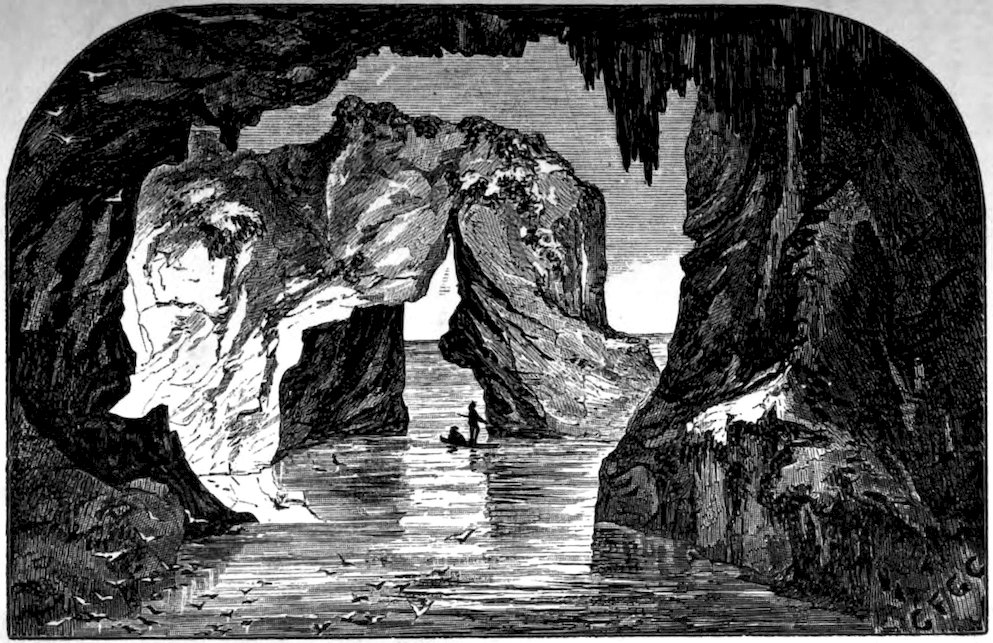
SCHLOCH MADDIE CAVE, SKYE. To face p. 136.
I fear Martin the skipper expended some forcible Gaelic on my escort, but these Skye lads are used to gales of all sorts, and are not easily ruffled; and when we anchored for the night in beautiful Loch Staffin Bay, the most harmonious peace reigned 137among the crew, and the hours were enlivened as usual by wild Gaelic songs and choruses, or by stories of smuggling, in which the fathers and kinsfolk of the narrators generally took a prominent part. For to have been a professional smuggler is considered just as respectable as any other method of earning a livelihood. Then we were told many wild legends of the coast, and can bear witness how marvellously these gain in interest when the narrator can point out the very spot where the weird spirit appeared, or the miserable victim perished. And if divers caves will claim the same history, well, you must try and believe it to be true of each in turn.
Take such a wild, wailing pibroch as McCrimmon’s Lament, which whether played on the pipes in the early morning at a Highland funeral, with an accompaniment of wild cries from the sea-birds, or else sung by a chorus of plaintive voices, while the little waves splash against the ship, and the wind moans in fitful gusts, is about the most wildly mournful of all Gaelic Laments. It becomes positively thrilling when the singers pause, and pointing to a dark yawning cavern, extending far under the land, tell you that there, into that very cave, the bold piper marched, followed by his faithful dog; that he ventured bravely on, resolved to explore the dark passage, and that about a mile inland, where a deep hole is supposed to open into the subterranean passage, his watchful friends still heard his heart-stirring music, when suddenly it ceased, and soon an awful struggle was heard, and McCrimmon’s cry of anguish arose, telling of some awful creature that was grappling with him in the darkness. Then the cries ceased. Soon afterwards the miserable dog, which had been flayed alive, and had lost even the power of howling, crept to the mouth of the cave to die. And since that day no rash adventurer has been so foolhardy as to tempt the like fate. I must confess to having been painfully désillusionnée on hearing the same story told of the cave at Keill, in the Mull of Cantyre, and of half a dozen different spots on the west coast. Nevertheless you sometimes hear deliciously “creepy” stories, such legends as may well inspire the fishers with an ill-defined, mysterious dread of certain spots. Such is the tale that tells how on the shore of one of those dim isles (either Barra or Tyree, I forget which) is the cave where Ossian and his heroes sit spellbound in a long deep sleep.
138One day a bold fisher discovered this very cave, and entering, beheld this grand band of sleepers. Near them hung the magic horn, at the third blast of which, blown by mortal lips, he knew they would all awaken. He was a brave man, who scorned all fear, so he put his lips to the horn and blew such a shrill call that the cormorants and the sea-mews came shrieking forth from the dark recesses of the cavern. A strange indescribable dread took possession of him; nevertheless he repeated the blast more loudly than before, and every rock seemed to echo back the sound with strange spirit-laughter. Ere its tones had died away, he who seemed chief of the heroes, and was in truth Ossian himself, stirred in his sleep, and half awoke. He bade the rash intruder cease, and turning on his side, slept once more. The terrified fisher fled, and straightway sailed from the magic isle, and from that day to this no man has ever been able to find the cave where the heroes of Ossian sleep.
Although the influence of the clergy and of the schoolmaster is rapidly rooting out all traces of grey superstition, it still has some hold in the more remote corners of the land; and the non-existence of kelpies and brownies and urisks is by no means so clearly proven, that a midnight encounter with them would be a thing to risk lightly. The kelpies, as you know, are water-spirits which are always malignant, and delight in causing the floods to rise rapidly and overwhelm the unwary traveller, while their mocking cry rings in his drowning ears; that the kelpies are “bye-ordinar” irreverent is evident from the legend of the old kirkyard at Conan—a green dreamy hillock, where autumn leaves float silently down from overshadowing boughs, a russet covering for the grey mossy stones. Round the foot of the hillock rushes the dark-brown river, once the favourite haunt of a kelpie. One wild night when the storm was raging and the river was in spate, the song of the kelpie was heard above the voice of the winds and waters, and those who heard it trembled, for they knew that the kelpie sought human blood. Then in hot haste a messenger rode up whose errand would brook no delay, and he urged his horse to swim the stream, but the steed shrank back affrighted, and strong hands drew back the foolhardy rider, and vowed he should not thus court destruction. So they locked him up within the old chapel, and all night long the wild tempest battled and raved. When the morning light dawned they went 139to release him, that he might go on his way in safety, but they found him dead, for the kelpie had entered the sanctuary, and had not even dreaded the holy water, but seizing its victim, had held his face therein till he was drowned. So you see it was a very irreverent kelpie indeed!
All over Scotland there are legends of these water-goblins. Thus at Choill-a-chroin, “the wood of lamentation,” near Loch Vennachar, a beautiful pony once came playfully up to a merry group of children, and suffered several of the little innocents to clamber on its back. Then suddenly wheeling round, it galloped off with them, and plunged into the cold waves, and the mothers wept and wailed greatly for the little ones who might never return. This was the form in which it constantly appeared to the Shetlanders. Sometimes a kelpie would assume the form of a splendid black horse, which would appear at the market in charge of some strange uncanny-looking fellow. So fine a beast was sure to find a purchaser, and for a while all would go well, only its strange love for water was noticed, and it would prance and plunge with delight when a bucketful was thrown over it. At last, on some distant expedition, it was sure to be overtaken by a wild storm, and when the ford had swelled to a raging torrent, and its master was compelled to trust to the good swimming of its steed, he discovered too late that he was bestriding the awful kelpie, who would plunge with him into the depths of the foaming waters, never to rise again. We heard many a strange story, too, of those kindly brownies, who used to do so many good turns to lighten the drudgery of farm or household work, and take their payment in bowls of cream and other delicacies, just as the glashans did in the Isle of Man, or the pwaccas in Wales, or as the gins still do in the far-away deserts of Scinde. In every case the description of the creature is the same; he is like a dwarfish human being, covered with long hair, and breathing heavily; having moreover large eyes and great strength, which he willingly employs for any mortal to whom he takes a fancy, working for him hard and faithfully year after year; but nevertheless apt to be sullen and morose, and on slight provocation, to depart for ever.
It is curious to find this good brownie doing just the same work in the far east as in these western isles; but this is only one of many kindred superstitions. The people of Scinde have from 140time immemorial been able to draw the milk from their neighbour’s cows, just as well as any Highland wife; their witches divine from sheep-bones, and take the form of tigers and other beasts, just as easily as a Scottish witch transforms herself into a hare or a stag. They tell wild stories of rakshas or demons of the mountains, and of bhoots or ghosts of the dead; but those who have tried to collect these legends say that there, as in our own Highlands, this becomes year by year more difficult, for the old folk are dying off, and the rising generation do not care to speak of these things, so that the old stories are fast disappearing from the east as well as from the west.
Still there are tribes such as those of the Belooch hills who would be as unwilling as a Highlander to seek out the haunts of a gin, and who tell of magic caves through which the fairies sometimes admit mortals to their subterranean Paradise, where they all dance unceasingly from one year’s end to another beneath trees laden with fruit, which is all made of gold and precious stones.
Precisely the same story is told of a rock in the forest of Glenavon, in Strathspey, and of a green hillock in Strathglass, known as the Beatha Og, or Young Birch, on account of the trees that overhang the fairy knoll; as also of many another place both in Scotland and in Wales. In every case some wanderers are beguiled into a lighted cavern, where they find friends whom they had long since buried dancing with the fairies in merry rounds and reels. Invariably some of the party taste of the fairies’ good cheer, and forthwith join the dance, and the mere prudent abstainers are forced to go home without them. Should they return to seek for their lost friends, they hear only the waving of the birches and the rippling of the stream, till perhaps seven years later, on some mystic night such as Midsummer’s Eve or New Year, the cavern once more becomes visible, the dancers are as merry as before, and any mortal who has the courage to enter, armed either with a cross of the rowan-tree or a dagger of cold steel, such as all fairies abhor, may rescue his companions from their enchantment, though to them it will seem as if the seven years of hard dancing had been but as one night’s merrymaking.
These fairies are always clad in green, and are particularly vicious against anyone daring to wear their colour, more especially 141on Friday, when they have double power, and when a genuine Highlander will shrink from any allusion to them as being “no canny,” or at least to be made with marked respect, as to beings invisibly present, and who need to be conciliated. This is what Scott referred to when he told how
Why these creatures should be called Daoine Shi’ich, or men of peace, I cannot imagine, unless from that curious feeling which prompts so many races to propitiate evil demons who might harm them, rather than serve the good who will do them no ill. For these men of peace are spiteful creatures, jealous of human joys, and especially anxious to abstract new-born babies (which they have only power to do before baptism), leaving in their place their own cross-grained brats, with voracious appetites, always “skirling” for meat. These are known as changelings; hence the use of that name to describe a puny unsatisfactory child.
In South Uist there is the valley of Glenslyte, haunted by spirits called “Great Men,” and formerly whoever entered this valley must perforce repeat certain sentences, committing themselves to the guidance of these beings: for should this ceremony be omitted, they believed they would inevitably go mad, which (like the Chinese custom of beating gongs during an eclipse to save the sun from extinction) involved a risk too great to run.
Till very lately there existed all manner of curious methods for consulting oracles, such as sewing up a man in a cow’s hide, and leaving him for the night on some hill-top, that he might be made a spirit-medium. The commonest sort of divination was practised by means of the shoulder-blades of beasts slain in sacrifice, just as at the present day the shepherds of Niolo in Corsica foretell coming events by the left shoulder-blade of a goat or sheep. And it is a matter of firm belief, now that charms exist whereby a man can spoil his neighbour’s barm (yeast), and a woman can prevent cows from yielding their milk, and, by some 142invisible agency, appropriate it for her own use. She can also by evil arts take away the milk from nursing mothers. As to the superstitions connected with death, they are still numberless. There are warnings in the flight of birds, the howling of dogs, sights and sounds mysterious and undefined; and which are readily construed into good or evil. A hare or a fox crossing the path is held to be so sure a token of evil, that educated men have been known to turn back, declaring they could not travel after receiving such a sign of danger; and even in civilized Morayshire and Perthshire I know one or two stalwart men who have no hesitation in believing that certain poor harmless old wives are witches, who have the power to take the form of those animals. One old wife lately told us that there had been some talk lately about poaching hares. “But deed she kent it was na auld Geordie, nor young Geordie either. For ye see, we’re afeared o’ th’ hares. Ou gin ye wad kill a hare ye dinna ken wha ye wad be killin’! Deed the half of them’s witches!” This enlightened old lady was adorned with Prince Alfred’s photograph, set as a brooch, in which she had invested capital to the amount of one penny! Nor is it very long since one of the gamekeepers (in whom our Sassenach friends are wont to behold their ideal of a stalwart Highlander) wounded a hare, and triumphantly told us that the next time he saw a certain innocent old wife at the kirk her arm was in a sling, so surely there remained no room for doubt as to her dealing in witchcraft! As to the stories concerning second sight (which answers to the clairvoyance of the south), they are legion, and implicitly believed to this day. There is scarcely a village in which some one has not been favoured by ghostly apparitions from dead or living. Either the person seen has already died, or else his doom is swiftly approaching.
That the faith in fairy lore is not by any means extinct was proved to us only the other day when a lady in Banffshire asked an old woman how she came to know of a rather unusual cure for some illness. She replied that she had learnt that and many other things from a wife who had been spirited away by the fairies, and had lived with them underground for eight years. But having said thus much, the old lady relapsed into a mysterious silence, and though much questioned as to the manners and customs of the fairies and their guest, she refused to say another word, for 143“Ou! it wasna safe to be speaking o’ the gude folk; maybe they would be spiriting her awa’ next!”
One favourite story is of a lovely woman, clad in green robes and green mantle, carrying in her arms a young goblin child. She enters a cottage and sits down by the hearth, fanning the embers to warm her numbed hands; then by mere action of the will she draws the heart’s blood of one of the children to feed her young goblin, and sure enough when morning breaks one of the little ones is dying.
The belief in all these weird and wondrous legends has been greatly kept up by the old custom of story-telling round the peat fires in the long winter evenings; but the ban of the Church now lies so heavily on all that tends to encourage superstition, that the popular lore seems in danger of dying out, or of being preserved only by such collectors as Campbell of Islay, whose Gaelic mother tongue and local sympathies enable him to “draw” every blue bonnet and white mutch that cross his path. It is a matter of considerable difficulty nowadays to induce any of the younger generation to relate these old stories, partly from the dread of being laughed at by unbelievers, who look on their legends as being “just blethers,” and still more because their solemn unimaginative teachers try to put down all such foolish tales as utterly unworthy of wise and Christian men, though at the same time the schoolmasters labour hard to store the minds of their pupils with an amount of Greek and Latin mythology that would astonish most village schools in England. They little think what exceeding interest there may be for learned men in this old Gaelic mythology which is so fast dying out, and of its many strange analogies to the most ancient legends of the far east.
There is scarcely one of these fables which has not its twin brother in those of far-distant lands, and in these days when the common origin of the Aryan races is a question so widely discussed, when we are told how strongly Gaelic is akin to Sanskrit, and that Ceylon and St. Kilda were alike peopled by a Celtic race which started from a central point in Asia, it is strange indeed to find that both these islands have from time immemorial believed the same curious traditions, somewhat altered of course in their oral transmission from generation to generation, but virtually the same.
144In the Hebrides you will hear how John, the fisher’s son, leaped his horse over a strait to an island in the Sound of Barra, where he slew a dragon with nine heads and rescued a beautiful princess.
Precisely such a nine-headed dragon as is minutely described in these Gaelic legends is found sculptured on temples in Cambodia and India, where the old serpent worship prevailed in the most remote ages. One magnificent temple in Cambodia sacred to a seven-headed serpent still remains perfect, though probably more than a thousand years old. Many more were doubtless destroyed by the Aryan conquerors, who waged war on the Nagas, or serpent-worshippers, and who continually describe their sun-god as strangling the serpents of night.
A parallel to the history of how the Hindu god, Indra, slew the water monster, Vitra (as told in the Rig Veda), has been pointed out in the Gaelic legend of how Fraoch killed a great serpent on the Ross of Mull.
The wildest tales of Ossian are found again in the old Persian poets; and a thousand other instances might be adduced.
Nor is it alone in legends such as these that we mark strange coincidences. Such fragments of the old Gaelic and Irish mythologies as still exist, bear the strongest resemblance to those both of India and Ceylon, a similarity all the more striking as existing between gods whom neither the Aryans of east nor west would have worshipped in the days of their pure early faith. For just as the most recent interpretations of the ancient Vedas prove that in the original worship of Brahma all use of idols was strictly prohibited; so in these isles, and wherever the Druids held sway, no images of any sort were tolerated, and there seems no doubt that at one time the Celts adored only one supreme God. After a while, however (probably after they had mingled with the aboriginal races), they seem to have adopted a creed as complex, and fallen into idolatry as gross, as that of their degenerate Hindu brethren.
It would seem as if our forefathers had even devised images of their gods, for we find Gildas, a very old author, writing of “the monstrous idols of our country, almost surpassing in number the very devilish devices of Egypt, of the which we behold as yet some, both within and without the walls of their forsaken temples now mouldering away, with deformed portraitures, and terrible countenances, after the accustomed manner.” But what 145is most singular of all is that the very names of these gods and their histories are said to have a striking affinity to those now worshipped in the East. To begin with, it is stated that the most sacred name in the Celtic mythology—the holy and mystic title of the Almighty, was that very word Om or Aum (He who is), a title so sacred that a Brahmin will not utter it aloud, while the Buddhist repeats it a thousand times in his daily worship, and sculptures it on all holy places. Then Chreeshna was actually an old Irish name for the sun-god whom the Hindus adore as Krishna. The cruel goddess, Kali, too, had a namesake in Ireland, and the site where her altars stood is yet known as Leeba Caili, or the bed of Caili. As further examples I may quote
| Saman | answering | to | Samanaut. |
| Can | „ | „ | Chandra. |
| Neith | „ | „ | Nate. |
| Bud | „ | „ | Buda. |
Buda is the name under which, even to this day, the people of Ceylon reverence the planet Mercury. It is curious to observe how, with them, the system of Bali, or planetary worship, still reigns, in defiance of all prohibitions of Buddhist or Christian masters; just as in these British isles the same homage was rendered to all the host of heaven for many centuries after Christianity had held its partial sway. We may notice, by the way, that in the division of the week the people of Ceylon have not only retained the seven days, but have actually named each after the very same planet to which it had been dedicated in the western world.
Another very striking analogy has been shown to exist between the symbols considered sacred in the planetary worship of Ceylon and those which we find sculptured on the ancient memorial stones of pagan Britain; stones which we believe to be relics of a faith almost identical with the Bali. Not only do we find elaborately carved crescents, discs, double wheels, linked together by a royal sceptre, such as might naturally suggest themselves as emblems of the sun, but we also find fish, geese, serpents, and highly idealized elephants and camels,[28] 146the three last-named being creatures which would scarcely have presented themselves to the minds of our ancestors had not some tradition of these unknown forms reached them from the eastern world. It is, therefore, very remarkable to find that the elephant, the crescent, and the goose are sacred symbols in common use on the sculptured stones of Ceylon. Also, but more rarely, I have observed the fish among the emblematic paintings in the temples. It is also remarkable that another emblem found on these stones, namely the figure of a man cutting the throat of a bull, should be identical with the symbol of the Persian sun-god, Mithras.
The extreme reverence of both peoples for fire and water is another link between them. The Aryans of the east, we know, held Agni, the fire-god, in such honour that he must needs be present at all their religious ceremonies; indeed the presence of fire as a divine witness was often their sole marriage service. Of the veneration of our own ancestors for the same fire-god and for the water-spirits, we still find strange traces, though devotion to fire and water has, in general, superseded that of the simple elements. In Goojerat the presence of fire and water is still held essential at all marriage ceremonies. A square is formed in the centre of which a fire is kindled. At each corner of the square nine water vessels are piled, one above the other. The bride and bridegroom, standing by the fire, offer sacrifice; and after divers ceremonies they walk four times, sunwise, round the sacred element, and conclude by worshipping the polar star. Sometimes the marriage is by proxy. The warrior husband sends his sword as his representative. In this case the bride and her steel spouse make the circle round the fire twice only and she repeats that ceremony twice when she has actually reached the dwelling of her lord.
As to the divers forms of trial by ordeal, both with fire and water, we know that they were just as highly esteemed in the east as in Britain. There, as well as here, the accused was made to walk between burning ploughshares, or plunge his arm into boiling water.[29] There, too, the witches of old were thrown into ponds, either to prove their innocence by sinking, or their guilt by floating; in which case they were summarily 147despatched, and thus, whether innocent or guilty, society was rid of them.
The minute similarity between these various forms of trial among our own ancestors and the Hindus is very singular. In Britain the supposed culprit was made to plunge his arm into a cauldron of boiling water and thence pick out a pebble, after which the arm was tied up in linen and woollen cloths, and judicial watchers were set over the man to see that these were not unbound for three days. If at the end of that time no scar was found on the arm the accused was held innocent. The custom in India is, or was, that a man accused of a capital crime who chose this method of trial should, for several days previous to the ordeal, have his arm tied up in wax cloth to prevent any deceit. This cloth was sealed up with the great State seal, and in British districts was sealed with the Company’s arms, while a European guard watched over the prisoner. On a given day a piece of money was dropped into a cauldron of boiling oil, the prisoner’s arm was unsealed and washed, after which, while the Brahmins offered prayers for a just decision, he plunged his arm into the cauldron and picked out the coin. Then the wax cloth was again sealed up, and the prisoner guarded for several days. When the bandages were finally removed the condition of his arm revealed his guilt or his innocence.
In the Rajmahal hills the form of trial still in use is to drop a ring into a pot of boiling water, mixed with boiling oil and cow-dung; the accused must plunge in his hand and draw out the ring. Should he be innocent his hand will not be burnt, but if guilty the pot will boil up and scald him. The ancient Cingalese had precisely the same custom.
The well-known Indian ordeal of making the persons accused of any crime attempt to swallow a mouthful of consecrated rice, which would certainly choke the guilty person, also had its counterpart among our forefathers in the ceremony known as the Corsned, or morsel of execration. A piece of barley bread and a bit of cheese were laid on the altar, and any priest accused of crime was compelled to try and swallow a portion in presence of his brethren and the congregation, all of whom prayed fervently that if he were guilty the archangel might seal his throat that he might be unable to do so. The custom may have existed long before a Christian priesthood 148adopted it as their peculiar test, for such it was generally, in later days considered; yet there is no doubt that the laity also were subjected to the same ordeal, as when Godwin, Earl of Kent, being accused of the murder of King Edward’s brother, appealed to it, with fatal result.
As to the ordeal of walking blindfold over red-hot ploughshares, we turn from the page of English history to that of Hindu mythology to find descriptions identical in all points. In the former we read how Queen Emma, mother of Edward the Confessor, being accused of unfaithfulness to her lord, triumphantly vindicated her innocence by walking barefoot and blindfold, unhurt, over red-hot ploughshares. Precisely similar was the test by which the Hindu king Rama made his beautiful wife, Seeta, prove her purity, when rescued from the hands of Ravana, the king of Lanka. One strongly-marked similarity between our common ancestors was that firm faith in the immortality of the soul, which undoubtedly found a place in the Celtic creed, and which Cæsar mentions as one of the tenets of the Druids. In the tumuli of Britain, as well as those of India, skeletons of animals have been found as if placed ready for food; swords also that would have been precious to the living, were buried with the dead, that they might not be left defenceless on awakening. The old Gauls buried written statements of accounts and claims of debts, that they might be carried on in the next life; and so well was this creed acted upon that men would lend one another money, trusting to repayment when they met in some new phase of existence. I doubt whether modern Hindus would be equally trusting, or the Pharisees of olden days either, if indeed, as Josephus affirms, they too held this doctrine. Certainly we may infer that they did so from the readiness with which they suggested that Christ was merely a new incarnation of Elijah, Jeremiah, or one of the prophets, and also from that strange question respecting the man who was born blind, “Did this man sin or his parents, that he was born blind?”
A quaint trace of the old Druidical teaching of transmigration is the notion not yet wholly extinct, that when a man is slowly lingering away in consumption, the fairies are on the watch to steal his soul that they may therewith give life to some other body. To prevent this, old wives are often anxious to cut 149the nails of the sufferer, that they may tie up the parings in a bit of rag, and wave this precious charm thrice round his head, Deus Sol! Even to this day we are sometimes startled to find persons believing, not only that certain animals are witches in disguise, but that the dead have returned to earth in these strange forms. I have heard such stories whispered with bated breath, in our own hills, and the same traditions are common in the wilds of Cornwall, where we heard a gamekeeper positively refusing to fire at a fox that haunted a certain house, and came constantly baying under the windows. He was not deterred by any fox-hunting scruples, but by the conviction that the animal was really “poor Mr. Frank,” whose spirit returned to an earthly form sometimes in the form of a hare, sometimes as a black cock, but most often as a fox. No Brahmin could have been more decided in his views.
Another curious link between the highlanders of India and of Scotland is the custom now in use among the Khonds (a tribe in Madras), of gathering together their forces in time of need, by sending round an “arrow of summons,” which was identical with that “fiery cross” so well known to our ancestors, who, in times of danger used to slay a goat, and making a cross of wood, seared its extremities in fire, and extinguished them in the blood of the sacrifice. This was in constant use so late as 1745, and was known as the cross of gathering, or as Craan Tarigh, the cross of shame, because shame, fire, and blood awaited any man from the age of sixteen to sixty who failed to come to the help of his clan. It is said that in the isle of Shetland the arrow was the sign retained till very late days, just as it still is among these primitive Khonds, a race in which each family still bears the name of some animal, which is its Totem, or representative animal, so that the tribes are known as bears, owls, monkeys, or deer. They have neither temples nor images, because they cannot believe that a temple made with hands can be the favoured abode of God, so they prefer to worship him on hoar rocks amid the silence of the eternal hills, beside still fountains and by flowing rivers, or in the deep shade of sacred groves where the sound of axe is never heard. They reverence forests, rivers, and mountains, sun, moon, and planets, as types of the Creator’s power, very much as our own ancestors did in bygone ages.
150Even in simple questions of food, of clean and unclean meats, many curious coincidences occur in the customs of brown men and white.
Readers of Ossian and kindred Gaelic lore have sometimes been struck by the readiness with which mighty hunters of old feasted on the wild boars they had slain in the chase, as when Fingal and his son Ossian, and all the other heroes devoured the boar Scrymner. They note this fact in connection with the Scotch abhorrence of pork and pig’s flesh in all forms. It is, therefore, not without interest to notice that though the modern Hindus abhor the domestic pig almost as much as do the Mahommedans, they will feast on wild boar to any extent. Even high-class Brahmins will sometimes partake of this dainty, in remembrance of their sacred hog Baraha, who was an incarnation of Vishnu. Several learned men assert that in this land also the wild boar was once held sacred, and even in later times his effigy has been represented on the ancient British coinage.
It is curious that in Egypt also the Copts mark precisely the same distinction between the wild and tame pig, a prejudice which they are supposed to have retained from the remotest times; an inheritance doubtless from their Phœnician ancestors, who held pig in such abhorrence that they bequeathed the antipathy to all their race. It has been recorded even of the gluttonous Heliogabalus that he rigidly abstained from pork and bacon in every form, because of his Phœnician descent. As to these modern Egyptians, they will in no case rear pigs or taste the flesh of the tame animal, whereas that of the wild boar is considered a most desirable feast. One difference assigned is that the latter is almost entirely a vegetarian, whereas civilization has degraded the appetite of his tame brother. So hateful to the old Egyptians were the domestic swine, that should a man accidentally touch one with the hem of his garment he was rendered unclean. Yet at the full moon pigs were freely sacrificed to Bacchus, and the people feasted on their flesh. Each family slew a pig at their own door, while those who were too poor to afford one made an image of dough, which they offered instead. Doubtless the Jewish sin of eating pig was hence associated with idolatry, as we generally find that eating swine’s flesh and broth made 151thereof is associated with burning incense to strange gods, and on forbidden altars. This, too, would account for the intense abhorrence with which the Jew regarded poor piggy—far in excess of that merited by other things equally prohibited by the Levitical law. Thus in the account given in Maccabees of the persecution under Antiochus, we find that they submitted to every species of degradation, to the defilement of their altars, and the dedication of their temples at Jerusalem and Mount Gerizim, to Jupiter. They even submitted to walk in idolatrous processions at the licentious feast of Bacchus, carrying ivy like the rest of his worshippers, but when it came to the question of swallowing swine’s flesh, there they stood firm, from the least to the greatest, and we hear even of a mother standing by to see her sons murdered piecemeal with indescribable tortures rather than purchase life and wealth by this concession. One by one her seven sons were thus slain, while she encouraged then to endure to the end, and finally died with them.
Another interesting point of resemblance between the ancient Celt and the modern Hindu is the religious abhorrence in which the latter holds poultry, as being unclean, so that he will on no account taste it or touch it. The poultry market of India is, I believe, entirely supplied by Mahommedans, or by men too degraded to have any caste. The Celts we know were forbidden to eat a hen, a goose or a hare. The repugnance to the latter is not yet wholly extinct in some districts.
As to the goose it seems to have been held too sacred for food in all parts of the world. Here our forefathers sculptured it among the sacred emblems on their holy stones, together with elephants and horses. We find it, in the same company, carved on the most ancient stones of Ceylon. In Rajpootana and other parts of Hindostan it is specially dedicated to Hari, the Hindoo god of battle, who is also worshipped under the symbol of a sword. In Burmah the goose still floats on the royal standard as the national emblem. We find it receiving solemn worship in ancient Egypt, as also in Scandinavia, where it was sacred to Odin, and where the goose festival has been christianized to the honour of St. Martin instead of St. Michael as in this land. As to the old Romans, we all remember how the sacred geese of Juno saved the capitol, but though they doubtless gained great popularity thereby, their sanctity was a much older story. 152Even to this day the modern Italians fatten geese which are rarely, if ever, brought to table.
The very name of the bird has altered strangely little in its westward journey. Thus in the ancient Pali, it is Hanza; in Egyptian, Hanza; with the Romans, Anser. In Malay, Gangsa; in old German, Ganza; in English, Gander.
Equally wide-spread seems to have been the reverence for certain fish. It was affirmed by an ancient writer[30] that the people of Caledonia never ate fish. Certainly it is remarkable that in all Ossian’s songs of the chase, when he skims over flood and field, rivers and seas, no allusion whatever is made to the catching of fish. Yet we find these rudely carved on many holy stones, together with the mirror, which the sea-faring folk to this day declare to be always seen in the hands of mermaids. Their description of these fishy maidens and mermen answer, precisely to the old accounts of the fish god and goddess, Dagon and Derceto, which were worshipped by the Syrians and Phœnicians, who, for their sakes, would eat no fish. The temple of Derceto, at Ascalon, was on the edge of a deep lake full of fish, which, like those in the tanks in India, were held sacred, and religiously fed. Venus also protected the finny tribes, and on certain old Phœnician coins, fish appear in connection with the crescent moon. The priests of ancient Egypt were also forbidden to eat fish; and to this day certain tribes exist in Caufiristan and the remote Hindu-Koosh mountain ranges, who worship a god whom they call Dagon, and who religiously abstain from eating fish.
The ancient prohibition of the use of poultry, seems no wise to have interfered with its use as a most suitable propitiatory offering in all cases of need. In Britain as in India and Ceylon, a red cock seems from time immemorial to have possessed peculiar virtue, and to have retained such hold on the popular mind, that Christian teachers have found it well-nigh as difficult to check this sacrifice in the one land as in the other, even among their most hopeful converts. Among the Santhals, and various other tribes both of Northern and Southern India, it is customary in every case of dangerous illness, to sacrifice a cock beside the patient, to whatever demon is supposed to have caused his malady. A live cock is also nailed to the funeral 153pyre. And in our own Western Highlands, and in some of the border counties, it was till very recently quite a common ceremony to kill a cock beside the sick man, and either bury it beneath the floor of the cottage, or at least let its blood trickle into a hole in the floor. To this was probably added some of the patient’s hair, and some parings of his nails! This is generally supposed to be a trace of the old Roman worship of Esculapius, but I fancy that some older tradition still, must have taught the same practice to the Hindus. I believe this custom to be by no means extinct in Britain.
Sir James Simpson mentions several instances within his own knowledge in which this strange remedy has been resorted to, for the cure of fits, epilepsy, and insanity. In one case a cock was killed and deposited in a hole in the kitchen floor, on the spot where a child had fallen down in a fit of convulsions; and a Ross-shire lassie told him that the neighbours were urging her mother to try the like cure for the same cause! He also speaks of the sacrifice of cats, moles, and other animals. Thus, at Nigg, in Ross-shire, a lad being attacked with epilepsy, his friends laid on his head a plate, and above it, held a living mole, by the tail. They then cut off its head, and allowed the blood to drip on to the plate. Three moles were thus killed in succession, but without effect.
This offering a life for a life is the common Hindu practice in cases of sickness. Various domestic animals are brought into the room from a belief that they will absorb the noxious principles of disease, and act as disinfectants. When they are supposed to have done their work, they are thrown from the window. Even in the case of so enlightened a Hindoo as the young Rajah of Kolapore, whose recent death at Florence was a cause of so much regret, the presence of four European physicians would have been considered by no means sufficient had these traditional Hindu prescriptions been neglected; and as the Florentine authorities might justly have objected had these wretched animals been cast from the windows into the street, they were thrown down into an open courtyard!
Even the modern Jews seem to have borrowed this ceremony of cock sacrifices from their pagan neighbours. We know that the Levitical law makes no provision for any such thing. Yet the Rabbis are not only as strict as modern Hindus, or ancient 154Celts, in excluding all poultry from the holy city, but like them command that on the eve of the Great Day of Atonement the head of each house shall take a cock, and, having tied its legs together, shall swing it thrice sunwise round his own head, uttering a certain formula of words. The women of the household are not present, but they may in like manner deal with a hen, which they afterwards eat together. The Jews, however, are said to object to the use of a red cock, and, if possible, procure one that is pure white.
It seems that in old times the custom of sacrificing a cock by night at places where four roads meet was quite as common in India as in Britain, where this is one of the dark deeds most frequently laid to the charge of witches. Thus in 1324 we find a lady of high estate, Dame Alice Kyteler, accused by the Bishop of Ossory of having sacrificed nine red cocks and nine peacocks’ eyes to an evil spirit, at a place near Kilkenny where four roads meet, and having then boiled part of the flesh and other villanous compounds in the skull of a felon. About the same time we hear how the Cardinal of Gaæta, afterwards Pope Boniface VIII., was accused of similar communication with demons by drawing round him a circle, and therein sacrificing a cock. We know that drawing the circle was another ceremony common to sun-worshippers. Thus in Ceylon, where, as we before observed, the old worship of the planets has been incorporated with the purer faith of Buddha, the most solemn festival of the year is that of the midsummer full moon, when priests and people march in procession to the great river near Kandy, and, at the moment of sunrise, draw a magic circle on its waters with a golden sword, and, filling their water vessels within this mystic line, carry this sacred water to the temple of Buddha, where it is religiously treasured till the following year. Thus too the Arabs draw a mystic circle round any property which they are obliged to leave unprotected; and they, as we know, sacrificed cocks to the sun, long before the days of Mahomet. We also obviously trace sun-worship in such a sacrifice as one described at Llandegla in Denbighshire, where an epileptic patient was directed to go three times sunwise round the Holy Well, where he was to wash himself, and cast in an offering. He was then to carry a cock thrice sunwise round the well, and thrice round the church, and was himself to lie all night beneath the Communion Table, with 155his head resting on the Bible,—a curious blending of “the Table of the Lord” with the service of devils. A very common ceremony in the Highlands was for a man who believed himself to be in danger from fairies to draw a circle round himself with a branch of oak, a certain charm.
Speaking of the kindred superstitions of divers races, have you ever noticed how curiously those having reference to salt appear in many lands? For instance, the common Scotch belief that spilling salt at table will be the sure precursor of a quarrel finds a strange illustration in some of the oldest Italian pictures of the Last Supper, in which Judas is represented as having just overturned the salt. We all know how, among the Old Scotch and Irish, the place of the salt at table divided the honoured guests from those of lower rank, so that to sit below it involved a very humble position. Here, as in the East, eating salt together seems always to have symbolized a certain sacredness in hospitality, akin to the Arabic respect thereto—something of the obligation to fidelity implied in such scriptural expressions as “being salted with the salt of the palace,” or “having made a covenant of salt.” Hence, too, the Persian description of a traitor as one faithless to salt.
We know that not only the Jews, but also the Greeks, Romans, and other heathen nations, offered salt with every sacrifice. Whether this was done in Britain I do not know; but of the Jewish belief that a sprinkling of salt was “good for the land,” we find a trace in the old Scotch and Irish custom, that when the sowers went forth to sow the fields, the wife of the farmer first of all sprinkled a handful of salt, to ensure a good crop. Also when a man was appointed to any new position, women threw handfuls of salt after him to bring him luck.
As to our common custom of throwing salt over the left shoulder, to avert the quarrel which is sure to follow the upsetting thereof, it is said to be simply an offering to some devil, who was supposed to be the master of salt, and angered by its waste; unless, therefore, this atonement were made to him, he would stir up strife among the guests. On the other hand, the Egyptian women sprinkle salt on their floor in the name of God, in order to prevent evil spirits from entering their dwelling.
156Another custom which seems equally wide-spread is that of saying “God bless you!” to a person who sneezes, a custom which we generally trace back to the days of the plague, when this was held to to one of its first symptoms. But it seems that even the Siamese always wish long life to one who sneezes, because they believe that an angel holds the book wherein is written the life of every mortal, and as he turns to the page which contains the history of any particular person, that person infallibly sneezes, and so his friends wish him good luck in the reading of his fate. And likewise one of the old Greek poets speaks of an evil-minded person who refuses to say “Jupiter save him” when one of the company sneezes. Thus, too, in the “Odyssey,” when Penelope has just heard a rumour that gives her hope of the return of Ulysses, Telemachus sneezes violently, which she at once hails as a happy omen.
The old Jewish Rabbins, too, have curious traditions on this matter. They say that before the days of the patriarchs all men died of sneezing. They never sneezed but once, and straightway gave up the ghost. Jacob was the first man who died from sheer old age. So after his day, it was found that to utter words of blessing during the act of sneezing would avert all danger. And so it came to pass that every ruler ordained this custom in his land; and this, says the Talmud, is the reason why the same practice is found in all nations, even among the savage tribes of Africa. Thus when the King of Sennaar sneezes, all his courtiers turn aside and slap their thighs. But a sneeze from the King of Monomotapa is a very serious matter indeed, for all his courtiers must salute him in so loud a voice, that all who wait in the ante-chamber may hear and join in the acclamation, while those in the further rooms join chorus, till the very guards and sentinels take it up, and all passers-by in the streets, hearing the well-known salutation, must utter it aloud, so that the wave of benediction runs along every street of the city—and a pretty hubbub it creates.
But we have no need to go to savages for examples. The graceful “Eviva” or “Felicita,” of the Italians, and the sacred invocation of the Spaniards “Jesus!” will at once suggest themselves as implying some kindred notion—a greeting that shall avert some real evil from the person addressed. Hence the exclamation of a Spanish girl, when an English lady 157remarked that she had just had a violent sneezing fit, “Ah! Pobrecita!” poor little thing, “and I was not there to say Jesus! for you.”
In Egypt when a person sneezes, he exclaims, “Praise be to God!” and all who are present say, “God have mercy on you!” to which the sneezer replies, “God guide us all!” But should he yawn, he must cover his mouth with his hand, and say, “I seek refuge with God from Satan the accursed.” But no one wishes him luck, for they believe that the devil is ever watching to leap into a gaping mouth!
But all these curious coincidences between the customs as well as the traditions of the Eastern and Western world have tempted us to wander on and on from fairy tales to mythology, till we have drifted off into a vague world of superstitions that have carried us far away from the old Gaelic songs and legends, with which our sailors whiled away the lovely summer evening.
It was late before the little yacht was ready for the night, and her crew turned into their tiny cabin “for’ard.” The evening lights were so beautiful that we lingered on deck, hour after hour, scarcely knowing how to turn away from so much loveliness. There had been a golden sunset behind the Quiraing, which still stood out in rich purple against a lemon-coloured sky—while the calm sea reflected both. Each changing tint of the opal had rested by turns on all the islands and the hills of Torridon. Now the clear moonlight gleamed on the water, and silvered the soft white mists that half shrouded Ben Etra, even lending poetry to the little inn, with its group of thatched byres and offices.
But the other side of the bay lay in its own deep shadow, and it was not till we saw it in the early morning that we realized how beautiful it was. Green banks sloped gently down to the water’s edge, crowned with perpendicular stacks of basalt, in three distinct masses. It is from these basaltic columns that Loch Staffin, like Staffa, takes its name. Nearer us, a great headland of rock and greenest grass rose abruptly, half enclosing a shore of the smoothest yellow sand; while every mark and cleft in the rock lay clearly mirrored below. The scene was irresistibly suggestive of bathing; so, being by this time fully competent to pass as “able-bodied sea-women,” we rowed ourselves ashore, and vowed that no bathing-ground had ever been 158so charming; and that here must be our head-quarters fur the present.
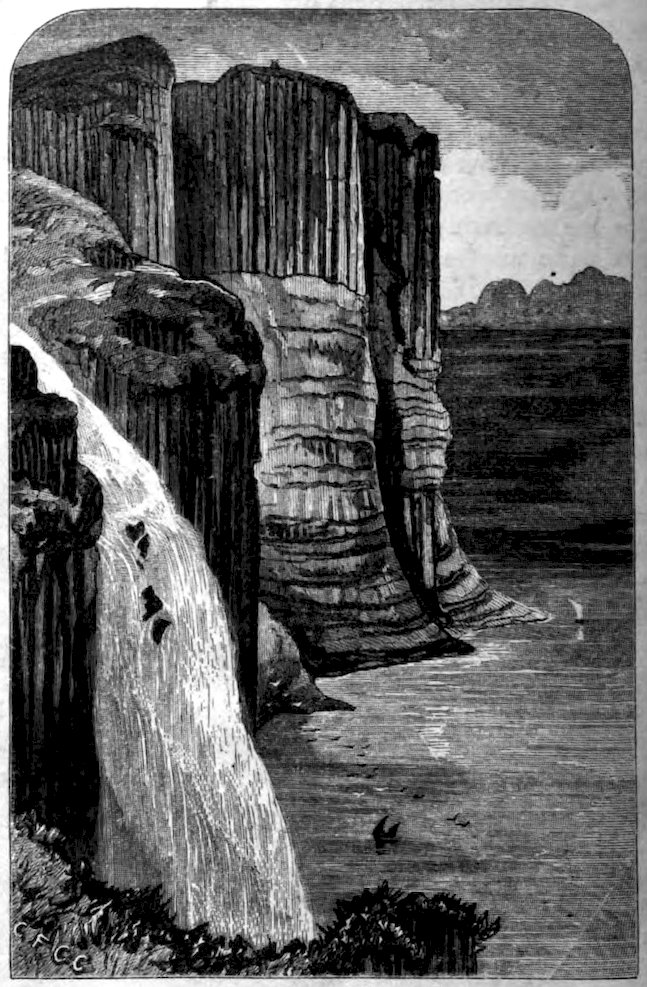
KILT ROCK.
Later in the day we had a lovely row all along the coast to a wonderful headland known as the Kilt Rock, by reason of the many-coloured strata of which it is composed. From the green sea upwards, layers of oolitic limestone, oolitic freestone and shale, alternating with lines of grass, lie horizontally; while rising vertically from these is a great mass of red, 159brown, and yellow columnar basalt: so huge are these pillars, that they quite dwarf those of Staffa; indeed Macculloch, whose sea-side geology was generally accurate, calculates them at five or six times the magnitude of those in the wonderful little Isle. On the top of this cliff[31] lies an extensive loch (Loch Mialt is the sound, though as to Gaelic spelling, he is rash who ventures to attempt it!) a loch with reedy shores, haunted by innumerable water-fowl. Hence the waters fall into the sea below, in flashing spray—a clear fall of 300 feet.
As we rowed slowly along, in the warm bright sun, so warm indeed that the men’s faces and arms, tough sailors though they were, were all blistered with the heat, and looked up to the cliffs above, and down into the waters beneath, with such an intensity of delight, as became almost oppressive, there was something overwhelming in the feeling of the amazing strength and immutability of those dry, scorching rock walls, contrasted with the perfect stillness of the exquisite green water, through the clear depths of which we peered down into the marine forest, whence trees and shrubs of every variety of form and colour stretched their branches upward 160to the light. There were giant brown sea-wares of many forms, some waving like graceful palms; others tossing great arms aloft, like the patriarchs of this untrodden jungle. Some have thick stems, and broad fleshy leaves of the richest golden brown, every leaf ten or twelve feet long. Some are smooth and leathery, and others all plaited, and fringed, and folded, and twisted, and crimped, as if the laundry-maids of the sea had no other work to do but just to get them up. Then we passed over others with large fan-like leaves; some that look like bunches of long pink or green ribbon; and countless varieties of delicate pink, and lilac, and olive sea-flowers and sea-weeds, like floating lace-work, woven in some fairy loom—more brilliant in this temperate sea, than either in tropics, or colder regions.
And in all this beautiful, luxuriant vegetation, myriads of dainty sea creatures make their home. Every lace-like weed seems beaded with black pearls, which are the smallest mussels you ever saw. You cannot lift up the tiniest plant but you will find on it a score of living things, whose delicacy of structure arrests your eye, even without the help of that best of companions, a small magnifying-glass.
As to the wonders of the invisible life of the sea, as shown by a good microscope—the almost invisible weeds, which give food and beautiful homes to millions of our fellow-creatures, and the endless varieties which float in every drop of water—that is a field of enjoyment quite by itself. Only, be sure that next time you get the chance you look at some common oyster-spat through a good glass, for I think that (except perhaps the purple bunches of grapes, which are only dust from the blossoms of the marsh mallow), no lifeless thing can be more beautiful. But the most careless eye can scarcely look down into a sea whose depths teem with such exuberance of life, animal and vegetable, without noticing something of the beauty that nestles under every leaf, lodges under each root, hides in every crevice: thousands of creatures, each of wonderful organism, building their curious nests of sand and glutinous matter, floating on the warm surface of the water, or drifting lazily hither and hither in the gentle current.
After passing the Kilt Rock, we came on what seemed to me still more curious geological freaks. There were patches of many-coloured rock; but in particular, just above the sea-level was a 161long layer of pale grey oolite, wherein at regular intervals were imbedded great round boulders, like huge black cannon-balls. We landed at Lon Fern, a region of black volcanic-looking rocks, some standing apart like quaint figures. One statue of John Knox in a black gown was so unmistakeable, that we pointed to it simultaneously.
This bay is like one vast aquarium. I never before saw so many living creatures in so small a space. Such multitudes of sea-anemones of every colour, and tiny star-fish, and little silvery eels, and shoals of fish no bigger than minnows. And then the countless varieties of crabs! Poor little half-naked hermits; dwellers in other folk’s houses; and braver little creatures who are ready to fight life’s battle for themselves, though they are so delicate as to be almost transparent, and their tender claws could scarcely nip the tiniest sea-anemone. Sometimes a great big fellow (a parten, as we northerners call him), would swim up from his rock home under the sea-weeds, and peer at us with his curious eyes, and then sink down again, faster than he rose, to his hiding-place in the fairy garden, among corallines and sea-weeds of every hue, crimson and gold and bronze—and lustrous metallic greens and purples. Besides these, there were innumerable jelly-fish, from the tiniest atoms of orange, or red-currant jelly, to the great giants who would overflow the largest jelly mould that ever was made. And such beauties as they are, with their delicate rings and stars of lilac, and the fringe of long sensitive fingers floating in graceful festoons.
The longer we looked, the more convinced we were, that, in spite of Kingsley, we had really discovered St. Brandan’s Fairy Isle for ourselves. There it lay before us, just as he describes it, “reflected double in the still, broad, silver sea.” That wonderful water world, where the water-babies, and all other little water-creatures, play hide and seek in the great water-forests. There, just as he tells us, was the Isle, “full of pillars, and its roots full of caves; and its pillars of black basalt, with ribbons of many-coloured sandstone, all curtained and draped with sea-weeds, the rocks covered with ten thousand sea-anemones of all beautiful colours and patterns, just like the gayest flower-bed. And here and there the soft white sand where the water-babies sleep every night, taking no heed of the little flounders which wriggle about in the sand, or of the crabs 162which lie buried under it, and only peep out with the tips of their eyes.”
Vainly we hunted and peered into every bright shallow pool for one glimpse of those most enchanting fairies who rule in this watery world—Mrs. Doasyouwouldbedoneby, and Mrs. Bedonebyasyoudid. For the sun overhead was scorchingly hot; and the glare from the water much the same; and the thought of sea ices, made of seacow’s cream, positively made our mouths water. But alas! our blind eyes had not been opened to discern their presence, so we were forced to turn inland, to a shady, quiet, happy nook among the silent grey rocks, with their beautiful ferns and grasses, and wild thyme and blue bells—and here we enjoyed ourselves and our luncheon as we could only do on such a day and in such a scene.
After awhile, my companions went off to call at a large farm, near which are some remains of the old Fort of Dun Deirg, so-called in memory of Dargo, the Druid, so the people say. I first inspected the rough sheiling—half natural boulders of rock, half loose stones—where the salmon fishers live; then idly, for lack of better occupation, wandered up a long grassy slope called Rhuna Brathrain, the Brother’s Hill, or as some say, Rhu-na-Bratan, the salmon’s headland, from the fact that the beautiful silvery fish love to lie in the clear green water below, which accordingly yields the best fishing off the island. Suddenly, as I reached the summit, such a scene burst on my astonished sight as left me fairly breathless with delight. The grassy slope, as I might have guessed, ended in an abrupt precipice, and right at my feet, far below, lay the clear calm sea, while from the shore one huge basalt needle stood up level with the hill whereon I stood. All along the coast lay sunny bays, each inclosed by great masses of columnar basalt, always crowned with rich green pasture. Bight before me towered the Storr, a mountain of the same character as the Quiraing, rising almost perpendicularly from the sea to a height of two thousand feet. Its smooth surface is clothed with rich green grass, while the rocky face which lies towards the sea is one mighty mass of broken crag. In every direction are heaped confused piles of rock, tossed about in forms gigantic and terrible, like the colossal ruins of some stupendous city, or the burial-place of some race of giants; a place utterly desolate and silent, where the spirits of the past 163may dwell undisturbed in unbroken solitude, and where the floating vapour-wreaths that cling to the weird rock figures, seem like the ghostly winding-sheets of an army of mighty dead.
The autumn of 1872 added a new element of eerieness to this unearthly scene, for here was found the body of a poor young Englishman, who, wearying all too quickly of the cares and sorrows of earth, selected this lonely spot as the most fitting to put an end to the young life that weighed on him so heavily. His body was carried to Portree for burial, for you know, in Scotland, even the rash dead, who has fallen by his own hand, is not excluded from a resting-place in the kirkyard, but is laid, with unbaptized infants, in the cold shade on the north side of the church. It seems, however, that such burials are liable to meet with opposition from the fishers, not from any special fear of the kirkyard being haunted but from a belief that for seven years to come the herrings will forsake the coast! In the present instance, whatever demur may have arisen, the funeral was suffered to proceed, and I have not heard whether the harvest of the sea has suffered in consequence.
High above this wilderness of grand pinnacles and tumbled crags, towers one gigantic rock-needle, poised as if in mid-air, on the summit of a great grass-covered crag. This is par excellence, the Storr. Its height is 165 feet, its circumference at the base 240 feet, and as it cuts clear against the sky, like some vast minaret pointing heavenward, it becomes a landmark whereby the fishers may guide their course for many a mile; the only wonder is that it should not ere this have been in some way utilized as a vast natural light-house, a guide for the night as well as the day.
Beyond this magnificently wild scene lie the blue Cuchullin and Sconser Hills, and the little Isle of Raasay, with the wild coast of Applecross, Torridon, and Gairloch, as a background, and as I looked down on the calm waters, a few brown sails of far-away herring boats were all that recalled human life and toil.
Along the horizon lay soft, silvery grey clouds, all reflected in the water, while from the clear blue overhead came such a chorus of laverocks as seemed to bring floating back pleasant memories of sweet home-voices singing joyous songs, 164to the blythesome “bird of the wilderness,” soaring on dewy wing through downy clouds. “Hail to thee, blythe spirit!” When the larks had vanished sunward, there followed a hush and stillness of unutterable delight—a “silence more musical than any song,” while the hot sunshine, pouring its flood of light on earth and sea, enfolded all nature in a dreamy, sleepy haze.
Looking forward to a delightful row homeward, I at last came down from my beautiful crag, losing sight of the sea for half an hour. To my dismay, on reaching the shore, and looking back in the direction whence we had come, I found that a sharp breeze had sprung up, and long heavy waves were beating violently on the rocks. It was clearly impossible for the boat to carry us in such a sea. The sailors, however, said that they could get her back to the yacht if we could go round by land.
It was a weary six miles walk, and we were pretty well tired already, but as there was no alternative, we just “set a stout heart to a stey brae,” and clambering once more to the top of the cliffs, found there a tolerably level road, and faced the dull grey mist as cheerily as we could. We could see nothing else on every side of us; and every sheep we met was so magnified by the fog as to be suggestive of some ghostly monster. At last we reached the desolate loch sacred to all manner of wild fowl, which looked up wonderingly as we passed. Still, on and on, we trudged through the soaking mist, with an ever-changing escort of curlews and plovers, circling round us with shrill angry whistle till we were well past the homes of their little ones. Then a fresh colony would be equally distressed by our approach, and took up the chorus of alarm.
At last we reached the little Inn at Stencholl, and here my companions determined to spend the night; but as we were not expected, and neither rooms nor supper were ready, I preferred going on board to my own little cabin, after getting good milk and scones, and a thorough good drying at Sandy M‘Leod’s blazing peat fire.
Have you ever, when thoroughly drenched, and in prospect of a long cold drive home, tried the experiment of pouring whisky into your boots? I cannot say I have ever tried it myself, but those who have, maintain that even if their supply is insufficient for both internal and external use, they consider the latter more important as a preventive against dangerous chills. 165Happily I had no need to try either on the present occasion as a very few minutes’ rowing saw me safe on board the Gannet.
Next morning broke calm and beautiful. I went ashore, and found my companions none the worse for our expedition, but not inclined to repeat it. So I returned to our favourite sandy bay, where a group of many-coloured rough Highland cattle were cooling themselves in the sea, and nibbling sea-weed which I believe in winter time, when other pasture is buried in snow, affords a livelihood to cattle and sheep, and sometimes even to deer. The sailors were filling our barrels at a spring of deliciously cool water, gurgling up from a cleft in the rock.
Beyond the blue sea lay the beautiful Ross-shire coast, every peak of the grand Torridon Hills standing out in clear relief. One in particular, a great cone of pure white crystalline quartz, glittered in the sunlight as though covered with fresh snow. From Gairloch to beyond Applecross that magnificent mountain range lay unclouded—a perfect sea of peaks and cones and great shoulders—a grand tract of treeless deer forest, in whose jealously guarded precincts lie hidden deep rocky corries, as wildly beautiful as, and practically far more inaccessible than, any Himalayan pass. Verily the cup of Tantalus was a perfect joke to the woes of an artist dwelling in a land of deer-stalkers, daily looking with ever-increasing longing at the barrier of great brown hills which inclose the paradise, one rapid glance at which still haunts his dreams, but where he may not again dare to set foot, under penalty of instant expulsion by a whole army of vigilant foresters, backed by grim laws of trespass.
To the southern ear this use of the word forest always sounds a strange misnomer; and the raw Saxon who ventures to wonder at the absence of trees is apt to be rather startled at first by such a posing reply as “Trees! wha ever heard of trees in a forest?” Nevertheless, when for the satisfaction of our Sassenach friends, we refer them to their beloved Dr. Johnson, we find he defines forest as a word descriptive of “any untilled tract of ground.” You see he had been in the north country himself, and knew all about it. If lack of tillage be all that is required to constitute a forest, there is not much fear of those wild hills ever losing their rank as such.
In those deep corries lie unnumbered treasures for fern-lovers. The delicate parsley fern grows there in rich abundance; and 166there are sheltered nooks by the sea where the tall Osmunda Regalis flourishes undisturbed.
That wild coast still keeps legends of its early Christian days, and tells how just twelve hundred years ago, St. Maelruhba, who like Columba was descended from Niel of the Nine Hostages, King of Ireland, and like him, too, was a most zealous convert to the new faith, sailed over the sea from Bangor, and landing at Aber-crosen (the mouth of the Crosen), now known as Applecross, founded a church and monastery there, which received the name of Comaraich, the Sanctuary, and was acknowledged as a haven of refuge for criminals and debtors, a privilege which I believe it could claim to this day. On the little isle of Croulin, near Applecross, was Maelruhba’s oratory—and other memorials of his missionary wanderings remain in various parts of the country, where he is remembered as Malruba, Malrue, Mourie, or Maree. He was patron saint of the south-eastern half of Skye, the remainder of the isle being under the care of St. Columba. To him were dedicated the churches of Kilmoray in Brackadale, Kilmaree in Strath, and Aski-Malruby, commonly called Killashig. The parish of Kilarrow in Islay was also his, and though its church has wholly disappeared, a few carved slabs still mark the old kirkyard. In his honour beautiful Loch Maree is said to have changed its ancient name as an arm of Loch Ewe. The farm of Kinloch Ewe, at the head of the fresh-water Loch Maree, still retains the original name, though now some miles distant from its salt-water godmother; a fact which, taken in connection with the different levels of these lakes, seems to point to some very curious topographical change. One of the many islands on Loch Maree, commonly called Eilean Mowrie, or Malruba’s Isle, became a favourite retreat of the saint; and his chapel, burial-ground, and well, are still held by the people in such veneration that they resort thither to bathe, and drink, and hang up rags and other offerings on the bushes. It was formerly considered especially efficacious in curing insanity, and patients were taken there to bathe, and then rowed sunwise round the island, getting an occasional dip in the Loch as they went on. Malruba is said to have been slain near Conan Bridge, and his body was carried to 167his monastery at Aber-crosen, beside the sea, where a grey stone in a thicket of brambles marks his tomb.
Zealous as he was in teaching the people, he does not seem to have been altogether successful, for so late as the year 1656 we find the ecclesiastical authorities endeavouring to stop the annual sacrifice of bulls on the 25th of August to St. Mourie, “whoever he might be, saint or demon.” This recipient of dubious honour was, in fact, poor Malruba himself. The people also carried milk to the tops of the high mountains, and there poured it out upon the rocks as an oblation. The Presbytery was much troubled at the impossibility of checking these heathenish offerings, and found that not only at Applecross, but also at Loch Carron, Loch Broom, Kintail, and other places in this district, but more especially at Gairloch and Loch Mourie this demon had “his monuments and his remembrances.” The “sacrificeing of beests in ane heathenish manner” on the Eilean Mourie in Kinlochewe again troubled the Church in 1678, and “Mourie his poore ones, and Mourie his deviles” continued obstinately to hold their ground in these remote valleys. From these dreamy legends of the distant hills I was roused by the sound of footsteps, which in that silent spot was somewhat of a rarity. Looking up, I perceived that there was a gathering of the fisher folk, for from every side of the hills I could see groups of people approach, all making for this very spot, till two or three hundred had assembled; and I found that all the fisher lads were to start in the afternoon for the herring fishery on the east coast, and their sweethearts and wives, and old fathers and mothers, and little brothers and sisters, had all come down to see them off.
At first it was a scene of very cheery greetings, for many of them live far apart, and rarely “foregather.” But as the hour for parting drew near, it became sadder and sadder, and the amount of kissing and crying told pretty plainly how well they knew the dangers and perils that might arise within the two or three months that the fishing would last. For many a sad fireside has its own sore history of the Caller Herrin’, and can tell too sad a tale of why “wives and mithers, ‘maist despairin’, ca’ them lives o’ men.”
And though the sea to-day was literally without a ripple, we were reminded of its angrier moods by the great masts and ribs 168of an unhappy ship with which the whole bay was strewed, she having been dashed to pieces on these rocks some time previously. For old ocean has not forgotten what merry games it played in olden days, when the Norwegian galleys that had swept down so proudly on the Scottish shore were dashed to pieces by the wild storms on these Western Isles, and when
And his own royal galley, shorn and shattered, could hardly reach that bleak Orcadian coast where the brave Norseman only purposed to spend the winter, but where it had been decreed that he should sleep his last sleep amid stern warriors and drowned fishers. Such of his fleet as had weathered the storm stood right away for Norway, so the king had but a little band around him when his last sickness overtook him. When he knew that he was nigh unto death he arose, and being taken to St. Magnus’ Kirk, he made a sunwise turn round the shrine of the sainted Earl Magnus. A few nights later he died. His body, richly apparelled, and crowned with flowers, was laid in a hall lighted with great tapers, and thence borne to St Magnus’ Kirk, and buried near the shrine of the great yarl. But Haco’s dying command had been that he should be carried back to Norway and laid beside his fathers. So in the spring his body was taken on board that great ship of oak, with the twenty banks of oars, and all the dragons’ heads carved and gilt; the same ship in which he had sailed so gallantly from his own land. After many days the great ship reached Bergen, and all the royal family came forth to meet the funeral train, and with them all Haco’s warriors and a vast concourse of people who came to witness his burial in Christ Kirk. So there the brave sea-king was laid in the year of grace 1263. But the men of the Isles, while they mourned the death of their valiant foe, rejoiced in the mighty bulwark of hidden reefs and breakers that had proved so sure a defence against the invader.
This day, however, the clear sunshine and calm sea gave no hint of any danger being in store. One by one the heavily laden boats started; some with as many as thirty-six lads on board; half of whom would help to man the Ross-shire boats, and then fish the coast wherever the shoals might lead them, as 169far as Aberdeen. Fine strapping young fellows they were, for the most part, lads of whom the sobbing lassies on the shore might well be proud. They reminded me of an islander’s comment on a certain scriptural biography. “Ou! she was a stout lad, Samson; sure she cam’ frae Skye!” Away they sailed over the smooth waters; and though their rich brown sails were hoisted, it needed all their rowing power as well to make a fair start. So we wished them luck with all our hearts, and that
One of the many distinctions by which you may at a glance tell the boats from the east or west coast is that the former invariably have one woman on board, probably the sister of some of the men. Her duty it is to cook, and keep house for the party, and whether on board the boat-home, or some temporary encampment on land, always have as cheery a fireside as may be for these toilers of the sea. The men from the west coast and the isles dispense with even one fair ministering spirit; but each boat carries a lad who is bound to look after such limited creature comforts as are positively indispensable, their standard of such necessities being on a hardier scale than even that of their east-coast brethren.
Among the men who still lingered on the shore were several who in old days had accompanied one of my brothers in dangerous bird’s-nesting expeditions, when their strong arms had helped to lower him by ropes over cliffs and rocky ledges where the osprey and golden eagle had made their nests. These men one by one came up, in their kind rough way, each with some loving word to tell of “him that’s awa’” (as they say)—and for whose sake I found such genuine kindness wherever I wandered on these wild coasts. Kind hearts they are in truth. Leal to those whom they deem worthy of honour. And, as we have well proven, in times of trouble and in the hour of death, they can be gentle and tender, watching by a sick-bed with a patient unwearied love passing the love of woman. All honour be to such true metal, in however rough a mould it may be cast.
Among the many islands in the immediate neighbourhood, the group called the Shiant Isles is worthy of note. They are about 500 feet high, faced with columnar basalt, much less regular than that of Staffa. In some places, where the pillars have 170fallen, the rock to which they were attached has a smooth surface, as if the columnar form were merely superficial. The puffin and the guillemot, and myriads of sea-fowl of every description here make their homes, and hold undisputed possession of the site of a ruined chapel, where some ascetics of olden days had made their lonely cells. One of the islands has good pasturage, and I believe a shepherd generally lives on the spot.
Very similar is the Isle of Flodigarry, also called Eilan Alteveg, whose pillars are unusually large, but the lower part is generally divided into sections like a heap of gigantic millstones. Here formerly stood a chapel sacred to St. Turos, but of its ruins we saw no trace. All these islands and headlands have the same very striking form—namely, a long sloping face of smooth grass to the west and a precipitous face eastward. The placing with regard to the points of the compass varies, however, at different parts of the coast.
Sometimes, as you row silently along, you may catch a glimpse of a quiet seal basking on his favourite rock. He is so shy, that he will probably have vanished before you have well made him out; but if wounded, and compelled to meet a foe at close quarters, a grip from his powerful jaws proves him not altogether a helpless victim. I believe it is a common error to suppose that it is to this seal that we are indebted for our beautiful soft brown seal-skin coats. The fur seal[32] (Genus Otary; so-called from possessing an external ear) is found only in the Pacific and Southern Oceans, chiefly in the neighbourhood of the Falkland and South Shetland Isles; its silky brown fur underlies a compact coat of soft brownish-grey hair. Some of our coats are also made from the fur of the sea-otter,[33] which is a native of Behring’s Straits, twice the size of the common otter; its fur is a rich black tinged with brown. Nevertheless our own seal possesses a silvery coat, hidden beneath his rough grey hair, which is in great demand; this, together with his warm inner coating of blubber, has proved fatal to his peace, and he is now comparatively rare, greatly to the satisfaction of the salmon fishers, whose nets he often destroys in pursuit of the fish, to say nothing of his actually frightening the latter away from the coast.
171The cormorants, too, are keen fishers; you will see them pounce on their silvery prey, and gluttonously struggle to swallow it alive, though it may be twice too big a mouthful, and wriggles most piteously during the process. Vast numbers of these weird black birds (scarts, we call them,) live in every cave along this rocky shore. They choose some quiet nook where they heap up a mass of sea-weed for their nest, and, with the unerring instinct of all sea-birds, select a spot where the highest spring-tide cannot touch them. Here they sit, guarding their homes, or else stand solemn and immovable on the rock ledges, and never stir as we enter the cavern, till, as we come close to them, a sudden flap from their dusky wings startles us, as though some spirit of darkness would resent our invasion. Then they dart to and fro with wild piercing cries, just as they do before stormy weather, when they come forth from their caves, as birds of ill omen to all seafarers. There is something so demoniacal about the bird, that the sight of it always recalls Milton’s legend of its form being the first selected by the Arch Fiend when, perched on the Tree of Life, he overlooked with envious eye that fair garden, and plotted how to wreak his malice on the blissful pair. They are, however, capable of being trained as useful servants, and I often wonder why their fishing propensities are not turned to account in this country, as well as in the Celestial Empire. There are certain Chinese lakes where vast numbers of boats are employed solely for this fishery. Each boat carries about a dozen birds, which, at the word of command, dart with marvellous speed down through the waters, and return with fish of good size in their bills. So thoroughly well are they trained, that they never swallow the fish, but deliver it up to their master, who gives them such portions as he sees fit. In olden days, when cormorant-fishing was an English sport, and at the present time in Holland, a ring or leathern strap is fastened round the lower part of the throat, and the bird swallows as many fish as it can catch, and, on returning to its keeper, disgorges them. On some parts of our own coast the cormorant is considered rather good eating; a happy combination of fish and fowl. Its fishy taste, however, is reduced by burying the bird in sand for four-and-twenty hours, and then skinning him, when he makes a very tolerable soup.
172The deep-sea fishing here is excellent. White fish of all sorts is abundant. There is one poacher, however, who proves sorely annoying to the toiling fishers. This is the little star-fish, which at once makes for the lines, and eats the bait, and though he pretty often gets hooked himself as the penalty of his indiscretion, his useless death gives small satisfaction to the men whose night’s labour has been wasted. Not content with this, he destroys vast quantities of bait by attacking the mussel scalps, of which he makes sore havoc, destroying thousands of young mussels.
The best bait of all is the razor-fish or solen, the inhabitant of the long brown razor shells that strew our shores. He lies safely hidden beneath the sands, and so soon as he hears a step approaching, he digs a deeper hiding-place, and burrows his way lower and lower. But in the first anguish of terror he spouts a jet of water in the air, like a tiny whale, and thus betrays his presence to the watchful bait-gatherer, who from this custom, calls his hidden treasure the spout-fish. Plunging a barbed iron rod into the moist sand, he fishes up his victim; should he fail to strike him, he knows he need not try a second time, as the creature will have burrowed far beyond his reach; but, if bait is scarce, he will perhaps sprinkle salt on the hole, and then wait patiently till the solen rises to the surface, and is captured, to prove an irresistible dainty to all manner of fish.
Very fine turbot are sometimes caught, but the fishers have some curious prejudice against them, as they have against all fish without scales, and will, I believe, on no account eat them themselves. Possibly this may be from some insensible obedience to that old Levitical law which commanded, that “whatsoever hath no fins nor scales, in the seas and in the rivers, of all that moveth in the waters, that shall be an abomination unto you,” Certainly the abhorrence of the prohibited swine’s flesh is by no means forgotten in Scotland; and though, as I before said, the cormorant is occasionally used for food, it is a very rare exception, being the only unclean bird prohibited by the Levitical law ever eaten. Hares, too, are looked upon with repugnance by a large number of the people, as I have heard sundry Scottish housekeepers testify when their servants objected to eat the forbidden meat. To whatever cause this prejudice may be due, the same feeling exists in a much stronger degree amongst the Laplanders, 173between whom and the little Picts we have noticed various points of resemblance. With regard to the scaleless fish, it is curious to find that the ancient Romans were forbidden by Numa Pompilius to sacrifice such to the gods, while the Egyptians prohibited their use as being unwholesome.
As to tasting an eel, a very small minority of the Scotch have ever been induced to do such a thing, partly from its resemblance to a water-serpent, partly from a belief that, like the turbot, it has no scales. I believe that a good microscope might dispel the latter prejudice by revealing the scaly armour of most varieties of the eel. But as to the turbot, it is unmistakably smooth, and until very late years all the turbot taken even on the coast of Fife and Aberdeen were thrown away, as there was no sale for them, and only the most degraded and miserable of the poor would condescend to take these despised dainties to their homes. They are called roden fluke all along the east coast, and by this name the would be-purchaser must ask for them, or he will be served with halibut, a very coarse fish of the same species. I do not know whether the objection to scaleless fish extends to flounders. Probably it does, the more so as some of the fishers on the west coast believe the flounder (or, as they call it, fluke,) to be a young turbot. The inhabitants of the various islands have each their peculiar notions as to what fish are good for food. Some will eat skate, some eat dog-fish. Some eat limpets and razor-fish, and, as a matter of course, those who do not, despise those who do. In olden times the Highlanders used to cure hams of the seal, and I believe that in the Orkney Isles young seals are still esteemed a great delicacy. Whale used also to be eaten in these isles with certain herbs, tolerably coarse food, but useful in the victualling of ships. That which was sent to bring over the Maid of Norway is especially stated to have had fifty pounds of whale among her provisions. Porpoises were also in much repute at that time; and one most dainty bill of fare is recorded, of swans, cranes and sea-gulls, eaten with bread sweetened with honey, and flavoured with spices. Also at the coronation of Queen Catherine of France, wife of Henry V., the bill of fare included porpoise garnished with minnows!
The southern market profits by the Scotch antipathy to eels, large quantities of great conger-eels being caught on the Argyllshire coast, which are at once despatched to London; for the 174fishers who capture these unclean monsters would rather starve than eat one themselves, regarding them as lineal descendants of the original serpent of Eden. If they are such, we might suspect their wily ancestor of having pursued his researches in the garden farther than we wot of, inasmuch as nothing short of having tasted the life-giving tree could account for the horrible vitality of the whole race; a race which utterly defies all common modes of death, as you may see any day, by turning out a basketful of eels—hours after you believe them to have been thoroughly killed, still the thrill of life shoots with wavelike undulation along each fold of the writhing mass. Nay, you think you have secured death by severing the head from the body; yet woe betide the incautious finger that dares to examine that head too closely, for the sharp white teeth have lost none of their power, and can still inflict a vicious bite on the rash intruder.
Speaking of eels, I cannot resist telling you of the latest combination of the forms serpentine and satanic. On the occasion of a fancy ball, a gentleman, who shall be nameless, determined to appear in the form popularly ascribed to the Prince of Evil. A well-known Jew supplied the desired dress, but it was found that, as in the case of little Bo-Peep’s celebrated sheep, the tail had been left behind. How to supply a new one was the question. Some one vulgarly suggested a visit to a gin palace, where bad spirits are retailed, but his observation was treated with well-merited contempt. Suddenly a brilliant idea occurred to the poor tail-less demon. He repaired to the nearest umbrella shop, where he invested in the strongest shiny umbrella skin. Thence passing on to the fishmonger’s, he selected a fine healthy eel, in most active condition, just large enough to slip into the umbrella case, the ring at the further end allowing him breathing room. The said case being then attached to the dress, presented the appearance of a most lively tail in perpetual motion, wriggling and writhing;—now twined round the wearer’s neck, now round his waist, his arm, his leg—now moving aimlessly in mid-air, or darting suddenly towards some startled passer by. In short it was a complete success and matter of amazement to all beholders, but to none more so than to the Jewish owner of the costume, who stood gazing in wrapt admiration, offering free bribes if only this wonderful secret might be revealed to him!
175Drawing the salmon nets in the early morning was always a point of attraction to me. I was generally astir by 4 A.M.—the loveliest hour of a summer morning—and the sailor who had been on watch all night was glad enough to give me my lesson in rowing till it was time to return and awaken the crew at 6 A.M. So to the salmon nets I generally made my way, and a very exciting moment it is when the nets are hauled in—sometimes with a prize of bonnie silvery fish—which of course means salmon exclusively, for to apply that sacred word to any less noble species would mark you ignorant indeed. I’d like to see old Lauchlan’s face if you used it with reference to the lean dark long-nosed article he has just thrown back into the river. “Fish! indeed! Ou! it wasna a fish! It was no but a kelt!”
But fish or no fish, the nets are safe to draw up some curious treasures of the deep. Creatures such as you will see nowhere else, for they are so useless, that they are at once thrown back to mother ocean. Sea hedgehogs, and sea-urchins, and sea-hens, and queer beasts all head and fins, and young sea-serpents, and all manner of odd monsters. The gulls well know their chance of securing these prizes, and always follow the drawing of the nets; black-headed gulls, and kittiwakes, and graceful sea-swallows with their sharp wings and forked tails, hover expectantly around, with wild, musical cries, and gradually the line of floating corks narrows, and as the net is drawn in, great agitation prevails among the captives, who flop about, and tumble over and over in dire dismay. Now a great fin appears, now a tail, now a nose, and quick flashes of silver tell what treasures will reward the fisher’s toil.
Then as the meshy prison is hauled in an eager discussion goes on in Gaelic, and the bonnie silver fish are laid aside with honour due. After that their fellow-prisoners are sorted. White fish of all sorts—flounders, scythe, lythe, rock-codlings, skate, cuddies, and many another are judged worthy of human consumption, and the fishers teach us to call them by names unknown to ichthyologists, sometimes, perhaps, with a sly laugh at our ignorance. We point out something that we mistake for a haddock, and the skipper gravely says, “Na, it isna a haddock. I’m thinking it will be”——a pause reflective, so long that we wonder what is coming next.... “Weel, likely it will be—the son of a cod—or it may be the daughter!!”
176But it is by no means all fish that comes to the net, for, as I before said, all the quaintest, and, to you or me, the most interesting sea creatures are thrown away with infinite contempt, when they give a shake and a wriggle, and dive into their beloved depths with all speed, provided they can escape the rapid swoop of rapacious, hungry-eyed gulls, who watch vigilantly over the nets hoping for their share of the spoil.
Their reflections on the tenderness of the lords of the creation are probably highly subversive of discipline in our sea realms; for the fishers are not tender in their handling, and generally administer such a parting blow on the head as ought to kill them, but unfortunately does not do so; so they sink down “through their dim water world” with eyes battered and bruised heads—perhaps, if they are big enough, with a gash from a clip in their side—and all this because they are just what Heaven made them; and enjoy dining off their lesser fellow-creatures just as much as we do ourselves.
One of the foes most hated by the fisher folk, is the dog-fish, with its sharp shark-like teeth and rough skin like coarse sandpaper. It generally gets an extra blow, and wriggles away very sorely and sadly to its rock home. In some of the outermost isles, even this little shark is made available for human food, as it also is in West Cornwall, where the species known as toughhound is made into morghi soup; morghi being an ancient British word meaning sea-dog. (To an old Indian it might be suggestive of chicken-broth!)
Another creature which receives small pity from the fishers is known as the sea-pig. He is armed with sharp prickles down the back, which make him rather an unpleasant customer. Crabs too of all sorts and kinds come in, clinging to their dinner of fine large half-eaten fish, of which they make very short work; and once in the boat, how they do run from side to side, giving each of their companions in misery, a vicious nip as they pass. Then there was a very odd fish, with a huge head and gaping jaws, in wonderful disproportion to his small, lean body. He was like a Brobdingnagian species of the little miller’s thumb of our fresh-water streams; or still more like the sting-fish, which, however, is said only to grow four or five inches long, whereas this creature was fully eighteen.
One queer animal that we occasionally caught was the lumpfish, 177a hideous, fatty creature, singularly grotesque in form. It is covered all over with rows of hard, rough lumps; and on its under-side is a hard, lumpy mass, whence it derives its name. Its flesh is soft and oily; hence it is esteemed one of the dainties of Greenland, and such cold, oil-loving regions. In this country we resign the delicious morsel to the seals, who are said to be marvellously expert in flaying their rough-skinned prize, just as you would do a fine ripe peach, and swallow it with equal enjoyment. It seems that this fish, in the course of his little life, passes through changes more numerous and quite as remarkable as the development of frog’s spawn into tadpoles and full-grown frogs. When first he escapes from his tiny egg he strongly resembles the said tadpole, with large head and slim body. The next transformation shows him still large-headed and smooth-skinned, and duly provided with fins. In his last stage he becomes the bloated creature I described, with head and fins alike buried in fat, and his whole body covered with coarse, rough tubercles. The fishers call this ludicrous fish a sea-hen; and they firmly believe it to be either the parent or child of the common jelly-fish—a statement which I was not in a position to disprove, so listened with reverence.
I did not then know through what strange and beautiful transformations these exquisite medusæ (sea-butterflies we might call them) pass in the course of their short summer life. How, when the autumn days draw on, and the mother jelly-fish knows that the time has come when she must melt away, and lose herself in ocean-foam, she lays thousands of tiny eggs, each covered with invisible hairs—movable hairs like the spines of the sea-urchin—whereby the little living eggs paddle their way to some safe hiding-places in the crannies of the rock, and there fasten themselves, and wait to see what will happen next. Soon from each egg there grows a tiny stem, and from it spring delicate branches, and every branch is covered with minute cups, edged with little dainty arms—living arms, that float on every side. And when spring changes to summer, each graceful flower-like cup develops a new life, and buds and blossoms, and each fairy blossom proves to be a living rose, a little tiny jelly-fish, with thousands of fringe-like fingers; and the little creature frees itself from the stem, and floats away in the warm summer sea to commence its own life of gladness and independence.
178The fishers will tell you of many a strange transformation, if you care to listen. Many of them still believe that the barnacles which cluster on old ships, or any old wood, are really the young of the barnacle goose—a faith by no means confined to the Isles. Even in France this legend of a marine birth has led to this goose being eaten on fast days, though so foul a fish has met with some opposition from ecclesiastical authorities. So late as the twelfth century, we find a great Welsh divine[34] warning the priests of Ireland against such Lenten fare. For though he himself evidently fully believes the fable, he declares that fowl born of fish is no more fit food for fast days, than might be “a leg of Adam,” who was not born of flesh either.
A trace of this curious discovery in natural history is retained in the scientific name which describes the ship barnacle as the Anatifera or goose-bearer. The account of its transformation into a great winged fowl is given most circumstantially by divers old writers, together with minute illustrations of the creature in its various stages. Thus Gerard writes, in 1636: “What our eyes have seen and hands have touched we shall declare.” And he goes on to tell how, on various old timbers cast up by the sea, is found “a certaine froth, which in time breedeth into certaine shells, whence commeth the shape and form of a bird. When it is perfectly formed, the shell gapeth open, and the first thing that appeareth is the aforesaid lace or string; next come the legs of the bird hanging out, and as it groweth greater, it openeth the shell by degrees, till at length it is all come forth, and hangeth only by the bill. In short space after, it cometh to full maturitie, and falleth into the sea, where it gathereth feathers and groweth to a fowle.”
Various other learned ornithologists have left us the most minute description of the gradual development of this long-legged shell-fish, and the growth of its feathers, till it becometh a fowl bigger than a mallard. Even Southey speaks of “The barnacle, a bird breeding upon old ships.” Not content with this simple transition from fish to fowl, divers of our most learned forefathers taught (and the vulgar, of course, believed), that the barnacles themselves were indeed the blossoms of the old wood on which they were found clustering so abundantly. 179One renowned scholar[35] says: “We find trees in Scotland which produce a fruit enveloped in leaves, and when it drops into the water at a suitable time, it takes life, and is turned into a live bird, which they call a tree-bird!” Of this curious tree he gives a faithful picture, with leaves and blossoms, and half-ripe fruit, whence issues forth the head of the young duck, while fully-developed birds swim in the pool below. Another celebrated ornithologist[36] favours us with a yet more elaborate picture of the duck-bearing tree, whereon each fruit is a carefully drawn barnacle, whence newly-hatched ducks fall into the water, and there joyously disport themselves. When such strange fables were gravely discussed by the naturalists of the day, we need scarcely wonder to find traces of the same folly among the ignorant fishers. As to the loose reasoning which admitted this goose to the rank of Lenten fare, it became weaker still in the case of the otter, which was also eaten on the lesser fast days, its flesh being so fishy as to allow room for the quibble.
A quaint trace of the old Celtic belief in some forms of transmigration long lingered in some of these isles, where it was fully believed that those who were drowned, assumed the form of seals, and disported themselves joyously in ocean depths, or else passed onward to “the realm beneath the waves”—a world with an atmosphere like our own, where Vikings, and all brave pirates, sailors, and fisher folk, dwelt in a beautiful world, in pearl and coral caves—a world over which the blue sea arched, as the blue heaven does above this earth; and it was only when a craving for old ocean, or for mother earth, came over these denizens of that mysterious land, that they needed to wear their seal-skin coats to enable them to return to the upper world. Once a month they were allowed to lay aside their seal-skin raiment and, resuming mortal form, might dance and sing all night upon the shore; but, ere the sun rose, they must resume their amphibious character, and plunge once more into the green waves. Strange legends were told of how venturesome mortals had found and stolen the seal-skins as they lay on the rocks, and had thus won back fair wives and friends from their marine bondage. It is thus that the MacPhees of Isle Colonsay are descended from a drowned maiden, whose seal-skin the chief found one day upon a 180rock. When the weeping damsel came to search for her lost raiment, he shrouded her in his plaid, and rowed her ashore to his castle, when she became his wife. Sometimes, however, the brides thus captured found their seal-skins again among their lords’ treasures, and, having tried them on, could not resist plunging once more into the sea, whence they never returned.
The existence of mermen and mermaids is equally a matter of implicit credence. There are men and women now living on our coasts who believe in these curious compounds as truly as did the Syrians in their mermaid goddess, Derceto, for whose sake they would eat no manner of fishes, but rendered them all homage. We know too in what honour the Phœnician and Assyrian mermen, Dagon and Oannes, were held, both being marvellous combinations of fishes and human beings, and possessing human voices. The Babylonians believed that Oannes came every morning from the sea to the city, where he spent the day teaching men arts sciences, returning every evening to his ocean home. One of his statues was discovered by Layard at Nineveh—a genuine merman deity; not that we need go to such remote ages for well-authenticated mermaid stories. The Dutch chronicles give a minute account of a woman-fish, who, after a fearful storm, in the year 1430, was caught and tamed. She wore a woman’s dress, and was taught to spin. Moreover, she would never pass a crucifix without bowing lowly. It is especially recorded that she received Christian burial. Hence it is inferred that the magistrates of Haarlem had probably had her christened!
The story goes that these maidens and men of the sea possess a magic belt, without which they cease to be amphibious. Any one finding this treasure could keep the owner captive on the dry land for so long as he should please. There is a family now living at Hilton of Cadboll, in the parish of Fern, Easter Ross, who claim descent from a merman, whose belt a human girl had stolen. At Tarbert, in Easter Ross, lives another family, who believe that wind and tempest can never harm their boat; for their father, James Môr (who is still living to tell the tale), once found a mermaid’s belt, and would on no account restore it to her till she promised that none of his family should ever be drowned—a promise which she has faithfully kept.
181So the fishers gave me Hebridean views on transmigration; and gave me too bonnie syth and flounders, and fine large crabs, so that “The Gannet”[37] might have a due share of the spoil; though, like a dignified old bird, she had lain still in her place, and refused a scramble for breakfast with all her white-winged fellows.
The songs and legends of our sailors, and the suggestions which they now whisper to me of an interest deeper than their own, linking them to kindred tales of the far east, also bring forcibly to my memory many a quaint custom still lingering in the Isles and in many an out-of-the way corner of the Highlands; customs and superstitions which to many seem merely idle folly—matters altogether beneath the notice of their great intellect. Yet when I remember the exceeding interest taken in these things by one of the best of Scotland’s great sons—one whose loss is still so sorely felt by his countless friends, both rich and poor, learned and ignorant, I mean Sir James Simpson—and when I remember that he first directed my attention to the many traces of the old pagan creeds and rites, and quaint notions of medical lore, common among our forefathers, which still appear in these curious customs and traditions, I feel sure that even their most trivial details are as well worth preserving as are those fragments of antiquity—bones, metal, or pottery—which are so carefully stowed away in our museums.
All too quickly, as he himself expressed it, these are melting and disappearing before the light and the pride of modern knowledge, like fairy and goblin forms vanishing before the break of day. Yet from the scattered fragments that may even now be gathered together, there may still be found clues to guide us backward through the mazes of lost antiquarian lore. Nevertheless each day will make the task more difficult, for, as we before noticed, the ban of kirk and school lie heavily on all that 183savours of superstition. Even the old stories are losing favour; and though the young folk still listen, there are no longer such gatherings as there were a few years back, when fifty or sixty people would crowd round some Father of the Clachan to hear one wild legend after another.
One such man used to live at Broadford in the Isle of Skye, who told wondrous tales of the Elan na Fermor, Island of the Big Men, that is, the opposite Isle of Raasay, where huge bones of some extinct race of giants are still shown in the kirk. He told also of the Picts, or little men, whose curious “beehive houses,” built under ground, chamber within chamber, still puzzle the antiquaries in Lewis and Uist; unless, indeed, they have been content to accept Campbell of Islay’s suggestion of the strange likeness between these old houses and those in common use among the little Lapps of the present day. Both are alike sunk in the ground, so that to the passer by they appear but as grassy conical hillocks, with a hole at the top to act as chimney for the fire which burns in the centre of the hut—a chimney through which a man standing upright might suddenly thrust his head, greatly to the amazement of the passers-by. Round these huts, say the old Gaelic fairy-tales, the little men drove their herds of wild deer, and the little women came forth to milk the hinds; just as, at the present day, the little Lapps still drive the wild deer down from the mountains and the little Lapp women milk the hinds, and give the traveller rein-deer cream in bowls of birch wood. And in case any foolish unbeliever should doubt, as some have doubted, the existence of rein-deer on our Scottish hills, and should venture to suggest that our wild red deer never would submit tamely to be thus herded and driven about, we refer him to the old Orkney Saga, which tells how, in the eleventh century, when Harold and Ronald, Earls of Orkney, made peace after their deadly feuds, they came over to Caithness to hunt the rein-deer; and they and their merry men feasted abundantly on their venison, and left a great store of bones, both of red deer and rein-deer, as a special legacy to Professor Owen, and for the discomfiture of the incredulous, for there the bones remain to this day.
So, after all, it is probable that the fairy tales which tell of the little people who lived in the grassy hillocks and milked the wild deer are true stories, only spiritualized by the mists of 184time and imagination. The old man of Broadford was “weel acquaint” with the old wife in Lewis to whom windbound sailors told their griefs, whereupon she would give them a rope with three knots, bidding them never unfasten the third. And sure enough, when they undid the first knot a gentle breeze would rise, and at the second there sprung up a good stiff gale; but once a rash mariner was so mad as to undo the third, and straightway a wild hurricane swept over land and sea, and the boats were wrecked, and the men only escaped with their lives to rue their comrade’s presumption. Is this not a curious nineteenth century edition of the old accounts of the Druid priestesses of L’Isle de Sain, off Brest, who, in the days of Strabo, used to govern the winds by their wild songs, and sell a gale to all devout mariners? He speaks of them as “Samnite women” showing what strong resemblance there must have been between the wild orgies of these priestesses of the west and their eastern sisters.
This old man would also tell how it came to pass that so many soldiers had returned safe to the Isles after the French and Spanish campaigns. All because “there was a blind man in Broadford who was able to put the charm upon them. On each in turn he laid his hands, and they went away looking straight before them. One man half turned his head and saw his own shoulder—an evil omen—and sure enough he lost that arm; but though the balls fell round the others as thick as peas, they were nowise hurt, but returned as living proofs of the blind man’s power.”
As to the stories of witchcraft in the present day, they are still numberless. The old poacher told how he himself had been following a fine hart and stag in the corries, when suddenly, to his amazement, they were transformed into a man and woman. He watched them tremblingly, thanking his stars that he had not fired on them; when, in the twinkling of an eye, he once more beheld only a couple of deer feeding in the twilight. Had he only been possessed of a silver sixpence, he would surely have had a shot at them; but a common bullet was useless against such game, so he just stalked them for awhile, and again saw them resume their natural form, when he cautiously crept away down the glen, and was right glad to find himself once more in safe quarters! I think, however, he must have appropriated to 185himself some Gaelic legend of olden times, as the same story occurs in one of the very oldest Hindu poems, in which the Rajah Pandu goes out hunting, and shoots his arrows at a very fine stag and hind, which straightway resume human form, and appear as a Brahmin and his wife, who, turning on the luckless archer, curse him with a terrible curse. Moreover, in Ceylon we traced the same legend. When at the ancient sanctuary of Mahintale, we were shown a huge building, erected in the year B.C. 300, on the spot where Mahindo, a noted Buddhist missionary, appeared to the king in the form of an elk.
The stories that tell how certain “ill-women” from the Isle of Raasay were turned into seals, are matters of undoubted credence. So are a hundred instances in which (now in the present day) women spite one another, by destroying the milk of their neighbour’s cow—a fact which I have again and again heard most gravely asserted in various parts of Scotland by men and women who in most respects were sensible and clear-headed enough. They believe that if only a woman can privately gather a handful of grass from the roof of her neighbour’s cowshed, all the milk will pass from her neighbour’s cow to her own pail; and in proof of their superstition, they point out how so and so has invariably twice as much milk as her own cows could possibly yield, and how she always brings a double weight of butter to the market. I must not betray the names of old friends, but I know of divers hillside bothies where a bowl of rich cream or curds is always ready, and freely offered, greatly to the scandal of jealous neighbours, who believe it to be all the produce of the black art. It is only a few days since one of the principal inhabitants of a northern town assured me she had, with her own eyes, seen a woman preparing to make cheese, and that all her pans were filled to the brim, though it was well known that two of her cows were dry, and the third scarcely yielding sufficient milk for the family! Of such an one it is common to say, “Oh! she must have been drawing the tether;” meaning that early on Beltane morn, ere her neighbours were astir, she had gone forth secretly, dragging her cow’s tether through the dewy grass all round her field, and muttering incantations to secure good milk!
Where underhand dealings of this sort are suspected, a counter-charm must at once be brought into action; and such an one 186came under the notice of Mr. Carmichael, in Uist, in the summer of 1874. It is known as the Eolan an Torranain; or, Wisewoman Wisdom, which not only ensures a cow against the evil eye, but causes her to give quantities of rich milk. The Torranain was described to him as a large snow-white blossom, growing in rocky places on the hills, which fills with the dew of bliss while the tide is flowing, and slowly dries up again during the ebbing. Therefore, to obtain the virtue of the flower, it must be gathered during the flow of the tide, and then placed under one of the milk pails; not, however, till it has been waved over it thrice in a sunwise circle, while slowly and solemnly chaunting the Eolas, an incantation in which St. Columba, St. Bride, St. Oran, and St. Michael, of the high-crested steeds, are all called upon to lend their aid to win the nine blessings. The combination of the old planet worship, traceable in the reverence for tides and the sunwise circle, with the appeal to Christian saints, is noteworthy. Mr. Carmichael’s informant did not know the flower, but said she would gladly give one pound for the information, and that she had travelled far to see an old man (a descendant of the celebrated herbalists, the Bethunes of Skye, Mull and Islay), who knows much about flowers, but his wife would on no account allow him to tell her, and rated her soundly for daring to come to her house on such unholy missions, supposing she wanted to take away her neighbour’s milk!
The law does what it can to protect those accused of such unholy deeds; for instance, in the autumn of ’71 a case (by no means exceptional) was tried before the sheriff, at Stornoway, for defamation, a man having formally accused a whole family of having by witchcraft stolen the milk from his cows. He stuck to his belief, and was fined five shillings and costs. Still more frequent is the accusation of having wilfully cast the evil eye on a neighbour’s goods; and our northern sheriffs have to decide many a case for slander and defamation all turning on some such vague accusation of witchcraft. For the dread of the evil eye is just as great here as in the far East; and any one reputed to possess it, is shunned as a living plague. Quite recently I knew an instance of the people refusing to let a woman settle among them; and they even came to the proprietor to request that he would not give her a stance (i.e. an allotment), because they declared she had wicked eyes. To us the young woman 187and her eyes seemed rather comely and kindly. This curious superstition retains its definite position as an article in the household creed. Just as in Oriental lands women will suffer their children to be disfigured by dirt, lest any admirer should covet them, and so bring them ill-luck, here in the wilds of Ross-shire women will hide the bonnie bairn of a family from a stranger who might possibly have this evil eye. Nor is this dread of some envious being peculiar to Ross-shire. We find the same thing even in Banff and Morayshire, where praising the bairns is not always the way to the maternal heart. Hence too the answer given by a shepherd when inquiry was made for his beautiful dog: “Weel, sir, ye see, folk were aye admiring the dog, and at last he just took a hely and died!” So here, in sage Scotland, we have the identical belief in the evil eye with which we meet so constantly in Italy and Spain. In fact the shepherd’s answer was the counterpart of an observation made to us by a Spanish girl, whose dress we had been guilty of admiring on more than one occasion. “Yes!” she exclaimed, in extreme irritation, “you are always admiring my dress, and that is just the reason I have torn it!”
We know on how many of our north country farms the gude-wife who is busy at her churn or other household work, will bustle away her goods at the approach of any dubious stranger, because she knows that there are certain people whose presence will prevent the butter from coming, or the cakes from baking. We know too, how vexed a henwife would be should she catch us counting her chickens; and as to the experiment of counting a string of fishwives, it would be rash indeed to try it, for dire would be the storm of tongues. Should you be cruel enough to count the fishers as they get into their boat, they will probably refuse to go to sea that night, after so evil an omen. This, however, arises rather from the old dread of numbering the people, than from fear of the evil eye.
Another quaint old fret, which may have sprung from Scriptural tradition, or perhaps may own a more remote origin, is that curious objection to enter a house “empty, swept, and garnished” which exists in several of our northern counties. The out-going tenant whose officious care should extend to cleaning the floor would be held guilty of a most unneighbourly act to the new-comer. The more dirt and litter he leaves about, the 188better pleased is his successor. My attention was first called to this fact on one occasion when a tidy housekeeper at “the big house” had caused a cottage close by to be scrubbed before the arrival of the new tenant, whose look of dismay on glancing round rather astonished her. “Oh!” said the woman, “I would rather have found the dirtiest house in the country than this clean floor!” Shortly afterwards, a house in the same district (Speyside) was changing hands; the old housekeeper was most anxious to have everything in perfect order for its new master, but nothing would induce her to have the floors cleaned till he should have taken possession. On further inquiry we found the same superstition to be a matter of general acceptance throughout Banffshire and the neighbouring districts.
There is also a lingering belief in the ill-luck of taking a farm from which the previous tenant has been ejected against his will, lest a curse should go with the land—a curse which is expressed by a peculiar Gaelic word, eirthear. And it was till very recently quite a natural question to inquire whether any such grudge was attached to a farm, and if so, the bargain constantly fell to the ground. This feeling accounts for such entries in the transfer of land as that whereby in 1698, Alexander Kinnaird, in a legal document, making over the lands of Culbyn to Duff of Drummuir, specifies twice over that he gives the bargain his goodwill and blessing. Not that it proved worth much, as the estate was resold forty years later, and very soon after was overwhelmed with that mysterious sandstorm, which changed the fertile lands into the worthless desert we know so well. With regard to the unpleasant faculty of casting the evil eye, I am told by a very clever village schoolmaster that he had often gone fishing with one of his friends, a very good fellow, but one who was reputed to possess it involuntarily, and all the other men in the boat would watch him, and when they had a fish on their lines would try to draw it in secretly, for so surely as he observed them their fish would get away.
When such evil influence is supposed to have caused any illness, a witch is consulted, as a matter of course, and probably her first action will be to place a sixpence and a halfpenny in a bowl full of water. Then upsetting the bowl, if the sixpence sticks to the bottom, there is no doubt that the evil eye has been at work. As to dissuading the people from consulting these 189weird-wives, they have ready answers in store. One woman will tell you how, when she had no family, she consulted the old cailliach, and soon afterwards became the joyful mother of children. Another will tell how her milk went from her, and the witch brought it back. She can bring luck too to the herring boats, so it would be rash economy to save her puckle of meal. The boat-builder who knows his trade must place a crooked sixpence in the keel of every boat, and should she prove an unusually bonnie craft, her owner will probably do his best to start her on her first sail without spectators, lest any beholding should covet her, and so work mischief. The fishers of the good old school have full faith in the power of the silver coin to avert mischief from themselves as well as from their boats, and a sixpence placed in the heel of the stocking is even a more important wedding ceremony than the cross drawn on the door-post to keep off the witches.
I believe that at the present day there is scarcely a district in the Highlands in which some unlucky old wife is not shunned by her neighbours from the conviction that she is not “canny.” But so far from maltreating her, they invariably make way for her at kirk and market, never refusing anything she asks for, however inconvenient her request may be. One such old woman we knew well, whose neighbours firmly believed that she frequently assumed the form of a cat, and sat on the rafters to bewitch her husband. She had the reputation of bewitching other people besides him, and certain it is that dire evils befell those who incurred her hatred.
Happy it is for these poor ignorant old wives that the days we gone by when the kirk sessions used to vote supplies of fuel for the burning of the witches, and when the clergy, as a matter of course, stood by the funeral pyre, not, however, to comfort the poor victims, to whose shrieks they could listen unmoved, as to those of expiring devils. Little mercy awaited them from Romish priest or Protestant minister. They were held by both alike to have renounced their baptism and so placed themselves beyond the reach of God’s mercy; and while no priest would shrive one accused of the black art, however penitent she might be, no more could the Reformers find one glimmer of hope for such a one. Luther decreed that all such must be burnt; and John Knox stood by the fire to “mak sicker.” So admirable a 190thing as the destruction of a witch was held to be work meet far the day of rest, “a sanctifying” of the Sabbath! And there were even cases of church services being omitted in order that minister and people might be present at the burning.
There were actually men appointed in every district, known as prickers or witch-finders, who received from the kirk sessions and Court of Justiciary sums averaging six pounds Scots for every witch whom they discovered. In some instances the clergy themselves became witch-prickers. It was supposed that every witch and wizard bore the devil’s mark, which was simply a small discoloured spot, which would neither feel pain nor bleed, though a large pin were thrust through it. So soon therefore as any person was suspected of witchcraft, no matter how young and delicate a maiden or how venerable a grand-dame, she was seized and stripped naked, bound with ropes, and pricked all over with sharp needles. Screams of agony were of no avail. The witch-pricker continued his devilish work till the exhausted victim could scream no more. Whereupon at the next thrust of the needle it was declared that the mark had been found! Then sometimes for a whole week the tormentors took it by turns to watch, and keep the poor sufferer awake, lest in her dreams she should commune with Satan, as also in hopes of extorting semi-delirious confessions; the watchers themselves relieved guard every four-and-twenty hours. After these preliminaries, the accused were delivered to the tormentors to extort further confessions; and every form of torture which the arch-fiend himself could have devised was in turn practised upon the poor quivering flesh. They were sprinkled with boiling pitch and brimstone, which produced appalling sores, they were suspended in mid-air while burning torches were held beneath their uplifted arms. Finger-nails were wrenched off, red-hot tongs playfully gripped the bones, after burning away the flesh; the limbs were crushed with screws and hammers, while a witch-bridle (the four iron points of which pierced the tongue, the palate and both cheeks) was fastened on by a padlock at the back of the neck, and thus, to an iron ring in the wall. Sometimes the swimming test was applied. The victim was dragged to a pond and thrown in with her thumbs and toes tied together. If the merciful waters would receive and drown her, her innocence was proven. But should they reject her, and suffer her to float, she was guilty beyond 191all doubt, and the hottest bonfire must be made ready for her. Then she was dragged backwards by her hair to the court, lest by her looks she should bewitch the judges, who then solemnly pronounced sentence in the name of the most Holy Trinity.
Remember that all this devilish work was actually going on in Scotland less than two hundred years ago, at which time one of the witch-prickers, who for some of his misdeeds was most righteously hanged, confessed on the gibbet “that he had illegally caused the death of one hundred and twenty females whom he had been appointed to test for witchcraft.” It certainly sounds rather as if the judges themselves had been bewitched, when we read the accounts of the successive witch-manias that have overspread this land. For instance at the close of the searching reign of the Long Parliament, a list was drawn up of three thousand victims who had actually suffered death by its command on the most trivial accusations. Even in the year 1716 it is recorded that a woman and her daughter, aged nine, were hanged at Huntingdon for selling their souls to the devil, and raising a storm, by pulling off their stockings and making a lather of soap. Six years later another luckless witch was executed at Dornoch! It is a remarkable fact that the commencement of this diabolical persecution should have been coeval with the invention of that great civilizer, the printing press, one of whose first missions was to disseminate a stringent bull fulminated against witchcraft by Pope Innocent VIII., wherein, under the title of “Hammers for Witches,” he minutely described how all such might be recognized, and how punished. The flame thus kindled spread like wildfire; nor did the Reformation in any way lessen the evil. It was not till the year 1735 that the penal statutes against witchcraft were formally repealed, a measure decried by many of the clergy and other respected members of the community as direct disobedience to the Levitical command, that no witch should be suffered to live. When the reign of fire and faggot was thus finally abolished, it was calculated that within three hundred years upwards of thirty thousand people had been put to death in England alone on the charge of sorcery, while in Germany the number of victims could not have been less than one hundred thousand! Even such as were acquitted would in many cases have preferred death, as the mere suspicion seems to have placed them beyond the pale of human sympathy. They were outcasts 192for ever—hunted and cursed by all, save those who needed their arts. Certainly our forefathers were slow to learn lessons of mercy to malefactors.
It is only a hundred and seventy years since the treasurer’s accounts in Elgin contained such items as the payment of twenty shillings Scots, “for scourging two, lugging two, and burning two thieves,” lugging signifying in English cutting off their ears! And the Edinburgh records of the same date see nothing uncommon in paying one pound to the lockman (hangman) for scourging a woman! In fact, fifty years later, we hear how Agnes Blyth was by decree of the Sheriff whipped through the city of Edinburgh as a punishment for hen-stealing!
But the most curious thing of all is to find people who to this day believe that such old witches can by their magical arts compass the death of any foe. It sounds like a story of the middle ages to hear of women sitting by their own fireside modelling images of wax in order that as these slowly melt so he to whom they wish evil may likewise fade away. Yet such a case recently came under our notice in the good town of Inverness, where an old woman having conceived a violent hatred to her spiritual pastor on account of his refusing her admission to the Holy Communion, took this method of destroying him! It so happened that at that time he fell into very bad health, and as the old lady watched him growing gradually weaker and weaker, she was fully satisfied that her charm was working effectually. She was, however, doomed to disappointment, as her image was discovered and betrayed; and her spell being broken, the victim rapidly recovered!
Two similar instances have come under our notice in the same neighbourhood. Thus at Kirkhill near Beauly, in the year 1870, a farmer had occasion to dismiss a man summarily from his employment. The man owed him a grudge, and by way of avenging himself he made an image of clay which he buried near the farmer’s house, hoping that as the rains washed away the clay, his enemy would pine and die. Sure enough he did pine, and became very sickly indeed; when lo! one day, as he was digging in his field he found this image, and at once suspected its object, and the miscreant who had placed it there; so wroth was he, that it needed all the persuasive eloquence of his neighbours to prevent his at ones carrying the case before his 193landlord. Curiously enough, he is said to have recovered from that hour!
Again, also in Beauly, we hear of a man slowly dying without any apparent cause. His home was ruled by a woman of violent temper. “Ou! she was a wild woman!” said my informant. The neighbours at last became convinced that she was compassing his death by evil arts, and sought in every direction for some wax or clay image. They found she had been sticking very suspicious lumps of clay on divers trees. I ventured to suggest grafting; but the idea was scouted. However, they sought in vain for any more definite proof of guilt, and in due time the sick man died.
In Strathspey we were also told in whispered tones of this terrible form of witchcraft, as of a thing not to be doubted, and here the witches give piquancy to their crime by sticking pins into the clay doll, before laying it in some running stream, where it may slowly but surely melt away. A calf’s heart stuck full of pins is also accounted a sure means of disposing of a foe. A sick person having reason to attribute his illness to any such supernatural cause of course appeals to some local wise woman. Amongst the sapient cures suggested will probably be a poultice of warm cow-dung—a nice recipe, quite à la Hindu. Indeed, the whole transaction savours of Indian superstition, one race of witches being there known as Jigger-khor, or liver devourers; their evil eye, incantations, and slow charms being recognized as fatal means for the destruction of their victims. Their punishment, however, is severe—rubbing the eyelids with cayenne pepper being their least penalty, while the old ordeals by water, or holding balls of red-hot iron in the hand, are by no means forgotten. These Indian dames are on the whole more formidable than ours, as they can transform themselves into raging tigers as easily as our old women assume the innocent form of a hare.
There seems to be a curious family likeness connecting the witchcrafts of divers lands. This particular device of moulding a waxen image in the likeness of a foe seems to be very well known in Abyssinia, where, we are told, the people habitually carefully conceal their own baptismal names and those of their children, who from their infancy are only known to their fellows by some nick-name. The reason assigned for this odd custom is the conviction that only the baptismal name is recognized 194in heaven, and that therefore should any evil-doer wish to harm them, by moulding such an image to represent them, the spell would assuredly fail to work if the image were prepared in the false name. Rather a curious view of the subserviency of heaven to the powers of darkness!
Among the quaint little devices of modern Scotch witches, we know in Perthshire of a certain cat having been killed and coffined as a symbol likely to compass the death of a lady who had incurred the ill-will of some miscreant. The man who found this unlucky cat was very much disturbed in his mind, evidently considering it very dangerous. He was fully aware of its meaning, so it was probably by no means a unique instance.
Poor cats! they seem to be always associated with witchery and divination, and very hard lines they get. One revolting form of augury long in use in the Isles, was that of half roasting a live cat, in the belief that its screams would attract the king of cats, who could reveal all hidden knowledge, as the price of poor pussy’s release. They also occupy a very grave place in the records of James VI., where, in the trial of the witches of Tranent, two luckless old women confessed to having christened cats by the name of Anne of Denmark and having thrown them into the sea, in order to raise such storms as might impede her voyage. Thus it came to pass that by their evil arts a boat laden with gifts and jewels for the queen was wrecked in the Firth of Forth. A few years later, another witch confessed to having christened a cat by the queen’s name, and passed it nine times through the iron gate of Seaton, and then cast it to the devil. For this, and similar acts, she and four other persons were burnt alive!
It seems that these malpractices are neither a thing of the past, nor peculiar to the old wives of Scotland. Mackay, writing in 1841, mentions many recent cases of witchcraft having come under his notice in Hastings, Lincoln and Huntingdon; most especially one of a cunning man whose ordinary business it was to mould wax images stuck full of pins, in order to destroy such persons as annoyed his customers! He also tells of a wizard near Tunbridge Wells who was constantly consulted by persons of the highest rank.
There is no need, however, to look back for such cases. So lately as May, 1872, two onions, stuck full of pins, and ticketed 195with the name of the intended victim, were found suspended in the chimney of a publichouse at the village of Rockwellgreen, Somersetshire; showing that the old tricks are not forgotten there. Even in London at the present day there are professional diviners who beguile the unwary, and whose business proves as lucrative as the sale of quack medicines. I have just been told by one whose curiosity led her into one of these establishments, that she was shown into a large waitingroom crowded with well-dressed women, amongst whom she recognised the daughter of an English clergyman. Each in turn was ushered into a private room, where they were received by no hideous witch, but by a comely woman with a goodly array of tea-cups, each containing a little tea, with leaves. The anxious inquirer into futurity was made to turn one of these thrice sunwise, and throw out the liquid; whereupon the oracle interpreted the arrangement of the leaves, as solemnly as any old wife in Ross-shire, or any old washerwoman in any part of the country, could have done. Only last summer, four fortune-telling wizards were busy in London, working out planetary schemes, and casting nativities for all who cared to consult them. These men, being of the vulgar sort, were looked up by the police, and sentenced to three months’ hard labour. Among their stock-in-trade were found magic mirrors and magic cards, as also a regular register of their clients, showing that the number of their dupes sometimes amounted to nearly seven hundred in a week!
As concerns the more fashionable attempts at tampering with the Spirit-world, we can but congratulate the mediums on the repeal of the penal laws; a hundred years ago their Spiritrappings and table-turnings would have cost them dear indeed. What are we to say of the American Spiritual Journal? What of the British ladies, who with white hands resting on planchette (a heart-shaped piece of wood, pierced at one end with a pencil, and the other resting on two wooden pegs), send their maids on fools’ errands to thieves’ quarters for the recovery of lost jewels, on the strength of a few mysterious scratches on a sheet of paper? Stranger than all, what can we think of a large exhibition in Bond-street of spiritual paintings, apparently without any sort of form or meaning, though described by the medium in words that to ears uninitiated sound simply blasphemous? 196These things, however, belong to fashionable modern life and high civilization, while the antiquarian chips which we would fain collect are more likely to be found amongst the unlettered poor, who merely walk after the tradition of their fathers, without any wish to seek out new inventions. Such quaint old superstitions are common in every corner of England and Scotland, though rarely noticed save when they lead to some mischief which brings them within ken of the law.
Thus at Craigmillar, near Edinburgh, a woman, not long ago, refused to give a neighbour “a bit peat” to light her fire, because she was supposed to be uncanny. The old woman muttered, as she turned away, that her churlish neighbour might yet repent of her unkindness. This speech the other repeated to her husband on his return from work, whereupon he went straight to the old woman’s house, and gave her a sharp cut on the forehead, for which he was duly called to account, and pleaded his belief that scoring the witch above the breath would destroy her glamour!
Some very curious notions as to this non-giving of fire exist in some Highland districts. In various districts of Perthshire, in Ross-shire, and in Strathspey, I have found instances of it. At Beltane, Midsummer, Hallow-e’en, and particularly at the New Year, and on some intervening days, there is a dread of ill-luck in allowing a neighbour to take a kindling from the hearth, or even a light for a pipe. An old servant from the island of Islay tells me that there no one would, on any account, give or take a light at Hogmanay, that is, at the new year.
A schoolmaster, in Ross-shire, also gave me various instances of this superstition which had come under his immediate notice. For instance, an old wife came to a neighbour’s house to get “a kindling” for her fire. There was no one in the house but a wide-awake lassie eight years old. So well versed was the child in this fire lore, that she would neither give a match nor a cinder. Having turned out the poor old body, the little girl immediately went to fetch two friends, and they followed the old woman to her home, where, sure enough, they found a blazing fire and a boiling pot. “See you,” said the lassie, “gin the cailliach had gotten the kindling, my father would not get a herring this year!”
In like manner a poor tinker’s wife came into a house in 197Applecross, one morning in July, 1868, and took up a live peat from the hearth to kindle her own fire. She had got to some distance before she was observed, whereupon the gude-wife rushed after her, and, snatching away the poor gipsy’s prize, turned to a stranger who ventured to remonstrate, saying, “Do you think I am to allow my cow to be dried up? If I allowed her to carry away the fire, I would not have a drop of milk tonight to wet the bairns’ mouths.” She then threw the peat into a pail of water, so as to recover whatever milk might already have found its way from poor crummie to the tinker’s camp. Generally, when a kindling has thus been taken by stealth, it is considered safer to consult a wise woman (or, as they call her, a disciple of Black Donald), that she may put a counter-check on the evil designs of the unneighbourly neighbour.
We find allusions to this quaint superstition in divers legends of old, as for instance in those that tell of the mighty brothers Akin and Rhea, prehistoric giants, who dwelt on the mainland, and occasionally crossed over to the Isle of Skye by leaping the Straits. The brothers built two strong towers in the Glenelg country, where they lived in fraternal harmony, till on one evil day the younger brother, returning to his home, found only a black hearth to greet him. Weary and chill, he passed on to his brother’s castle, where the fire was smouldering as usual. Soon he kindled a cheery blaze, and having warmed himself, prepared to return to his own lair, taking with him, however, a burning peat for a kindling. At this moment the loving elder brother returned from the chase, and great was his wrath on perceiving the theft. The culprit made off with all speed, as well he might, for to this day the valley is strewn with rocks hurled after him by the infuriated giant; one mighty boulder in particular stands forth is a warning to all men to respect the rights of Fire.
This curious fear of ill-luck connected with the giving or stealing of fire is doubtless one of those quaint traces of old Paganism on which we still occasionally light; and which, in these days of humdrum common sense, have a charm like that of some wild-berry wine—a gamey flavour in short, recalling the days when the mainland, and probably even these islands, were covered with dense primeval forests, where wild deer, and wild men, and stately Druid priests, found home and shelter; and where our ancestors worshipped Baal, the sun-god, and 198Ashtaroth, the moon-goddess, with strange mysterious rites, mostly connected with fire, and with the gathering of sacred plants; when on the great Fire festivals the priests kindled fire by friction, and all the people carried it to their cottages, where it was never suffered to go out, but, as new, smouldered on, night and day all the year round; except when purposely extinguished to make room for the new holy fire. As the purchase of this fire was a source of profit to the priests, it would naturally be considered criminal for one neighbour to give it to another at the seasons when every man was bound to purchase it for himself. Of course, though the old customs are still retained, their original meaning is utterly forgotten; and the man who throws a live peat after a woman who is about to increase the population, or he who on Hallow-e’en throws a lighted brand over his own shoulder without looking at whom he aims, little dreams whence sprang these time-honoured games. I know that in many of the remote glens of Perthshire there are still living women who on Beltane morn always throw ashes and a live peat over their own heads, repeating a certain formula of words to bring them luck. But the strictest secresy is observed, lest such practices should reach the ear of the minister: so the stronger their belief, the less willing are they to confess to any knowledge of such matters.
One remarkable trace of this old faith was the long-continued use of the Fire-churn, or Need-fire,—that is to say, fire kindled by friction of dry wood, as a charm against cattle plague. That which was procured from striking metal was considered worthless. Among the various accounts of Highland customs, which in the year 1830 were spoken of as still quite common, was the kindling of this Need-fire in any case of murrain, or cattle disease. A small booth was erected near some river or loch, in which divers wooden posts, upright and horizontal, were placed: the horizontal timber was provided with several spokes, by means of which it was rapidly turned round, till, by its friction with the other posts, it became ignited.
The men who turned the spokes were obliged to divest themselves of any metal they might have about them, in conformity with that curious feature in all magic, or fairy lore, which makes the presence of steel or iron utterly neutralize all spiritual influences. In all the Celtic fairy tales we find that the touch of 199a dirk deprives the “good folk” of all power, so that to lay cold steel on one fairy-bound would release him from the spell. Therefore it was, doubtless, that the Druids cut their sacred mistletoe with golden sickles; and for the same reason, their descendants to this present day go forth on May morning to gather ivy and other plants, which must not be cut by any knife. It is worthy of note that the same superstition exists among the Africans of the Gold Coast, who, to this day, deem it necessary when consulting their Fetish, to remove their knives, and any other ornament of steel or iron.
The Need-fire having been kindled, all other fires about the farm were put out, and relighted from this one, and all the cattle were made to smell it; sometimes the sick animals were made to stand over the fire for a quarter of an hour with their tongues out. According to the original custom, the sacrifice of a heifer was necessary to the salvation of the herd. The latest instance on record of this sacrifice having actually been offered occurred at Dallas, in Morayshire, on my father’s estate, and within his memory. A murrain having grievously afflicted one of the small farmers, he proceeded to kindle the Need-fire with all ceremony—then having dug a pit, he therein sacrificed an ox, to some Spirit unknown.
Sir James Simpson mentions two similar ceremonies within the memory of the present and past generation; one was at Biggar in Lanarkshire, the other near Torphichen in West Lothian, within twenty miles of Edinburgh; at the latter, a near relative of Sir James was present. In each case an unhappy cow was buried alive, as a sacrifice to the Spirit of the Murrain, in the hope that the rest of the flock might thereby be saved! He goes on to tell how, in the same district, another relation of his own bought a farm not many years ago. The first thing he did, on taking possession, was to enclose a small triangular corner of one of the fields with a stone wall. This corner remains cut off to this day, and is known as the “Goodman’s Croft,” being an offering to the Spirit of Evil, who, being thus appeased, might abstain from blighting the rest of the farm. Lucifer seems, however, to have made rather a bad bargain, the “Goodman’s” portion being the most worthless and sterile corner on the whole farm! There are few parishes in Scotland in which some scrap of land has not, in olden days, borne this 200significant title. Two such odd corners lie near the town of Crieff in Perthshire, though there, as in most other places, the “Goodman’s Croft” is now known as the “Bellman’s Croft,” that functionary having in most cases been served heir to the d——l, whose land he works for his own benefit.
I am told that there have been various instances in the present century in which bulls have been sacrificed in England. One such case was the offering of a calf in Cornwall, in the year 1800, to arrest a murrain; and the Rev. J. Evans describing Wales in the year 1812, says that whenever a violent disease broke out among the horned cattle, the farmers of the district joined to give up a bullock to be offered as a ransom for the herds. It was led to the top of a precipice and thence cast down; the ceremony being known as ‘casting a captive to the devil.’
Somewhat similar is the annual sacrifice in Brittany of an ox, a cow, a calf, and a sheep, which, being gaily adorned with flowers and ribbons, are led in procession round the church with music of drums and fifes, and flags flying. These animals are then sold for the benefit of St. Nicodemus, to induce him to protect all other flocks and herds in the district.
In olden days it was currently believed that this offering of a life for a life was equally efficacious in the case of human beings as in that of animals. Hence we read strange stories of witchcraft, whereby men or women sought to redeem their own lives by the sacrifice of another human life, or else when they “laid their sickness” on some animal—cat, dog, or sheep; and it was firmly believed that this modern scapegoat would straightway vanish, and never again be seen.
Several of these ceremonies are strangely akin to some of the Hindu practices, and it is said that this kindling of the Need-fire as a charm against disease, though varying in detail, is practised by nearly all the Indo-European races.
Shaw, writing at the end of last century, mentions having frequently been present at this fire-making, and adds that a great cauldron was set on this forced fire (teine eigin) wherein juniper was boiled, and the bree sprinkled on the cattle. Juniper was also burnt in the cattle stalls, that its fumes might keep away the witches. Possibly it may have acted as a disinfectant. It was also customary to burn juniper before the cattle on New Year’s Day, and to adorn the cow-byres with mountain-ash 201and honeysuckle at Beltane, the first of May; all pointing to the old Celtic reverence for certain plants. In some parts of Ross-shire the lassies still go out on May morning to gather sprays of ivy, which, as already noticed, must on no account be cut with metal, they must be gathered by hand or bitten with the teeth. These they sew into their petticoats, to bring them luck for the year. The favourite charm against the evil eye is a sprig of mountain-ash worn inside the dress, or else tied to the door of the cow-byre or the halyards of the fishing-boats, with a scarlet thread—a custom referred to in the old rhyme which tells how—
In Banffshire it is still a common custom to tie a couple of twigs crosswise with red thread, and place them above the door of the cow-house, and we know various knowing old wives who keep a red thread twisted round the tail of their cow, as a safeguard from evil. The perforated stones worn as amulets were also tied round the neck with a red thread, and we know that a triple twist of red, blue, and white thread is considered the safest medicine for a sick child in the island of Islay, and probably in many another corner of the Hebrides.
This reverence for a scarlet twine is by no means confined to these isles. We hear how the witches of Mongolia carry on their incantations in the tents of the sick by slaying a sheep in sacrifice (not, however, to Buddha, who forbids such practices, though his image is produced to witness the ceremony), and the shoulder-blade is then tied up above the fire, suspended by a twist of scarlet silken thread. We also read in the old chronicles of Ceylon, how Vishnu protected some of his votaries from the sorceries of the demon-worshippers by tying threads on their arms. The same custom is still common among some of the hill tribes of India. At a Hindu or a Khand wedding the presence of a red or yellow thread is as necessary a part of the ceremonial as is the gold ring of Christendom. The Hindus bind the thread round the waist of the children, while the Khands tie it round their necks. The Mahrattas tie the young couple together with a crimson scarf.
The diviners in the Rajmahal hills commence their incantations by binding a red thread round the head with five cowrie shells 202attached to it. The same shells are commonly worn in Egypt as amulets against the Evil Eye. The divining-stool is spotted with red paint, and has a red thread tied round it, and at certain festivals branches of the sacred muckmun-tree are cut, and having been carried five times round the house, they are bound to the door-post or the rafter with a red thread. Branches of the same tree are bound with a red silk thread to the shrine of certain of the gods, to whom are sacrificed red cocks, or eggs spotted with red paint. But the deity to which they fly for refuge in times of pestilence is an unhewn Black Stone, to which they sacrifice goats and fowls; just such a stone as that which Sir Walter Scott declares to have been held in such extreme veneration throughout the Hebrides that the people would never approach it without certain solemnities. It lay on the sea-shore, and was supposed to be oracular, and to answer whatever questions might be asked by the influence which it secretly exerted on the mind of the inquirer. A similar black stone was, as we have seen, long preserved in the cathedral of Iona; others were worshipped by the Phœnicians and Romans, while one is still revered as the most sacred treasure of Mecca.
The rowan-tree, or mountain-ash, was in continual requisition in all parts of Ireland and Scotland, and we find it now in all Welsh churchyards. At May Day (Beltane) rowan twigs were carried thrice sunwise round the bonfires, then carried home, and placed in every house to ward off all evil in the coming year. On the same day the farmers of Strathspey and Inverness were wont to make a twisted hoop of rowan, and cause each sheep and lamb to pass through it, till the whole flock had thus been secured from harm.
Every cow-herd having a due regard to the safety of his cattle would certainly drive his beasts with a rowan stick. In Forfarshire we know of certain byres where, if even the rowan-tree and red thread have failed to keep away disease, the cow-herd invariably places a burning peat on the threshold of the byre, and makes the sick beasts walk over it, as a sure and infallible cure; while in Islay the custom is on May morning to smear the ears of the cattle with tar to keep off the warlocks.
One very ancient custom for the good of the cattle was to take a sod from the roof of the byre and a burning peat, and plunge both in a pail of strong ale,—a drink which was made 203from the young tops of heather, with a certain proportion of malt; it seems to have been the favourite brew of the ancient Picts, but the art of preparing it is now lost.
But the superstition which we find most constantly cropping up is the practice of the deisul, that is, a turn southward, following the course of the sun, such as the custom of rowing a boat sunwise, at first starting, or of walking thrice sunwise round any person to whom one wishes good luck. At the new year, when the sun begins its yearly revolution, a cow’s hide used in like manner to be carried thrice round the house, following the course of the sun.
The word deisul is derived from deas, the right hand, and sul, the sun; the right hand being always kept next to that object round which the turn was made. I believe deas literally means the south which lies on the right hand when the face looks eastward; but the word is used to denote everything which is right and well doing. The Gaelic for east is ear, from eiridh, to rise. West, on the contrary, is iar, after. A person turning against the course of the sun faces the west, and everything becomes unlucky. His right hand will then be to the north, tuath, and the very word tuathaisd denotes a stupid person; hence the words deisul and tuathail are in Gaelic equivalent to right and wrong.
This contrary turn from right to left was called tuaphol, or widdershins, or cartua-sul; and by the Latins sinistrorum. It was only made when invoking a curse on some particular object. Thus evil-doers and malignant witches began the devil’s work by so many turns against the course of the sun. Among the confessions of a wretched schoolmaster accused of witchcraft, and tortured in presence of James VI. and his Privy Council, he is shown to have gone round the Church of North Berwick in a contrary direction to the sun, after which he merely blew upon the lock, and the door opened. For this and similar offences the wretched man was burnt alive. Times had changed since a precisely similar action, wrought by St. Columba, had been extolled as a saintly miracle; at least there is a tradition to the effect that it was thus Columba gained admission to the presence of Brude, when that monarch refused him an audience. St. Adamnan, however, affirms that the cross signed on the palace gates was the sole talisman used on that occasion.
204Whatever may have been the virtue ascribed to these singular solar turns, we find them again and again alluded to in the history of various ancient nations. Even in the sacred page we may trace their symbolical use; most notably in that strange account of the miraculous siege of Jericho, when by divine command the host of Israel was made to compass the city thirteen times in awful silence, unbroken save by the dread sound of the seven sacred trumpets borne by the seven priests who preceded the Holy Ark. On seven successive days were Joshua and his men of war bidden to form a vast procession, escorting the priests who bore the ark, and, having marched once round the doomed city in the sight of its wondering, and doubtless mocking, people, they were then to return silently to their camp. But on the seventh day they were commanded to compass the city seven times, and when the trumpets sounded, then the whole multitude joined in a shout so mighty that it seemed to rend the very heaven, and even as they did so the strong foundations were shaken, and the battlemented walls crumbled and fell to the ground, and the Israelites marched up straight before them and possessed the city that had been thus marvellously given into their hands.
Some idea of the mysterious virtue attached to these sunwise turns may perhaps be the reason that the Jews, in several different countries, thus march seven times round their newly-coffined dead. In Pagan records we find the same customs common to both Greeks and Romans. There is also historical evidence of their having been practised by the Gauls three thousand years ago. Virgil mentions them among the funeral rites of Pallas, when the mourners first marched thrice in sad procession round the funeral pile, then mounting their steeds, again made the same sad circuit three times, amid wails of sorrow.
Among the Santhals (aborigines of India) the corpse is carried thrice round the funeral pyre, and laid thereon; the next of kin then makes a torch of grass, and after walking three times round the pile in silence touches the mouth of the deceased with the flaming brand, averting his own face. After this the friends and kindred gather round, all facing the south, and set fire to the pyre. The same ceremony is observed by every devout Hindu. In the days of suttee, now happily gone by, the wretched young widow must thus go thrice sunwise round 205the funeral pyre whereon lay the body of her deceased lord, before she ventured to lie down beside him to await her horrible death. I have myself often watched either the Brahmins or the nearest relations of the dead walk thrice sunwise round the funeral pyre before they applied the torch. In their pilgrimage round the holy city of Benares and other places of pilgrimage they follow the same course. With them, however, this homage to the sun is a natural part of their daily worship, wherein he is adored as the true light of Brahma, filling earth and heaven, the foe of darkness, the destroyer of every sin. Therefore the worshipper bows to the great cause of day, and making a turn toward the south exclaims, “I follow the course of the sun. As he in his course moves through the world by the way of the south, so do I, in following him, obtain the merit of a journey round the world by way of the south.”
So in the Himalayas. The prayer-wheels are always turned sunwise, and it is held to be iniquitous to turn them in the opposite direction; hence the great unwillingness of the people to allow us to touch them. In Thibet also, where they build long terraces engraven with forms of adoration, there is always a path on each side of them, so that the people in passing by may go on one side and return by the other, sunwise. When they dance round their idols, or go in procession round their temples, the same course is always followed, just as it has been in all ages by the followers of Buddha, whether in Thibet, Nepaul, Burmah, or Ceylon, where it has ever been accounted an act of merit to walk sunwise round every dagoba, or relic shrine, in the land. I must, however, confess that on several occasions I observed the pious Buddhists of Ceylon making their circuit round the dagobas in the wrong direction. Whether malice to any neighbour prompted such a course must be ascertained by some one better versed in the Singhalese tongue. I was told that in the same isle there still exist tribes whose custom it is to carry their dead thrice sunwise round the newly-dug grave ere they are laid therein. Thus, too, the devout Mohammedan completes his meritorious pilgrimage to Mecca by making the circuit of the Caaba seven times sunwise.
In the Christian churches of Abyssinia the officiating priests, bearing the cross and incense, thus march three times round the altar; with slow and solemn step, at the end of each part of the 206service. I suppose the custom is common to all the Greek Church, as in the marriage ceremony (every part of which is thrice repeated), the young couple having thrice drank from the chalice and thrice kissed the cross, conclude by following the priest thrice sunwise round the altar.
All Russian sects likewise order their processions so as to follow the sun’s course, and I have little doubt that some insensible trace of homage to the deisul has ordered the course of our own ecclesiastical processions round churches on the day of consecration, when, beginning at the east, they go round the south aisle to the west, a course which I believe is invariable, and not otherwise accounted for. That this was the daily custom of our ancestors is well known; and at Stonehenge we can still distinguish the earthen path encompassing the temple whereby the priests and people passed on their daily round.
We need not go far for instances of the deisul. At our own tables, the bottles are always sent round following the course of the sun, and to reverse their journey has always been held unlucky. Should a bottle be thoughtlessly diverted from its course, a true Highlander will turn it round before sending it on. Not that this feeling is peculiar to the north. The remark of a Lincolnshire servant concerning a helper whose waiting at table had been commended, shows that the old instinct is still alive; “Oh! I did not think much of his waiting! He went round the table against the sun.”
The idea of luck was, as we have seen, connected with the south, the right hand being described as the south hand. Therefore a bride must, at the marriage service, be led east by south, westward to the side of her future husband; and if the young couple hope for any luck in the future, they must begin their wedded life by making a turn sunwise. Likewise at the churching of women, and at burials, this custom was commonly observed, till quite recently. Every village had its lucky spot round which the dead were so carried.
Among the “Reminiscences of a Highland Parish,” mention is made of the fact that the bier must be thus carried thrice round the old Iona Cross, at the foot of which it then rested for a few minutes. This old custom had been continued without a break from the old pagan days; for in the life of St. Columba it is recorded that when he took possession of the Holy Isle of 207the Druids, every funeral procession that came to lay its dead in Iona, halted at a mound called Eala, whereon the corpse was laid, while the mourners marched thrice solemnly round the spot.
It appears also as if the unaccountable prejudice against burying the dead on the north side of a church was due to the same insensible reverence for the sun (the source of all purity and light); towards whose rising the sleepers were to look as they lay with their feet turned eastward. The abode of the evil spirit lay to the north, away from the sun’s gracious influences. Hence the crowd of graves invariably found on the south side of almost every country churchyard, whether in Scotland, Wales, or England, while on the north side there are probably none, save perhaps the tiny green mounds that mark the burial-place of some unbaptised infant, or the unhallowed tomb of a suicide. The same curious fact has been remarked by antiquaries in their researches among the graves of the Ancient Britons. They tell us that in examining their burial hills, all the interments, however numerous, are invariably on the south side. Out of several hundred barrows examined in different parts of the country, only two instances are recorded in which human remains were found to the north of the tumulus.
The perpetual recurrence of the terms east and west, in the mouth of a genuine Highlander of course originate in the same feeling. If you ask a man into your house, you bid him “come west,” quite irrespective of the points of the compass. To bid him come east, however true geographically, would be gross insult, involving ill-luck. Once within the house, the host gives his guest a dram, and bids him “Put it west his throat,” implying goodwill in the swallowing of it. A lad courting a lass is said to be “putting it west upon her.” If you bid a man take some work in hand heartily, you bid him “put it west,” or “put west your foot.” Hence the answer of a poor old man to whom a bolus had been recommended for his often infirmities. Being asked if he had taken it, he replied, “Na, mem! it wadna gang east!” meaning that it was so utterly against the grain. I suppose, however, we must refer merely to the points of the compass, the question lately asked us by an old woman at the post-office, whether she must stamp her letter in the east or west corner!
208The only exception to this rule of good and evil luck which has ever come to my knowledge is in the case of divination by smoke, when it seems to be accounted the luckiest omen that the smoke should drift eastward towards the rising sun. A quaint instance of this old superstition came under the notice of the minister of Nether-Lochaber in the autumn of 1872. An old man had gone to a distant market to sell a colt. He was absent so long that the wife grew anxious, more especially desiring to know whether he had been successful in getting the price they had agreed to ask for the colt. So she heaped up a big fire, and sent out her young daughter to gather a bundle of green alder boughs. These she placed on the fire; then going outside the cottage watched to see in what direction the smoke would drift as it issued from the chimney. It so chanced that it floated eastward, and the wifie turned to her daughter well pleased, saying she knew all was well, for she had never known that omen fail. Nor did it do so in this case, for a few hours later the gudeman returned, having sold his colt for a price considerably higher than he had expected. It seems that the only condition necessary to working this spell is, that the alder boughs must be gathered with definite reference to the case in point, and by the hand of a maiden. If these two points are not rigidly observed, the augury will fail, and the smoke will drift aimlessly to and fro; the direction of the wind is apparently a matter of no consequence. The ever-observant narrator of the above, adds that this particular form of witchcraft was common both among the Greeks and Romans, and was known to the students of magic as capnomancy, that is, divination of smoke. It seems, however, that when the priests drew auguries from the smoke of the sacrifices, the most hopeful omen was that the column of smoke should ascend direct heavenward. Perhaps the most remarkable use of the terms east and west occurs in the old version of the creed in Gaelic, which tells how our Lord “went east” into the place of the dead, and “went west” into heaven. (By the way, how curious in this land of rain to notice the derivation of the Gaelic word hell.—I-frin, from I-bhuirn; the island of incessant rain.)
You see, in great matters, as in the least, the same insensible reverence for the sun-god prevails. May I not even suggest a childish derivation in the similarity between the words deisul 209and daisy (day’s eye), as faithful a follower of the bright eye of light as the great sun-flower himself, the Giro al Sole—anglicé, Jerusalem Artichoke!!
Of the use of the deisul as a charm there are still frequent instances. When the cattle are sick, any wise woman consulted invariably begins her prescription by an order for three turns round the cow-byre, with other ceremonies. This was quite recently earnestly recommended by the cow-herd to a gentleman living on the Black Isle in Ross-shire, whose cows were ailing. Fishermen have also told me that whenever any accident befalls the boats, if a man is drowned, the older men are sure to try and prove that he turned out of bed the wrong way—or that he steered against the sun at starting!
I have just been told by a lady now living in Banffshire, that having in her childhood taken a strong aversion to her new nurse, the servants in the house agreed that she must have been bewitched by a previous attendant. They therefore set her on the floor, and drew a circle round her, with sundry ceremonies. These having failed to counteract the charm, they took her to the great kitchen fire, whence projected an iron crank and chain, by which the pots were suspended. This was solemnly turned round her nine times, sunwise. Even this potent spell failed—so she was next removed to the cow-byre, when the cow’s tail, adorned with red thread, was in like manner passed nine times sunwise round her neck!
In the same parish there is now living an old woman, who carries a live peat sunwise round her cottage every night, just as regularly as she says her prayers. Moreover she is most particular about keeping a red thread twisted round her cow’s tail, as otherwise she is convinced that the milk would pass from her cow to her neighbour’s. Also if it is sick, she at once kindles the old Need-fire.
A curious old book, relating Mr. Martin’s tour in the Hebrides in the year 1690, gives sundry particulars of these old customs. In Lewis he met the parish minister, who had just returned from his first visit to the distant Isle of St. Ronan, where the people had greeted him with the assurance that he was expected, as they had beheld him by second sight. In spite of his protests they made their sunwise turn round him. They then slew five sheep, one for each family—and making sacks of their skins, at 210once filled them with barley meal, which they presented to him as being a stranger. They told him that they always knew when either the minister or the Earl of Seaforth had died, by the coming of a cuckoo, which they never saw or heard at any other time. He also observed that when the men went to the island of St. Flannan, near Lewis, in pursuit of sea-fowl, as soon as they had effected the difficult landing, they uncovered their heads, and made a turn sunwise, thanking God for their safety. They then repaired to the little chapel of St. Flannan, on approaching which, they stripped off their upper garments and laid them on a great stone set there on purpose, after which they advanced on their knees towards the chapel, and so went round the little building in procession—just as the Hindus in the Himalayas do now. They then set to work rock-fowling till the hour of vespers, when the same ceremony was repeated. They held it unlawful to kill any sea-bird after evening prayer, and in any case might never kill a bird with a stone.
The islanders used to say that even the birds of the air were taught by nature to follow the deisul; more especially noting how the puffin, on its arrival in March, makes a tour round the island sunwise, before it will settle on the ground, and observes the same ceremony before its departure in August—therefore, they said it was assuredly right that they should make a similar turn with their boat before starting for the fishery.
One place where the deisul is still kept up is at Kilbar in the Isle of Barra, where on St. Barr’s day (25th September), all the Roman Catholic population attend mass in the chapel at Borve, in honour of their tutelar saint, and then ride across the island to Kilbar, the ancient burial-place of the M‘Neils. Each rough pony carries not only his wild unkempt master, but also that master’s sweetheart or wife, who in her turn carries a bunch of wild carrots. This quaint procession marches thrice round the ruins to secure luck for the little island in the coming year.
Of the strong popular feeling as to the ill-luck attending any procession going contrary to the sun, an example was lately furnished in connection with the new cemetery near Inverness; on the top of the Fairies’ Hill (which now might rather be called, “the Hill of the Silent”), a hill moulded by nature into the form of a mighty tumulus, rising abruptly from the level vale below. It so strongly resembles an artificial mound, that you can 211scarcely discredit the old tradition which tells that here in long-forgotten days, certain old Scottish kings were buried: and that it really is an ancient tumulus, which now, after the lapse of a thousand years has been restored to its old use. A very peaceful and calm resting-place it is for these quiet sleepers; far above the cares and troubles of the town; already somewhat nearer heaven than their neighbours; and lying where every light seabreeze that sweeps up the valley from the Firth to Loch Ness, must kiss the green hillock on its way. The regular road to this city of the dead approaches the hill with a circuitous turn sunwise. There is, however, a shorter path to the corner where the very poor are buried, and it has sometimes been found convenient to bring their simple processions by this more direct line. In various instances the people have remonstrated against such infringement of all decency and old custom, as proposing thus to carry the corpse against the course of the sun; so the circuitous route must always be followed.
Another curious superstition is that the churchyard-gate (the Lych-gate) must on no account be made to open outwards—otherwise the spirits of the dead would pass out, and trouble the land. It must open inwards, and the dead must be carried in feet forwards.
The opening of a new churchyard always awakens some of these strange fancies; there is an especial dread of being the first laid in such new ground, as it is firmly believed that the Evil One claims all such first-fruits—so any strong-minded spirit who desires that his funeral should inaugurate a new kirkyard, is a public benefactor. When the sunny burial-ground, on the fir-clad hill above Forres, was first made, it waited long before a suitable victim could be found. At last a miserable old drunken soldier died, whose future prospects seemed so very poor, that they could not well be made worse; so he was forthwith installed in these new quarters. So too in the case of the new cemetery at Inverness. The anxious question was solved by the arrival of an American ship, in which a poor young officer had died of fever, and his shipmates buried him on the Fairies’ Green Hill, unheeding, or ignorant of the consequences.
Among the curious customs connected with funerals, one, still common in some counties (in Aberdeen and Banff invariably), is, 212that before the coffin leaves the house a couple of chairs are laid on the ground, and the coffin is set standing across them. Then when it is raised, the chairs are kicked over, to symbolize that the dead has no further use for anything on earth. The chairs must be left untouched till the mourners return from the grave, and it is sometimes a matter of difficulty to prevent the children from going near them in their play. What may be the origin of this curious “fret” no one has the smallest idea, but it is rarely if ever omitted in the districts I have named. In these it was also customary, till within the last thirty years, to let loose every animal on a farm, at the death of the owner; a faint trace, perhaps, of old days, when they might have been sacrificed to appease his spirit, or for his future use; as, when the Scythians and Scandinavians, or the wild tribes of Northern India and America slew the favourite horse of the dead, that he might find his accustomed steed awaiting him on the happy hunting grounds. Or, it may be, that the thought symbolized, was the newly found freedom of the spirit, in token of which those same Indians carried cages full of birds to the newly made grave, and there gave liberty to the captives, that by their joyous flight from the empty prison, they might tell of a glad unshackled life “in the fields of the viewless air.”
Formerly it was the custom immediately after a death to extinguish all fires in the house, while on the breast of the dead was set a wooden platter, whereon were placed a lighted candle, a handful of salt, and one of earth, not mixed; the former being the emblem of the spirit, the latter of the body, whose separation was hereby shown. Far more graceful is the type in use among such Jews as hold the resurrection of the body, and who symbolize its union with an immortal spirit, by a glass lamp with a burning flame—the notion being, that as the glass if broken into fragments may be restored to its original perfection by the glass-blower who first produced it, so the human body, though dissolved into dust, may, with equal ease, be re-created by its Maker. So the burning lamp is placed at the head of the dead, as a reminder to the living.
One remarkable practice which, till very recently, existed in Lewis and other isles, was that of carrying fire all round the houses and goods of different members of the community, men especially, round women after the birth of children, and round 213infants until baptized, to protect them from evil spirits. There can be no doubt that this was a trace of the old worship of Baal. Though the custom of encircling a cow with fire, after she has calved, is probably now extinct, one somewhat similar is still common in Shetland, where a cat being set on the cow’s neck, is drawn along by her tail, to that of the cow. Then the cat is placed on the middle of the cow’s back, and drawn down one side and up the other, tail foremost. Thus the interesting mother is inclosed in a magic circle, which makes her proof against the enchantments of the trows or trolls, and the elfin tribes who dwell in the green hillocks, and whose haunts no Shetlander would pass after nightfall, without carrying with him a live coal.
These islanders are said still to retain various strange superstitions, one of the most remarkable is described as “casting the heart,” which means that when anyone is wasting away from some vague consumptive disease, he assumes himself to be the victim of some witchcraft. He therefore calls in some skilled woman, who with many mystic ceremonies, melts lead, and pours it through a key, into cold water, repeating the operation till the lead assumes a form something like a heart, which the patient then wears as an amulet, hung round the neck, and next the skin. So you see you need not go to oriental lands in search of such charms. Though the custom of encircling the cow is now probably extinct, and its meaning forgotten, many old farmers believe that to measure her, is a certain cure for divers diseases; this doubtless being a trace of the former fire-circle.
Of course, in seeking for traces of the old fire-worship, we are most likely to find them on those days when the great fire festivals were celebrated. Of these, the four principal were held on the eve of May-day or Spring; on Midsummer’s-eve; on Hallow-E’en, the Autumn festival; and at Yule, the midwinter feast. There were also sundry lesser festivals. The first of which we still find some trace is “Brose-day,” which is one of the merriest farm holidays of the year—more commonly known perhaps by its Christian name of Fastern’s E’en—that is, the eve of Ash Wednesday. It is, in fact, the carnival of Scotland; and, like that merry saturnalia, is an undoubted relic of pre-Christian times. It is said to have been one of the Phœnician 214and Celtic Fire festivals, with ceremonies akin to Hallow-e’en and Yule. We all know how, on this day, all the farm servants and cottagers go from house to house, each carrying his own spoon and bowl to “sup brose;” that is, a thick gruel, wherein are placed divers objects of mystic meaning—buttons, coins, a thimble, a bit of red thread—which denote the future fate of whoever finds them in his portion. Similar objects are hidden in the bannocks or cakes, which every good wife distributes. These, like the pancakes of England, must be made with eggs and milk. The person who bakes them must not speak one word till her task is done. She may then tell the fortunes of all comers by dropping the white of an egg into water. Formerly this was a great day for cock-fighting; doubtless a relic of olden times when cocks were offered to the sun, and when these various preparations of flour, eggs, and oatmeal were also among the things sacrificed. Many an old wife in the Highlands, who never perhaps heard of Shrove Tuesday, can tell you the doggrel lines by which she finds that movable feast:—
In some parts of France we still find traces of this old feast; but, just as in Scotland, many of the observances of May-day are reserved for the following Sunday; so in this case, the ancient merry-makings have been adjourned till the first Sunday in Lent. Thus we find the “Faschenottes” a rural festival of the Vosges; when, immediately after vespers, all the young folk assemble on the open green. The lads and lassies in separate companies each form a chain, and commence wheeling round three times. They then sing in chorus, “Whom shall we marry?” and having elected a couple, they dance round them three times. This goes on, amid much kissing, till all the company are paired, and go whirling on like mad creatures. On a given signal, each girl receives a torch brought from the church, and all go up together to set fire to a pile of wood in the middle 215of the green. Then they resume their whirling dance; and when the bonfire is nearly extinct, each couple joins in the scramble for a brand, and those who succeed in getting one, carry it off in triumph to the home of the young woman.
A very similar custom is observed in the Lyonnois on the first Sunday in Lent, which is called the “Dimanche des Brandons,” from the fact that all the peasants on this night go into their orchards carrying fire-brands, and walk round every fruit tree, adjuring it to bear fruit abundantly the following season, lest it be cut down and burnt.
As to the Roman Carnival so strangely akin to the Eastern Sun-festival held at the same period, there can be little doubt that it was a feast of Carneus, under which name the Sun-god was sometimes worshipped, and the name also from which the Armoric Carnac, and the Gaelic Carnach, and Carn-fires were derived. The alteration of the word to Carne-vale, “adieu to flesh,” was simply the usual expedient of adapting Pagan feasts to Christian uses.
If we turn to the far East where Krishna, alias Heri, the Sun-god, is also worshipped as Carna, “the radiant one,” we shall there find the identical feast still observed throughout the length and breadth of Hindoostan, where the Hooli festival is kept as the maddest saturnalia of the year. It is especially sacred to Bhavani, the goddess of the spring, in honour of whose re-awakening the people make merry, and hold a carnival, in which, instead of bonbons, they throw powders of every brilliant colour to represent how nature strews the earth with flowers of every hue. The effect of such a game on the white robes of the natives can be imagined. In an old book of Asiatic researches it is stated that on this day the Hindus invariably erected a Maypole hung with garlands, around which the people danced, precisely as in England. This may be the custom still in some districts. Such a practice seems clearly to point to a festival celebrated by the common ancestors of the Eastern and Western worlds. The custom of sending folk on fools’ errands (April fools in short), is one of the amusements of the Hooli.
The Buddhists likewise celebrate a great Spring festival in February, which they call the festival of the new year. It lasts fifteen days, during which sacrifices are offered of tea, butter, flour, and milk (animal sacrifices being prohibited), and great 216feasting is kept up, with dances and illuminations. In short, it is the great carnival of Thibet. They hold a second festival at the commencement of summer; a third at the beginning of autumn.
A somewhat similar Spring festival is observed among the snake-eating aborigines of India. I mean those hill tribes of the Eastern Highlands—the Coles, or Coels, and Santhals—whom Bishop Heber describes as the Gaels of the East. In the month of April they assemble by thousands, and devote several days to feasting and dancing. Captain Sherwill has described one of these wild midnight meetings by torchlight. There were about five thousand half-naked savages present. In the centre of an open plain was erected a high stage, whereon sat the more distinguished men. This seemed to be the axle of a wheel, whence radiated living spokes; in other words, long strings of women, twenty or thirty in a line, each holding her neighbour by the waistband. There were about four hundred women thus dancing at once—chanting in measured time; while the men danced wildly in a great outer circle, playing the maddest, wildest music on pipes, and flutes, and drums, covered with monkey skins. This huge living wheel rotates on its own axis, slowly turning from left to right—that is, sunwise—and fresh relays of dancers are always ready to take the place of the weary. The women wear graceful drapery, and adorn their hair with flowers, or bunches of red Tussore silk, while the men tie bunches of porcupine quills or tall peacock’s feathers round their heads; and these nodding plumes add a finishing touch to this strange wild scene, which no doubt bore some allusion to the great wheel of light, a symbol well understood by the Santhals, who at the commencement of their rebellion in 1855, declared that their god had appeared to them as a flame of fire, in form like the wheel of a bullock-cart.
The wheel, as a sacred emblem, is found on a considerable number of ancient sculptures in Southern India—generally on those of the Buddhists, who are supposed to have adopted this symbol from the sun-worshipping tribes who preceded them. It is also held sacred by the followers of Vishnu, who is, in fact an incarnation of the Sun-god, and whose temple-spire is distinguished by the mystic wheel which surmounts it. Moreover, every temple of Vishnu (alias Juggernaut) is provided with 217a car raised on great wheels, whereon, at midsummer, the idol is drawn forth for an airing—the circuit it performs being held symbolic of the course of the heavenly bodies.
We also find the wheel carved on some of the gems of the Egyptian gnostics, and generally in connection with other recognised symbols of the sun. Sometimes a winged griffin, with triple human head, and riding on horseback, is shown rolling the wheel of eternity. Sometimes the griffin has the head of a cock, while his body terminates in a coil of serpents. Thus the principal emblems of sun-worship are condensed into the space of small gems.
It certainly is curious to observe how many nations have attached a religious signification to circular dances. There seems reason to believe that the sacred dancing of the Israelites was of this mystic figure; and we are told that the Hebrew word used by King David in the verse “Praise Him with timbrels and dances,” implies a circular dance. These were also commonly performed by the Druids in the oak groves and forests of Gaul and Britain; and I think we stumbled on some very curious nineteenth century chips of these old blocks at Helston, seven miles from Penryn in Cornwall, where, from time immemorial, the ancient Spring Festival has been observed on May Day old style, that is to say, the 8th May.
Helston derived its name from a huge boulder of dark granite, which erst (so runs the legend) lay at the mouth of hell, whence for some diabolical purpose it was brought to earth by the Arch Fiend. But as he passed over Cornwall, St. Michael, the faithful guardian saint of the land, espied him, and gave him battle, wherein the Prince of the Air, being worsted, fled, and in his flight dropped the hell-stone, which, as a matter of course, became thenceforth an object of superstitious reverence. The stone was broken up some years ago, as being handy building material, and its fragments were shown to us, built into the stables of the Angel Inn.
The Spring Festival is there known as the Furry or Floral Day and observed as a general holiday. The whole town is decorated with flowers and flags, long garlands of flowers are festooned across the road, shops are closed, bells are ringing, and the day is given up to festivity, of which the main feature is the Furry dance, formerly a circling twining dance, all holding hands and 218carrying a garland, now degenerated into a jiggy polka, which keeps time with the Furry tune, a quaint old Cornish air. The dancers, of course, are adorned with flowers. Every house in the town being thrown open to the revellers, the long procession starts from the old inn, headed by the musicians; these again being preceded by the lord of the manor and the civic authorities represented in these degenerate days by a common domestic “Bobby,” who clears the way for the dancers and leads them in and out of every house in all the main streets of the town. The furniture has all been previously cleared away, so as to leave ample space for the dancers, who, circling in at the back door, dance through the kitchen or parlour, and out at the front door into the street or garden, and thus visit every house in succession. As the procession whirls onward it is gradually increased by a multitude of bystanders, who at first had been too bashful to claim partners, but who, after a while, begin beating time to the irresistible Furry melody, and soon, yielding to the general excitement, find themselves whirling along to its quaint tuneful measure. This is called going the round of the town, and the ceremony is repeated several times in the course of the day. Whether the old bonfires still blaze at night I failed to learn.
Another trace of these old festivals is to be seen at Penzance, where the Midsummer Eve rejoicings, instead of being celebrated on the Eve of St. John, are transferred to that of St. Peter, which immediately follows, St. Peter being the patron saint of fishers. On this night the fishwives assemble with lighted torches in one hand, and, each grasping her neighbour with the disengaged hand, dances a curious circling dance, somewhat resembling those of the Himalayan girls, though lacking their elegance.
There can be no doubt that some similar fire festival of old gave rise to that mad scramble for the holy fire which the Greek and Armenian monks in Jerusalem pretend to receive from heaven on the Greek Easter Eve. Just as our forefathers were wont to gather round the Druid priests, to receive from them the Heaven-sent gift, so on this solemn night a vast multitude of pilgrims assemble in the Church of the Holy Sepulchre, and work themselves up to a state of frenzy and madness while waiting for the fire which shall ensure their salvation. The bishops and priests, bearing banners and crucifixes, smoking censers and lighted candles, march thrice round the church in 219solemn procession, invoking the aid of every picture, altar, and relic, to win for them the fiery blessing. A Greek and an Armenian bishop now disappear into a small room adjoining the Holy Sepulchre, and presently heavenly flames are seen to issue from the door and from the small circular windows. Priests of the various sects stand waiting, torch in hand, ready to receive the holy fire; and all the multitude press forward in a tumultuous scramble, to kindle candles and torches, either from the torches of the priests or from the living flames that play round the inner chamber. In their frenzy they press forward, no matter at what cost, many of the feebler pilgrims being literally crushed to death, or trampled under foot in the confusion. Kinglake mentions that in one year two hundred people were killed in the awful struggle. When at length all the torches have been kindled, and when the atmosphere of the church has become stifling by reason of the smoke and heat of the flames, the bishops come forth from their hiding-place, and forming a solemn procession, they once more march thrice round the church, giving thanks to the Almighty for the fire so miraculously vouchsafed.
With the omission of the sham miracle, the observance of this night would seem to be much the same wherever the Greek Church rules, and awfully solemn in truth is the hushed silence when in great cities such as Moscow or Athens vast multitudes, holding in their hands unlighted torches, assemble in the streets or in the churches at the dark midnight hour, such perfect stillness being maintained that no sound breaks the deathlike silence, save the voices of the priests, chanting solemn Misereres. Suddenly the firing of a cannon announces that Easter Day has begun, and in one moment the oppressive darkness is succeeded by a blaze of light from thousands of torches and tapers, which seems to run along the length and breadth of the city in streams of fire, shedding a red glow on the multitudes who, with one voice, join in the triumphant shout of “Christ is risen! Christ is risen!”
The Church of Rome pretends to no miracle, when on Easter morning she rekindles the lights on the altar (which had been extinguished on Good Friday) with holy fire brought from the Sistine Chapel, where (according to the rubric) it has been kindled by sparks struck from a stone, in remembrance of Christ 220the Living Corner Stone. Nevertheless it is interesting to notice how very many pagan nations have observed the same custom of once a year extinguishing their holy fire, and then rekindling a new flame. We have already spoken of the practice in Britain and in Persia. We find it also amongst the ancient Peruvians, and the old Romans. The latter, we are told, always renewed the sacred fire of Vesta on the 1st of March.
Very similar is the practice of the modern Sun-worshippers in Chaldea, as described by Layard in his “Nineveh.” He found at Semil a vast concourse of people assembled at a temple known as the temple of Sheikh Shems, that is, the sun, round which pastured a drove of white oxen sacred to the sun, and never slain except at great festivals, when their flesh was given to the poor. As night drew on the priests lighted innumerable lamps, which were suspended from rocks and trees through all the valley, and which glittered from every recess of the dark forest and the mountain side. As they moved to and fro, carrying this sacred fire, the people pressed forward and passed their right hands through the flame, and touched their right eyebrows with the hands thus purified, which they then kissed devoutly. Those who carried children did likewise by them. Thousands of torches were then lighted, gleaming on stream and foliage as the people moved to and fro in the depths of the forest, while from every side rose a pathetic chant, with a melodious flute accompaniment, the effect of which was strangely melancholy and harmonious. This shortly changed into a wild, shrill chorus, accompanied by an insane dance, which was kept up till the worshippers fell exhausted to the ground.
It is from this great Spring Festival that we still retain our poetical name for the eve of May Day, Beltane or Beil-teine, which means Baal’s fire, a name familiar to every Highlander. So late as the beginning of the present century it was customary in some remote corners of the Highlands, especially in Stirlingshire and Perthshire, for the young folk to meet on the moors on the 1st of May, and after cutting a “round table” in the green sod by digging such a trench round it as to allow of their sitting in a great circle, to kindle a fire in the middle, and cook a mess of eggs and milk, which all shared. Then they baked oat cakes, a bit for each person present, and one bit was burnt black. These cakes were shuffled 221in a man’s bonnet, and each person, blindfold, drew one. Whoever got the black bit had to leap three times through the flames. The original meaning of which was that he became a sacrifice to Baal, and, doubtless, in old days was actually offered up; the object being to secure the favour of the Sun-god, and consequently a good harvest. I have been told by several persons that they have found traces of these Beltane circles in quite recent years, so probably the practice is not yet extinct.
The circular trench was of course only another form of the same symbolism as the Druidic stone circles, within which the fires of Baal were continually kept burning. A curious proof of this is the fact, recorded by the late Lady Baird, of Ferntower, in Perthshire, that every year at Beltane a number of men and women assembled at an ancient circle of stones on her property near Crieff, and, having lighted a fire in the centre, as their forefathers had been accustomed to do from time immemorial, proceeded to draw lots for the burnt oat-cake, as described above, he who drew it having straightway to leap through the flames. A strangely unmeaning ceremony if, as some learned men would have us believe, these circles are merely sepulchral, but very suggestive indeed, if we are content to accept the traditions of our fathers of their having been the temples on whose altars unhallowed fire was wont to burn.
In some districts the shepherds varied the Beltane festival. They cut the circular trench and kindled a fire like their neighbours, and after marching thrice deas-sol round the fire, they sat in a great circle and shared the mess of eggs, milk and oatmeal, pouring out part thereof as a libation to the spirits. This done they each took pieces of oat-cake, specially prepared for the occasion, each cake having upon it nine raised knobs of mystic meaning. This they cast into the fire, dedicating it to the eagle, the gled, the weasel, the fox, the brock, and all other baneful creatures, who were thus bribed to spare the flocks. This custom was commonly observed up to the middle of last century, even in civilized Morayshire. When all the eggs were roasted and all the cakes baked, the surplus was carried home, and every man gathered certain herbs, which he tied to his staff, and fastened bunches of the same above his cow-byre to preserve his cattle from all disease until the following May Day. Every cow-herd was bound to wear a sprig of rowan, to keep off the warlocks from 222his charge, and the cattle were considered safe from witches provided there were sprays of rowan (mountain-ash) and honeysuckle in their byre.
I am told that in some parts of Perthshire it is still the custom for the cow-herd of the village to go his rounds on May morning collecting fresh eggs and meal, and then to lead the way to some hill top, where a hole is dug and a fire lighted therein; then lots are cast, and he on whom the lot falls must leap seven times over the fire, while the young folk dance round in a circle. Then they cook their eggs and cakes, and all “sit down to eat and drink and rise up to play.”
On the first Sunday in May, in olden days, the municipal corporations in every town elected an Abbot of Unreason to lead the sports of the people. Prior to the Reformation they acted miracle plays, but afterwards only such lawless and unseemly plays as turned Romanism into ridicule. So these were, after a while, put down. Nevertheless the municipal recognition of the day continued, and in Edinburgh, so late as fifty years ago, the magistrates used to walk down the Canongate in procession on the first Sunday after Beltane, decorated with flowers, and carrying large nosegays. Imagine the feelings of these grave men, if it had occurred to them that they were rejoicing over Bel’s new birth! This old custom has passed away with the mirth of the Maypoles, and now the day is only observed by young folk, who try to be astir, and to climb to some high ground in time to hail the first appearance of the May sun, and bathe their faces in May dew.
Many such walks you and I can remember in the balmy spring mornings, when we used all to be up and gathering the glistening dew-drops by the bonnie burn-side, or from the gossamers on the heathery hill, startling the roe from their sanctuary in the deep fir woods. Then home again in the sunlight, before idler folk were well awake to know what pleasure they had missed. In the middle ages this was the day for the Wapping-shaw, or weapon show, when all the king’s lieges were obliged to repair to the weapon-shawing with their hagbuts, culverins, and other ornaments!
Of the Swiss “Wapping-shaw” we still find a trace at Bürglen, the birthplace of Tell, where a certain meadow has for ages been set apart as the field of council of the men of 223Uri. Here, on the first Sunday in May, they assemble, marching thither in procession, bearing a huge bull’s head. They are accompanied by flags and music, and by ancient Switzers dressed in black and yellow, carrying buffalo horns on poles to represent the arms of the city.
In England, as might be expected from the multitude of their Druidical remains, Cornwall and Devon are the districts where Beltane and its kindred feasts have been most fully retained. And indeed their weird rites would seem strangely in keeping with such scenes of bleak desolation as you may find on Dartmoor, where an irregular ridge of grey granite forms a rocky backbone to the barren moor, studded here and there with enormous blocks, piled together in broken masses, or running up into sharp grey peaks, towering gaunt and grim above the mists and cloud-drift, which float around in ragged shreds.
These peaks are known as Tors. One of them bears the name of Belevor, in perpetual memory of the awful sacrifices once offered to Bel upon its rocky crest. A little further lies Great Mis Tor, especially sacred to Misor, a name under which Astarte, the moon-goddess, was worshipped in Britain. On the summit of this crag there is a singular circular pan excavated in the rock, probably for some sacrificial purpose. It is about three yards in circumference, and eight inches deep. In every direction you stumble on traces of the strange forgotten faith of our forefathers.
The most curious old custom still retained in this neighbourhood occurs in the village of Holne, on Dartmoor; at least, it was kept up so late as 1853, and probably continues to be observed. Before daybreak on May morning all the young men of the village assemble in a field sloping to face the east, where stands a mystic granite pillar (or menhir). Thence they all proceed together to the moor, where they run down a fine young ram, and bringing it in triumph to the pillar, there cut its throat, and roast it whole—skin, wool, and all. At midday they return thither with all the village lassies to celebrate the ram feast, and a grand struggle takes place for a slice of the ram, a taste of which is supposed to bring luck for the year to lad or lass. Then wrestling and other games commence, with abundant cider, and dancing is kept up till midnight. Here again is an obvious trace of oriental practice, a similar festival having been 224observed by the ancient Persians at this season; that is, when the sun entered the sign of Aries. The people sacrificed rams to Genshid, the reformer of their solar year, and in his honour stamped the ram’s head on their coins. Lord Herbert of Cherbury identifies the ram-god with the sun, but adds that his worshippers would not eat mutton!
Perhaps the most graceful May morning custom still lingering in England, is one observed at Oxford, where before daybreak all the choristers and many students ascend Old Magdalen tower, and alternately facing north, south, east and west, greet the rising sun, and all awakening nature, with joyous chants.
Of the old English Maypole and all its accompaniments of mirth and feasting, we surely do not need reminding. Probably it was more nearly akin to the feasts of Flora, as observed by the old Romans on the Kalends of May, than to the fiery sun-festival But it does seem strange to us, who know Cornhill only as a centre of London’s busiest business life to hear of days when the streets were crowded with merry-makers, and gaily dressed maidens and smart ’prentices danced and frolicked, while the gigantic Maypole, adorned with flags and streamers, was dragged by forty oxen, all decked with flowers, through Cornhill to the Church of St. Andrew, Undershaft: so named because of the huge Maypole or shaft, far overtopping the church, which from time immemorial had been there erected. Near this Maypole were erected summer-halls, bowers, and arbours; and feasting and dancing went on all day, till evening drew on, when great bonfires were lighted. Another celebrated London Maypole stood in the Strand, at the entrance of a street formerly known as Little Drury Lane, but which after the days of Cromwell was renamed Maypole Alley. It was a stately mast of cedar-wood, 134 feet long, prepared in the London docks, and carried to the Strand by a detachment of sailors, with bands playing and colours flying, amid the rejoicings of the people. When grave citizens ceased to care for such frivolities, Sir Isaac Newton purchased the spar, and conveyed it to Wanstead in Essex to support a great telescope; and thus the poor old Maypole was forced to lend its aid to solemn science after all, a new phase of homage done to the host of heaven!
In the Isle of Man, the month of May is still called Boabdyn or Baal’s fire, and the custom of bonfires on the Eve of May Day 225is kept up to such an extent “as to give the appearance of a general conflagration, whilst the inhabitants blow horns and hold a kind of jubilee.” Until very recently the Manx used to light two fires near together, and cause their cattle to pass between them, as a protection against murrain. The origin of these fires was of course in honour of Baal.
The same custom prevailed in Ireland up to the tenth century, where May Day is still called La Bealtine, or Latha, which in Celtic means day; and is to be traced in many parts of Germany and Holland, where the Beltane fire festivals are still fully observed. In Scandinavia this night is called Baldersbal or Balder’s-pyre, Balder meaning literally bright-day, and every hill is crested with fire. How Balder is connected with sun-worship I do not know, as he was the god of poetry, son of Odin. He was killed by an arrow made of mistletoe, the only plant which Friga, his mother, had neglected to enlist in her service when she bound all other plants to abstain from harming her son. This insignificant parasite made her pay dear for her contempt, and Scandinavian maids and mothers still gather the mistletoe in sadness of heart.
I am told that the Greeks at Athens still keep May Day according to the old style, on the 13th day of the month, whether with bonfires, I cannot learn. In the centre of the public rooms they hang a circular loaf of bread, with a hollow centre, which is filled with dyed eggs. There (as in all other lands, north, south, east, and west) the children are supplied with the coloured eggs, now generally known as Easter eggs; the ancient emblem of nature’s new life having thus become a Christian symbol of the Resurrection.
This in itself is a very remarkable link between customs old and new. How little our lads and lassies on Highland braes or English downs, dream, as they go out on Easter Monday with their basket of gaily-coloured eggs, dyed with yellow whinblossoms, log-wood, cochineal, or coloured rags, that their playthings are, in fact, the most ancient symbol of a renewed life; and that from the earliest ages the Persians have celebrated the festival of the sun’s new birth, the New Year, by exchanging brilliantly dyed eggs; blue, red, and yellow. The ancient Egyptians also had an egg-feast in honour of the god whom they adored as the Judge of the Dead; and heathen Romans and 226Greeks likewise reverenced this mystic symbol, which their Christian descendants now pass from hand to hand on Easter morning with the greeting “Christ is risen!”
In Germany we find a quaint variety of this custom. The eggs are laid in a nest of moss, and a hare is set on it. The nest being hidden, the children are sent forth to seek the hare’s nest and eggs. Whatever association of ideas there may be between hares and eggs, we find it again recurring in England, for at Coleshill, in Warwickshire, it is supposed that any young man who can catch a hare and bring it to the parson before ten o’clock on Easter Monday may claim in return a gift of a hundred eggs, and a calf’s head for breakfast, besides a silver groat.
We gain a hint of the egg-giving custom in olden days from an entry in the household expenses of Edward I. to the effect that eighteen-pence had been paid for four hundred Easter eggs! They were even introduced by the Jews in some mystic sense, in celebrating the feast of the Passover. From them the custom was adopted by the Greek Church, and in the museum at Lambeth (collected by Tradescant, who was the Dutch gardener of Charles I.) there were exhibited specimens of “The Easter eggs of the Patriarchs of Jerusalem!”
At the present day the Greek Patriarch at Moscow gives gilt or red eggs to all who are presented to kiss his hand on Easter Day. He gives one, two, or three eggs, according to the rank of the recipient. All over Russia the custom prevails; all classes carry eggs, generally coloured red; and the ordinary greeting when two friends meet, is to kiss and exchange eggs, with the salutation ‘Christ is risen;’ the same inscription being written on many of the eggs. These ceremonies are kept up for a term varying from four to fifteen days. At Smyrna too, travellers tell us how at Easter-time they are persecuted by crowds of boys offering coloured eggs for sale.
Thus in France, Italy, Germany, and Russia, the same custom is kept up, with more definite meaning than in this land, where I doubt whether many of our children could explain the name of Pask Eggs (Paschal), which rises so readily to their lips. Certainly our Presbyterian Highlanders have no respect for Easter, yet I have seen children on Speyside dyeing their eggs as eagerly as the little ones on the moors of Northumberland, or in the lowlands of Fife and Stirling, where many a 227kindly cottage wife will offer you a Pask Egg from her bowl of carefully dyed treasures.
It certainly is curious to find this true name for the solemn Paschal feast in such common use, amongst people who have forgotten all reverence for such times and seasons; while we Episcopalians, who so deeply honour this Easter festival, and who would fain associate it only with the traditions of Judea, know it only by a name which, according to the Venerable Bede, is derived from that of Eastre, a Saxon goddess whose feast was celebrated at this season. How the popular name came to be so widely known in this northern land is a question of some interest—a trace perhaps of an earlier Christian teaching, which had not deemed it expedient to borrow names from Saxon mythology. That this goddess claimed the service of fire we may infer from an ancient entry in the disbursements of an old London church, St. Mary-at-Hill, where sixpence is charged for a quarter of coles for the hallowed fire on Easter Eve. In later years great Paschal tapers weighing 300 lb. were adopted in lieu of the bonfires.
The next great Fire festival was on what we now call the Eve of St. John, or Midsummer’s-eve, when the sun had run half his course. At the present time this is especially observed on the shores of the Baltic—in Prussia, Lithuania, and the lands adjacent. Indeed the name of the Baltic, and of many Scandinavian places, still point to the old worship. Lamartine alludes to the ceremonies of this night as now practised in the French Alps. He tells how the peasants have processions, and carry lighted torches of pine-wood and straw. Should they wish especial luck to any young couple, they march round them in a circle, just as the islanders of the West used to do.
Doubtless similar traces of old customs might still be found in the highlands of Auvergne, once the stronghold of Druidism, and the province of all others where Paganism longest reigned in France. Here we are told that idolatrous worship lingered till very recent times; and though the council of Clermont fulminated anathemas against those who worshipped stones—who carried the Eucharist to the graves, or who ate meats offered to devils—still the old rites went on. So that a May-day or a Midsummer’s-eve in Auvergne might still afford us some specimens of Christianised heathendom.
228But with equal right may we seek traces of the old Paganism on the shores of Armorica—inasmuch as both in Brittany, and more especially in Finisterre, the people clung to their ancient worship with such tenacity, that beyond the mere fact of baptism, they could hardly, two hundred years ago, be called Christians at all; but continued to worship, as their fathers had done before them, amid the huge ghostly temples which still abound in all that district. Thus we hear of zealous priests going forth in the seventeenth century as Missionaries to preach Christianity to the people of Finisterre as almost a new faith. Even then Church Councils vainly strove to stop the pilgrimages to these Druidic circles.
At the present day they blend, with picturesque effect, in various scenes of peasant life. Thus, on Midsummer’s-eve, all the lads and lassies in Brittany assemble at divers groups of old weather-beaten stones. The lads wear green corn, the girls a bunch of flax, with blue blossoms. They lay their corn and flax on the great grey stones, and dance round them till sunset. Then, according as they find their flowers fresh or withered, they read the fate of their love; and return home, each lad leading his lass by one finger. As the darkness closes in, bonfires are lighted on every hill-top, lighting up all the land with their red glow, and the young people dance wildly round them, hurrying from one bonfire to the next; for all manner of luck in love and life attends those who have danced round nine fires before midnight.
In Sardinia, on this night, the people light great bonfires in their villages and at every cross-road. Men make compacts one with another by passing their hands three times through the flames while grasping a stick. Moreover, they cause their children to leap through the flames, just as their Phœnician ancestors doubtless did in bygone ages. They then go in procession to a church, near which they sit in a circle, and feast on eggs fried with divers herbs. In Southern Germany this night is known as Johannisfeuer; but further north, the principal observance is of Osterfeuer, now celebrated as Easter, though originally held on May-day; our Beltane being there known as Walpurgis-nacht—the night of the witches’ revel—when the depths of the Black Forest and the wild caverns of the Harz Mountains re-echoed the shouts of their orgies.
229Beltane, Candlemas, and Hallow-e’en were the three great days in all witch-lore. For, although every Saturday was a witches’ sabbath, when they held orgies with the devil, their master, near some ruined church, yet these were their chief days of gathering, when all witches from all countries were bound to be present. Those who dwelt in distant lands came across the sea in egg-shells, while those whose homes were within driving distance merely ordered their brooms; and this is the reason why all right-minded people break their egg-shell when they have emptied it, lest the witches should enter therein, and, raising terrible storms, should wreck poor mariners—a danger much dreaded by the wise old Romans. These, then, were the seasons when there was mischief in the wind, and the sons of men needed to guard themselves and their goods against all crafty attacks from the powers of the air. St. John’s-eve seems to have been celebrated in much the same way all over Europe. It seems to have been customary in all towns, Paris and Metz especially, to kindle fires in the market-place. These were sometimes blessed by the parish priest, who offered a prayer in the name of St. John—thus adapting the old heathen festival to Christian use. The young people then leaped over the flames, and threw flowers and garlands into them, singing, shouting, and dancing merrily. Even the great folk sometimes joined in the old games.
In Paris a barbarous custom was long observed on this night, and it was said to be still practised in various French towns in the year 1830, when the mayor put a number of live cats—a dozen or more—into a large wicker-basket, which was thrown into one of the bonfires. This, and the great figures of wickerwork and canvas, which are, or were, annually made at Douay and Dunkirk, and moved about by men concealed within them, are obviously traceable to that colossal figure of which Cæsar, Strabo, and Pliny have left descriptions—a huge image of straw and wicker, containing fuel, live sheep, other animals, and sometimes human victims, which was cast by the Druids into a great sacrificial fire amid the shouts of the people and the noise of unmusical instruments.
In Florence, and other Italian cities, the Midsummer-eve bonfires are, I believe, still kept up as cheerily as of yore. Some 230quaint old lines by Googe describe how this festival was celebrated in Britain:—
The gathering of the vervaine, or wild verbena, seems to have been as solemn a mystery as that of the mistletoe itself. He who found it, must draw a circle round it, and approach it cautiously and secretly. Then, suddenly plucking it up by the roots, must throw it up in the air, and straightway make an oblation of money to the earth in atonement for the theft of an herb so precious. Its leaves sprinkled on the floor before a feast were supposed to be conducive to mirth; and as a medicine, it healed both bodily and mental diseases, even reconciling the most bitter foes. We are told that the old Roman heralds always carried a bunch of this peace-making herb when sent on any embassy, and that the Greeks and various Eastern nations employed it in the service of their gods.
In Scotland the Midsummer’s-eve Festival was observed till very recent times. It was customary to kindle great bonfires near the corn-fields, and then make the Deus Sol round the fields, with burning torches, to secure a blessing on the crops. Shaw mentions having frequently seen this done both in Moray and in the Lowlands in the middle of the last century. In Cornwall also the feast was till quite lately celebrated in various villages, and in all probability is still kept up. Great bonfires blazed, and torchlight processions marched sunwise round the fires and round the village.
In Ireland too this night was long considered an occasion for rejoicing; and so late as 1795 a gentleman writes from Dublin to one of the magazines, describing “the lighting of the fires at midnight in honour of the sun; the clamours, and other ceremonies, such as strewing the streets with divers herbs.” Charlotte Elizabeth, describing the huge bonfires in Ireland, and the scenes she herself witnessed, tells how the people all danced everlasting jigs to the music of the pipes. This lasted some hours. Then, when the fire burnt low, every one present passed through the fire, and children were thrown across the glowing embers. Lord John Scott, speaking of the same 231festival, says he has seen parents force unwilling children to pass through these purifying Baal fires! Strange, is it not? to find still lingering in Britain so exact a counterpart of the great annual festival held in the Deccan, when (as described by Sir Bartle Frere) huge fires were lighted, through which devotees ran or jumped. I believe that this practice is now prohibited, together with divers forms of self-torture; but, of course, it is still practised in secret, and I myself saw an instance of it in one of the temples at Benares.
Presumptuous as it may seem to hazard ever so vague a guess at the origin of any Masonic customs, it is hardly possible to hear of the celebrations of St. John’s-eve at some of the Scotch lodges without a vision of Deisul and Fire Worship rising to the mind. Take such an account as that given by Wade of the customs at Melrose, where, after electing office-bearers for the coming year, “the brethren walk in procession three times round the market-cross. After dinner they again turn out, walking two abreast, each bearing a lighted torch. Preceded by their banners, the procession again walks three times round the cross, and then proceeds to the abbey, round which it slowly marches thrice, making a complete circuit of the building.” The effect of the mystic torch-lit procession, threading its way through the dark masses of shadow cast by clustering pillars and dreamy aisles, must be eerie enough to satisfy the ghosts of the old Druids; but when at last the procession draws up in a semi-circle round the high altar, where lies the heart of the Bruce, suddenly the grey ruins stand clearly revealed in the cold glare of blue lights, and of such flashing fire-works as would have seemed to our forefathers to betoken some awesome dealings with the meteors and planet-worlds!
Perhaps the most interesting trace that still remains to us of this Midsummer homage to the sun is a custom which, for ages unknown, has been observed at Stonehenge, and which acquires double importance in these days, when this, and all kindred buildings, are set down as being either merely sepulchral, or else memorials of old battles. Mr. Wm. Beck writes, that every year, on 21st June, a number of people assemble on Salisbury Plain at 3 A.M., in the chill of early dawn, and make for the circles of Stonehenge, from the centre of which, looking north-east, a block of stone, set at some distance from the ruin, is so seen that its 232top coincides with the line of the horizon, and if no mist prevail, the sun as it rises on this, the longest day of the year, will be seen coming up exactly over the centre of the stone, known from this circumstance as the Pointer. Mr. Beck has himself repeatedly witnessed this interesting proof of the solar arrangement of the circles of Stonehenge; has watched the sun thus come up over the Pointer and strike its first ray through the central entrance to the so-called altar-stone of the ruin. He points out how this same huge stone is set at such an angle that at noon it marks the shadow like the gnomon of a sun-dial.
In Yorkshire also some of the old customs still linger. I believe that at Brimham Crags, near Harrogate, the Midsummer-eve bonfires still blaze as they have done from time immemorial. It is a rocky hillside, covered with Druidical remains, and was one of the great strongholds of the old faith. Its name is said to be a contraction of Beth-Rimmon, under which name the ancient Irish worshipped the sun, moon, and stars collectively. If this be so, there may be some foundation for the identification of this worship with that of Rimmon the god of Damascus, in whose temple Naaman the Syrian craved permission to attend the king, his master.
That the Bel of the Druids was identical both with Baal and the Molech of the Ammonites—
is evident, from every allusion in Holy Scripture to the idolatries of the Jews; of whom we are told again and again how they made groves, and set up images under every green tree and on every high hill, and worshipped all the host of heaven, and served Baal, or reared up altars for Baal. Also how they caused their sons and their daughters to pass through the fire, and used divination, and enchantments, and witchcraft, and dealt with familiar spirits and wizards; and how, even in the Temple of the Most High, men knelt between the porch and the altar, with their back toward the Temple of the Lord, the Sun of Righteousness, and their faces towards the east, and worshipped, the sun toward the east.[39]
On the other hand, the reverence with which the holy fire 233was guarded in this and many other lands seems almost like a tradition of the worship of Israel, of that altar of the Most High, whereon the fire was, by divine command, to be kept “for ever burning,” never to be put out, or suffered to go out. It was carelessness concerning this sacred flame which cost the sons of Aaron so dear, when they ventured to offer incense before the Lord with strange fire, which He commanded them not, so that there went out fire from the Lord and devoured them.[40]
In like manner the precious oil, with which it is recorded that the Celts, like Hindoos of the present day, anointed their sacred stones, suggests a parallel not only to the old custom which prompted Jacob to pour oil upon the stones at Bethel, but also to that holy oil which, by the Levitical law, it was death for any Israelite to compound for his own use, as “a perfume, to smell thereto,”[41] but which was to be kept exclusively as a holy anointing oil, wherewith to anoint the Tabernacle and all sacred vessels.
In truth, nothing is more strange in the traces of these divers faiths than to note how closely the false and those which we deem true seem sometimes to assimilate their ceremonies and their symbols, blending and intertwining till the mind becomes well-nigh bewildered in the attempt to separate them. For it is not as though the old idolatries, having once diverged from the clear stream of truth into a polluted channel of their own, were thenceforth a thing apart. On the contrary, the very same outward and visible signs which to the people were one day types of an abhorrent creed, had but to be invested with some new meaning to become at once emblematic of all that was most pure and holy. Thus when Elijah desired to prove to the worshippers of Baal the supreme Divinity of his Master, the test he chose was that which most directly appealed to their reverence. “The God that answereth by fire, let Him be God,” and the shouts of the people proclaimed that henceforth the very element that they had held in deepest awe as the representative of Baal was once more acknowledged as the type of One stronger than he. Again, the Israelites had scarce forsaken the land of Egypt, among whose many abominations the worship of living serpents ranked foremost, when, in the hands of Moses, and by Divine appointment, the Brazen Serpent became a 234type of life to be held in such reverence as, ere long, led to a relapse into the old idolatry. And in later ages it was when idolatrous systems of dove-worship and fire-worship prevailed in diverse lands, that the mystic dove, and the cloven tongues came down from heaven, thenceforth becoming to all Christian people the very types of all they deem most sacred.
The next great Fire Festival in Britain seems to have occurred on the 1st November, when all fires, save those of the Druids, were extinguished, and from whose altars only the holy fire must be purchased by all householders for a certain price. Terrible penalties were in store for any rash person who dared to kindle a flame from any other source. This sacred fire was fed with the peeled wood of a certain tree, and must never be blown with the breath lest it should be polluted. Precisely similar is the custom which prevails among the Guebres and Parsees of the present day. All fires being allowed to die out, each family must procure sacred fire from the temples, wherewith to rekindle the domestic hearth. In the Talmud it is stated that the Israelites who were captives in Persia adopted this practice.
The festival is still known in Ireland as Samhein or La Samon, i.e., the Feast of the Sun; and on the eve of the 1st of November all manner of old games and customs are still observed just as fully as in Scotland, where, however, though All Saints’ Day is a thing forgotten, the heathen festival has assumed the name of Hallow-e’en.
Of the countless varieties of Hallow-e’en games, it would be superfluous to write, as they are so well known. Only it is curious to notice that they all retain some trace of old practices of divination. First, the mystic apple comes into play—the apple that so often appears in Celtic fairy lore. These swim in water, and each person in turn must catch one in his mouth. The apple when caught must be carefully peeled, and the long strip of peel passed thrice, sunwise, round the head, and thrown over the shoulder, when it will fall in the form of the true love’s initial-letter. Then advancing to a mirror, without looking back, a face will presently be therein reflected, looking over the shoulder, and it needs good nerve to resist looking round. This too is a relic of that form of divination with mirrors which was condemned as sorcery by the popes of old. 235Hence we find hand-mirrors among the emblems sculptured on the stones of Pagan Scotland. Next, each alone must go to the kail-yard to pull up a cabbage-stalk, which symbolises the form and character of the favoured lover. Thence passing on to the peat-stack, still alone, and never looking back, each must walk round it thrice sunwise, and at the end of the third turn some one will appear as in a vision. Another means to the same desirable end is to go alone to a stream of running water, and therein plunge the arm thrice, so deep as to wet the sark-sleeve. Mystic words must be repeated while so doing, but no other sound may be uttered, either in going or returning.
In Strathspey, a favourite game is the expedition to the kiln for drying corn, which is attached to every farm of any consequence. Each lass must steal away by turn from the kitchen fire, and going alone to the kiln, must throw a ball of worsted into the empty furnace, and slowly wind it up, saying certain words. It is supposed that some one will take hold of the end of the worsted, and appear to her in the form of her future lover. She must not speak, either going or coming.
Formerly, every farm over the length and breadth of the land had its Hallow-e’en bonfire, which was often surrounded by a circular trench, symbolical of the sun.
These fires are in many districts nearly burnt out, but it is not many years since Sheriff Barclay says he could count thirty fires blazing on the hill-tops between Dunkeld and Aberfeldy, and could discern the weird figures of the people dancing round them, while the faint echoes of their choruses gave a still more unearthly feeling to the midnight. In the neighbourhood of Crieff, also in Perthshire, the balefires, as the people call them, still blaze as brightly as ever, as we have had full opportunity of observing in the course of long twilight drives, when it seemed as if every cottage we passed had its little bonfire for the children; while later in the evening larger fires were lighted by their elders, and kept up till midnight. We saw groups of dark figures dancing round the fires; the principal refreshment consisting of milk, thickened with oatmeal. Here, as in the northern counties, especially in Banff and Aberdeenshire, all rejoicings are deferred till the 11th November; that is Hallow-e’en old style. Sometimes, when the bonfire begins to burn low, a circle of stones is placed round 236it; one to represent each person present. Should any stone be moved before morning, it is a token of evil to that person. He is said to be fey, and his death within the year is considered probable.
The night of the 1st of November, Christianised as the Eve of All Souls, was especially sacred to Samhan, who merely represented the sun in another character. It was a night for special intercession by the living for the souls of those who had died in the preceding year. For the office of Samhan was to judge these souls, and either award them their place of reward or of punishment. He was also called Bal Sab, or the Lord of Death. In this character he seems to have been a kindlier master than when at Beltane he claimed sacrifices of blood. At this harvest festival he only needed offerings of the fruits of the earth; and his name, Samhein or Samtheine, denotes peace-fire. It is probable that Saint Samthena, whose day is still marked in the Romish calendar, was in some way connected with this festival.
On the 25th December, when the shortest day was past, the great winter festival called Yule was celebrated, to mark the turn of the year—the sun’s new birth. It was a day of solemn worship and a night of feasting. Fires blazed on every hill, which were rekindled on the twelfth night subsequent to Yule. All manner of sacred plants were cut—more especially the ivy and mistletoe. It has been suggested that in olden days a kiss of peace was probably part of the ceremonial, and the origin of the well-known kiss under the mistletoe, which in later years has led to its prohibition in church decorations; though it is certain that till the middle of last century it retained its place of honour as the chief decoration on the altar of York Minster.
From the day answering to this 25th December, the ancient Hindus also reckoned the beginning of their new year, distinguishing the day as “the morning of the gods.” How the seasons of their year were made to balance, is a standing mystery; for we know that, like the Druids of the West, they reckoned by lunar years of 360 days.
On this night the Persians from time immemorial celebrated the birth of their god, Mithra, the sun, whom they also worshipped under the name Tseur, or Saviour, because of his saving them from the empire of Ahriman, the power of darkness. 237(Hence, it is said, the name of the ancient Druidic city of Tseur in Yorkshire, now called Aldborough.) The Persian festival of the New Year is known as the Naurutz; the Shah and all the court wait in solemn silence till the astrologers announce that the sun has reached the equator, whereupon there follows a burst of music, and the city is given up to rejoicing and mirth. Amongst other games peculiar to this day, both among Persians and Arabs, is one known as the game of the Beardless Rider, when men, hideously disguised and painted, ride through the city on asses, playing all manner of whimsical pranks, and going from door to door, followed by an admiring multitude, to solicit small gifts. The custom answers precisely to that of “guizarding,” still practised in various parts of Scotland, and known in England as mumming and morris dancing.
Not alone in Persia was this day held in honour. In ancient Babylon it was sacred to Rhea and Nin, the latter being the child of the sun, born of a human mother. That mother was Semiramis the Great Queen, who, doubtless well aware of the tradition that of the seed of a woman should be born the promised Messiah, chose to assume the title of Spouse of the Sun and Queen of Heaven; and taught the people to reverence her son accordingly. Hence that worship of a mother and child which spread from Chaldea to so many other lands, and which so amazed the Jesuit missionaries, who first penetrated to India and China, and there, in heathen temples, found images apparently representing the Madonna of their own faith.
It is said that in Etruria, Gaul, and even Britain, a similar form of worship was observed on this birthnight, and that the goddess of the year was represented as nursing the infant god of day.
When the earlier teachers of Christianity found themselves unable to abolish times and ceremonies so widely observed, and with so great a hold on the faith of the people, it seems to have been judged expedient to engraft the great Christian festival on that already established without too rigid an attempt to alter external customs. There is no doubt that this day first began to be observed as that of our Lord’s nativity, about the middle of the fourth century, under the Roman Bishop Liberius, and was not adopted by the Eastern Church till somewhat later. St. Chrysostom, in preaching at Antioch A.D. 386, speaks of it as having been 238first observed in that city about ten years previously. Had the feast been of certain date, it would be very strange that the city in which the disciples first received the name of Christians, should have been so tardy in making it a day of annual rejoicing. St. Augustine also admits that the observance of this feast, now so dear to every Christian heart, was neither sanctioned by any great council nor derived from apostolic usage. In fact it was never mentioned by any of the ante-Nicene Fathers, even while enumerating the other festivals of the Church.
It does seem strange, indeed, that the early Christians should have retained no definite tradition of the exact date of the Nativity. Indeed there is the greatest possible doubt when any feast commemorating it was instituted. Some believe it to be traceable to the first century, but the first certain information we have respecting it was its being sanctioned as a Church Festival by Pope Telesphorus about A.D. 137. We next hear of it in the persecutions under Diocletian, who burnt a church full of Christians while they were celebrating this feast. But though the observance of a birthday festival gradually spread, every branch of the Christian Church selected whatever day seemed best in its own eyes, and such was the diversity of opinion on this subject that we are told that no less than 136 different days in the year have been fixed on for Christmas-day by various Christian sects and learned men. They have been summed up as follows: “The Egyptian Christians said the right season was in January. Wagenseil thought February or August, but inclined to the latter. Bochart was for March. Some, mentioned by Clemens Alexandrinus, placed it in April, and others in May. Epiphanius mentions two sects, one fixing it in June, the other in July. Lightfoot says September 15th. Scaliger, Casaubon and Calvisius are for October. Several others put it in November. The Latin Church decided on December 25th, which is the day now universally recognised by Christendom. This was decreed by Pope Julius I. A.D. 337, and he fixed it on the same day that the ancient Romans celebrated the feast of their goddess Bruma, a festival much observed by the heathen in the winter solstice.” It would, however, appear as if December could lay even less claim to this honour than most of the other months suggested, inasmuch as the rainy season in Judea being then at its height, the shepherds 239would probably betake them to their homes rather than watch all night in the open fields. Nevertheless, in the absence of a certain date, the selection of one particular day was a mere matter of expediency. Neander and others, writing on this subject, observe that precisely at this season of the year, a series of heathen festivals occurred so closely interwoven with the whole civil and social life, that it was impossible to wean the people from them. First came the Saturnalia, the maddest, merriest day of the year. Then the custom of making presents (the Strenæ), followed by the festival of infants, when the little ones received gifts of images. Next the birthday of the New Sun. Therefore it was advisable to draw the Christians away from sharing in the revelries of their Pagan neighbours, by substituting some legitimate cause of rejoicing, and what more natural than the birth of Christ, the Spiritual Sun appearing to dispel the powers of darkness and to be Himself the Light of the world?
A feast so reasonable found ready acceptance, though it was long ere the churches agreed on which day it should be celebrated; those of the east still preferring to observe it on the 6th January, which had there already been adopted as the Feast of the Epiphany. It was not till the sixth century that anything like unanimity prevailed on the subject, between the Eastern and Western Churches, and that all acknowledged the wisdom of substituting a series of Christian feast-days, for those heathen merry-makings which the converts were called on to abjure. Nevertheless the universal feasting was still liable to abuse, and too often degenerated into mere revelry and drunkenness; puppet shows and miracle plays were devised to replace the idol worship of the temples, and pagan superstition and excess still continued to reign under a new and more sacred name. Yule having thus been deposed in favour of Christmas, it followed as a matter of course that the Midsummer Festival, just six months earlier, must represent the nativity of St. John the Baptist. Thus two of the principal Pagan festivals were at once utilized, and the bonfires, the exchange of gifts, the cutting of evergreens, and the feasting were endowed with new meaning, and so continue to this day; though the wild rejoicings of Yule have resolved themselves into more sober Christmas mirth.
240Do you remember Scott’s lines on this subject?
Our brewers can tell how well our Christmas ales keep up their demand, though Thor no longer claims his libations. As to the crescent-shaped cakes, which on this night were baked in honour of Astarte, queen of heaven, they have long since been rounded at the ends, to give them somewhat the form of a cradle.
The mistletoe of the Druids, and the Yule-log which once blazed in honour of Odin and Thor, still hold their honoured place, and until very recent times, the charred remains of the log of one year, were preserved carefully until the following Yule, when they served to light the new log; their presence in the house, being a safeguard against fire. A monstrous candle called the Yule candle was also lighted, and was expected to burn for twelve nights. Hence the Twelfth Night, so dear to the little ones; a day of Pagan rejoicing, exactly corresponding with the Feast of the Epiphany,—the manifestation of Christ as “the true light that lighteth every man that cometh into the world.” Whether this heathen festival was in the first instance purposely utilized by the Christian Church, does not appear, nor indeed whether it existed in those eastern lands where the Epiphany was first observed. One of its customs, however, as described by St. Chrysostom is curiously akin to one practised among the worshippers of the sun. He says that in memory of our Saviour’s baptism in water, the people did on this day carry home water at midnight from the church, and lay it up, where it would remain for several years as fresh and uncorrupt, as though it 241had just been drawn from some clear fountain. One of the most ancient practices of the priests of the sun in Ceylon, and still continued by their successors, was on the morning of the New Year to draw water from the river, just as the sun’s first ray lighted thereon, and in like manner to store it up as a thing most precious, and incapable of pollution.
Of the Pagan observance of Twelfth Night in this country, the latest trace lingered in Gloucestershire, where it was the common custom in the last century, for all the servants of each farm to assemble in one of the fields sown with wheat, and to make twelve small bonfires in a row, the twelfth being larger than the rest in honour of the Twelfth Night. Round this they gathered in a circle, and drank cider, returning home to feast on cakes and ale. This method of preserving the crops from all manner of evil, seems to have lingered in the parish of Pountley till very recent days, and certainly affords a clear proof of the origin of the festival.
There seems also no doubt that the Christmas-tree of Germany, now so common among ourselves, was also a relic of old idolatry; of that tree-worship common all over the world, which has ever reverenced special trees as the chosen abode of some Divinity. It is said that the custom of always using a fir-tree for this purpose, is traceable to very remote days, when the Chaldeans worshipped their new-born god, under this symbol, as Baal-bereth or berith, i.e. lord of the fir-tree, or lord of the covenant, a sort of priestly pun to conceal the higher meaning from the populace.
On Yule morning, offerings of oatmeal and of various grains were made to Hulda, the Divine Mother, to induce her to send abundant crops; and the people feasted together. Hence the bowls of furmety or sowans, alias sour gruel, which in our childhood we always shared in the early Christmas morning. Hence too the custom of all the lads and lassies going from farm to farm, each carrying their own bowl and spoon, to share the brew of each gude-wife. Probably it was also in her honour that those curious “Yule doughs” originated, still common in the north of England, where many a time we have assisted at the manufacture and baking of wonderful dolls, adorned with currants. Dolls masculine and dolls feminine, to be duly distributed as sweethearts to every lad and lass in the house—and 242many such have we received as offerings from the cottage wives. Curiously enough, the same custom exists in New Granada, where on New Year’s morning the native inhabitants assemble in their temples, and the priests distribute to each worshipper a figure made of flour of maize, which is to be eaten as a charm. The first month of their year is called “The month of the ears of maize.”
Thus in our Christmas rejoicings we trace a strange combination of Druidical rules, with German and Scandinavian customs, together with those of the grim old Saxons. Nor has the Saturnalia of the Romans failed to leave its mark. It is to such blending of divers creeds that Dr. John Henry Newman refers when he tells us that Constantine, in order to recommend the new religion to the heathen, transferred to it the outward vestments to which they had been accustomed in their own ceremonies. “The use of temples, and those dedicated to particular saints, and ornamented on occasions with branches of trees; incense, lamps and candles; holy water; asylums; holy days and seasons; the use of calenders, processions, blessing on the fields; sacerdotal vestments; the tonsure; the ring in marriage; turning to the east; images; ... are all of pagan origin, and sanctified by their adoption into the Church.”
The name of Yule is said to be derived from the Arabic “Yul,” the day of (the Sun’s) revolution. The Norse Yol and the Icelandic Hoil bear much the same meaning, and here we have the very name, Heul, under which the Celts worshipped Helios the Sun-god; the Heli of the ancient Sanscrit. The word Heul is still retained in Cornwall, while on the opposite shores of Brittany it becomes Heol. In Frisian Yule means a wheel, as does also the Gothic Giul, and the word would naturally mark the turning point of the year. Hence our English word while; Gothic hucila, to express the wheeling, or revolution of time. It is said that on the old Clog Almanacks, Yule tide is simply marked by a rude wheel. This being the case, it is curious that the French word Noel should be so generally referred to a Latin derivation (from natalis). Is it not more probable that like the Irish Nolagh, the Gaelic Nollig, the Cornish Nadelig, it may rather be traced to the old Chaldee Sun-worship; to such a word as Noulad, to be born; or Naugol, to be rolled along; and may, in some remote age, have 243been brought to our shores by those same Phœnicians whose sun temples remain to this day? Not only is this view corroborated by the common use of the word Noel, Noel! as a shout of greeting from the populace, when processions, or great men, passed by, but it is also noteworthy that the term Noel and its symbolic wheel, were not in olden time applied exclusively to the winter festival, but were used with reference to divers other periods in the revolution of the great Wheel of Light, or as it is called in the Edda, the fair and shining Wheel.
Hence, so late as the year 1823 we find rolling a fire wheel (an obvious relic of sun-worship), mentioned among the common sports of Midsummer’s Eve, among the villagers of Konz on the Moselle, and at Trier; where it was customary to take a great wheel wrapped in straw to the top of a hill, where it was set on fire, and made to roll down, flaming all the way; and if it reached the Moselle before the flames were extinct, it betokened a good harvest, and filled the people with gladness.
Even among ourselves, a trace of this Wheel-emblem exists in one of the common sports of Beltane, when smooth circular cakes, or bannocks, of divers sizes, are carried up a grassy hill and thence rolled down. They must be made very smooth and flat at the edge, like the tire of a wheel, so as to run readily. The Badnock-Brae at Grantown is a gathering point well known to all the young folk of Strathspey, who from their infancy have assembled there on May morning to roll their bannocks, and their hard-boiled eggs.
Among the New Year’s-eve customs in Hamburg and other parts of Germany is one which savours of the old divination by fire. Like the Hindu maidens at the Ganges, each person anxious to know his fate, or that of his friend, places a tiny light in a walnut shell, which is set floating in a flat dish full of water. Should the light go out within a certain time, sore trouble will come within the year, probably death.
In Sweden, fire and light constitute the Jul decoration of the churches, which are all illuminated; the pillars are wreathed with candles, the galleries are adorned with double rows of them, the pulpit and the altar alike glow with light, and in short the whole church is decked with lighted candles just as ours are with evergreens. In the country districts where old fashions most prevail, every window of every house, however 244poor, displays a lighted candle in early dawn of Jul morning, while long before daybreak the people pour into the churches for the Jul-Otta or morning song, many of them sledging twenty miles and back in the chilly night to be present at the service, and invariably bringing their children, to secure various phases of good luck supposed to be then bestowed on them. The farmers especially are careful to be present at a festival, which secures a blessing on their harvest. Then all the sledging parties dash home again, blowing horns as they go. Then follows the mirth of the Jul-bord, the consumption of the Jul-cakes, the distribution of Jul-gifts. Nor are the inferior creatures forgotten in the rejoicings. All the farm animals receive a double portion of food, and a sheaf of unthreshed corn is hung upon a high pole as a Jul feast for the famishing birds. This yule sheaf is always laid up unthreshed at harvest time, and any hard farmer who might grudge the birds their offering would assuredly pay dear for his churlishness in the failure of the next crop.
In Scotland and the northern counties of England the Midwinter festivities are divided been Yule and New Year’s-eve, or Hogmanay as the people call it; a name whose origin, like that of some of its customs, seem lost in the mist of ages. Chambers suggests two derivations as equally plausible, one the Scandinavian term Hogenat, the eve of Yule, when various animals were slaughtered for sacrifice and for feast (hogg meaning, to kill), or failing this, it might be traced to “Au qui menez” (lead on to the mistletoe), of course referring to Druidical custom. Be this as it may, the word is in the mouth of every child who comes to the door, demanding the customary gift of oat-cake; as also of the mummers or guisers who go from house to house dressed up and singing. In many cases they still take the old turn round the house to bring it luck.
There is a further division of the winter festivals, by the partial adoption of New Style in reckoning. Thus just as one half of the people keep Halloween on the last night of October, and the others observe the 11th of November, so with the New Year. This is especially remarkable on the Inverness and Ross-shire coasts, which face one another, on either side of the Beauly Firth. Long before sunrise on the first of January, the Inverness hills are crowned with bonfires, and when they burn low, the 245lads and lassies dance round them, and trample out the dying embers. The opposite coast shows no such fires till the morning of the New Year, Old Style, when it likewise awakens before daybreak to greet the rising sun. One curious old custom is still observed in our good town of Burghead (on the Moray Firth). It is called the burning of the Clavic. Its meaning and its origin are alike unknown—but from time immemorial the fisher folk and seamen, have, on this Yule night, reckoned according to Old Style, assembled at the west side of the town, carrying an old tar barrel and other combustible materials. This barrel being sawn in two, the lower half is nailed into a long spoke of firewood, which acts as a handle. This nail must not be struck by a hammer, but is driven in with a stone. The half-barrel is next filled with dry wood, saturated with tar, and built up like a pyramid, leaving only a hollow to receive a burning peat, for no modern lucifer match may be applied, and a final libation of tar completes the Clavic, which is shouldered by one of the lads, quite regardless of the streams of boiling tar which of course trickle all down his back; should he stumble or fall, the omen would be held unlucky indeed, both to the town and to himself. When weary of his burden, a second is ready to fill the honoured post, and then a third and a fourth, till the Clavic has made the circuit of the town, when it is carried to a hillock, called the Doorie, where a hollowed stone receives the fir spoke. Fresh fuel is added, and in olden days, the blaze continued all night, and at last was allowed to burn itself out untouched. Now, after a short interval, the Clavic is thrown down the western side of the hill, and a desperate scramble ensues for the burning brands, the possession of which is accounted to bring good luck, and the embers are carried home, and carefully preserved till the following year, as a safeguard against all manner of evil. In bygone times it was thought necessary that one man should carry it right round the town, so the strongest was selected to bear this weighty honour. Moreover it was customary to carry the Clavic round every ship in the harbour, a part of the ceremony which has latterly been discontinued. Last year, however, the Clavic was duly carried to one vessel, just ready for sea. Handsful of grain were thrown upon her deck, and amid a shower of fire-water, she received the suggestive name of the “Doorie.” The modern part of the town is not included 246in the circuit, only the old town is thus encompassed, if we may in all reverence borrow the expression from the grand old Hebrew Prophets, by a protecting wall of fire. Round this town of Burghead, are certain green hillocks known as the Bailies. Doubtless they also bear witness to the balefires which once crowned them.
The only other place where I can hear of any custom akin to this burning of the Clavic, is at Logierait, in Perthshire, where certainly till late years (probably even to this day) the young men assembled on Hallow-e’en, and made great torches of faggots, by binding broom, flax, and heather on a pole. This being kindled, is, or was, carried on the shoulders of a strong lad, who runs round the village, followed by all the crowd; and as fast as one faggot burns out, a second is kindled. Sometimes several are lighted simultaneously. Pennant describes the same ceremony as one of the regular institutions of Hallow-e’en a hundred years ago, and says that when the faggot had been thus carried round the village, its embers were used to kindle a great bonfire. This custom, says Borlase, was forbidden by the Gallic Councils, and all concerned were held to be as guilty as though they had actually sacrificed to devils.
How strangely all these traces of old days bring to our very doors that stubborn idolatry at which we so often marvel in reading the history of the Israelites. Here, in our own land, we find our forefathers constantly practising the same rites which were so solemnly prohibited upwards of three thousand years ago; so that as we read the sacred records of those old days, we almost seem to have stumbled on a history of our heathen ancestors. There is just the same gradual departure from a pure monotheism to the worship of many gods; so that the people who once had worshipped one only Lord, began to burn incense in high places, and on the hills, to Baal, to the sun, to the moon, to the planets, and to all the host of heaven, which they loved. They worshipped Ashtaroth, and set up graven images in her honour under every green tree. They planted groves; they assembled beneath the oaks to burn incense to her as the queen of heaven. The children gathered wood, the fathers kindled a fire, and the women kneaded their dough to make cakes in her honour; probably just such crescent-shaped cakes as the women of Britain were wont to bake for her. Then they worshipped 247and poured out to her drink-offerings, such as those libations of milk which in this land were poured out on the Gruapach stone of the villages.
The custom of passing children and cattle through the fire was one of the rites which was longest in force in these isles. Even in the early part of this century, it was, as we have already noticed, the constant practice at these festivals, both in the Highlands and in Ireland, for fathers to take their children in their arms and leap thrice through the flames. The cattle were driven between two fires kindled near together. It was also the custom to make criminals stand between two fires, to expiate their sins, or else walk barefoot thrice over the burning ashes of a carn-fire. Hence the Gaelic description of a man in dire extremity, that he was “Edir da theine Bheil,” that is, between two fires of Baal.
The Highlanders still call the year Bheil-aine, the circle of Bel or the Sun. It does not appear that they ever called their children after him, as did some nations, where we find such names as Hannibal, the gift of Baal (Dieu-donné), and Hasdrubal, one helped by Baal; or Belteshazzar, Bel’s treasurer, the “new name” conferred on Daniel by his Babylonian master. But the salutation of “Bal dhia dhuit,” or “Baal be with you,” was retained, till the present century. And it seems probable that in the English word marvel and the French merveille we still make use of the Celtic description of a miracle, as being Miov-Bheil or Meur-Bhe’il, the finger of Bel.
Even the old Scotch saying, that a man will go to the Clachan, or “stones,” meaning Church, is evidently derived from the days when the temples of the land were simply circles of great stones; circles by the way which are supposed to have been typical of eternity. Sometimes the church was more clearly defined as Clachan Muire or Clachan Michael, the stones of Mary or of Michael. It is also said that the old Saxon word Kirk or Circ simply denotes such a circle. In fact the words Clachan and Church seem to have been used promiscuously to describe either the old pagan temple, or the Christian Church; for while the latter is constantly called the Clachan, and the village is indiscriminately known as the Clachan, or the Kirktown, we find various Druidic circles bearing the more Christian title. One in Glamorganshire is called the Old Church. One 248in Aberdeen is the Auld Kirk of Alford. Another is the Kirk Hill of Logie Newton; while a fourth is the Auld Kirk of Tough.
One great Druidical cairn in the Isle of Bernera is called Clach-na-greine or the Stone of the Sun. The very frequent recurrence of this word Grean, in some form or other, is in itself a curious proof of the wide-spread worship of the Sun in these isles. Colonel Robertson has recently told us that in seven different counties of Scotland he finds a stream called Greenburn, the stream of the Sun (answering to the idea of the Suaj Khoond or Mirror of the Sun which we find so often in India). He has also shown Greenock to mean Grian-chnoc, or the Knoll of the Sun, i.e. the place where he was worshipped. In six counties he finds Bal-green or Baile-greine, which was the town of the sun, and at Ba-green in Perthshire a large artificial mound, with flat top, marks the site of the holy ground. He also notes various mountains and lands, in whose name the same word occurs; the latter sometimes further marked by circles of Druidical stones as at Grenach or Grian-achaidh, the field of the sun, in Perthshire.
Another familiar name is that of Grianan in the Isle of Arran; grand serrated crags, whose bare crests catch the first gleam of the rising sun, long before the dark shadows have rolled from off gloomy Loch Ranza. On the opposite coast of Ayrshire we find Grianan Castle. One great spur of Bein-na-Cailliach in Skye is called Bein-na-Grianan, and Jura also, has its mountain of the sun, another Bein-na-Grianan, where many a time we have watched the last rays linger, ere the great Day Star seemed to sink beneath the waves. Perthshire also, has its Ben Grianan above Glen Lyon; at its base there still remain the ruins of one of the twelve great round towers, built by Fingal in this “winding valley of the grey-headed stones.”
It is worthy of notice that, when the Romans invaded Britain, they bestowed on Apollo, their Sun-god, this surname of Grianach, under which they found him worshipped in these Isles: so he was known as Apollo Grannus. That the worshippers of Apollo observed precisely the same ceremonies as the Druids of the British Isles, has been recorded by many old writers; more especially in describing the rites practised on the 249Mount Soracte in Italy, where as soon as the flames of the great fires ceased, one of the chief men present took in his hands the entrails of some animal that had been sacrificed, and, walking thrice barefoot over the still half-kindled embers, delivered them to the officiating priest. This was the identical custom of the British Druids.
The fact is that there is scarcely a corner of the earth where the worship of sun and fire do not seem to have found a place. Whatever lesser gods were adored by any nation, the first place seems always to have been accorded to the great Day Star.
We know how many cities were specially dedicated to the sun; as, for instance, Rhodes, whose far-famed Colossus was supposed to be his image; and it is now generally admitted that the Hercules of the Phœnicians was simply an impersonation of Orchol, or Aurkl, the Sun. Perhaps his history may have been originally borrowed from those ancient Hindu legends that tell of the Heri-cules, the lords of the Solar race, who claim descent from Heri, the Sun. Again he appears as the Phœbus, Cephalus, and Endymion of the Greeks, and under divers other names of Pagan gods, whose worshippers, when going forth to battle, caused their priests to march at the head of their armies, bearing fire as his emblem on little altars of silver—a symbol which to them was doubtless akin to that guiding pillar of fire wherein the Israelites recognised the presence of the Almighty going forth with their hosts.
Nor was this worship confined to what we are wont to term the old world. In the sun temples of Mexico and Peru the ruthless Spaniards found their richest spoils. On the site of one of these was erected the present great Roman Catholic Cathedral in the town of Mexico, within which is still preserved the Kellenda, a circular stone covered with hieroglyphics, by which the Aztecs used to represent the months of the year. In Peru, the Incas, as the monarchs were called, claimed to be children of the Sun; and in their capital city stood a magnificent temple dedicated to him. It was open at the east end, so that the rays of the rising sun were reflected with dazzling light as they fell on a great golden image at the western end representing his disk and rays. Here a great annual festival was held at the summer solstice, when multitudes gathered together from all parts of the empire, and, headed by the Inca himself, awaited the moment 250when the first ray should touch the golden image. Then all fell prostrate in devout adoration. Sacrifices were offered akin to those of the Jews, after which the worshippers shared a solemn feast of bread and wine.
Thus, truly, the tabernacle of the sun was set in all the ends of the world; so that there was neither speech nor language where the host of heaven failed to declare, not the glory of God, but their own majesty. Even in the Christian Church there arose in the third century a schism whereby the true Sun of Righteousness was confounded with the visible sun, wherein He was said to have put off His incarnate body.[42] This doctrine found the more ready acceptance from the fact that Pagan Rome was at that time deeply stirred by a wide-spread revival of the old faith; and the Christian converts lent a willing ear to the teaching which seemed so well to blend the old and new creeds.
Fifteen hundred years have passed away since then, and still the fiery god claims his place among the divinities of the earth. If we turn to the wide plains of Hindustan, we there find that though many of the old reverential customs of sun-worship are still retained in the complex creed of the modern Brahmins, they are for the most part so blended with the fables of an intricate mythology, that they are to educated minds as purely symbolical as they are to the Parsees—a race who utterly repudiate the name of fire worshippers, declaring that in their reverence for sun and fire, they merely recognize the same symbol as does the Christian in the lights which burn on the Christian altar.
But in some corners of the land the descendants of the aboriginal races still retain the worship of their ancestors unchanged. There are small colonies to the south-west of Calcutta[43] which bear the name of Sauras, in honour of the sun, to whom, night and morning, they offer a burnt sacrifice of clarified butter, and otherwise adhere to the ancient ritual described in the Vedic hymns. They tend the undying fire in some deep grove, where, beneath the waving palms, they may worship undisturbed. Here they assemble also at every full moon and hold solemn service. In India, as in England, the first day of 251the week bears the name of Sunday.[44] There, however, it is treated rather as a fast than a feast, for the strict worshippers of Vishnu abstain on this day from all animal food. On this morning, throughout the time of harvest, each household makes special offerings to the sun. They prepare trays of earth, in which they sow rice seeds, and thereon pour out a libation of water while invoking the sun. Some tribes exist, both in Orissa and in the Himalayas, who will not break their morning fast till they have obtained a clear view of their god, and who in cloudy weather sometimes go all day without tasting food, rather than sin in this matter. In the Garrow Hills in Bengal, there is another race of primitive Highlanders, who profess the simplest nature worship; they adore the Sun, Moon, and Elements; their temple is a dark mountain pass, where beneath the blue canopy of Heaven, they assemble to offer solemn sacrifices with just such ceremonies as we believe to have been formerly observed in these Isles of Britain. But for traces of Sun-worship in its perfection, we must look to such marvels of beauty as the ruined Sun temples in Orissa—such as those at Kanarak, Jájpur, and Shergarh, where amid an endless profusion of rich and intricate sculpture, the Sun-god still drives his celestial car, drawn by the seven symbolic horses, carved in imperishable granite. Other sculptures show the Sun, Moon and Planets. These splendid temples have long since been forsaken save by a little colony of faithful worshippers who still keep up the sacred fire in a grove near Jájpur. But the mass of the people now follow the teaching of the sagacious Brahmins, who have stretched their own faith, so as to incorporate those of all their neighbours, and they now worship the Sun under the form of Vishnu or Juggernaut. Yet within the great courts of Juggernaut, one small temple is specially dedicated to the Sun, and thither the people have transported their sacred black stone, from the old temple at Kanarak. Not a shapeless unhewn stone, such as those whereon the simple islanders of the Hebrides, used to pour out their libations to the Sun, on Sunday morning—but a monolith 150 feet high, carved into a stately and graceful pillar. Such pillars, we are told, were common in Southern India even half a century ago, but they have for the most part been destroyed by the ruthless ravages of Mohammedans and others.
252To return to the Scottish Sun-god, Grian. It seems that the Highlanders consider the beneficent Brownies to be in some way his representatives, though all their kindly work was done at night. The name by which they were commonly called was Gruagach, the fair-headed. For, just as in the Rig Veda, the Hindu Sun-god is described as the golden-haired, the bright-haired, so the old Celts always spoke of the sun’s rays as his yellow hair, and the Brownies were therefore supposed to have long yellow hair. Hence this was a lucky colour, and the same Gaelic word expresses both yellow and fortunate. Whether the same notion may account for the sacred saffron robes of the Hindu Fakeers and of the Buddhist priests of Siam and Ceylon; I will not venture to guess.
Each village in the Highlands had its rough unhewn stone, called the Gruagach-stone, where, till very recent times, the villagers poured out libations of milk on every day consecrated to Graine or Grian, just as we now see the Hindus pour their daily offerings of milk, flowers, and water, on a similar rough unhewn stone, wherein their god is supposed to be present, and which invariably occupies a place of honour in every village. I do not know whether any of these stones still remain in Skye, but we are told, that not many years ago, there was scarcely a village in the island where the Gruagach-stone was not still held in some sort of reverence. Even in the last century libations of milk were poured on these stones at dawn every Sunday as a preliminary to Christian worship! Often, and I confess somewhat grudgingly, have I watched the poor Tamils of Trincomalee thus offering their oblations of precious milk, which they pour on the mighty headland of rock, where twice a week they assemble at sunset, to make offerings of fire, which their priest, standing on the utmost verge of the crag overhanging the sea, lifts heavenward, while all the people throw their arms upward—a weird and striking scene.
It would appear that the Romans likewise honoured their Sun-god with milky offerings, one of the titles of Apollo being Galaxius, the milky one, in whose honour was held a festival called Galaxia, when his votaries feasted on pulse boiled in milk.
Pennant mentions divers places in Wales and Ireland which he describes as Greinham, the house of the sun, where, he says, 253the Celts of old were wont to worship. We also find an island on the Druidic coast of Brittany which still bears the name of L’Ile de Groach. In Ireland there is to this day a great number of ancient stone altars,[45] which are called Graine’s beds. Of these there are said to be three hundred and sixty, one for each day of the old Celtic year, and the people have a quaint old legend, like one of Ossian’s songs, telling how Graine, the fair-haired and beautiful wife of Fin-Mac-Cool, fled from her lord, with young Dermot, and so incessantly did they fly from their pursuers that they never rested twice on the same spot; a strangely poetic version of a scientific fact, showing how early these old Celtic bards had noticed and idealized the sun’s daily, restless course. Among the ancient Breton legends we find divers versions of the loves of Graine and Diarmid, as also in the songs of Ossian, where Diarmid is slain by a poisonous bristle of the mysterious boar, which has pierced his heel. In the county of Donegal, at Grianan of Ailach, there still remain various traces of Cyclopean masonry, where, doubtless the temple of the Sun formerly stood.
Those places in which the name of Graine occurs are by no means the sole topographical traces of the early faith.
Many others thus betray their origin, as Dochann-le-bas in Perthshire, which means “the agony pertaining to the flames,” having evident reference to the old trials by fire. There are also a multitude of names in which teine, or fire, occurs as Tulliebelton, from Tulach-Beil-teine, “the knoll of the fire of Bel;” Ardentinny, from Ard-an-teine, “the height of the fire;” and Craigentinny, from Creag-an-teine, “the rock of the fire:” all doubtless having originally been the places where the great Baal fires burned. As to the prefix Bel, or Bal, which occurs in upwards of two thousand places in Scotland, and which at first sight would suggest a similar connection, Colonel Robertson declares it to be in every case derived from Baile, a village, or dwelling; not even excepting such names as Balnacraig or Belcraig, or even Balfron in Stirling, which is still marked by a Druidical circle, at which, tradition says, all the people had assembled for worship, leaving their little ones at their homes, where, alas! the wolves found and devoured them. Hence the Clachan received the name Bail-fron, “the town of mourning” 254(or the mourning by reason of Baal, as the case may be). Belan, in Montgomeryshire, and the Baal hills in Yorkshire, are, however, said undoubtedly to owe their names to the old faith.
Speaking of derivations, the name of the Hebrides is suggestive of one of those curious amalgamations of Paganism and Christianity, which we have so often had occasion to note. The name is literally Ey-Brides, the Islands of Bridgit, to whom six parishes in Scotland are also dedicated. Killbride, the cell of Bridgit, occurs eighteen times in Scotland alone, and we also find Panbride, and our own Lhanbride in Morayshire. The latter name tells its own story of the dubious saint; Lhan being the sacred grove of the Druids. Hence Lhanbride means simply the grove of Bridgit, the Celtic goddess. Panbride is said to mean the light of Bridgit, implying a place where light was vouchsafed.[46] Hence, it is said, the church lands round Elgin Cathedral and the gate leading thereto, derived their names The Pans, and Pans Port.
It seems, then, clear that the Hebrides (the Ebudæ of the ancients) were under the special protection of that goddess Brighit, wife of Tath, whose temple was attended by virgins of noble birth, called the daughters of fire, or sometimes merely Breochuidh, the fire-keepers. Like the ancient Persians, they fed this fire only with one kind of peeled wood, and might never breathe upon the sacred flame. The ancient Irish are said to have so greatly reverenced all fire that they would not even put out a candle without uttering a prayer that the Lord would renew to them light from heaven.
When Christianity began to make its difficult way in these isles, it was so impossible to wean these vestal virgins from their post, that it was found simpler to institute a Christian Order of Nuns of St. Bridgit. To one of St. Patrick’s converts was assigned this delicate work of adapting things old to new meanings. St. Bridgit accordingly took up her abode in the grove of sacred oaks, where the people were accustomed to worship the goddess, and here she instructed them in the new faith. The vestal virgins were thus transformed into the first Christian community of religious women, and the temple of Bridgit at Kildare, became a great convent. To these Christian 255nuns was entrusted the care of the sacred fire, which from time immemorial had been kept burning in honour of the Celtic goddess. When, on the Eve of Good Friday, all other churches and convents extinguished their fire, not relighting it till Easter Eve, the nuns of St. Bridgit always kept theirs steadily burning, a practice which Giraldus Cambrensis says he knows not whether to attribute to a desire to have warmth and food always ready to bestow on all pilgrims and poor people, or whether it was done in obedience to the Levitical command that the fire should be ever burning on the altar, and never go out.
Thus the fire of Bridgit was kept perpetually burning till the year 1220, when it was extinguished by order of the Archbishop of Dublin to avoid superstition and scandal. So great, however, was the veneration in which it was held by the people that it was speedily rekindled, and was kept burning steadily on, till the monastery was suppressed in the time of Henry VIII. The ruins of the Fire House are still to be seen.
A somewhat similar incorporation of things old and new, was the Romanist procession of lighted candles on the 2nd February, “in memorie of Christe ye spirituall Lyghte.” It seems that on this day the ancient Romans burnt candles to the goddess Februe; and Pope Sergius, seeing it was useless to prohibit the practice, ordained offerings of candles to the Holy Virgin. Hence the feast of Candlemas.
Thus you see, Christianity was made easy by a very simple process of assimilation. Sometimes, indeed, it was found necessary to make a decided stand, as when the Christianized Goths craved permission to retain many wives, and to eat horse-flesh. The former point was conceded; but on the latter question the Church remained firm. Certainly it was a better decision than that which sanctioned St. Vladimir, the first Christian prince of Russia, in putting away all his wives, preparatory to his Baptism and marriage with the sister of the Emperor of Constantinople, inasmuch as putting them away meant simply depositing them in the Volga together with Perune, his deposed idol. So the process of assimilation certainly had some advantages!
This rigid prohibition of horse-flesh must have had reference to the sacrificing of horses to the Sun; a custom common to all the Aryan nations. The Scythians did so we know, so did the 256Armenians and Persians, whose costly horse sacrifices, and milk-white chariot of the Sun, have been described by Xenophon. Those of the Hindus are recorded in the Rig Veda, wherein we are told how at the great festival of the Aswamedha, a horse with rich trappings was led thrice (sunwise of course) round the sacrificial fire—then, while the king confessed his sins, and offered gifts to the Sun, the horse was sacrificed by the priests, and its flesh was made into little balls, and eaten by the worshippers. On some of the ancient Hindu Temples, such as the marble ruins on Mount Aboo, we find sculptures representing the car of the Sun drawn by seven horses, a custom probably still retained in Rajpootana and other native States. The Sun, however, is now honoured with an extra steed, as recent residents in Jeypore describe how on the festival of his birth, his chariot is brought from his temple and drawn through the city by eight horses. Other steeds are solemnly dedicated to him by the people, who pray that in return for such sacrifice, their cattle, and their children may multiply.
Precisely similar was the custom of the Welsh, who long continued to offer horses at the Holy Well at Ceqidoc, in order to bring a blessing on their herds; and there seems no doubt that the horse-flesh eaten by our ancestors had been previously sacrificed to the Celtic Sun-god Heul, under which name they worshipped that Helios, to whom the Greeks offered white horses. The horse occurs on the old coins both of Gaul and Britain; in connection with other emblems of the Sun and sometimes even with the head of Apollo.
Thus, too, the Egyptians of old were wont to represent Ra, their Sun-god, in a car drawn by seven horses, bearing with him seven prisoners, to represent the seven days of the week. Doubtless it was this Egyptian practice that suggested to the Kings of Judah the offering of chariots and horses to the Sun.
Several curious relics of heathen days, connected with the baptism of children, were kept up in the Highlands certainly till the beginning of this century. The fire-place of a Highland cottage being in those days almost invariably just a hollow in the middle of the floor, such as you may see in some parts of Argyle and the Isles, the child was handed across the fire, immediately after its baptism, being thus as it were, made to pass through the flames. This was done thrice. Then each person 257present took three spoonfuls of meal and water, or something stronger. Sometimes the child was placed in a basket covered with a white cloth, and bread and cheese being laid beside it, the basket was suspended from the crook in the fire-place, which was moved round thrice sunwise. Moreover every person entering the house was required to take up a burning firebrand from the hearth, and therewith cross himself, before he ventured to approach the new-born child or its mother.
These customs seem to have formed part of the ceremony to which Pope Gregory alluded, when speaking of pagan baptism, a ceremony in which both fire and water were employed by the Druids, in honour of Neith, their goddess of waters, whose name is said to signify purifying with water. Perhaps when these men first beheld the symbolic use of these sacred elements in Christian baptism, they may the more readily for old sake’s sake have submitted to that mystic rite. As regards the presence of fire in the Christian Sacrament, we must bear in mind that although the majority of Protestants disallow it, it is still retained by very large sections of the Church, as representing the fire of Divine love. Thus the Romish Church, in blessing the water to be used in baptism, dips a lighted taper in the font, in token that the baptism from on high is not with water only “but with the Holy Ghost and with fire,” and the Greek Church symbolizes the same mystery by the great lighted tapers, which are ranged round her font.
Whatever may have been the original idea in worshipping Neith, as a goddess of purifying water, it seems to have quickly degenerated into the commonest invention of mythology. This River-goddess had the power of assuming the form of a horse or of a bull, and invariably proved treacherous and malicious. Hence she was dreaded as a destroyer, who lured men to their doom. She appears in endless stories of Water Bulls and Water Kelpies, and is supposed still to haunt Loch Lomond, Loch Rannoch, Loch Awe, Lochan Dorb in Morayshire, and many of the distant isles. Sometimes she takes human form, and sucks the blood of man or maid. Sometimes she appears as a stray horse, quietly grazing by the water; then should any rash rider mount her, or any canny farmer harness her, with others, to the plough, she will dash into the water and there at her leisure, devour her victims. Sometimes an irreverent 258hand has tried to kill the suspected stray horse, but at touch of cold steel, she is transformed into a quiet pool of water.
Various places both on the mainland and in the Hebrides still bear her name of Neith or Nait; Annat burn, and Annat glen in Perthshire; the Tempul-na-Anait in Skye, and the Tabir-na-Annait, or Well of Neith, in the little island of Calligray belonging to Harris, where the worshippers purified themselves before proceeding to the Teampull-na-Annait, close by—the ruins of the old Christian Chapel, retaining the name of the heathen goddess. Colonel Forbes-Leslie has pointed out the singular identity of this name with that of the Persian goddess Anaitis, whose temple was reared on an artificial mound. Strabo describes having himself witnessed the ceremonial of the Magi in her honour; and, as we know that they offered horses to the rivers, the origin of the water kelpies seems plain enough. Wilford writing in the last century describes certain springs of naphtha near the Tigris, which were sacred to the goddess Anaïas, and he mentions that many holy Hindus made pilgrimages to her temple. Pennant also speaks of Anait as a goddess of Armenia, and mentions that Diana was sometimes called the Anait. He says that in the Isle of Skye he found traces of four temples of Anait; one of these was near Dunvegan. In each case they were built at the spot where two rivers met, a stone wall extending from stream to stream, so as to form with the two waters a triangle, in the centre of which stood the ruins of the temple.
Doubtless the worship of the goddess Neith was the origin of the reverence paid to all wells and fountains, and of the custom of leaving offerings of more or less value, to propitiate the spirit of the well. Both Edgar and Canute issued prohibitory statutes touching this matter; and Gregory of Tours, writing in the sixth century, shows that woods, waters, birds, and beasts, were still commonly worshipped. Pope Gregory III. in 740, prohibited the Germans from offering sacrifices and consulting auguries beside the fountains in sacred groves. And so late as A.D. 1102, St. Anselm issued commands in London, forbidding well-worship. In Ireland the difficulty was solved by dedicating the wells to saints, whose votaries still deposit a rag or a pin, to represent the more precious offerings of olden days. But it is strange indeed to find the very same custom still lingering 259in this land of sturdy common sense, and to find that divers wells and lochs are still supposed to have miraculous powers of healing. For instance there is a loch in Strath Naver in Sutherland, to which people constantly resort for all manner of cures. They must walk backwards into the water, take their dip, and leave a small coin as an offering. Then without looking round they must walk straight back to the land, and so, right away from the loch.
On the island of Inch-Maree, in Loch Maree in Ross-shire, there is a well where the people still hang “clouts,” and leave small coins, and which till very recently, had the property of curing madness, at such times as the waters were full. Should they be low, it was a sign that the spirit of the well was unpropitious, and the waters had no such power. Close by the well, and surrounded by a low copse of oak and birch wood, there is a very old burial-place surrounded by a circular wall, which Pennant believed to have been originally a Druid temple. The stump of a very old tree was pointed out to him, as the place of the altar, and here lunatics were made to kneel, and make their offerings; thence passing to the well, they drank its sacred waters, and made a second offering, after which they bathed, thrice in the lake. This ceremony was repeated daily for several weeks, by which time, the feverish madness was often pretty well cured; and so firmly did the people believe in the power of St. Maree (Malruba), that his name was the most solemn oath by which they swore. All went well, till one evil day, when alas! a mad dog was thrown into the well. The dog was cured, but the angry spirit of the well departed for ever. The man whose presumption wrought this mischief himself went mad; but he tested the waters in vain; their virtue had gone from them, never to return, nor have they ever again risen to their former level. Whether this miracle had any connection with certain deep drainage cuttings made at that time, I leave sceptics to determine.
In like manner in a churchyard on Loch Torridon is a well where for centuries three stones have been perpetually whirling round and round. All manner of illnesses have been cured by carrying one of these stones in a bucket of water to the patient, who touched the stone, after which it was carried back to its usual place, and began whirling as usual. But one day, a 260foolish woman carried home one of them in her bucket to heal a sick goat, and when it was put back, it would no longer whirl, but sank to the bottom of the well, where it has lain quietly ever since.
All these well-stories seem to prove the spirits terribly prone to take offence. One of the springs held in especial reverence was the Tonbir Knabir in Islay, literally the locomotive well, so called because it was originally in Isle Colonsay; but one day a rash woman was guilty of washing her hands in it, whereupon it instantly dried up, and transported its waters to Islay, where it was henceforth honoured with Deisul processions, and small offerings were made to its tutelary spirit. St. Catherine’s well and chapel in the Isle of Eigg were also treated with much reverence. So was that at Sleat in the Isle of Skye. At Broadford there is a well in the churchyard, near to which used to hang a bell, that rang supernaturally about once a week. No human bell-ringer had any hand in producing the wild chimes that rang out so loud and clear that they could be heard for miles, giving warning to all the sick folk to come to the healing waters and be made whole. But a new power at last interfered (minister or steward) and the bell was removed, since which time the virtue of the well is gone, and the people are left to the tender mercies of a human leech. One loch in Ross-shire is still said to cure deafness, and the neighbours told me of one man who had undoubtedly recovered his hearing by judicious adherence to the letter of the law; thrice he had walked backwards into the water and thrice returned to land without looking round. Their admiration of the cure was somewhat damped by the fact of the man’s death within a year. The well at Craig-Howe in Ross-shire also cures deafness, and receives large stores of clouts, pins, and coins.
In the parish of Avock, in the Black Isles (facing Inverness), is a well called Craigie Well, probably from the dark crag rising behind it. On the first Sunday in May (old style) all the people from far and near gather here at daybreak—a regular hearty Highland gathering—as merry as a fair, all exchanging kindly greetings and good wishes for the health of the coming year, in good broad Scotch, in Gaelic, or in such pure English as we rarely hear from the poor in any part of Britain, save here, where it is an acquired tongue. The health, of course, is to be secured by a draught of the lucky well. But they must get their drink 261before the sun rises. Once he climbs the horizon the spell is broken, so as the last moments draw near the eager pressing forward for a taste amounts to a downright scramble.
A stranger, whose curiosity induced him to go forth betimes and witness this curious scene, tells how “some drank out of dishes, some stooped on their knees to drink, the latter being occasionally plunged over head and ears by their companions.” As the first rays of the sun appeared a man was seen coming down the brae in great haste. He was recognised as “Jock Forsyth,” a very honest and pious, but eccentric individual. Scores of voices shouted, “You are too late, Jock. The sun is rising. Surely you have slept in this morning.” The new-comer, a middle-aged man, perspiring profusely, and out of breath, nevertheless pressed through the crowd and never stopped till he reached the well. Then, muttering a few inaudible words, he stooped on his knees and took a large draught. Then he rose and said, “O Lord, Thou knowest that weel would it be for me this day, an’ I had stoopit my knees and my heart before Thee in spirit and in truth, as often as I have stoopit them afore this well. But we maun keep the customs of our fathers.” So he stepped aside among the rest and dedicated his offering to the briar bush, which by this time could hardly be seen through the number of shreds which covered it. For part of the ceremony is that each comer must hang a shred of cloth on a large briar bush, which grows close by the well, as an offering to the healing and luck-conferring waters, forcibly reminding the beholder of those holy wells and bushes in the Emerald Isle, where many-coloured rags flutter in the breeze; poor Paddy’s votive offerings to the blessed St. Somebody on behalf of sick parent or child. Reminding us also of the tombs of the Mohammedan saints, near Constantinople, where every pilgrim ties to the window bars a shred torn from his or her own raiment. The same custom is religiously observed by the Mohammedan pilgrims visiting the Mosque of Omar at Jerusalem; beneath the great dome of which lies that huge rock whence Mohammed ascended to heaven, supposed to be the identical rock whereon Abraham did not sacrifice Isaac. This rock is surrounded by a great iron railing, adorned with thousands of rags, tied up by the pilgrims as reminders to the Prophet. Indeed, strips of old cloth seem to be a recognised medium of communication with 262the spirit-world in all corners of the globe, for in our eastern wanderings we found many a gaily decorated shrub in the lonely Himalayan glens and passes, which, in the distance, seemed to be loaded with blossoms, but which on closer approach proved to be laden with bright morsels of rag, the simple offerings of the Hill-men to the spirit of some tree or well. In Ceylon also, where we spent a lovely moonlight night on the summit of Adam’s Peak, the “Holy Mount” of Buddhists, Sivaites, and Mohammedans, we noted the multitude of rags tied to the iron chains which prevent the roof of the temple covering the holy footprint from being blown away. The poor pilgrims believe that a shred of their raiment, thus offered, will surely prevent Buddha from forgetting them and their vows. On these superstitious customs in far-away lands we look with calm indifference. But to find the very same practice still lingering among our sturdy Ross-shire Highlanders is certainly somewhat startling.
Similar customs are still kept up at St Mary’s Well, in the birch wood above the house of Culloden, two miles from Inverness, where on this same morning (first Sunday in May, old style), several hundred people assemble from far and near, to wish for their heart’s desire, drink solemnly, and hang up a rag on the bushes before sunrise as being a most efficacious hour, though they continue coming as long as the dew lies on the grass, which it often does all day. Formerly a chapel stood close by, but its ruins have now disappeared.
There were certain wells from which water was carried to the sick. It was necessary that it should be drawn before sunrise, that the bearer should not speak on his way to or from the well, neither open his lips till the sick man had drank the life-giving potion. Nor might the water-vessel be allowed to touch the ground. There were also peculiar virtues belonging to water drawn from under a bridge “over which the living walked and the dead were carried.” Especial virtue was attached to south-running water.
One condition of success in all these charms was that there should be no looking backward, and the same idea is clearly traceable in various Hindu customs. Thus in Bengal, a man intending to travel will first consult an astrologer, and having ascertained the lucky moment to start, he takes a green leaf 263from out a brass lota (vessel) filled with water from the sacred Ganges, and then walks straight out of his house and right away, without once looking back.
All lads and lasses who, on Hallow-e’en, peer into the looking-glass for visions of the future, know well that they must not dare to glance backward lest they should see more than they ought. One curious legend of our own dear old home tells how Sir Robert Gordon of Gordonstown, who was well known to have dealings with the powers of darkness, chose one morning to drive his coach and four across Loch Spynie after a single night’s frost. He bade his servant to sit steady, and on no account look back. The man obeyed till just as they reached the further side, he could not resist “a glower ower his left shoulder,” and as he turned he beheld a large black raven fly from the back of the carriage, which at the same instant sank into the mud, so near the edge, however, that the good steeds managed to extricate it without further aid from the spirit-world.
So strongly is this point insisted on in all dealings with the wizards of all lands, that I almost fancy some such notion may have crept in among the old Jews (who were constantly tainted by the superstitions of their heathen neighbours), and may have been the cause why, when the ten lepers were cleansed, the nine went straight away, and the stranger alone returned to give thanks for his cure. They were always sufficiently ready to attribute the miracles of our Lord to witchcraft and the agency of Beelzebub, prince of the devils, and may have done so in this case also.
These sacred wells seem to have been reverenced all over the country, and every now and then the records of the kirk sessions tell of some luckless wight having been subjected to discipline for heathenish practices as an example to all other offenders, without, however, producing the desired effect. Among the various efforts made to check the well-worship in the seventeenth century was an order from the Privy Council, appointing Commissioners “to wait at Christ’s well in Menteith on the first of May, and to seize all who might assemble at the spring, and imprison them in Doune Castle.”
Great efforts were then made to extinguish heathenism of all sorts, necromancies, and spells with trees and with stones, as also to put down the custom of bringing men sick of divers diseases to 264be touched by “the seventh son of a woman; never a girl or wench being born between.” But at the same time, the law still sanctions all cases of scrofula being brought to the King, as “daily experience doth witness that Kings and Queens do possess this speciall gift of God, to heall with only touching.” Therefore, not only did the kirk authorise the continuance of this practice, but the Church of England sanctioned a special liturgy to be used on these occasions. This custom was first introduced by Edward the Confessor in 1058, and was continued by his successors. So we hear that Charles I. did on St. John’s Day 1633 visit Holyrood Chapel, and there “heallit 100 persons, young and old, of the Cruelles, or King’s Evil.”
In the days of his captivity, when a rude soldiery would not suffer the poor cripples to come near the royal person, the King prayed aloud that God would grant their petition, and that prayer, says the historian, was granted, although the touch was thus prevented. Charles II. actually touched ninety-two thousand one hundred and seven such patients, being an average of twelve per diem for twenty years. Verily he had “a doctor’s trouble, but without the fees!”
In fact, he paid the fees, as he restored the custom of giving to each sick person a broad gold piece, instead of the “beggarly silver coin” which his predecessors had substituted for the original “fair rose-noble.” According to Wiseman, the King’s Physician, scarcely one instance occurred in which the Royal touch failed to accomplish a cure. Indeed, not he alone, but a host of learned divines and surgeons wrote treatises on the subject, declaring their perfect faith in this miraculous power. Even in the days of good Queen Bess, an eminent surgeon, in a professional work on the treatment of this disease, declares his confident belief that when all the other methods of cure have failed, people may expect sure relief from the touch of Her Majesty.
Nevertheless, when vain men and women dared to practise soothing mesmeric passes and “stroking,” the cures which they sometimes performed were invariably attributed to witchcraft, just as magic was suspected, when the Egyptian priests of old proved that “by touching with the hands,” or “stroking with gentle hands,” they could immediately restore to health those to whom medicines had proved of no avail; a miraculous power which descended to one, at least, of the Egyptian saints of the 265desert, of whom it is recorded that he found that by his touch he could heal all manner of diseases.
In early days these royal physicians signed their patients with the cross; but this was discontinued when the wrath of Rome was fulminated against Protestant kings, to whom, nevertheless, Catholics, as well as patients of other creeds, continued to come for relief. In fact, as if to prove how powerless was the anathema of the Pope to check this gift of Heaven, we find Henry VIII. not content with miraculously curing all scrofula-stricken patients who came to him, but also such as were afflicted with cruel cramps. The former he cured by the usual royal process of stroking; while on the latter he bestowed magical rings, known as cramp rings. So strictly orthodox, however, were these miracles, that Church and State alike clung jealously to them, as to a most precious item of regal prerogative, and so late as 1684 (while presumptuous subjects who dared to work similar cures, were condemned as wizards and witches), we are told how one Thomas Russell was tried for high treason, because he had spoken with contempt of the King’s touch.
The practice of bestowing on every patient a gold coin, suspended from the neck by a white ribbon, was first introduced by Henry VII. in the gladness of finding that he indeed possessed the regal gift of healing, just as truly as that poor Richard whose Divine right to the throne he failed to acknowledge. Charles II., as we have seen, dealt out his ninety-two thousand cures and golden coins with liberal hand, but in later days a trifling silver coin was substituted. Such an one was bestowed, by Queen Anne on the infant Dr. Samuel Johnson, and is still preserved as a relic by the Duke of Devonshire. It is strange indeed, to think of the great embodiment of heavy learning having been subjected to this quaint remedy for his infantile pains. He speaks of his earliest recollections of Queen Anne, as a lady dressed in a black hood, and glittering with diamonds, into whose awful presence he had been ushered in his infancy, that by her royal touch she might cure him of his sore disease!
The office appointed by the Church to be said on these occasions was actually retained in the English liturgy till 1719, when it was quietly omitted by command of George I., who altogether discouraged the superstition. Yet the practice was only finally 266relinquished by George III. As to the Jacobite party, they retained their faith in the Stuart touch to the very last. Thus when Charles Edward was at Avignon, certain sufferers were taken to him there; others were brought to him at Holyrood.
The same strange power has always been claimed by the Kings of France, as part of their Divine right. So early as A.D. 481 it was practised by Clovis. And we are told that on Easter Day 1686 Lewis XIV. touched sixteen hundred people, saying to each, “Le roy te touche, Dieu te guérisse!”
When royalty refused any longer to practise this healing art, a substitute was found, noways flattering to the royal touch. It was discovered that rubbing the body of a patient with the dead hand of a criminal who had been executed, was a certain and instant cure for the King’s Evil. Such a hand had other good qualities as well, and even in the beginning of the present century, it would sell for a considerable sum, the executioner at Newgate deriving large monies from this little perquisite.
As concerns the royal touch, it was small marvel that while such superstitions were encouraged in high places, the law could do little to check the practices of the people, so that little effect was produced till after 1745, when, with the fall of the Jacobites, everything that was supposed to savour of Popery, was doubly discountenanced.
Nevertheless, as we have seen, the old superstition still lingers in certain districts. At Glass, in Banffshire, the Wallack Well and the Corsmall Well still receive pins, buttons, rags, and coins from sick folk, who hope thereby to be cured of their diseases. So does St. Mungo’s Well in Huntly, where the people assemble on the first of May, and carry away bottles of its water as a charm against the fairies, who are supposed to hold their revels at the Elfin Croft hard by. I thought of this custom while watching the pilgrims near the source of the Ganges sealing up bottles of the precious water, which they carry with them to their far-distant homes, therewith to anoint their most cherished idols. Another favourite well has always been that of St. Cecilia, near Netherdale in Aberdeenshire: some strong enforcements of the law of trespass have, however, recently checked the meetings here. The same law did its best to check the gatherings at the old well at Hopeman, near Burghead; but the sturdy fishers there do not understand such interference with their old 267customs, so they are now left undisturbed.... St. Fergon’s Well, near Inverlochy, is another which is said to possess divers virtues, and continues to be a favourite place of resort—the general offering to its spirit being a crooked pin, or, on rare occasions, “a bawbee.”
The well at Metherclunie, near Dufftown, is a great gathering-point on May morning, when the usual offerings of pins, &c., are made. The well of Montblairie, also in Banffshire, is equally sacred; so is St. Colman’s Well, in the parish of Kiltearn, in Ross-shire. But perhaps the most popular of all is the Greuze Well, near Dunkeld, which is still frequented by people from all parts of the country, who bring their sick children, that having tasted the mystic waters they may be healed. The offerings here are of a very superior sort, as silver coin is occasionally thrown in instead of the more frequent pins and pence; and rags and scraps of the sick folks’ clothes are left hanging on the heathery tufts, as a reminder to the spirit of the Greuze.
St. Mary’s Well at Orton, on Speyside, still continues to attract crowds on certain days, chiefly of young folk, who here hold their tryst—lads and lasses who count on a day’s sweethearting and merrymaking; but for more serious purposes, such as quest of health, it seems to have somewhat lost favour lately, though it is not long since we noticed a girl hiding the cap of a sick baby under a stone, as though shrinking from observation. In Badenoch, however, there is no such shame. There are wells for heart ache and wells for toothache, and one well that is bottomless, for when careless hands drop their pails therein they can never be recovered. At Culbokie, in Ross-shire, there is another lucky well, which, like all these others, is duly honoured by contributions of votive offerings, chiefly in the form of “clouts.” St. Fillan’s Well, in Perthshire, has been held sacred from time immemorial, though the name it bears dates only from the days of that sainted abbot of Strath-Fillan, to whose pious intervention Bruce was said to owe the victory of Bannockburn. The King’s chaplain had been commanded (so says Boethius) to bring to the field of battle the sacred arm of the saint; but the wily priest, fearing the loss of the relic, brought only its silver shrine. Yet when the King invoked the holy saint, the shrine opened of its own accord, revealing the precious limb laid safely therein; and the soldiers beholding 268this token of the favour of heaven fought as those already assured of victory. St. Fillan’s Well was long believed to cure insanity, and the luckless sufferers received very rough handling to effect this, being thrown from a high rock down into the well, and then locked up for the night in the ruined chapel. On “the witch-elm that shades St. Fillan’s spring” were hung the gay rags and scraps of ribbon wherein the saint was supposed to find delight. An average of two hundred patients were annually brought to this well. Precisely similar was the belief of the Welsh in the waters of Llandegla for the cure of the same mysterious affliction. They, in like manner, cast the unhappy patient into the well, and then left him bound for the night in the church, beneath the communion table. An offering of poultry was deemed essential; so if the patient were a woman, a hen was imprisoned with her; in the case of a man, the victim was a cock, into whom doubtless the demon of insanity passed.
A very important feature in the ceremonial at St. Fillan’s, Struthill, and other wells where lunatics were cured is, that after their bath in the holy fountain and their sunwise procession, they were tied to a pillar, supposed to be far more ancient than the Christian church wherein it stood. Colonel Forbes-Leslie mentions just such a pillar in the ruined city of Anarajapoora, in Ceylon. It is said to be possessed of precisely similar virtues, and though the natives call it an old Buddhist monument, it is probably a relic of a much earlier superstition.
He also alludes to the legend which tells how Gautama Buddha first realized his having attained perfection by finding that a dish which he placed on the water would float miraculously against the current of the stream. This is much the same notion as we find connected with various holy wells; such as the Well of Shadar, in Isle Bernera, whereon a wooden bowl was set floating as a means of discovering whether a sick person would or would not rally. Should the dish turn sunwise all would be well.
St. Andrew’s Well, in the Isle of Lewis, was also consulted as an oracle when any one was dangerously ill. A wooden tub full of this water was brought to the sick man’s room, and a small dish was set floating on the surface of the water; if it turned sunwise it was supposed that the patient would recover, otherwise he was doomed.
269One such far-famed fountain lies at the foot of the great rock-mountain of Quiraing, in the Isle of Skye, where, sheltered by the greenest of grassy hills, are the clear crystalline springs of Loch Shiant, whose bright waters gleam over a bed of pure sand, and are still considered a specific for all manner of diseases. Pilgrimages are still sometimes made here, and the usual turn sunwise must be made thrice before drinking, after which some small offering is laid down for the guardian spirit of the well. Formerly, though the rivulet and the loch were alike full of fish, no one would presume to touch them; they were, in fact, esteemed as sacred as those holy fishes which fatten in the tanks of Himalayan temples, and which rise mockingly to stare at hungry travellers. Close by the Loch there still remains some low brushwood, marking where formerly a copse of larger bushes flourished, which, even a hundred years ago, were held in such reverence that no one might venture to break a twig from their branches. This probably was the latest trace of the tree-worship once commonly practised in these isles.
It is somewhat singular that this phase of idolatry should have died out so wholly in all Christianized countries, while water, fire, and stones retained so strong a hold on the reverence of the people. Vainly did the Council at Arles, in A.D. 452, decree that “if in any diocese any infidel either lighted torches or worshipped trees, fountains, or stones, he should be found guilty of sacrilege.” Vainly did divers other Councils again and again repeat the same warning, especially forbidding the lighting of torches and offering candles and other gifts to these three sacred powers. Vainly, too, did King Edgar and Canute the Great forbid the barbarous adoration of the sun and moon, fire and fountains, stones, and all kinds of trees and wood; still the people clung with tenacity to all their varied forms of paganism except the worship of trees, which seems gradually to have been forgotten, or only remembered in Germany, whence we have borrowed the Yule custom of illuminating a fir-tree with offerings of candles. The people of Vienna still preserve one curious relic of this worship in the heart of their great city, namely the Stock am Eisen, the battered trunk of an old tree, into which every apprentice must drive a nail for luck ere starting to seek his fortune in life. This old tree is the last relic of that sacred grove beneath the shade of which the people were 270wont to worship, and round which the Christian city has grown up.
Another holy well of some note is that at Tullie Beltane, near to which are two Druidic circles. Here the people met (at all events till lately) and having drunk of the water they solemnly walked nine times sunwise round the lesser temple and nine times round the well. But it is not only in Scotland that these traces of the old well-worship are to be found. Shropshire has divers sacred wells, which are reputed to cure lameness. In Yorkshire many wells are decked with flowers on Ascension morn in lieu of the old spring festival; while in Derbyshire the original day claims the same honour, and women and children carry their flowers on May morning to deck the wells.
Passing southward to the wild coast of Cornwall, we find the same lingering reverence for many a gushing fountain; for
Just as in the days of Cæsar, the old Druids foretold the future by watching the bubbles that rose in these clear waters as they dropped pebbles therein; so to this day the Cornish peasant casts in pebbles or bent pins, and watches their course to learn what may be in store for him and his. Especially at St. Madron’s Well, a great number of people still assemble at sunrise on the first Sunday in May, bringing sickly children to bathe in its healing waters, and tying scraps of rag on the bushes near as votive offerings. Near this well stands an ancient cromlech, which a neighbouring farmer in an evil hour determined to pull down for his own building purposes. He succeeded in pulling the stones out of their place, but not all his horses and not all his men could do more. The stones remain; but from that hour all went wrong with the covetous farmer. His crops failed, his cattle died, and the people’s reverence for the old stones and the old well grew stronger than ever. A very similar story is told of another foolish farmer who tried to steal the granite basin from St. Nunn’s Well, in Pelynt, as being a desirable pig’s trough. The heavy stone broke its chain, and rolled back to its place; the oxen which drew it, died; the owner became lame and speechless. Would that the same 271condign punishment had overtaken some of our Northern Goths!
The efficacy of these wells does not seem to be limited to the first Sunday in May. There are certain Cornish wells to which the people resort on the first three Wednesdays in May; as, for instance, St. Euny’s Well—a clear spring at the foot of a hill called Carn Brea. Nor is it only in cases of sickness that they are visited. Dr. O’Connor mentions having asked a very old man what possible advantage he expected from frequenting such wells as were situated close to old blasted oaks, or to some upright, unhewn stone; and what was the meaning of sticking rags on the branches of such trees, and spitting on them. His answer, and that of other old men, was that their ancestors always did it; that it was a preservative against Gaesa-Draoidact—i.e., the sorceries of the Druids; that their cattle were thereby preserved from infectious diseases, and that the fairies were likewise pleased by this attention.
Some of these Cornish wells are as efficacious for the cure of insanity as those in our own Highlands. Thus at St. Nunn’s, in the parish of Alternum, any unhappy maniac was tossed headlong into the deep pool, and thrown to and fro in the water, backwards and forwards, till he was quite exhausted—a process which was called boussening or bathing. After this the patient was carried to church, and masses were sung over him. This process was repeated again and again, till his feverish lunacy was chilled, either by death or recovery!
Of the fishing-wells, some have high repute in deciding questions of supremacy between man and wife. St. Keynan has bequeathed to a well in Cornwall, and also to one in South Wales, the power of conferring the mastery on whichever of a young couple first drinks of it after their marriage. One aggrieved husband confesses his wife’s superior wit in these lines:—
If we cross the Channel, we find similar wells in Brittany; as, for instance, that of St. Anne of Auray, where the worshippers, after making their confession in due form within 272the church, come forth and walk thrice, sunwise, round the well, and then return to their devotions in the church. From the time of Charlemagne, successive edicts have striven to put down well-worship in France; and with as little success as in our own land.
Strange hints of the old faith also reveal themselves dimly through the traditions which relate to the principal churches of St. Michael, just as on some old palimpsest the curious scholar discerns faint traces of the characters first inscribed thereon, and but partially erased by the later scribe. Both at Mont S. Michel and at Monte Galgano, in Southern Italy, the mystic waters, and still more mystic bull, are strangely interwoven with the legend of the archangel. Thus, on the Monte Galgano, a herdsman is said to have pursued a refractory bull into a cavern on the very summit of the mountain, and, drawing a bow, would have slain him; but lo! the arrow returning, pierced the archer to the heart. Then the owner of the herd appealed to St. Michael, who, appearing in visible majesty, revealed the cause of the herdsman’s death—namely, that by seeking to slay the bull, he had profaned a cave, especially sacred to St. Michael himself; who further revealed that within the cave there flowed a hidden stream of limpid waters for the healing of all diseases, while beyond, there stood three mystic altars, decked by angelic hands. But the bull was no more seen. On this spot Galgano erected the first church dedicated to St. Michael.
Again, we hear how the archangel revealed to the Bishop of Avranches that on the very highest point of the detached crag, now known as the Mont S. Michel, there was concealed a living bull, and also a well-spring of pure water, and that where the bull had trampled the earth, a church was to be erected. The Bishop repaired to the crag, found the bull and the fountain, and built a small church, which in after years was replaced by that magnificent abbey whose massive towers and pinnacles, cresting the rocky, wave-beaten peak, have already “braved the tempests of a thousand years.”
As we listen to these Christian legends, we are carried dreamily back to the still older days, when healing waters and light and fire were adored; when the sun’s daily victory over the dark serpent of night was a matter of religious rejoicing, and the mighty bull was his recognised symbol of strength and power. 273From these to the triumphant archangel, and the crushed dragon, with the shadowy mysterious bull, and the hidden fountain of crystal waters in the background, the sequence seems so natural, that we need not wonder to find that all along the coast of Brittany and Cornwall the adoration of St. Michael was the branch of Christianity which found readiest acceptance among the people—a fact which accounts for the multitude of churches along these shores which bear his name.
Comparatively few traces now remain in those isles of the worship of the moon-goddess, Ashtaroth, or
Some lingering notion of her influence doubtless inspired the extreme reverence with which the Highlanders and Islanders have always noted all changes of the moon. So late as the year 1700, the latter invariably selected the time of the moon’s increase for cutting their peat and rushes, building their earthen dykes and felling timber (hence we assume they had some trees then!) asserting that all manner of evils would attend their labour, should these things be done at the time of her decrease. As to the timber, they certainly have left little for their descendants! A birth or a marriage at the time of the full moon was accounted lucky; whereas to marry, or to kill a beast for food while the moon was waning, would have been the height of folly. In fact, no important business was commenced at the wane.
It is but a few years since the people of Morayshire used to gather long sprays of woodbine and ivy during the increase of the moon in March. These they twisted into wreaths, and kept them till the following March. Sick children were (as we have noticed) passed thrice through the wreaths, and likewise cattle, and their cure was considered almost certain. Shaw mentions having often seen this done. Even in England there are still some remote corners, such as Dartmoor, where it is considered very dangerous to cut children’s hair in March, at certain phases of the moon.
In Orkney the moon worship seems to have lingered longer 274than in most of the isles. Even in the present century the people used to assemble on New Year’s night and dance by moonlight round an upright Druid stone. Precisely the same custom is said to be still observed at the village of Croisic in France. In Orkney it was formerly de rigueur for all young couples to repair by moonlight to the semi-circle of great stones at Stennis, known as the Temple of Odin (the Scandinavian sun-god), whom the woman, kneeling on the ground, must invoke. Then the lovers plighted their troth by clasping hands through the perforated stone of Odin. This pledge was recognized as legal, and so late as the year 1760 we hear how the elders of the kirk punished a girl’s false love, because he had broken the promise of Odin.
But binding as was this ceremony, there was, nevertheless, provision made for the untying of such matrimonial bonds as proved unbearable, and that, by a simpler process than the Divorce Court; for the unhappy couple had only to adjourn to the circle, or in later years to the kirk at Stennis, and thence go forth, one by the north, the other by the south door, a ceremony which was held to be a legal divorce, each being free straightway to make a new selection. A simple and more poetic form of betrothal was for the lad and lass to stand on either side of a narrow brook, and to clasp hands across the stream, calling on the moon to witness their pledge. Sometimes the young couple each took a handful of meal, and kneeling down, with a bowl between them, emptied their hands therein, and mixed the meal; at the same time taking an oath on the Bible never to sever till death should them part. A case was tried in Dalkeith in 1872, where this simple marriage ceremony was proved by Scotch law to be legally binding. But the commonest, and certainly the most curious custom of betrothal was that of thumb-licking, when lovers licked their thumbs and pressed them together, vowing constancy. This was held binding as an oath, and to break a vow so made was equivalent to perjury. This custom is still quite common in Ross-shire, on concluding all manner of bargains, such as sales of cattle or grain. Hence the saying, “I’ll gie ye my thumb on it,” or, “I’ll lay my thoomb on that,” expressing that the statement last made is satisfactory. There are men still in the prime of life who remember when the custom of thumb-licking was the recognised conclusion of business transactions, even so far south 275as the Clyde, and not unknown in Glasgow itself! Whatever may have been the origin of this quaint ceremony, it is curious to remember that the ancient Indian custom on sealing a bargain or conferring a gift was to pour water into the hand of the recipient, as is shown on many sculptures. Probably the thumb-licking was a convenient substitute for the original symbol.
Certainly it is curious to trace back some of these simple customs to their origin. How little we think, as we kiss our hands to the young moon, that more than three thousand years ago, Job, the grand old Arabian patriarch, spoke of this very action as of a sin to be punished: a denial of the Creator![47] There seems always to have been some difficulty in determining under what sex to adore the host of Heaven. The feminine Sun, and Moon masculine of the Germans certainly sound incongruous in our ears. In Northern India, also, as with the old Scandinavians, the moon is worshipped as a male divinity, under the name of Chandra (silvery), at whose great festivals all devout Hindus appear in white raiment, with silver ornaments. They sit on white cloths, and make offerings of milk and white sugar—gifts which surely must be more acceptable to the heavenly bodies than such libations of swine’s blood, as we are told the priestesses of the Philippine Isles, pour out to the stars (whom they adore as the children of the Sun and the Moon), and wherewith they mark the worshippers on the forehead.
The moon seems always to have found more favour with the women than the men, and while we hear of the old Highlanders taking off their bonnet to the rising sun, the women reserved their homage for the new moon. Any lassie who desired to invoke her protection, and crave her good influence in her sweethearting, had to go out at night and watch for the first new moon of the new year. Then kneeling on a “yerd-fast stane” (that is, one fixed immovably in the earth like the Druid altars) she was to lean her back against a tree, and thus wait for the moment when she might hail the pale crescent as it rose above the horizon. Bitterly cold work this must have been, on a chilly night in January, but with such an object in view, what mattered the freezing blast? Le jeu valait bien la chandelle!
How often we have laughed at the story of the lassie who 276thus went out to invoke the lady-moon, and pray that she would speedily send her a faithful swain. Now in the ivy behind her sat a great white owl, whose eyes winked and blinked and twinkled as he said “Who-o-oooo?” “Oh!” cried the lassie, “I dinna mind who. Just anybody!” Thereupon she returned home in all faith, and having found a suitable love, sent all her friends and companions forth on a similar errand.
All these legends of old Pagan times have tempted me to wander very far away from the green shores of Skye, along which we were sailing; but, knowing that such old lore is as dear to you as to myself, I make no apology for having spun such a yarn. However, it really is high time to return to the little yacht, and glide onward on our pleasant way, congratulating ourselves that our barque is no frail curragh of wickerwork and raw hides, nor our merry blue-jackets grey barbarians tattooed with woad!
Whenever you make up your mind to come and explore these islands, I advise you, before starting, to rub up your Jacobite lore; for you will find stories about Prince Charlie springing up from every rock and cave; and the Highlanders will think you sadly ignorant, if they find you wanting in knowledge on so important a topic.
Being myself one of the ungifted many, with scant memory for biography, and less for history, I took the precaution of reading up all manner of Jacobite books; and from these (more especially from Browne’s History of the Clans), managed to trace Prince Charlie’s wanderings from island to island; and I think it may save you some trouble, if I give you a short sketch thereof.
Of course you remember how, after the terrible defeat of Culloden, 1745, Charles escaped first to the wilds of Ross-shire. This being too hazardous a hiding-place, he embarked in an open boat for the Hebrides. A violent storm arose; rain pouring in torrents, and vivid lightning, which only revealed the blackness of raging waters on every side, while thunder crashed over the heads of the little company. They had no compass, and had to drive before the wind, fearing lest the fury of the waves should dash them on the coast of Skye, where the Government had troops watching for the Prince.
To their intense relief, when the day broke, they found themselves 278on the coast of Benbecula, a small island lying between North and South Uist, and connected with both by fords, through which at low water you can drive or walk. These, together with Harris and Lewis, form the Long Island; though, in point of fact, the Sound of Harris completely divides the two latter from the former. Here for awhile Charles found safety in a deserted hut. Meanwhile his pursuers, stimulated by the promised reward of £30,000 for his apprehension, were not idle. Being convinced that he had found refuge in the isles, they adopted the plan of taking the furthest point first, and sailed to St. Kilda. The terrified inhabitants fled, and concealed themselves in their rocky caves and cliffs. Some of them were, however, captured, and brought before General Campbell, who inquired what had become of “The Pretender,” to which they replied that they had never heard of such a person; but they believed that their laird (Macleod) had lately been at war with a woman at a great distance, and had overcome her. This, they said, was all they knew of the affairs of the world.
Meanwhile in the hut on Benbecula, the bonnie Prince, taking the old sail of the boat as his only bed, slept the sleep of the weary on the hard earth; and two days later, he and his little party sailed for Stornoway, hoping to pass themselves off as the shipwrecked crew of an Orkney boat, and so be able to hire a vessel, under pretext of returning home, and thus escape to France. A violent gale, however, compelled them to put in at the small island of Scalpa (or Glass), near Harris, where they assumed the name of Sinclair, and, in their character of Orkney merchants, were hospitably entertained by a farmer, who insisted on their remaining with him while one of the party went on to Stornoway to hire a vessel. This being done, Charles again sailed; and again the wind was contrary, and he was compelled to land in Loch Seaforth, in the island of Lewis, whence on a dark and rainy night he had to walk over a wild and trackless waste. The young Highlander who acted as his guide, lost his way, and so it was not till the following day at noon that they reached Stornoway; a fortunate accident, inasmuch as the Presbyterian minister of South Uist had sent information that the Prince had landed with 500 men to burn the town and carry off the cattle; in consequence of which, the inhabitants were all rising in arms to oppose him.
279As it was, a trusty friend came to meet him at the Point of Arynish, half a mile from the town, bringing provisions, which the wanderers sorely needed, having tasted nothing for eighteen hours, during which they had been drenched to the skin. Here a shelter for the night was procured, and a cow bought and slaughtered, the Prince taking his share in the rough cookery, mixing oatmeal with the brains of the cow, and making cakes, which he baked before the fire.
The captain of the vessel which they had hired now positively refused to stand by his engagement; so the Prince had once more to sail from these inhospitable shores, and take refuge on the smaller islands; a desolate rock called Iffurt, or Euirn, being his next hiding-place for a few days. A roofless hut was his sole shelter; one of the little band keeping watch while the others slept.
This becoming unendurable, it was resolved to return to Scalpa. Not daring to remain there, they started once more. A hard night’s rowing followed, the sea being dead calm; but towards morning the wind rose, and they scudded along the coast of Harris.
Now a new danger threatened them. They were detected by a man-o’-war, and chased for three leagues, till they escaped among the rocky inlets about Rodel. After this, they kept close in shore, along the creeks of North Uist, when they were espied by another war-ship, which was lying in Loch Maddy. This also gave them chase, when they again narrowly escaped, and once more landed on Benbecula, when such a storm arose as drove away the ships, and gave the fugitives breathing-time.
All this time their sole food consisted of oatmeal, mixed with salt water—as they had no fresh—and washed down with a dram of brandy which they fortunately had on board. Great was their rejoicing when they succeeded in capturing as many crabs as filled a whole pail, which Charles himself carried to a miserable hut two miles distant. The door was so low that they could only crouch in on hands and knees till they dug away an entrance.
Here they remained for several days, during which a welcome present of half a dozen shirts, shoes, and stockings, and needful food, was sent by Lady Clanranald, whose husband, Macdonald of Clanranald, was lord of the island, and faithful to his Prince 280for whom he contrived a more secure hiding-place in the Forest House of Glen Coradale, in South Uist. The house not being water-tight, two cow’s hides were placed upon sticks to prevent the rain from falling on him when asleep.
On this island there was abundance of game, by pursuit of which Charles wiled away the weary hours, as well as kept the pot boiling. Here he remained for upwards of a month in perfect confidence, although his hiding-place, and the promised reward of £30,000 for his apprehension, were alike known to upwards of a hundred of the poor islanders.
Meanwhile every creek and ferry along the shore was guarded by cutters, sloops of war, and frigates, and upwards of 1,500 militia, as well as some regular troops, were landed in different parts of the Long Island. At length the peril became so imminent that he dared remain no longer in South Uist, and again fled, in an open boat, first to the tiny islet of Ouia, thence to Rossinish, and again to Loch Boisdale, backwards and forwards, always in imminent danger. At one time no less than fifteen sail were in sight. There were days when they were so hard pressed that all hope seemed lost, and when no food could be obtained save the limpets and sea-weeds which they gathered on the rocks.
At last they had to disperse their little band, and Charles, keeping with him only one companion, O’Neil, returned to Benbecula, where happily he found a kinswoman of Clanranald, namely Flora Macdonald, a name thenceforth honoured among women. She was the daughter of Macdonald of Milton, in South Uist; but her father died in her infancy, and her mother married secondly Macdonald of Armadale, in Skye, who commanded one of the militia corps now in pursuit of the Prince.
Flora was at this time aged four-and-twenty, a woman fair to look upon, and as wise and loveable as she was fair. Her own description of the Prince, whom she now met for the first time, is that he looked thin and delicate, utterly worn out by fatigue, yet “showing such cheerfulness and fortitude as none could credit but those who saw him.”
Now came the celebrated plan for his escape to Skye, disguised as her tall Irish maid Betty Burke—a difficult matter, as even she and her man-servant were taken prisoners by the militia while attempting to cross the ford on their return to 281Ormaclade (Clanranald’s house), where she was to procure the necessary feminine raiment. They were detained all night, and next morning were taken before the commanding officer, who, happily, turned out to be Armadale, her step-father, from whom she procured the necessary passports, including the name of “her spinning-woman.” There is little doubt that he more than suspected who the Irish maid really was.
Flora Macdonald now sent a message to bid the Prince join her at Rossinish; but how to do so was the difficulty, as both the fords were guarded. At length a small boat was procured, and, after many difficulties, he arrived, drenched to the skin and exhausted with hunger and fatigue. Here he was rejoined by Flora Macdonald, Lady Clanranald, and Mrs. Macdonald. They found him roasting the heart of a sheep on a wooden spit, and he met their commiserations with cheery words and jokes at his own expense. They all dined together, and afterwards Betty Burke’s homely dress was produced. It consisted of a flowered linen gown; a quilted petticoat, white apron, and cloak of dun camlet with hood, as worn by the Irish peasants.
In the evening they went to the sea-shore, near where the boat lay, when a messenger rushed down to say that a large party of soldiers was at the house in quest of Charles. Lady Clanranald at once returned home, and was cross-examined as to the cause of her absence. She said she was visiting a sick child.
While the Prince and Flora were waiting on the shore, four boats full of armed men sailed close past them, happily without detecting them, as they lay hidden behind the rocks. As soon as the darkness covered their escape, they set sail, and during an anxious and stormy night, made more anxious by having no compass, Charles inspirited the crew with songs and stories.
When morning broke they were thankful to find they were off Skye, near the point of Waternish. Here, however, they were fired upon by MacLeod’s militia, who called to them to land, a summons to which they paid no heed, and continued to row on, but slowly, so as to prevent suspicion. The MacLeods continued to fire till the boat got out of range, no one, however, being hurt; and in due time the fugitives reached Monkstadt, where they landed.
Monkstadt, or Mogstat, belonged to Sir Alexander MacDonald, 282then serving with the Duke of Cumberland at Fort Augustus. His wife, Lady Margaret, was a daughter of the Earl of Eglinton, a true Jacobite, as her husband also was at heart, though too timid to declare himself for the Prince.
Flora went at once to the house, fortunately accompanied only by her man-servant, for there she found an officer commanding a detachment of militia, who questioned her closely about her journey, but was satisfied with the simplicity of her account. Lady Margaret, on hearing of the arrival of the Prince, left Flora to keep the officer in play, and taking Macdonald of Kingsburgh into the old garden, confided to him the state of affairs, and it was agreed that his house would be the best hiding-place for the present.
He therefore went down to the shore to seek for Betty Burke, and they started together on foot. To disarm all suspicion, Flora dined with Lady Margaret, and helped her to entertain her military guest. Afterwards she started on horseback, accompanied by a Miss Macdonald, who was returning home escorted by two servants. The latter, on overtaking the pedestrians, were struck by the tall woman stalking along beside Kingsburgh, and exclaimed that it must either be an Irishwoman or a man in woman’s dress. “Bless me,” said the maid, “what lang strides the jade takes, and how awkwardly she manages her petticoats!” Flora quickened her pace and soon distanced the walkers, rejoicing when she reached the turn of the road where Miss Macdonald and her prying maid were to turn aside. Then she turned down the path to Kingsburgh, to which a short cut across the hills had brought the Prince at the same time, that is, about 11 P.M.
The lady of the house had gone quietly to bed, when her daughter ran up to tell her that her father had brought to the house the “most odd, muckle, ill-shaken-up wife that ever she seed, and taken her into the hall too!”
The good wife hastened down to welcome her husband’s guest, but when the strange Irishwoman rose and gave her a kiss of greeting, according to the old Highland custom, she suspected that it must be some nobleman or gentleman in disguise, and, going aside to her husband, asked if he had any tidings of the Prince. On hearing that he himself stood before her, the anguish of having only such homely fare as bacon and 283eggs ready to offer him, and the overwhelming pride of being made to sit down at table with him, were almost too much for the good woman. She was greatly horrified on hearing that the boat in which he had come to Skye had at once been sent back to South Uist, as she said there was great risk of capture and of the boatmen being tortured to make them confess what they knew. And this proved to be precisely what did happen, and resulted in the men even giving a minute description of his disguise.
To the infinite satisfaction of the Prince it was decided that he should resume the garb of Old Gaul, his host giving him a Highland dress of his own, which he was to put on when safely out of the house, and out of danger of being discovered by the servants. As the women were fastening on his cap Mrs. Macdonald of Kingsburgh bade Flora ask for a lock of his bonnie hair. This she refused to do, but the Prince, gathering the meaning of the request which was made in Gaelic, laid his head on Flora’s lap and bade her cut off a lock herself, a precious relic, which the ladies dearly treasured. His hostess likewise treasured the sheets in which he had slept, and vowed they should never be washed or used till her death, when they should serve as her winding sheet, to which use they were accordingly put.
Meanwhile it was decided that the Prince, with a little gillie for his guide, should walk across the hills to Portree, while Flora rode round the other way. The object was to get to the isle of Raasay, which was then clear of troops, but it was impossible to trust a Portree crew, so how to reach the island was the next question. At length the young MacLeods of Raasay, one of whom had been sorely wounded at Culloden, recollected that a small boat lay on a fresh-water loch about a mile inland from Portree, and these brave brothers, with the help of some women, contrived to drag the boat over soft bog and rocky ground till they reached the shore. The boat was old and leaky, but the two brothers, with only the help of a little boy, rowed it over to Raasay, where they found their cousin, and having got a seaworthy boat they returned to Portree.
By this time Charles had arrived across the hills, thoroughly drenched by the pitiless rain, as many an English tourist has since been while trying the same route, only much as they occasionally 284grumble at the lack of refinement of the Portree Hotel, it is a very different story to what it was in those days, when the Prince could not even get a drink of milk, nothing but whiskey and water; and the only substitute for a tumbler was a dirty-looking bucket, used by the landlord for baling out the boat. Not even one of those large cockle-shells out of which spirits were commonly drunk, seems to have been forthcoming. These shells are alluded to in old Gaelic, when Ossian’s banquet-hall is called “the hall of shells,” the host “the chief of shells,” feast “the joy of shells.”
Charles for once did stare at this obnoxious drinking cuach, but a whisper from Donald Roy reminded him of caution, so he took a great gulp of water, lest his over refinement should excite comment. The faithful Donald Roy Macdonald was also alarmed at Charles’s extravagance in refusing the change for a sixpenny bit, in payment of four pennyworth of tobacco, and equal carelessness in refusing silver change for a guinea.
The Prince had now to bid farewell to the leal woman, who, at the imminent risk of her own life, had rescued him from so many perils, and whom he was never to meet again. He presented her with his own miniature, and departed before daybreak, carrying his own meagre store of provisions, a cold fowl and some sugar in one bundle, four shirts in another, a bottle of brandy and one of usquebaugh hanging from his belt. Notwithstanding this Robinson Crusoe-like appearance, Donald Roy was subjected to close questioning by his landlord, who said he thought it must be the Prince in disguise, for he looked so noble. However, he was put off the scent by a feigned confidence, and the Prince, having lain concealed on the shore till midnight, escaped to Raasay with the faithful MacLeods. Here they found the forsaken hut of some shepherds, and soon gathered masses of heather as bedding, no bad couch when closely packed with the fragrant blossoms upwards, and (this was in the month of July) a more springy mattress could hardly be desired.
In this little island there seemed to be comparative safety, but Charles could not rest, and insisted on crossing over to Trotternish in Skye, a distance of fifteen miles. The sea was very rough, and his men sorely demurred, but Charles, as usual, encouraged them with stories and Gaelic songs, which he had picked up, together with some knowledge of that language during these wanderings.
285The men rowed with a will, and though the waves were boisterous, and there was a very violent surf along the shore, they contrived about midnight to land at Nicholson’s Rock near Scorebreck, drenched, of course. A steep and difficult scramble led them to an old cow-house, the only shelter they could obtain on the bleak, desolate coast. Here they divided a wretched meal of mouldy oat-cake and cheese, and then, soaked as they were, slept till daylight. In addition to other discomforts the luckless Charles was tormented by toothache, no great wonder.
In the morning he dismissed all his companions save Malcolm MacLeod, whom he desired to conduct him to Strath, Mackinnon’s country, a long and perilous journey across the island, in continual risk of meeting soldiers. They chose the wildest and most mountainous route, and having agreed that the Prince should pass as MacLeod’s gilly, they exchanged clothes, and Charles kept up the character by walking some steps in the rear, carrying their joint bundle, and touching his bonnet when addressed by his master in presence of any chance passer by. As they neared Mackinnon’s country they feared the disguise would prove insufficient, whereupon Charles pocketed his bonnet and wig and bound his head with a handkerchief; he also tore the ruffles from his shirt and the buckles from his shoes, which he fastened with a string. Nevertheless, his graceful mien and carriage betrayed him to two men of Mackinnon’s clan, who, on recognising him wept bitterly. They were sworn to secrecy on a naked dirk and kept their oath.
A weary march of twenty-four Scotch miles, equal to thirty English, brought them to Ellighiul near Kilmaree, where MacLeod’s sister, in her husband’s absence, gave them a cordial welcome, and such a supper as seemed to the famishing creatures kingly indeed. Charles showed due reluctance to sit down at table with his supposed master, who, of course insisted on his doing so. But when a stout Highland lass brought water to wash MacLeod’s feet, and he bade her do likewise for the sick lad, Lewis Law, his servant, her pride revolted at such a suggestion, and it needed much coaxing to induce her to obey, which at last she did, but so roughly that Charles had to cry for mercy! Utterly exhausted the 286travellers now lay down for a few hours’ sleep, but the restless mind would not suffer the weary body to lie still, and Charles arose and busied himself nursing Mrs. Mackinnon’s wee bairn.
Her husband was now seen approaching the house, and on hearing who his guest was, he was transported with joy, and wished at once to make his obeisance. MacLeod, however, reminded him of the danger of being observed by servants, So he entered the room, determined to pass by “Lewis Law” without notice, but the faithful Highlander had counted too much on his strength of will, for on seeing the Prince he burst into tears, and had to leave the room.
The laird of Mackinnon was now informed of the presence of the loved fugitive, and the old chieftain could not rest, till he had done him homage, and conducting him to a neighbouring cave, presented him to Lady Mackinnon, who had prepared a dinner of cold meat, bread and wine. Towards dusk he embarked, accompanied by the two Mackinnons, and, having narrowly escaped capture by the men-o’-war, succeeded after a rough voyage in reaching the coast of Loch Nevis in Moidart.
His further adventures on the mainland continued to be as perilous as those in the Hebrides, but being foreign to our present object, it is unnecessary to follow him further.
Of the friends who had hitherto shared his danger, the majority were shortly captured on suspicion of having aided his concealment, but for the most part, were released after a term of imprisonment. Flora Macdonald was amongst the number; her beauty and her wit brought her favour with her jailors, and after a term of honourable captivity, she was released at the special request of Frederick, Prince of Wales; and, being invited to the house of Lady Primrose, in London, became an object of considerable interest to the great folk there.
In due time she returned to Skye, and married young Macdonald of Kingsburgh, whom she accompanied to America twenty-five years later, there making a home for her family which consisted of five sons and two daughters. Having suffered sore privations during the American war, she once more returned to her native island, and there peacefully ended her days.
She was buried in the old kirkyard of Kilmuir (the cell of 287Mary), on the high ground overlooking the Long Island, and the sea; across which she had, amid so many perils brought her Prince in safety to the old house of Monkstadt, on the shore below. At the time of our visit to Skye, a little mound of earth, half hidden by rank weeds and tall grasses, alone marked the spot where sleeps the dust of one, whose honoured name is now a household word. Now an Iona Cross of grey granite has been erected: and the Highlanders willing to atone for having left this tribute so long unpaid, have taken care that the modern cross shall overtop the highest of the ancient monolith crosses. The best known to us of these are MacLean’s and St. Martin’s crosses at Iona, which measure respectively 11 and 14 feet. The new cross on Kilmuir is a monolith of 18 feet 6 inches in height, placed on a basement 10 feet high. The old kirkyard in which it stands, lies 300 feet above the sea, so that Flora Macdonald’s grave will henceforth become a landmark for every ship that sails these stormy seas.
Having as yet had but a distant view of the Outer Hebrides, we determined that the next cruise of the Gannet should be in their direction. The principal islands included under this head are the two, which, together, constitute the Long Island; namely Lewis and Harris, while North and South Uist, and Benbecula, are all three so connected by fords, as to be in fact one. The Long Island claims the dignity of being the third in size of the British Isles, and has a population of somewhere about 20,000 souls. Sixty miles beyond Harris, and 140 from the mainland, lies St. Kilda. Fain would we have explored those remote shores—the rocky island round which a never-ceasing snow-shower seems to fall—a shower whose quivering snow-flakes are each beautiful living creatures; birds of dazzling whiteness that float in tremulous clouds around their chosen home—the isle of which Scott said that—
289But the extreme danger of the coast, which has not one safe harbour, makes it terribly difficult of access, and it is not pleasant to land, with the knowledge that your yacht may have to run at any moment.
The little island is about three miles long and two broad; and, except at two points, where there is a landing place, whence you can scramble up the rocks by a steep path, its sea-face is a series of precipitous cliffs, rising perpendicularly to a very great height, in some places nearly 1,400 feet, being the highest in Britain. These in the distance seem positively white by reason of the myriads of gulls, gannets, guillemots, and every species of sea-bird, whose nests are closely packed on every ledge of rock.
The solan goose, the great northern diver, the fulmar or northern petrel, which the sailors declare is named alter St. Peter, in memory of his walking on the sea, great solemn black cormorants standing sentinel, thousands of puffins; in short, every sea-bird you ever heard of, are here, living busy domestic lives; talking hard about the prospects of the year, and of the millions of blue and green eggs which they have laid among grass or rushes, on bare rock, or among the large stones. Each tribe has its own encampment, though wayward individuals will sometimes sit apart in some solitary niche.
The puffins especially, live in colonies; burrowing in the earth with their strong beak or “neb” as the country folk say. Hence their name of coulterneb; from the coulter of a plough. The idler puffins, profit by the labour of others, and make their nests in old rabbit-holes.
Then there are the foolish guillemots, which earn their name by sitting still on the rocks, and allowing themselves to be caught by the hand. They are said to carry their young on their backs, from their high nests on the rocks, down to the water, when it is time to give them swimming lessons. Each bird lays one large egg, which is considered excellent food. That of the solan goose is also a delicacy, being translucent and oval, much resembling that of the plover. She also only lays one egg, and sits with her foot on it—the male bird very properly taking his turn. The great auk altogether declines to sit on her eggs, but nestles close beside them, and the warmth of her body or of her maternal love, hatches them in due time.
290There are eider ducks too, whose precious down the islanders carefully collect, going the round of the nests several times in a season, and thence stealing all the soft fine lining which the mother duck has plucked from her own-breast, and with which moreover she covers her four eggs, that her tender nestlings may find a warmer welcome when they come out of their shell. So patient and longsuffering is this good mother, that when ruthless hands have despoiled her nest and taken one or two of her eggs, she will lay more eggs and pull more down, repeating the process till she has no down left, and has to appeal to the drake, who then gives all he can spare. It is said, that one duck will thus yield about half a pound in a season, an immense quantity considering its amazing lightness. Besides these eggs, vast numbers are taken of other sorts, and of the young birds, which the people use as food. It is reckoned that upwards of 20,000 gannets are annually destroyed in the Hebrides, yet their number shows no perceptible decrease.
The life of a rock fowler is perilous indeed; sometimes he must make his difficult way along scarcely perceptible ledges, where one false step would involve certain death. But the most inaccessible cliffs are always the most thickly crowded with nests, so these are the goals to be won; the lower cliffs to which his companions can let him down by strong ropes, are comparatively safe quarters, though dangerous enough. As to the ropes, they are precious property; a good rope is a maiden’s dowry, and is the most precious legacy which friend can bequeath to friend. The rope must be about thirty fathoms long, and the best are those made of strong raw cowhide, in threefold twist; this is wrapped round with sheepskin to prevent the sharp rocks from cutting it. Such a rope is a treasure indeed, and with fair usage it ought to last at least two generations. The man who possesses such a one may reap his never-failing harvest on the most awful crags, while his poorer neighbour must be content with smaller gains on less dizzy ledges.
There is one very simple method of catching old birds, known as the gull fishery. An old woman will set long strings with nooses, and then sits watching them, ready to draw them in at the right moment. She carries a small pouch, ready to catch the oil which the bird throws up in the anguish of being captured. 291The oil of the fulmar is coarse and yellow, having a strong rancid smell; the people say it cures rheumatism, and they burn it in their lamps in the long winter nights. The bird is so full of oil that some slovenly householders do not even extract it, but passing a wick through the body of the dead bird and drawing it out by the beak, actually light the wick thus oiled, and it goes on burning for a considerable time. Thus they have a ready-made bird-lamp.
This oil and the feathers are very important articles of export. Not the only ones, however, as the island and the islets round it give pasturage to 2,000 sheep and a fair proportion of black cattle, so that the inhabitants not only clothe themselves in good homespun, but export both cloth and wool; also much salt fish. Nevertheless, it is said that their own chief diet consists almost entirely of the flesh of sea-birds, which is as unwholesome as to our taste it is repulsive, and its constant use produces divers diseases. A small portion of the island is arable, and the people grow oats, and (thanks to the warm Gulf Stream) raise very fair crops in their ocean-cradled farms. The said kindly current befriends them in many ways, sometimes bringing them fine logs of mahogany and other timber, which, on an island where even a bush is a thing unknown, are precious indeed. Sometimes an opportune wreck brings good store of driftwood within reach, and though the precipitous coast offers no tempting shore where old ocean may cast its treasures of flotsam and jetsam, still many floating trophies are brought home by the fishers, which find good welcome in the little cottages, which are now for the most part neat and comfortable homes, having been rebuilt by the late proprietor, who found there a miserable village like a Hottentot kraal—flat-roofed-huts, half buried in an accumulation of filth, both outside and in. Here about eighty inhabitants lived, and it was said that not one in ten of their children survived the ninth day of their unhappy little lives, owing to the foul air they breathed. Now the village is as tidy as can be expected of a fisher-town, and the children being no longer poisoned in infancy, grow up strong lads and lassies, who do credit to the grand sea-breezes which come sweeping right across the broad Atlantic, as it rolls in one unbroken sweep from Newfoundland or Labrador.
Just imagine the force with which the great waves must 292dash against these desolate cliffs in the wild wintry storms, chafing and frothing over all the low breastwork of sunken rocks, till the island is encircled for miles by range beyond range of raging breakers, the whole ocean boiling and seething like yeast, while blinding spray drifts right over the little island, and even the wild sea-birds dare not face the storm, but take refuge in the caves and hollows of the rock, where they sit half stupefied and in danger of starvation. Terrible thunder-storms add awe to these wild winter months, and darken the brief hours of day. Those long summer months, which know no real night, are succeeded by wintry nights of sixteen hours’ duration, when the poor folk must huddle together in their filthy cabins, and pass the time cleaning and preparing their feathers for the market.
Dr. Macculloch’s account of the island reads like that of a feather-bed gone mad. He says: “The air is full of feathered animals, the sea is covered with them, the houses are ornamented by them, and the inhabitants look as if they had been all tarred and feathered, for their hair is full of feathers and their clothes are covered with feathers. The women look like feathered Mercuries, for their shoes are made of gannet’s skin. Everything smells of feathers.” When the feathers are ready for exportation they are stowed away in low stone cells and covered with turf, to await the coming of the next boat, laden with such simple goods as may suit the needs of these children of the waves and of the mist. For in their own primitive fashion they are self-supporting, and care little for the changes and chances of the outer world, with which they have no regular connection. Once or twice a year a boat goes over from Harris laden with useful merchandise to exchange for the produce of the isle; but there is no post, no doctor, and, as I before said, no harbour where any boat can find refuge in a storm.
It is said that after the death of King William the good old minister continued to pray for him for three years, at the end of which he accidentally heard of the occurrence!
The inhabitants of Portree take great delight in telling how some old men once came there from St. Kilda, and were so much alarmed by the size and height of the houses that they could hardly venture to walk along the street; and of all eccentricities 293of civilization that which amused them most was an umbrella, which they borrowed and hoisted in the sunshine. They were especially amazed at the sight of a few small trees, their only notion of vegetation being stunted grass or oats; but when they beheld a coach and pair their amazement at the house on wheels knew no bounds, more especially when they observed that the horseshoes were fastened to the horses’ hoofs with iron nails—a most marvellous novelty.
What would they say, could they now return to Portree, to see the marvellous telegraphic needle, bringing ceaseless messages from all parts of the earth, more especially in the tourist season, when Skye now attracts such multitudes of busy men for a brief holiday? Surely they would accuse the clerks of dabbling in the black art. Still more would they marvel if, passing on to the opposite shore, they could see the swift iron horses, with fiery breath, rushing to and fro with interminable strings of wheeled houses crowded with Sassenachs!
The pottery of St. Kilda is curious, being the simplest clay, rudely shaped by hand and baked in the sun, having previously been glazed with milk. Jars, bowls, and all manner of culinary dishes are thus made and answer all purposes, a metal cooking-pot being still a rare treasure. Even in some parts of the Isle of Lewis it is said that metal pots were almost unknown a dozen years ago, and I have seen various specimens of the home-made crockery of Barvas that you would certainly attribute to the ancient Britons! Indeed the manufacturers have clung very closely to the customs of their ancestors; as I before remarked, until the present generation were supplied with better homes by a careful landlord, they and their cattle and their poultry all lived together in huts with neither chimney nor window, and without furniture of any sort, merely turf mounds thatched and filled with a perpetual cloud of thick peat smoke. The houses rarely exceeded four feet in apparent height, being sunk in the earth so as to be less exposed to the wild raging winds which sweep the island.
It would be difficult to find poorer people in all Scotland. They “have no English,” and perhaps are ignorant enough; yet as regards statistics of morality it is said that few districts stand so high, and that these poor islanders may well shame some of our highly-educated country villages and towns. 294Strange as it may sound to such as know anything of the state of many of these, it is said that here illegitimacy is actually considered disreputable, in fact is a thing almost unknown! Certainly the parishes of the mainland must admit that these are a remarkable people.[48] Moreover, so careful are they in the upbringing of their little ones, that I am told by one well acquainted with these kindly islanders, that there is scarcely a child of six years old among them who cannot read at least some part of the Bible in the native Gaelic. The same friend gave me a most touching description of the kindness shown him by the people when a terrible storm threatened his ship with destruction, and it seemed as if nothing could save her from drifting right on to the cruel rocks, where no assistance could be rendered and all hands must perish. In the bitter storm the islanders, one and all, left their fire-sides and repaired to the lowly little church, where they remained for hours in a ceaseless agony of prayer, till at last, just when all hope seemed past, the wind changed as if by a miracle, and the ship was saved. Thus their prayer was turned to thanksgiving; and before many hours were passed the storm abated and they were able once more to welcome the crew and her captain to their little rocky isle.
In Martin’s Visit to St. Kilda (A.D. 1690) he says that the ancient measures of omer and cubits still continued to be used in this isle. MacLeod’s steward was entitled to receive one omer of barley from every family. He was much struck by the simplicity of a young woman’s marriage dower, which often consisted only of one pound of horsehair, wherewith to make snares for her husband’s fowling. There was at that time only one boat belonging to the isle, and it so happened that on one occasion this boat, containing six or eight men, was wrecked on a neighbouring islet. These men contrived to swim ashore, and collecting heaps of dry sea-weed they made one fire to represent each man. So the wives, understanding the sign, were comforted, and set to work diligently to carry on the men’s work till such time (after some months had elapsed) as the steward should visit the isle, and could sail across and rescue the men, who had kept themselves alive with fish and dulse. He 295observed that the people divided the fishing and fowling rocks as exactly as they did their corn and grass land, and no poaching would have been tolerated. The produce of these was something enormous. He says that in one day he saw the people bring home 2,000 sea-fowl and twenty-nine large basketsfull of eggs; some containing 400 large eggs, others about 800 of lesser sorts. The only miracle is how the vast amount of bird-life is kept up without diminution, but year by year fresh myriads are there; countless millions floating about in feathery crowds and darkening the air with most substantial cloud-shadows, or else packed together in serried rows along every niche and ledge of the cliffs, each bird knowing its own nest and egg by some marvellous instinct, and rearing its curious brood of soft, downy nestlings in that strangely public family life. And so the race of beautiful snowy, white-winged spirits, with the wild eyes and the eerie cry, still holds its ground, rejoicing in the calm sunshine, or battling with wind and wave, and showing no decrease in its numbers in spite of all its human foes.
It is said that these outer isles retain many traces of the old Norse, though in a much less degree than Orkney and Shetland, which were entirely colonised by Norwegians, and where Gaelic is unknown. The language there spoken is ordinary Scotch, with a Quaker-like use of “thou” instead of “you.”
I suppose you know that in olden days the isles were quite independent of the mainland, and ruled by such piratical chiefs, that at length Harold Haarfager determined to annex them all, as far south as the Isle of Man, and they continued nominally subject to Norway till 1266, when they were transferred to Scotland (not, however, as a very peaceful possession, as it is somewhere about this time that we hear of the King of Man making over the Sudereys to Somerled). About eighty years later, the whole were seized by one chief, whose private property they continued for 200 years, when James V. finally reconquered them.
In very early days, these islanders were thought worthy of more spiritual care than falls to their lot nowadays. There is hardly one island on which some devoted Christian did not make his cell and build his chapel. The more remote the island, the better it was cared for. St. Kilda owns several such sites. 296St. Ronan’s oratory still remains on Isle Rona; but for the most part the ruins have disappeared, and only the name of some saint, perhaps with the prefix of Kil, to mark his cell, tells that here once was holy ground, the place where prayer was wont to be made. Here and there we find some little islet bearing only the name of Pabba, which is a corruption of Papar, or Father, the title whereby these anchorite fathers were addressed in the Norse tongue. One such isle lies off Skye, another off Harris, a third off Barra. We find Pappadil in Rum, and divers isles off Orkney and Shetland are known as Papa, the Father’s Isle, telling their own history of those early servants of the Cross. Some, indeed, say that these Culdees were merely hermits (Cuildich, men of seclusion), who sought these desolate “clippings of the earth” as the loneliest spots in which they could hide from their species. Be that as it may, there can be no doubt that they did devote themselves to teaching the people, and in some measure succeeded in instilling a very grey, clouded sort of light.
For the result of their labours was much like what has been recorded of that of the priest of Samaria, who was brought to Bethel to teach the nations how they should fear the Lord.[49] Their pupils took so kindly to both faiths that we are told “they feared the Lord and served their own gods, their graven images, their children, and their children’s children.”
The extent to which these Pagan rites were tolerated, even in later days, seems strange indeed. But the conciliatory policy of the mediæval Christians made room for every species of heathen observance, provided the people would submit to baptism. It was the same policy which in Rome itself suggested christening the idol-image of Jupiter, and so converting it into that adorable statue of St. Peter, which the people might thenceforward worship to their hearts’ content, and whose sacred toes have ever since continued to receive such enthusiastic kisses from the Christians of all successive generations. Thus it is that we find such edicts as that of Pope Gregory in A.D. 601, declaring that “as it is impossible to efface old customs from the obdurate mind of the Britons, they may, on great festivals, continue to build themselves booths and huts with boughs of trees round about such old Pagan temples as have been sanctified by the 297sprinkling of holy water, and may there continue to sacrifice and feast on the flesh of cattle.” The local affections of the people were thus enlisted on behalf of the new faith, and the old rites being retained, in course of ages true Christian churches were built on the identical spots where the heathen idolatries had so long prevailed. Such was the origin of our glorious cathedrals of Canterbury and Westminster; of St. Paul’s, St. Martin’s, St. Pancras’s, and many another time-honoured places of worship. The tradition concerning Westminster is that it was built on the site of the Temple of Apollo.
It has been suggested that in all probability our church spires (those “fingers pointing Heavenwards”) were but the development of the tall monoliths reverenced by earlier generations. And perhaps the minarets, or minars, of the Mohammedans may have sprung from the same origin. Fergusson believes the word minar to be the same as our menhir,[50] or tall stone. It is a word which cannot be traced to any root in any Eastern language. So possibly for once the east may have borrowed from the west!
Sometimes when Christian sanctuaries were built on Pagan sites, the very stones dear to the heathen were retained within the new church. A curious instance of this may be seen to this day in Spain, where at the hermitage of St. Michael at Arrichinaga, in the province of Biscay, a church has been built, actually enclosing the huge stones of a great dolmen, between which is placed the shrine of the saint. Thus the original veneration for the sacred stones was sanctified by the saintly combination. This Christian church is so modern as to prove that the reverence for the great stones must have continued till a very recent period.
I cannot but think that a similar policy accounts for a peculiarity of several ancient Christian stone altars (one of which you may see in a side chapel of Norwich Cathedral), where a square grey stone, measuring, perhaps, eighteen inches across, is inserted into a large stone slab of quite different formation and colour. It serves to cover the hidden relic which gave sanctity to the altar, and was itself Christianized by being marked with five small crosses (symbolizing the five wounds of Christ). Nevertheless, it seems probable that these blue-grey stones 298which were exalted to such honour were themselves originally objects of heathen veneration.
Thus, too, it was that in the early glimmering of that grey dawn there existed such strange anomalies as that Christian Rewald, King of the East Saxons, who erected in his churches two altars, at one of which he offered sacrifices to Christ, and at the other to devils; a species of hedging not peculiar to the dark ages, for a recent writer on India tells us of a Hindu convert who, while firmly believing the Christian creed, and worshipping the Saviour, would nevertheless never pass an image of any of the Hindu gods, or even a sacred stone daubed with red paint, without kneeling down to worship it; for she used to say, “Maybe there’s something in it!”
In like manner the Roman Catholic priests of Southern India find it no easy matter to prevent their converts from secretly sacrificing cocks to the demons, whenever any special danger arises, so as to make sure of some favour on the winning side. A similarly obstinate adherence to old custom, in defiance of all prohibitions, civil or ecclesiastical, has recently been pointed out, as still retained in Southern Sweden, where, at any spot where a man has been killed, each passer by must either lay a stone or a dry bough (juniper being preferred), as an offering to the spirit of the dead. The cairn thus raised is called bal, (i.e., pile for burning) and is set on fire from time to time, as a protection for the living against the unquiet ghost, which is supposed to haunt the spot. Obviously this custom may be traced back to the days when their Pagan forefathers were wont to burn their dead and offer sacrifices at their places of burial.
In glancing eastward and westward, nothing is more striking than the strong grip which this tendency to ancestor and devil-worship seems ever to have had over the human mind. Whatever waves of faith may have passed over a land—whether Christian, Mohammedan, Buddhist, or Brahmin—and however each may have striven, by gentle means, or by the sword, to put it down, the crushed faith has still been treasured in secret, and though its own votaries are generally ashamed to confess it, still nothing will induce them to give it up. Thus it still exists all over the earth, independent of the reigning faith, whatever that may be, and actually in opposition to its teaching. Hence even in India, where Brahminism has so largely borrowed from that, 299which in olden days it strove to subdue, we still find the demon-worshippers assembling near the Brahmin temples to celebrate unauthorised rites. And in Ceylon the devil-dancers build their own halls close to the Buddhist temples, not satisfied with the fact that multitudes of their demon rites have already been incorporated with Buddhism.
Perhaps one of the most curious instances of an amalgamated creed at the present day is that of the Circassians, who, while retaining marked traces of the successive waves of Mohammedanism and Christianity, have nevertheless well-nigh relapsed to the Paganism of their forefathers. We are told that they still reverence the Blessed Virgin, and keep holy the first day of the week. Also that they adore One Supreme God. Nevertheless they erect altars in the open air in the shade of ancient groves, and there offer sacrifice to the gods of the air, of fire and thunder, of wind and water. On ordinary occasions the patriarch of the family assumes the priestly office, kindling the sacred torch; but six times a year great public sacrifices are offered in the sacred groves, in some of which still stand ancient Christian crosses, some of stone, and some of iron. One is mentioned as standing on the summit of a hill, another as being suspended by an iron chain from the branches of a great oak tree. To these old crosses all the people pay devout homage, though apparently without any tradition of their meaning, nor will even those who call themselves Mohammedans pass them by without bowing down and making the sign of the cross. They especially venerate the moon, and hold their principal meetings by her light. At one of their festivals, called the “Feast of Presentation,” they solemnly present to God all lads of a given age, and, having erected an altar at the foot of one the old crosses, they adore the Most High God, and sacrifice to Him a goat or calf for each of the lads; at the same time presenting bowls of mead and cakes of unleavened bread before the cross, and imploring a blessing thereon. Then they spend the day in athletic sports, leaping and racing, and afterwards feast on the meat of the sacrifices, washed down by flowing bowls of mead.
There was just as strange a blending of faith (as well as of race), when these old Norsemen and Celts first began to amalgamate. The new Christian faith, retained so many of the 300practices of old Paganism, that at times it was hard to tell which claimed the upper hand; and the people are described as having generally been “Christians, in time of peace, but always certain to invoke the aid of Thor, when sailing on any dangerous expedition.” At a later date they used to induce the priests to sprinkle the sea with holy water, as an infallible means of procuring plenty of herring! and until the year 1660 the custom prevailed on Hallow-e’en of wading into the sea, with a cup of ale, which was poured out as a libation to Shony, a sea-god, who was implored to send abundant sea-ware for the good of the land. After this the people adjourned to the church, and from the church to the fields—to spend the night in feasting and dancing.
Of course the sea-going folk were sure to retain their old superstitions to the last, and it reads curiously in an account of the launch of Clan Ronald’s galley, as sung by an old Celtic bard to find, first a most beautiful prayer to the Holy Trinity for the safety of the ship; and that “He Who knows every harbour under the sun may render the breath of the sky propitious, and urge the vessel over the waters, uninjured, to a safe haven;” and then to find, that to make assurance doubly sure a he-goat had been suspended from the mast, to secure a favourable wind! This double precaution seems to have failed in its object, for soon after leaving South Uist, a terrible storm arose, and the bard tells how “the awful world of waters drew on its rough mantle of thick darkness, swelling into mountains, and sinking into glens,” and how the tall masts of good red pine, were shivered by the tempest. Not till they reached the Strait of Isla did Ocean make peace with these mariners, “and dismissed this host of winds to the upper regions of the air, leaving the waters smooth as a polished mirror.”
The unhappy goat which thus adorned Clan Ronald’s mast, reminds us how, when the first crusade set forth from France and Britain, the Christian hosts carried with them a goose and a goat, to which they rendered homage, believing the Holy Spirit to be present within them![51]
Speaking of the quaint way in which those early Christians adopted the symbols revered by the people, and gave them new meanings; we find allusion to one, which is quite as puzzling in 301its Pagan as in its Christian diameter, namely the common comb, which we know was used in divination, which is referred to in so many old legends, and sculptured on divers pagan stones;[52] but which in Christian days acquired some such strange sanctity that we find it mentioned among the appliances once needed at solemn high mass, more especially when sung by a bishop, in which case a comb was always essential. Sometimes it was made of ivory; sometimes quite plain; others were adorned with elaborate carving, and even gemmed with precious stones. Both in English and foreign cathedrals they were reckoned as ecclesiastical furniture, and numbered among the costly possessions of the Church. A list of many such ritual combs is given by Dr. Rock, as having belonged to St. Cuthbert, St. Neot, St. Dunstan, Malachias, and other saints. Various other combs were long preserved at Durham, Canterbury, Glastonbury, and other holy minsters. At Thetford, in the church of St. Sepulchre, you may still see the comb of St. Thomas, the martyr of Canterbury. Certainly if history speaks truly concerning these holy men, their combs were in no danger of wearing out from overmuch use! We find, however, that combing the hair of the priest or bishop was one of the offices performed by the inferior clergy not once only, in the vestry—but several times during Divine Service!
The only other instance I know of in which a comb figures in connection with worship, is that of the Moslems, who constantly carry one, for the purpose of dressing their beards, which is commonly done immediately after prayers, the devotee remaining on his knees during the operation. He carefully collects any hairs that may fall, and preserves them that they may eventually be buried with him; frequently he deposits them beforehand in his destined tomb! But surely the custom of hairdressing at the Christian altar could never have been of indigenous growth, but must rather have sprung from some old pagan rite of unknown import.
But to return to customs, more especially belonging to these remote shores. A number of quaint old superstitions were noted by Mr. Martin, when he visited these isles in 1690. He observed that most of the people wore a sea-bean or sea-nut hanging round the neck, as an amulet against the evil eye, and 302witchcraft of which they stood horribly in dread. After noticing the usual procession sunwise, round the chapel on the Isle of Oronsay, he was much astonished at a request for the loan of his Bible, as he knew the borrower could not read. This was repeated every morning and evening, and he found its leaves were used to fan the face of one sick with fever, who declared himself greatly benefited in consequence. Mr. Martin found chapels (some indeed half ruined), on almost every isle, and he tells us in the same breath, how the people passed from their actual worship in these, to their old religious processions round the Druidical stones.
On Borera, a small island in North Uist, he noticed a burial-ground called Monk’s Field, where all the monks who died in the Isles north of Eigg were buried. He also tells how in the island of Benbecula he came on a ruined chapel called Bael-nin-Killach, or the Nun’s town. Here he was greatly scandalized at finding a vault, full of very small bones, which he believed to be those of infants. He was also struck by the frequent recurrence of the name Mac-Varnich, “son of a monk.” He might also have included the names of Mac-Vicar, Mac-Vriar, “son of a friar;” Mac-Taggart, “son of the Priest;” and Mac-Nab (Mac-na-Ab), “son of the Abbot,” as all being equally suggestive of dubious antecedents in the days of priestly celibacy, unless indeed it be true, as stated by Mac-Lanchlan, that in those remote ages, the Church in the Highlands did allow her priests to marry. It is said, however, that the early Celtic Church (as distinct from that of Rome), never did hold celibacy to be imperative, and that hence the clannish feelings of the Celts very soon showed themselves, in the matter of ecclesiastical patronage and family livings—such a hint we may gather from the name of Dunchad Mac Mic Maonach, “the son of the monk’s son,” who in A.D. 1099 was Abbot of Iona. In any case, the Mac-Phersons, “sons of the parson,” claim sanction of the Church for their existence, the parson of Kinguissie having received a special dispensation, allowing him to marry, when by the death of his elder brother he succeeded to broad lands. Buchanan is also said to be of ecclesiastical origin, the Gaelic name from which it is derived being Mac-a-Chanonaich, “the son of the canon.”
After the Reformation, multitudes of these small churches 303were allowed to fall into ruin, and a very irregular system of church services was substituted. Thus in the more distant isles, the minister on his occasional visits, would celebrate the marriages and baptisms of perhaps two or three years. On these occasions it was very important to have the lads baptized before the lassies, for should this order be accidentally inverted, the lassie, who was christened out of her turn, was certain to grow a beard! A superstition, which till very recent years, was firmly believed in, so far south as Stirlingshire, where within my own memory it was alleged by the church officer, as a reason why the laird’s infant daughter must on no account be baptized till after several collier laddies. So strongly was this separation of the sexes insisted on, that we know of one old font belonging to the church at Birnie near Elgin which was actually divided in two by a plate of iron let into the stone, that the water for the baptism of males, might not be mixed with that for females. This old font having been discarded in favour of the modern bason, was for many years left lying neglected in the kirkyard.
The minister’s greetings from these heathen infants were sometimes striking. One child on being sprinkled with cold water exclaimed passionately, “De’il be in your fingers!” which, you will allow, was a stronger form of remonstrance, than the stick of barley sugar, which we occasionally see employed in infantile resistance to the means of grace! Well in keeping, however, with the character given to a West Highland village by its new pastor. “Eh! it’s a pitiful thing to see children that can neither waalk nor taalk, running about the streets, cursing and swearing!” It sounds as if he must have had a dash of the Emerald Isle, but he was described as being “just as Highland as a peat.”
In these remote corners of the earth, Church ceremonies are sometimes considerably affected by wind and weather. There are many cases when one minister has charge of several small flocks, and has to divide his care of them as best he can; sometimes he has to row across a dangerous ferry or a sea-loch, against wind and tide, to reach the congregation awaiting him on the other side. Sometimes all the efforts of the strong arms that row him are unavailing, and after battling for hours without being able to effect a landing, they have to make the best of their way back to the island whence they started, leaving the 304little flock to disperse at their leisure. Even where no arm of the sea intervenes between the minister and his parochial work, a swollen river will prove quite as effectual a barrier, and we have heard stories that reminded us forcibly of the form of baptism practised by St. Francis Xavier, when, sailing up the Indian river, he sprinkled holy water with a long pole on the astonished people, who assembled on either bank to see him pass. Dr. Chalmers told a story of a Highland minister having been summoned to baptise an infant, whose parents lived on the other side of a small stream. When he reached the burn, he found it was in spate, and there were no means of getting across. He therefore shouted to the father to come down to the burn-side, and hold the infant (as the custom is, in Scotland). He, himself, procured a wooden scoop, which he dipped in the burn, and flung the water across, aiming at the bairn’s face. But the stream was so wide that he repeatedly fell short of the mark; and the shout of “Weel! has it gotten any yet?” was reiterated again and again before a satisfactory answer enabled him to conclude the service! This I believe to be a fact of the present century. To return from ecclesiastical eccentricities, to the modern life nautical, we had a glorious sail to Rodel in Harris, where we at once made for the old church, St. Clement’s Cathedral, which has a few bits of quaint carving. The tower is the oldest building in Scotland, except part of St. Mungo’s Cathedral at Glasgow, and those who doubt the antiquity of the kilt as now worn, may here see a most unmistakable sculpture of the garb of old Gaul. I suppose the use of tartan in remote ages was well proven, even before the appearance of that quaint old metrical version of the Scriptures, still preserved at Glasgow, which told how
We had heard much of the beautiful stones in the old churchyard, but sought for them in vain amid such a crop of nettles as I never saw elsewhere. It is a picturesque spot notwithstanding; and when, among the golden brackens and brambly tangles, we found a rich harvest of ripe, delicious, blackberries, we were content to feast like children, and were comforted for the disappearance of the old gravestones beneath so pleasant a wilderness. This was the burial-place of certain old MacLeods 305of Dunvegan, whose monuments are inside the church. One, a knight in armour with two-handed broadsword. Another sleeps in his shirt of mail and high-peaked helmet, his feet resting on his dogs. We could not get the key of the church, so failed to see the tombs of the isle and ocean lords. The tombs of the Vikings are distinguished from those of the mighty hunters, by their having a galley engraven near the hilt of the sword, whereas the latter almost invariably have deer and hounds in full cry, careering round them. One old gravestone here, tells of a Sir Donald MacLeod of Berneray, who married his fourth wife, when he was past eighty, and left a numerous family by her!
We had also wished to see certain old Picts’ forts, or duns, which we knew existed on various hill-tops in the neighbourhood. They are simply circles of large stones piled up without cement, and always placed within sight of one another, to act as alarm-posts. The people say that a curious building of this form lies under deep water, within a few yards of the shore—and on a clear day they can see it distinctly near the village of Rodel. However as the wind was favourable, we went on to Tarbert, a name which applies to a strip of land between two waters.[53] It was nearly dark when we anchored; but at daybreak we went ashore. Five minutes’ walk took us across the narrow neck of land to the other side of the coast, and we were duly edified by the primitive modes of agriculture.
Here and there, in the middle of morass or peat-moss some little scraps of arable land are carefully cultivated; the funniest little fields you ever saw, something in the style of the “lazy beds” of Ireland, and the “plantic cruive” of the Orkneys.
We talk of the cruelty of a Hindu’s reverence, which forbids him to put a wounded bullock to death—but here we saw a poor beast left to suffer the same torture from a very different motive. During the night it had fallen over a low wall and dislocated its shoulder, and was moaning in agony. Its owner refused to kill it till a fair bid was made for its flesh, and the wretched beast was left to linger in torture till either late at night or next morning. By that time the would-be purchasers declined having anything to do with the meat, which was accordingly sent over to Skye!
Our original intention was to have sailed immediately after 306breakfast; but with the easy fashion of yacht life, we decided at the last moment to go ashore again, and took “the dog-cart” from the inn. Such a wonderful trap, you never even dreamt of!
We drove twelve miles through the wildest and most beautiful scenery; past Bonaveneta Loch, and the lower end of Glen Mevig, where one grand dark hill stands up almost precipitously from the valley—a fine subject for an artist. The road lay between wild moorland and mountain on the one hand, and the sea on the other; while at no great distance lay the yellow sands of Laskantyra, extending for several miles along the coast. In the wildest spot of all stands Fincastle,[54] a grand new building, placed in such a valley of rocks that a level spot had to be blasted before the foundations could be laid. A rocky mountain rises immediately behind the house—a rocky salmon river on one side, and a rocky burn on the other, always rushing and tumbling with ceaseless noise; while the terrace in front of the windows is a great sea-wall, against which the waves dash; and the “snorting sea-horses” and the river-kelpies together make such a turmoil as would become wearisome to any ear but that of a keen fisher.
We thought it a graceful compliment to Morayshire that the yellow freestone with which the house is faced had all been brought from our dear old Covesea quarries. Not that there is any lack of good building material in Harris. The grey whinstone is what masons describe as “a good binding rock;” and there is fine granite, and every variety of mineral substances.
This is the only place in the isles where I have ever been unable to procure one drop of milk. Not for lack of rich and abundant pasturage, but because the grass was so wholly devoted to deer, that there was none to spare for cows. Even at Tarbert we found a most insufficient allowance; a very sore privation to a people whose chief diet consists of porridge and oat-cake. Both Harris and Skye seem to depend almost entirely on the Glasgow steamer for their supply of what sailors call “soft bread;” and as it costs one shilling a loaf, the consumption thereof is not very great.
We were fortunate in having seen the country in sunshine; 307for our homeward drive was through such torrents of rain as left the beautiful scenery round us entirely to the imagination. A genuine Highlander will tell you that a thoroughly wet plaid is the warmest thing in the world, as the swollen wool can keep out the cold, and keep in the heat twice as well as when dry; and if he has the luck of an extra wrap to throw on outside of all, he asks no warmer bedding. The good folk of Harris had on this occasion a fair chance of proving the comfort of this arrangement, for it poured even on till midnight, and the poor little Gannet had her plumage sorely draggled.
The accounts we heard of the Druidical remains at Callernish, near Loch Bernera, in Lewis, sorely tempted us to extend our wanderings in their direction. Two concentric circles of huge monoliths, and one semi-circular group, still remain, as also various solitary stones.
But the most remarkable thing is a circle, sixty-three feet in diameter, formed by twelve great stones, with a large central obelisk. The circle was supposed to represent the sun, and the twelve stones were the twelve signs of the Zodiac. From this circle four lines of great upright stones extend towards the four points of the compass. One of these lines is double, and, moreover, twice the length of the other three; thus producing the form of the Christian cross. Within the circle are two small chambers built of stone. There are also various tumuli and menhirs in all that district; one of the latter being twenty feet high, and broad in proportion. Certainly of all the wide-spread links which bind together the shadowy past of the Eastern and Western worlds, none are more striking than the stubborn facts of these mysterious stone circles and other rude stone monuments. On the remotest of the Orcadian Isles, as in the Hebrides, here on the green shores of the Isle of Lewis, and beneath the mountain peaks of Arran, and on many another isle, we find the same uncouth temples and tombs that meet us again in the heart of the Indian jungle. Perhaps the most noteworthy monument of the sort in Scotland is the serpentine double avenue at Kames, on the Kyles of Bute, discovered so recently as January 1875, by Mr. Phené, to whom we are also indebted for first calling attention to the dragon mound near Oban,[55] of which I have already told you. To what race these 308widely-scattered monuments must be ascribed, and for what purpose they were erected, are questions that will probably continue to puzzle wise heads in all ages. All the speculations concerning them leave us pretty much where we began, and we come back to the old unsolved mystery, namely, that here
Whatever truth or falsehood there may be in the theories which connect these cyclopean remains with the worship of olden days, certain it is that, as we travel eastward, we again and again find the same forms repeated so exactly, that it seems hardly possible to doubt their having been the work of kindred races. Thus, on certain stones near Carthage, the circle and crescent are found carved, as emblems of sun and moon, just as on the British monuments. As to Algeria, it has recently been discovered to abound in every known form of rude stone monument; even including that mysterious combination of a square with two circles, which has so puzzled antiquaries in the American States. At one spot, Roknia, three thousand monoliths are grouped together as if in a vast city of the dead; and a second cluster, nearly as large, has since been discovered near Constantine. In the district around Setif, the number of menhirs has been calculated at ten thousand, including some stones so gigantic, that one is described as fifty-two feet high and twenty-six in diameter at the base; while we hear of a dolmen near Tiaret, the cap-stone of which is sixty-five feet long by twenty-six feet broad, and upwards of nine feet thick—a rock-mass, which is poised on boulders of thirty to forty feet high.[56]
Tripoli likewise possesses many of these mysterious remains; more especially certain groups of three great stones, so placed as to form high, narrow doorways; so narrow, however, is the space between the upright stones, that a man of average size can hardly squeeze his way through between them;—“strait and narrow gateways,” full of symbolic meaning. The discovery of these African monuments is the more curious, as suggesting some foundation of truth for old Geoffrey of Monmouth’s assertion, that “giants in old days brought from Africa the stones which 309the magic art of Merlin afterwards removed from Kildare, and set up at Stonehenge.” The latter, you will remember, is the only place in Britain where these trilithons exist. We next hear of their being discovered by Palgrave in Central Arabia, where he finds them placed, as at Stonehenge, facing the north-east, and in connection with circles of great monoliths.
To pass onward to Hindustan. We find dolmens in Malabar, consisting of one huge stone poised on three upright ones like a giant fungus, precisely the same as those found in Britain. There is not one form of cyclopean monument known in the British Isles, or in France, which does not also exist in the Dekkan, either for worship or for sepulture; oblongs, circles, parallel lines, and many little circles within one large circle.
In various parts of Southern India there have been found a great multitude of circular sepulchral tumuli, precisely like those which our antiquaries take such pleasure in exploring. They contain the same class of relics, coarse pottery, arms, arrow-heads, &c., buried sometimes with bodies, sometimes with urns containing human ashes, collected from funeral pyres after cremation. They exist in thousands to the south of a line drawn from Nagpore to Belgaum. In parts of Mysore, and the Neilgherries, in Arcot, and other places, they are met with in large numbers, occasionally accompanied by kistvaens; sometimes by dolmens and cromlechs; in fact, just what we call Druidical stones. In some of these kistvaens are found bodies carefully laid; while above them are heaped human bones, male and female, in indiscriminate confusion, as though they had been offered in sacrifice to the dead. The same tumuli are found by thousands near the Krishna and Moosy rivers. It is rather a singular and hideously-suggestive fact that in some of the corresponding barrows of ancient Britain these bodies that seem to have been sacrificed to the dead, are found in such a condition, with bones split and skulls cracked, and all tossed about in wildest confusion, that it is generally supposed the flesh had been eaten at some cannibal feast after the sacrifice! a custom which some of the Indian hill tribes are suspected of having kept up till a very recent date.
The funereal ashes contained in so many of these monuments, both ancient and modern, may perhaps afford another hint of the brotherhood of east and west, as there seems no doubt that the 310earliest Celts, like the mass of Hindus, constantly burned their dead. We are told that the Irish preserved “that cleanly custom” long after the introduction of Christianity. Colonel Forbes-Leslie tells us that it was till recently customary in Ceylon for the lower ranks to bury, while the higher classes burnt their dead. Possibly this may also have been the rule in Britain, and would account for our finding human remains sometimes buried, sometimes preserved as ashes collected from the pyre. Among the most noteworthy cromlechs of Northern India may be mentioned that of Byjnath in Bengal, where three huge monoliths of gneiss rock, each weighing upwards of seven tons, stand alone. Two of them are vertical, and the third lies horizontally across the uprights; just the usual form of the British cromlech. This has from time immemorial been the favourite place of worship of the Santhals, the noblest of the primitive races of India. But these monuments are not all the work of bygone ages.
Even at the present day we find at least one of the wild aboriginal tribes, who still retain their separate existence on the confines of Upper India, continuing year by year to erect somewhat similar cromlechs; one large stone being supported by four lesser ones, something like our own old fashioned tombs. Behind these, however, are erected gigantic monoliths; sometimes singly, sometimes in rows. These are mentioned by Dr. Hooker in his Himalayan Journal. The tribe he alludes to dwell in the Kassia hills near Assam. These stones are sometimes erected as tombs, covering the ashes of the dead. More frequently, however, these precious ashes are collected from the funeral pyres, and preserved in small urns, which are duly deposited in circular wooden boxes. These act as seats for the village politicians, who thus receive inspiration from their forefathers, and the aid of their ancestral wisdom. The spirits of these dead are invoked in all cases of sickness or trouble; and should the prayers be granted, these huge monoliths are erected to their honour. Other sufferers invoking the same spirit will vow more stones, and so after awhile a favourite intercessor will be honoured by quite a cluster of these strange thank-offerings.
Sometimes, however, they commemorate divers other events. In no case are they considered sacred, or treated with veneration. Dr. Hooker says the country for many square miles is 311dotted with them. Some of those he saw were only half finished and the people were working at them; they had no manner of tools except levers, and the whole work was done by sheer brute force. He omits to mention how, in the absence of all mechanical appliances, these huge monoliths were raised to the perpendicular—a difficulty which invariably suggests itself in presence of similar works of olden days.
It is the close analogy between these modern dolmens and circles of the east, with the ancient remains elsewhere, that has led to the (surely somewhat rash) conclusion that all our so-called Druidic temples were, like the tumuli, either places of sepulture, or commemorative of the dead, or of some great event. Why a similar analogy in favour of the temple theory may not be drawn from the circles of Bombay, which are undoubtedly places of worship, it is hard to say. Moreover, considering the well-known tendency to ancestor-worship, which from all ages has pervaded all nations, no inference can be more natural than that the places of sepulture should become places of worship. Of this tendency in its utmost refinement, no more singular proof can be adduced than the fact that even in the Christian Church no Roman Catholic altar can be consecrated which does not contain some relic of a departed saint. So it is probable that in many instances both theories are tenable.
One singular fact to be noted with regard to these tribes who build new cromlechs, and venerate old ones, is that they are all descendants from the primitive inhabitants of India, who held the land long before the Aryan conquerors had found their way either to Britain or to Hindustan. Hence we must infer that in this our own land they were also the work of some aboriginal race, whose descendants may have lingered on for centuries in the wilds after the Aryans had become rulers of the country. So perhaps our cousinship to the east may yet be traced back to some still more remote connection than any yet proven.
At the villages round Poona, near Bombay, the people continue to erect great stone circles near the Brahmin temples, and in defiance of the Hindu priests, who vainly strive to put down a form of superstition in which each man sacrifices for himself without priestly intervention. Here goats and red cocks are offered to the demon Vetal, or Betal, whose worship has for centuries been condemned by the Brahmins, but which has still 312been kept up sub rosa, and now that religious toleration has been secured, the people are returning to their first love, and demon-worship is regaining the ascendency. The worship of Betal is wide-spread, extending to Guzerat and Cutch. His name is suggestive of that temple of Botallick in Cornwall, where a stone circle still exists precisely like these at Poona, having three principal stones placed facing the east and one placed quite outside the circle. Those at Poona are painted white, having a great daub of red paint, with a darker spot in the middle, dashed on the upper end of each stone, to represent the blood of the sacrifices. This red spot invariably faces the rising sun.
The number of stones differs in each circle, and is supposed to represent the number of families who sacrifice at each temple, just as the twelve stones which Moses and Joshua set up on Mount Sinai and at Gilgal represented the twelve tribes.[57]
Whether the identical stones set up by the old Israelites remain to this day is probably unproven, but we know that various kindred forms of monument are found in Judea. We hear of cromlechs and dolmens near the banks of the Jordan and the Dead Sea, and Porter speaks of a circular temple of Baal on Mount Hermon. Both in Media and in Persia similar circles of great stones are found, having in some cases been brought from afar. Tall monoliths are also reverenced by the people, as the stones of the ancient fire temples. Near to these circles there are often artificial hillocks, where the old Persians resorted to hold their solemn councils, just as our forefathers held their mods, or moats—that is, their courts of justice—on hillocks near the Druid circles, as at Silbury Hill, in Wiltshire. We are told that the old Greeks likewise repaired to circles of stones to hold grave council.
It has been remarked that wherever these old temples are found there are invariably remains of gnarled old trees in the immediate neighbourhood, telling of the groves that once overshadowed them—such groves as those wherein our fathers worshipped, obedient to their Druid teachers. In truth, if other 313proof of eastern origin were lacking, the mere existence on these cold, grey shores of a white-robed priesthood, crowned with oak-leaves and adorned with neck-ornaments and armlets of brass, who ministered barefooted in unroofed temples open to every storm of heaven, would speak of a race who surely had wandered here from warmer climes.
A singular coincidence concerning the groups of great monoliths common to so many lands, is that they are invariably ascribed by the people to some magical power, which has thus transformed human beings to pillars of stone. Whether in Brittany, Cornwall, Somerset, Northern Africa, or Central India, some variety of the same story is told of these groups of menhirs. Sometimes they were maidens, sometimes young men, sometimes serpents, sometimes soldiers, who for divers misdeeds have thus been petrified.
Many most interesting coincidences of this sort have been pointed out by Colonel Forbes-Leslie; none more striking than the existence in India of various rock-crevices through which the people resolutely squeeze themselves, just as our forefathers did in all parts of this country, from Cornwall to Orkney, hoping thereby to scrape off all their sins, in the same manner as the wise serpent by twisting and writhing over stony ground contrives to cast off its old skin, a skin, by the way, which was esteemed so great a treasure that in some parts of England it was long believed that if worn by a woman in child-birth it would insure her safety.
These sacred rocks are found in the Isles of Scilly, Cornwall, Waterford, and many other places. At St. Declan’s Stone, in Waterford, we are told that “on the 24th of July, 1826, upwards of eleven hundred people, men and women, having removed the greater part of their clothes and laid themselves flat on their faces, struggled through the opening beneath St. Declan’s Rock.” At Craig-Madden also, in Stirlingshire, there is, beneath the Druidic stones, a triangular hole, through which persons may crawl, and so avert the danger of dying childless.
This double notion—namely, the cleansing from sin and the insuring of progeny—is precisely that which brings Hindu pilgrims from all parts of the empire to the temple of Walkeswar, or Malabar Point, at Bombay, where the priests assure them that by squeezing through a narrow opening between two 314great rocks they will leave their sins behind them, and will also insure having descendants to perform their funeral rites. So the people have sometimes come even at the risk of their lives to this rock of regeneration; kings and princes have travelled here from distant districts, and the founder of the Mahratta empire disguised himself in mean apparel, and came here to the very midst of his enemies, to perform this rite. The Peishwa of Poona, not content with this, strove to attain more sure forgiveness of his sins, and a higher grade in the next life, by making a golden cow, through which the priests drew him! Many of the native Rajahs, such as Tanjore and Travancore, adopt precisely the same curious method of purification from their sins, firmly believing that just as the poor vile worm emerges from the narrow mouth of its dark chrysalis as a radiant butterfly, in stainless freshness and purity, and endowed with new and wonderful energies, so they, however sin-defiled and vile they may be before entering this dark and narrow passage, will surely come forth thence in newness of life, having scraped off all their sins in their transit through that strange grave.
The same idea caused our forefathers to make little underground tunnels at places where four roads met, and through these they drew their children—a practice denounced by Holy Church as an outward and visible sign that a mother had given herself and her child to the devil. The crying cheese, which we have so often been made to taste in Scotch and English cottages on the birth of an infant, was formerly cut from the centre till only the rind remained, forming a ring through which the baby was passed on its christening day. Even in the last generation it was a common custom in the north of Scotland to gather long withes of woodbine which had overspread the oak-trees, and twisting these into the form of a hoop, to cause sick people to pass through them—a remedy which was chiefly used on May Day and at Midsummer’s Eve. We hear of the same strange custom in the Canary Isles, where, on Midsummer’s Eve, parents gather long rushes, and having split them pass their sick children through the loop thus formed. What may be the mysterious virtue of the rush I cannot say, but Campbell of Islay has noticed its frequent mention in the old Celtic fairy lore.
To the same cause was due the value of all manner of 315perforated stones, some so large that people could pass through them, some so small that they were worn as amulets, or tied to the key of the stable-doors to prevent the witches riding the horses at night. Of the former sort is one on the domains of Malruba the saint, or Mourie the demon, at Applecross, in Ross-shire, where it occupies the centre of a circle of stones. There is a similarly perforated stone in the Druidic circle at Mauchrie Moor, in Arran. Perhaps Mauchrie and Mourie may have been identical. As to the celebrated perforated stone of Odin at Stennis,[58] in Orkney, it is known to have existed there long before the Northmen came and called it after Odin, and the people continued to hold it in reverence till the beginning of this century, when it was destroyed.
As it was not possible for us to explore Loch Bernera’s lone temple, we solaced ourselves by conjuring up most uninviting visions of those desolate flat shores, which in truth have little beauty to recommend them. We also regretted being so near Stornoway without seeing how art has triumphed over bleak nature in producing such wonderful gardens round the modern castle—gardens where every bit of rock is turned to picturesque account; where roses are made to blossom in long glass passages, and where figs and bananas and grapes ripen in profusion in stoves and hot-houses. But when we thought of having to land and walk through the fishy abominations of the town—women gutting herrings, and all the horrors of that odorous dissection—we felt almost glad to be obliged to return to Uig for letters.
Stornoway is one of the chief stations in the Outer Hebrides where boats congregate for the early herring fishery. They come over from the mainland, or the Inner Isles, to where they know the fish will first appear, and all along the Lews, Loch Boisdale, and Barra are regular stations, where the treasures of the deep are landed to be cured and packed for market.
Perhaps as many as 1,500 boats will assemble at these ports, each boat averaging a crew of six men and perhaps a boy, making 10,000 souls; the fish-curers, gutters, and labourers amount to fully 20,000 more. A vast multitude are these “toilers of the sea,” and in a good season they are well remunerated. For instance, in the spring of 1870, the May and June fisheries realized 120,000l. After this the shoals move onward 316to the east coast—and the boats must follow wherever they lead—as far probably as Aberdeen, where, in general, they are at once hired by the fish-curers, for whom they work. But, as a sample of the changes and chances which affect the trade, I may mention that during the late French and Prussian war they found, on reaching their destination, the usual immense export of herrings to the Baltic was an impossibility, so the majority of the boats could get no engagement at all; some of those already working found no market for their silvery ware, and had to throw them back into the sea. And so, in the height of the fishing season, the boats returned home poorer than they started, many of those passing through the Caledonian Canal on their return to the Isles being unable even to pay the lock dues.
Having returned from Tarbert to Uig, we next sailed over to Loch Maddy in North Uist, a curious bay, with innumerable long narrow creeks, which intersect the land for miles in every direction. It takes its name from two Maddies, or watch-dogs; in other words, two great masses of basalt which jut up from the sea as though guarding the entrance to the loch, and are remarkable as being the only basalt within many hours’ sail.
As a general rule, a more utterly lonely spot could scarcely be found than this flat dull shore. On the present occasion, however, it was a most picturesque scene, for it was the eve of a big cattle market, and there were yachts and boats from all the neighbouring islands, boats with rich brown sails, and living cargoes of Highland cattle, brown and red, pale sandcolour, or rich sienna, silvery grey and black. Beasties of every shade of warm rich colour, which found themselves unceremoniously thrown overboard, to find their own way ashore.
So strangely do the creeks twist and turn in every direction, that if you attempt to walk half a mile, you are certain to be stopped when you least expect it, and it was on strangely broken ground that this market was held. The cattle were well pleased at finding such cool bathing places on every hand, and stood in the water in groups that would have given Rosa Bonheur a thrill of pleasure. Such beautiful little beasts, rough and shaggy, with wide spreading horns, and large soft eyes, looking in calm surprise at the unwonted stir around them. The heat was intense, and no shelter from the burning sun except a few white booths where the lads and lassies might buy their fairings, or get 317their dram. A vast number of the islanders had assembled, and sat about the ground in groups that were pleasant to look upon.
One group in particular delighted me. Two nice old wives in dark blue homespun, with scarlet plaids and white mutches, sat on the grass under large, bright blue umbrellas; beside them grazed two or three sand-coloured ponies. In the background were the white booths, and all along the yellow shore faint wreaths of white smoke from the kelp fires, seemed to blend the blues of sea and sky.
The people in North Uist still continue the kelp making, which their neighbours in Skye have altogether given up; but these diligent folk seem to leave no work untried, and are said to be by far the most prosperous of the outer islesmen. However small their profits may be, they contrive to gather that small surplus which a Scotchman describes as “making such a great plenty i’ the hoose.” Certainly the majority of the folk who had assembled for this market were a tidy comfortable-looking race, and a more striking scene could hardly be imagined.
Loch Maddy itself is as curious a place as any I know, with the endless ramifications of its dreary salt-water lochs winding in and out in every direction in countless little fiords, some of which run inland for nine miles, so that although the loch only covers about ten square miles, its coast line actually exceeds three hundred miles. It has been compared to the pattern of fairy frost on a window pane, or to an outspread branch of sea-weed, whose countless leaves and stems represent the number of creeks and fiords that spread in every direction. On this occasion it looked its very best, bathed in a flood of hot sunshine; but, on a dull misty day, or after prolonged rains, it must be dreary beyond description, when the sad-coloured land, and “the desolate rainy sea,” seemed so blended as to have no clear boundaries, but are simply a sort of amphibious creation, or, as it has been described, a labyrinth of islands and channels; a hybrid sea and shore; the sea all islands, and the land all lakes. It is a strangely wild eerie place, the haunt of all manner of man-hating creatures. Even the shy seal ventures up these silent creeks, and lies basking on the rocks which the tide has left bare; and as to the sea-birds, they know every turn of the winding waters, and the quiet nooks where they may rear 318their downy broods in perfect safety. In addition to all these intricate arms of the sea, these islands are intersected by innumerable shallow fresh-water lochs, with sedgy shores; most of these are covered with white and yellow water-lilies, amid whose fairy blossoms skim radiant dragon-flies of every hue. The lilies are very precious to the islanders, who use their roots for dyeing wool. Another rich brown dye is obtained from some of the dark mosses and lichens that make such kindly coverings for the cold rocks. Heather yields a yellow colour, and a warm red is extracted from the common bramble.
But the most beautiful dye of all is procured from a kind of rue which grows on the sandy shores, but which is so valuable for binding the said sand that it is illegal to uproot it. The people, however, tell of one vain woman who, in her longing to procure this rich red dye, went out by night to gather it, in defiance of her husband’s prohibition. She was never seen again, but soon afterwards the northern sky was red with such flashing lights as had never been heard of, and all the islanders believe assuredly that the spirit of the woman had good cause to rue that red dye. They are by no means the only race who watch the fluttering of those eerie spirit-fires with something of awe. The Greenlanders believe the northern lights to be the spirits of their forefathers going forth to battle. And to all dwellers on the west coast the aurora brings a certain warning of much rain and storm approaching. So surely as “the sable skirts of night” are fringed with that celestial light, and the dark midnight wears her luminous crown of flashing rays, so surely is foul weather in store, and the wise among the people make provision accordingly.
On these fresh-water lochs are many small islets, on which are the remains of Pictish duns. It is said there are about twenty of these in North Uist alone. They are circular, and of the rudest construction, being connected with the land by stone causeways, which are still visible above the water level.
All the east coast of North Uist is the same sort of dreary, boggy, mossy, peaty soil, with weary, uninteresting, low creeks and inlets. The west coast, however, is far more smiling, and here all the inhabitants are to be found. All along the shore are wide white sands, beautiful on a calm day, but liable to drift over the cultivated lands. The aim of the people is, 319therefore, to cultivate the wiry, bent grass, which spreads its long clinging roots, and makes such a mat as binds the sand and keeps it in its place. After awhile a thin crust of soil forms over these roots, and eventually finer grasses find a livelihood on these machars, as this sandy soil is called. The tussac grass is one which is said to take kindly to the double task of feeding the flocks and binding the sands. Nevertheless the machars are dangerous neighbours, and it needs but a little rent in the surface, to let the winds recommence their old games, and one stormy night may produce such wild drifts as will leave promising fields sown with more sand than the poor farmer need ever hope to get rid of.
This is said to have been the cause of that overwhelming sand-drift which converted the fertile lands of Culbyn, in Morayshire, into that vast chain of sand-hills which now extends along the coast. Seven disastrous years of famine had reduced the people to the extreme of poverty, and they were driven to collect fuel where and how they could. Thus the broom and bent grass which had hitherto bound the shore were all torn up, and the wind catching the sand, blew it in thick clouds upwards of twenty-five miles along the coast, burying thousands of acres beneath this deep ever-shifting sand desert.
Happily for the islanders, a considerable portion of these white sands consists of shells, ground to the finest powder by the pitiless action of the waves. These, of course, are pure lime, and act as a very useful manure, enriching all manner of crops. You can generally tell the little islands where the shell-sand is most abundant by the richness of the grass, and the sweet white clover which scents the air. On some islands protected from the fury of the Atlantic, the shells lie unbroken in countless myriads. On one such we landed, near the coast of Ross-shire (the Saint’s Island, protected by the Isles of Raasay and Skye), where, to the depth of many feet, the little shells lie heaped up, each quite perfect, a quarry of shell-gravel. There are no pebbles, no sand, nothing but shells closely packed together in inexhaustible store; little shells which were once silvery, or bright yellow and brown, but are now for the most part utterly bleached. Above them is a light crust of earth, in which the greenest of green pasture shows how well the shell-lime acts.
It has been suggested as just possible (though certainly not 320probable) that in the case of such shell-heaps as these, where not one grain of sand or gravel is found mixed with the shells, we may have stumbled on something akin to the “shell middens” of Denmark, or “kitchen middens,” as the same mountains of refuse are called along our Moray coast, where, as at Burghead, Spynie, Lossiemouth, and among the Culbyn sand-hills, similar heaps of shells are found; vast quantities of oyster-shells, periwinkles, whelks, mussels, cockles, razor-fish, and many other sorts, which have evidently been the food of whole tribes in bygone days. Sometimes we come upon bones which have been split to extract their marrow. Occasionally, too, old flint arrow-heads are found among the shells, plainly suggesting their own tale. These middens are sometimes of great extent and great depth. They are invariably covered with light soil, and with the greenest of grass. As to these shell islands, though they do not consist of what we generally consider edible molluscs, it is within the bounds of possibility that they may have been the homes of divers ascetics, whose frugal fare has left its mark even to this day—a good deal of shell, and very little fish!
The cultivation of the machars is not the sole means taken to prevent the encroachments of the sea. In some places, more especially in the Lews, tracts of land have actually been reclaimed, and the tide shut out by flood gates, in Dutch fashion.
On the other hand, it is quite certain that the sea now covers various shores where villages and even forests have stood. For instance, on the green island of Vallay, lying north of Uist, there are traces of very fine timber and mossy ground lying below high-water mark. Now there is neither moor nor moss on the island, only rich green pasture lands, and shallow fresh-water lochs, on whose gleaming surface float myriad white and golden water-lilies; creamy blossoms, resting on their own glossy leaves, with young buds nestling around; buds that even in the depths of the “dim water world” have been all unconsciously seeking the glorious light above them; mysteriously drawn upward to do it homage, and never swerving to the right hand or the left till they have found it, and their pure hearts silently expand toward the great calm heaven, which broods on every side, and lies reflected in the clear surface of the waters. Truly an image of peace unutterable.
On one of these quiet lochs there is a tiny green island which 321is the favourite haunt of the deer; they swim across in the moonlight, to this, their chosen sanctuary, where they are rarely molested.
One hospitable farmhouse represents human life on this isolated shore, which is connected with North Uist by one of those strange fords, that link together so many of these islands, affording a secure road on terra firma at certain hours of the day, while a little sooner or later, a strong tide rushes along in foaming currents, covering the ford to the depth of eight or ten feet with salt waves—and bringing with it a vast store of all manner of shell-fish, which forms a very important item in the harvest of the islanders. As soon as the tide recedes, a great number of people betake themselves to the shore, with their creels, and their rough little ponies—knowing that a good tide will bring them far more than they can carry, of cockles and mussels, periwinkles and limpets, razor-fish and clams, and all manner of odds and ends besides.
The abundance of cockles and periwinkles is almost inconceivable Of the latter from twenty to thirty tons are despatched to London every week, by the steamers, viâ Glasgow; and go to replenish the stalls of the old wives at the street corners. Oysters from Scalpa and Loch Snizort also find their way there—and vast numbers of lobsters, dragged from their rocky homes on the wild coasts of Harris, are likewise carried off alive. Poor prisoners, their claws are tied up to prevent their fighting by the way—and they are packed together in one great black and blue mass of twisting, struggling, wriggling life, and thus they are transported to the boiling-houses near Billingsgate, where they meet with a vast army of their Norwegian brethren, and all share the same sad fate. Perhaps twenty thousand arrive from Norway in one night, while the Western Isles furnish an average of fifteen thousand per week, and in some instances, more than double that number.
Shades of lobster salads! what food for nightmares rises before us, at the thought of so terrible an array of vengeful, cold-blooded monsters, clad in panoply of blue-grey armour, standing over us with those awful claws uplifted, ready at the bidding of Mrs. Bedonebyasyoudid, to plunge us into those horrible boilers, and avenge their luckless parents and kinsfolk.
The lobster fisheries are more profitable now than in the last 322century, when about seventy thousand were annually sent from the coast of Montrose, to London, and there sold at prices varying from three halfpence to twopence halfpenny! Almost as cheap diet as salmon, which varied from three halfpence to twopence a pound! Those were the days when Scotch servants stipulated that they should not be obliged to dine on salmon more than three days in the week!
Another large item in the contributions of the isles to the mainland, is a vast supply of eggs—not for human food, but to be used in the Glasgow callandering works, to produce the glaze on chintz. It seems that freshness is no object, so every old wife lets her eggs accumulate till she has enough to be worth carrying to the “merchant.” Do you remember our old Skye henwife who said she always gave the nest-eggs to her own bairns? When we suggested that they must be slightly objectionable she replied, “Weel, maybe they’re just some snuffy!” I suppose that nest-eggs, like some other dainties, require an educated taste. So we also thought, when tasting the razor-fish or “spout-fish” which the fisher folk consider so nutritious. Not all the art of a French cook could make those leathery lumps palatable!
The fords on all sides give a very curious character to this coast. It seems so strange to be for ever calculating tides—high tide and low tide—spring-tide and neap; with the knowledge that sometimes the safe ford shifts, and that you may find yourself in trouble before you dream of it. Hence the state of the fords becomes the marked topic of conversation; and every person you meet, instead of making the usual comment on the weather, gives you the last news of the tide—or wishes you a dry ford—and a good ford—or hopes you may get a ford at all—a very serious matter, as to miss the ford, and have to stay all night on the wrong side of it, would involve an amount of “roughing it” scarcely desirable. The fords differ much one from another. That which connects Vallay with South Uist is an unbroken beach of hard, white sand, extending the whole two miles from isle to isle, a lonely level shore on which generally no sign of life is visible, save a few white-winged sea-birds, that float on the breeze like flecks of spray from the white surges beyond. Sometimes, however, a strangely incongruous symptom of civilization appears, in the form of a brougham, 323lately imported by a wealthy inhabitant, an innovation which must greatly astonish the wild sea-bulls and sea-horses, whom the islanders still believe to dwell in the realms of the sea.
The next ford lies between North Uist and Benbecula, and is known as the Big Ford, being about four miles across. Half of this lies over sand, by no means sound—and the rest of the way is so intricate, that a stranger must take a fisher-laddie for his guide, along a track twisting and turning in and out between low reefs of black rocks, skirting quicksands, and dangerous holes—splashing through water ankle-deep or sometimes deeper still, through beds of sea-weed and tangle; altogether a very labyrinth. The track is marked by black beacons, but many of these have been washed away, and altogether a more dismal road to have to travel on a stormy day, with a dubious ford perhaps, and dreary grey rain, could hardly be imagined; you cannot help picturing the horrors of sudden illness, or overpowering weariness, detaining some lonely woman or child in that melancholy channel, till the waters return in their might, whirling along in the strong swift current which here pours from the Atlantic to the Minch.
Having passed this dismal ford, you find yourself in bleak Benbecula—a dreary level of dark peat-moss and sodden morass—only broken by the same shallow lakes—a very picture of desolation, and haunted by croaking “hoodie-craws,” foul birds of ill omen. Only one great ruin relieves its dreary monotony; the ruins of Borve Castle, a fine massive keep, commanding the whole island, which after all is only five miles across. There is small temptation to linger here, so you hurry on to try and save the next ford, and so reach South Uist. This ford is only one mile across; it may, however, happen that you reach it only in time to see the waves pouring in, rapidly changing the ford to a sound, which no boat will cross, so there is nothing for it but to wait in Benbecula till the next day; and a very dreary wait it is, as two of my friends proved to their cost. They were thankful to get a night’s rest in a house at that time the only apology for an inn, leaving their carriage on the moor; and found matter of interest in observing the woodwork of their room, which was all built of worm-eaten driftwood, with here and there rusty nails still marking its descent from 324some good ship which had gone to pieces on the rocks. All the furniture in the room was of the same sort.
It is curious to think of these treeless islands, where every atom of wood for every household purpose must be imported from afar, where a good wreck must necessarily be looked upon as a god-send, and where day by day the tide line is eagerly scanned, to see what treasures may have drifted in from far countries. For the wrecks are not the sole timber supply. Good logs of mahogany and other felled trees, as well as chance branches and spars, are washed ashore from West Indian and Mexican forests, drifting along with the warm Gulf Stream. Bales of cotton, and bags of coffee, Molucca beans, or fairy eggs as the people call them, and all manner of quaint treasures are among the spoil which rewards the patient seekers. Sometimes they find foreign shells; sometimes such bamboos and fragments of carved wood as encouraged Columbus to seek for an unknown world, far away to the west; and sometimes—most precious prize—some drowned lady’s raiment, which will set the fashion, no matter of what country, for many a long day. Live tortoises occasionally drift ashore, not much the worse for their long voyage; and once there came floating in, the mast of a man-o’-war, the Tilbury, which had been burnt off Jamaica. Sometimes the wrecks yield stores, the use of which sorely puzzles the simple islanders, as when a vessel laden with tea met her doom off Dalebeg in Lewis, and the people could devise no better use for the precious cargo than to use it as manure, and to this day a field is there known as the tea field. The large seeds of western forest trees, which are thus found, are esteemed great treasures, and are worn as charms, especially by women whose progeny is not so numerous as they might wish. One of these was recently presented to a friend of mine, with the assurance, given quite in earnest, that a similar one having been worn by another member of the family, had been the undoubted cause of the safe arrival of a son and heir! The commoner seeds are of two sorts, a large purple one, and a round grey one, both of which I have found in great abundance on the shores of Ceylon, washed down by the great rivers which flow through the forests, collecting contributions on their seaward way. But precious to the islanders, as are these charms, no gift of the sea can compare in value with the timber, whether it comes in form of logs or of 325wrecks. It is only a little while since the factor of one of the largest proprietors, wrote to acquaint his employer with the joyful fact that, thanks to Providence, there had been three wrecks in the early part of the winter, so that the island was well supplied with wood!
It does sound curious to the unaccustomed ear to hear the quaint phrases of piety with which these spoils of the deep are sometimes welcomed, and the ill-concealed regret of some of the old folk at the building of light-houses, which have tended to warn vessels from these shores. They certainly have a practical belief in the proverb, “It’s an ill-wind that blows no one good”—a creed which my great-grandfather must assuredly have held when, in the middle of the last century, he wrote to an uncle in Morayshire giving an account of his wife’s estate of Penrose, near Helstone, in Cornwall. He says: “In my last, I sent you enclosed a rent-roll of this estate, but I forgot to mention one thing, which is a very considerable appurtenance belonging to it, viz., a royalty on the sea-coast, which generally keeps my cellars well stock’t with wine, brandy, and many other valuable comoditys. These things are called God’s blessings in this country! I had one of them last year that brought me in eight hundred gallons of French brandy; another brought me ten hogsheads of good claret and frontiniack, which your friend Bruce seems to like very well; and this very winter I have had two of these blessings, one of which brought me a noble stock of flour, wine, and bale goods; the other brought me only a parcel of hides, log-wood, and some other trifles that may be converted into cash. These things are very convenient in a large family in these hard times, for corn of all kinds is very dear in this country at present, and I suppose not much cheaper in Moray. I would therefore advise you to come and partake of our Cornish blessings!” The writer might have added that he himself was among the “blessings” thus drifted to the Cornish shores. For having sailed for India, his ship was compelled by stress of weather to run into Falmouth, where he arrived in time for a grand ball, at which the young heiress of Penrose was present. She expressed her willingness to dance with any of the officers “except that ugly Scotchman!” who, nevertheless, wooed and won her with amazing velocity; and we have good reason to believe that she was well content with her share of “Cornish blessings!”
326Still more recently, the inhabitants of St. Agnes, one of the Scilly Isles, were in the habit of praying to St. Waurna that she would be pleased to send them a richly-freighted merchantman, or any good ship that pleased her; and should such a vessel happily be wrecked, they were not content with appropriating her spoils, but also murdered any unhappy sailors who reached the shores alive!
The tradition concerning St. Waurna is that she crossed over from Ireland in an open corragh, possibly with a view to instructing the Scillonians in Christian principles! More probably, however, her worship is a relic of early Celtic Paganism, which was “adapted” by the Christian teachers who found it impossible to suppress her. Saint or goddess, nothing certain is known concerning her, save her power over the elements, which her worshippers sought to enlist in the cause of wrecking. Her name bears a singular resemblance to Waruna or Varuna, the title whereby the Supreme God is addressed in the early Hindu hymns; as Varuna, Lord of the Ocean, Creator of the World and the Planets, Ruler of the Winds. St. Waurna had a holy well into which her votaries used to cast pins, and similar small offerings, but it has now fallen into disuse.
Old ocean pays tribute of all sorts. Sometimes, together with rich merchandise from the ships she has swallowed up, she brings the bodies of drowned sailors, and lays them gently down on the white sands; and the sea-faring folk give them such decent burial as they themselves hope to receive, should they meet the like fate.
One of their oldest burial-grounds is in South Uist, on the grassy top of a sand-hill overlooking the sea. The centre is marked by a cross of worm-eaten driftwood, round which are clustered the dead of many centuries. The people of the island are for the most part Roman Catholics, and for them the central ground is reserved. Protestants are buried in an outer circle; while in a third circle are laid all strangers, and all the unknown dead who are cast up by the sea. Some of these tombs are marked by memorial stones—one or two richly carved; but for the most part only a grassy mound, with a few wild flowers, marks where the sleepers lie waiting so quietly. And when the wind whispers and rustles among the bent, or rushes with swift swirl over sea and land, the islesmen listen reverently, for 327they have still a lingering belief that that swift rushing sound is caused by the great army of the dead passing hither and thither on their ghostly missions. So eerie and awesome are the effects of mist, storm, and tempest, and of wild meteoric lights, flashing blood-red, as they often do on these northern skies, that it is small wonder if these people cling to their faith in the legends of olden days, and still think that sometimes the strange spirit-world which lies so near to them may mix itself with their daily life, and the wan grey ghosts of their fathers become visible to their mortal eyes.
Dreary and desolate as are the low shores of Benbecula, South Uist is more dreary and more desolate still. As you cross the ford, you find your path overshadowed by the dark mountain mass of Hecla. Then, as far as the eye can reach, stretches the endless brown morass, with more and more shallow lakes, only a few feet deep, dark and pitch-like. Of course, in sunshine, all the rich colours of mosses and lichens and skyey reflections lend beauty enough to any bit of uncultivated land and water, but when the whole is saturated with continuous rains, and reduced to one vast bog, the aspect of such a country must be depressing indeed. Right across the island the road is built upon a narrow stone causeway, which is carried in a straight line over moor and moss, bog and loch, and which grows worse and worse year by year. Such miserable human beings as have settled on this side of the island are said to be poorer and more wretched—their hovels more squalid, their filth more unavoidable than any others in the isles—the huts clustering together in the middle of the sodden morass, “the damp peat walls all bulging, the damp turf roofs filtering the rain through upon the damp floors, and black quagmires crossed by stepping-stones on every side.”
Horrible as these human homes must be, to a sportsman the island must indeed be a paradise—by reason of the vast tribes of wild duck, snipe, teal, woodcocks, and all manner of aquatic birds which haunt the fresh-water lochs. The grey geese breed here, and the poor farmers have trouble enough to defend their little crops from these marauders, who assemble in flocks of five or six hundred, and attack the fields. The barnacle-geese winter here in almost incredible numbers. Tribes of wild swans pay an annual visit to the coast. In short, all manner of feathered fowl here find a favourite refuge.
328Six miles of sea separate South Uist from Barra, an island which, together with Bernera and Mingalay, is so rarely visited that I am indebted to the friends[59] before alluded to for whatever ideas those names convey to my mind. Barra is an island of green hills, girt with dark rocks and caves, but with deep bays gleaming with the finest white shell-sand—well-nigh as white as the sea foam which breaks upon the shore—a land of rich pasturage, but wild and rugged notwithstanding. The vessels found good anchorage in Kisimul Bay, close by the rocky islet on which stand the massive ruins of Kisimul Castle—the old dwelling of the MacNeils of Barra—and perhaps the most picturesque thing in the Hebrides, having a strong likeness to Chillon, as it rises from the waters with its fine hilly background. Drawing near to the stately old keep, it seems to be thickly covered with the greenest ivy, which, on closer inspection, proves to be a clinging drapery of the Asplenium marinum. For those who love wild flowers, these islands offer various treasures. For instance, in the Isle of Eriskay, in Barra Sound, a lovely blue flower, something like a convolvulus, with waxy leaf, blooms in July and August. As it is unknown elsewhere, the people account for its presence by saying that Prince Charlie brought some seeds from Normandy, and sowed them here in some idle moment.
The castle of Kisimul is about seven hundred years old. When Martin visited it two hundred years ago, he found guards and sentries still posted, on the watch for possible surprise. Over the gate, a “gockman” spent the night thus pleasantly watching for the foe which never came, repeating warlike rhymes to keep himself awake, and hurling stones at possible invaders. In the rocks below, a dock was cut, wherein MacNeil’s galley might lie in perfect safety, with the additional defence of a strong sea-wall. Thence he was wont to sally forth, and carry terror through the isles, as his Danish predecessors had done before him; for old as is this wave-washed, weather-beaten fortress, it was built on the site of one very much older, called by the Danes Tur Leoid, under the walls of which lay a fleet of Danish galleys always ready for action. The burial-place of the MacNeils was at Kilbar, now ruinous and overgrown with 329nettles and rank weeds. Two small chapels remain, dedicated to St. Barr—one of those dubious early Christians not recognised by the Romish calendar, whose memory, however, is still honoured by the people who come here annually to perform the Deisul, and go thrice round the ruins, following the course of the sun. Barra, like its neighbours, is rich in ruined forts and duns. Every loch has a fortified island to remind this peaceful generation of their turbulent ancestors. The people are generally a cheerful race—very different from the dwellers in the bogs of South Uist, though their homes are much the same, with only one hole in the thatch to admit light and emit smoke. The fire burns in a hollow in the middle of the floor, and round it gather all the picturesque details of such an interior—the cattle on one side, the human beings on the other; the big black pot, the heaps of fishing nets, or tarry wool, and the blue peat smoke veiling all.
There have, however, been certain curious statistics lately published, which tend to show that however kindly these good folk may be among themselves, some of them have curious laws of morality as regards the strangers whom ocean casts on their hospitality; like the Ishmaelites of old, their hand is said to be against every man; but unlike them, these sea-arabs have small regard for the rights of their guests, in the matter of wrecked property. The stories of grasping and dishonesty which have been revealed in the securing of such heaven-sent cargoes sound rather like legends of bygone ages, than like true narratives of the present day. We hear how the survivors of such wrecks have been pitilessly plundered of what little they had contrived to save; while heavy bills for service rendered, were sent in to the authorities. Such instances as that of the Bermuda, which was driven ashore some years ago in a wild wintry gale, seem by no means rare. The captain related how after long tossing in a fierce tempest his ship was cast upon the sands of Barra. All lives were saved—but the scene of lawlessness at the wreck was something indescribable. Everybody began to rifle, rob, and plunder—and such was the effect on the crew of the vessel, that, notwithstanding their recent escapes from peril, they joined in and plundered too. Meanwhile the captain’s wife and little daughter were left to shiver on the beach while the driving snow fell fast. Benumbed, bewildered, half dead with fright 330and cold, they were surely fit objects for mercy; but the tender mercies of the wreckers were cruel indeed, for taking the boots and plaids of the helpless woman and child, they departed leaving them half dead. The captain, who had been a powerless spectator of the scene, had no redress, save the recounting of his woes to the nominal authorities. Yet these harpies of the shore consider themselves most zealous Christians, and will on no account put to sea without the blessing of the priest and the safeguard of holy water.
Sixteen miles to the south of Barra lies South Bernera, about a mile long by half a mile broad; the uttermost isle, whose grand rocky rampart is crowned with such a light-house of iron and granite as may defy the wildest tempest, and warn all mariners to keep well away from this deadly coast. In clear weather this light is visible at a distance of thirty-three miles, but it is said that the height of the tower itself, fifty feet, and the fact of its being perched on a cliff nearly seven hundred feet above the sea, actually diminishes its value, as its light is often shrouded in mist, when all is clear below. It is a strange life of exile which falls to the lot of the light-house men, living on so remote an isle, with only one possible landing place; a shelving ledge of rock, on to which, if you are expert, you may jump as your boat rises on the crest of a wave, and thence scramble up a slippery rent in the cliff. It is only in the summer months that even this is possible. During the long winter with its nights of sixteen dark hours no vessel ventures within miles of the island, and a distant glimpse of a sail, the size of a butterfly, is a noteworthy event.
For two hours in April, and two hours in June, a steamboat devotes its attention to the light-house stores; and once a year, a priest from Barra visits his little flock; otherwise the forty islanders are happily independent of all outer influences, and a fine, hardy, self-reliant race they seem to be. They made much of the officers of the vessels and their friends, more especially as they had only once before beheld a lady, and now they had two at once. So they produced their richest bowls of cream, and took good note of their guests, whose dress was a matter of especial interest to the lassies; who themselves were dressed in striped winceys of their own spinning, and who, having heard some rumour of the use of crinoline, had manufactured an 331equivalent from the hoops of the barrels which had floated ashore from a wreck! The amount of furniture in the houses spoke volumes for the abundance of driftwood.
As soon as the Shamrock anchored, one man dived like a South-sea Islander, and came on board, but the sight of a black cook was a very great shock to his nerves, as it subsequently was to those of his fellows; being almost entirely in accordance with their satanic theories. They had only two petitions to make to their visitors. The first and most earnest, was that a teacher might be sent them for their children, they would willingly do all in their power for his maintenance, if only he were sent. The other request was for any extra spars which they could use as bird poles. Bits of rope or sail would also have been precious.
Of course, the people are dependent on the sea-fowl, whose flesh they salt and eat, and whose feathers not only supply their bedding—but, together with dried fish, enable them to buy tea and tobacco from the outer world. Their most successful times and seasons for capturing these wild beautiful birds, are the storms, when mad hurricanes are raging, and tossing the sea spray over the land. Then the very birds are bewildered, and instead of flying straight to their nests in the cliff, are swept beyond their mark, and the islander (who is patiently lying on his back on the very verge of the cliff, with his head to the sea, armed with a long pole), strikes the bird with swift dexterous hand, and rarely misses his aim. It is curious, in thinking how our luxuries come from other men’s toils, to trace even our warm downy featherbeds to such battling with bitter cold and tempest as falls to the lot of these fowlers.
One mile from South Bernera lies the Isle of Mingalay, whose black crags and precipices are even grander than those of its neighbours, rising a thousand feet from the sea. These also, are in summer, literally white with the myriads of sea-fowl of every species, while the whole air seems to quiver with the soft fluttering cloud of white and grey wings. The account of their proceedings is very curious. The orderly manner in which each tribe keeps possession of its own allotted space; and the regularity with which in the first week of February all the birds arrive, devote some hours to house-cleaning, then vanish again, only returning at intervals till May, when they lay their eggs. 332Then come the cares of their vast nursery and the education of the young birds, and when that is completed, the whole legion departs, no one knows whither, but the islanders sadly watch the last quivering cloud vanish on the horizon, while a melancholy silence reigns on the great cliffs, and for seven months, the mad tossing waves have it all to themselves, and are the only signs of life and motion as the snowy surges dash through every cleft and fissure of the dark rocks.
One trace of olden days remains on South Bernera, to puzzle antiquarians. It is a wall about thirty feet high and two feet in thickness, stretching right across the precipitous end of the island just beyond the light-house, for what purpose no one can imagine. The stones of which it is built, are described as being ten inches long, wedge-shaped at both ends, and fitting into each other with extreme regularity and nicety.[60]
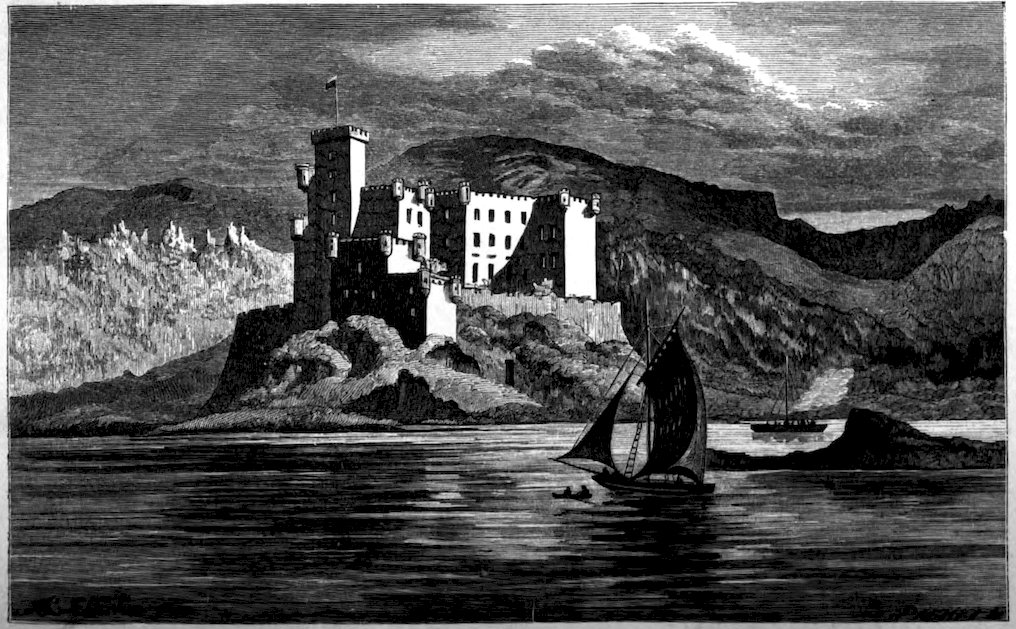
DUNVEGAN CASTLE. To face p. 333.
But it is time we should return from this flight to the uttermost isles, to the cattle market at Loch Maddy, where we left the snowy Gannet surrounded by sister-yachts and brown-winged fishing smacks, while lesser craft plied to and fro, filling the lonely harbour with unwonted stir and bustle. How pleasant it was to row away from this idly-busy scene, and float dreamily along some winding fjord, never knowing how far inland it would carry us; passing one moment through a channel as narrow as it was shallow; then opening into a deep, wide, brackish lagoon; an eerie place in rainy weather, but to-day all glorified by the light that gilds each weed and broken bank! Overhead hovered a cloud of restless birds, breaking the dreamy silence with the wild clamour of their querulous cries; and along the reedy shore, a mother eider duck was teaching her fluffy young ones the art of swimming. Sometimes shy seals steal up these creeks, but the stir of the market had driven them miles away, though no sound could reach these quiet havens. We paddled idly along, drinking in the perfect stillness of the glad sunshine; watching its glancing rays reflected from the water on the shadowy rock face, in rippling trickles of light. Here and there long tendrils of honeysuckle trailed almost to 333the water’s edge, and ever and anon the quick motion of large white wings, stirred the breathless air, and honeyed fragrance of the woodbine came wafted towards us, like some whisper of Heaven—some
Then once more turning towards the more open sea, we watched the sunlight playing on the opal waters, which, defying all vulgar theories of colour, vary their tints according to some law of their own, changing from deepest blue to clearest green, or richest purple, according as the white sand, or the golden sea-weed, are the hidden treasures that lie beneath their depths. The yellower the tangle, the deeper the purple; and lest you should be tempted to doubt the secret of that strange rich colouring, here and there some tall giant of that marine forest raises its head to the upper world, and its glossy fronds float on the surface in lines of quivering light.
Towards evening a light breeze sprang up, and, the market being over, the many-coloured sails quickly dispersed, with their lowing cargoes; and the beautiful little cattle were well tossed about ere they reached their new homes on far-distant isles. The Gannet likewise took advantage of the favouring breeze, and once more sailed for Skye, coming in for a very curious tidal current off Waternish Head. The sea on either side was perfectly calm, when suddenly, the steersman found he had work enough on hand, and for about two miles we passed through grand three-sided waves, which came dashing right over the deck—very grand and beautiful. Then we found ourselves once more in calm water.
The sunset was one of never-to-be-forgotten loveliness. Intensely brilliant gold and yellow, with soft misty clouds, giving place to brightest rose-colour, ere yet the blue groundwork of the sky had paled. And the hills were flooded with softened crimson, and every tint was reflected in the waters, till twilight crept on, and the whole surface of ocean became like clear green liquid glass. Then in the beautiful moonlight we rounded Dunvegan Point, and at midnight anchored in the quiet harbour.
Long before the rosy flush of morning had faded into the wan grey day, I was off in the wee boat, and got a sketch of the old 334castle, then, landing, roamed about the woods and noted the usual wealth of wild flowers, more especially the golden mimulus which was growing in rank profusion.
I returned on board just as the morning pipes were tuning up with the usual “Hi! Johnnie Cope,” to which in due time MacLeod’s piper gave answer from the castle terrace. I must say that those who object to pipe music as being discordant can never have heard it with the right accompaniments of time and place; and if there be one corner of Scotland more than another where its wailing pathos is thoroughly in keeping with the wild beauty of nature, it is in these isles, where, I grieve to say, it is much discouraged by some of the ecclesiastical authorities, who imagine that “the mirth of tabrets, and the joy of harp” are in some mysterious manner the parents of evil, and that the bagpipes are the very incarnation of mischief. Evidently the tradition which tells how the shepherds played their pipes at Bethlehem finds small favour with them, and the Christmas piping of the Italian pfifferari in memory thereof would doubtless be held criminal indeed. I believe that in Barra, and South Uist, where the majority of the people are Roman Catholics, the merry-hearted still have a fair share of “music and dancing.”
In Skye, Harris, and North Uist, however, these vanities are discouraged to such an extent, that the mirth of the land is gone. No longer do we hear of a piper following the reapers in the harvest field, and keeping behind the slowest workers to cheer and animate them. The pipes are being put down most effectually, or, at least, are being subjected to a most unfair persecution. Would that it might work its usual result, and that the persecuted pipes might sound once more on every hillside in Scotland. Meanwhile I hear of one instance after another in which the luckless musicians have refused to tune up as of old, in accordance with promises extorted by their wives and other spiritual guides. Even the public-houses have in divers cases ejected the piper (though perfectly sober) the moment he volunteered a tune. Whisky, he and his companions might have in abundance, but such ungodly mirth was not to be tolerated in a Christian man’s house. The dismal history of the dancing elder of North Knapdale, in Argyleshire, who in 1868 was formally excommunicated from the Free Kirk for the sin of 335dancing a reel at his son’s wedding, is an instance which happens to have become public, because the worthy farmer, whose minister had declared “that dancing was a scandal; a sin and bitter provocation to the Lord,” had the courage to appeal to a higher court, and succeeded in getting the first sentence reversed.
I fear that excellent minister must have had a very low opinion of those old Hebrew prophets who made use of such metaphors as to promise the Virgin of Israel that she should again go forth adorned with her timbrels in the dances of them that make merry, and that both old men and young should rejoice together with her in the dance. Moreover he must find a dire stumbling-block in those sounds of music and dancing which followed the killing of a certain fatted calf. Probably, like that elder brother, he would have turned away from the door.
But though the voice of song is silenced, the light wine of the country is by no means at a discount; whether in the street or the bothy it holds full sway, and whatever noise of rejoicing may greet your ear, probably owes its origin to the barley bree.
There was formerly a piper’s college in Skye, which gave regular diplomas to its best men.[61] It was under supervision of the MacCrimmons, who from generation to generation held office as MacLeod’s hereditary pipers. There was a certain cave where MacCrimmon’s disciples were wont to study, alone and unheard. A rock overhanging the sea was the piper’s seat, where he might practise unmolested to his heart’s content, with such wild surroundings, waves, cliffs, and echoes as might best teach him to interpret Nature’s own rare melodies. The college endowment 336was a farm, which MacLeod gave rent-free. When the value of land rose he ventured to reclaim a portion of the ground, an insult which the minstrels could not brook, so they arose and went their ways, leaving their rock music-hall to the seals and cormorants.
MacDonald’s pipers, the MacCarters, had a similar college at Peingowen. Their practising-ground was a green hillock called Cnocphail. Various other families were noted for their hereditary talent as pipers, but the names of these two are well-nigh as historical as those of their masters. That piper’s golden age is, now alas! a thing of the past. Not past, however, is the inspiring power of the shrill notes which stir the inmost heart of every true-born Highlander. So well did the English know their influence that when, after the dispersion of Prince Charlie’s troops, the unhappy pipers tried to plead that they had not carried arms against the king, it was decided that their pipes were truly instruments of war. And so, in truth, they may be called, for no Highland regiments would advance to battle without the pipes to inspirit them, and often the piper has fallen in the thickest of the fire while cheering his comrades to victory with his most soul-inspiring music.
There have been instances (as in the case of the 78th Highlanders at Argaum) when it has been necessary to silence the pipes as the only means of restraining the men from breaking the line and rushing upon the foe before the time. In various other cases, the sudden burst of “the gathering” has been the signal for such a charge as has caused the foe to fly utterly discomfited. Among the stories of old days are several memories of the pipers at Waterloo; how the pipe major of the 92nd stood on a hillock where the shot was flying like hail, without thought of danger, only bent on cheering his comrades with the inspiriting notes. One of his brother pipers received a shot in the drone at the beginning of the battle, whereupon, half mad with rage, he drew his broadsword, and rushed into the thickest of the fight to wreak vengeance on the destroyers of his precious pipes, whose fate he soon shared. When the piper of the 71st was advancing at the battle of Vimiera, he was wounded in the leg by a musket-ball, and utterly disabled. Nevertheless he swore his pipes should do their work, and sitting on the ground, he managed, in spite of his pain, to keep up such 337warlike notes as might best inspire his brethren, and well they fought that day.
At the storming of Ciudad Rodrigo it is recorded that McLauchlan, piper to the 74th Highlanders, being foremost in the escalade, marched calmly along the ramparts, playing “The Campbells are coming,” till a shot, piercing his bagpipe, silenced its music. He quietly sat down on a gun-carriage, and, amid a storm of shot and shell, repaired the damage, and speedily tuned up again, to the entire discomfiture of the foe, for as Scott has it—“When the pibroch bids the battle rave,” “Where lives the desperate foe that for such onset staid?”
You remember Napier’s high praise of the brave Highland regiments, who rushed to the charge “with colours flying, and pipes playing, as if going to a review.” Those who have led them in our own day, can best say how well this character has been kept up.
However little a Southron may be able to enter into this passionate enthusiasm for what, to his ear, seems shrill discord—he must bear in mind that, just as in him, the scent of a flower, or a few chords of old melody, will sometimes waken up a long train of forgotten memories; so, to one whose earliest love has been for the wild mists and mountains, these strains bring back thoughts of home, and the memory of the dead and of the absent comes floating back as on a breath from the moorland, mingling with a thousand cherished, early associations, such as flood the innermost heart with hidden tears.
How often we have heard of men whose lives have been spent toiling in far-away lands till all home memories seemed dimmed; yet to whom, in hours of weakness, and pain, and death, the dear mountain-tongue, came back, and with it, the longing that the wild music they loved in boyhood, might soothe their last hours.
You and I may bear witness how, twice within one year, as we watched the last weary sufferings of two of the truest Highlanders that ever trod heather, we have noted the same craving 338for “the dear old pipes,” and the satisfied calm that drove away the tossing restlessness, as shrill pibroch, and wild, wailing lament succeeded one another, and at last brought sweet peaceful sleep, which doctors’ opiates had failed to procure. Nor can we ever again listen to those piercing notes without a vision of an early morning when a dark funeral procession sailed up a misty loch, and thrilling pibrochs re-echoed from hill to hill, awakening the sea-birds, which circled round the boat with plaintive cries, as though they too were wailing for the “going away” of one who loved all wild and beautiful things and creatures.
Dunvegan is the quaintest medley of the architecture of every age; each proprietor, from the ninth to the nineteenth century, having left his mark on the old castle. Its position is very fine, with surroundings of wood, Skye’s rarest treasure, and standing on a mass of grey rock which juts out into the sea; land-locked, and on this morning calm as a mirror, reflecting each line of the old building as the water lips round the foot of the crag. When the tide ebbs, there will be a broad belt of the richest brown and gold tangle, and yellow sand.
Before we had finished breakfast, the young master of MacLeod came alongside in his canoe to bid us welcome; and the pleasant greetings of old friends soon consoled us for the pitiless rain which now commenced.
As we landed, and passed up the steep ascent to the castle, visions of Vikings came over us, and of the turbulent feasts and frays which these old walls have witnessed. We entered by a drawbridge—an object always suggestive of days of sudden danger and of siege. And there are dungeons, of course, in the thickness of the walls—so-called dungeons at least—though like those at Gordonstown, where, in the dear old days of our childhood, we played such merry games at hide and seek, I fancy these were rather devised for the safety of their inmates, than for the imprisonment of their foes.
The foes of the MacLeods were generally the Macdonalds; for in spite of frequent intermarriages, the two clans were perpetually at feud, “putting wedding rings on each other’s fingers, and dirks into each other’s hearts.”
Thus, the old Norse and the Celtic nature are fully combined in these races; for the MacLeods were originally pure Norsemen, 339bearing such names as Torquil and Thormod; while the Macdonald who built the old castle was a Celt. He gave his daughter (his only child) in marriage to MacLeod of Harris; and on one occasion, when rowing across the Minch to meet his son-in-law and grandchild, the two galleys came into collision in a thick mist. Tradition says that the dutiful daughter bade her husband steer on and strike her father’s smaller ship. Be that as it may, the little galley did sink, and Macdonald was drowned. Then MacLeod rowed over to Dunvegan, and took possession of it in the name of his wife.
Above the doorway of one of the offices is an old stone carving, where the arms of Macdonald are quartered with those of MacLeod, commemorating one of those strange political marriages which resulted in so little peace.
Through these the MacLeods, as well as the Macdonalds, claim descent from that old hero of many legends, the great Somerled, whose ruined castle we marked at Saddell in Cantyre. He was the youngest and fairest son of Godfrey, king of Argyle—a mighty hunter, to whom the men of the Western Isles made offer of their homage, if he would come over to Skye, and be their chief. Somerled was standing beside a dark river when the Islesmen found him. He pondered for awhile on their words, then made answer, that if in yonder dark pool he caught a clean run salmon, he would go with them. If not, he would remain where he was.
In a few moments, a silvery fish lay on the bank, and a shout of joy from his new subjects proclaimed him their chief. Then he forsook his father’s halls, and his beloved chase, and led his men to conquer neighbouring isles. Wild deeds of valour by land and sea, soon made his fame ring far and near; and in due time he became both Thane of Argyle and Lord of the Hebrides. At his death, his eldest son Ronald, became Lord of the Isles, while Dougal, the second son, succeeded to the territories on the mainland, and founded the family of MacDougal of Lorn; making his chief stronghold at the Castle of Dunstaffnage; thence ruling his country with an iron hand. Not that he was allowed to hold it undisturbed. On the opposite shore of Loch Awe, the Campbells were already established, and Cailean Mòr, the great Colin, Knight of Lochow, was not one tamely to own any superior. So there were fights and forays; fire and bloodshed, 340even till the days of the Bruce, against whom MacDougal fought with desperate hate, to avenge the murder of his wife’s father, the Red Comyn. Then the misty heights of Ben Cruachan, its dark passes, and the darker lake below, re-echoed the shouts of conflict, on many a hard-fought day. Dunstaffnage was besieged and taken, and the broad lands of Argyle were forfeited, and, after being held for awhile by the Stewarts, were conferred on the Campbells, who had proved staunch supporters of the Bruce in his dark hours of trouble. On Sir Neil Campbell, who had fought “shouther to shouther”[62] with the king at Bannockburn, he bestowed the hand of his sister, the Lady Mary Bruce; nor was it long before the Chieftainship of Argyle and the Lordship of Lorne likewise passed into the same strong keeping. By a wise stroke of policy in love, Colin the first Earl of Argyle wooed and wedded the Lady Isabel, daughter of the Lord of the Isles, and consequently a direct descendant of Somerled, thus sealing the peace between the boar’s head of the Campbells and the galley of the isles.
To return to the MacLeods. In their sea-girt fortress, among the treasures of Dunvegan is a green fairy flag, which some materialists believe to be only a relic of the crusades, a consecrated banner of the Knights Templars, but which all true Highlanders affirm to have been a gift to some ancestral MacLeod, from a fairy maiden. She promised that on three distinct occasions when he or his clan were in danger, he might wave the flag with certainty of relief. MacLeod proved false to his fairy, and married a mere commonplace human maiden, whereupon his spiritual wife waxed wroth, and ordained that every woman in the clan should give birth to a dead child, and all the cattle should have dead calves. Then a loud and bitter wail rang through the green valleys and along the shores, and MacLeod, in sore tribulation, bethought him of the flag. The fairy proved more true to her words than her lover had been to his, so she withdrew her spell, and the clan once more flourished. Then came a terrible battle, when MacLeod and his men were well-nigh routed, and again, though he must have been sorely ashamed of himself, he waved the flag, and the victory was his. Why the flag was not waved for the third time, when the isles were ruined by the failure of the kelp trade; or during the 341potato famine, MacLeod best knows. Perhaps he thought it well to save one “last tune in the old fiddle.” At all events the green flag still lies in its old case, and is such a treasure as no other laird can show.
There is also a precious drinking cup, bearing date A.D. 993. It stands about ten inches high, on silver feet, and is curiously wrought in wood with embossed silver, once studded with precious stones, and still retaining some bits of coral. It bears an inscription, telling how certain old Norsemen died, trusting in Christ’s mercy; and within the cup, the letters IHS are four times repeated. Hence we infer its original use as a chalice—though for many a long year it has crowned the wildest scenes of revelling and drunkenness; such as were held in these wild fastnesses up to very modern days. Another drinking trophy is Rorie Mhor’s horn; an ox’s horn with silver rim, which holds about five English pints; the old custom was that every young chief should prove his metal by draining this horn, filled to the brim with claret, at a draught—but in this degenerate age of shams, a false lining within the horn enables the chieftain to pledge his vassals in a much shallower goblet. Big Sir Roderick was one of James VI.’s knights, and his royal master seems to have taken an amiable interest in his sobriety, for we find his name in an order of the Privy Council for 1616, when it was enacted that MacLean of Duart, and Sir Rorie MacLeod should not use in their houses more than four tun of wine each; Clanranald was limited to three tun, and Coll, Lochbuy, and Mackinnon, were allowed but one. An attempt at compulsory reformation, which must have encouraged smuggling to an unwonted degree.
The horn is not the sole remaining trace of the Big Knight. Part of the castle was built by him, and a waterfall close by is still known as Rorie Mhor’s nurse, because he loved its lullabies to hush his slumbers! On the opposite side of the loch are two high hills, known as MacLeod’s Tables; and on their broad flat tops, the pure white snow lies unmelted, for long months, as though it were some spotless fairy napery. MacLeod has his maidens also, three dark rocks rising from the sea, which, when seen through foam and mist, bear some fanciful likeness to the mermaids, whose murmurous songs should soothe the dreams of the old sea kings.
342Near these rock-maidens is a cave, which for some time was the prison of the unhappy Lady Grange, wife of the Lord Justice Clerk; whose sad history is stranger than any fiction. In an evil hour she became aware that her husband and many of his friends were in league with the Jacobites in 1715. MacLeod and Macdonald agreed for their mutual safety, to remove her to some distant district and announce her death. So violently was this effected, that two of her teeth were knocked out in the struggle. The unhappy lady was conveyed to Durinish, and kept in this dreary cave, whence she was removed to Uist; and then to St. Kilda, where she remained seven years. Just imagine this! Seven years in St. Kilda!! Dreading lest any clue to her existence might be discovered, her persecutors now brought her back to Uist, and to Skye, whence she contrived to despatch a letter to England, rolled up in a hank of wool. The chance purchaser of this wool forwarded the letter, which thus reached its destination safely, and deliverance seemed at hand. A government boat was despatched in search of her, but failed in its quest, and her jailors carried her back to Innis-fada, the long island, carrying in the boat with her, a rope with noose and heavy stone attached, wherewith to sink her to the lowest depth of the sea, rather than suffer her to be rescued. The poor lady finally died in Skye, and was buried in the old kirkyard of Trumpan.
We would fain have prolonged our cruise, but that tyrant of the age, the post, recalled us once more to Uig, where all was calm and peaceful as usual. There were the same picturesque lassies, whose one short “coatie” and bare legs, were seen running along the wet shore; while head and shoulders were lost beneath the great creel, overflowing with such a pile of green grass, and pink clover, with large white hemlocks and daisies, as seemed only a huge nosegay, with a sickle stuck in the middle of it.
If you speak to one of these little foragers, a bright face will glance up from under a scarlet handkerchief—but she will not attempt to answer, for though the lassies as well as the lads learn English at the “schule,” and can read it pretty well, hardly one can translate a sentence; and the girls, living in Gaelic homes do not find that necessity for English, which compels their brothers to pick it up. These were our last days in the 343sunny bay; and they recall pleasant memories of rowing and fishing—and of long beautiful evenings when ofttimes we wandered up to some green headland, thence looking across the calm sea to the distant isles, all wrapt in that deep peace which specially belongs to the gloaming—the hour
Thence returning to the little lodge by a path, skirting fields of tall brown rye grass and sweet clover, the chosen home of the corn crake, who, through all the dewy night, watches among the long grasses, and utters her harsh grating cry, jarring to most ears—though to some, dear through association, more like the croaking of a frog than the note of a little brown bird, guarding the nest where sleep her brood of quaint, black, long-legged little ones.
Wakeful though she may be, we must sleep now, to be ready for the morrow’s cruise.
O hone! O hone! to think that such a change could have passed o’er the spirit of our dream. Here we are once again in beautiful Loch Staffin. But can it be that this is indeed the fairy bay in which, so few days ago, we took such exceeding delight? Now the pattering rain falls with dull plash on the sullen waves; a heavy ground swell rolls us to and fro, and the cold spray dashes over us; the bitter wind whistles through the rigging, or blows in hollow gusts, echoing among the crags; on every side the lowering sky is black with gathering storm; the slippery, black rocks are flecked with salt sea-foam, and there is no beauty in the dripping sea-weed, or the wet sands, or the flapping sails of the fishers’ boats—with their rich brown changed to dirty black.
It is with infinite difficulty that we effect a landing (for business has brought us here, and must be attended to); but as to embarking again, it is simply impossible. So there is nothing for it but to spend the night ashore in the little inn. All night we hear the sullen moaning of the wind, and the waves beating heavily on the shingle; and when the cheerless dawn breaks over the cheerless land, nothing is visible through the colourless mist, save heaps of tangle and weed lying in dark masses along the shore. Nevertheless we must re-embark 345with all speed, for the skipper distrusts his anchorage, and wants to run for Portree. So we are off, and look up at the great basaltic rocks, all dim and grey, wondering what had made them so beautiful in our eyes? Our question is answered by the sun himself, shining out suddenly through the mist, lighting up the grand old Storr—now right above us, and revealing a thousand beauties of form and colour. Still we pass along the same basaltic pillars, which at one spot are fairly bent over, as if by some vast pressure in their early life. By the time we reach Portree, the evening is clear and sunny. Next morning, when we would again set sail, we find ourselves becalmed.
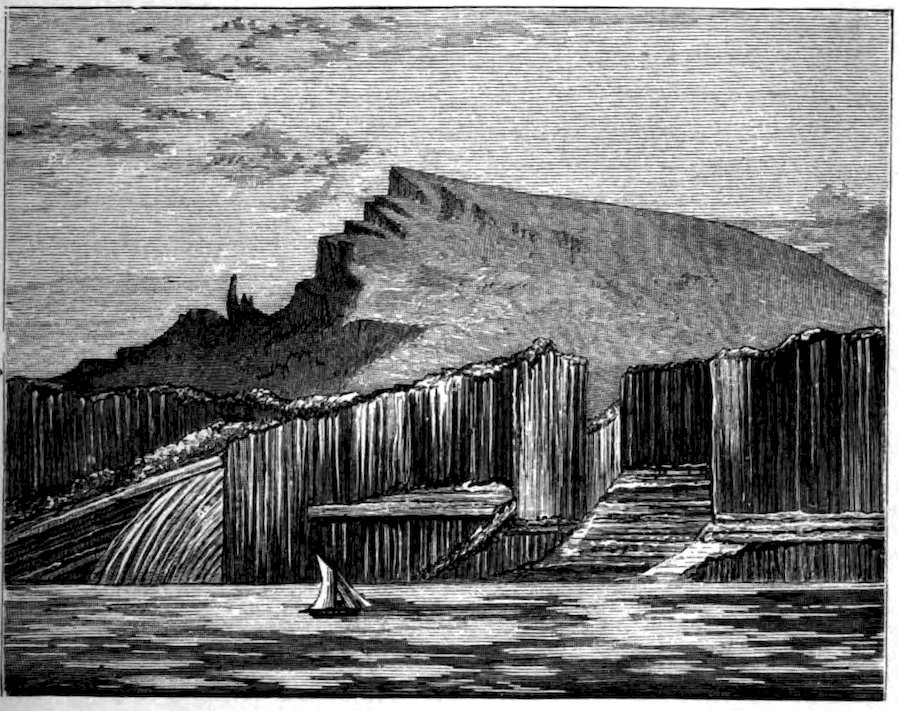
THE STORR.
You remember our first arrival at Portree was by the steamer at 4 A.M., and we awoke to find only torrents of rain. Now we had time enough to row about the harbour, fishing and sketching from all points, and rejoicing in the stillness of a calm as perfect 346as that wherein Milton describes the beginning of Messiah’s reign of peace:—
I think no more perfect image of peace exists than these soft white-breasted “birds of calm,” floating on a mirror so still, that each white plume is reflected; the brightest spots on the broad plain of gleaming light.
This fine sea-loch divides itself into an inner and an outer harbour, perfectly land-locked. The former is still known to the older fishers as Loch Columbkille, being one of the spots specially dedicated to St. Columba, who was patron saint of half of Skye, and many neighbouring isles. The other half was the property of St. Maelruhba. At the further end of the loch, close to the sheriff’s house, is a small rocky islet, where a few fragments of building and traces of old graves are all that now remain to mark the spot where once stood the oldest monastic building in Scotland; so, at least, say certain of our wisest antiquarians. Early and late we rowed about on those calm waters; sometimes landing in some little creek, where the great rocks sheltered us from the burning sun, and the cool wavelets, rippling over white sand, whispered an irresistible invitation to bathe. Then, wandering along the shore, some heathery knoll would tempt us to linger amid its fragrant purple till the mellowing evening light called us back to our floating home.
Alongside of the Gannet lay two yachts, similarly becalmed, the inmates of which, for lack of better distinction, we dubbed the “Cockneys” and the “Paddies;” and we took the usual British interest in one another’s proceedings. At last we made sure of a gale, and determined to sail next morning. So at 3 A.M. I went off to the head of the bay to get a final sketch of the Storr; and returned, of course, to find the breeze more sleepy than ever. Next day we determined we would get under way; so we contrived to get to the mouth of the harbour, and there lay immovable till the men got into the boat, and, rowing with all their might, contrived to tug us back, greatly to the 347edification of the Cockneys and the Paddies, who had had too much wit to try.
You see our sailors were above the common practice of whistling for the wind, as their brethren the fisher folk do to this day in most real earnest. Hugh Miller tells us how, often, when he has been sailing with the Cromarty fishermen in calm weather, he has watched them with faces anxiously turned in the direction whence they expect the breeze, and earnestly invoking the wind in a shrill, tremulous whistling. He says that one evening when it was blowing hard he commenced whistling a careless tune, whereupon one of the men instantly silenced him, saying, “Whist, whist, lad! we hae mair nor eneugh wind already.” He traces this superstition back to the old days of mythology, when each spirit of air or earth or water must be invoked in its own language and in its own manner. He quotes another instance of this conciliatory dealing with the elements, when, in the case of a rising storm, one of the fishers used to be told off to sit astern and continually move his hand to and fro over the waves, as though making mesmeric passes, to soothe the spirit of the storm. The St. Kilda men came nearer to “pouring oil upon the water,” inasmuch as they made a pudding of the fat of sea-fowl, and fastened it to the end of their cable, to hinder the waves from breaking. Sometimes the fiery Highlanders opposed wrath to wrath; and there is one angry tide always chafing and fretting off the coast of Mull which is called the “Men of Lochaber,” because, having occasion to cross over to Mull, the contrast of these waves with their quieter waters amazed and angered them to such a pitch that they drew their dirks and stabbed the waves!
Speaking of oil upon the waters, how strange it is that we should hear so much of its use and yet go on thinking of it as wholly a fiction. So far back as the days of Pliny, he tells us how “all seas are made calme and still with oyle, and therefore the dyvers do spurt it abroad with their mouths into the water, because it dulceth the unpleasant nature thereof, and carryeth a light with it.” In later days we have heard of the fishers at Gibraltar pouring oil on the sea to still its motion, so that they might the better see the large oysters lying beneath; and the fishermen of Bermuda do likewise when the ripple of the water prevents their seeing clearly enough to strike their fish. The divers of the 348Mediterranean actually do spurt oil, in the way Pliny described, in order to clear the light under the surface of the water by the stillness so caused. And on our own Scottish rivers, both poachers and other folk besides well know the use of a good flask of oil in smoothing the surface of the deep brown pool where the silvery salmon lie all unconscious of the impending spear. We also hear of the fishermen of Lisbon, when finding the surf on the bar of the Tagus unusually rough, emptying a bottle or two of oil into the sea, and thereby soothing the waves so far as to be able to pass the breakers in safety. I wonder how the experiment would answer at Madras! It has further been observed that the leakage of oil pumped up with bilge-water out of whaling vessels, seems to surround them with smooth water while their neighbours are pitching in a chopping sea. The herring fishers on our Scotch coasts say they can tell at a distance where the shoals of fish lie by the smoothness of the water over them (we know how oily they are); and the seal fishers used to detect when their victims were eating their oily fish below the water by the unruffled surface above them.
A curious letter on this subject, shown to Dr. Franklin, seems first to have called his attention to the matter. The letter told of a stormy passage in a Dutch ship, when the captain, to prevent the waves from breaking over the vessel, poured a small quantity of olive oil into the sea, a little at a time, not more than four quarts altogether; and so effectual did this prove, that the writer suggested that surely the same simple means might be made greater use of. Franklin accordingly tried sundry experiments on a very rough pond one windy day. He found that when he stood to leeward the wind blew the oil back to the shore; but on going to the other side of the pond, one teaspoonful produced an instant calm over a considerable space, and spreading rapidly, soon made an oily film over an extent of at least half an acre, which he says became as smooth as a looking-glass. He afterwards tried the experiment on a larger scale with less effect than he expected, for the swell continued, only the surface was not wrinkled or broken, and though the sea around was white with crested waves, there were none in the smooth track left by his boat, and he noticed that a barge rounding the headland under sail, at once turned into that oily path as on to a turnpike road. It is curious that after the subject had 349been so far taken up by so learned a man, it should not have been turned to more practical account. Possibly a few extra kegs of oil may still come to be looked upon as part of the regular stores of our fishers. As concerned our present cruise we needed no such soothing influence, for we watched the smooth, glassy, unrippled surface of the water till we despaired of ever getting out of harbour. At last, however, the welcome breeze sprang up, and when the spirit of the wind did awaken it did so in good earnest, and we straightway returned to Loch Staffin, where I had determined to have a fortnight alone with the rock-spirits of Quiraing. It was very dismal to watch my playfellows sail away in the evening, but I received a cordial welcome in the wee inn, though “inn” I should not call the kindly farmhouse where I found myself in the position of an honoured guest. My gentle landlord was most assiduous in his care, and being the only creature who could speak a word of English, used anxiously to come and interpret whatever information might be necessary to the one fair spirit who was my minister—namely, a strapping, cheery wench, Peggy Mòr, who, though of course utterly guiltless of English, was wonderfully “gleg at the uptak.” This was fortunate, as her master was generally absent all day. When my intelligent giantess succeeded in understanding my various signs she would pat and stroke me exultingly, uttering clicks and chuckles of exceeding interest and delight.
Mine host was, in some way, responsible for all the lunatics in the district, and being a man of a tender heart, could rarely resist the appeal of any who were particularly anxious to leave the asylum and find occupation among his herdsmen. So it came to pass that various strange beings haunted the neighbourhood, haavelings, as we call half-witted creatures on the mainland. One in particular who herded the kye was engaged in a ceaseless warfare with devils, and was for ever battling with invisible foes, in order to protect himself and us. The raging waves were an especial annoyance to him, and he attributed their noise to myriads of women roaring in concert. It used to amuse me in the evenings to hear all the farm lads and lasses gathered round the kitchen fire, “laughing and daffin’ and lilting and quaffing,” and after their simple supper of porridge and milk, singing all manner of Gaelic songs and choruses, which were 350just sufficiently softened by distance to lose their harshness; “low winding songs, with as little beginning or end as the murmur of a brook,” and well in keeping with the wild sea and mountains round me.
Each day that promised a tolerable allowance of sunshine I went up to the Rock Wilderness, getting a lift in “the cart,” which was full of sweet fresh straw, very needful, considering the character of the ground over which we jolted. But on the whole the rain had the best of it, and though a waterproof rug and waterproof coat made me quite amphibious, my sketching blocks lived under shadow of an umbrella, which alas! was rapidly giving up the ghost. What was to be done? The problem was solved by the return of mine host from a distant cattle market, whence he brought me a fairin’—a roll of pale brown ribbon. It mattered not that the poor umbrella was dark maroon; we sewed strips of ribbon down each seam, and little patches of ribbon under every tear, and when our masterpiece was finished, it not only defied wind and rain, but was the admiration of all beholders—nay, more; it proved a fruitful topic of conversation, which is no mean praise in these parts!
Events were few and far between. In three weeks about three drowned tourists arrived from Portree viâ the Storr—pedestrians, of course—and one day, while I sat painting on the shore, a very large English yacht came in, with a steam-tug to take care of her. The owner having packed as many of his party as could find room into “the cart,” went off to Quiraing. I was much amused at noting the difference between the English sailors who manned this yacht and those we had had to do with. The latter were grave thoughtful men, content with the simplest fare, biscuit, herrings, and milk, and appreciating the beauty of scenery as much as we did ourselves. These, like a pack of wild boys were intent only on the fun of foraging, and capturing sheep, fowls, eggs, whatever they could lay hands on, and their verdict on each place where they had halted was solely dependent on the commissariat. Then I began to realize how curiously this contrast must have struck the frugal old Highlanders, when first the Saxons came among them, and the grim humour that prompted their retort to some English taunt—a retort which became proverbial—“Show me a Southron, and I will show you a glutton!” Far be it from me to apply such a term to these jolly tars. 351Nevertheless, not one of them gave a glance at the strange scene their master had come so far to look at, though they found considerable amusement in watching my sketch of it.
Three months later, when I embarked for India at Southampton, a cheery voice wished me luck, and that I might get good drawings, and looking up, I recognised one of these hearties. Just beyond him, on the deck, sat one of “the Paddies,” who was equally astonished at meeting a neighbour from the Gannet. He left us at Aden, going to see Bombay and the North-West Provinces. A month later, as I sat in a lovely garden in Agra, I started at hearing my name. There stood my friend, who having “done” India thoroughly, was on the eve of embarking for Australia, or any other place where English, and English only, would greet his ear!
When the time came that I must bid adieu to Quiraing, my friends at Uig, true to the good old precept, “Welcome the coming, speed the parting, guest,” escorted me as far as Portree. My next halting-point was Sligachan Inn, which stands on the borders of Lord Macdonald’s deer forest of Sconser.
The drive from Portree to Sligachan was over a heathery moor, a broad expanse of rich browns and purples, with patches of vivid green, or dark moss with darker peat stacks ready cut for winter fuel. Here and there a broken sea-bank, and a rippling stream; and beyond, an ever-changing outline of fine mountain forms, just appearing through the mist, then vanishing again. The inn, though small, is comfortable enough, and affords shelter to a wondrously varied multitude of tourists and travellers. Members of the Alpine Club, distinguished artists, statesmen, ecclesiastics, botanists, geologists, yachting parties, pleasure seekers of all sorts, drovers, excisemen, down to that class of tourist who “does” Skye as a sort of unpleasant duty, and confides to his friend “‘ow hawfully the ’orses gibbed coming up these ’ideous, ’orrible, ’ills,” adding that if only Nature had “put all the ’ills into the ’ollows, it would have been a much finer country.” Also giving him startling information of all sorts, such as that “A gwilse is the female of a gwouse,” and making oh! such havoc of all local names. One of these southern gentlemen, whose presence had only been remarked by his excessive silence, suddenly electrified his neighbours by springing wildly towards the window, exclaiming, “There they 352are! There they are! Don’t you see the red deer?” at the same time pointing out a couple of collie dogs which were quietly surveying the world from the brow of the hill. After this failure the unhappy man once more relapsed into silence, and made no further attempt to enliven the public. But none of these conveyed to our ears so curious a sensation as when a pretty young woman, who had been listening in much bewilderment to a discussion about Oban, suddenly looked up, and with an expression of beaming intelligence, exclaimed, “Well to be sure! Why, I thought you were talking of Oban in London!” Judge of our first feelings of mystification, and congratulate us on our command of countenance, in that, as a vision of Holborn Hill slowly presented itself to our minds, we contrived not to move a muscle![63]
But though we take our quiet laugh at the Sassenach, perhaps he, in his turn, may find his little joke at the expense of some of our northern worthies, and may treasure up such speeches as that of a certain drover, who, moved with indignation at finding himself supplied with a dessert-spoon at second-course, shouted to the damsel in waiting to bring back his soup-spoon, exclaiming, “Hoot! lassie, isna ma mouth just as big for pudding as for kail?”
Many a good story has been told under that roof, and many a queer longwinded discussion of every topic under heaven, overheard, with more or less amusement, by people, who, accustomed 353always to go on trotting round and round their own social cabbage-leaf, here catch perhaps the only glimpse they ever get of the existence of their fellows, whose diverse caste has run them likewise into their several grooves; grooves wherein (like those delicate white-shelled creatures[64] which bore their thousand paths through the hard rock, yet rarely break through the thin stone barrier that separates them each from the others), they may work their way through this hard world from their birth to their grave, each ramming his own head against the stone wall, and buying his own experience without once coming in friendly contact with his nearest neighbours, or venturing to run in any of their thousand and one smoothly-worn paths. Here, however, for once, they do just meet, and bring with them enough of their own individuality to make them amusing studies for one another.
And of all this, you get full benefit, as the little inn boasts of only one private sitting-room, and the occupant thereof is considered by the other inmates exclusive indeed. I for one had been so long alone with the Rocks and the Peggy Môr, that I was not disposed to shun my species! Moreover I was fortunate enough to fall in with thoroughly pleasant companions, who, arriving on the same day as myself, were likewise in no hurry to leave so beautiful a spot. So we formed ourselves into a most agreeable coterie, and found abundant pleasure, social and scenic, during the three happy weeks we spent beneath the shadow of the dark Cuchullins. Of those kindly companions, one alas! may never more tread mountain crag. Ere two summers had passed, during which he had scaled many a cloud-capped summit, he met his fate suddenly, as he had always himself predicted. Wandering alone on the Maritime Alps, a falling mass of rock struck and killed him in a moment. Some peasants brought tidings to Mentone of the death of an unknown Englishman, and after a while it was known that this was our friend of the Cuchullins, and that yet another of the companions of these two short years had passed away from earth.
The inn stands on a flat peat-moss, just where a brown trout-stream rushes down Glen Sligachan into a salt sea-lake of the same name. To the right of the valley towers the mass of dark peaks, eight of which are upwards of 3,000 feet in height. Of 354these, Scuir-na-gillean or the gillie’s hill, claims precedence. It earned its name in remote ages from a legend that two lads had been killed while attempting to scale its dark crags, and till very recently its summit was deemed inaccessible. Even to the most experienced cragsman the ascent is no child’s play, as has been recently but too well proven, when a member of the Alpine Club met his death alone among these cruel black rocks, his body being found next day at the foot of a precipice.
On the other side of the valley rises a ninth peak of similar height (Blabhein, pronounced Blaven), also of greenish black hyperstene; its strangely serrated outline cutting hard against the sky.
Against it, in strong relief, stands Marskow, one of a group of conical hills of red syenite, whose steep sides are furrowed by the torrents (true children of the storm) that rush down literally from the clouds. These red hills seem like huge piles of disintegrated rock, pale flesh colour, more curious than beautiful, though a brilliant green herbage has managed to creep up the lower slopes, and glances with rainbow light when touched by that “clear shining after rain,” with which dwellers in a hill country become so familiar. Another of these pink hills bears the name of Glamaig, whose shoulder, Scuir-na-Mairi, or the crag of Mary, was so called in memory of a woman who was there killed in attempting to rescue her cow.
At the head of the valley stands one cone whose name, Trodhu, recalls the days when the old Norsemen overran the land, and left traces of their presence all along the coast. Such names as Skeabost, Orbost, Kirkabost, Hushibost, Bornaskitag, Hungladder, Valtos, and a thousand more seem to carry us north to Scandinavian shores. For this cone of Trodhu you must make, if you wish to look down on the far-famed Loch Corruisk, literally the corrie of the water. Three hours’ good walking or pony-riding should take you up beautiful Glen Sligachan, and by a steep ascent to the shoulder of Trodhu, whence the view on a clear day is magnificent. Wild hills rise high on every side of you; their dark rocky crests half veiled by wreaths of floating mist. Far below you lies black Loch Duich, connected by a streamlet with blacker Corruisk, whence a river, perhaps a quarter of a mile long, rushes down the rocks into Loch Scavaig, the most exquisitely transparent green sea-loch, on whose calm surface is mirrored a great white waterfall that comes tumbling over the crags. The contrast in colour between these lochs is most striking; the fresh-water so sombre, like darkest indigo—the salt water so wondrously green. On the latter float a few brown and red specks, veiled with the faintest thread of blue smoke, which tells that the fishers have kindled fires on board their boats, and are cooking their midday meal of fresh herrings. A little apart from these, flutters a tiny white sail no bigger than a fairy’s wing, which proves to be a yacht just anchoring in the bay. And beyond Loch Scavaig lies the great blue sea, from which rise the shapely hills of Rum, and the lower shores of Canna and other isles.
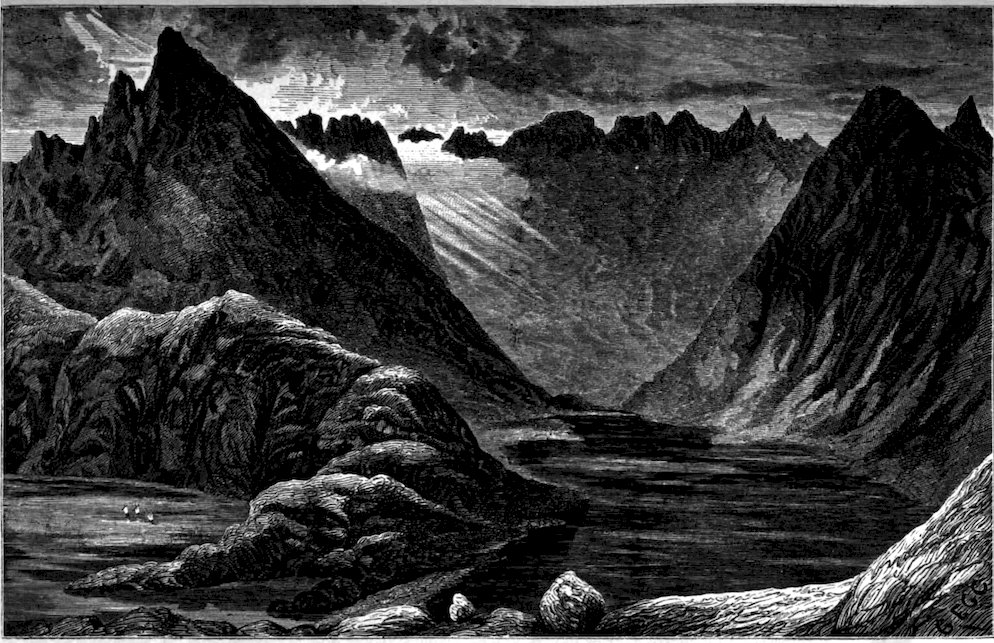
LOCH CORRUISK, SKYE. To face p. 354.
355Beautiful however as is such a day of glorious sunshine, when we feel the mere fact of existence to be bliss unspeakable, there is no denying that fine dry weather is certainly not the time to see these hills in their glory. We thought ourselves singularly fortunate in having selected a perfect day for our first visit to the corrie of the waters, little thinking how a few days of sunshine would inevitably have parched and scorched the rocks, and dried up every trickling stream and tiny waterfall. We started, having our minds thoroughly imbued with Scott’s description of this scene, “so rude, so wild,—yet so sublime in barrenness.”
At the summit of the ridge below Trodhu we paused breathless with delight at the glory of the panorama outspread before 356us. There, as is customary, we turned the ponies loose, an amount of trust which these wise creatures never betray. This done we started for a long and fatiguing scramble down the steep hillside, fairly awed by our solemn expectations, which intensified as we neared the ridge whence we might overlook those black mysterious waters. Once there!... O bitter disappointment! This weird and wonderful scene of whose barren grandeur we had read such descriptions in poetry and prose—and had seen such exaggerated pictures, beginning with Turner’s far-famed drawing, where overhanging cliffs are shown overshadowing the black water; is this Corruisk? This the peerless loch whose stillness and solitude poets have sung, as though no other spot of earth could show such leaden-hued waters, embosomed in such a wilderness of rugged rock mountains, whose black pinnacles seem to pierce the heavens, towering far above the masses of floating clouds which for ever hang around their summits? We looked for such grim solemnity as should befit the chosen home of spirit-giants, and we beheld only a little dark tarn, with grassy shore, surrounded by hills, very steep certainly, but not very impressive, and all of much the same height, running in a slightly jagged line across a cloudless blue sky; while every detail of arid rock and every tuft of grass stood out clearly revealed in the calm sunshine. Not a wreath of friendly mist was there to lend mystery to the scene, but far up the valley a party of odious tourists were making the sad hills echo their vulgar shouts! We stood mute with disappointment—and if we had not been too tired, I think we should have gone straight back to the brow of the hill. However by degrees a few clouds stole up, and some hill-tops were partially veiled, and dark crags stood out in relief—and as the sun moved westward long shadows from the great rocks fell athwart the weary land. The shouting snobs were gone, and nature’s still small voice spoke for herself.
Then we began to realize what that scene might be under dark effects of storm and thunder—at the outgoings of morning and evening—or in the clear starlight. So we determined to come back, and try a second impression. And the second led to a third; and the third to a fourth; and the oftener we went, the better we loved that wild ride through Glen Sligachan, and the dark valley where the deep, blue-black tarns 357gleam like black diamonds beside the emerald sea-loch. Often we halted just to listen to the intensely solemn silence, broken only by faint whispers of the breeze that just fanned the light mists in the corries, or the rippling murmur of the quiet brooklet as it flashed here and there in the sunlight. And sometimes when a jarring human voice rang harshly in our ears, disturbing those perfect harmonies, we did feel—oh, such sympathy!—with the grand old Indians, who believed that the lonely stillness of their tranquil lakes was especially sacred to the Great Spirit, and that His wrath would sink the canoe of any rash mortal who dared to lift up his voice while on the waters.
Once in the days of the early settlers, a white woman had occasion to cross Lake Saratoga, and the Indians, ere they started, warned her of the danger that one rash word might bring. It was a calm, cloudless sky, and the canoe sped like an arrow athwart the smooth waters. Suddenly, when in the middle of the lake, the strong-minded woman determined to prove to these simple folk the folly of their belief. So, like the shouting snobs at Corruisk, she lifted up her voice in a wild cry that woke every echo of the hills. The Indians were filled with consternation. They uttered no word, but straining every nerve, rowed on in frowning silence. They reached the shore in safety, and the soulless woman triumphed. But the Mohawk chief looked upon her with scorn. “The Great Spirit is merciful,” he said. “He knows that the white woman cannot hold her peace!”
The apparent size of the corrie is strangely deceptive. It is almost impossible to make the eye realise that the loch can be a mile in length; and yet we know that it is nearly four, and that a grassy valley lies at the further end, where the black rocks seem to close in so precipitously. Well do the red deer know how to prize that oasis in the rock wilderness—truly green pastures beside still waters. Yet not even here does “the antlered monarch of the waste” reign in peace. Once, at least, this little glen was the scene of as good a day’s sport as ever fell to the lot of solitary stalker.[65] It was before the days of cartridges and breechloaders, when men were liable to have their sport spoilt and their tempers ruffled by the failure of a damp cap. In the present instance, the irritating cause was the lack 358of that small essential; for, after a long and tiring walk across the hills, the sportsman suddenly bethought him that he had forgotten to replenish his store. In vain were his pockets turned out, in hopes of finding hidden treasure in some corner. All his search only produced five caps; short allowance, you must confess, with which to start on a long day’s stalking. However, he pushed on, and made for the head of Corruisk. Judge of his dismay when he beheld five stags quietly feeding by the stream that trickles through the green valley. All through the long day he stalked them, one by one; and at midnight returned home, with one cap in his pocket, having bagged the four fine heads each with a single shot, while the fifth was so poor as not to be worth having. Next day the foresters went in search of their prizes, and found them in spots so inaccessible, that they had to cut them up where they lay, and bring them down piecemeal, as no pony could possibly carry such a burden on such ground.
But if the corrie of the waters has thus its tale to tell of the kingly red deer, Loch Scavaig has older legends of the days when its shores were haunted by fierce wild boars. On the edge of the loch there is a cave wherein the chief of the Mackinnons once found shelter when separated from his followers by the luck of the chase. He kindled a fire, and proceeded to cook some of his venison on the embers. In one hand he held a large bone off which he was cutting slices ready for dressing, when a rustle on the dry sea-weed in the mouth of the cave made him look up to see a dark creature approaching him with gaping jaws and wicked tusks. He recognised a savage wild boar, and, having no choice between absence of body and presence of mind, he made good use of the latter. Holding the bone upright in his hand, he awaited the charge of the grizzly brute, and dashed his arm down its throat, the cross-bone, of course, holding the terrible jaws open, and leaving him full time to despatch the foe with his hunting-knife. To this feat the Mackinnons of the present day owe their crest, which is a boar’s head, open-mouthed—apparently choked by a great bone. This description of his cutting slices ready for dressing, points to a common manner of preparing food in those wild days by simply squeezing the meat between two flat stones, or two battens of wood, till all the blood was forced out. Of course, 359there were many cases when kindling a fire would have been inconvenient, and this was always ready.
This story of Mackinnon’s crest must remind Oxonians of the kindred legend telling how a student of Queen’s College was wandering in Shotover Wood, and reading a volume of Aristotle, when a fierce wild boar charged him open-mouthed. The electrified student had no alternative but to thrust Aristotle down the boar’s throat, which most effectually choked him; in memory of which exploit the boar’s head, borne into hall with all due pomp, still graces the Christmas dinner at Queen’s.
One very striking geological feature of this district is the prevalence of the class of rocks known to Alpine travellers as roches moutonnées and blocs perchés, that is to say, long swelling surfaces of bare rock, in form like the outline of a great stranded whale, whereon lie poised huge detached boulders of rock of totally different formation. These vast rounded slopes of gritty chocolate-coloured sandstone are almost always quite bare, even the kindly lichen failing to obtain a resting-place thereon. All along the margin of the lakes, and indeed everywhere on the lower slopes of these hills, these rounded red masses appear, invariably lying in a transverse position to the general direction of the valley; telling of a time, far hidden in the remotest mist of ages, when mighty glaciers lodged in every ravine of those dark mountain ranges, and thence slowly descended to the valleys with sure though imperceptible progress, smoothing the rugged rocks as they passed over them, and bearing on their cold ice-waves huge boulders of fallen rock, weighing perhaps fifty tons or more, for many such still lie in the valleys; gigantic masses which, from their formation, must evidently have been carried hither from far-distant points. These boulders, of every size, from the least to the greatest, lie scattered in every glen, as though the giants of the mountain had been pelting their pigmy foes in the lower world.
Constantly we find these erratic blocks perched on the very edge of the rounded rock, as though the ice-wave had had no power to carry them further; and so ever since, through the storms and hurricanes of centuries untold, they have remained there, poised, as if waiting for some new motive force to send them crashing down the hill. Although the action of the glaciers has planed these swelling forms to such apparent 360smoothness, you need but step upon them to find that they are in truth all grooved with continuous minute lines; the result of which is, that so far from being slippery, they are in reality so rough to the foot as to afford a perfectly secure hold, and a most agreeable surface on which to walk. A few days after returning to the mainland, I heard the Archbishop of York make very striking reference to these glacial marks, as illustrating the gradual moulding of human character and the ineffaceable traces of daily life on the far-distant future; and straightway there rose before me a vision of Corruisk in antedeluvian days!
Strange indeed are the pictures that suggest themselves when, from time to time, Mother Earth reveals to us hints of the marvellous geological changes through which, in her long life, she has had to pass. Phases of poverty and of wealth, of burning heat and bitter cold. Imagine days when British coal-fields were forests of waving palms and giant tree-ferns, rich and beautiful as a tropical jungle. Days, too, when these isles were peopled with such monstrous reptiles as those which haunt the dreams of our children after a day at the Crystal Palace—creatures whose remains have been found even on yonder blue Isle of Eigg. Not that the reptiles had it all to themselves. Gigantic elephants and kindred creatures roamed through the forests and there left their bones, which, after countless ages, have been dug up in the streets of London and of Oxford by puny bipeds, who little dreamt that they had built their cities on the very site of the great mammoth cemeteries! The bipeds, however, seem to have invaded the land before all these curious beasts had become extinct; so at least we may infer from finding the bones of the woolly-haired rhinoceros lying beside those of the rein-deer, the roebuck, and the horse, in the cave of Aurignac, where apparently they had graced certain funeral feasts, and the survivors, who were evidently gourmets, had split the rhinoceros’s bones to extract the marrow! Moreover, in some of the British caves the remains of brown bears and grizzly bears, hyenas and cave lions, elk and bison, have been found together with objects manufactured by man.
Poor Mother Earth tells of far more sudden alternations of heat and cold in her northern regions, where not only are the perfectly-preserved carcases of woolly elephants found embedded 361in the ice-cliffs, but huge buried forests, such as those in North Greenland, where now no shrub can brave the cold, but where, in the very heart of the glaciers, fir trees, oaks, elms, laurels, plantains, and magnolias have been dug up—not their branches and trunks only, but even leaves and cones, all perfectly preserved. It seems as if Greenland and Siberia are now passing through the same course of treatment to which Britain was subjected so many ages ago; possibly their shores may some day be considered as the temperate zone, when our isles have attained some condition as yet undreamt of!
Sometimes we varied our route up Glen Sligachan by invading the Hart o’Corrie, a deep, dark gorge running into the very heart of the Cuchullins, which rise on every side in mighty crags—ash-coloured, seamed with a green that is well-nigh black, and streaked with tremulous lines of white that tell of rushing waters. No sound of living thing is there save the cry of the muir-fowl startled from their sanctuary in the rich blossoming heather; yet there was once an awesome night when these rocks echoed the shouts of warriors and the cries of the dying; and a great boulder of red rock, known as “the Bloody Stane,” still marks the spot where a fierce battle was fought by the MacAllisters, the Macdonalds, and the MacLeods, whose lands still meet at this very spot, so each clan buried its dead on its own ground; and this it is which makes the place so eerie in the moonlight, for as we all know, the fairies fashion their bows and arrows from the ribs of men buried where the lands of three lairds meet.
Many a fierce clan-feud have these silent hills witnessed, as some still testify by the names they bear. Thus one dark spur overhanging Corruisk is known as Strona Stree, or the Hill of Strife, the possession of its bare and rugged crags having been hotly contested by jealous chiefs. And at the back of this range lies the Corry-na-Criech, or Corry of the Fight, a deep, dark gorge, where the MacLeods surprised the Macdonalds in the act of dividing the spoil gathered in a foray on their own homes. Then followed quick revenge, and the red rocks were dyed of a deeper hue, with the life-blood of many a sturdy clansman.
In some of the marshy pools in these valleys we found a very rare, but very ugly plant growing abundantly,[66] namely, the jointed pipewort, so called because of its stalk being jointed and set at 362seven or eight angles; its roots are coral-like. The plant is indigenous to North America, and its only British homes are at this spot, the neighbouring Isle of Coll, and a few small islets near. It is also found at Connemara in Ireland. To botanists its rarity makes its existence here a point of considerable interest, otherwise its insignificance would fail to attract notice.
The expeditions to Corruisk always involved a stiff day’s work, generally of twelve hours, of which eight were spent on the road, going and returning. Moreover it was such a road as was not pleasant after dusk, even for such sure-footed ponies as those we rode, so that we always had reluctantly to leave off work just when the lights were most beautiful; and our faithful, sturdy lout, Donald, took good care that we should not outstay what he considered the right time. The height of artistic pleasure would be to visit Corruisk with such a tent as that in which I spent the following summer, amid loftier, but scarcely more beautiful mountains.
Our homeward ride was always a delight, as we watched every changing effect of sunset and gloaming, pass over beautiful Blaven and Marskow, and their dark brethren. There was something eerie in the companionship of our own shadows, lying right across the valley, on the opposite hillside, as if some silent spirit of the mountain were haunting our footsteps. Sometimes they fell far below us, and rested in ghostly stillness on the white vapours that lay there hushed in deathlike silence, motionless as “the mist that sleeps on a waveless sea.” And far overhead the solemn mountains towered, Marskow and Glamaig glowing ruddier and more golden in the light of the setting sun, and Blaven rearing his dark crest against a pale green sky—a marvellous confused mass of crags, ashy-grey as the heron’s wing, and cutting black in strange serrated outline against the clear frosty heaven.
Many a time since then have the words of the “city poet,”[67] come floating back to my mind, with the same great longing once more to return to that beautiful wild valley—
It was always an amusing lottery, on returning in the evening to the little inn, to ascertain who were the fresh arrivals, as many of our southern friends came there for a few days, and looked upon a chance meeting in Skye much as if we had met in Kamschatka.
I had been fortunate in securing a tiny little attic which possessed the only window with a view of the Cuchullins, so I could see them at all hours and seasons, in beautiful moonlight, and before dawn. Then when I saw a clear pale sky, I knew what was coming, and went away down the shore of the little bay to watch the fiery finger touch the peaks, while their perfect image lay mirrored at my feet. Gradually the fire spread, till the whole mass gleamed crimson in the clear frosty air, and the cloudless sky was a faint lemon colour, and deep purply shadows lay on the brown peat-moss. By the time that all this beauty had faded to the “light of common day,” it was time to feel how chilling was the air, and turn breakfastward, with some compassion for the sleepers who came so far in search of beauty, and invariably missed the cream of it.
It is only by letting these varied aspects of the hills sink through your eyes into your imagination, that you really get into the spirit of the place, and of those remote days when Cuchullin and Diarmid, Ossian, and Fingal dwelt among these wilds, with their beautiful wives, and stalwart sons and daughters, brave vassals and trusty hounds, whose adventures in chase and war have been the theme of the islesmen ever since. Gradually they have taken colour from the poetic imaginations of a people nurtured among stormy mountains and dreary moorlands—wild mists and rocks, with wilder seas around—the legends becoming more and more shadowy and weird as they were transmitted 364from one generation to another, till sea foam and drifting vapour—wraiths and spirits of earth, sea, and air became so interwoven with each heroic deed, and the whole so magnified by the mists of ages, that they have taken the form of those Ossianic legends, whose first appearance in the civilised world occasioned a turmoil among men who had not cared to note for themselves how the commonest story of the present day becomes fraught with poetic imagery when heard from the lips of these untutored children of the mist; keenly sensitive as they are to all spiritual influences, whether of faith or of mere superstition. A people, moreover, who, from the dawn of life always live more or less in memory of the “steadfast doom of death;” whose chief anxiety is to stint themselves of luxuries during life that they may provide fair linen for their winding sheet, and a funeral feast for those who shall carry them to their grave. One of their legends tells of a strange burial on one of these misty summits, which bears the name of Ben-na-Cailliach, the old wife’s hill. For, just as the old granite-faced pyramids of the east received the ashes of mighty kings, so this great pyramid of unhewn red granite is sacred to the memory of an old viking’s daughter, whose spirit could not brook to sleep beneath green turf, so she bade her people carry her to the top of the mountain “that she might sleep right in the pathway of the Norway wind.” It was a hard task, and a steep and difficult ascent, but the command of the dead must be obeyed. So there they laid her alone in the starlight, and the wild winds and storms have for long ages raved and battled around that lonely cairn.
You will find many a cairn as you wander over these steep hillpaths, each one marking where some funeral procession has halted; for many a long and weary tramp will the Highlanders take, sooner than suffer the dead to be laid in unloved ground, and all alike have the same longing to be buried at the old home, and sleep with kindred dust. So when a man dies, his old Bible and dirk, blue bonnet and plaid, are laid on his coffin, and his friends gather round, while a few last words of reverent 365prayer are uttered; then, shouldering their heavy burden, they start for the far-away kirkyard, while the wild pibroch echoes through the misty hills. In olden days it would have been the wilder coronach, but this is now a memory of the past. At every spot where the coffin has rested a cairn of loose stones is heaped up, and in future each passer by is expected to add a stone in reverence for the dead. Curiously enough such cairns also mark the spot where malefactors have perished or have been buried, and each passer by flings a stone in token of abhorrence of their crime, or, as some folks say, to appease the unquiet spirit, which the old Celts believed was doomed to hover near the unhallowed spot. Whichever is the true meaning, the custom is still kept up. It is curious to remember that in Egypt, Syria, Ceylon, and some other lands, cairns are likewise heaped, with strangely divers meaning—either in honourable memory of the dead, or in abhorrence of some evil action. The difference seems to be, that in the former case the stone is laid carefully, in the latter it is thrown contemptuously.
Such a funeral procession as I have described you may chance to see winding its way through these wild glens towards Skeabost, where a rocky river runs between low, green hills into a blue sea-loch, both bearing the same name, Snizort. On an island in the stream stands just such a ruined kirk as those in Mull and Cantyre, with the same old carved stones and rank grass—old knights with their swords, old mossy inscriptions, some stones broken, others upheaved. The place was known in olden days as “Sanct Colm’s kirk in Snesfurd, in Trouterness.” It is a bonnie resting-place; but the frequent influx of new sleepers, and the rushing and babbling of the divided waters, take away from the perfect peace and silence—and the feeling of being alone with generations long since forgotten, which lend such a charm to those quiet tombs among the green bent hills. There is no bridge to connect the island with the banks of the river, so the funeral processions from either side of the country must ford the stream, and sometimes they find it in spate, and have to wait for hours—it may be days—before they can lay their clansman beneath the sod. Happily they find no lack of creature comforts in the tidy village, and the usual approved method of keeping up their spirits is rarely neglected. Nor need we wonder if, returning from the little inn through the gloaming or 366in the moonlight, strange eerie tales gather round the Island of the Dead—of weird phantoms riding on dark storm clouds, or bright spirits on the moonbeam, connecting it with the world of shadow.
There is sometimes a poetry of scene and thought about these Highland funerals that sounds like an allegory in real life. Thus, one quiet autumn day, two strangers wandered into the old kirkyard of Kilmorack, perched on the top of a grey crag which rises abruptly from the Beauly, the darkest of black-brown rivers, whose colour seems only intensified by the scarlet and green and golden leaves of the overhanging trees. As they lingered among the grey memorial stones, they noted a little company sitting near a spot where the green grass had been newly upturned. Presently one of these came forward, and offering the strangers a cogie containing mountain dew, asked “if they would drink to the bride, for she had gone home that day.” Such a toast could not be refused. Then all the mourners came up, and each silently grasped the hand of these new-comers who had wished their dear one God-speed on her far journey to the Land o’ the Leal. Afterwards they inquired who was this traveller to the spirit-land, and heard that it was no bride of earth, but a village lassie who had thus passed away in her spring-time.
Numerous as are these ancient burial-grounds, they are not all held in equal favour. In Easter Ross, for instance, where every green bay along the coast has its quiet kirkyard beside the sea, though the old church itself has generally mouldered away, you will notice a strange predominance of very small graves, and may naturally suppose that child-life in Ross-shire is at an unusually low ebb. The truth of the matter is, that some peculiar sanctity is attached by the people to the kirkyard of Nigg, to which they will carry their dead from distances of forty miles, and the little graves by the lone sea-side are for the most part those of unbaptized children, who are not deemed worthy to be laid beside Christian dust in the much-esteemed ground of Nigg. This, however, implies a superstitious reverence for baptism which a genuine Highlander will indignantly disclaim; only in the strictest confidence would such a confession be unwillingly made.
The implied disrespect to the poor babies reminds me of a 367speech made by the old grave-digger at Nairn, in a year of sad mortality among the little ones. A friend seeing him at work asked, “Weel, John, hae ye had a gude season?” “Hoot na!” was the answer; “just a heap of sma’ trash!” You perceive that being paid so much per foot for his work, his profits varied with the stature of all comers.
Happily for the survivors, the old customs of extravagant funeral feasts are now well-nigh among the things of the past. Such feasting, for instance, as has been recorded at the funeral of one of the Lords of the Isles in Iona, when nine hundred cows, each valued at three marks, were consumed! Or that of Sir William Hamilton, which cost 5,000l., equal to two years of his salary as Lord Justice Clerk! Or, again, that of the Mackintosh, in 1704, when cooks and confectioners were brought from Edinburgh—no easy matter in those days—and extravagant feasting was continued for a whole month, waiting the arrival of the chief mourner, who had to be sought and found in the south of England. Indeed one account says that the body lay in state at Dalcross Castle for upwards of two months, during which open house, in the widest acceptation of the term, was kept, claret flowing incessantly. When at length the funeral day arrived, the procession extended for four miles, the first man having reached the churchyard of Petty before the last had left the castle!
Such profusion marks the same strange law of hospitality which forbade a Highland chief to question his unbidden guest as to his business until the expiration of a year, should he choose to stop so long. Hence the Gaelic sentence which describes the house of a chief as “the point to which the road of every stranger leads.” Not that the chief had any monopoly of this unbounded liberality. The poorest of these islanders were so ready to entertain strangers and load them with the best they had to give, that in olden days we hear of unprincipled persons from the mainland frequenting the Hebrides for no other purpose than that of sponging on their neighbours; and when the first householder whom they honoured with a visit had been eaten out of house and home, he took them on to his next neighbour, where they remained and repeated the process.
Perhaps the quaintest illustration of a hospitable board literally 368groaning under the weight of good things heaped upon it, was a great dinner given to Argyle by M‘Eachin, in Cantyre, whereat every creature he could possibly lay hands on was roasted whole, and set on the table “standing on its stumps!” There were an ox, a goat, a sheep, a stag, a roe, hares, rabbits, and all manner of poultry, and many another good thing, cooked in such fashion as might well have given Soyer a dream of Bedlam!
There was one part of the coast which, to our great regret, we had not time to visit, namely, that of Talliskar, which is said to be very fine columnar basalt. We also omitted seeing the spar cave at Strathaird, which Sir Walter Scott declared to be one of the three finest caves in Scotland, the other two being Smowe, in Orkney, and Staffa. He records how, having with difficulty clambered up the smooth, polished ascent, over water-worn marble, he slid down again after the manner of schoolboys, greatly to the detriment of his pantaloons! Within the cave is a deep pool of limpid fresh water, and the roof is encrusted with stalactites, which, when seen by torchlight, glitter like fairy frost-work. Unfortunately the smoke of the torches, and the destructive habits of tourists are rapidly destroying all beauty.
At length the sad day came, when we were compelled to bid adieu to beautiful Skye—its mountains, and its kindly people. We took the coach to dreary Broadford, where I suppose most future visitors will be landed by steamers from Strome Ferry, the new railway terminus. Just imagine the snorting iron horses having found their way even to these wilds (solitudes no longer), and making those grand old summits echo back their hideous shriek and whistle. The poet’s nightmare of seeing a railway “bridge the Hebrides” has well-nigh been rendered a vulgar fact, and his wail over the great Saxon invasion keeps ringing in our ears—
369All of which is very fine theoretically; but practically it must be confessed that a luxurious railway coupé has some advantages over a crowded coach; and as to our brethren of the city, I only hope they may all carry away as sunny memories of Skye as have clung to me. To them above all others, the four-and-twenty hours which transport them from the heart of London to the farthest limits of these wild hills should be a concentrated essence of delight—and no British railway could possibly lie through scenes more beautiful, than does the new Skye line. The old folk will tell you that the railway is no new idea to them, for, just as the making of the Caledonian Canal had long been foretold by seers, who beheld ships with great white sails passing to and fro, where other men could see only broom and heather,—so, more than two hundred years ago, Coignoch Oig, the prophet of Brahan in Ross-shire (many of whose prophecies have already been strangely verified) foretold that a day was coming when every stream would be bridged, when a white house should stand on every hill, and balls of fire would pass rapidly up and down Strathpeffer. More especially, for the last thirty years have they expected the railway, for it was about that time, “just thirty years syne,” that the folk travelling by the coach, between Loch Carron and Strome Ferry, (by the old road, which ran very near where the railway now goes), were startled one dark winter night by seeing a great light coming towards them, and as it drew nearer they saw that it was a huge dark coach with fiery lamps—they could see no horses; only a great glare of flames and sparks, and it rushed past them at a place where there was no road, and vanished among the mountains. After this, the mysterious coach was seen at frequent intervals for two or three years—till at last the coachman could no longer stand the constant strain on his nerves, and gave up running at night.
This is the story that you may hear from any old “cailliach” as she sits in the gloaming, crooning her old songs by the light of the red peat fire, or spinning her endless yarns to the group of bare-legged and bare-armed lassies, whose bright eyes glitter in the ruddy light as they press around her, or cling closer one to another, as the interest of the story becomes more thrilling. Presently the lads will join them, for the day’s work is done, and “e’en brings a’ hame” to the pleasant fireside.
370But we must return to the coach which we left toiling along the steep hilly road, only two years ago; and already we look back to these as to “the old coaching days!” Yet there are people still living who remember when the coaches first began to run regularly north of Aberdeen, and what a grand thing that was thought. Nay, more; there are many gentlemen who can vividly recollect going from here to London in a sailing smack, as the simplest and least troublesome route. How often I have heard my father describe such voyages, and the annoyance of being becalmed for days together. Then came the coasting steamers; a grand improvement, and many a merry sail we have had in them between London and Moray. Now all these are things of the past. You breakfast one morning in sight of the great Skye hills, and the next finds you at Euston Square—a process so simple, that life becomes one incessant railway journey, for ever whirling to and fro!
On the present occasion, we were not oppressed by the encroachments of civilisation. Our route lay by Kyle Akin, or Kyle Hakin (the Straits of Haco), where we had to cross Loch Alsh by ferry. Happily the weather was calm and dry, else the crossing in a small open boat might have been unpleasant. The scramble of young natives to secure a fair share of our luggage and our coin was something startling to behold in Britain.
Close to Kyle Akin are the ruins of Castle Moil, an old square keep, whose solid and substantial walls seem to form part of the rock on which they stand, overhanging the water. It was built by the daughter of a Norwegian king (or some say, by a Scottish dame, known as Saucy Mary), who exacted a toll from all vessels passing through the Kyles; and kept a strong chain stretched from shore to shore as a toll-bar, the chain being fastened with iron rings to the rocks on either side.
We drove on viâ Balmacarra and Loch Alsh till we reached Dornie Ferry, where, with one honourable exception (and he was an American), we found every man connected with the ferry hopelessly drunk, in honour of a cattle show. Some were surly; some were cheery; others helplessly imbecile, having attained the same pleasant stage as that worthy Londoner, who, returning home at an advanced hour of the morning “shlightly shober,” plumed himself on being particularly early, having passed the great tower of Westminster just as Big Ben was 371striking one, and what was more, “it had struck one sheveral times”!
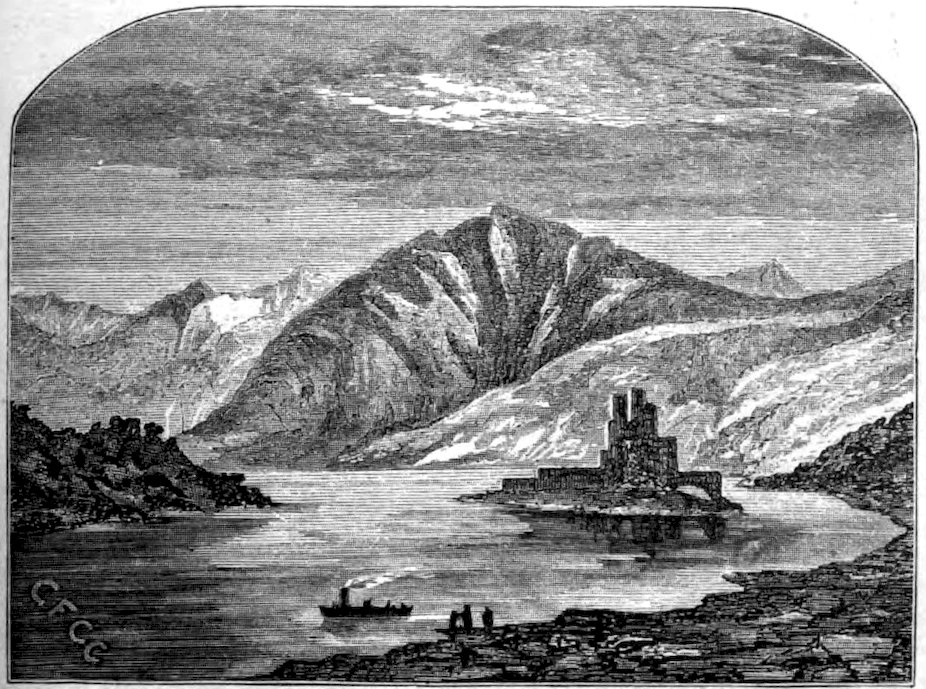
CASTLE OF EILEAN DONAN.
Being thus forcibly detained, we consoled ourselves by sketching the old castle of Eilean Donan, which stands on an island in Loch Duich. It was built on the site of an old vitrified fort, by Alexander II., to overawe the Danes and Norwegians; and the first constable of the castle was one Kenneth Matheson, whose descendants were known as MacKennich, the sons of Kenneth. Hence sprang the Mackenzies of Seaforth. Since then the old castle has been twice consumed and twice rebuilded. In the last instance it was taken for Prince Charlie by a farmer who held that all stratagems are fair in love and war. So he feigned sore distress at the prospect of stormy weather, and induced the governor to lend him some hands to help in rapidly garnering the harvest. No cloud on the political sky, threatened danger in that quarter, and the unwary governor sent a detachment of his men to turn their swords into sickles. 372In their absence, a strong body of Kintail men, surprised the enfeebled remnant, and captured their stronghold.
Then the last Earl of Seaforth rallied all the men of Kintail to fight in the Stuart cause, and as the pipes struck up their heart-stirring notes the enthusiasm knew no bounds, and the crags around re-echoed the wild shouts that rose, as one and all started up to dance on the old leaden roof ere they went forth to join the prince. That defiant war-dance was the last merrymaking of these brave lads. A few days later a wail of grief and woe resounded from every hill and valley, for news of battle and of defeat had been brought by the foe, who came to burn the castle (A.D. 1719), and to tell how that gallant band had shed their hearts’ blood for their king on Sherriffmuir.
When we had waited fully a couple of hours, our American friend thought some of his men might be made to work; and, though they presented the lively appearance of inebriated owls, they made a start; and under pressure of startlingly strong language, did succeed in getting across. It was, however, 10 p.m. before we reached Shiel House Inn, which stands at the head of Loch Duich—a blue sea-loch—fringed with golden sea-weed. The house is a pleasant one to halt at. Behind it rise the Seven Sisters of Kintail, a group of grassy, cone-shaped hills, bearing so strong a family likeness as to have earned this name. Next day we had a lovely walk up Mam Ratakan, to see the sun set once more behind the far-distant Cuchullins, and as we turned to descend, a wondrous effect of storm and rainbow swept over the Peaks of Kintail.
About a mile from Sheil House is a subterranean cave, close to the road, into which (if you are curious to see what was probably the dwelling of some old Pict) you may crawl. Once inside, you will find a chamber eight feet high, paved and lined with large flag-stones, and with a stone roof of long slabs, resting on cross rafters, also of stone.
We greatly regretted not having left a day to see the Falls of Glomak, by far the highest in Scotland, and within a very beautiful ride of Glen Shiel. However, we were bound to push onwards to lovely Glen Quoich, where the pleasant weeks slipped by all too quickly. Very charming were the long glorious days on dark Loch Hourn, and pleasant too the social evenings in the sunniest of sunny homes, when the deer-stalkers 373and fishers returned in the gloaming to tell of their day’s sport, and to dream away happy hours in a paradise of roses and fair women, lulled by that
music which seemed to glide away on each moonlight ripple, as the tiny wavelets of the blue loch plashed against the trim, well-mown lawn.
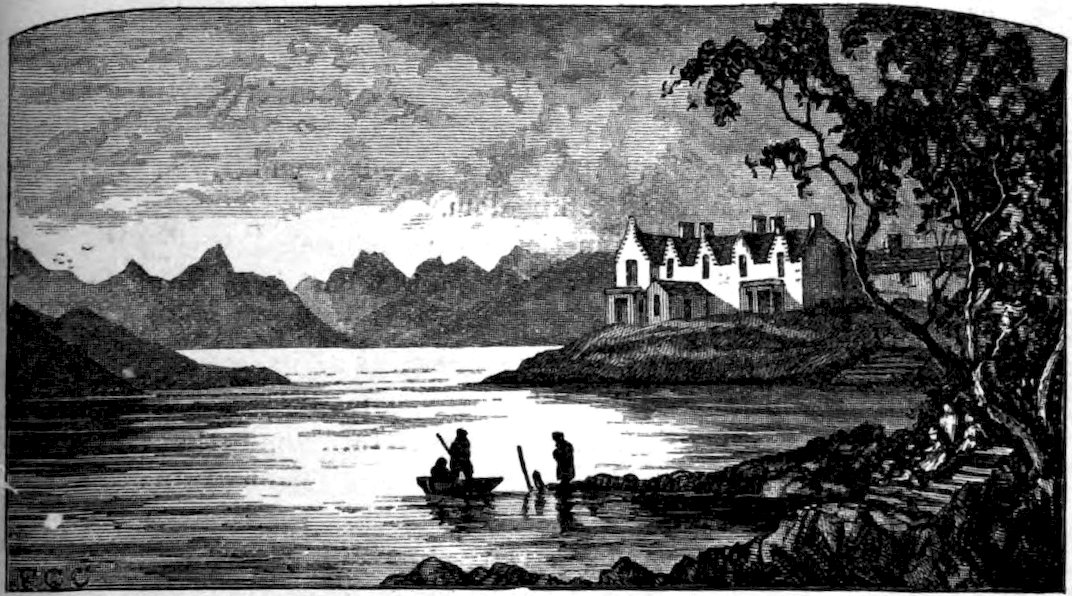
GLEN QUOICH.
The calm bosom of the lake is dotted with little birch-clad islands. One of these, about the centre of the loch, was for many years the home of a bold outlaw, Ewen MacPhee, who, having in an evil hour enlisted, soon found the trammels of barrack life and the study of goose-step altogether unendurable. So he returned to his native wilds in Glengarry, where he was captured as a deserter, but, watching his opportunity, he made one brave bound from off a rock so precipitous that his escort cared not to follow; they fired at him, but missed their aim. Dashing his hand-cuffs against a rock, Ewen was once more a free man, and for many years found a safe haven amongst the hills of Lochiel, where he chased the red deer, as his fathers had 374done before him. Here he wooed and won a maiden of tender years, and he and his child-bride—she was but fourteen—reared their flocks of wild goats, or wandering by the bonnie burn-side, thence drew silvery fish enough for their simple table. After some years, the fear of the law made Ewen seek a surer refuge for his wife and her little ones; so he took possession of this little island, where, beneath the shadow of the birch-trees, he built a bower for his love, wherein she lived for many long years in safety. The loch supplied them with fish, and the neighbouring hills with game; there, too, they contrived to find pasturage for about sixty wild goats, asking leave of no man. When Mr. Ellice bought Glen Quoich, MacPhee came, as a dutiful vassal, to do homage to his liege, bringing him an offering of goats’-milk cheese, and promising that he would not molest the new laird, provided he was left undisturbed in his island home. The free speech and bold bearing of this wild Highlander won the heart of the new-comer, and Ewen was left in possession of his little kingdom.
One tiny island, at the junction of the river Quoich with the loch, has for many a long year been the burial-place of the neighbourhood. From far-distant hills the people bring their dead, and row across the stream in sunshine or in storm, to lay them in the ancient churchyard where so many bygone generations rest in peace beneath the green turf, amid the murmurous voices of flowing waters, with the echoing hills on every side.
A beautiful drive down Glen Garry brought us to old Invergarry Castle and so to Fort Augustus, still called by the Highlanders Cill Chuimein, in memory of that Cuming the Fair who twelve hundred years ago held the bishopric of the Isles as seventh Bishop of Iona, but known to the Sassenach only by the name of the grey old fort, whose rough walls still bear the names of the Duke of Cumberland’s soldiers, carved in their idle leisure in those grim quarters.
To you and to me those grey walls bring far other memories—such memories as consecrate some few spots of earth, and mark them for evermore as hallowed ground where Heaven’s own angels have paused rejoicing. Nay, more, places which have been to us as the very gate of heaven, whence there have been vouchsafed to us such glimpses of the glorious light within the vail as may well cheer and sustain us along the darkest and dreariest turns that can await us on life’s journey.
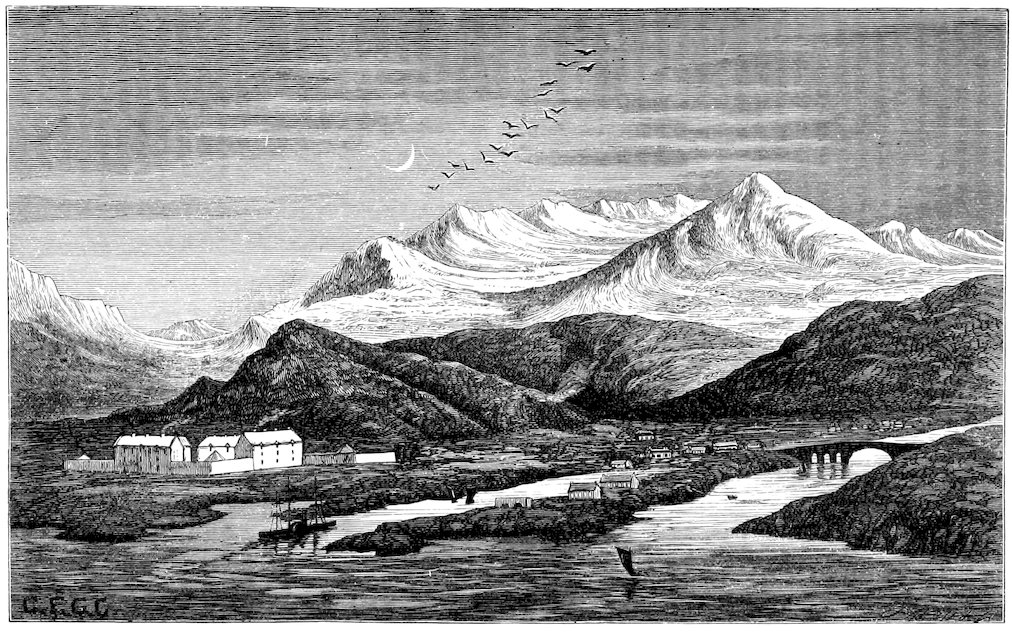
FORT AUGUSTUS AND THE GLENGARRY HILLS. To face p. 374.
375Many a time, during the intervals of anxious watching, you and I have looked down from those windows on the wild wintry storms, which, sweeping over the cold grey hills, turned the blue waters of Loch Ness to inky darkness. And again, when the strange chill of early morning told that the long sleepless night was drawing to a close, how often we have stood together watching for the crimson dawn which flushed Glen Garry’s snowy peaks, and faded away to leave them dazzling and glittering in the clear sunlight. Then one (whose mighty strength was slowly ebbing as night after night passed by in pain and weariness, yet to whose lion-like beauty each morning seemed to add a new, refining touch of radiant spirit-light) would look up and whisper the words of an old, old promise, telling how scarlet of a deeper dye might yet be made whiter than that snow, to shine in the light of perfect day.[68]
Day after day slipped by among old memories and old friends, and we were on the eve of returning to the ordinary life of high civilisation, when a letter reached me from a sister far over the seas, suggesting that, having seen the finest hills in Scotland, I should join her for a summer in the Himalayas.
I think that if the post had gone that same morning the idea would have been dismissed at once as utterly preposterous; but as some hours must elapse before the old runner returned, there was no use in answering at once. And so, while Loch Ness patiently sat for its portrait, it gave me so many good reasons for going, and dismissed all difficulties so summarily, and its little wavelets seemed to run to such a jingle of Cuchullins and Koolins, and collies and coolies, that when the old postman did start he was laden with a perfect budget of letters—one to secure a passage in the next P. and O. ship; another to Winsor and Newton for stores of fresh paints and Brobdingnagian sketching-blocks in tin cases; a third to Thornton for such a waterproof as should mock at Indian rains; and a fourth to Macdougal for extra warm raiment, an investment much jeered at by my friends, but one which proved the very comfort of my life in India.
376Then away we sailed in the little steamer, taking a farewell look at Castle Urquhart, said to have been once an old holding of the Clan Cumming, and in later days one of the old royal forts of Scotland, besieged by Edward I. in 1303, and which stood many a hard tussle with the English in the succeeding years. For the last three hundred years there has been no mention of it in any chronicle of fight or fray. It is now a picturesque ruin, rising from the loch on a rocky promontory. The Highlanders call these grey ruins Strone Castle, and believe that two mysterious vaulted cells are hollowed in the rock below. The one contains a countless treasure of gold; but in the other a fearful pestilence is sealed up, which, if once released, would stalk forth in irresistible might and depopulate the land, having first slain the rash hand that opened its prison door. So the dread of liberating so dire a scourge has even subdued the covetous craving for gold, and the treasure-chamber remains inviolate.
Thus ended my pleasant six months’ wanderings in the Western Isles. A fortnight later, (a fortnight divided into infinitesimal visits to an incredible number of relations), I started for the Eastern Highlands, and bidding farewell to Britain’s grey shores on a gloomy November day, proceeded in search of sunshine, light, and colour—a quest speedily rewarded with success. The six weeks’ voyage, amid new scenes and pleasant companions, was a delight in itself, and its close was only welcomed because older friends and more bewildering novelties greeted our arrival in the strange Eastern world.
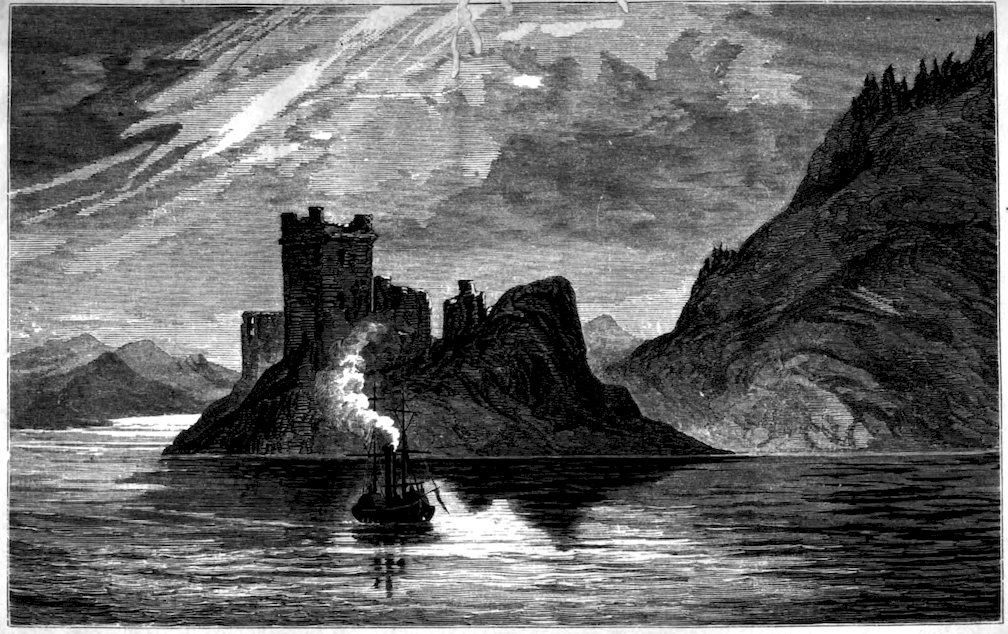
CASTLE URQUHART. To face p. 376.
1. Archibald Campbell, Esq., of Blythswood.
2. Mr. Darwin evidently alludes to this circumstance in his Notes on St. Helena. He says, “I was standing on the edge of a plain, terminated by a great cliff of about a thousand feet in depth, when, at the distance of a few yards to windward, I saw some tern struggling against a very strong breeze, whilst where I stood the air was quite calm. Approaching close to the brink, where the current seemed to be deflected upwards from the face of the cliff, I stretched out my arm, and immediately felt the full force of the wind: an invisible barrier, two yards in width, separated perfectly calm air from a strong blast.”
3. See the beautiful cast of this gateway in the Kensington Museum.
4. The virtue of the shamrock, as a charm against the stings of snakes and scorpions, has also been recorded by Pliny, who declares that the serpent is never seen on trefoil.
5. Annales Turcici, by Leunclavius.
6. In Acts xvi. 16, where we are told of the Philippian damsel possessed of a spirit of divination, the marginal reading is ‘Spirit of Python.’
7. Engraved by Fabretti, Inscript. Antiq.
8. Maurice’s “History of Hindoostan.”
9. Gram-Deota.
10. See Chapter V.
11. Quoted in “The Worship of the Serpent,” by the Rev. J. B. Deane.
12. Ceridwen. This was the goddess in whose honour our ancestors used to dress up an image made of corn, and crowned with flowers, which was carried home triumphantly with the last load of corn; while the reapers sang the song of harvest-home to the music of pipes and drums. A trace of this old custom still lingers in some of the northern counties, where the ‘kern,’ or corn baby, still figures at the harvest-home.
13. As shown in the following quotations from “Chronicles of the Picts and Scots.” In the “Irish Chronicle” of the twelfth century the story runs thus:—
On the other hand, in the “Chronicle of the Scots,” preserved in the British Museum, and bearing date A.D. 1412, we read that—
“Ye nation of Scotts began in ye time of Moses, as is contained in ye Bibill; in quhilk time ye Ethiops warred all Egypt with cruell wars, for ye quhitk ye Egyptians called their ally in help, ye Greeks; that was allied then with them, as is now France allied with us Scots. Therefore ye King of Athens called Neolms [and?] his son Gayelglas (after whom our language called is, Gayelige) with a great power of men into Egypt, and discomfited ye Ethiops, and abandoned them aye, to the time that Moses rase; for ye quhilk victory ye King of Egypt gave his only daughter and heir called Scota to this Gayelglas in marriage, of ye quhilk Scotia, we after was callit Scottis, as ye custom was then, to call nations after women, and not after men.
“This aforesaid Scota and Gayelglas were maryite together in ye time yat ye bairnes of Israel passyt in ye Red Sea, and ye death of Pharaoh yat governed ye land of Egypt. And for they saw ye cruel plagues that came on Egypt, they decreed to pass with their folk that they brought of Greece, and many of Egypt, for to seek void lands and to inhabit them; they went with gret riches and many ships, and so they came to Spain.”
14. Daily Morning and Evening Prayer.
15. “Twenty-seven Identifications of the English Nation with the Lost House of Israel,” by Edw. Hine, Glover, and others.
16. Jer. xliii. 6, and Jer. xliv. 14, being the authority quoted.
17. Ledwich, Fosbrook, and Higgins.
18. This connection may seem less far-fetched, when we recollect that Cæsar states that the Druids of Gaul, whom he asserts to have been less enlightened than those of Britain, made use of the Greek alphabet in writing all public and private records.
19. It seems probable that it found a place in Russia, where to this day, the dove is never eaten. In fact, I am told that a Russian would consider it an insult to be offered a pigeon pie!
20. The Scandinavians seem to have kept up some communication with the East in much later days, for in certain sepulchral barrows in the parish of Sandwick, in Orkney, which are attributed to them, we find coins of Athelstane, A. D. 925, with those of the contemporary Caliphs of Bagdad!
21. Fergus, A.D. 536. St. Columba landed 563. Died 597.
22. St. Baithen, alias Comin, died in 601. Comin Ailbe (that is, the Fair,) died in 668, and was seventh Bishop of Iona. It is consolatory to the Clan Cummin (alias Comyn), to have produced at least two saints, at so early a date!
23. 9th June, A.D. 597.
24. “We deem it impious to fast on the Lord’s day, or to pray kneeling.”—Tertullian, De Coronâ Militis.
“The Church instructs her nurselings to make their prayers standing on the Lord’s Day.”—Basil. De Spiritu Sancto.
Justin Martyr says:—“Forasmuch as we ought to remember both our fall by sin, and the grace of Christ by which we rise again from our fall, therefore we pray kneeling six days, as a symbol of our fall by sin; but our not kneeling on the Lord’s Day, is a symbol of the resurrection, whereby, through the grace of Christ, we are delivered from our sins and from death, that is mortified thereby.”—Constantine enacted a law, that on festival days prayers were to be offered by the congregation, not kneeling, but standing.—Hilary speaks of it, as an apostolic practice, neither to fast, nor worship kneeling on the Lord’s Day, or the fifty days between Easter and Pentecost.—Jerome reckons it among the traditions of the universal Church.—Cassian says of the Egyptian Churches, that from Saturday night to Sunday night, and all the days of Pentecost, they neither kneeled nor fasted.
25. Zeus Apomyios or Myiagros, who was worshipped as the Disperser of flies.
26. In most of these magical cures, the person bearing the healing draught to the sick was forbidden to speak to any one by the way—or if the sick man came to drink himself, he was bidden to walk straight away, and not look back. In the sacred record of one of Elisha’s miracles, a curious coincidence suggests itself. When the child of the Shunamite lies dead, and Elisha bids Gehazi take his staff, and lay it on the face of the child, he expressly commands, “If thou meet any man, salute him not, and if any salute thee, answer him not again.” Another coincidence in the same story is the use of the mystic numbers, common to East and West; Elisha stretches himself three times on the body of the child, who then awakes, and sneezes seven times.
27. The brooch is still in the possession of the Macdougalls of Dunolly.
28. This combination of sacred fish and geese is not peculiar to the sculptured stones of Scotland. In Montfaucon’s Antiquities, vol. ii. there is a very curious engraving of an Egyptian (wearing on his head a triple emblem) embracing a stone altar, to which six geese and two fishes are bound with cords.
29. Is it to this that we owe the expression that one will go through fire and water for his friend?
30. Dion Cassius.
31. In case you care for further particulars of the “warp and woof,” which combine to produce this extraordinary specimen of geological tartan, I may quote Professor Edward Forbes’ description of the series of formations shown in the face of the cliff.
First of all comes the crowning mass of huge columnar basalt, red, brown, and yellow. Below this lies—
1. A thin band of small-rolled pebbles, mingled with fragments of jet.
2. Crumbling blue shales, with fossils, five feet in thickness.
3. A thin band of concretionary limestone.
4. Five feet of blue shale, with Ammonites and large Balemnites.
5. Two bands of hard, grey limestone, weathering yellow, three feet.
6. Dark blue fossiliferous shales, seven feet.
7. Red and yellowish limestone, with fossils, one foot.
8. Blue shales, one foot.
9. Ferruginous sands, with fragments of wood in the state of jet, one foot.
10. Concretionary limestone, with fossils, one foot.
11. Soft white sands, three feet.
12. Hard fossiliferous sandstones, two feet.
13. Grey sands, with carbonaceous streaks, five feet.
14. Hard shales, with bands of fossil wood, three feet.
15. About fourteen bands of loose slaty and shaly beds, about twelve feet in thickness, resting on the basalt which lies beneath the waves.
Add to this varied mineral colouring occasional stripes and patches of vivid emerald and gold, wherever the kindly grass and moss has found a niche, and you perceive that this natural tartan is about as diverse as any “coat of many colours” ever woven in human loom.
32. Otary Falklandica.
33. Lutra mariana.
34. Giraldus Cambrensis, Archdeacon of St. David’s, born 1146.
35. Sebastian Munster, on Cosmography.
36. Aldrovandus.
37. The yacht was so named.
38. Those who, like ourselves, have, on the occasion of this festival, heard a Romish priest instructing his flock of sturdy Scotch peasantry, to bring their candles to him to be blessed (promising that the burning of lights so sanctified would keep away all infectious diseases from their homes), may well doubt whether the old superstition has quite passed away.
39. Ezek. viii. 16.
40. Lev. vi. 13; Lev. x. 1.
41. Exodus xxx. 22 to 38.
42. Such was the teaching of Hermogenes.
43. Orissa, W. W. Hunter.
44. Rabibar.
45. I fear, however, that the majority are really great sepulchral dolmens!
46. More probably, however, it comes from panis, “bread,” being land set apart for the maintenance of her priests.
47. Job. xxx. 26 to 28.
48. The statistics of births in the principal towns of Scotland, give an average of one tenth as illegitimate. In certain country parishes the proportion is very much higher.
49. 2 Kings xvii. 33.
50. Maen-hir. Stone-high.
51. Mill’s Hist. of the Crusades.
52. The Church of Our Fathers. By Dr. Daniel Rock.
53. Literally, Draw-boat.
54. Built by Lord Dunmore, the late proprietor. Now the property of Charles Scott, Esq.
55. Chapter II.
56. Rude stone monuments.—Fergusson.
57. By the way, it is curious to notice that this word Gilgal is still in use in Brittany to denote those great tumuli to which many stones were “rolled.” Such an one for instance as that at the Mont St. Michael, whereon the Christian Church is said to occupy the very spot where Bel’s altar once stood.
58. Stennis, “The headland of the stones.”
59. Two ladies who visited these islands with Captain Otter, R.N., in H.M.’s ships Shamrock and Rose, engaged in the Admiralty survey.
60. For most of the details concerning those islands which the author was unable to visit herself, she is indebted to a series of papers entitled “Pen and Pencil Sketches of the Outer Hebrides,” which appeared in the Leisure Hour, vol. for 1865.
61. The Saxons who pretend to shudder at our pipe music, quite forget that the bagpipe was an English musical instrument of very old standing. Chaucer has recorded of his miller, that “A bagpipe well coude he blowe and sowne;” and it is further stated that this was the music which cheered the Canterbury pilgrims on their journey. The instrument itself is represented on divers old English carvings; such as in a church at Cirencester, which dates from the time of Henry the Eighth. It also occupies a prominent place on the organ screen in the chapel at Magdalen College, Oxford, which represents the celestial choir with their divers instruments of music. One comfortable-looking angel is shown working his drone cheerily. This organ screen, though itself somewhat modern, is copied in all its details from ancient carvings. The pipes are also found carved in old Melrose Abbey, and on certain stones in the Orkneys.
62. Shoulder to shoulder.
63. Nevertheless she was probably nearer right than ourselves, inasmuch as Dean Stanley tells us that Holborn, like Hay Hill, owes its initiatory H to sheer Cockneyism; the latter denoting the hill where the Aye Brook once flowed, while the former takes its name from the Old Bourne (the ancient river), which, rising in High Holborn, formerly ran down that green hillside. Its once clear waters, like those of all the neighbouring streamlets, have now been imprisoned and sentenced to hard labour underground, in purifying sewers. The Dean also quotes the suggestive names of Langbourne (the long stream), Tyburn (The Aye Bourne), Mary-le-bone (from St. Mary le Bourne), Southborne, and Shareborne as reminders of the early days, when these shares, or small rills, flowed through peaceful meadows; and when ships came up to Old Bourne Bridge, pausing on their way at Fleet Bridge; strange vision of a time when the fleet, or swift brook, flowed (a silent highway) where now the stream of busy life surges so noisily, with ceaseless roar. Apart from this curious change in London’s geography (above-ground at least) it is interesting to remember that our own Scotch name for a brook, a burn, has so near a relationship to old English—though I doubt whether many modern Britons ever think of a river, in connection with “the bourne whence no traveller returns.”
64. The Pholades.
65. Lord Middleton.
66. The Eriocaulon septangulare.
67. Alexander Smith.
68. Roualeyn Gordon Cumming died at Fort Augustus, March 24th, 1866. Sir Alexander P. Gordon Cumming only survived his brother five months.