The Trey of Spades
“This looks like the place, ‘Sleepy.’ In all my years, this is the first time I ever seen just the place to settle down. Look at the wide places, cowboy. Away over there is the river, cuttin’ almost down the center of it. Them green cañons are showing plenty of water, and look at the feed.”
“Hashknife” Hartley lifted his lean head, as he swung one long arm in an arc, encompassing the length and breadth of the Thunder rangeland. Sleepy Stevens, his companion, humped in his saddle, rolling a cigarette.
“Feast yore eyes upon her, cowboy,” urged Hashknife seriously. “She’s the range of our dreams. No fences and danged few ranches. If it was made to order it couldn’t hit closer to what we’ve wanted.”
“Gimme a match,” said Sleepy indifferently.
Hashknife fumbled for a match, but did not take his eyes off the panorama before him. Behind them and on both sides stretched the Thunder Mountains, half-encompassing a rolling range that only ended in a hazy distance—hundreds of square miles of rolling hills, small valleys, dotted with cottonwoods and live-oaks; an ideal cattle range. Far away, in the middle distance, the Bitter River pursued its irregular course; a green thread that split the land in twain.
“Yuh ought to give me a match with a head on it,” complained Sleepy. Hashknife turned in his saddle and squinted at him. There was a hint of reproach in Hashknife’s thin face, as he produced another match and handed it to Sleepy.
They were unlike, these two. Hashknife was well over six feet in height, bony, angular, with long arms and generous-sized feet. His face was bony, nose long, mouth large. The hair that showed from under his back-tilted sombrero was of the neutral shade. His eyes were gray-blue and set in a network of wrinkles.
Sleepy was of medium height, rather heavy of build. His face was blocky, and wrinkled from the weather and an over-developed sense of humor. Both men were dressed in well-worn cowboy clothes. Their horses looked weary, thankful for the siesta in the shade of the cliffs behind them.
“They don’t put enough —— on their matches these days,” complained Sleepy as he barely managed to ignite his cigarette and puffed contentedly.
“Yuh ought to be glad we can find somethin’ without too much —— on it,” grinned Hashknife, turning back to his survey of the landscape.
“I reckon that’s right,” agreed Sleepy. “Kinda pretty view from here, ain’t it?”
“Kinda!” Hashknife snorted aloud and turned his head. “My gosh, that’s the place we’ve been dreamin’ about——”
“Who’s been dreamin’ about?” demanded Sleepy indignantly. “Don’tcha mix me up in that dream, Hashknife. The only ones I ever have are a dream about me bein’ at a dance without nothin’ on but a pair of socks. Huh! By golly, I’m the only danged view that ever shows up in my dreams.”
“You ain’t got no imagination, Sleepy.”
“The —— I ain’t! Don’t it take imagination to think yo’re at a dance without nothin’ on but——”
“I don’t mean that kind of imagination, Sleepy.”
“Oh, you mean the mild kind, eh? Well, I dunno about me. Prob’ly I do go a little too strong. The last dream I had——”
“Sleepy, I feel that this is the place we’ve hankered for. Right here is the place where we can speak about, when folks asks us where our home is. There’s peace down there, cowboy.”
Hashknife’s eyes were soft and speculative as he turned to Sleepy and motioned toward the country below them.
“God A’mighty made that country for cowpunchers, Sleepy. He sure knowed what they needed. And if they ever bring barb-wire into that paradise it’ll make the angels weep. Me and you will go down into her and we’ll find a little spot for ourselves.
“Mebbe we can buy out a small brand down there. We don’t need much, do we? We’ll start small, cowboy—and we’ll never get so big that we’ll forget that we stopped here to live peaceful. We’ve got enough money to give us a start.”
Sleepy squinted at Hashknife and turned away to look out over the sun-swept hills. He slowly cleared his throat, shifted in his saddle and looked at Hashknife.
“Me and you never had a home, Hashknife,” Sleepy’s voice was wistful. “We never had a place to speak about when folks asked us where we was from. All our lives we’ve just been driftin’ along, singin’ our song. And it ain’t always been easy travelin’, cowboy. The old boy with the scythe has just barely missed us on several occasions, and it sure seems like he’s swingin’ closer every time.
“Down there it looks good, Hashknife. It sure looks like a land of milk and honey; a land that’s so filled with peace that the coyotes have filed off their teeth and learned to eat grass. It looks like all of that, and more—but any old time yuh think it’s like it looks—yo’re cockeyed and crazy.”
“Thasso?” Hashknife smiled softly.
“Thasso?” mimicked Sleepy. “Yo’re danged right it’s so. Me and you have always looked for a peaceful range. Hashknife, it’s like lookin’ for the end of the rainbow. There ain’t no such animile. No range is peaceful.”
“I dunno about that,” Hashknife shifted in his saddle and picked up his reins. “Anyway, a man can make his own peace.”
“Even if he has to make it with a six-gun, eh?”
“All peace is brought about through battle, Sleepy.”
“Sounds fine,” Sleepy gathered up his reins and settled in his saddle. “I’ll make yuh a proposition, Hashknife. We’ll go down into this country, find us the right kind of a place, if we can, and settle down.
“If there ain’t no ready-made peace, we’ll make some for ourselves. But right here and now, we’ll both agree to let other people’s troubles alone. To —— with the whole gang, eh? We’ll fight for our own from now on. Is that a go?”
“Well,” said Hashknife slowly, the corners of his mouth twitching slightly, “that’s a good idea. It won’t hurt us none to agree to mind our own business. I’m in favor of it. All my life I’ve been hornin’ into other people’s business, and it’ll be kind of a relief to know that I’m handlin’ my own troubles.”
Sleepy grinned softly, as they rode off down the ridge, heading for the lower ranges, going into an unknown land. Far beyond the green ribbon of the Bitter River a tiny thread of smoke showed the passing of a railroad train, heading toward Oxbow, the county seat.
Lower and lower they went down across the rolling hills. Range cattle stared wide-eyed at them, or raced away through the brushy coulées, wild as deer.
“Fat as butter,” observed Hashknife. “Box M brand, mostly.”
“Betcha it gets colder’n —— in the winter,” said the pessimistic Sleepy.
“Mebbe we can buy us some skates,” suggested Hashknife.
They both laughed as they swung around the head of a brushy coulée and angled down through a thicket of greasewood. Hashknife, who was in the lead, suddenly drew rein. A horseman had ridden across the coulée below them, riding low in his saddle and flogging his horse at a stiff gallop.
It was only a glimpse and the rider was gone.
“What do yuh make of that?” wondered Hashknife. “I’ll say that he was hurryin’.”
“Kinda racin’ for a train or trainin’ for a race,” grinned Sleepy. “Mebbe he was cuttin’ around some stock. That brush is so tall that yuh couldn’t see his horse.”
“Couldn’t even see much of the man,” smiled Hashknife, as he urged his horse ahead.
The heavier growth of greasewood forced them to swing lower into the coulée, and they managed to angle their way to the left at a point approximately where the rider had entered the coulée. An overhanging branch swept Sleepy’s hat off his head and he swore softly as he dismounted to recover it.
Hashknife rode on slowly to the edge of the thicket, where he drew rein and turned to look back at Sleepy. A moment later something struck the fork of his saddle a terrific blow. The horse swung sidewise and from beyond them came the spang of a high-powered rifle.
Hashknife flung himself sidewise out of the saddle and crashed down into the greasewood.
Sleepy had not mounted, and now he came running low in the cover, six-shooter in his hand.
“Hashknife!” he called softly. “Hashknife, you —— fool, why don’tcha answer me?”
“Gimme a chance,” grunted Hashknife. “I’m all tangled up in this darned brush.”
“What did it hit?” asked Sleepy, his voice showing relief. “I heard the bullet hit somethin’, Hashknife.”
“Hit my saddle, I reckon. Can yuh see anybody?”
“Yuh don’t hear me shootin’, do yuh? Which way did it come from?”
“The way we was pointin’. Keep yore danged head down, can’tcha? I’ve got seven feet of greasewood up one leg of my pants, dang the luck. How in —— am I goin’ to get loose, Sleepy? I can’t bend her over so I can slide loose from it.”
“Jump seven feet in the air,” chuckled Sleepy.
“I’ll prob’ly do that, if the bushwhacker discovers me in this condition.”
“Take yore knife and slit the leg of yore pants, Hashknife.”
“Yeah—and I ain’t got no other pants.”
Came a burst of soft profanity and a sigh of relief. After several moments:
“Cut it off with my knife.”
“Yore leg?”
“Naw—the greasewood. Seen anybody yet?”
“No such luck. My trigger-finger has gone to sleep. C’mon and help me look for ’em. This is yore peaceful land, Hashknife. Milk and honey!”
Hashknife came crawling out of the brush. His face was badly scratched in several places and one sleeve of his shirt was ripped from cuff to shoulder, but otherwise he was all right. His horse had swung around and moved to lower ground, where it managed to tangle the reins in a bush.
Hashknife examined his six-shooter carefully and squinted speculatively at the brush around them.
“Goin’ to set here and wait for ’em?” queried Sleepy, who wanted action.
“Debatable question, Sleepy. I figure that they thought they were shootin’ at the gent we seen foggin’ across the coulée. If we had showed any sense a-tall we wouldn’t ’a’ crossed his trail. The question is this: Was he right or wrong?”
“What do yuh mean?”
“Just wonderin’ whether we ought to help him or not. Question of persecution or prosecution.”
Sleepy wrinkled his nose disgustedly.
“There yuh go,” he declared. “A while ago we agreed to let the troubles of others alone.”
“Yeah, that’s true,” nodded Hashknife. “I suppose we ought to sneak out and get away the best we can regardless.”
“They dang near killed yuh,” reminded Sleepy, who did not like the idea of sneaking away from trouble.
They had been talking softly, but their ears had been alert for the least noise. There was nothing foolhardy about either of them, neither were they the least excited over the fact that a bullet had narrowly missed killing one of them.
The fact that it had missed was sufficient for them. Several years in the worst ranges of the west and southwest had made them confirmed fatalists; caused them to look upon death as something that would not come to them until their “time” had arrived, and resolved to meet it with a grin.
Just beyond them and to the left the hill was covered with a growth of greasewood, showing here and there a cropping of granite. A loose rock bumped down through the brush, dislodged by some one or something. They looked quickly at each other and Hashknife shook his head slowly.
“Too careless,” he whispered. “Watch the other side.”
They snuggled lower, paying little attention to the side of the hill, and were rewarded by seeing the stealthy approach of a man, who was worming his way through the greasewood with the skill of a savage.
He was going slowly, weaving his way along. The heavy thicket behind which they crouched prevented him from seeing them. Now another rock came rolling down the side of the hill, but this time they heard the unmistakable sound of the rock being thrown onto the hillside from a distance.
Hashknife grinned and held his gun in a position to cover the approach of the man, who was almost into them now, while Sleepy kept an eye on a possible approach from the hillside. Then the man crawled into the opening, about ten feet from them, and turned his head to look into the muzzle of Hashknife’s gun.
The man was of medium height and weight, grizzled, with a heavily lined, bronzed face and a pair of steady gray eyes. In his right hand he held a heavy Colt revolver. For a moment his eyes held a startled expression, which quickly changed to one of evident relief. His hand relaxed from around his gun and he lifted himself to a sitting position.
“Kinda nice weather for this time of year,” said Hashknife pleasantly.
The man nodded and glanced back on his trail.
“Yeah, it is,” he agreed. He lifted his left hand and rubbed his chin thoughtfully. “There seems to have been a mistake made.”
“Does kinda seem thataway,” agreed Hashknife. “At least it had us wonderin’ what it was all about.”
“Um-m-m.” The man’s face widened into a grin.
“Yuh might as well call the rest of ’em in,” said Hashknife. “They’ll get sore arms from throwin’ rocks onto that side hill.”
The man turned, disclosing a sheriff’s shield on the lapel of his vest, and called loudly:
“Hey! Buck! Come on in!”
“Aw-w right,” called a voice. “Comin’ right along, Jud.”
“Yo’re the sheriff, eh?” queried Hashknife.
“Yeah. My name’s Farley—Jud Farley.”
“Mine’s Hartley,” grinned Hashknife. “This here curio with me is Sleepy Stevens. My friends call me Hashknife.”
“Glad to meetcha,” nodded Farley, as a tall, raw-boned, sandy-haired man came clawing his way through to them. He looked at Farley and glanced quickly at Hashknife, who still held his gun in position. Farley’s gun was lying on the ground, and this seemed to greatly concern the newcomer.
“Tha’sall right, Buck,” assured Farley. “My hand got tired. Buck, meet Mister Hartley and Mister Stevens. Folks, this is Buck Hardy, my deputy. Buck, do yore little bow.”
“Aw, what the ——!” growled Buck.
Hashknife laughed and shoved his gun back into its holster. This action seemed to relieve Buck, who almost smiled as he put away his own gun and reached for the makings of a cigarette.
“One of you fellers almost got me,” declared Hashknife. “The bullet tore half of my saddle-fork loose.”
“That was me,” said Buck slowly. “I dunno what’s got into me lately. ’Pears like I’m shootin’ too low all the time.”
He said it with such sincerity that Hashknife laughed outright, and Farley’s eyes twinkled with laughter.
“Buck’s a good shot,” offered Farley.
“I used to be,” admitted Buck.
“Well,” laughed Hashknife, “I’m glad it happened now instead of the used-to-was. That shootin’ was too good to suit me. But you haven’t said just why yuh shot at me.”
“Yuh didn’t happen to be gunnin’ after the jasper that rode through here a while ago, did yuh?” queried Sleepy.
“Did you see him?” Thus Farley quickly.
“Just about. He wasn’t paradin’ to any extent.”
“What color horse was he ridin’?”
“We didn’t see,” said Hashknife. “We were up the coulée a little ways and just got a glimpse. This brush hid the horse, and the man didn’t go slow enough for us to see what he did look like.”
“He was the whippoorwill we were after,” stated Farley, and added disconsolately, “By this time he’s erased himself plumb off the map.”
“Who was he?” asked Sleepy.
Farley smiled sadly and shook his head.
“Pardner, I’d sure give a lot to know.”
“He’s a —— fool!” snorted Buck indignantly. “Any man that does what he’s done and wants folks to know that he’s the jigger that done it—he’s plumb crazy, tha’sall.”
“We call him ‘The Trey of Spades,’” said Farley slowly. “That’s his trade-mark.”
“Trade-mark?” queried Hashknife.
“Uh-huh. He’s a lone bandit—and a slick one, Hartley. This is the nearest we’ve come to gettin’ him. About four o’clock this mornin’ he went into the Cheyenne gambling room in Oxbow and stuck up the crowd. There was only seven men in there. He sure cleaned up a nice piece of change.
“He backed out of there, but at the doorway he took a playin’-card out of his pocket and flipped it back at ’em. It was the trey of spades. Me and Buck was just ridin’ in from a trip to Snake Creek, and we hit Oxbow just about the time that this was goin’ on.
“We seen this feller break for his horse. Somebody yelps that the Cheyenne has been held up; so me and Buck takes out after this feller. It was bright moonlight, and we sure runs him ragged, but we can’t stop him. Can’t tell the color of his horse either. Back about two miles from here he holes up in the brush and we think we’ve got him dead to rights, but he foxes us and gets away.
“Buck gets a glimpse of him foggin’ out; so we slides right after him. We’re pretty close behind him, and we’ve got a hunch that he hived up here again; so yuh can’t hardly blame us for takin’ a shot at yuh.”
“Sure looked to me like he was lookin’ over his back-track,” said Buck. “I dunno what’s wrong with me, anyway. By golly, I used to be able to hit a tomatter-can at that distance. Gotta fix them sights, I reckon.”
“Yuh don’t need to on my account,” grinned Hashknife.
Farley picked up his gun and shoved it into his holster.
“Well, Buck, I reckon we might as well ride along and see what we can see,” he observed. “This is just another time when we didn’t get the game.”
“I s’pose so—dang the luck.” Buck yawned widely.
“Which way is the town from here?” asked Hashknife.
Farley pointed west:
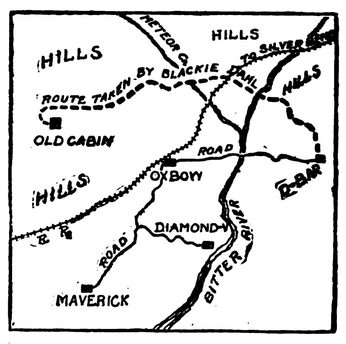
“Out thataway about ten miles, I reckon. About three miles from here you’ll hit the road that leads past Maverick ranch. Keep goin’ straight ahead and you’ll hit Oxbow.”
Hashknife and Sleepy mounted and rode out past where the sheriff and deputy were preparing to circle the coulée. Buck looked with gloomy eyes upon the havoc caused by his bullet upon Hashknife’s saddle.
“Mebbe,” he said hopefully, “that bullet hit a limb and was deflected. It could happen, yuh know.”
“Anybody would think that yo’re sorry to miss me,” observed Hashknife.
“No-o-o, it ain’t so much that as it is gittin’ to feel that yore shootin’ is gittin’ bad. I used to shoot pretty good.”
“C’mon, Buck,” laughed Farley, and then to Hashknife, “Hope we’ll see yuh ag’in, Hartley—both of yuh.”
“Y’betcha,” nodded Hashknife. “We’ll be around here for a while, I reckon.”
“This here land of milk and honey,” scoffed Sleepy, as they rode away. “A land of peace, Hashknife. I’ll bet there’s more real —— to the square inch around here than any place we’ve ever hit.”
“Well, it won’t affect us,” laughed Hashknife. “Yuh must remember that we’re goin’ to mind our own business from now on.”
Old “Dad” Parker sat on the front porch of the Maverick ranch house and looked with gloomy eyes at the rider who was coming past the house, heading toward the bunkhouse. The rider was Cliff Parker, Dad’s twenty-seven year old son, a wild young blade.
Just now his clothes were disheveled, dusty, and his seat in the saddle was none too secure. In fact, Cliff Parker was drunk—disgracefully drunk. He half-fell from his horse in front of the bunkhouse, staggered inside and slammed the door.
Old Dad shook his head painfully and squinted off across the hills, his old eyes misty with sorrow. In his younger days, Dad Parker had been a powerful man, but now he was a gaunt, old man, with a mop of white hair, a deeply-lined face; an old, old man at sixty.
As he settled back in his chair a girl came to the doorway. She was a slender, capable-looking girl, attractive of features and with a wealth of soft, brown hair. There was a smudge of charcoal dust on her cheek, and her arms, bare to the elbow, bore evidences of contact with the flour barrel.
“I’ve been making some doughnuts, Dad,” she offered, with a smile. “Harmony said they wouldn’t be worth anything, but they look good.”
The old man nodded without looking at her. She studied him for several moments, her eyes shifting toward the bunkhouse, where Cliff’s horse stood.
“Cliff came home?” she asked softly, but he did not reply. Slowly she shook her head and a look of unutterable sadness came into her fine eyes, as she stepped out behind old Dad and put her hands on his shoulders.
“Some day he will quit it, Dad,” she said softly. “Cliff’s only a kid.”
“He’s almost thirty, Milly.” Dad Parker’s voice was husky. “He’s old enough to know better. Every time he goes to town he gets drunk. He’s gettin’ a bad reputation for drinkin’ and gamblin’.”
“Yes, that is true,” nodded the girl. “He loses more than is good for him.”
“His cattle are all gone,” said the old man. “He sold the last ten head a week ago, and I suppose the money is all gone.”
The girl turned away. She knew that Cliff had also sold four horses during the past week, which left him with only one, his favorite riding horse. Mildred Parker was not at all like her brother. Their mother was of French descent, impulsive, hot-blooded; and Cliff had inherited his wild traits from her side of the family. Mildred was twenty-three.
As she turned away she saw two strange horsemen swing off the main road and ride toward the house. It was Hashknife and Sleepy. Dad Parker watched them indifferently, as they rode up close to the porch and lifted their hats to the girl.
Their smile was contagious and Mildred found herself smiling back at them.
“We just stopped,” said Hashknife rather lamely. “We might say we stopped for a drink of water, or to ask the way to Oxbow—but we know the way, and we ain’t dry. We stopped, tha’sall.”
Mildred laughed with them. There was something so straightforward about the lean-faced cowpuncher that she liked him instinctively.
“This is the Maverick ranch, ain’t it?” queried Sleepy.
“This is the Maverick ranch,” replied Dad Parker. “Get off and rest your feet, gentlemen.”
“We didn’t aim to stop,” protested Hashknife, “and I don’t reckon we will.” But he was half-way off his horse as he finished. They dropped their reins and came up the steps.
“My name is Parker.” The old man had got to his feet and held out his hand. “Folks call me Dad. This is my daughter.”
Hashknife introduced himself and Sleepy, and Mildred brought some chairs from the living-room.
“We just can’t stay long enough to set down,” protested Hashknife. “No, ma’am—honest to gosh.”
“Running away from some one?” asked Dad, a twinkle in his eye.
Hashknife laughed and fumbled for the makings of a smoke.
“No, not that. We’re kinda stubborn when it comes to runnin’ away. Nope, we just didn’t want to bother yuh.”
“You haven’t had any dinner, have you?” asked Mildred.
“Dinner?” Hashknife looked up quickly.
“Yes, ma’am. We couldn’t eat a thing, thankin’ yuh just the same.”
Hashknife turned to the old man and Mildred looked inquiringly at Sleepy, who stared at her for a moment. It was a look of understanding, but to make it more expressive, Sleepy reached down and cinched up his belt another notch.
Mildred laughed softly and turned into the house, while Sleepy wrinkled his nose joyously and rolled a cigarette. He was hungry, and he knew that Hashknife was half-starved.
“This is the first time we ever got into this range,” offered Hashknife. “It sure looks good.”
“It is good,” declared the old man. “It’s hard to beat the old Thunder range, Hartley. We’ve got everythin’ here.”
“Even to sheriffs that shoot on sight,” said Sleepy.
Dad Parker turned and stared at Sleepy.
“I didn’t quite get that.”
“Well, they do,” declared Sleepy. “One took a shot at Hashknife and tore half the fork off his saddle.”
Hashknife laughed and hastened to explain the incident. Dad Parker listened closely until Hashknife had finished.
“That was a close call, Hartley,” he said slowly. “And it was not a pleasant introduction to our country. You say this bandit held up the crowd in the Cheyenne this mornin’?”
“That’s what the sheriff told us.”
“And sooner or later Jud Farley will get him,” declared Dad Parker. “Farley is a good man. This bandit will leave his card once too often.”
“Is he a rustler, too?” queried Hashknife.
“Not yet. He confines his robberies to hard cash. As yet he has made no big hauls, but he seems to have nerve enough to pull off any kind of a job.”
“Any suspicion of who he is?”
“No. He laughs behind his mask, talks like a man suffering from a heavy cold, and rides like the ——. He has never been seen in the daylight; so no one knows the color of his horse.”
“Kinda interestin’,” mused Hashknife aloud. “I like his idea of identifyin’ himself with a playin’-card. It’s like somethin’ yuh read about.”
“He probably read about it.” Thus Dad Parker dryly. “There’s a washbench around by the kitchen door, if you feel like takin’ a wash. I think that ‘Harmony’ has about prepared the dinner.”
“A little wash won’t hurt us,” laughed Hashknife, getting to his feet. A rider was turning in from the road, and as he neared the porch he waved at the old man, who motioned for Hashknife and Sleepy to wait.
The man rode up and dismounted. He was a man of possibly forty years of age, with a pale, esthetic face, deeply set, dark eyes and a sensitive mouth. From his garb it was plain to see that he was of the clergy, although he wore a sombrero hat and high-heeled boots.
As he removed his sombrero he disclosed a partly bald head above his high forehead. His horse was a decrepit gray, which had long ago outlived its usefulness on a cattle range, and his riding rig was of the poorest.
“Get down, minister,” said Dad Parker pleasantly. “You are just in time for dinner.”
“Perhaps,” the minister smiled, “perhaps I timed it, Mr. Parker.”
Dad laughed and indicated Hashknife and Sleepy.
“This is Mr. Hartley and Mr. Stevens, two newcomers to this country. Gentlemen, shake hands with the Reverend Jones, the man who rides on his church.”
Hashknife laughed as he shook hands with the minister.
“I never knowed one to ride a church before,” said Hashknife.
“Perhaps Mr. Parker is right, at that,” said the minister. “In this country a horse is more valuable than a pulpit.”
He shook hands with Sleepy, who made a wry face after the minister had turned away. Mildred came out and greeted the minister warmly.
“We will set another place at the table,” she said, as she turned and went back into the house.
Hashknife and Sleepy went to the washbench near the kitchen door and began their ablutions. Mildred was in the kitchen, talking to some one, whose voice immediately rose to a higher pitch.
“Well, my ——, who next! What do they think this is—a caf-fay? Preacher, eh? Ten Commandments and an appetite! Mebbe he’ll expect a yaller-legged hen, won’t he? By grab, I don’t do nothin’ around here, except work. Somebody always showin’ up at meal time. I wisht I had a job herdin’ sheep!”
“Oh, I’m sorry.” Thus Mildred’s voice sorrowfully.
“Yuh don’t need to! Don’t waste sympathy on a cook. They’re the lowest order of humanity. Put a plug hat on one and he’s still so low he could walk under a snake. What does he drink—except liquor?”
“Tea, I think.” Laughing.
“Tea? Aw right. Give’m skim milk. I know that jigger. He’ll want to ask the blessin’, won’t he? Thank the Lord for somethin’ that I cooked, eh? That’s all the thanks I git. If I saved his life he’d thank me through somebody else, I s’pose.”
Came the banging of pans, as the cook vented his further displeasure on the utensils. Hashknife laughed joyously.
“That’s Harmony.”
“A human bein’,” Sleepy spluttered through the towel. “I’m for Harmony. Didja notice that preacher’s grip? Just like takin’ hold of a dead fish. By golly, I was afraid to let go of his hand for fear it would fall in the dirt.”
The cook came outside and looked at them. He was a short, heavily built man, with grizzled hair, wrinkled face and a walrus mustache. He glared balefully at the two cowpunchers for several moments before a grin overspread his face.
“Jist tryin’ to figure out which one of yuh was a preacher,” he said huskily. “Milly said we had comp’ny, but didn’t say how many, yuh see. Then she edged in on me and said that the preacher had arrived.”
“Yo’re Harmony, ain’t yuh?” asked Hashknife.
“Yeah,” Harmony spat viciously. “I’m the best —— cook in the county. Harmony Hobbs, that’s me. A disciple of peace and a promoter of brotherly love. I’ll have harmony, if I have to bang —— out of everythin’ and everybody to git it. Howdy!”
They shook hands gravely and Hashknife introduced himself and Sleepy.
“Hashknife Hartley, eh? Didja git that name from the old Hashknife outfit?”
“Uh-huh.”
“By ——! Say, it’s a small world, Hartley. Didja ever know ‘Saleratus’ Smalley, who used to cook for that outfit?”
“I sure did,” laughed Hashknife. “Did you know him?”
“No, but I knowed a man that did. It’s sure a small world, ain’t it.”
“Yeah, it ain’t very big,” laughed Hashknife.
“Uh-huh. Well, well! You sneak around to the front and come in with the main herd, gents. Dinner is get-at-able, right now. And don’t forget to bow yore heads.”
They laughed and went around to the porch, where the minister was talking to Mildred and Dad Parker. Harmony’s gong sounded its announcement and Dad Parker motioned them all into the dining room, where they sat down at the big table.
Harmony bustled around, placing food on the table, while they all waited for the minister to begin. Even Harmony stopped at the doorway, obeying some hereditary impulse, in spite of the fact that he outwardly detested ministers.
As they bowed their heads and the minister’s voice began in sonorous tones to invoke a blessing upon the food, there came the scrape of a boot heel on the threshold of the dining room and a soft laugh of derision.
Every one looked up quickly. Half-way inside the doorway stood Cliff Parker, a dark, thin-faced youth, handsome in spite of his lines of dissipation. His black, curly hair was in disorder, and there was a smear of blood on his cheek from a recent cut. Around his throat was a scarlet muffler, the ends swaying down over the front of an ornamented vest. He was still wearing a pair of heavy, bat-winged, beautifully stamped chaps, and around his waist was a heavy belt and holstered gun. His feet were encased in a pair of high-priced, extra-high-heeled boots.
He was still half-drunk, wholly sarcastic, reckless. As he encountered his father’s rebuking glance he laughed softly and glanced around the table. Harmony swore softly to himself, but it was audible to every one.
“More Sunday school, eh?” Cliff’s voice was as vibrant as a harp string. “The Reverend Jones is with us again. This makes three times in a little over a week, don’t it?”
“Cliff!” Dad Parker started to his feet. “What is the matter with you, son?”
Cliff laughed nastily and rocked slowly on the balls of his feet. His eyes narrowed, and he licked his lips. The minister was looking at him wonderingly, and Hashknife was inclined to feel sorry for him.
“—— psalm singer!” sneered Cliff angrily. “Ridin’ all over the country, preachin’ hell-fire and brimstone—and gettin’ free meals. I suppose it’s a fair trade, though.”
“Cliff, be still!” warned his father hoarsely. “Don’t forget what you are and where you are. The minister is my guest.”
“You can have him,” Cliff laughed and leaned back against the wall. “You think he’s comin’ here to save our souls, don’t yuh? Souls, ——! He’s got a different reason than that, Dad.”
The minister’s face had gone a shade more pale and his eyes shot sidewise at Mildred, who was gripping the table-cloth as she stared at her brother. It was a plain inference that the minister was coming there to see Mildred, and Hashknife knew from the minister’s actions that Cliff was not far wrong in his suspicions.
“What do you mean, Cliff?” Dad Parker spoke softly now. He knew that there was no use antagonizing Cliff in his present frame of mind.
“Mean?” Cliff laughed. “Do you think that the sky-pilot is droppin’ in here so often just to see you—or me? Do yuh think that our souls mean anythin’ to him? Mebbe you can stand for a Gospel shark in the family, but I can’t.”
“Cliff!” Mildred’s face flushed angrily, as she got to her feet. “Cliff, you have no right to say such things!”
“Is that so?” Cliff turned angrily on her. “If you don’t sabe him—you’re kinda dense, Milly. I figured him out a long time ago.”
The Reverend Mr. Jones got slowly to his feet and turned to Cliff. He had recovered his composure now.
“I am sorry you feel as you do,” he said slowly. “There is no use in telling you that you are mistaken, because you have made up your mind as to certain things.” He turned to Dad Parker. “Mr. Parker, I am more sorry than I can say, and I sincerely hope that this will not affect our friendship.”
“No, don’t go—yet,” begged the old man. “This is not a thing that can——”
“Please.” The minister gave a gesture of impatience. “It is only an unpleasant situation that might be relieved by my absence. I will say good afternoon, and be on my way.”
He nodded to those at the table, turned and went out through the open door, leaving Dad Parker facing his erring son.
“Well, go ahead and explode, Dad,” said Cliff airily.
“Explode?” Dad Parker considered his offspring. “No,” he said slowly. “I am not goin’ to explode.”
“That’s good,” Cliff turned his head and looked at Harmony, whose mustache was jerking spasmodically. “What are you cryin’ about, Harmony?”
“Huh?” Harmony looked up quickly, “Who the ——’s cryin’?”
“Then yuh was laughin’,” declared Cliff. “You ought to be ashamed of yourself—laughin’ at a preacher.”
“Cliff, we still have guests—strangers,” warned Mildred.
“I seen ’em,” nodded Cliff, shifting his eyes to Hashknife and Sleepy. “I’m not apologizing to anybody today. Anyway, they don’t look like the kind of people yuh can apologize to and make ’em believe it; so I won’t try.”
“We’re not askin’ for an apology,” said Hashknife.
“That’s thoughtful of yuh,” said Cliff sarcastically, as he turned and walked out of the room. They heard him clump down the porch steps and walk away from the house.
“I don’t know just what to say,” Dad Parker turned back to his chair and looked at his guests.
“Then don’t try,” said Hashknife softly. “Whether yore son is right or wrong, he spoke his little piece in public. Now, let’s forget it.”
“I’m goin’ to thank you for that, Hartley,” said the old man, as he sat down. “I can’t understand Cliff.”
“Well, he had no right to say what he did,” declared Mildred warmly. “I think he owes me an apology.”
“I think these are among the best biscuits I ever ate,” said Hashknife seriously, “and that coffee would make any man leave home and hunt for a job on the Maverick ranch.”
Mildred was forced to smile at Harmony who beamed upon Hashknife and hurried away for another supply of biscuits and more coffee.
“I dunno why yuh specify any certain thing on this table,” stated Sleepy. “’S far as I can see, it’s the best line-up of reg’lar food we’ve surrounded in a long time.”
“I’m glad you like it,” said Mildred.
“Like it,” grinned Sleepy, “——, I love it!”
Sleepy’s inelegant compliment brought a general laugh and the former unpleasant incident was shelved for the time. They finished their meal and went out on to the porch. Cliff was in front of the bunkhouse, talking to another man who was sitting on the steps, holding the reins of his horse. The animal was a tall bay horse of racy build, and the sun sparkled on an ornate saddle of black leather and silver.
“Fancy lookin’ outfit,” observed Sleepy, as they sat down to enjoy a smoke.
Dad Parker frowned slightly, as he nodded and said:
“That is Vincent Roche, owner of the Diamond V ranch. His place is about twelve miles west of here.”
“Rides a runnin’ horse,” observed Hashknife admiringly.
“Yes, he is a little particular,” agreed Dad. “That saddle was made for him in Mexico City, and the horse cost a big sum. Roche is a plunger. I can’t admire his style, but there is no question of his nerve or ability.”
“Mebbe yore son is tryin’ to imitate him,” suggested Hashknife.
“That is the whole trouble,” said the old man sadly. “Roche and Cliff are altogether too friendly. Here he comes now.”
Hashknife and Sleepy studied the man as he walked up toward them. He was well dressed, athletic looking, with a free swing to his stride. Except for a weak chin, Vincent Roche was a handsome man. His eyes were cool, calculating, widely spaced; his forehead was broad. His ears seemed to be fitted snugly to the sides of his head, and there was a well-groomed look to his closely-cropped brown hair.
“Hello, Mr. Parker,” he called pleasantly, as he came up to them and held out his hand.
“Hello, Vincent.”
The old man was cordial enough, as they shook hands. He introduced Hashknife and Sleepy, and Roche accepted the introduction in an indifferent manner.
“Hear the old Cheyenne was held up this mornin’,” said Roche, smiling. “The Trey of Spades keeps up his deadly work, it seems.”
“They’ll get him one of these days,” declared Dad Parker. “He can only last so long, Vincent.”
“Yes, I suppose so,” Roche seemed thoughtful. “I suppose it all depends on how long he keeps workin’, but you can’t expect him to quit, as long as things come easy.”
“Easy come, easy go,” quoted the old man. “He will keep it up too long, Vincent. They always do.”
“Well,” Roche laughed, “I suppose it is unlawful to say so, but I hope he keeps goin’ for a while. He’s a sport. It takes a lot of nerve to stick up a saloonful of men. And I kinda like his idea of a trade-mark, it keeps him from being identified with the common herd. Is Mildred in the house?”
Without waiting for an answer Roche brushed past them and went into the house, where he began talking to Mildred. Dad Parker sat down and they resumed their smoking.
“This is a pretty big range, ain’t it?” asked Hashknife.
“Yes, pretty big,” replied Parker. “Lots of beef shipped out of here. Oxbow is the big shipping point. Quite a lot of horses shipped out of here, too; and they’re worth money now.”
“I wonder where we might get jobs,” said Hashknife. “It looks like a good range, and we’d kinda like to work a while and look it over.”
“With an idea of going into the business?”
“Possibly.”
“I don’t know. There’s the Box M southeast of here. They run a lot of cattle. Old ‘Flint’ Moore owns the place. Feller by the name of Delaney is foreman. There’s ranches scattered all across the county, and any of ’em might need a good man or two.”
“I—” he hesitated for a moment—“I might use a couple myself.”
“You mean that you need two men?” asked Sleepy quickly.
“I might.”
“Dad, I reckon you’ve had two punchers move right in on yuh.” Thus Hashknife seriously.
“Well, I suppose it’s all right,” Dad Parker grew thoughtful. “I really can use two men. I’ve only used one extra man up to this time. ‘Honey’ Davis quit me to go to work for Roche the other day. I ain’t worth nothin’ in the saddle any more, and Cliff—well, you see how it is. Yes, I guess you are hired, if you want the jobs.”
“And all the time you’ve been talkin’, we’ve been on yore payroll,” said Sleepy wonderingly. “Hashknife, we better hit for Oxbow and load up on tobacco, ’cause we’ve got a job.”
“Forty a month and food,” said the old man.
“The forty don’t interest me,” grinned Sleepy, “but the food does. C’mon, Hashknife. We don’t want to be late for supper.”
The sheriff and his deputy gave up the chase after an hour more of searching for further trace of the bandit, and rode back to Oxbow. The sheriff, in spite of several failures, was confident of ultimately putting the Trey of Spades behind the cell doors of his little jail.
But Buck, the deputy, was not so optimistic.
“My shootin’ is goin’ back on me,” he complained. “Can’t make out why I didn’t salivate that skinny jigger. I’ve got to do better than that, Jud.”
“Oh shut up!” snapped Farley. “Be danged glad yuh don’t have the blood of an innocent man on yore hands.”
“How do I know he’s innocent, Jud?”
“Hm-m-m!” Jud Farley wrinkled his brow in thought.
“There ain’t nothin’ to show that one of ’em ain’t the Trey of Spades,” continued Buck. “We don’t know ’em. They sure showed up there at a queer time, dontcha know it? How do we know that the Trey of Spades ain’t a stranger in this country? We don’t. By grab, mebbe I missed nailin’ him to the mast.”
“I don’t think so, Buck,” replied Farley.
“That horse never showed any signs of runnin’.”
“Thasso? Say, didja ever stop to think we didn’t get a look at the other horse—not close to? That animal was back there in the brush. By golly, you’ve got to use yore brains in this kind of a job.”
“Foresight, not hindsight, Buck,” smiled Farley. “The time to have thought of that was when we were there. It’s too late now.”
“Well, gimme credit for thinkin’ when I did,” requested Buck.
“All right. Better late than never, I suppose.”
“I ain’t supposed to do it all,” muttered Buck. “I’m only the deputy, yuh must remember.”
“You try rememberin’ it, too,” retorted Farley dryly, and Buck was squelched sufficiently to keep still for a while.
Oxbow was mildly interested in the return of the sheriff, although no one was surprised to see him come back without a prisoner. “Slim” Cole, owner of the Cheyenne, was volubly profane. The Trey of Spades had taken about five hundred dollars from Slim and he was very peevish.
In fact he was so peevish that he kicked Shy, the three-legged black cat, which was supposed to be the mascot of the Cheyenne gambling house.
“You’re goin’ to have bad luck for that, Slim,” declared “Sufferin’” Stockton, who dealt faro for the house. He was so nicknamed because of the many ailments that beset him, most of them being caused from perusing a medical book.
“The —— I am!” snorted Slim. “Goin’ to have, am I? Say, Sufferin’, you’re about ten hours late on your prognosticatin’. I’ve had my hard luck.”
“Kickin’ a three-legged cat won’t help yuh none, that’s a dead immortal cinch.”
Slim glared across the table at Sufferin’ and said—
“Just where abouts in —— do you feel bad?”
“Liver. Spots in front of my eyes, short breath. Kinda ——”
“Yesterday yuh had symptoms of tuberculosis. The day before that yuh had an ulcerated tooth and a double-headed carbuncle.”
“All right—” Sufferin’ grew sad—“mebbe I did. By grab, yuh don’t get no sympathy, no matter what yuh get, around here.”
“Know what you’ll have tomorrow, Sufferin’?”
“Feller never knows from one day to the other, Slim.”
“You’re goin’ to have blisters on your feet—from runnin’—if yuh don’t quit diagnosin’ yourself. You make me sick.”
“Your liver is out of kilter, too,” declared Sufferin’. “Late hours and liquor.”
“Hey! You gamblin’-house dudes! C’mon up and have a drink of yore own liquor.”
“Blackie” Dahl had come in during Slim and Sufferin’s argument and yelped at them from the bar. Blackie was a regular contributor to the Cheyenne’s exchequer, and too wild-eyed in his actions to brook a refusal to drink.
Blackie was wild, irresponsible, quick to anger. He owned the D Bar outfit and a chronic thirst. His was one of those little “starve-to-death” places, as they were known, and it was hinted that Blackie’s herd was composed of, and supported by, mavericks—unbranded calves.
Blackie was well named. His hair was as black as the proverbial raven’s wing, and he wore it long. His face was thin, evil, and his brown eyes were always bloodshot. There was nothing refined about Blackie Dahl. He boasted that his loop was wide.
“It’s all grist that comes to my mill,” he declared. “If it ain’t accordin’ to Hoyle—let ’em stop me.”
The inhabitants of the Cheyenne responded with alacrity and Blackie snorted contentedly, as they lined up at the bar.
“What’s all this talk about the Trey of Spades?” he asked Slim, who explained about the holdup.
“After I left here, eh? Knew too much to show up while I was here. I’d ’a’ sure shot the rest of the deck loose from him. Roche was here, wasn’t he?”
“He left here about two o’clock,” volunteered Sufferin’.
“Loser, as usual, eh?”
“Roche broke about even last night,” said Slim. “Cliff Parker lost about two hundred. I reckon he left about an hour after Roche left.”
“And the Trey of Spades comes along and takes the whole pot, eh?” Blackie laughed delightedly. “That whippoorwill is a dinger. I’m for him, by——!”
“Wait’ll he nicks you for a wad,” said Sufferin’.
“Me? Ha, ha, ha, ha! Wait’ll he does, Sufferin’. He knows who to fool with. What did he look like?”
“Had two legs, two arms,” said Sufferin’, checking them off on his fingers.
“Yeah, and he had a head, too!” snorted Blackie angrily. “You jug-heads didn’t even take a good look at him. It was like takin’ candy from a baby!”
Hashknife, Sleepy and Dad Parker were coming in and those at the bar ceased their conversation. Dad Parker had decided to ride to town with them. He spoke to those at the bar.
“C’mon and have a drink, Parker,” invited Blackie.
“Thanks, Dahl,” smiled Dad, “but you know I neither drink nor smoke.”
“Yuh don’t, eh?” Blackie’s lips curled in a sneer. He knew that Dad Parker did not drink, and that it was through no ill-feeling that he declined, but Blackie’s brain was slightly warped from too much liquor. “C’mon and have a drink, I said!” he snorted angrily, as the old man started toward the rear of the room. Dad Parker turned and looked at Blackie, a smile on his lips.
“Thank you just the same, Blackie—I do not drink.”
“You just think yuh don’t,” Blackie surged away from the bar and advanced toward the old man, grasping him by the lapel of his coat. “When I say ‘drink’, they drink, Parker. C’mon!”
“Aw, he don’t drink, Blackie,” said Slim, crossing to them and trying to persuade Blackie to desist. “Don’t do that. He’s an old man.”
“Yea-a-ah?” Blackie whirled on Slim, his eyes blazing. “Where do you git in on this, Slim? You mind yore own —— business, will yuh? I asked him to drink with me, and he’ll sure drink. C’mon, you old bible-back!”
“He don’t drink, pardner.” Hashknife spoke clearly, a half-smile on his lips.
Blackie whirled and looked at Hashknife closely. For several moments he considered these two strange cowpunchers, as if wondering that any one would interrupt his pleasure. Then he came slowly toward Hashknife, squinting quizzically at him.
Hashknife’s lips smiled, but his eyes were serious. He did not retreat; so Blackie stopped a few feet away, where he glanced questioningly around at those at the bar. His gaze came back to Hashknife and he licked his lips delightedly as he said—
“I didn’t quite git what you said, feller.”
Hashknife looked steadily into Blackie’s eyes, which wavered slightly.
“Yo’re a liar,” said Hashknife softly.
Blackie’s right hand jerked nervously, but he did not reach for his gun. There was something in those level eyes that told him to wait a while.
“That’s a fightin’ word,” he said hoarsely.
“That’s why I used it.”
“Oh!” It was more than Blackie could understand. He shifted his feet nervously.
“That’s why you used it, eh?”
“Yeah, I thought you was lookin’ for trouble.”
“Thought so, didja?”
“At first. Now, I know you want a chance to run.”
“Oh, the —— I do?” Blackie fairly bristled.
“Right now you wish I wasn’t here.”
“Well, you’ve got some —— queer ideas, feller.”
“Mebbe I have. I’ve met yore kind before. Yo’re all kinda hard to insult. In fact I don’t think it can be done.”
“Yeah? Are you tryin’ to insult me?”
“Spit on his boots,” advised Sleepy dryly. “Mebbe he’ll sabe that.”
“Who the —— are you?” growled Blackie.
“I’m the guy that cleans up the mess after the big feller gets through,” grinned Sleepy.
“Tough hombres, eh?” Blackie laughed. “If you came to Oxbow lookin’ for trouble, I reckon yuh can find it.”
“I don’t think so.” Hashknife shook his head and half-turned toward the bar. As he turned away Blackie’s right hand flashed to his gun, which seemed to fairly hop from the holster to meet him. But before it could swing level, Sleepy’s gun jarred the whole room and Blackie staggered sidewise, his gun falling to the floor.
Blackie stumbled into a table, caught himself with one hand and swore viciously as he tried to find out how badly he was hurt. The bullet had ripped across the front of his chaps and smashed against his six-shooter between the cylinder and the butt. It had taken a chunk out of Blackie’s second finger and the shock had numbed his hand and wrist.
“You dirty coyote!” Sleepy walked over to Blackie, who cringed back against the table. “I’ve got a good notion to bend this gun over yore empty head and collect bounty on yore ears. You’d be a bad man—behind a bush.”
“That was a dirty trick,” agreed Slim. “And I think that Blackie got off cheap. By golly, that was straight shootin’ if anybody stops to ask yuh.”
Blackie scowled and stepped away from the table. He had nothing to say. He was shocked sober now. His finger was bleeding badly and he looked curiously at it.
“Better bind it up,” advised Hashknife. “The bone ain’t busted, is it?”
Blackie shook his head.
“No, it’s all right.”
Jud Farley and Buck Hardy came cautiously into the place and looked around.
“Heard some shootin’,” stated Farley, squinting at Blackie’s bleeding finger. “Didn’t know but mebbe the Trey of Spades had showed up again.”
“That’s a question,” said Hashknife slowly.
Blackie turned and shot a malevolent glance at Hashknife as he walked outside without saying a word. Farley watched him go out through the door and turned to Hashknife.
“What happened, Hartley?”
“Lemme tell it,” begged Sufferin’. “My ——, don’t let a story like that git ruined in the tellin’.”
“Go ahead,” grinned Farley. “You won’t dare to lie, ’cause a lot of yuh all seen the same thing.”
Sufferin’ grinned and launched into his story, which lost nothing in the telling. Farley listened closely, thoughtfully. He knew Blackie Dahl fairly well. In fact he had tried at odd times to catch Blackie stealing cattle, but failed.
“He’s a bad boy,” agreed Farley, after Sufferin’ had finished. “Also it isn’t good policy to merely disarm a man like Blackie. It’s like takin’ a fang out of a rattler.”
“I hardly ever kill a man, unless I have to,” said Sleepy dryly. “Of course, sometimes yuh have to work on ’em the second time, but that’s all right. It kinda makes yuh feel that yuh didn’t act too hasty.”
“Um-m-m!” Farley squinted at Sleepy, whose face was as innocent of guile as that of a year-old baby.
“I’ll buy a drink,” stated Slim Cole. “By golly, I will. And I’ll buy a lemonade for Dad Parker.”
“Well,” laughed Dad, “I might have taken a lemonade with Blackie and saved all this trouble. But I won’t quarrel with you, Slim.”
“Don’tcha try it,” said Slim seriously. “I’m no fool.”
“I’ll do my best,” laughed the bartender. “I know that yuh put lemons and water in it. These here fancy drinks sure do puzzle me.”
“Cliff didn’t come in, did he?” asked Slim. Dad Parker shook his head.
“He prob’ly don’t know we had a holdup,” grinned Slim. “He pulled out about an hour too soon.”
“Did he?” The old man squinted thoughtfully at the backbar. “What time was the holdup, Slim?”
“About four o’clock.”
“Vint Roche missed it, too,” offered Sufferin’. “He left ahead of Cliff. Vint was ahead of the game, but Cliff had his reg’lar luck. If Vint had stayed the Trey of Spades would have been a couple hundred better off.”
“Here’s the lemonade,” grinned the bartender. “Them lemons has been here a year or so, but I s’pose they’re all right.”
“Thanks,” muttered the old man. He was more interested in wondering where Cliff had been from three o’clock in the morning until about eleven.
“Didja hear about our church?” asked Sufferin’.
“What church?” queried Buck.
“The old Chuck Luck saloon is to be reformed,” laughed Slim. “Lot of the old jiggers around here was tryin’ to take up a collection to build a church; so I—yeah, they came to me first. They always come to a saloon to get money to build a church—so I thought I’d get off cheaper by lettin’ ’em have the old saloon building.
“They’re fixin’ it up. I let ’em have some chairs and donated enough to buy song books. That preacher Jones ain’t such a bad sort of a jigger. He lets my soul alone. He wanted to make a deacon out of me.” Slim laughed. “I offered to put in a roulette wheel and give him a percentage. We’re still deadlocked on our trade.”
“What denomination is he?” asked Hashknife.
“What does that mean?” queried Sufferin’.
“Is he Methodist, Presbyterian, Baptist, or what?”
“I dunno,” said Sufferin’ seriously. “He packs a Bible, if that’s anythin’ to go on.”
“And he sure can read it,” declared “Hunky” Smith. “I heard him rasslin’ with it over at the Box M. They had quite a meetin’ over there. Jimmy Delaney sung a song. By golly, that feller sure can sing. He married old Flint Moore’s daughter, yuh know.”
“The minister is all right,” said Dad Parker softly. “We need him in the Thunder range. I’m glad we’re goin’ to have a church in Oxbow, Slim. A little Gospel won’t hurt any of us.”
“A little won’t,” admitted Sufferin’. “It’s like delirium tremens, Dad. A little shot of it will make yuh look at things different; but too much is plumb liable to collywobble yuh.”
“Where did you get that idea, Sufferin’?” asked Dad.
“From my Pa.” Sufferin’s nose twitched violently. “Pa was a good man, I’d have yuh know. When he drank whisky he kept two distilleries workin’ nights; when he fought, he never knowed when he was licked; and when he got religion, he got all there was. And when he died—” Sufferin’ wiped away a tear—“they found a Bible inside his shirt-front. There was three bullets stickin’ into that Bible.”
“Was he in the war?” asked Hunky.
“A private one,” nodded Sufferin’. “It was him agin’ three deputy sheriffs and a U. S. marshal. Yuh see, Pa was always tryin’ things out. He didn’t believe everythin’ he heard or read.
“He wanted to prove things for himself. A preacher told him that anybody would suffer if they broke the Ten Commandments. Pa wanted to be sure about this; so he picked out the eighth one and broke it all to thunder. From the looks of Pa when they brought him in, the preacher had the right hunch.”
Sufferin’ was so serious that his listeners did not smile, although several of them, including Hashknife and Sleepy, had very moist eyes and aching belt-lines.
Hashknife, Sleepy and Dad Parker crossed to the store and made their purchases. There was no sign of Blackie Dahl. The old man was very thoughtful on the way back to the ranch.
“Blackie is a bad man,” he told them. “It seems that he has pretty much had his own way, and this incident is not going to set well on his mind. Just be as careful as you can.”
“Dontcha worry about him,” smiled Hashknife. “He won’t be so cocky next time. Shootin’ that six-gun out of his hand made us kinda ace-high with him.” Hashknife turned and looked at Sleepy. “Just where did yuh aim to hit him, Sleepy?”
“Somewhere between the belt and the chin,” chuckled Sleepy. “I come dang near pullin’ what yuh call a ‘fox-pass.’ I’m like Buck—I’m shootin’ low.”
“Do you mean to say that you did not deliberately shoot that gun out of his hand?” demanded Dad Parker.
“Give me more credit than that,” laughed Sleepy. “There wasn’t no time for fancy work. I aimed to cut him off about at the lower vest-pocket. Any old time I shoot, yuh can bet all yore roll that I’m shootin’ to kill.”
“Blackie ain’t noways slow on gettin’ his gun,” observed Hashknife. “I didn’t look for him to do it, but yuh never can tell about his type. And he ain’t exactly a coward. Peculiar sort of a jasper, I’d say. Didja notice the look he gave me when I kinda connected him with the Trey of Spades?”
“I did,” nodded Sleepy. “He sure throwed a lot of hate into that look. Mebbe he is the Trey of Spades, at that.”
“What kind of a feller is the sheriff?” asked Hashknife.
“Salt of the earth,” replied Dad Parker. “Jud Farley is one white man. Buck Hardy is pretty much of a danged fool, but he’s as honest as the day is long. They’re both old timers in the Thunder country. Jud isn’t what you’d call a thinkin’ sheriff, but he tries as hard as the next man.”
“Have you any idea who the Trey of Spades is?”
“Not the slightest. From his work, I would say that he is an experienced hand at the game. He has never made a false move yet. His hauls have not been big, but big enough to make folks uneasy. No, I do not think it is any one who belongs around here.”
“Prob’ly don’t,” agreed Hashknife thoughtfully. “I sure hope not, anyway.”
“Why do you say that, Hartley?”
“’Cause it ain’t nice to think of home folks runnin’ their neck into a noose.”
They rode on to the Maverick ranch, put up their horses and were shown their bunkhouse quarters by Harmony.
“Yuh won’t have much chance to loaf around,” informed Harmony. “Nothin’ but work around here. Seems like I have it all to do, too. Some day I’m goin’ to start right off across the hills and not quit runnin’ ’till I git so —— far away from a cow ranch that all I’ll ever see of a cow is a pitcher of one on a condensed milk can.”
“Ain’t this a good outfit to work for?” laughed Hashknife.
“Good? Is any of ’em good, I ask yuh? I s’pose that Dad Parker is as good as any to work for. It don’t make much difference who yuh cook for. You’ve got a —— of a job anyway yuh look at it.”
“Miss Parker helps yuh, don’t she?”
“Milly? Help? Yeah.” Harmony spat dryly and turned to the door. “She makes doughnuts. Vincent Roche likes doughnuts. I’ll be —— if I’d make ’em for him.”
“Well,” laughed Hashknife, “I think we’re goin’ to like it around here. It’s quiet, harmless and the food is fair.”
“Fair, eh? Quiet, harmless, ——! Say, how did you fellers happen to come along and land jobs here?”
“Just happened.” Hashknife stretched out on a bunk and squinted up at the ceiling.
“Uh-huh. I heard Cliff talkin’ to Milly after yuh left. He kinda opined that mebbe yuh was sent in here.”
“Sent in here? What for, Harmony?”
“Well, the sheriff ain’t been able to catch the Trey of Spades.”
Hashknife laughed and shook his head violently.
“Nothin’ like that, Harmony. We’re just a pair of driftin’ cowpunchers, tha’sall. The Trey of Spades don’t bother us, and as long as he lets us alone, we’ll let him alone.”
“I wasn’t tryin’ to pump yuh,” reminded Harmony.
“You got any idea who he is?” asked Sleepy.
“Prob’ly.” Harmony grinned and hitched up his belt. “I mostly always do have an idea on things—wrong ideas. If I ever do hit it right I’ll quit cookin’ and buy me a tin star. I seen in a magazine where I can become a detective for a dollar and six-bits, includin’ star. All I’ve got to have is a gun and a clever mind.”
“Yuh could buy a second-hand gun,” grinned Sleepy.
“That’d make me mechanically perfect,” sighed Harmony. “But I’d still be a —— of a good cook.”
For the next few days Hashknife and Sleepy were busy. The home corrals were in a bad state of repair and the line fences had been neglected for months. Dad Parker gave them a free hand. Cliff gave them no assistance. In fact he spent little time at the ranch, and it was hinted that Cliff was “stuck” on a dance-hall girl in Oxbow, who was known as the “Countess.”
“And if that ain’t ——, I’ll eat m’ shirt,” declared Harmony confidentially. “Cliff’s fi-nan-seer is comin’ to visit the ranch in a few days. She’s a dinger of a girl, too. Name’s Dorothy Clement.
“She was here last summer for a couple months. Her and Milly used to go to school together. Cliff got stuck on her last summer and Milly told me that they was goin’ to git married this fall. That’s why Dad helped Cliff to git a start. Done him a —— of a lot of good, didn’t it? Blowed in everythin’ he owned, and now he’s stuck on a dance-hall skirt. Life’s a —— of a queer deal, any old way yuh look at it.”
“We’re all queer,” declared Hashknife.
“Well, I run kinda true to form,” stated Harmony seriously. “I’m a —— fool all the time.”
“Yo’re just a human bein’,” laughed Hashknife. “Mebbe yo’re a little more human than some of ’em, Harmony. What kind of a feller is this Vincent Roche?”
“That’s a question, Hartley. Vint is a wild ridin’, high-rollin’ sort of a jigger. The Diamond V ain’t makin’ no money, but Vint is sure spendin’ a-plenty. His dad left the ranch to him, and he’s made a monkey out of it.
“I’m plumb scared to death that Milly is goin’ to marry him. He’s one of them doughnut eaters and wears plenty of vi’let perfume. But don’tcha ever get the idea that Vint ain’t hard-boiled. Cliff was all right until he got to trailin’ with Vint. ’Course he wasn’t no mamma’s angel child before—but tryin’ to keep up with Vint—” Harmony shook his head sadly. “Well, Cliff is seven kinds of a —— fool, tha’sall.”
“I ain’t seen the preacher around here since Cliff bawled him out,” observed Sleepy.
“Aw, that egg!” Harmony’s nose wrinkled disgustedly. “He’s stuck on Milly, too. I’ve seen that comin’ on for quite a while, but it wasn’t none of my business. He may go to heaven when he dies, but he won’t git far on this earth.”
“Do you know Blackie Dahl?” asked Hashknife.
“Yuh danged right! He’s a tough jigger, Blackie is. Dad told me what happened down at the Cheyenne, and I can say that you was plumb lucky. Blackie’s sudden, y’betcha. And you take my advice—look out fer him.”
Hashknife promised that they would follow his advice, and started for the bunkhouse when Mildred called to them from the front porch. Dad had just come in with the mail, but was not with her.
“Somethin’ we can do, ma’am?” asked Hashknife.
“Come and sit down here on the porch,” said Mildred, and they accepted her invitation. She had a letter in her hand which she had been reading, and there was a worried expression on her face. She hesitated about opening the conversation.
“I just had a letter.” She indicated the one she held. “Dad just brought it from Oxbow, and it is from the girl that Cliff is engaged to marry. She is coming here to spend a month—and Cliff is in town, drunk. Dad tried to get him to come home, but it was no use.
“Dorothy Clements—that is her name—will arrive in Oxbow about five o’clock today, and she expects Cliff to meet her at the train. She thinks that Cliff is an angel.”
Mildred got to her feet and walked to the edge of the porch with the letter clutched tightly in both hands.
“Oh, it is just too bad! Dorothy is a lovely girl. I can’t bear to tell her what has happened to Cliff—but she will have to know. Dad is all broke up over it. Cliff is killing Dad by inches, but Dad says nothing.”
“Yeah, it sure is too bad,” agreed Hashknife softly. “But it might all come out in the wash, ma’am. Do yuh want us to go down and bring her in from Oxbow?”
“Would you?” Quickly. “Dad and I could go, but there is too much danger of us running into Cliff. You know what he is like when he is drunk. He would be sure to suspect that Dorothy was coming in tonight, because he knows that she is coming soon.”
“Won’t it look kinda queer to her to not see any of the family there to meet her?”
“Yes, I suppose it will. But I—I——”
“You go along with us,” suggested Hashknife. “We can give Cliff a bum steer. Leave it to me and Sleepy, will yuh, ma’am?”
“Yes, I will, mister,” mimicking Hashknife’s expression. “Why don’t you call me Milly, like everyone else does? I hate to be called ‘ma’am.’ I won’t mind calling you Hashknife and Sleepy. Harmony told me that you were a couple of non-pa-reels. I don’t know what he meant, but it was quite a lot for Harmony to say about anyone.”
Hashknife and Sleepy laughed as they got to their feet.
“All right, Milly,” said Hashknife seriously. “The carriage will be ready any old time yuh say. We’ll hitch that roan team to the spring-wagon, and I’ll betcha Miss Dorothy won’t miss anybody until she gets her breath back ag’in.”
“All right, Hashknife. Better put in some robes, because it will be cool riding home.”
An hour later they drove the half-wild team up to the front of the house, and Sleepy swung to their bits until Mildred was into the seat. Then he swung them around and managed to climb into the rear of the wagon as Hashknife drove them through the gate on the run, swinging into the main road on two wheels, and heading for Oxbow in a cloud of dust.
Cliff Parker’s future had assumed an indigo tint. There was a sour taste of liquor in his mouth, as he leaned against the Cheyenne bar and considered everything in general. The aproned bartender was openly sympathetic and also philosophic.
“They’re all alike,” he told Cliff. “The Countess wasn’t no exception, son. She accepted your money, loved yuh accordingly and then transferred her attentions. I dunno what she can see about Blackie Dahl—but wimmin are queer cattle. Aw, cheer up, Cliff. There’s lots of wimmin’. I’ve been in love lotsa times.”
“Oh, go to ——!” groaned Cliff.
“Hit hard,” observed the bartender to himself, and then to Cliff: “Why don’tcha go home and sober up? You’ve been drunk for a week. Next thing yuh know you’ll be seein’ little red devils with green hats and goggle-eyes. Grab on to yourself.”
Cliff shoved away from the bar, spat viciously and searched his pockets for tobacco and cigarette papers.
“You hadn’t ought to hold no bad feelin’s toward Blackie.” Thus the bartender thoughtfully. “He never took her away from yuh—she just went.”
“Yeah, she just went,” nodded Cliff dryly. “She’s straight as a string, but she didn’t play square. I don’t sabe her. She don’t drink, smoke nor swear.”
“But she sure can sing,” said the bartender. “That’s all Slim hired her for. By golly, she sure don’t have nothin’ to do with anybody, unless she wants to. Next thing we know she’ll be snaggin’ the preacher. Ha, ha, ha! I wouldn’t put it past her.”
“Aw, shut up!” Cliff resented this accusation. He hated the minister.
“She’s over in the Rodeo restaurant, eatin’ with Blackie,” continued the bartender. “Prob’ly fried oysters.” That was the bartender’s idea of something out of the ordinary.
Cliff walked outside and leaned against the doorway. It had been an effort for him to keep his hands off the loquacious bartender. He realized for the first time that he was making a fool of himself, bringing disgrace upon his father and sister.
It seemed weeks since he had been home and he wondered, in a detached sort of a way, if every one was all right. His mouth was dry and his throat ached.
“I’m in awful shape,” he told himself. “Kinda jiggly all over. I wonder if that bartender—aw, to —— with the red devils!”
He squinted across the street at the Rodeo restaurant. What was it the bartender had said, he wondered? Wasn’t it something about fried oysters?
“When did I eat last?” he asked himself. He couldn’t remember.
Then he swung away from the building and crossed the street toward the restaurant. As he stepped up on the wooden sidewalk the Countess came out, followed by Blackie Dahl.
The Countess was not of the approved type of dance-hall girl. She was slightly above medium height, slender, graceful. Her face was well modeled, and chemicals had had nothing to do with the tinting of her dark auburn hair.
She was well dressed, with none of the artificial colors and bangles of the honkatonk, and there were no lines of dissipation in her creamy complexion. There was a half-smile on her lips, as she listened to Blackie Dahl who was shutting the door behind them.
Cliff glanced at her, in a detached sort of a way, and almost bumped into Blackie, who tried to step around Cliff to join her. But he did not watch his step, and stumbled over Cliff’s foot, taking a header square into a porch post.
He threw out both hands to save himself, but his head hit the post a resounding whack. An ordinary man would have been knocked unconscious, but Blackie Dahl was no ordinary man—so far as thickness of skull was concerned.
He swore dazedly, got to his feet quickly, and, with only one instinct left—to walk—he strode boldly into a hitch-rack, a few feet away, and was knocked flat on his back.
The Countess did not look at Cliff, who leaned against the café door and gazed seriously upon Blackie’s acrobatics, but there were tears on her cheeks, as she started across the street alone.
Blackie managed to get to his feet, but he was too dazed to understand what had happened to him. He could see the Countess going away from him; so he followed her, or as near as he could, with his erratic course.
“If he was tryin’ to entertain her, he’s loco,” declared Cliff to himself. “She didn’t even wait to see if he got up.”
Then he turned and went into the restaurant.
Five miles of dirt road had taken most of the ambition out of the roan team, and they were willing to stop at a side-street hitch-rack. Hashknife and Sleepy went to the depot with Mildred, where they found that the train was several hours late.
“Isn’t that bad luck!” exclaimed Mildred impatiently. “If we stay here very long, Cliff will surely find us or see that team.”
“Don’t yuh worry about that,” grinned Hashknife. “We’ll take care of Cliff for yuh.”
The depot agent came back to the window and looked out at them. He had been in charge of the Oxbow station for years and knew every one.
“Miss Parker, why don’tcha go upstairs and visit with my wife until train time?” he asked. “She don’t have a lot of company, and she’ll be tickled to have you. Supper is almost ready, I think.”
“Oh, that would be just lovely,” agreed Mildred.
“You bet it would,” agreed the agent, laughing. “Come on and I’ll go up with you.”
“That’s sure a swell idea,” grinned Hashknife, patting her on the shoulder. “You go ahead and don’t worry about anythin’. Me and Sleepy will be here when the train comes.”
They left the depot and walked up the street to the Cheyenne, where they ran into Blackie Dahl. Blackie was cold sober, and one of his eyes had assumed a purple shade. He merely nodded to them and walked away. The bartender grinned covertly and set out the glasses.
“I dunno who done it to him, but I think it was Cliff Parker.”
“What did they fight over?” grinned Hashknife.
“Mebbe it was the Countess, I dunno. Cliff left here and I think he went over to the Rodeo restaurant, where Blackie and the Countess was eatin’ oysters, prob’ly. Anyway, it was only a little while until the Countess comes in and goes back toward the dance-hall, with Blackie trailin’ her. He’s sure owl-eyed.”
“Where is Cliff now?” asked Hashknife.
“Gosh, I dunno.”
“Is he drunk?”
“Not so very. He’s kinda got a hang-over. If he don’t brace up he’s goin’ to see things, don’tcha know it? A young feller like him can’t gurgle hooch forever without annexin’ a few queer animals. But he ain’t the kind yuh can advise. Have another on the house—the boss ain’t here.”
They accepted the invitation and strolled around the place. The Cheyenne was quite an institution. The bar-room was about fifty feet long by twenty-five feet wide, adjoining the gambling room, which was of the same proportions, with a wide, arched doorway connecting the two rooms. At the rear was the dance-hall, which was about fifty by thirty, with a small stage built across the right-hand end. Wide doorways opened from both the bar-room and the gambling room.
The appointments were not elegant, but they were substantial. Slim Cole drew the business of Thunder range, and his games were on the square. Over the bar was this caption:
And in a huge frame in the gambling room was this statement:
“Slim Cole is honest, anyway,” mused Hashknife, as they looked at the framed warning. “‘Tear drops on its trail.’ By golly, there’s a lot of it, Sleepy.”
Some one was playing the piano in the dance-hall, and as they strolled over there a woman began singing. They halted in the big doorway and listened. It was the Countess. A lanky, pasty-faced young man was at the piano, playing her accompaniment.
“She can sing,” muttered Hashknife. “That ain’t no honkatonk voice, Sleepy.”
Slim Cole had come through the gambling room and halted beside them.
“That’s the Countess,” he said softly. “Her stuff is too danged good for these half-drunk punchers. The rest of the girls just whoop or screech their songs, and they make a big hit.”
“She’s pretty, too,” declared Sleepy.
“Yeah, she sure is,” grinned Slim. “But don’t never get the idea that she’s anythin’ but a singer.”
“She kinda hooked Cliff Parker, didn’t she?” queried Hashknife.
“He blew a lot of money on her, if that means anythin’. She keeps ’em off at arm-length and they blow all their money on her. Of course,” Slim grinned, “she’s an asset to my business, even if she does call me Mister Cole.”
“I s’pose,” said Hashknife softly. “Listen!”
The piano was playing softly, and the clear contralto voice was lifted in an old love song, “The Sweetest Story Ever Told.”
The place was silent now, except for the soft voice of the singer.
Whisper softly, sweetly, as of old.
Tell me that you love me,
For that’s the sweetest story ever told.”
The singer’s voice died away. Again came the whirr of the roulette wheel, the soft clatter of poker-chips. Hashknife and Sleepy turned away and walked back toward the bar with Slim Cole.
“When it comes to women—I pass,” said Hashknife softly. “That one has the voice of an angel. I’m kinda hard-boiled myself, but she had me takin’ a deep breath. She’s broke Cliff Parker and a lot more, I reckon. A gold digger with a voice of gold. A honkatonk singer, when she might be—well, anythin’.”
“Yore loop’s draggin’,” warned Sleepy softly.
“Yeah, that’s a fact,” admitted Hashknife, and Slim laughed.
“I reckon a woman wouldn’t fool you much, Hartley.”
“One of ’em fooled Adam,” smiled Hashknife. “I don’t know anythin’ about ’em, Slim. Mebbe I’d be the biggest fool in the world—if I tried to find out somethin’ about ’em.”
“Everybody is,” said Sleepy quickly. “The best thing to do is to forget ’em. That’s what I’ve always done.”
“It’s a good idea, I suppose,” agreed Hashknife. “But the good God made us rational critters, and why shouldn’t we hanker for a mate at times. Why even the birds——”
“I’ll remind yuh of this,” interrupted Sleepy seriously. “Next time you tell me that my loop is draggin’, I’ll speak my little piece about the birdies.”
They laughed and moved to the bar, but Hashknife’s face was serious. Slim Cole noticed it with amusement.
“I’ll tell yuh what I’ll do,” he suggested softly. “I’ll take yuh back and introduce yuh to her, Hartley.”
“And he’ll leave his money with me when he does,” declared Sleepy quickly.
Hashknife shook his head.
“No, thanks, Slim. It ain’t that serious. Have yuh seen Cliff Parker lately?”
“Not for quite a while. Mebbe he went home.”
“That might be,” nodded Hashknife. “We’ll take a look around town.”
They crossed to the Rodeo restaurant and sat down at a table. It was growing dark and the lamps had already been lighted. They asked the waiter if he had seen Cliff Parker, and he took the question under advisement.
“Yeah, he was here just a while ago. I served him with a meal, but he didn’t eat all of it. I’m not sure, but I think he went out the back door.”
“Was he drunk?”
“No-o-o, I don’t think so. He acted sober enough.”
They finished their meal and went out again. It was half an hour before the train would be in.
“We’ll take another look around the Cheyenne,” said Hashknife. “If we don’t find him there, he’s likely gone back to the ranch.”
Before they reached the door they ran into Jud Farley and Buck Hardy.
“Well, how’s the Maverick ranch?” asked Farley, shaking hands with them.
“Fine,” laughed Hashknife. “We haven’t had time to vent many brands yet, but the year is young. How’s crime?”
“Kinda slow. Goin’ in?”
They started in through the doorway, when there came the unmistakable sound of a shot, or an explosion: It was muffled, like a shot fired inside a building, but there was nothing to show them its location.
“That sure sounded like a shot,” said Farley anxiously. “Where did it seem to come from?”
“That’s kinda hard to tell,” replied Hashknife, walking back into the street.
To the left of the Rodeo restaurant was a general store, a vacant building, and next to that was a small jewelry store, in which a single oil lamp gave a poor illumination. It was after closing hours.
Suddenly a man came out of the jewelry store, slammed the door shut behind him and came running across the street. It was the proprietor, a little, fat man, with gray hair and spectacles.
He was so short of breath that he was unable to speak for several seconds. Then he panted:
“I’ve been robbed!”
“Robbed?” blurted Farley. “Held up, yuh mean?”
“Yes, yes! He came in the back door, with a mask on his face. I—I was alone—putting my jewelry into the safe. He held me up and took it all with him. Diamonds——”
“Wait a minute,” begged Farley. “What did he look like, Mr. Freeland?”
“Look like? I don’t know. Ju-just a man, with a mask on his face and a gun in his hand.”
“And he took a shot at yuh, did he?”
“No, he didn’t shoot.”
“There was a shot fired.”
“Tha-that was me. I—I have a shotgun under the counter. As he shut the door, I grasped this gun and fired both barrels at the door, just as it was closing.”
“Think yuh hit him?”
“No, I—I don’t know.”
“Loaded with buckshot?” asked Hashknife.
“No, it wasn’t buckshot; it was birdshot.”
“Was you expecting to be held up by a duck?”
“Probably had a horse out back of the store,” said Farley quickly. “Our horses are here at the rack; so we’ll just see if we can cut his trail. C’mon, Buck.”
They raced for the hitch-rack, mounted and went pounding away in opposite directions, circling that side of the town, while Hashknife and Sleepy went back to the store with the excited owner.
“He was slick,” explained the old man. “Not much talk. Just scooped up everything into his pockets.”
“Here’s his callin’ card,” observed Hashknife, picking it off a show-case and handing it to Freeland. “It’s the Trey of Spades’ trade-mark.”
“And they won’t get him,” wailed the jeweler. “He’s too slick for anything. See where I shot at the door?”
They went back and examined the jeweler’s marksmanship. The two loads of birdshot had plentifully sprinkled the door, but the distance was too great for it to have injured the bandit to any extent, even if part of the pattern had struck him.
“Small shot don’t do very well in a sawed-off gun,” observed Hashknife, as the jeweler exhibited his weapon. “You ought to use buckshot, pardner.”
“I should have kept that back door locked.”
“Nailed,” said Sleepy. “Very few robbers carry claw-hammers.”
“Let’s take a little look around, Sleepy,” suggested Hashknife, and they went out the back door, leaving the jeweler to try and figure out just how much he had lost.
It was quite dark out there and the ground was strewn with the usual litter found at the rear of business houses in small towns; broken boxes, odd pieces of lumber, tin cans. To the right was a low, tight-board fence, which enclosed the rear of the vacant building.
Hashknife scratched a match and cupped it in his palms for a more direct illumination, and as he glanced down at the litter-strewn ground, he whistled softly.
“Come here, Sleepy!” he called softly, as he scratched another match.
Together they bent down, picking up a miscellaneous assortment of jewelry, which seemed to have been strewn broadcast.
“By golly!” exclaimed Sleepy. “He sure must ’a’ been scared to lose all this.”
A groan echoed Sleepy’s exclamation, and they both sprang to their feet. With a couple of long strides Hashknife reached the fence and knelt down again.
“Light another match, Sleepy. Here’s a wounded man.”
Sleepy scratched the match and they looked down into the pale face of Cliff Parker. There was an open cut above his temple which was bleeding freely, and several more tiny spots of blood on his face. The match burned out in Sleepy’s fingers, and he swore softly.
Another match was lighted. A few feet from where Cliff lay was the black mask, lying where it had fallen or been thrown.
“There’s the Trey of Spades, Hashknife,” said Sleepy sadly. “The deadwood is upon him, that’s a cinch.”
“Yeah, that’s so,” agreed Hashknife. “He got some of the shot in his face, too. He probably got stung and dropped some of his loot, and it kinda looks like he ran into the fence and busted his head. A fine finish, Sleepy.”
“Fine for old Dad and Milly.”
Hashknife lifted his head and listened closely. From far away came the sound of a locomotive whistle. He sprang to his feet and grasped Sleepy by the arm.
“You beat it for the depot, Sleepy. Milly won’t think anythin’ of havin’ to walk back to the wagon. She won’t even ask where I am, ’cause she’ll think I’m tryin’ to keep Cliff from findin’ out anythin’; sabe?”
“But what—” began Sleepy.
“Never mind about this end of it, Sleepy. You better rattle yore hocks, cowboy.”
Sleepy grunted softly and circled the store. He knew that Hashknife would do the best thing in regard to Cliff Parker. There was no question in his mind that Cliff Parker was the Trey of Spades, and his heart sank when he thought what it would mean to Dad Parker and Milly.
About midway between the store and the depot he ran into Blackie Dahl, standing in front of a store, but neither of them spoke. Milly had come downstairs and was standing on the depot platform, talking to a man who turned out to be the minister. He spoke to Sleepy, who was panting from his hurried trip. The headlight of the train was already in sight, and they moved back as it approached.
As the train drew to a stop, Milly ran to a car platform and threw her arms around a girl, who was coming down with the assistance of the conductor. Sleepy kept in the background while the two girls finished their greeting, and then secured Miss Clement’s two valises.
“Sleepy, I want you to meet Miss Clement,” said Milly. “Dorothy, this is Mr. Stevens, known as Sleepy.”
“I’m sure pleased to meet yuh,” grinned Sleepy, as they shook hands. “How’s all yore folks?”
“Where is Cliff?” Miss Clement ignored Sleepy’s question.
“Oh, Cliff’s out on the range,” said Milly quickly. “You see, he didn’t know you were to arrive today. He was gone when your last letter reached us, Dorothy.”
“Oh, I’m sorry. It just seems ages and ages since I saw him.”
“Well, it won’t be long,” assured Milly. “I know he will be greatly put out when he finds out that you arrived when he was away.”
“Put out is just what he will be, that’s a cinch,” said Sleepy to himself. “He was sure ‘out’ when she arrived.”
“We’ll walk to the wagon,” said Sleepy, leading the way. “We was kinda afraid to bring that team up here near the train.”
“That’s all right,” said Milly. “It is such a short distance.”
They found Hashknife sitting on the driver’s seat, but he sprang down at their approach and shook hands with Miss Clement. The two girls occupied the rear seat, and had little chance for conversation on the way to the ranch as the team was inclined to make the greatest possible speed, and Hashknife made little effort to slow them down.
Dad Parker and Harmony met them at the porch and escorted the visitor inside, while Hashknife and Sleepy drove down to the stable and unhooked the team.
“What did yuh do with Cliff?” asked Sleepy anxiously.
Hashknife did not reply. They stabled the horses and came back to the wagon, where Hashknife lifted off the rear seat and climbed into the wagon.
“We’ll slide him out the end, Sleepy. We’ve got to get him into the bunkhouse before anybody sees us.”
“You mean to say——”
“Sure. He’s all wrapped up in robes, and I reckon them two girls had their feet on him all the way back.”
Together they lifted out the robe-wrapped bundle and carried it into the bunkhouse. Hashknife lighted the lamp and they proceeded to remove the robes, disclosing Cliff Parker, with his arms and legs tied and a gag in his mouth. He stared at them, but without recognition.
“I had to make a mummy of him,” explained Hashknife, “so I took a tie-rope. I gagged him, too.”
They removed the ropes, and Hashknife was just starting to investigate the knots in the handkerchief gag, when the door opened and in came Dad Parker. Hashknife groaned softly and stepped aside, while the old man stared at Cliff wonderingly.
He came slowly forward, looking down at his son’s bloody face. His eyes shifted to the loose ropes and he looked at Hashknife, as if begging for an explanation.
“It’s kinda hard luck, Dad,” said Hashknife slowly. “We was tryin’ to fix him up and put him to bed before yuh had a chance to see him.”
“But what does it all mean?” asked Dad hoarsely. “Why is my son in this condition? Why was he bound and gagged?”
Cliff was trying to sit up, and Hashknife swiftly removed the gag. He tried to get to his feet, but was unable to do so alone; so Sleepy helped him onto a bunk, where he flopped full-length.
“Won’t either of you tell me what it means?” asked Dad.
“I’ll tell yuh about it, Dad,” offered Hashknife. “It ain’t somethin’ nice to tell a man about his son, but I reckon you’ve got to know it. It’ll hurt to beat ——, old timer.”
“I want to know about it, Hashknife.”
“All right, Dad.”
And in a few words Hashknife told him about the holdup and of how they had found Cliff with loose jewelry scattered all around him. He told just why he had bound and gagged Cliff, and how they had brought him home without any one suspecting that they had even discovered a clew to the bandit.
“And this means that Cliff is the Trey of Spades?” Dad’s voice broke badly. “Is that it, Hashknife?”
“It sure looks thataway, Dad. Any jury on earth would convict him in a minute.”
The old man bowed his head for several moments, his gnarled hands clutching at his knees. Then he looked up, shaking his head.
“I—I was afraid of this,” he faltered. “The morning that the Cheyenne was held up, Cliff left there at three o’clock. He did not get here until about eleven. What is there left to do, except to turn him over to the sheriff?”
“Think it over quite a lot,” replied Hashknife slowly. “We’ll have to let Harmony in on it, I reckon. Sleepy will go up there and get some hot water and rags. We’ll prob’ly have to find some tweezers and a razor, ’cause we’ve got to get them shot out of his face. Mebbe Harmony’s got what we need, Sleepy.”
Cliff made no objections to having Hashknife remove his clothes and put him to bed. He was in a dazed condition, but did not seem to be suffering greatly.
Dad picked up his soiled coat and felt in a pocket. His hand came out, holding a jewel case, which he opened under the light of the lamp. It contained a string of imitation pearls, which would cost about fifty dollars.
Hashknife squinted at them thoughtfully.
“Hide ’em, Dad,” he advised. “They’re evidence against him.”
“I’ve never broken the law yet,” said Dad firmly.
“All right,” Hashknife reached over and took the case. “You won’t be breakin’ any law by keepin’ your mouth shut, will yuh?”
“No, I—I suppose not. But you can’t evade——”
“It has been done,” interrupted Hashknife. “Do you realize what this means, Dad? Do you know what it would mean for Milly?”
Before the old man could reply, Sleepy and Harmony came in, carrying a kettle of hot water, some rags and a towel. Sleepy had told Harmony part of the story, or at least enough to keep him from asking too many questions.
“Harmony had some tweezers,” said Sleepy, “and there’s a razor here. We brought some of that stickum-tape, too.”
With the able assistance of Sleepy, Hashknife managed to clean out Cliff’s wound, bind it up; and by dint of perseverance he succeeded in taking the six birdshot out of his cheeks and forehead. Several more left scratches, which would soon heal.
The pain of the crude surgery had revived Cliff, who looked at them wonderingly.
“What in —— is goin’ on around here?” he muttered, trying to sit up.
“Better stay where yuh are, Cliff,” advised Harmony.
“Huh?” Cliff felt of his bandaged head. “Must have got hit, eh? How did I get home?”
“You try sleepin’ for a while,” advised Hashknife. “In the mornin’ we’ll answer questions.”
He slumped back on his pillow, squinting painfully at the ceiling. Dad Parker turned wearily to the door and Hashknife walked out with him.
“Don’t worry about this, Dad,” he advised. “Let me and Sleepy handle it for yuh. If we can keep Cliff under cover for a few days he’ll be as good as new. Nobody suspects him, don’tcha see?”
“I see,” Dad Parker sighed deeply, turned and went slowly to the house.
Hashknife watched him enter the house. Silhouetted against one of the windows were the two girls, talking. Their shadows turned away at the entrance of the old man. Overhead a star-jeweled sky lighted up the hills, and on the jagged top of the Thunder range, a silvery crescent moon seemed to balance on one tip.
Hashknife breathed deeply and turned back to the bunkhouse where he found Harmony and Sleepy talking softly. Cliff was asleep.
“You fellers take care of him,” said Hashknife softly. “I’m goin’ back to town and see what the sheriff found out.”
He picked up his hat and turned to the door.
“Why, even the birds—” Thus Sleepy indifferently.
Hashknife squinted at him, and a grin flashed across his lips.
“Yeah, even the little birds, Sleepy.”
He shut the door softly behind him and went to the stable, where he saddled his horse and rode swiftly away toward town. He had no clear conception of just how he was going to keep Cliff under cover until his face was healed. Hashknife was not in the habit of trying to defeat justice; rather he had upheld the law during most of his career.
“The Trey of Spades will disappear, it will be a lesson to Cliff, and everybody will be happy—I hope,” he told himself.
He found the sheriff at his office, talking with Buck and the jeweler. Their ride had been in vain.
“We wondered what had become of you, Hartley,” said Farley.
Hashknife told them of the arrival of Miss Clement, and that he had hurried as fast as possible to get back to town.
“Well, he made a clean getaway,” declared Farley gloomily.
“We went out through the back and all around,” said Hashknife, “but naturally he wouldn’t be there.”
“Not likely,” agreed Farley, and Hashknife felt sure that they had not discovered the scattered jewelry.
“You fellers were lookin’ for Cliff, wasn’t yuh?” asked Buck, and Hashknife felt that there was a hidden meaning in the question.
“Yeah,” said Hashknife easily. “He was home when we got there. Harmony said he came a little while after we left.”
“Drunk?” queried Buck.
“As a goat,” nodded Hashknife, leaving it to their imagination as to how drunk a goat might get.
“Well,” concluded Farley, “there’s no use huntin’ in the dark; so we might as well close up the place.”
Hashknife drifted over to the Cheyenne and mingled with the crowd. There was a fairly heavy play, and a number of couples were dancing. On the far side of the room, the Countess and Blackie Dahl were sitting at a table. She seemed greatly interested in what he was saying, although Hashknife could see that he was maudlin drunk.
As the dance finished she left Blackie and went to the platform. Slim Cole walked in beside Hashknife and took him by the arm.
“Back again, eh?” he laughed. “They sure do come back. When she finishes her song I’ll introduce yuh. Stay here, where I can find yuh before she gets back to Blackie. He’s as jealous as ——”
Hashknife grinned and nodded. Vincent Roche passed him and went up close to the platform, but the Countess merely glanced at him, as she started her song, which was a music-hall ditty and not at all what Hashknife wanted to hear her sing.
As she came down off the platform, Slim Cole hurried him across to her before she could reach Blackie’s table.
“Countess, I want yuh to meet Mr. Hartley,” said Slim, grinning widely.
She looked keenly at Hashknife for a moment and held out her hand.
“I am very glad to meet you,” she said slowly. “I noticed you in here today.”
“I didn’t s’pose yuh would,” smiled Hashknife. “I sure did enjoy yore singin’, but I didn’t care much for yore last song.”
She smiled softly.
“Do you like the old love songs, Mr. Hartley?”
“Love songs don’t ever get old, do they?”
“No, I suppose not. You are a stranger in Oxbow?”
“Yeah, we’ve only been here a little while. We’re workin’ at the Maverick ranch—Parker’s place.”
“Oh, I see.” She looked away.
“You’ve been here long, ma’am?”
“Almost a month.”
“Well, I hope to see yuh ag’in, ma’am.”
“Thank you—I hope so too.”
She walked on to where Blackie sat glowering at Hashknife’s back, as he crossed the hall and went into the bar-room, where he found Slim Cole.
“How did yuh like her?” grinned Slim. “Ain’t she a dinger?”
“Very nice,” admitted Hashknife. “And just for that, I’ll buy a drink.”
The jewel robbery had become generally known by this time and was the main topic of conversation.
“When did this Trey of Spades start operatin’?” asked Hashknife.
“The first time was about four months ago, Hartley. In that length of time he has pulled off eight jobs. His first job was to stick up the Crow Creek stage out of Silverbend. The next one was to blow the post-office safe at Silverbend and grab a lot of registered mail. Since then he has robbed the Snake River Hill stage, out of Cottonwoods, the little bank at Cottonwoods, the store at Weston, the express office, Cheyenne saloon and now the jewelry store here in Oxbow.”
“And he always left his card, eh?”
“Every time. Whoever he is, he’s gettin’ rich. It’s a payin’ proposition, as far as he’s gone.”
Several other men came up to the bar, engaging Slim in conversation, and Hashknife drifted away. He crossed the street and glanced in the Rodeo restaurant, where Jud Farley and Buck were eating their delayed supper. Then he circled the jewelry store and came in behind it, moving carefully. This time he did not light a match, but he did grunt delightedly as he found what he was looking for. Then he swung around behind the Rodeo, went back to the street and untied his horse.
He rode swiftly back over the moonlit road and stabled his horse. There were no lights showing in the ranch house, but he could see a dim light in the bunkhouse. Sleepy was in bed, reading an old magazine, while Cliff slept soundly in a bunk across the room.
“How’s the little birds?” grinned Sleepy, tossing the magazine aside and reaching for his tobacco.
“They’re fine, Sleepy,” Hashknife sat down and began removing his boots. “The sheriff hasn’t found that jewelry yet.”
“Didja meet the Countess?”
“Yeah.”
“Yeah?” Sleepy lighted his cigarette thoughtfully. “Well, I ain’t no hand to chide a man as old as you are, Hashknife; but, personally, I think you’re seven kinds of —— fool. You go plumb back there to meet a dance-hall female. And you ain’t even ashamed of yourself, are yuh?”
“No-o-o-o, I can’t say that I am, Sleepy.”
“I’m ashamed for yuh, cowboy.”
“Thanks, Sleepy. You sure are considerate.”
Hashknife yawned, reached inside his shirt and drew out a flattened sombrero. He looked at it, looked around the place and threw it under the bunk. Sleepy leaned down and looked under the bunk, while Hashknife removed the rest of his clothes.
“What’s the idea of the hat, Hashknife?” queried Sleepy.
“Cliff’s hat,” said Hashknife softly, as he blew out the lamp. “We forgot about it, Sleepy. I went back after it.”
Hashknife crawled into bed and adjusted himself to a comfortable position.
“I apologize to the little birdies,” said Sleepy meaningly.
“They accept it,” drawled Hashknife, “but they’re still singin’ their little song.”
Dad Parker was up early the next morning. He had spent a sleepless night, trying to decide just what to do, but was no nearer a solution than he had been the night before. His mind was haunted by the picture of his son, lying on the bunkhouse floor, bound and gagged, with a white, blood-streaked face and dazed, wondering eyes.
Down in his heart he thanked Hashknife and Sleepy for doing what they had done to save Cliff from the law. There was no doubt in his mind that Cliff was the Trey of Spades, and he wondered just what restitution he could make and still save his son from the penitentiary.
He walked slowly around to the front of the house, where Dorothy Clement stood on the porch, gazing across the hills. She was a pretty little thing, with wide, wistful eyes that matched in color her soft blue morning gown. She smiled at Dad and indicated the hills with a sweep of her hand.
“I’ve been looking far back into the hills, Dad,” she said slowly. “Milly said that Cliff might come this morning, and I wanted to be the first to see him.”
The old man shaded his eyes and stared at the hills, with their rose-tinted crests and cool blue shadows in the morning light. Then he dropped his hand and looked up at her.
“I’ll let you do the lookin’, Dorothy,” he told her wearily. “My old eyes ain’t as good as they used to be.”
He turned and started toward the rear of the house, when a joyful exclamation caused him to turn. Dorothy was looking down the road, where a lone rider was coming toward them.
“Oh, that must be Cliff!” exclaimed the girl. “Why doesn’t he hurry?”
Dad squinted at the rider and his lips shut in a thin line. He had recognized the horse. Milly came out onto the porch and Dorothy threw one arm around her waist.
“Isn’t that Cliff coming?” she asked.
Dad looked at Milly, who turned from a glance at the on-coming rider, and their eyes met. Neither of them spoke. The rider swung in at the gate and came slowly up to them. It was Jud Farley, the sheriff, riding his white-faced sorrel.
“Howdy, folks,” the sheriff smiled as he drew up near the porch and dismounted.
“Good mornin’, Jud,” said Dad Parker. “Glad to see you.”
Farley looked closely at Dorothy, and a wide grin wreathed his face.
“Well, by golly, if it ain’t little Miss Clement!” he exclaimed. “Say, I’m sure glad to see yuh, little lady.”
“And I am very glad to see you, Mr. Farley,” smiled Dorothy, as they shook hands. “You haven’t changed one bit.”
“Well,” Farley grinned at her, “you have. You’re gettin’ prettier every year.”
Dorothy blushed, and this amused Farley greatly.
“Paints her own cheeks, too, by golly. Ho hum-m-m! I wish I was twenty years younger. Hartley told me somethin’ about bein’ at the train to meet somebody, but I was too busy to pay any attention to the name. You goin’ to stay a while?”
“If they don’t get tired of me.”
“Tired of yuh? Say, you’ll be here a long time,” Farley laughed. “Suits me if yuh never go away. This country sure does need somethin’ for sore eyes. Ha, ha, ha!”
“Have you had breakfast?” asked Milly.
“Hm-m-m, kinda. I can always eat, though. You know me, Milly.”
“I’ll tell Harmony that you are here.”
“Tell me what he says,” laughed Farley. “It does us good to know what other folks think about us once in a while.”
The two girls went into the house, and a moment later Hashknife came out of the bunkhouse door and started toward the stable.
“I want to see Hartley,” said Farley, and turned abruptly away from Dad Parker, following Hashknife. The old man looked after him, his heart filled with apprehension. Did it mean that the sheriff knew something of what had happened the night before, he wondered?
He knew that Farley would suspect something, if he saw Cliff in his present condition. Perhaps, he thought, Farley already had evidence against Cliff. He could see Hashknife at the stable door, waiting for Farley to reach him. They stood there for a minute or two, talking, and then moved over by the corral, where they sat down on a pile of old poles.
Hashknife was a little puzzled at the early morning appearance of the sheriff. He tried to think of something they had overlooked; something that might be a clue for the sheriff to fasten the guilt upon Cliff.
“Out kinda early, ain’t yuh?” asked Hashknife.
Farley smiled thoughtfully. “Mebbe. Let’s set down and talk a little.”
They walked over by the corral and sat down on the pile of poles.
“We got back most of that jewelry,” said Farley. “It was scattered around the yard back of that store.”
“Tha’sso?” Hashknife feigned surprise.
“Yeah.” Dryly.
“The jeweler was lucky, don’tcha think?”
“Uh-huh.” Farley rubbed his chin thoughtfully. “I wouldn’t be surprised to know that some of the birdshot hit the Trey of Spades.”
“It might, at that. A shotgun sure scatters a lot.”
“Yeah. We found blood alongside that fence out there, and we found the mask he wore.”
“Blood, eh? By golly, he must ’a’ been hit.”
“And,” said Farley looking straight into Hashknife’s eyes, “there was a little blood here and there. In fact we was able to foller the trail from there plumb around to the hitch-rack beyond the old feed store.”
Hashknife squinted thoughtfully.
“Is that so? Then he didn’t leave town, eh?”
“Mebbe he did, and mebbe he didn’t.”
“Yeah, that might be true,” Hashknife knew that Farley suspected that he knew more about it than he was willing to tell.
“He was there at the hitch-rack quite a while,” stated Farley. “There was more blood at that spot.”
“Uh-huh. He prob’ly was quite badly hurt and it took him a little while to untie his horse.”
“Mebbe,” Farley smiled softly.
Milly and Dorothy came around the house, walking with an arm around each other. They stopped at the kitchen door and talked with Harmony.
“Awful nice little girl, that Clement girl,” observed Farley.
“Finer than silk,” agreed Hashknife softly. “She’s goin’ to marry Cliff Parker.”
Farley glanced sharply at Hashknife.
“Yuh say she is?”
“It ain’t a secret, Farley.”
“Well,” Farley frowned heavily, “it may not be a secret, but it’s a —— shame.”
“She thinks a lot of him, Farley.”
“Um-m-m. Where’s Cliff?”
“In Oxbow, I suppose. He spends most of his time there, don’t he?”
“He was here last night, wasn’t he?”
“Not when I got back. He said somethin’ to Sleepy about goin’ over to the Diamond V ranch. Him and Roche are good pals, I reckon.”
“Over to the Diamond V, eh?”
Hashknife nodded quickly, but with a fear that Farley knew that he was lying. Came the musical jangling of Harmony’s big steel triangle, calling them to breakfast, and Hashknife was very thankful for the interruption. As they started for the house, Sleepy came out of the bunkhouse and joined them.
Hashknife told him about the recovery of the jewelry, and Sleepy’s surprise was almost overdone. At the doorway, Hashknife turned back.
“Got to have a coat,” he grinned. “Plumb forgot that we have company. Be with yuh in a minute.”
He hurried down to the bunkhouse and went inside. Cliff was sitting up in his bunk, feeling of his bandages. He scowled at Hashknife and waited for him to explain.
“Get into your clothes,” ordered Hashknife. “You’ve been about all the different kinds of —— fools that there is runnin’ loose, Parker; and you’ve got to work fast. Have you got a horse and saddle here?”
“What the —— are you talkin’ about?” demanded Cliff.
“Somethin’ about your future. Dorothy Clement is up at the house, waitin’ for you to ride in out of the hills. The sheriff is also up there, kinda hankerin’ for a chance to look yuh over. You spin into your clothes, grab a horse and saddle and slide into the hills.
“As soon as the sheriff rides away, you ride in; sabe? Don’t ask a lot of fool questions! You ain’t got a lot of time. Now start movin’, while the time is right.”
“Dorothy up there?” Cliff scowled as well as he could with his bandages.
“Came last night. We’ve lied all we could. Get goin’.”
“And the sheriff, too, eh? What in —— does he want?”
“Listen,” Hashknife stopped at the door, pulling on his coat, “you do as I say, Parker; unless you want to cool the soles of your boots on a penitentiary floor for the next ten or twenty years.”
“Is that so?”
“Be a —— fool about this, and see if it ain’t,” replied Hashknife, shutting the door.
He went swiftly up to the house and took his place at the breakfast table. The atmosphere seemed a trifle tense, and the conversation strained. There was none of the usual good-natured banter of a cow ranch breakfast table. Farley noticed this.
“Kinda like a Quaker meetin’,” he observed.
“Dorothy and I talked half the night,” said Milly quickly. “We are all talked out.”
Farley told them about the robbery in Oxbow and how he had found the stolen jewelry that morning.
“Oh, I think that the Trey of Spades is just too romantic!” exclaimed Dorothy. “He is like Robin Hood.”
“He’s romantic all right,” grinned Farley. “I’ll betcha he ain’t so romantic this mornin’, ’cause he got some of old man Freeland’s birdshot in his anatomy. If I can find the man who is sufferin’ from a duck-load, I’ll have the Trey of Spades.”
“Well, I hope you don’t find him,” declared Dorothy.
“I’ll do my best,” smiled Farley, as he got up from the table. “I’ve sure earned him, little lady.”
Hashknife and Sleepy walked outside with Farley, who mounted his horse.
“You goin’ back to Oxbow?” asked Hashknife.
“I s’pose,” Farley grinned thoughtfully. “I’ve got to kinda keep movin’ and try to find the jigger that got hit with that shotgun. From the amount of blood he lost, I’m wonderin’ if it all come from a few birdshot.”
“Might ’a’ pinched his hand in the door when he was goin’ out,” reflected Hashknife aloud.
“Oh, yeah,” Farley’s nose wrinkled in affected seriousness. “That could sure cut him up a lot. Well, I’ll see yuh later.”
They watched him ride away and turned back to the bunkhouse. Cliff was not there. Dad Parker came down and Hashknife told him what he had ordered Cliff to do. The old man seemed to breathe a little easier, but was still dubious.
“Jud Farley suspects him,” he declared. “Jud is no fool. He has some evidence against Cliff, that is a sure thing.”
“All right, Dad.” Hashknife slapped the old man on the shoulder. “Let him suspect. He ain’t got enough evidence to make an arrest—or he’d make it. If we can keep Cliff under cover until his wounds heal, it’ll be a cinch.”
“Yes, we might evade the law, Hartley; but we can’t evade our own knowledge. Milly knows—or suspects. She will have to know the truth.”
“Yeah, you’ll have to tell her, Dad.”
“And what right have you two to help compound a felony? You know that my son is guilty. It is your duty to notify the sheriff—not to block justice.”
Hashknife smiled softly and shook his head.
“Dad, do you read the Bible?”
“What has the Bible to do with this?” Bitterly.
“‘Let him who is without sin cast the first stone.’ Who are we to judge your son, Dad? Why should we send him to prison? Are we so danged much better than he is that we must see the law punish him?”
“You are law-abiding, aren’t you, Hartley?”
“Perhaps. There are no sheriffs after us—now.”
“You are breaking the law right now.”
“Sure thing. And what is more, Dad, we always will—or until the law starts writin’ in more ‘do’s’ and less ‘don’ts.’ It is always a ‘don’t.’ Me and Sleepy stay within the law—or as far as our conscience will allow.”
“There comes Cliff,” said Sleepy, who was near the door.
They looked out. Cliff was riding in at the front gate, bareheaded, bandaged. Dorothy and Milly had come out on the porch, and now they went running down to him. Cliff dismounted, as they reached him, and Dad Parker left the doorway, going toward them.
Hashknife and Sleepy went back into the bunkhouse and sat down.
“He never wore his hat,” observed Sleepy. “I’ll betcha he never seen it down there under the bunk.”
“He’s got a lot of lyin’ to do now,” grinned Hashknife. “I’d sure hate to be in his shoes. And he’s got to lie before Dad and Milly, who know danged well he’s lyin’. It sure is one swell situation.”
“And it’s none of our business,” said Sleepy seriously. “We ain’t got nothin’ to do with it a-tall, Hashknife. There used to be a time when me and you would be hornin’ into this here Trey of Spades thing—but that time has passed.”
“Yeah, that’s true,” Hashknife sighed deeply and began rolling a cigarette. “I feel sorry for Dad and Milly. He’s a dinger, Sleepy. Dad ain’t makin’ no —— of a fuss, but down deep in his heart it’s hurtin’. Milly don’t know it all yet. It’ll kinda jar her, I reckon.”
“And it’ll jar Miss Clement, too, Hashknife.”
“Oh, sure. She thinks that Cliff is a little tin god.”
“Speakin’ of tin gods,” Sleepy tilted back on his bunk and squinted at the ceiling. “How about the Countess?”
“Kinda tinny,” said Hashknife seriously.
“Hm-m-m. Didja see her ag’in?”
“Yeah—talked with her, Sleepy. She’s a pretty danged nice sort of a girl—for her kind.”
“For her kind,” echoed Sleepy. “But yuh got to remember that Cliff turned thief to buy things for her.”
“He did, like ——!” Hashknife fairly exploded.
“Well, dear me!” Sleepy sat up quickly. “He didn’t?”
“No, Sleepy. The Trey of Spades was doin’ a land-office business before she ever came to Oxbow. I found out how long she has been there.”
“That’s a different colored horse,” grunted Sleepy.
Hashknife cleared the table and began playing solitaire, while Sleepy watched him indifferently. It was about thirty minutes after Cliff’s arrival at the house when he opened the door of the bunkhouse and came inside. The two cowboys waited for him to speak.
His face was slightly flushed and he had the appearance of a man who was badly in need of a stimulant.
“Well,” he said hoarsely, looking at Hashknife, “what next?”
“Next what?” Hashknife shoved back from the table.
“Next order.” He came closer and stared at Hashknife. “You seem to be runnin’ things around here, Hartley.”
There was a distinct threat in Cliff’s attitude; so Hashknife got to his feet, leaning across the table.
“Don’t be a fool, Parker,” Hashknife spoke softly. “You’ve got past so far—now be careful.”
“Yeah?” Cliff spat dryly, thoughtfully. “What’s the big idea?”
“The big idea is to keep you out of the penitentiary. Mebbe you don’t appreciate it, but yo’re edgin’ in pretty close to the big stone corral, young feller.”
“The —— I am!” snorted Cliff angrily. “Let me tell you——”
The door opened behind him and Dad Parker came in. Cliff turned and looked at his father, who came up close to him, leaving the door open. The old man’s eyes were stony cold and his jaw was set, as he faced his son.
“More trouble, eh?” said Cliff angrily.
“No, not trouble,” Dad Parker shook his head. “It is just a showdown, Cliff. You told your story very well, and I think that Dorothy believes you, but I know better and I’ve told Milly the truth.”
“Well,” Cliff frowned heavily, “that’s all right.”
“All right with you, Cliff. Perhaps you will have time to get out of the country, if you don’t waste too much time in starting. The sheriff is suspicious of you, and when he sees you his suspicions will be confirmed. These two men have saved you from the consequences of your crimes, but there is little that they can do now.”
“Huh!” Cliff rubbed the back of his hand across his mouth and licked his dry lips. For several moments he stared at the floor, as though trying to concentrate his thoughts. Then he lifted his head and looked at his father.
“Dad,” his voice broke slightly, “what in —— is this all about?”
“All about?” The old man laughed bitterly. “You would dare to stand there and ask me that question? Cliff, I’ve been afraid of this for several days. Last night you were brought here, suffering from an injury which was inflicted at the time you held up and robbed Freeland’s jewelry store in Oxbow.
“Your face was filled with birdshot from Freeland’s shotgun. Hartley and Stevens found you just after the holdup, where you had accidentally injured yourself in the dark. The jewelry was all scattered around, where it had fallen. Your mask was beside you. Now, can you stand there and deny that you are the Trey of Spades?”
Cliff was staring at his father, his face gone white under the accusations. Hashknife’s eyes shifted from the two men and looked at the doorway, where the minister stood, a puzzled expression on his face. None of them knew how long he had been there, but he had surely been there long enough to have heard Dad Parker’s accusation of his son.
Cliff shook his head and started to speak, but Hashknife forestalled anything further by saying:
“Here’s the preacher who rides on his church.”
Dad Parker and Cliff turned quickly.
“Pardon me,” smiled the minister. “I was going past; so I stopped for a minute or two.”
“Oh, yes,” Dad Parker’s voice was barely a whisper. “You ju-just stopped. Well, won’t you go up to the house?”
“Thank you, Mr. Parker.” He glanced at Hashknife and Sleepy, turned and walked slowly toward the house. Hashknife walked to the door, leaning on the casing, watching the minister go into the house. Then, without turning his head, he said:
“Dad, I’m afraid he heard everythin’ yuh said.”
“Well, suppose he did,” Cliff laughed harshly. “It don’t seem to be any secret.”
“There are only four of us, except you,” said Sleepy.
Dad Parker turned away and started for the door. His anger had burned out, and with it had burned several years of his life. His hand groped uncertainly at the doorway as he went out and walked toward the house, like a man with the weight of the world on his shoulders.
Cliff stared after him and his face softened as he turned to Hashknife.
“It—it looks like they’ve got the deadwood on me, don’t it, Hartley?”
“The law hasn’t—yet.”
“It’s a funny thing.” Cliff sighed deeply and shook his head. “I feel like I’ve missed a few months out of my life.”
“Don’t remember doin’ these things?”
“No. I reckon—say, what day and month is this?”
Hashknife pointed to a calendar on the wall, and Cliff walked closer to examine it. Hashknife and Sleepy exchanged glances. Lapse of memory had already been established as a point of defense, and they felt that Cliff might be going to claim such a condition.
But he turned away from the calendar and sat down on a bunk, thinking deeply.
“How much time have you forgot?” queried Hashknife.
“Not a —— day.”
“Then you remember everythin’, eh?”
“Well,” Cliff smiled wryly, “not what Dad accuses me of, if that’s what yuh mean.”
“All right. Then how do yuh account for bein’ where we found yuh last night, flat on your back, with jewels scattered all around yuh and yore face punctured with birdshot?”
Cliff held his head in his hands, staring wide-eyed at the floor.
“I can’t tell yuh, Hartley. It’s all too hazy.”
He got to his feet and moved toward the door.
“I’m goin’ to town, if anybody asks about me.”
“Don’t be a fool!” exploded Hashknife. “The sheriff is lookin’ for a shot-marked man, and your face looks like you’ve had the small-pox.”
“I’ve got to have a drink,” declared Cliff. “There ain’t a drink on the ranch, and if I don’t get a shot of whisky pretty soon, I’ll kill somebody—or myself. I—I—” he snapped his fingers nervously—“I’ve just got to have it. To —— with the sheriff and the law.”
“Well, I s’pose that’s up to you,” said Hashknife. He picked the hat from under the bunk and tossed it to Cliff.
“If you’ve got to go, don’t go bareheaded. Here’s yore hat.”
Cliff straightened out the sombrero, looked inside it and threw it back onto the table.
“That ain’t my hat.”
“It ain’t your hat?” Hashknife gasped at him.
“—— no! Mine’s a perfectly good Stetson, and she’s got my initials in the sweat-band.”
He whirled and went outside, leaving Hashknife and Sleepy staring at the hat which Hashknife had brought from the scene of the crime. Hashknife turned the hat slowly in his fingers. There were several tiny holes in the top of the crown, where some of the old jeweler’s birdshot had penetrated the felt, and along the brim were several pencil-like marks where the tiny pellets of lead had scraped.
“It ain’t his hat,” said Hashknife, half to himself. “His hat has his initials in the sweat-band. And I’ll betcha a hundred-to-one that Jud Farley had that hat. Sleepy, we’ve got somebody’s old discard.”
“We haven’t,” stated Sleepy. “You have. Don’t blame it onto me, cowboy.”
And while Hashknife and Sleepy wondered, “Hat, hat, who’s got the hat,” the Reverend Mr. Jones sat in the living-room of the Maverick ranch house and tried to make conversation with Milly and Dad Parker. Dorothy was in her room, changing her dress, making herself more beautiful for Cliff’s sake, while he was riding wildly back toward town, with his soul shrieking for whisky.
“I am making wonderful progress with my church,” offered the minister. “Mr. Cole is giving me every assistance in fixing up the old building, and it will not be long until we have a suitable place of worship.”
“Yes, yes, I suppose so.” Milly awoke from her abstraction long enough to know that some reply was necessary. Dad Parker sat in stony silence.
“And I think that it will be a very good thing for this country.” The minister persisted in talking. “There has been a need for religious revival in Thunder county. It is really a shame—almost a heathenish—if I may use that word—condition.”
“Yes, I suppose so,” said Milly slowly. “We need something, that is a sure thing.”
She got to her feet and walked to the front door. If the minister would only go away it would relieve the situation to some extent, she thought. She did not want to talk with him—nor to any one else for that matter. Since her father had told her what he knew about Cliff, she had been in a daze.
He got up and walked over to her. Dad Parker looked at him, wondering how much he had heard at the bunkhouse. Milly moved out onto the porch and the minister came out beside her.
“Milly,” he said softly, “you are in trouble. I know that. In fact I overheard a conversation between your father and brother, which was—well, enough to make me understand the situation.”
“You heard?” Milly stared at him.
“Yes. I know that your brother is the Trey of Spades, Milly.”
She turned away and stared blankly. This was worse than she had imagined.
“It is too bad,” he said slowly, “and I want you to know how sorry I feel.”
“And,” he continued after a moment, “I want you to understand that this does not affect my respect for your father nor my—er—feelings toward you, Milly.”
“Toward me?” Milly turned and looked at him.
“Yes,” he admitted, half-bashfully. “I am not afraid to tell you that I think you are the finest girl I have ever met. It is difficult for folks to imagine that a minister might fall in love with a girl; but that is just what I have done.”
“But—but you mustn’t do that.” Milly was half-crying with nervousness. “Don’t you see I can’t talk with you? Everything is wrong—everything!”
“Not everything, Milly. I love you.”
“Well, I don’t love you, don’t you see? I—I like you, but—but I don’t love anybody.”
“You don’t mean that, Milly. When you calm down you will feel differently about it.”
“No, I won’t!” Milly shook her head violently. “Please go away, won’t you?”
The minister turned slowly away, his eyes hardening slightly, and started down the steps toward his horse, while Milly turned and went back into the house. He stopped at the foot of the steps and looked back toward the empty porch, before he mounted his horse.
As he rode toward the gate, Hashknife walked over from the bunkhouse and intercepted him. Neither of them spoke for several seconds. Then Hashknife said:
“How much of it did you hear?”
“About all of it, I think.” The minister’s voice was crisp and hard. Hashknife squinted curiously at him.
“About all of it, eh? Uh-huh!” thoughtfully. “And how much of it are yuh goin’ to tell?”
“How much am I going to tell? What makes you think I am going to tell any of it?”
“Because,” Hashknife’s grin was aimed to take off some of the sting, “yuh don’t look like a man I’d trust with a secret.”
“Really?” The minister straightened in his saddle at the direct insult. “That is not very complimentary, Hartley.”
“——, I didn’t mean it as a compliment.”
“No?”
“No-o-o. Yuh see, they taught me in Sunday school to tell the truth. If my talk offends yuh—blame religion. If so much of my Sunday school teacher’s talk hadn’t stuck to my brain, I’d prob’ly lie to you like other folks do.”
“A paragon, eh?”
“Mebbe,” said Hashknife, after a moment, “it’s a good thing I don’t sabe that word.”
“Possibly. Now just where are we getting to in this conversation?”
“Right back to where we started, Deacon. You heard Dad Parker accuse Cliff of being the Trey of Spades. Cliff didn’t deny it. The question is this—are yuh goin’ to tell what yuh heard?”
“Why should I?”
“And there yuh are,” Hashknife flapped his arms wearily. “I’d just as soon argue with an old woman as a preacher. They always say ‘because,’ or ‘why.’ My ——, do yuh think I want to ask questions and answer ’em myself?”
The minister smiled at Hashknife’s serious expression.
“Would it be a Christian thing to do, Hartley—to tell?”
“What do I know about Christian things?”
“We seem to be deadlocked again.”
Hashknife laughed and shook his head.
“We sure are, pardner.”
“Are you trying to coerce the church, Hartley?”
“I ain’t sure. I’ve got a hazy idea what that word means, but I do know this: We’ve got a sheriff to chase criminals, and we’ve got a preacher to chase the devil. The sheriff ain’t got nothin’ on the devil, and the minister hadn’t ought to chase criminals. It ’pears to me that they’d both do pretty well if they minded their own business, as far as they are personally concerned.”
“That is not a bad philosophy, Hartley.”
The Reverend Mr. Jones picked up his reins, laughing softly. “I think it can be carried out—as far as the preacher is concerned.”
“That’s fine,” smiled Hashknife. “I’ll answer for the sheriff. If he monkeys with yore Gospel, let me know, will yuh?”
“I will, Hartley. As soon as my church is inhabitable, I would like to see you in the congregation.”
“Yuh might, at that,” laughed Hashknife. “So-long, compadre.”
“Good-by.”
Cliff lost no time in getting to Oxbow, and his horse was dripping with sweat when he drew up at the Cheyenne hitch-rack. Jud Farley had seen Cliff ride into town, and there was considerable of a pucker between the sheriff’s eyes as he speculated upon things.
He watched Cliff hurry into the saloon, and his conclusions were that Cliff was badly in need of a drink. After a short wait he sauntered over to the Cheyenne and eased himself inside.
Cliff was at the bar, leaning on his elbows and looking at his reflection in the backbar mirror.
His body tensed slightly as he saw the sheriff’s face reflected in the glass, but he did not turn.
“Howdy, Cliff,” said the sheriff pleasantly as he moved in beside him. “Have a little drink?”
“Thank yuh, Jud; I’ve had enough for now.”
Cliff turned and they looked at each other. The sheriff’s eyes flashed to the bandage, but he did not remark about it.
“Bronc throwed me off in a mesquite,” said Cliff slowly. “I was back in the hills. That —— mesquite sure punches yuh full of holes.”
The sheriff nodded thoughtfully.
“It’s mean stuff, Cliff. Lost yore hat, too, eh?”
“Uh-huh. Got to get me a new one. I was kinda knocked out and went away without it. Mebbe I could find the place, but it’s doubtful.”
“Bronc throwed yuh, yuh say?”
“Yeah—not my bronc though. He’s in the stable here in town. I was kinda wobbly; so I went to the ranch in the wagon. I was ridin’ another bronc when I got throwed.”
“Uh-huh,” Farley smiled, because he knew that Cliff’s horse was still in the livery stable, and he decided that Cliff was a first-class liar. Then it suddenly struck him that Cliff had not lied about it all. That Maverick ranch wagon had been in town the night before, and had gone back to the ranch while he and Buck were trying to pick up the trail of the bandit.
“I was out to the ranch this mornin’,” offered Farley. “I seen Dorothy Clement. By golly, she’s a nice girl, Cliff.”
“Yeah,” said Cliff thoughtfully. “I’m sorry I was out in the hills and didn’t get to meet her at the train.”
“Yeah, it was too bad.”
Farley knew that Cliff hadn’t been in the hills. He had seen Cliff in Oxbow that afternoon, and Cliff was in no condition to ride a horse. And Cliff knew that Farley did not believe him.
“You heard about the jewel robbery, didn’t yuh?” queried the sheriff.
“They talked about it at the ranch,” said Cliff easily. “Didn’t amount to much as long as the jeweler got his stuff all back. That Trey of Spades has sure got nerve.”
“Yeah, but he’s careless.”
“Thasso?” Cliff’s eyes studied a framed picture on the opposite wall. “Well, I suppose they all get careless. Wouldn’t be much use for jails, if they didn’t. Let’s have a drink, Jud.”
They drank and turned away from the bar. Vincent Roche came swinging through the front door but stopped suddenly at sight of Cliff’s bandaged head.
“What hit you?” he asked.
Cliff explained about being thrown off his horse in the hills. Roche listened closely, a half-smile on his face. He knew that Cliff had not been in condition to ride into the hills, but he felt that Cliff had a good reason for lying about it in the presence of the sheriff.
“I was over to the ranch to see yuh,” said Roche, anxious to change the subject. “I met the Reverend Jones, who had also been there.”
“Had he?” Cliff smiled grimly. “Some day——”
“You let the preacher alone,” advised the sheriff dryly. “He’s needed around here.”
“Then keep him around here,” retorted Cliff. “We don’t need him out at the Maverick,” and then to Roche, “Did yuh go out to the ranch, Vint?”
Roche shook his head.
“No. The sky-pilot told me that you had pulled out for town; so I rode back here with him. He invited me to church.”
Farley smiled and walked away. He knew that there was nothing further to be gained from talking to Cliff. They watched him disappear.
“You went out in the hills and got bucked off in a mesquite,” said Roche slowly. “That’s fine. Dorothy showed up; so you better brace up and behave yourself. Now tell me somethin’ about those two new punchers at the Maverick.”
“What do yuh want to know about ’em, Vint?”
“Are they just a pair of driftin’ cowpunchers, or are they here to try and find the Trey of Spades?”
Cliff squinted thoughtfully. Then, “Just cowpunchers, Vint.”
“Are yuh sure?”
“Well, I’m as sure as death or taxes. What do you want to know for?”
“Just curious, tha’sall. Let’s go and take a whirl at the old wheel.”
“I’ll look on,” grinned Cliff. “I’m sure lookin’ for cheap amusement.”
The sheriff went back to his office, where Buck was asleep on a cot, and sat down to try and plan just what to do. Buck awoke in a bad humor, as usual, but grew interested when the sheriff told him about Cliff’s injuries.
“Looks kinda bad for Cliff,” agreed Buck. “I wonder why the blasted fool came back thataway.”
“Got thirsty, I reckon.”
“You didn’t have much luck with that feller Hartley, did yuh?” queried Buck.
Farley shook his head.
“Not what you’d notice.”
Buck cleared his throat raspingly and shifted his position.
“I’m suspicious of them two, Jud. I tell yuh, they’re laughin’ at us all the time. Dang ’em, they know too much t’ suit me.”
“Aw, ——, they couldn’t have anything to do with this.”
“Well, suppose it ain’t Cliff? Who’s the next bet?”
“I’m not bettin’, Buck. If it ain’t Cliff—I’ll eat my old shirt.”
“Then why in —— don’tcha arrest him?”
“And have Hartley, Stevens, Dad Parker and Milly prove an alibi for him, eh?”
“That’s the —— of it!” snorted Buck disgustedly. “Every hand is agin’ us, Jud. ’Pears to me that the law ain’t pop’lar no more. I’m sure glad we’re goin’ to have a church. If a lot of these jiggers would git the Ten Commandments drilled into ’em, me and you would have an easier job.”
“How many of ’em do you know, Buck?”
“——, I don’t have to know ’em.”
“You’re pure, are yuh?”
“Jist like the driven snow,” said Buck savagely. “And I git poorer and poorer every year. Pure and poverty-stricken. Them two words fit together jist like meanness and money.”
The rest of the day was uneventful. Several times the sheriff went to the Cheyenne and found Vincent Roche bucking the roulette wheel. Cliff was not playing; so the sheriff decided that Cliff was either broke or afraid to show too much money.
It was after dark when Buck joined him and they went to the Rodeo restaurant. Blackie Dahl was there, sitting moodily at a table, alone. He had been drinking steadily all day.
“Prob’ly got turned down by the Countess,” said Buck. “That’s kind of specialty with her—turnin’ ’em down. But I don’t blame her for ditchin’ Blackie. My —— he’s a awful specimen of humanity.”
“Don’t talk so loud,” advised the sheriff. “Blackie’s in a bad humor.”
“Aw, ——! We’ll have to kill him sometime, Jud; so it might as well be one time as another.”
Jud grinned and attacked his food. In a few minutes Hashknife and Sleepy came in and sat down at the nearest table. Buck glowered at them, but the sheriff seemed pleased. As soon as he finished his meal he went over and took a vacant chair beside Hashknife.
“Well, what’s new?” asked Hashknife.
“Nothin’ new,” The sheriff rested his elbows on the table and chewed thoughtfully on a toothpick.
Hashknife and Sleepy finished their meal and got up from the table. Buck went out ahead of them and crossed the street, but the sheriff waited for them to pay their check and met them outside.
“I don’t want to seem to be ridin’ you fellers, but I’d sure like to trade talk with yuh.” The sheriff was apologetic.
“Trade talk?” Hashknife grinned.
“Yeah. I want yuh to understand that I ain’t jumpin’ at no conclusions; sabe? With what I already know I could make a lot of grief for somebody; but I ain’t hangin’ crape on doorways until I’ve got the old deadwood planted.”
“That’s sure square of yuh, Farley; and I might trade on that basis—if you talk first.”
“All right. Come down to my office, will yuh?”
They walked down the street and went into the office. The sheriff lighted the oil lamp, closed the door, and the three of them sat down beside his desk.
“I’m goin’ to play my cards face up,” stated the sheriff. “Beatin’ around the bush ain’t goin’ to get me nothin’ with you two. Cliff Parker held up that jewelry store last night, got hurt and was taken to the ranch by you fellers.”
Hashknife and Sleepy squinted at each other.
“I’m playin’ ’em in sight,” warned the sheriff. “You two went into that back yard, while me and Buck went ridin’. There’s blood on the ground where the robber laid, and it wasn’t hard to trail him to the hitch-rack. Cliff’s got his head all bandaged up today and there’s shot marks on his face. He got enough shot to make him blunder into that fence, where he bumped himself. The plunder flew out of his hands. All this was dead easy to read. Now, I’m askin’ you to talk a little.”
“But why do yuh say it was Cliff Parker?” grinned Hashknife. “You only know that Cliff has been hurt. He said he got throwed into a mesquite bush.”
“Mesquite, ——! I’ll show yuh how I know.”
The sheriff hitched over to his desk and drew open one of the drawers. He scowled deeply, and reached for the lamp with his other hand. After a close inspection, while the two cowboys watched him closely, he lifted his hand from the drawer and tossed a playing card on to the table, face up. It was the trey of spades.
The sheriff looked searchingly at the two men, and poked at the card with his finger.
“Two hours ago Cliff Parker’s hat was in that drawer,” he said slowly. “It ain’t there now.”
“Turned into the trey of spades, eh?” queried Hashknife seriously.
Farley’s eyes hardened and his lips drew into a straight, level line.
“I didn’t ask yuh for much help, Hartley,” he said coldly, “but I do ask yuh not to interfere with the law.”
Hashknife leaned across the desk and squinted in the sheriff’s face.
“Do yuh mean to say that we stole the hat?”
Farley’s eyes shifted under Hashknife’s steady gaze and he looked at the card.
“We didn’t, Farley,” said Hashknife. “I figured that you had the hat, and I’d ’a’ stole it, if I had the chance.”
The sheriff sighed and leaned back in his chair.
“Well, there’s no evidence left, that’s a cinch. I was a fool to leave it in that drawer.”
Hashknife picked up the card and examined it. The back of it was an intricate design, printed in blue. It had never been used, because it was as white and crisp as a card from a new deck.
“Are all his cards like this?” asked Hashknife.
The sheriff rummaged in another drawer and took out another trey of spades with the same colored back.
“That’s the one he left at the jeweler’s place.”
“Can I take this one?” asked Hashknife.
“Yeah. I dunno what good it’ll do yuh, though.”
Hashknife pocketed it and they went over to the Cheyenne. Blackie Dahl was at the bar, and he glared at them, but did not speak. His eyes were almost crossed from excessive drinking but he did not stagger. They went into the gambling room and looked over the games. Cliff was humped in a look-out chair, with a glass of liquor in his hand, watching the play.
“He ain’t been playin’ today,” observed the sheriff.
“Prob’ly broke,” said Hashknife.
“Prob’ly not,” replied the sheriff dryly. “I wonder where Roche is?”
Blackie passed them, going toward the dance-hall, and Slim Cole met them at the entrance. He glanced at Blackie and grinned widely.
“Blackie’s workin’ up a grudge,” he said. “Vint Roche has been talkin’ with the Countess for an hour, and Blackie has been wanderin’ around like a lost duck.”
They moved into the dance-hall, dodging the dancers, and gained a position near the orchestra. About half-way down, on the opposite side, sat Vincent Roche and the Countess in close conversation.
“Roche hit the wheel for a lot of money today,” said Slim. “He must have cashed in about two thousand dollars.”
“Not so good for you, eh?” said Hashknife.
“Aw, I’ll get it all back.”
“With interest,” added the sheriff.
“That’s the beauty of this business,” laughed Slim. “It’s like makin’ a loan. Once in a while yuh find a man who is wise enough to keep what he wins, but the majority of ’em can’t forget how easy it was to get.”
Blackie Dahl had been bumped by several dancers, which did not increase his humor to any extent. He moved closer to Roche, although trying to appear indifferent. It amused Slim Cole, but not so Jud Farley.
“Blackie is drunk enough to be dangerous,” said Jud. “If Roche is wise he’ll watch that son-of-a-gun.”
Suddenly a dancing couple collided with Blackie, knocking him almost into Roche, who looked up at Blackie and said something. A moment later Blackie had flung the table aside and stepped back, reaching for his gun.
But whisky had slowed Blackie’s speed, and before he could use the gun Roche smashed him full in the face, knocking him half-way across the hall, where he sprawled full-length on the floor. The orchestra stopped with a crash and the dancers scattered.
Instinct had caused Blackie to cling to his gun, in spite of the blow, but before he could recover sufficiently to use it, Roche’s right foot was on it, crushing it out of his hand. Jud Farley crossed to them and helped Blackie to his feet.
The punch had loosened all of Blackie’s front teeth and had driven the whisky from his brain. He looked weakly around, as if wondering what it was all about.
“You go home and sober up,” advised the sheriff.
“That’s good advice,” agreed Roche, examining his skinned knuckles. “And next time you start to draw on me—look out, Blackie.”
“Yeah?” Blackie spat painfully, turned on his heel and went out of the place.
“Whipped,” declared a cowboy.
“Not whipped,” said the sheriff. “Yuh can’t whip this kind.”
Roche went back, straightened the table and sat down again.
“He’s no milk-fed infant himself,” said Sleepy. “He sure cooled Mister Dahl with one punch.”
Hashknife and Sleepy drifted back through the gambling room. Cliff was still in the look-out chair, joking with the players.
“We might as well go home,” said Hashknife. Sleepy nodded and they went back to their horses.
“Cliff ain’t as big a fool as I thought he was,” observed Sleepy, as they rode back to the ranch.
“And the funny part of it is,” laughed Hashknife, “Jud Farley didn’t get any trade talk out of us. He told us all he knew, Sleepy. I was sure he had that hat, and I didn’t lie when I told him I would have stolen it.”
“Yeah, I suppose yuh would, Hashknife. Didn’t we agree to keep out of other people’s business?”
“Well, yeah, we did. I ain’t hornin’ into anything, Sleepy. We won’t get any deeper into this thing. Cliff is clear, as far as the law is concerned.”
“Yeah—as far as the law is concerned.”
“Well, that’s as far as we can go, Sleepy. I know how Dad and Milly must feel about it. It’s a —— of a jolt. But it kinda looks like folks were put on this earth to suffer. For every whisky glass full of joy there’s a five-gallon demijohn of bitter misery for a chaser.”
“That’s true, Hashknife. Still, me and you ain’t never been so danged unhappy.”
“Because we don’t mind our own business, I suppose. We’ve been so busy foolin’ with other people’s troubles that we ain’t never had time to have any for ourselves.”
They rode in at the ranch and stabled their horses. As they walked back toward the bunkhouse, Milly came to meet them.
“Where is Cliff?” she asked.
“He’s still in Oxbow,” said Hashknife.
“Drinking?”
“N-not an awful lot,” Hashknife hesitated.
“Oh, I don’t know what to do,” said Milly wearily. “Dorothy knows that something is wrong, but I can’t tell her the truth. She has been crying all the evening. She—she thinks that Cliff don’t love her any more. I’d rather have her think that than to know the real truth of the matter.”
“Prob’ly be better.”
“What about the sheriff?”
“Don’tcha worry about him, Milly. He had Cliff’s hat; found it out back of the jewelry store. But he ain’t got it now.”
“Oh, did you get it, Hashknife?”
“No-o-o, we didn’t, Milly. There was a trey of spades in its place.”
“Oh!”
“How’s Dad?” asked Sleepy.
“Dad?” Milly looked back at the yellow lights from a window. “Dad is reading.”
“Readin’?”
“Yes—the Bible.”
“Uh-huh.”
“Prob’ly do him good,” observed Hashknife softly.
“I don’t know how much it will do him,” Milly laughed wearily. “You see, he never read it before.”
“Well, he’s old enough to know what it’s about,” said Hashknife thoughtfully. “Is there anything we can do, Milly?”
“Not a thing. I wish Cliff would come home. If he don’t come pretty soon I’ll be tempted to tell Dorothy the whole thing and let her faint dead away. And she probably will, too.”
“Might be a good stunt,” said Sleepy. “She’ll be better off, if she knows the whole thing.”
“No, she won’t,” declared Hashknife. “She thinks Cliff is all right. There’s been many a brand snatched from the burnin’, as the preacher said. We’re takin’ a lot for granted.”
“What do you mean by that?” queried Milly anxiously. “You don’t mean that there’s a possible chance of Cliff not being guilty, do you?”
“He’s guilty of bein’ a fool. He’s guilty of drinkin’ too much hooch and all that, Milly.”
“And of falling in love with a honkatonk girl,” added Milly.
“Well,” Hashknife chuckled slightly, “there’s a few things yuh might excuse him for.”
“Hashknife met her,” laughed Sleepy. “But thank gosh she’s too fickle to rope him for long. She shifted from Cliff to Blackie Dahl, and now she’s got Vincent Roche roped and hog-tied.”
“Oh!” exclaimed Milly softly. “Vincent Roche.”
Sleepy knew that he had talked too much, but it was too late to retract it now. Milly turned away without another word and went back toward the house. Hashknife swore softly, as they went on into the bunkhouse and lighted the lamp.
“You sure talked too much,” said Hashknife sadly.
“I know it. I didn’t stop t’ think about Roche bein’ a regular visitor. I reckon I’ve just added to her misery, Hashknife.”
Hashknife nodded over his cigarette making.
“Yeah, I s’pose so. And old Dad up there readin’ the Bible; tryin’ to get some comfort for his soul: Oh, ——!” Hashknife got to his feet and paced the length of the bunkhouse. It was not often that he exhibited anger, and Sleepy squinted at him closely, wondering what was coming next. Hashknife stopped at the table and looked down at Sleepy.
“Cowboy, we’ve got to foller out our natural inclinations.”
“Meanin’ which?” Seriously.
“Up there in the house is an old man, tryin’ to find out in the Bible that his son still has a chance, Sleepy. There’s a girl up there cryin’ her heart out because she thinks that her feller don’t love her no more. And there’s a game little sister up there, tryin’ to keep a stiff upper-lip through it all.
“And down here in the bunkhouse are two —— fool cowpunchers who ain’t got no business of their own, and have sworn to mind it. Now, you can do as you —— please, Sleepy. Stick to yore pledge, cowboy, if yuh want to; but I hereby bust —— out of mine; sabe?”
“Well,” Sleepy grinned softly and stretched out his legs comfortably, “I been wonderin’ how long we could stand for our own affairs. Just which end of this affair do we start gnawin’ on, Hashknife?”
“The first end we run into. By golly, I feel like a feller who hears the dentist say, ‘Well, it’s out.’”
Sleepy yawned and began pulling off his boots.
“This is our land of milk and honey, Hashknife,” he bantered. “A land where the coyote files off his teeth and eats grass with the cows. We came huntin’ peace and it didn’t taste good.”
Hashknife merely grinned widely. He knew that Sleepy was anxious for action, and was only talking for effect. They went to bed, and in about an hour Cliff came in. He was half-drunk, but was careful to not disturb them.
Feigning sleep Hashknife watched him take a quantity of money out of his pocket and stuff it under his pillow. It was impossible to estimate the amount, but it looked sufficient to excite Hashknife’s curiosity. Cliff seemed to be in good spirits, whistling softly to himself as he undressed. He knocked the chimney off the lamp, trying to extinguish it, and mumbled an apology as he crawled into his bunk.
“I tell yuh I’m about through.” Harmony leaned against the kitchen doorway and delivered his ultimatum. “By ——, I don’t mind a little gloom, but I draws the line at too much of it. Won’t nobody eat. They set down at the table, look like they’re goin’ to bawl about somethin’, and then plumb ignore my cookin’. I tell yuh, it’s too —— solemn to suit me.”
Hashknife looked up from the washbasin, his face dripping, and reached for the towel.
“Is it as bad as that, Harmony?” he asked.
“As bad? ——, I ain’t got el-o-cution enough to express m’self. Cliff comes up here early and he runs into Dorothy. She’s cried until there ain’t no moisture left in her system. Yes, sir, she’s been cryin’ over that —— fool half-baked kid; weepin’ over the fact that he don’t love her no more. My, ——, if she had any sense she’d be wavin’ a flag and cheerin’.
“And does she fall into his arms? Does she? Like —— she does. She turns him down as cold as old man January. Whooee! I hears him say, ‘Dot, what is the matter?’ Ha, ha, ha, ha! Him down at Oxbow lappin’ up liquor, and her up here bawlin’ ’cause he don’t come home—and he wants to know what’s the matter.
“Well, she don’t tell him what’s the matter; so he follers her into the house, tryin’ to find out. Ain’t a man in love a awful —— fool. I’m just about makin’ up my mind to stay single, I’ll tell yuh that. Gloom? Whooee!”
Hashknife and Sleepy laughed at Harmony’s disgusted expression. Cliff had awoke and left the bunkhouse ahead of them, and they were curious to know about his reception.
“How’s Dad Parker?” asked Hashknife softly.
“Him?” Harmony spat explosively and hooked his thumbs over the waistband of his overalls. “Well, sir, I dunno. I like the old man. I’ve been with him quite a while, and I thought I knew him kinda well.” Harmony shook his head sadly, “I don’t know him a-tall.”
“Of course he feels bad about Cliff. It’s plumb natural for a pa to feel bad when his offspring de-parts from the strait and narrer and goes bumpety-bump toward ——; but if I ever git married and have a son that gits bogged down, I’ll spit on my hands, load up the old six-gun and find out who in —— threw the switch on him—and not read any Bible!
“Now, I ain’t sayin’ that the Bible ain’t good readin’, yuh understand. It’s jist like a cook-book or an almanac—all right for what it’s intended—but in a case like this, action speaks a —— sight stronger than printed words. Now, if you jaspers want to eat—say so. I’ll throw a flock of ham and aigs together for yuh in a minute, and I’m the best cook between here and there, but I ain’t cookin’ for somebody to sigh over.”
“About four eggs for me, Harmony,” said Hashknife, “and not more than that many for Sleepy. And if yuh cut that ham thin, I’ll measure yuh for a harp. Make the coffee for grown men; sabe?”
“My ——, there still is joy in the world!” Harmony fairly skidded into the kitchen and began rattling the pans.
They squatted on their heels against the house and waited for Harmony to call them. Cliff came around from the front of the house, walking with his head down, and almost ran into them.
His face was a trifle drawn and in the harsh light of day he looked much older than his years.
“Mornin’, Cliff,” said Hashknife pleasantly. “Yuh kinda beat us out of bed this mornin’.”
Cliff nodded, but did not speak. It was evident that he was not interested. Milly came out through the kitchen and stopped in the doorway. She looked tired, weary, and did not speak to Hashknife and Sleepy. In a few moments Dorothy came out behind her.
It was evident that Dorothy had spent a sleepless night and an unpleasant morning.
She seemed on the verge of crying, but at sight of Cliff she braced up and tried to appear indifferent.
“Yore breakfast is ready, you two punchers!” sang out Harmony. “Come and git it!”
They got to their feet and started past the two girls, when Milly said:
“I wonder who this is?”
They turned and looked down the road, where a lone horseman was coming. He swung in at the gate and rode straight up to them. It was Buck Hardy. He lifted his hat and eased himself in the saddle, as he spoke directly to Cliff.
“When did you see Vincent Roche last, Cliff?”
“Vincent Roche?” Cliff squinted at Buck. “Why, Buck?”
“Somebody shot him last night.”
“Shot him?” It was Milly’s voice, almost a croak.
“Yeah—shot him. He had a lot of money with him, so Slim Cole says. He didn’t have any when we found him.”
Hashknife put a hand on Milly’s shoulder to steady her. She was staring into space, her hands clenched tightly.
“Sid Franklin found him,” continued Buck. “He was at the forks of the road. And stickin’ in his bosom was a trey of spades.”
“Was he dead?” asked Hashknife.
“Danged near it. I dunno whether he’s got a chance or not. The doctor’s workin’ on him.”
Hashknife grasped Milly by both shoulders.
“Brace up,” he whispered. “He’s still alive.”
She nodded dumbly. Cliff was staring at the ground, trying to think.
“How much money did Roche have, Cliff?” asked Buck.
“I don’t know!” Cliff threw up his head defiantly. “I’m not his banker. Slim Cole ought to know how much Vint won yesterday.”
“Well, I s’pose that’s right,” said Buck slowly. “Somebody seems to have the idea that you and Roche rode away together last night.”
“Somebody, eh? Who said we did?”
“Just somebody, Cliff.”
“Yeah? Do you think you can fasten this onto me?”
“Not me,” Buck shook his head. “I ain’t tryin’ to fasten it onto anybody, Cliff. I just wanted to know, tha’sall.”
“Well, you’ve found out.”
Cliff swung away from the house and headed for the stable. Buck looked after him thoughtfully. Milly and Dorothy had gone into the house, and Harmony was standing in the doorway, holding a pan in his hand. Buck turned back to Hashknife and Sleepy, and a look of understanding passed between them.
“Well, I reckon I’ll be ridin’ back to Oxbow,” said Buck.
“Wait until we saddle up and we’ll ride with yuh,” offered Hashknife. “Come on, Sleepy.”
They saddled quickly and rode away with Buck. Cliff watched them ride away, a puzzled expression in his eyes, while in the kitchen door stood Harmony, his head bowed in thought. Suddenly he looked around, stepped to the stove and picked up a frying-pan. He strode to the door, and with a flip of his hand, sent eight fried eggs spinning out into the yard.
“I’m just about through,” he told them. “It’s gittin’ so that they don’t even set down at the table.”
Buck showed Hashknife and Sleepy where Roche had been found, lying beside the road, near where the Diamond V road intersected with the county highway.
“Jud told me about losin’ that hat,” said Buck meaningly, as they rode on toward town.
“I reckon he still blames us,” grinned Hashknife. “But he’s all wrong, Hardy. We would have swiped it if we had a chance.”
“That’s what Jud said. I dunno why somebody is always tryin’ to block the law. This is the first killin’ that the Trey of Spades has done, and yuh bet it’ll go hard with him when he’s caught. Thunder county is plumb tired of that whippoorwill.”
“Who do yuh think it is?” queried Hashknife.
“Who?” Buck grinned sourly. “Well, figure it out for yourself, Hartley.”
“Cliff and Roche were the best of friends.”
“Yeah—sure. And Cliff needed money. Roche had over two thousand dollars when he left the Cheyenne last night.”
“If Cliff is the Trey of Spades—did he need money?”
Buck frowned at this new angle. It had never occurred to him that the Trey of Spades must have accumulated considerable money in a few months.
“Somethin’ to that,” he admitted. “Still, a couple of thousand is quite a argument agin’ it, Hartley.”
Hashknife knew that Buck’s argument was logical, and he also knew that Cliff had money when he came home. It looked bad for Cliff. They rode into town and found Farley at his office.
“He’s still alive,” said Farley in answer to their questions. “He’s badly hurt and the doctor don’t hold out much hope for him. Shot twice.”
“From behind?” asked Hashknife.
“What made yuh think that?” asked Farley quickly.
“The reasonable thing to do. Roche is a gunman. The Trey of Spades would know that, Farley.”
Farley nodded thoughtfully.
“Yeah, I s’pose that’s true. Anyway, Roche was shot from behind with a rifle.”
“Where did they find his horse?”
“It came to the ranch. That’s why Franklin went lookin’ for Roche early this mornin’. There was blood all over the saddle.”
“All over it, eh?”
“Yeah. I’ve got the saddle here in the back room.”
“I want to see it later,” said Hashknife. “Buck said there was a trey of spades.”
Farley took it from his pocket and handed it to him. It was not a new card and was of the brand known as “Steamboats.” Hashknife examined it closely and gave it back to Farley. They went to the rear room and looked at Roche’s saddle. It was an expensive thing, studded with silver; but just now it looked as if it had been dragged through a slaughter-house.
“Franklin brought the horse and saddle with him,” said Farley. “The horse is in the livery stable.”
“What’s your theory?” asked Hashknife.
Farley’s grunt was very expressive. They went back to the front office and out into the street.
“How about Blackie Dahl?” asked Hashknife.
“Not enough brains,” Farley shook his head. “Blackie is just a cold-blooded snake, tha’sall. The Trey of Spades has got more sense than an ordinary outlaw.”
“Roche knocked him down last night,” reminded Hashknife.
“Yeah, that’s true. But yore pardner shot a gun out of his hand and made him look cheap; and yore pardner is still alive.”
“I reckon you’ve got the right hunch.”
As they stood together, thinking it over, the minister came from the livery stable where he had just stabled his horse. He came up to them, with a smile on his dusty face.
“Good morning, gentlemen,” he greeted them pleasantly.
Farley shook hands with him.
“I reckon we’re goin’ to need yuh, Jones.”
“Need me?” The smile faded, as he studied the serious face of the sheriff. “What is the matter, Sheriff?”
“The Trey of Spades shot Vincent Roche last night, and he prob’ly won’t get well.”
“The Trey of Spades shot Vincent Roche?” The minister was thoroughly shocked.
“Yeah. Shot him and stole somethin’ over two thousand.”
The Reverend Jones removed his hat and brushed back his hair nervously.
“Tell me more about this, Sheriff?”
In a few words Farley told him what they knew about the affair.
“Shot him in the back,” said the minister bitterly, “and left the Trey of Spades on his bosom. Has the doctor any hopes for him?”
“Just about one chance in a hundred.”
“Not very great. You say he is at the doctor’s home? I will go there at once and see what I can do to help.”
He nodded shortly and hurried on up the street.
“That’s my type of preacher,” said Farley. “He don’t try to act like he was so —— much better than everybody else.”
“Pleasant sort of a jigger,” admitted Hashknife. “What kind of a sermon does he preach?”
“Never heard him yet. He’s been here quite a while, but yuh see he ain’t had no place to preach. He rides from one place to another, kinda makin’ the rounds. I’ll betcha he’ll sure have a crowd when he does preach.”
“I’d like to hear him,” said Hashknife.
“Yuh might get the chance. They’re fixin’ over that old saloon for him to use as a church, and it ought to be ready in a week or so.”
Hashknife and Sleepy drifted over to the Cheyenne. The shooting of Vincent Roche was the main topic of conversation and there was none of the usual hilarity. Slim Cole met them with a grave smile, and with his usual invitation to have a drink; but they declined.
Blackie Dahl was there, sitting alone at a card-table. He glanced at Hashknife and Sleepy, a bit of a sarcastic smile on his thin lips. He seemed entirely sober, watchful; more dangerous sober than drunk. He must have known that men were hinting that he might have shot Vincent Roche to revenge the blow, but he did not seem afraid.
Buck Hardy came in and joined them near the bar.
“Just been down to the doctor’s place,” he said. “Roche has a fightin’ chance. The minister is down there with him now.”
“It’s too bad we don’t know who shot him,” said Slim. “This shootin’ was too mean to be left to the law.”
That seemed to be the general opinion of the cattlemen, as they rode into town and talked about the shooting. It was Saturday, and by the middle of the afternoon the hitch-racks were well filled with saddle-horses and vehicles of every description.
Hashknife and Sleepy sat around, listening to the talk. It was entertaining to listen to the different theories regarding the Trey of Spades. Buck Hardy was drinking heavily. It was not often that Buck looked upon the wine when it was red, but just now he had declared a holiday and was imbibing more than was good for him.
It was almost dinner time when Cliff Parker rode into town and tied his horse to a hitch-rack. There was nothing jovial about him as he strode into the Cheyenne and encountered Buck Hardy.
“C’mon and have a drink,” said Buck thickly, indicating the bar with a sweep of his arm, which almost overbalanced him.
Cliff squinted at Buck and shook his head slowly.
“I don’t want any drink,” he said gruffly.
“Is zasso? Don’t want no drink, eh? Zasso? My, my!”
There was quite a crowd at the bar and they were in the right mood to enjoy trouble. Cliff started on, but Buck grasped him by the arm. For a moment it appeared that Cliff was about to strike Buck, but he merely jerked his arm away. The sheriff elbowed his way in, but did not interfere in any way. Hashknife and Sleepy were near Cliff, as he almost jerked Buck off his feet.
“Whatcha tryin’ to do?” queried Buck angrily. “Think yo’re too good to drink with me? By ——, you ain’t too good. If somebody hadn’t stole that hat, you’d be in jail right now.”
Cliff did not move a muscle, but his eyes narrowed. Buck laughed shortly and turned to the crowd.
“He lost his hat the night he robbed the jewelry store, but somebody stole that hat from the sheriff. Gen’lemen, I introduce to you—the Trey of Spades.”
Buck tried to bow and almost lost his balance. Cliff swayed forward, his right hand sweeping downward to his gun. Came the soft slap, as hand met pistol-butt; but before he could draw Hashknife was into him, fairly picking him off the floor and going toward the door with a headlong rush.
So unexpected was the move that men stepped back to give him room. But Jud Farley, the sheriff, knew. Swiftly he went out behind Hashknife and Cliff, while behind him came Sleepy, blocking the crowd long enough to give Hashknife and the sheriff time to rush Cliff across the street.
Men’s voices broke into excited argument, as they realized Buck’s accusation. It meant that Cliff Parker was the man who had shot Vincent Roche.
“Jud Farley knew!” cried a cowboy, back in the crowd. “We’re wastin’ time here.”
“Aw, ——! He’s got him in jail by now!” snorted another.
“Don’t be a lot of —— fools!” roared Slim Cole, trying to make himself heard. “If Cliff is guilty, the law will take care of him.”
Some one had procured a lariat, which they tossed toward the ceiling, and the half-drunk, reckless gang fell onto it like a pack of wolves and surged out through the door. Sleepy ran across the street, where Hashknife was standing in the doorway waiting for him. They went inside and barred the door. The jail cells were built into the rear half of the building, but had not been constructed to withstand any great assault. Jud Farley lifted a Winchester rifle and a sawed-off shotgun from pegs in the wall and laid them on his desk, while he took a supply of cartridges from his desk and spilled them into a pile.
“—— Buck!” he grumbled. “That’s what whisky does to yuh. Buck will be ready to cut out his tongue when he sobers up. That crowd is half-drunk and they’re willin’ to take Buck’s drunken talk for Gospel truth.”
“What’ll this place stand?” asked Hashknife, looking it over.
“A hard wind.”
The sheriff stuffed the Winchester full of cartridges, while Sleepy examined the double-barrel shotgun.
“You got Cliff in a cell?” queried Sleepy. But before he got a reply, some one hammered sharply on the door.
“Go ahead and talk,” said the sheriff.
“This is Franklin,” said the man outside.
“All right, Franklin.”
“We want Cliff Parker, Jud.”
“Thasso? And then what?”
Several voices mumbled softly, as if they were conferring on their next reply.
“We’ve got enough men to take this building apart,” said Franklin. “You haven’t shot square with us, Jud. You knew that Cliff Parker was the guilty man, but you let him keep on goin’. Now—we want him; sabe?”
“Folks don’t always get what they want,” replied the sheriff. “And I wouldn’t advise yuh to try takin’ this shack apart. I’ve got two good men in here with me, and we’re well heeled. If it comes to a showdown I’ll hand Cliff a gun and let him defend his own life.”
“You know your own business, Jud. And you know us, too. We’ll give you one minute to open that door.”
“All right!” The sheriff’s voice rang coldly, as he moved closer to the door. “Let me tell you somethin’. That door is thin. I don’t reckon it’s a inch thick in any place, and it ain’t hardwood. Right now there’s sixteen buckshot squintin’ at that door, and if you snake-hunters don’t break ranks right now——”
Came the sudden scrape of boot soles, as the crowd faded away from in front of the door. They knew the evil effects of buckshot, backed by three and one-half drams of powder, and they were not taking chances.
The sheriff laughed gleefully. It was getting dark in the room, but he did not want to light a lamp. There was a hum of voices outside, as the crowd debated.
“Prob’ly havin’ another drink,” grinned Farley.
A moment later a rock smashed through one of the front windows, half tearing away the heavy curtain. Sleepy did not stand on ceremony. The rock had barely crashed to the floor, when Sleepy sent a charge of buckshot screaming out through the curtain.
The concussion shook the house and the shot ripped the curtain into shreds, but the crowd had anticipated just such a move and had acted accordingly. The sheriff grabbed a blanket off a cot and ran to the window, quickly fastening it over the ruined one.
“Yuh can see we mean business, can’tcha?” yelled a voice.
“That sounds like Blackie Dahl,” said Farley. “Don’t pay no attention to ’em. That back door is solid oak and has a bar across it. They can’t hurt us from that direction.”
Some one outside fired a shot and the bullet splintered through the upper part of the front door.
“Bluffin’,” declared Farley. “They know —— well we ain’t up that high.”
They sat down to wait for the next move. There was no more conversation. They knew that the crowd would not quit that easy. Suddenly a heavy weight crashed against the door lock, splintering the panel of the door.
“Look out!” snorted Farley. “Another like that and the door is open.”
He threw up his rifle and sent three bullets through the wall to the right of the door, trying to drive the assault away from that quarter. His answer came in the shape of two bullets, which hummed through the door and splatted over their heads against the wall.
“Gittin’ serious,” said Farley thoughtfully, as they moved farther out of line with the door. The room was filled with powder smoke, which tickled their throats.
“Tough travelin’,” said Sleepy, trying to suppress a sneeze. “I’ve seen places where I’d rather be than this. Let’s kick the door open and give ’em ——. This —— idea of shootin’ from a fort don’t appeal to me. Dang it, yuh ain’t even got their address.”
Just then another blow crashed against the lock and the door creaked open, pieces of the lock spinning across the room.
“Flat down!” exclaimed the sheriff. “They’ve got us cold!”
Several voices yelped with triumph, while others warned against being too quick to assault.
“Bring him out, Jud!” yelled a voice. “We’ve got yuh now! Don’t be a —— fool. Your life is worth more than the life of a dirty murderer, ain’t it? We’ll give yuh ten seconds to come out and hand over your guns.”
“What’ll we do?” queried the sheriff softly.
“Nobody ever counted me out yet,” said Hashknife.
The man outside was counting slowly, drawling the numerals—
“Wun-n-n-n—two-o-o-o-o-o—three-e-e-e—”
Came the clatter of footsteps, a muttered exclamation from the crowd outside, and a man stepped to the doorway of the office, silhouetted against the lights across the street. Three guns were trained on him from inside the building; some one outside swore viciously.
“This is a fine thing for a civilized community to do,” said the man in the doorway. It was the Reverend Mr. Jones, hatless and coatless.
“Git to —— out of the door!” yelled a voice.
“It’s the preacher,” called one of them. “What does he want here?”
“A square deal,” said the minister. “If you would stop to think this over, I would not have to ask for a square deal, friends.”
“You better git out of the doorway,” cautioned a voice.
The minister laughed.
“No, I do not think so. If I stand here long enough, perhaps you savages will realize that you are all wrong. You want to hang Cliff Parker—or think you do. My advice to you is: go back where you came from and let the law handle it. What right have you to hang a man?”
“The —— law won’t do it!” yelled some one.
“How do you know it won’t? Give it a chance. The sheriff doesn’t serve hangman’s knots with his warrants. And what right have you to judge Cliff Parker? The careless remark of a drunken man isn’t sufficient evidence. Go home before the sheriff has cause to arrest all of you for assault with deadly weapons.”
“He’d have a —— of a time gittin’ a jury to convict us.” Thus some wit, who knew that such a thing would be impossible.
“Are we goin’ to argue or do what we came here to do?” demanded one of them. “We’ve got the door open.”
“He deserves hangin’,” said another.
“Who—the preacher?” The wit again. Several men laughed.
“I am glad to hear that laugh,” said the minister. “It proves that some of you are human enough to see the humor of hanging a minister. Now let’s all go home, or back to the Cheyenne, and let the sheriff handle this. Anyway, it is not a hanging matter. Vincent Roche is still alive.”
The crowd mumbled and argued, but their ardor was dampened, and they followed the minister’s advice.
“——!” snorted a disgusted voice. “I got the top-half of my ear shot off with a buckshot, and now I ain’t goin’ to git even with nobody. Preachers and civilization sure do rise —— with the country.”
“And thus endeth that chapter,” said Hashknife wearily, and they moved over to the door. “I thought it was goin’ to be a reg’lar fight and it wasn’t nothin’ but a speech.”
The minister had followed the crowd, without waiting for the sheriff to thank him.
“They won’t come back again tonight,” said the sheriff. “It was kind of a half-cocked proposition, anyway; but it might ’a’ been bad pickin’ if the preacher hadn’t showed up. I’ll have to build me a new door, I reckon.”
“I’m goin’ to have a talk with Cliff,” said Hashknife. “You two stay here, in case they decide to come back.”
He went through the connecting door and down to the cell, where Cliff stood behind the bars trying to find out what was going on.
“It’s all over,” said Hashknife. “The minister stopped ’em.”
Cliff swore softly.
“The minister, eh? It’s a —— of a wonder he didn’t head the mob.”
“Well, he sure done you a good turn. We couldn’t ’a’ stopped all of ’em. Now, I want to ask you a few questions, Cliff. You can lie, if yuh want to—but I hope yuh won’t. What do you know about that jewelry store robbery?”
“Not a —— thing.”
“Wrong answer. Remember, I carried yuh away from behind that store.”
“All right.”
“What was you doin’ there?”
“I dunno.”
“You ain’t goin’ to pass in yore studies, young feller.”
“Oh, ——! What’s all this about, anyway, Hartley? Who are you?”
“One of yore pa’s hired men.”
“You better stick with your job and let me alone.”
“Thasso? You’ll have to tell it to a judge. If yuh tell it to me first, I’ll kinda figure it out, and between us we might be able to fool a jury.”
“Figurin’ that I’m guilty, eh?”
“Of bein’ a hard-headed —— fool—yes.”
Cliff was silent for several moments. Then:
“Vincent Roche was a friend of mine, Hartley. I never shot him.”
“We was speakin’ about that jewelry store holdup.”
“All right. I told you I didn’t know anythin’ about it, and I don’t lie. I guess I was pretty drunk that night. I remember that the bartender at the Cheyenne told me I’d have delirium tremens, if I wasn’t careful.
“I went to the Rodeo restaurant to eat. I can remember it a little. The food made me sick, and I went out the rear door. I remember that I sat down out there. There was a cool wind blowing and it made me feel good. I was kinda trembly all over and I wanted to lie down, but was afraid.
“I think I got up and tried to find my way back to the street, but I bumped into things. I was wandering around like a lost pup, when all to once I got a flash of light in my eyes, and something stung my face. I can kinda remember hearin’ a gun go off, but I won’t swear to that.
“Anyway, something or somebody bumped into me, almost knocking me down, and a moment later somethin’ landed on my head. The next thing I remember was wakin’ up in the bunkhouse at the ranch. It was like a fool dream—even the next mornin’, when you made me ride into the part of a queer dream—somethin’ I had to do.”
“Yo’re liable to git a di-plomay,” said Hashknife softly. “Now, tell me about last night, Cliff. Did yuh leave there with Roche?”
“Yeah. I wasn’t very drunk last night. Roche won a pile of money, but I didn’t play, ’cause I was broke. We rode away together, late last night. We talked things over and he gave me a wad of money. He kinda blamed himself for me bein’ broke; so he gave me a poker stake.”
“That was it, eh?” Hashknife nodded slowly. It was dark in there, but Hashknife did not need to see Cliff’s face to know he was telling the truth.
“Where did you leave Roche?”
“Where the road forks. We talked a few minutes. He asked me to sober up and behave myself. I—I told him I would.”
“Will yuh, Cliff?”
“I was goin’ to. Now, I dunno what’ll happen.”
“Ain’t nothin’ goin’ to happen. Your story might not be much good in court, but it’s good with me.”
“Dad thinks I’m guilty.”
“What about Milly?”
“Prob’ly.”
“Does Miss Clement know?”
“Part of it. She thinks that I turned her down for another girl.”
“Didn’t yuh, Cliff?”
“By ——, I reckon I tried to, Hartley. Oh, I’m no good. I’ve rode ’em wild for the last few months, and I’m right where a lot of folks said I’d be. I had a start—once. Dad helped me out. He’s a good old dad. Milly’s a peach. But I don’t know why I act like I have. Mebbe I’m a throw-back.”
“Are yuh still engaged to Miss Clement?”
“I—I don’t know. Not if she’s got good sense.”
“She prob’ly hasn’t. Girls are kinda funny thataway—about fellers they like a lot.”
“Well, I’m sorry. I want to thank yuh for blockin’ my draw tonight. I suppose I might have killed Buck. And they’d ’a’ hung me, if you hadn’t rushed me out. Oh, I was sore at yuh, Hartley. But bein’ here behind these bars, with a drunken mob wantin’ to hang me—well, I kinda seen things different.”
“If yuh get out of this mess—will yuh be good?”
“Well,” Cliff hesitated for a moment, “I dunno. Human nature is a queer thing, Hartley. I don’t want to lie to you; so I’ll just say that, lookin’ at it now, I sure as —— will. Once I get outside—I dunno.”
“I’m glad you’re a human bein’,” said Hashknife slowly. “I like folks that know somethin’ about themselves. So many men only know what they can see of themselves in a mirror. They never get deeper into their own mind than the root of their hair. You set down and enjoy yore surroundin’s, while I try to find out a few things.”
“You’ll tell ’em—at the ranch, won’t yuh?”
“They’ll have to know, Cliff.”
“Well, you tell ’em, Hartley. They’ll believe you.”
Hashknife went back to the front office, where Sleepy and the sheriff were repairing the front door.
“What did yuh find out?” asked the sheriff.
“Quite a lot,” said Hashknife. “Let me take that card yuh found on Roche, will yuh?”
“Y’betcha.” The sheriff gave him the card. “What good will the card do yuh, Hartley?”
“I dunno. C’mon, Sleepy. We’ll see yuh later, Farley.”
They crossed the street to the Cheyenne and went inside. The place was thronged with cattlemen. Many of them knew that Hashknife and Sleepy had been with the sheriff, but bore them no ill-will. In the gambling room they found Slim Cole, who greeted them with an expansive grin.
“The preacher sure saved you jiggers,” he declared.
“We appreciate that part of it,” replied Hashknife. “It was a fool idea, Slim. Whisky makes a mob forget that they’re human. But even if the preacher hadn’t showed up, there would have been plenty of crape hangin’ to Thunder County doorknobs tomorrow.”
“And that’s no dream,” agreed Slim slowly. “Well, I suppose they’ll let the law make the rest of the mistakes.”
“You don’t think that Cliff is guilty?”
“Do you?”
Hashknife grinned and took a playing card from his vest-pocket.
“Do you use this brand in here, Slim?”
Slim squinted at the card, examined it closely and shook his head.
“Nope, we don’t use ’em. That’s a high-grade card, Hartley. No gamblin’ house ever furnishes them kind.”
“How about this one?” Hashknife handed him the card which had been found on Vincent Roche.
“That’s the kind we use,” nodded Slim.
Hashknife pocketed the cards and looked around the room. In the dance-hall the orchestra was playing furiously, while half-drunk cowpunchers swung dizzily through the rapid-fire two-step.
“Is the Countess in there?” asked Hashknife.
Slim grinned widely, as he shook his head.
“She ain’t, Hartley. But if yuh really want to know where she is, I’ll impart the information that she’s down at the doctor’s place.”
“Interested in Roche, eh?”
“Well,” grinned Slim, “it might be the old doctor. He’s past sixty and homely as ——; but yuh can’t tell nothin’ ’bout the Countess. She sure does switch brands often.”
“How’s our friend Blackie Dahl?”
“That reptile!” Slim looked around. “He was here about the time the mob decided to rub yuh out, but he ain’t been in since.”
Slim moved away to a group around a faro game.
“You stick around here, Sleepy,” said Hashknife. “I’m goin’ down to see how Roche is comin’ along.”
“Oh, yeah?” Sleepy was a trifle sarcastic. “Well, just remember the little birdies, Hashknife.”
Hashknife grinned and elbowed his way through the mob. The doctor’s house was on the outskirts of the town, tucked away in a clump of stunted cottonwoods. As he went through the gate and started up the narrow walk, the door opened and the Countess came out. She was dressed in black, with the exception of a filmy white scarf.
She recognized Hashknife in the light from a window.
“Good evening, Mr. Hartley,” she said softly.
“Howdy, ma’am.”
“You were going to see the doctor?”
“No-o-o, I reckon I was comin’ to see you.”
“To see me? How flattering! Really, I never expected to have you coming to see me.”
“Why not?”
“Well, for one thing, you seem too sensible.”
“I’m much obliged,” laughed Hashknife. “I wish Sleepy could hear yuh say that. Sleepy thinks I’m the big he-fool of ’em all.”
“No,” she said slowly, “you are not a fool, Mr. Man.”
“But I’m liable to be—most any time, ma’am.”
They moved down closer to the gate in the heavy shadows of the cottonwoods, where they leaned against the fence. From there they could hear the Cheyenne orchestra, the music softened by distance. Somewhere a half-drunk cowboy was trying to sing.
“Why did you wish to see me?” asked the Countess.
“To tell yuh a few things, ma’am. You’ll prob’ly tell me that it ain’t none of my business. Mebbe it ain’t. The fact is, I can’t mind my own business. You know what happened tonight, don’tcha?”
“The arrest of Cliff Parker—yes.”
“I work for his dad. He’s a fine old man. Cliff’s got a sister that’s awful nice and sweet, ma’am. She’s as game as they make ’em. And then there’s a little lady who came here to marry Cliff. She’s out there at the Maverick ranch, cryin’ her eyes out.
“She don’t know that Cliff is suspected of being a criminal, but she does know that Cliff got stuck on a girl here in town, and she thinks he don’t care for her no more.”
The Countess was silent for a while. Then she put her hand on Hashknife’s arm.
“Oh, I’m sorry about that,” she said softly. “Awful sorry.”
“And there’s Milly—the sister. Yuh see, her and Vincent Roche was kinda engaged, I reckon. She found out that Vincent Roche was kinda takin’ a lot of interest in some girl in town, too.”
“Vincent Roche.” The Countess spoke softly. “Oh, I’m sorry, Mr. Man. I didn’t know, don’t you see?”
“Yeah, I see. But bein’ sorry don’t help ’em out. I’m not blamin’ you. Good gosh, it’s all in yore business. But I thought I’d kinda let yuh know about it, ma’am.”
“Do you blame them—Cliff Parker and Vincent Roche?” There was a hint of laughter in her voice. Hashknife shifted uneasily.
“Well, I s’pose not,” he faltered. “I dunno just what to say, in a case like this. They’re human, ma’am.”
“And being human, they fall from grace and into love with a dance-hall jade.”
“Somethin’ like that, I s’pose. Still, you didn’t keep ’em trailin’ yuh forever.” Hashknife laughed softly. “You kinda look ’em over, don’tcha? I was just wonderin’ if yo’re lookin’ for a certain kind of a person, and discardin’ them that don’t measure up to what yuh want.”
“Perhaps.” She laughed softly. “Who knows? I may have designs on you.”
“No-o-o, I don’t reckon yuh have, ma’am. I ain’t worth investigatin’. The fact of the matter is, yuh can look right at me and tell what I am.”
“Perhaps I have.”
“Well, that’s good. Yuh saw a homely, long-legged puncher, who don’t amount to anythin’, and decided to let him alone. I looked at you and seen a new type of dance-hall girl. But honest Injun, ma’am, yuh hadn’t ought to waste yore voice in a place like the Cheyenne. Yo’re young, pretty, and you’ve sure got one dinger of a voice.”
“Do you like to hear me sing, Mr. Man?”
“Somethin’ like that song yuh sung the first day I seen yuh.”
“‘The Sweetest Story Ever Told’?”
“I dunno the name—but it sure was sweet. Well, I reckon I’ve taken up enough of yore time. If yuh don’t get back to the Cheyenne you’ll be losin’ yore job.”
“I suppose so.” Her voice was a trifle weary. “Was this all you wanted to tell me? Just warn me to keep away from Cliff and Vincent?”
“Not warn yuh, ma’am. Lord love yuh, that’s yore business. I just wanted to tell yuh what it means to others. If you don’t want ’em—I know who does.”
The Countess laughed and moved through the gate.
“Then you have no interest beyond trying to help your friends?”
“Ain’t that enough interest, ma’am?”
“Yes, I think that is enough. Do you believe that Cliff shot Vincent?”
“I know danged well he didn’t.”
“Then who did?”
“Remains to be seen, as the undertaker said.”
A rider was coming toward them from the rear of the south side of town, a shapeless blot in the dark, traveling slowly. It appeared that he was coming to the doctor’s home, but swung north and passed them. It was impossible to distinguish the color of the horse. The blot faded into the night, with only the soft thud of slow moving hoofs and the creak of saddle-leather to tell of its passing.
“Some cowpuncher goin’ home,” said Hashknife softly.
“It is wonderful here at night,” said the Countess. “The day brings out nature at her worst. It is like turning a spotlight onto the face of a miser. But at night, under the blue of the moonlight, or under the yellow lamp-light, the roughness is all gone, like an out-of-focus picture. I hate reality, but love mystery, the moonlight, blurred figures.
“I have watched them ride into town, a blotch of ink-like, shapeless things, which blends with more blots at the hitch-racks. Then they come clumping along on foot toward the lighted windows, which throw long, grotesque shadows behind them, until they suddenly take the shape of men under the lights. Then the mystery is gone. They are only human beings, laughing, talking, swearing in their friendly way. But I would rather see them in the night, goblin-like hulks, with their spur-chains rattling, saddles creaking.”
“I like it thataway,” said Hashknife softly. “I like the camp-fire in the hills, cattle trailin’ along in the moonlight, when the world is all silver and blue. Why, ma’am, even the bark of a coyote sounds like a welcome to me.”
“I love it, too, Mr. Man. It seems that we love the same things, doesn’t it?”
“Well,” said Hashknife slowly, “I wouldn’t go quite that far, ma’am. Yuh see, I ain’t got much use for Blackie Dahl.”
For a moment the Countess was silent, and then she laughed chokingly, almost hysterically. It was quite a while before she recovered her composure.
“I think I will go now,” she said, trying to keep the laughter out of her voice. “I don’t know whether you meant that or not—but it sounded like it. Good-by, Mr. Man.”
She went swiftly back toward the street, while Hashknife leaned on the gate and watched her disappear. He grinned to himself, as he rolled a cigarette.
“Birdies singin’?” he muttered to himself. “No-o-o, I don’t think so. But she’s danged nice—too nice to be singin’ songs in a honkatonk and mixin’ with folks like Blackie Dahl.”
He turned away from the gate and started toward the house, but stopped. Another horse and rider went pounding past, but this one was going in the opposite direction, and going fast. The cottonwoods obscured his view now, but as the rider swept past he was sure he caught a glimpse of something white. It was only a flash. He was unable to distinguish shapes, but he knew it was a horse and rider. The pounding hoofs died away in the distance.
“Somebody in a hurry,” he reflected, as he knocked on the doctor’s door.
The doctor answered the knock. He was a little old man with partly bald head and spectacles. Hashknife had never seen him before, and did not waste time in introductions.
“I just wanted to find out how Roche is gettin’ along?”
“Well,” the doctor hesitated. “He’s doing better than I expected, but he is still unconscious.”
“Do yuh think he’ll get well?”
“As long as he’s alive he has a chance.”
“Didja get the bullets out of him?”
“There were no bullets in him.”
“Went plumb through, eh?”
“Yes. Rather a small caliber bullet, I suppose.”
“I see. Well,” Hashknife turned away, “I’m much obliged, doctor.”
“You are welcome.”
Hashknife walked back toward the street, thinking things over. It was evident that Vincent Roche had been shot with a rifle. The average small caliber six-shooter, using black powder and an all-lead bullet, would hardly pass entirely through the body of a man, except in rare cases. And it would be too much of a coincidence for two of them to do so in succession.
He went back to the Cheyenne and joined Sleepy, who had been losing a few dollars on a roulette wheel. The crowd was fairly orderly. Buck Hardy had sobered enough to hate himself for what he had done, and was moping around, trying to square himself.
Hashknife stood in the entrance to the dance-hall for half an hour, but did not manage to see the Countess. Sleepy knew what Hashknife was looking for, and it amused him greatly.
“The tall feller is lookin’ for the fairy lady,” he told Slim Cole, loud enough for Hashknife to hear.
Slim laughed.
“They all fall for her, Sleepy. She’s a heart-breaker. The last time I seen Blackie Dahl he was eatin’ a handful of spikes. I’m tellin’ yuh she’s a hoodoo. There’s Cliff Parker in jail, Vint Roche in the hospital, and Blackie Dahl filin’ his teeth, like a cannibal gettin’ ready to eat ’em raw.”
But Hashknife merely grinned easily and let them joke at his expense. It was about an hour later that Hashknife saw Blackie Dahl in the gambling room. He was playing the roulette wheel, his sombrero tilted low over his eyes, a set grin on his lips.
And Hashknife grinned as he thought of how the Countess had laughed at his insinuation that she loved Blackie Dahl. He was not a lovable character. Several times he lifted his head and squinted at Sleepy who was watching the play. He had never paid any attention to Sleepy since the day Sleepy had shot the gun out of his hand; but Sleepy knew that Blackie had not forgotten the incident.
Someone touched Hashknife on the arm, and he turned to see the sheriff, who beckoned him to follow. They went outside and walked away from the doorway.
“I’ve got somethin’ for yuh, Hartley,” said the sheriff, as he handed something to Hashknife. Hashknife stepped back to the light from the window and squinted at another trey of spades. It was another of the expensive brand.
“Where did yuh find this?” queried Hashknife.
The sheriff laughed shortly and put the card in his pocket.
“The man that left that card took the fastest horse in the Thunder country, Hartley.”
“Yore horse, Jud?”
“Yeah—my black horse. I don’t use him much. Kept him in the stable with my other bronc and Buck’s roan. He could run a mile while our other horses were just thinkin’ about startin’. A while ago I went out to feed ’em. The black was gone, and stickin’ to the feed-box was this —— card.”
“When did yuh see the black horse last?”
“This afternoon.”
“Hm-m-m!” Hashknife was thinking of the two riders, who had passed him, going in opposite directions. The first one had come from toward the sheriff’s barn, which was located behind the office and jail building.
“Somebody is expectin’ to travel like ——,” said the sheriff sadly. “That animal was worth a thousand dollars of any man’s money.”
“Mebbe the Trey of Spades is thinkin’ it’s about time to hit the grit, Jud.”
“Well, he picked somethin’ to hit it with.”
They went back into the saloon and joined Slim at the bar. The sheriff did not mention the stolen horse. In a few minutes Sufferin’ Stockton came to Slim and drew him aside. After a short conversation Slim came back to the bar.
“I was just wonderin’ what became of the Countess,” he said, as he filled his glass. “She went down to the doctor’s home quite a while ago. I sent Sufferin’ down there, but she left there early. She ain’t in the house nor in her room.”
“That’s kinda funny,” remarked the sheriff.
“The doctor told Sufferin’ that a strange man came there shortly after she went away.”
“That was me,” said Hashknife. “I talked with her. She was just startin’ back.”
“Aw, she’ll show up,” assured the sheriff. “So danged many things happen these days that we’re lookin’ for trouble.”
As they turned away from the bar, Blackie Dahl walked past them and went outside. Hashknife sauntered over to the door, and in a minute or two Blackie rode past the saloon, seemingly in a hurry.
Hashknife found Sleepy in the dance-hall and they sat down at a table.
“I’ve been waitin’ for the Countess to sing a song,” said Sleepy grinning, “but she ain’t showed up yet.”
“Somebody stole the sheriff’s race horse,” said Hashknife. “They left the trey of spades.”
“Another one?” Sleepy leaned his elbows on the table and squinted at Hashknife. “Comin’ kinda fast, ain’t they?”
“Too fast. It looks like a getaway, Sleepy. Farley says that the black horse can outrun anythin’ in the country. The Countess left the doctor’s house about fifteen minutes after I left you—and she ain’t never showed up since.”
“Thasso? This is gettin’ interestin’, Hashknife. Do yuh think she’s connected in any way with the Trey of Spades?”
“I hate to think so. We were standin’ at the gate down at the doctor’s house, when somebody rode past, comin’ from the general direction of the sheriff’s stable. It was too dark to see who it was. They were sure goin’ careful-like.
“A few minutes later another rider goes past me, travelin’ in the opposite direction, but this one was just hittin’ the highspots. It might have been the same rider, but whoever it was, they sure went away spinnin’ like a spike.”
“Went past you?” queried Sleepy. “Wasn’t the Countess with yuh?”
“Not when the last one went past. She had started for here.”
Farley came into the hall and headed for their table, where he took a seat.
“They’ve looked all around for that girl,” he said slowly. “None of the girls have seen her.”
“What do you think about her?” asked Sleepy.
“In what way, Stevens?”
“Think she’s mixed up with the Trey of Spades?”
“Huh!” Farley scowled thoughtfully. “I never thought of her in that way. I wonder if that horse of mine——?”
Hashknife interrupted him to speak about the two riders he had seen.
“By ——, I’ll bet that’s it!” said Farley emphatically. “She left you in time to meet him.”
“But it was only one rider, Farley.”
“And if it was her—why do they make their getaway now? We don’t know who the Trey of Spades is,” said Sleepy. “Their game is just as good as ever.”
“But, if Roche dies, they’re facin’ a noose,” argued Farley.
Hashknife shook his head.
“I don’t sabe it, Farley. Why did the Trey of Spades try to fasten the crime onto Cliff Parker? Cliff and Roche rode away from town that night together. They parted at the fork of the road.”
“And that’s where Roche was found the next mornin’.”
“Yeah, that’s true,” agreed Hashknife. “But did you notice Roche’s saddle? It was all gummed up with blood, wasn’t it?”
“Yeah, it sure was.”
“Would a man spill that much blood before he could fall off his horse? Roche was hit hard enough to knock him plumb out of the saddle. I tell yuh, he was shot quite a long ways from the fork of the road, and they packed him back there on his horse. They stole his money and left him there, with a trey of spades stickin’ in his vest.”
“Well, that don’t mean anything to me, Hartley.”
“All right,” grinned Hashknife. “It only means to me that whoever did that job knew that Cliff and Roche rode away together that night. And the Trey of Spades—well, look at it thisaway, Jud: If the Trey of Spades wanted to throw suspicion of his crimes onto somebody else, he wouldn’t leave his trade-mark on every job.”
“Then you don’t think that the Trey of Spades shot Vincent Roche?”
“One of ’em did.”
“You mean—do you think there’s more than one?”
Hashknife smiled softly and began rolling a cigarette.
“Mebbe you’re right,” mused the sheriff. “I never thought of such a thing before. How about that jewelry store robbery?”
Hashknife scratched a match and puffed thoughtfully.
“That’s one thing that convinces me that the Trey of Spades did not shoot Vincent Roche. You found Cliff Parker’s hat out in that back yard, Jud. It was danged good evidence, wasn’t it?”
The sheriff nodded quickly.
“I could almost get a conviction on that hat.”
“And,” grinned Hashknife, “to keep Cliff Parker from stealin’ his glory, the Trey of Spades stole the hat from you, Jud.”
“You mean to say that he stole the hat to keep Cliff from bein’ arrested?”
“Just exactly.”
“Mebbe,” Jud wasn’t exactly convinced. “I had the idea that one of you fellers took the hat. You done yore dangdest to keep what you knew under cover. You found Cliff there, didn’t yuh?”
“Sure we did,” Hashknife grinned widely. “If we hadn’t he’d be in the penitentiary right now. My gosh, everythin’ was agin’ him.”
“He ought to thank yuh,” said Jud. “I was sure he pulled that job.”
“He saved the jewelry, Jud. The Trey of Spades bumped into him and scattered the loot all over. I reckon he bent his gun over Cliff’s head, thinkin’ Cliff was tryin’ to stop him.”
Farley nodded and got to his feet.
“I’ve got to keep movin’,” he said. “I’m gettin’ as nervous as an old lady.”
He moved across the dance-hall, dodging the dancers, and Sleepy turned to Hashknife.
“What about that string of pearls we found in Cliff’s pocket?”
“Oh, yeah. I forgot about them, Sleepy. Let’s go across to the store and get some tobacco.”
They crossed the street and went into a general store. There were a number of men in there, swapping lies. Hashknife bought some tobacco and cigarette papers.
“You got any high-power rifle ca’tridges, with solid jackets?” he asked the clerk.
“Nope. Nobody uses ’em here. I’ve got plenty thirty-thirties, with soft-noses, and some thirty-forties, same bullet.”
“Do yuh know anybody around here that might have some?”
“Nope, I don’t.”
“What was that?” One of the bystanders, a long-nosed person, wanted to be of assistance.
“High-power cartridges,” said the clerk. “Them solid pointed ones.”
“Oh! Nope, I dunno anybody what uses ’em. Ol’ Pete Duncan used to have one of them there Mow-zers. I reckon he had some.”
“Where could I find him?” asked Hashknife.
“Well—” the long-nosed one grinned slightly—“that’s kinda hard t’ tell, stranger. Ol’ Pete went t’ New Mexico ’bout three year ago, and died of tick-del-aroo; so it’s kinda hard for t’ give yuh his address.”
Hashknife thanked him gravely and they went back to the Cheyenne.
“What kind of a —— disease did old Pete Duncan die of?” asked Sleepy.
“Tic douloureux,” laughed Hashknife.
“Didn’t yuh ever hear that name before? It’s neuralgia of the face, I think. Prob’ly he died of a sore head. A lot of the old timers used that name for mostly every disease. It sounds like a lot, don’t it?”
“It sure does.”
A few minutes later they ran into Buck Hardy, and he drew them aside to impart the information that the sheriff had released Cliff Parker.
“I reckon Jud knows what he’s doin’,” said Buck. “Yuh see, he never did arrest Cliff.”
“Where’s Cliff now?” queried Hashknife.
“Gone home, I reckon. Jud was afraid somebody might take exception to seein’ Cliff runnin’ loose; so Jud went with him to get his horse. By golly, I came —— near gittin’ Cliff lynched, didn’t I? That’s what liquor does to a feller. I’m all through with that stuff, y’betcha.”
“The preacher kinda saved yuh,” laughed Hashknife.
“Dang right he did. He sure helped everybody, and I’ll betcha he has a crowd to his church tomorrow.”
“Tomorrow?”
“Yeah. The place is all fixed up fine now. He sure worked hard to get it fixed. The ghost of the old Chuck Luck Saloon will sure turn over in its grave tomorrow.”
Farley came in and joined them.
“Buck told yuh, didn’t he?” he asked.
“Yeah,” smiled Hashknife. “Some of ’em will likely yelp about it, but it was about all yuh could do. Did he go home?”
“Well, he started home. Let’s have a drink.”
They went over to the bar and made known their wants.
“Give me whisky,” said Buck seriously. “When yo’re quittin’ liquor, whisky is the best stuff to taper off on.”
Slim Cole joined them and Hashknife asked him about the Countess.
“Can’t find her,” said Slim shaking his head. “I tell yuh, I’m worried about that girl. Somethin’ must ’a’ happened to her.”
“What could happen to her?” asked the sheriff. “Things don’t usually happen to a dance-hall girl.”
Slim’s lips formed an angry reply, but he turned away and walked across into the gambling room.
“Mebbe he was stuck on her, too,” whispered Buck.
“Funnier things than that have happened,” said Hashknife dryly, and Sleepy grinned knowingly.
They drifted away from the bar and watched the play in the gambling room, which was growing heavier all the time. Cowboys swore feelingly, as their month’s wages were swept away in a few turns of the wheel or the turn of a card. Some of them were fortunate enough to keep ahead of the game, but few were able to stand prosperity and strewed their money recklessly; talking at the top of their voices to no one in particular, and laughing at their own witty remarks.
“Well, shall we go home?” asked Hashknife.
“Might as well,” Sleepy yawned widely. “I could use a little sleep.”
Just outside the door they found the sheriff and another man, talking earnestly. The sheriff turned to Hashknife.
“This is Jack Woods, the depot agent, Hartley. He says that the passenger train left Silverbend an hour and a half ago and ain’t showed up yet. It don’t take over forty minutes for the run.”
“And the wires are dead,” added Woods. “Went dead just after the train left Silverbend.”
“Ain’t much yuh can do, except to wait, is there?” asked Hashknife.
“Not much,” agreed the sheriff. “Let’s walk up to the depot.”
They were nearly to the depot when they heard the far-away whistle of an engine.
“There she comes!” exclaimed Woods, increasing his pace. “We’ll soon know what caused the delay.”
The headlight of the engine was in sight when they reached the platform. The train clanked in slowly and stopped with a decided jerk. Several men were standing in the open door of the express car, holding lanterns, and the conductor came hurrying from the rear of the train.
“Anything wrong?” asked Woods. The conductor lifted his lantern nervously.
“Oh, is that you, Woods? We were held up at Meteor Creek. Engineer shot. Got to get a doctor for him right away.”
“This is the sheriff,” said Woods quickly. “We were afraid something had happened. The line is cut between here and Silverbend.”
“I’ll go after the doctor,” offered Sleepy, who went running down the street, while Hashknife and Farley climbed into the express car where the engineer was stretched out on a cot groaning with a broken right arm.
The through safe was lying on its side, door wide open, and there was a strong odor of dynamite in the car. Passengers were unloading from the train and walking about the platform.
“Tell me about it,” said the sheriff.
“It was a one-man job,” said the conductor, placing his lantern on the wrecked safe. “He flagged us down with a red lantern on the far side of the Meteor Creek bridge, and he was into the cab before the engine crew realized what it was all about.
“He took them back and uncoupled the express car. I had swung down to see what was the trouble, and he drove me back with a couple of shots. Then he made the crew pull the express car over the bridge and up the line two miles. Oh, he knew his business.
“He threatened to dynamite the door of the express car; so the messenger let him in, and he made them all look on while he loaded the safe with dynamite. The engineer made an attempt to stop him and got a bullet in his arm. It took nerve, I’ll tell you.”
“How much money did he get?” asked the sheriff.
“That’s hard to tell.”
“Enough,” said the messenger shortly.
“This side of Meteor bridge, eh?” grunted the sheriff. “He probably had his horse planted there.”
“Yore horse,” corrected Hashknife.
“Yeah, my horse, I reckon. And there ain’t a bronc in this doggone range that could catch him. There ain’t a bit of use goin’ out there. He knew where he was goin’ when he left that train—and we don’t.”
“Better wait until mornin’,” agreed Hashknife.
Sleepy arrived with the doctor, who had the injured man removed to the waiting-room of the depot.
“Well, he didn’t leave his card,” observed Sleepy, as he and Hashknife went back to the hitch-racks after their horses.
“That’s right, nobody mentioned the trey of spades.” Hashknife started to mount his horse, but hesitated and handed the reins to Sleepy.
“Wait here a minute.”
He went into the Cheyenne and found Sufferin’ Stockton, who had just left his game to get some supper.
“Sufferin’, did you ever know a gent by the name of Pete Duncan?”
“Old Pete Duncan? Sure did. He left here and went to Old Mexico and——”
“Died of a pain in his face,” added Hashknife, grinning. “Where did he live around here?”
“D Bar ranch. He sold out to Blackie Dahl.”
“Much obliged,” said Hashknife, and bolted out of the place to join Sleepy. But instead of riding toward the Maverick ranch they swung out of town in the opposite direction and took the road which led to the east.
“You ain’t turned around, are yuh?” queried Sleepy.
“Not yet. I’m just beginnin’ to get straightened out.”
Hashknife glanced at his watch. It was well past midnight. A moon poked itself over the crest of the Thunder mountains and lighted up the yellow ribbon of road ahead of them.
“I’m glad there’s a little light on the subject,” stated Sleepy peevishly. “Either you think I’m a mind-reader, or yuh want to keep me plumb ignorant. I’ll betcha yo’re afraid you’ve made a mistake, and that I’ll laugh at yuh, if yuh have.”
“I’m lookin’ for somethin’, Sleepy.”
“The —— yuh are! By golly, I thought yuh was just takin’ a ride. Well, that makes it better and relieves my mind quite a lot.”
Hashknife laughed, but did not enlighten Sleepy, who knew that Hashknife was not in the habit of talking about what he was going to do. It was a strange road to both of them, but they knew that it led to the D Bar ranch, which was about six miles from Oxbow.
“That old moon sure makes it nice for us,” observed Hashknife, as they galloped along over the dusty road.
“Yeah? Is this a six-shooter mission, Hashknife?”
“Yuh never can tell, Sleepy.”
“Well, it’s somethin’—to know that much about it.”
The road swung farther into the hills, going onto the higher ground, as they neared the D Bar ranch. A right-hand curve brought them out onto the brow of a hill, where they could see the outlines of the ranch buildings below and to the left of them.
They drew up their horses and dismounted.
“Drops us below the skyline,” observed Hashknife, as he squatted on his heels and began rolling a cigarette.
“There’s a light in the house,” said Sleepy. “That’s Blackie Dahl’s place, ain’t it?”
“Must be. Mebbe we better move closer and find out what’s keepin’ him up so late.”
“Yo’re the general of this army, Hashknife.”
Hashknife laughed and straightened up.
“We’ll walk in from here, Sleepy. It ain’t far, and we can keep kinda under cover thataway.”
They tied the horses just off the road and went down through the sagebrush toward the ranch house. The light had disappeared now, as they made a cautious advance. They were almost to the tumble-down fence, which partly enclosed the ranch house, when Hashknife grasped Sleepy by the arm.
A rider, leading a horse, had appeared from around behind the house and was heading northwest. It was not light enough to distinguish colors, but it was light enough to show that there were two horses and one rider.
“Whoever that is, he’s takin’ a pack-horse along,” declared Hashknife. “Can’tcha see the pack on the rear animal?”
“Plenty plain,” grunted Sleepy. “I’ll betcha that’s Blackie Dahl, and he’s makin’ his getaway.”
“Looks like it, sure enough. C’mon.”
They trotted over to the house and looked around. The rider had disappeared in the hills. Hashknife knocked on the front door with the barrel of his gun, but no one answered. Cautiously he tried the knob and found the door unlocked.
They went inside and found a small oil lamp on the table. Hashknife scratched a match and touched it to the wick. The weak illumination showed them a dirty, disordered room; smelling strongly of liquor and grease. The table was littered with dirty dishes, the rusty stove was gobby from spilled food. But Hashknife paid little attention to the room, as he carried the lamp from place to place, searching. On a crude mantel he found some empty cartridge shells, which he examined and showed to Sleepy.
“A feller down at the store would call ’em ‘Mow-zers’,” grinned Hashknife. “I had a hunch that we’d find a Mauser here, but it ain’t here. Vincent Roche was shot with a high-power gun, shootin’ solid-point bullets.”
After a final inspection, Hashknife blew out the lamp and led the way outside.
“We’ll get our broncs and see if we can catch sight of that jigger and his pack-horse, Sleepy. I’ve an idea he’s the feller we’re lookin’ for, and he won’t travel so awful fast.”
“I’ll foller yuh blindly,” complained Sleepy, as they panted back up the slope to their horses. “I’ll betcha you ain’t got no —— of a fine idea where we’re goin’, nor what we’re liable to find.”
“You’d win,” laughed Hashknife.
“And that pack-horse sure shows that somebody is pullin’ out for a good long stay, Hashknife.”
“Longer than that—mebbe. C’mon. We’ve got to keep off the ridges, cowboy; so peel the old eye ahead.”
And while Hashknife and Sleepy rode through the moonlit hills, trying to catch sight of the rider ahead of them, Dad Parker and Cliff sat on the front porch of the Maverick ranch house, talking seriously. Cliff had told them of the attempt to lynch him. Making a clean breast of it, he told Milly and Dorothy of the many things that had happened to him; of how, in a drunken haze, he had bumped into the jewelry store robbery, and of how Hashknife and Sleepy had saved him. He did not spare himself.
“I’m not out of the woods yet,” he told them. “Until the real Trey of Spades is caught—I’m liable to be it. The sheriff had my hat. He still thinks that Hashknife or Sleepy stole it from him, but they swear they didn’t.”
“Where is their interest in it all?” asked Milly.
“I think they’re detectives. Vincent thinks they are, too. They may be Government agents. You know, the Trey of Spades stole registered mail, and Uncle Sam don’t lie down and let a mail robbery go unnoticed.”
Dorothy listened silently to it all. Then:
“You were not in the hills the night I came, Cliff?”
“No. I was rolled up in a blanket, with my hands and feet tied and a gag in my mouth; and you rested your feet on me all the way home that night. I didn’t know much about it. I had been hit pretty hard, and I was soaked with whisky to begin with.”
“You girls better sleep over it,” advised Dad Parker. “It looks worse now than it will in the mornin’. We’re goin’ to church tomorrow afternoon.”
“I’m going to town right now,” declared Milly. “Vint needs me. Whether he is right or wrong, I’m going. Will you go with me, Cliff?”
“Sure thing.”
“We’ll hitch up the team,” said Dad Parker slowly, “and all go. I’ll wake Harmony and tell him that——”
“Who’s this comin’?” wondered Cliff. Two men rode into the ranch and came straight up to them.
“Howdy, folks,” called one of them.
“It’s Franklin, of the Diamond V,” said Cliff. “How are yuh, Frank?”
“Travelin’ in good company, too,” laughed Franklin. “Brought the minister with me.”
“The minister?” said Dad wonderingly.
“Yes, the minister,” laughed the Reverend Mr. Jones, dismounting. “This is a queer time to come calling, isn’t it?”
“What brings you here?” asked Dad.
“It appears that a lady is missing,” explained the minister. “She is a singer in the Cheyenne dance-hall. There seems to be considerable apprehension over her absence. Mr. Cole organized sort of a search party, but she is not to be found in Oxbow.
“A number of the boys volunteered to make a search of the surrounding country, and I offered my services; so Mr. Franklin and myself came in this direction.”
“The Countess missing?” queried Cliff.
“That’s her,” said Franklin. “Where are them two punchers that’s workin’ here?”
“They’re in Oxbow,” said Cliff.
“They pulled out for home quite a while ago. Right after the train robbery.”
“Train robbery?”
“Didn’t yuh know about that?” asked Franklin. He told them about the robbery—or what he knew of it.
“Well,” laughed Cliff, “they can’t blame me for that. If it hadn’t been for the preacher, I’d be danglin’ on a rope now.”
“Yuh sure would,” agreed Franklin. “It was an awful fizzle.”
“Mebbe not,” said Cliff dryly. “Farley had Hartley and Stevens in there with him. You fellers got off lucky.”
“They seem like a nice pair of fellows,” said the minister.
“You don’t know half of it,” said Cliff. “If I was the Trey of Spades I’d sure hightail it out of here.”
“What do yuh mean by that?” asked Franklin.
“Well,” laughed Cliff, “Dad thought he hired a pair of cowpunchers.”
“Thought he did?”
“Yeah. Mebbe the Trey of Spades thought so, too. I’ll go down and hitch up that team, Dad.”
“Did Cliff mean that them two fellers are detectives?” asked Franklin.
“He seems to think so,” replied Dad.
“Are you going to town?” asked the minister.
“Yes. We were coming in tomorrow to church—or rather today—but Milly is anxious to see Vincent Roche.”
“We might as well be movin’,” said Franklin. “That bronc of yours needs plenty of time to go anywhere, Jones.”
The minister laughed shortly and mounted.
“We’ll see you at church,” called Dad.
“Not me—yuh won’t,” called back Franklin, as they rode away back toward Oxbow.
“Why won’t you come to church?” asked the minister, after a long period of silence.
“Don’t care for it, that’s why.”
“Don’t believe in it?”
“Mebbe not.”
“Franklin, who do you think shot Vincent Roche?”
“Who?” Franklin laughed hoarsely, as he swung his horse in closer to the minister. “Who do I think shot him? Listen to me you —— sneak! I know you. Preacher ——! You ride too well, and you’ve got a six-gun under yore vest. —— you, I don’t know what you know, but I hate a —— detective!”
As Franklin snapped out his last sentence he fired his gun almost against the minister. The two horses whirled wildly at the crash of the heavy revolver, and the minister went headlong to the ground, sparks of fire drifting from his clothes where the powder had ignited them.
Franklin jerked his horse under control and spurred back to where the minister lay, a blacker blot in the shadow of the sage. The gray horse had only gone a short distance away.
The minister had fallen far enough away from the road to be invisible at night. Franklin looked cautiously around, as if debating what to do next. Then he rode out to the gray horse, caught the reins and led it further back against the hills, after which he spurred on toward Oxbow.
And Franklin might have been surprised to see the minister get to his feet, brush the dust off his black suit and move away from the road, while the wagon from the Maverick ranch went past.
“That is the advantage of a shoulder holster,” said the minister, half-aloud. “The bullet was fired almost against the gun. So it was Franklin, eh? The last man I would have suspected. Well, I suppose I shall have to walk to town.”
And while the minister plodded along the dusty road in the moonlight, Sid Franklin rode into Oxbow, a potential two-time murderer, but with a feeling of security in his heart.
“It’s too —— bad I didn’t have a trey of spades to stick into his vest,” he told himself. “By ——, it might not be a bad idea to do it after all.”
He strode into the Cheyenne, with that idea in mind.
The crowd had thinned considerably, but there were still a few men playing the games. The floor was littered with cards; so Franklin waited his chance to pick up a trey of spades. In order to allay suspicion he picked up several more, and amused himself by spinning them across the room.
Finally he slipped one into his pocket and sauntered out of the place, stopping at the bar to find out whether any one had found the Countess—which they had not. Then he got his horse and rode furiously back to where he had left the minister.
At first he thought he had made a mistake in the place, but closer inspection showed that it was the right place, but the body was not there. For a long time he sat on his heels, his mind in a whirl. He had been an awful fool he was forced to admit.
He had virtually confessed to the shooting of Roche, and had failed to make sure that the minister’s lips were sealed.
“Held the gun right agin’ him, too,” he told himself. He took the card out of his pocket and looked at it closely. Then he swore hoarsely and tore it into bits.
It was a joker! He had thrown away the wrong card.
“I’ve gotta keep under cover,” he told himself. “And I’ve got to kill that —— detective before he can tell on me. I’ll go to his shack and finish the job.”
He rode swiftly back to Oxbow, tied his horse at a little-used rack, and made his way around to the minister’s little shack, which was located some little distance from the center of town. He walked boldly to the door and knocked loudly, but there was no response.
“——!” swore Franklin. “He ain’t got here yet. No wonder—I made him walk.”
A light streak had appeared in the eastern sky, proclaiming that daylight was not far away. He noticed this and swore nervously. His future was not half as rosy as that sky was becoming. But still the minister did not put in an appearance. Finally he left the house and walked back to the street. He had made up his mind that there was only one thing for him to do, and that was—flight.
There were several men in front of the Cheyenne, which Franklin avoided. He did not want to waste time in idle words with any one, because time was worth money to him now. He passed between the Rodeo restaurant and the vacant building, walked around to the hitch-rack—and cursed bitterly.
His horse was gone.
And while the Gods of Fate juggled with Sid Franklin’s future, Hashknife and Sleepy rode higher into the hills, traveling over a strange country, following some one whom they knew not. Twice in an hour they had seen the rider and a led horse top the skyline of the hills, and they were sure that it was the same man they had seen leave the D Bar ranch.
He had swung in a quarter-circle, until now he was heading almost west of Oxbow. They had traveled slowly.
“Goin’ to be daylight pretty soon,” observed Hashknife. “If he’s makin’ a getaway, he’ll likely hole up at daylight and we’ll have a chance to look him over.”
They had crossed the railroad near the point where the train had been held up, although they did not know it.
“I thought he was headin’ for the main divide,” said Hashknife, “but he’s swingin’ too far to the left now. There might be a pass over there, where he can go through, but my private idea is that he’s huntin’ a hole to crawl into.”
“I hope he’s been worth follerin’,” said Sleepy. “If we’ve just been trailin’ some prospector, I’ll be kinda peevish.”
Hashknife laughed shortly. It had been hard traveling. The hills were rather brushy, dry; which made it difficult for them to travel with any degree of silence.
Daylight swept away the haze and they found themselves on the slope of a timbered cañon. There was no sign of their quarry, although they sat there and studied the country for several minutes.
“We’ll swing around the head of this cañon,” suggested Hashknife, after studying the broken slope of the opposite side. “If that jigger knows this country, he wouldn’t go down there.”
They rode slowly along the rim, scrutinizing the depths, and were just about to swing back to higher ground, when Sleepy drew up his horse and pointed down through the timber.
“See it down there?” he asked, as Hashknife swung around and came back to him. “See that horse down there?”
“A black horse!” snorted Hashknife, and added: “In a brush corral. Whatcha know about that?”
He dropped off his horse and hunted for a better view.
“There’s a shack down there, Sleepy!” he called softly from where he crouched on the rim of the cañon. “Yuh can’t see it very plain, but it’s there.”
Together they studied the place. It was impossible to get a clear view of the shack, which was quite a little distance below the brush corral.
“We’ll go further up the cañon and see if we can find a way to sneak down,” said Hashknife. “I think our man is down there, and he’s the jigger that took the sheriff’s horse, I reckon.”
“It won’t take us long to find out,” grinned Sleepy.
“If he ain’t already seen us. We better go danged quiet.”
They drew away from the rim, circled wide and came in at the upper end of the cañon, where it was possible to find a fairly easy slope down through the heavy brush.
Sid Franklin leaned on the hitch-rack for some time. He was both frightened and angry. Whether his horse had pulled away and gone home, or whether some one had stolen it, he had not the slightest idea. He could not remember whether he had tied the animal securely or not.
Finally he resolved to steal a horse from the Cheyenne rack and ride back to the Diamond V, where there were plenty of good horses. But he was destined to more disappointment. As he neared the rack, the sheriff, Buck Hardy, and Cliff Parker came out of the saloon and saw him.
“Sid, I want yuh to go with us,” said the sheriff. “Get yore horse right away and bring him around to the office.”
“Huh!” Franklin debated swiftly. He had thought at first that the sheriff meant that he was under arrest, but now he knew that Farley wanted him to ride with the posse.
“Somebody stole my bronc,” he said calmly. “I tied him to the rack around there a while ago, but he’s gone.”
“Did he leave his card?” asked Buck.
“Get yuh a horse at the livery stable,” ordered Farley. “Cliff has to get one, too. And then come down to the office and get yore rifles. Me and Buck will have everythin’ ready.”
Inside of fifteen minutes the four men rode away from the office and headed for the hills to the west of Meteor Creek. There was little conversation.
“No use huntin’ for a trail,” said Farley. “We’ll just swing into the hills and see what we can see.”
They rode for an hour, finally grouping on the crest of a high ridge, where Farley examined the country through a pair of field-glasses. Franklin was watchful, nervous. Farley replaced his glasses in a leather case and turned to Franklin.
“Sid, if you was goin’ to hide out from the law in this country, where would yuh head for?”
Franklin grinned slightly and swallowed dryly.
“I dunno, Jud. I might head for the main divide, I s’pose. There’s lots of hidin’ places in these hills. How about that rocky cañon over there? The one where the creek sinks out of sight.”
“I know which one yuh mean,” said Cliff. “Vint Roche told me that there’s a cabin back near the head of it.”
“I know where it is,” said Farley thoughtfully. “Old Pete Duncan built it. He had an idea of catchin’ wild horse out there in the winter time, and he built it to live in. I never seen it, but old Pete told me the location.”
“Well, let’s go,” said Buck. “I hope to gosh there’s a bed in it, ’cause I’m asleep right now.”
They moved ahead. Franklin’s brow wrinkled in thought as he considered the Thunder Range, towering closer and closer. If the opportunity arose he was going to desert the posse and take chances on finding his way across that range and into a new country. He did not want to go back and face the minister.
Franklin had always borne a fair reputation. He did not have a face that would inspire any great amount of confidence. But he had just enough imagination to picture himself, standing on a breakaway platform, with a knotted rope tickling his ear. It was not a pleasant picture, and his face expressed his feelings.
“You must ’a’ et somethin’ that didn’t set well, didn’t yuh?” asked Buck, who was riding beside him.
“Too much Cheyenne hooch,” said Franklin quickly. “It sure sours on yuh.”
“You ought to quit it,” said Buck. “I sure did.”
“When?” queried Farley, looking back at him.
“Well, I’m taperin’ off,” corrected Buck.
“Yore taperin’ off came danged near bein’ my finish,” declared Cliff. “If it hadn’t been for the preacher, I’d be a ghost.”
“Aw, that was before I quit,” laughed Buck. “I sure pulled what you’d call a ‘fox-pass’ that time.”
“And I never even thanked the preacher,” laughed Cliff. “He was at the ranch about three o’clock this mornin’ with Franklin. We should have brought him along—him and his race horse.”
Franklin spat dryly and looked away, while the rest of them laughed. Far away to the south of them, a rider was skirting the side of a ridge; just a moving speck in that world of sage.
Franklin called Farley’s attention to him, and they stopped to use the glasses. For several moments the sheriff studied the spot, and handed the glasses to Franklin. One glance was enough for Franklin to know that it was his horse, but the distance was too great to identify the rider. He handed the glasses back to Farley.
“Recognize the animal?” queried Farley.
“It sure looks like mine,” declared Franklin. “It’s a red-roan, with a white face, and that’s what mine looks like.”
Farley used the glasses again, but the horse and rider had disappeared into a cañon.
“Goin’ in the same direction as we are,” said Farley. “We’ll kinda edge in on him.”
“Better edge in,” agreed Buck, “or we’ll miss that cañon.”
Hashknife and Sleepy tied their horses above the brush corral and worked their way silently down through the undergrowth. The tall black horse in the corral looked them over indifferently. It was a racy looking animal. Hanging to a snag near the corral was a saddle, with a loose rope dangling on the horn.
The cabin was well hidden in the brush, but the cover was heavy enough for them to come close without chance of being detected. They were almost to the corner of the cabin, when Hashknife grasped Sleepy by the arm and drew him down.
A rider was coming down the right hand side of the cañon, and was almost to the bottom. They dropped lower and waited for him to appear again. It seemed that he had stopped and was looking at the cabin. To the right of them was some down-timber and a tangle of brush, and Hashknife crossed swiftly to this with Sleepy on his heels.
This gave them a fairly good view of the front yard of the place, where two horses were standing. Both of them were saddled. On the ground was a blanket and a tarpaulin, thrown aside.
Then Blackie Dahl came from the cabin door and went to one of the horses. He looked around at the left-hand rim of the cañon and back at the cabin. He seemed undecided what to do. Hashknife and Sleepy had forgotten the other man.
Blackie tested the cinch on his saddle and turned to go to the other horse, when he stopped suddenly, looking toward where the other rider had stopped. For several seconds he did not move. Then his hand jerked back to his holster, and his revolver shot crashed out in the stillness of the cañon.
His shot was echoed by another—and another. Blackie turned, reached for his horse, as if trying to support himself, and fell sprawling on his face.
He did not move. The two horses sidled away from him, looking down at their fallen master. One of them nuzzled at him and threw up its head to look at the man, who was coming toward them.
This man was walking quartering to Hashknife and Sleepy so they were unable to see his face. He was wearing a gray shirt, black sombrero, which seemed very new, and wore his overalls tucked into the tops of his high-heeled boots.
He went slowly up near Blackie and touched him with his toe, but Blackie did not move. Then he whirled quickly and went into the cabin. Hashknife grinned widely and started to his feet, but Sleepy drew him back. Riders were coming down over the left-hand rim of the cañon, fairly sliding their horses in their haste.
“Sheriff’s posse!” exclaimed Hashknife. “Keep down.”
The posse dismounted and deployed through the brush, advancing on the cabin. They were almost to the cabin, when the man came outside. He had his back to Hashknife and Sleepy, but the sheriff was plainly visible to them.
“What in —— are you doin’ here?” demanded Farley. His voice was filled with wonder and anger.
The man did not speak, but his hands dropped to his sides.
“You dirty horse thief!” It was Sid Franklin’s voice. “I’ve got you.”
With an almost imperceptible motion the man drew and fired. A second later another shot crashed out, and the bullet whined off a rock on the side of the cañon.
“Don’t move!” The man snapped his order. He had a gun in each hand now, and his hands were weaving back and forth, as he covered the posse.
“Drop your guns!” he snapped again. “Don’t be a —— fool, like Blackie Dahl and Sid Franklin.”
“I’ll be ——!” exploded the sheriff, but obeyed.
Hashknife stepped out of his hiding place and began walking toward the man, his gun ready. The sheriff had dropped his rifle, and now reached slowly for his holster.
“Take ’em out easy,” advised the man.
The sheriff laughed and leaned sidewise to get a better view of Hashknife.
“None of that!” warned the man. “I’m no fool.”
“Look behind yuh,” challenged the sheriff. “Yo’re afraid to look behind yuh.”
“Shut up, —— yuh!” The man was getting nervous. His arms tensed and his shoulders hunched slightly. He wanted to turn, but would not.
“Drop them six-shooters!” he snarled. “—— yuh, be quick.”
And it was then that Hashknife bunched himself and dived into the man like a football player making a hard tackle. They went down, with Hashknife on top, while both guns fired into the dirt as they fell.
The attack had been so unlooked for that the man was completely at Hashknife’s mercy, but he twisted over on his side and Hashknife looked down into the face of the Reverend Mr. Jones. The sheriff, Cliff and Buck were running to his assistance, while from the other direction came Sleepy, laughing joyfully.
“All right, —— yuh!” snarled the prisoner. “I’ll behave.”
They jerked him to a sitting position, while Buck got a lariat and secured him.
“If you’ve got a trey of spades I’ll pin it onto yuh,” offered Hashknife.
“Thank you, I’m all out of cards,” said Jones.
“You killed Blackie Dahl?” asked Farley.
“Yeah, I killed him. Had to. He shot first.”
“Well, what in —— was he doin’ here? Who is the Trey of Spades? Who shot Vincent Roche?”
“Hey! C’mere!” Buck called from the doorway.
“Go ahead—I’ll watch him,” said Sleepy.
Hashknife and Farley went into the cabin where Buck pointed at a pile of blankets on the floor.
“For gosh sake! How did she get here?” exploded Farley.
It was the Countess, bedraggled, disheveled, her face caked with blood, but with eyes that tried to smile and a mouth that trembled visibly. Hashknife knelt down beside her and peered into her face.
“Hello, Mr. Man.” Her voice was not very strong.
“How did you get here?” repeated Farley wonderingly.
“Our friend, Mr. Dahl, furnished transportation.” She tried to smile, but it was a dismal failure. “He met me last night, after I left you at the doctor’s home, and I think he hit me with his gun. He is not very gentlemanly, you know.
“I don’t remember much, except that he had me in a cabin. He didn’t know that I was conscious. Anyway,” she grimaced, “he packed me on a horse, just like a sack, and I nearly died. He had me roped on and brought me here. He thinks I’m dead. Yes, he does. I heard him say it out loud. He was going to leave me here.”
“He won’t never do it again,” said Hashknife softly. “He’s all through doin’ things like that.”
“The preacher shot him,” offered Buck.
“The Reverend Jones?”
“The Trey of Spades,” corrected Hashknife softly.
A moment or two of silence, and then came the smashing report of a rifle. The men rushed to the doorway just in time to see Sleepy kick a rifle out of Franklin’s hands. He had managed to get to his knees, but now he slid sidewise.
The pseudo preacher was lying on his face, arms outstretched.
“—— him!” wailed Sleepy. “He shot the prisoner!”
“The dirty spy!” Franklin managed to lift himself on one elbow. “He won’t never have a chance to squeal on me. I—I’ll bet his shoulder holster won’t save him this time. Why, dang his soul——”
Franklin slid back dead.
Hashknife stepped over and turned the other man. He was barely conscious, but managed to smile. Hashknife lifted him up.
“Thanks,” he whispered. “It’s all right. Saves time. Most of the money is under the bunk in my shack. The express loot is—is tied to the cantle of my saddle. I—I stole that black horse for a swift getaway. Tell Cliff I’m sorry I had to hit him that night. It was dark. I stole that hat to save him.
“I thought that Blackie shot Roche, but it was Franklin. He admitted it to me. Thought I was a detective. I—I had to make my getaway today, because I couldn’t preach. I’m sorry I—I fooled folks. They do need a preacher pretty bad.”
“Why did you use the trey of spades?” asked Hashknife.
“Superstition. Treys have always been lucky for me. I—I stayed at it too long, I guess. I was afraid somebody might suffer for my trade-mark. You tell the Countess,” he smiled up at Hashknife, “that she picked the wrong ones.”
His head swayed forward and Hashknife laid him down.
“What did he mean—about the Countess pickin’ the wrong ones?” asked Hashknife.
“I will tell you.”
He turned and looked at the Countess, who was leaning against the door. She sighed and felt of her aching head.
“You better set down,” advised Farley.
“No, I’m all right. I’m not a dance-hall girl. Mr. Cole knows who I am. He is a friend of the United States Marshal. I am a Government operative. You would call me a detective, I suppose. So I played the dance-hall girl and let men fall in love with me to see what I might learn. That is what he meant. I guess he knew who I was.”
“And that is why yuh let men fall in love with yuh?” Thus Hashknife. She looked at him closely.
“Perhaps I should have said ‘encouraged’, Mr. Man.”
“And the little birdies sing in the spring, tra, la, la, la,” said Sleepy softly. Hashknife looked at Sleepy closely, and a grin wrinkled his homely face.
“The next place we go, I hope we’ll find peace.”
“As far as I’m concerned—we’re half-way there right now,” said Sleepy.
“What I want to know is this,” said Farley thoughtfully, turning to Hashknife: “Did you suspect the preacher?”
Hashknife smiled softly and nodded his head.
“Yeah—in a way. I suspected Cliff, Vincent Roche and Blackie Dahl. By the way, Cliff, I’ve got a pearl necklace that belongs to you.”
“Have yuh?” asked Cliff. “That’s fine. I wondered where it went. I bought it for Dorothy, and lost it that night.”
“Yuh suspected Cliff and the others, eh?” queried Farley.
“Until I eliminated ’em. Blackie wasn’t smart enough; so I dropped him. Roche got shot, but the Trey of Spades kept on goin’; so that fact eliminated Roche. I never did suspect this Franklin person. I suppose he needed the money. I knew that Roche had been packed quite a distance after bein’ hurt, but I thought Blackie was the one that done it.”
“Vincent Roche is an old friend of my family,” said the Countess painfully. She was keeping up on sheer nerve now. “He knew why I was here, and he was doing everything he could to assist me. I want Miss Parker to know that Vincent Roche was not making love to me.”
Hashknife smiled and turned to Cliff:
“Is there a Mauser rifle at the Diamond V ranch?”
“Yeah. There’s an old one that Vint bought from old Pete Duncan. We used to shoot coyotes with it.”
“Well, that’s what Franklin used on Roche. It seems that Blackie wasn’t to blame for anythin’ worse than turnin’ cave-man.” Hashknife turned to the Countess.
“Blackie took you to the ranch and came back to town, didn’t he?”
“I don’t know,” she replied. “It was all rather hazy. He roped me to a horse, I know that much. And he thought I was dead; so he was going away and leave the door open. He knew that some one was using this cabin, and he was afraid to stay.”
“But what made you suspect the preacher?” persisted the sheriff.
“The smallest thing yuh could imagine,” grinned Hashknife. “Did yuh ever see him smoke cigarettes? Well, that’s what made me suspect him, Jud. He was a regular feller in everythin’ else. Nobody around here would ——”
“But he didn’t smoke,” declared Jud. “I’ll leave it to everybody that knew him.”
Hashknife stepped over and lifted one of the dead man’s hands—the left one. The thumb and first two fingers of it were yellow from nicotine stain.
“Well, I’ll be jiggered!” declared Farley. “It—it kinda looks like his is the first cigarette fatality we’ve ever had in Thunder county, by gosh!!”
“How do you suppose he knew who I was?” asked the Countess.
Hashknife smiled at her.
“Because yuh didn’t fit yore job, ma’am. Anybody would suspect you.”
“Is that so?” She tried to smile at him. “And what did you suspect me of being, Mr. Man?”
Hashknife reddened slightly, and Farley stepped into the breach.
“I reckon we better load up the casualties, boys. We’ll have to recover that stolen money, too. By golly, it all worked out fine.”
The Countess was still looking at Hashknife, but he did not lift his head. Sleepy moved in closer to her and from his puckered lips came a few notes of “The Mocking-Bird.”
Hashknife looked up at her and grinned slowly. There was a wistful expression about his eyes, as he went to her and held out his hand.
“I suspected yuh of bein’ a mighty nice girl, ma’am; and I reckon my suspicions worked out. I hope I meet yuh agin’ some day. C’mon, Sleepy.”
“Ain’t yuh goin’ back with us?” queried Cliff, as they started toward their hidden horses back in the cañon.
“I reckon not,” said Hashknife, looking back at them. “We ain’t got nothin’ to go back after.”
“There’s a lot of thanks comin’ to you both, Hartley.”
“Tha’sall right, Cliff. Yo’re welcome. Be good. So-long, everybody.”
They turned and disappeared up through the brush, while the three men and the disheveled looking woman looked at each other wonderingly.
“Funniest thing I ever heard of,” declared Farley.
“What—what is funny about it?” queried the Countess.
“That’s what I say,” grunted Buck. “It may be funny, but it ain’t gettin’ a —— of a lot of laughs out of me.”
And from the rim of the cañon, the two riders looked back before they rode on toward the high range.
“We’ll find the milk-and-honey land some day, Sleepy.”
“Hm-m-m. Gimme a match, Hashknife.”
They turned and rode away through the purple sage.
Transcriber’s Note: This story appeared in the November 30, 1924 issue of Adventure magazine.